


Mark 7:36
Bible text: King James Version (1769 Blayney text) · Public domain
Bible text: Berean Standard Bible · Public domain
Bible text: American Standard Version (1901) · Public domain
Bible text: World English Bible, Messianic edition · Public domain
Bible text: Geneva Bible (1599) · Public domain
Bible text: Young's Literal Translation · Public domain
- καὶkaiAndG2532CONJConjunction
- διεστείλατοdiesteilatoHe instructedG1291V-AMI-3SVerb Aorist Middle Indicative 3rd Singular
- αὐτοῖςautoisthemG846P-DPMPersonal pronoun Dative Plural Masculine
- ἵναinathatG2443CONJConjunction
- μηδενὶmēdenito no oneG3367A-DSMAdjective Dative Singular Masculine
- λέγωσιν·legōsinthey may speakG3004V-PAS-3PVerb Present Active Subjunctive 3rd Plural
- ὅσονhosonAs much asG3745K-ASNCorrelative pronoun Accusative Singular Neuter
- δὲdehoweverG1161CONJConjunction
- αὐτὸςautosHe himselfG846P-NSMPersonal pronoun Nominative Singular Masculine
- αὐτοῖςautoisthemG846P-DPMPersonal pronoun Dative Plural Masculine
- διεστέλλετοdiestelletowas instructingG1291V-IMI-3SVerb Imperfect Middle Indicative 3rd Singular
- μᾶλλονmallonmoreG3123ADVAdverb
- περισσότερονperissoteronexcessiveG4054ADV-CAdverb Comparative
- ἐκήρυσσονekērussonwere proclaiming [it]G2784V-IAI-3PVerb Imperfect Active Indicative 3rd Plural
English is a literal word-by-word gloss of the Greek, not the KJV's wording. Why?
This is the original text the KJV's translators worked from — each Greek word with its own literal English meaning in this verse, prepared by scholars at Tyndale House, Cambridge. The KJV translates whole sentences, not word by word, so its wording differs: one Greek word can become several English words, and the KJV may choose “charity” where the gloss reads “love”. Both are faithful — they answer different questions. For the KJV's own rendering, switch to the KJV text.
Details
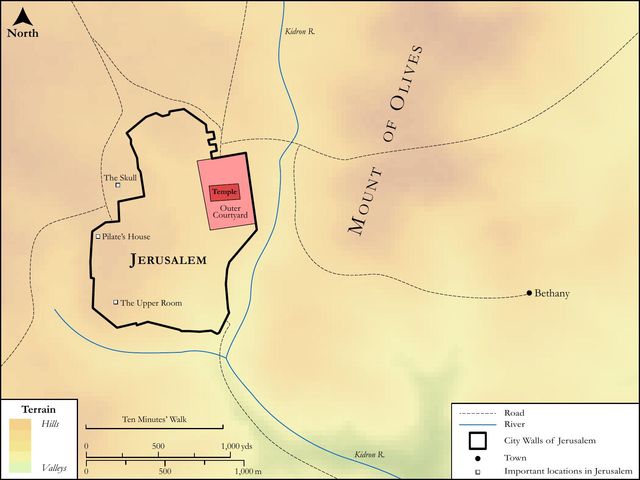
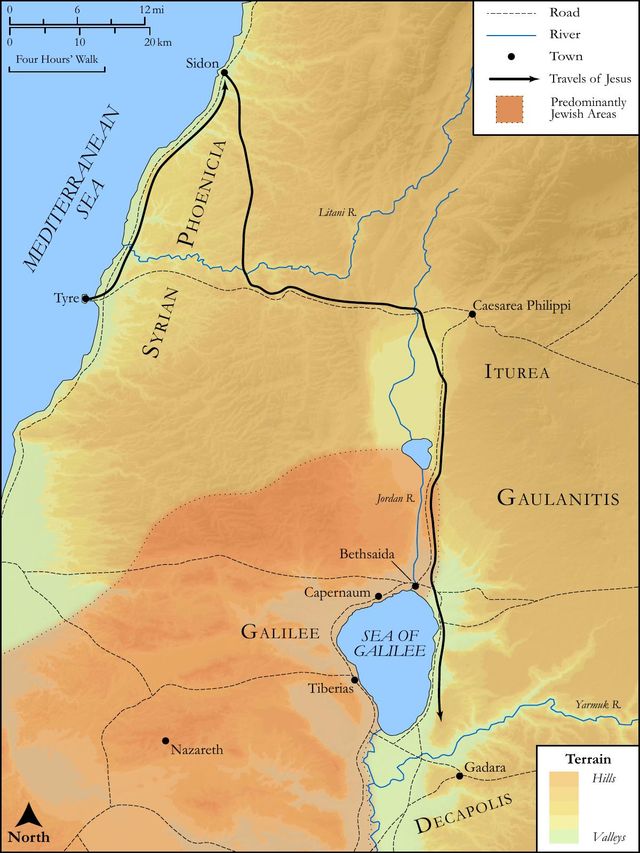
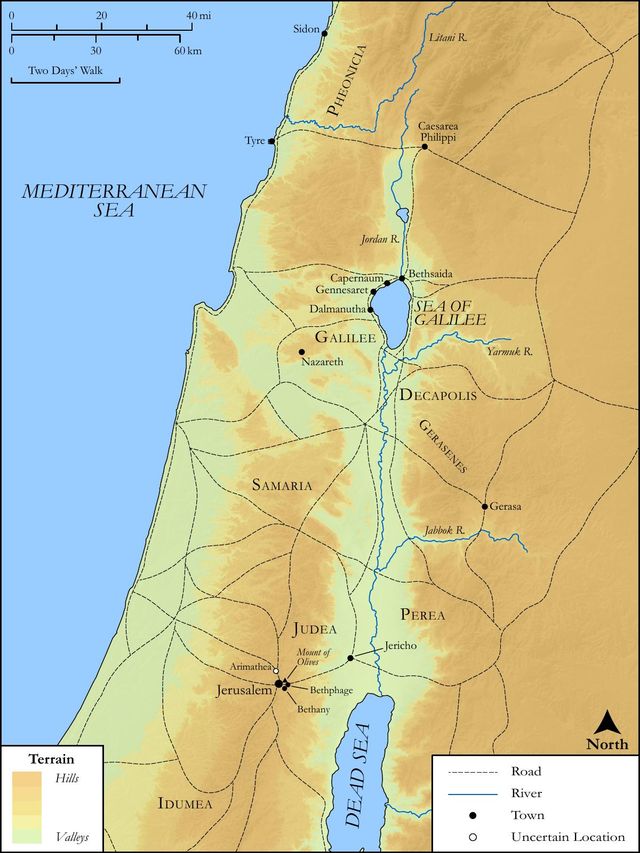
See on the biblical-era maps
Study this verse
Public-domain commentary
Matthew Henry
From his Commentary on the Whole Bible. Henry comments on passages, not single verses — this entry covers Mark 7:31–37. His three-level outline is real structure in the source text, so it is rendered as structure.
Our Lord Jesus seldom staid long in a place, for he knew where his work lay, and attended the changes of it. When he had cured the woman of Canaan's daughter, he had done what he had to do in that place, and therefore presently left those parts, and returned to the sea of Galilee, whereabout his usual residence was; yet he did not come directly thither, but fetched a compass through the midst of the coasts of Decapolis, which lay mostly on the other side Jordan; such long walks did our Lord Jesus take, when he went about doing good.
Now here we have the story of a cure that Christ wrought, which is not recorded by any other of the evangelists; it is of one that was deaf and dumb.
I.His case was sad, Mar 7:32.
There were those that brought to him one that was deaf; some think, born deaf, and then he must be dumb of course; others think that by some distemper or disaster he was become deaf, or, at least, thick of hearing; and he had an impediment in his speech. He was mogilalos; some think that he was quite dumb; others, that he could not speak but with great difficulty to himself, and so as scarcely to be understood by those that heard him. He was tongue-tied, so that he was perfectly unfit for conversation, and deprived both of the pleasure and of the profit of it; he had not the satisfaction either of hearing other people talk, or of telling his own mind. Let us take occasion from hence to give thanks to God for preserving to us the sense of hearing, especially that we may be capable of hearing the word of God; and the faculty of speech, especially that we may be capable of speaking God's praises; and let us look with compassion upon those that are deaf or dumb, and treat them with great tenderness. They that brought this poor man to Christ, besought him that he would put his hand upon him, as the prophets did upon those whom they blessed in the name of the Lord. It is not said, They besought him to cure him, but to put his hand upon him, to take cognizance of his case, and put forth his power to do to him as he pleased.
II.His cure was solemn, and some of the circumstances of it were singular.
1.Christ took him aside from the multitude, Mar 7:33. Ordinarily, he wrought his miracles publicly before all the people, to show that they would bear the strictest scrutiny and inspection; but this he did privately, to show that he did not seek his own glory, and to teach us to avoid every thing that savours of ostentation. Let us learn of Christ to be humble, and to do good where no eye sees, but his that is all eye.
2.He used more significant actions, in the doing of this cure, than usual.
(1.)He put his fingers into his ears, as if he would syringe them, and fetch out that which stopped them up.
(2.)He spit upon his own finger, and then touched his tongue, as if he would moisten his mouth, and so loosen that with which his tongue was tied; these were no causes that could in the least contribute to his cure, but only signs of the exerting of that power which Christ had in himself to cure him, for the encouraging of his faith, and theirs that brought him. The application was all from himself, it was his own fingers that he put into his ears, and his own spittle that he put upon his tongue; for he alone heals.
3.He looked up to heaven, to give his Father the praise of what he did; for he sought his praise, and did his will, and, as Mediator, acted in dependence on him, and with an eye to him. Thus he signified that it was by a divine power, a power her had as the Lord from heaven, and brought with him thence, that he did this; for the hearing ear and the seeing eye the Lord has made, and can remake even both of them. He also hereby directed his patient who could see, though he could not hear, to look up to heaven for relief. Moses with his stammering tongue is directed to look that way (Exo 4:11); Who hath made man's mouth? Or who maketh the dumb or deaf, or the seeing or the blind? Have not I the Lord?
4.He sighed; not as if he found any difficulty in working this miracle, or obtaining power to do it from his father; but thus he expressed his pity for the miseries of human life, and his sympathy with the afflicted in their afflictions, as one that was himself touched with the feeling of their infirmities. And as to this man, he sighed, not because he was loth to do him this kindness, or did it with reluctancy; but because of the many temptations which he would be exposed to, and the sins he would be in danger of, the tongue-sins, after the restoring of his speech to him, which before he was free from. He had better be tongue-tied still, unless he have grace to keep his mouth as with a bridle, Psa 39:1.
5.He said, Ephphatha; that is, Be opened. This was nothing that looked like spell or charm, such as they used, who had familiar spirits, who peeped and muttered, Isa 8:19. Christ speaks as one having authority, and power went along with the word. Be opened, served both parts of the cure; "Let the ears be opened, let the lips be opened, let him hear and speak freely, and let the restraint be taken off;" and the effect was answerable (Mar 7:35); Straightway his ears were opened, and the string of his tongue was loosed, and all was well: and happy he who, as soon as he had his hearing and speech, had the blessed Jesus so near him to converse with.
Now this cure was, (1.) A proof of Christ's being the Messiah; for it was foretold that by his power the ears of the deaf should be unstopped, and the tongue of the dumb should be made to sing, Isa 35:5, Isa 35:6. (2.) It was a specimen of the operations of his gospel upon the minds of men. The great command of the gospel, and grace of Christ to poor sinners, is Ephphatha - Be opened. Grotius applies it thus, that the internal impediments of the mind are removed by the Spirit of Christ, as those bodily impediments were by the word of his power. He opens the heart, as he did Lydia's, and thereby opens the ear to receive the word of God, and opens the mouth in prayer and praises.
6.He ordered it to be kept very private, but it was made very public (1.) It was his humility, that he charged them they should tell no man, Mar 7:36. Most men will proclaim their own goodness, or, at least, desire that others should proclaim it; but Christ, though he was himself in no danger of being puffed up with it, knowing that we are, would thus set us an example of self-denial, as in other things, so especially in praise and applause. We should take pleasure in doing good, but not in its being known. (2.) It was their zeal, that, though he charged them to say nothing of it, yet they published it, before Christ would have had it published. But they meant honestly, and therefore it is to be reckoned rather an act of indiscretion than an act of disobedience, Mar 7:36. But they that told it, and they that heard it, were beyond measure astonished, huperperissōs - more than above measure; they were exceedingly affected with it, and this was said by every body, it was the common verdict, He hath done all things well (Mar 7:37); whereas there were those that hated and persecuted him as an evil-doer, they are ready to witness for him, not only that he has done no evil, but that he has done a great deal of good, and has done it well, modestly and humbly, and very devoutly, and all gratis, without money and without price, which added much to the lustre of his good works. He maketh both the deaf to hear, and the dumb to speak; and that is well, it is well for them, it is well for their relations, to whom they had been a burthen; and therefore they are inexcusable who speak ill of him.
Historical interpretation
Nine Centuries of Reception
8 surviving comments on this verse. Each one is dated, so this reads as a timeline rather than a list.
Select a marker to jump to its quote. Markers stagger vertically where authors wrote within a few decades of each other.
A city, however, placed on a hill cannot be hid, and lowliness always comes before glory. Wherefore it goes on, But the more he charged them, so much the more a great deal they published it.
Mystically, Tyre is interpreted narrowness, and signifies Judæa, to which the Lord said, (v. Isa. 28:20) "For the bed is grown too narrow," and from which he turns himself to the Gentiles. Sidon means 'hunting,' for our race is like an untamed beast, and 'sea,' which means a wavering inconstancy. Again, the Saviour comes to save the Gentiles in the midst of the coasts of Decapolis, which may be interpreted, as the commands of the Decalogue. Further, the human race throughout its many members is reckoned as one man, eaten up by varying pestilence, in the first created man; it is blinded, that is, its eye is evil; it becomes deaf, when it listens to, and dumb when it speaks, evil. And they prayed Him to lay His hand upon him, because many just men, and patriarchs, wished and longed for the time when the Lord should come in the flesh.
Further, he who obtains healing is always drawn aside from turbulent thoughts, disorderly actions, and incoherent speeches. And the fingers which are put into the ears are the words and the gifts of the Holy Ghost, of whom it is said, This is the finger of God. (Exod. 8:19) The spittle is heavenly wisdom, which loosens the sealed lips of the human race, so that it can say, I believe in God, the Father Almighty, and the rest of the Creed. And looking up to heaven, he groaned, (Cf. Mat. 12:20. Luke 11:20) that is, He taught us to groan, and to raise up the treasures of our hearts to the heavens; because by the groaning of hearty compunction, the silly joy of the flesh is purged away. But the ears are opened to hymns, and songs, and psalms; and He looses the tongue, that it may pour forth the good word, which neither threats nor stripes can restrain.
Deafened ears, of sound unconscious,
every passage blocked and closed,
At the word of Christ responding,
all the portals open wide,
Hear with joy friendly voices and
the softly whispered speech.
Every sickness now surrenders,
every listlessness departs,
Tongues long bound by chains of silence
are unloosed and speak aright,
While the joyful paralytic
bears his pallet through the streets.
(ap. Aug. non occ. sed ap. Bed. ubi sup.) If however He, as one Who knew the present and the future wills of men, knew that they would proclaim Him the more in proportion as He forbade them, why did He give them this command? If it were not that He wished to prove to men who are idle, how much more joyfully, with how much greater obedience, they whom He commands to proclaim Him should preach, when they who were forbidden could not hold their peace.
(Vict. Ant. e Cat. in Marc.) He takes the deaf and dumb man who was brought to Him apart from the crowd, that He might not do His divine miracles openly; teaching us to cast away vain glory and swelling of heart, for no one can work miracles as he can, who loves humility and is lowly in his conduct. But He puts His fingers into his ears, when He might have cured him with a word, to show that His body, being united to Deity, was consecrated by Divine virtue, with all that He did. For since on account of the transgression of Adam, human nature had incurred much suffering and hurt in its members and senses, Christ coming into the world showed the perfection of human nature in Himself, and on this account opened ears with His fingers, and gave the power of speech by His spittle. Wherefore it goes on, And spit, and touched his tongue.
(Vict. Ant. e Cat. in Marc.) He at the same time also groaned, as taking our cause upon Himself, and pitying human nature, seeing the misery into which it had fallen.
(Vict. Ant. e Cat. in Marc.) By which He has taught us not to boast in our powers, but in the cross and humiliation. He also bade them conceal the miracle, lest He should excite the Jews by envy to kill Him before the time.
And he commanded them not to tell anyone. But the more he commanded them, the more they proclaimed it, and they were exceedingly astonished, saying: He has done all things well, he makes the deaf hear, and the mute speak. If he knew they would proclaim it even more as he had the present and future wills of humans known, why then did he command this except to show the lazy how much more fervently and eagerly they ought to preach, whom he commands to preach when those who were forbidden could not keep silent?
(in Marc. 2, 31) Decapolis is a region of ten cities, across the Jordan, to the east, over against Galilee.c When therefore it is said that the Lord came to the sea of Galilee, through the midst of the borders of Decapolis, it does not mean that He entered the confines of Decapolis themselves; for He is not said to have crossed the sea, but rather to have come to the borders of the sea, and to have reached quite up to the place, which was opposite to the midst of the coasts of Decapolis, which were situated at a distance across the sea. It goes on, And they bring him one that was deaf and dumb, and they besought him to lay hands upon him.
(ubi sup.) He looked up to heaven, that He might teach us that thence is to be procured speech for the dumb, hearing for the deaf, health for all who are sick. And He sighed, not that it was necessary for Him to beg any thing from His Father with groaning, for He, together with the Father, gives all things to them who ask, but that He might give us an example of sighing, when for our own errors and those of our neighbours, we invoke the guardianship of the Divine mercy.
(ubi sup.) But that which He says, Ephphatha, that is, Be opened, belongs properly to the ears, for the ears are to be opened for hearing, but the tongue to be loosed from the bonds of its impediment, that it may be able to speak. Wherefore it goes on, And straightway his ears were opened, and the string of his tongue was loosed, and he spake plain. Where each nature of one and the same Christ is manifestly distinct, looking up indeed into Heaven as man, praying unto God, He groaned, but presently with one word, as being strong in the Divine Majesty, He healed. It goes on, And he charged them that they should tell no man.
(ubi sup.) Or he is deaf and dumb, who neither has ears to hear the words of God, nor opens his mouth to speak them, and such must be presented to the Lord for healing, by men who have already learned to hear and speak the divine oracles.
The soul of each of us also, when he falls into sin, becomes a woman; and this soul has a daughter who is sick, that is, evil actions; this daughter again has a devil, for evil actions arise from devils. Again, sinners are called dogs, being filled with uncleanness. For which reason we are not worthy to receive the bread of God, or to be made partakers of the immaculate mysteries of God; if however in humility, knowing ourselves to be dogs, we confess our sins, then the daughter, that is, our evil life, shall be healed.
The Lord did not wish to stay in the parts of the Gentiles, lest He should give the Jews occasion to say, that they esteemed Him a transgressor of the law, because He held communion with the Gentiles, and therefore He immediately returns; wherefore it is said, And again departing from the coasts of Tyre, he came through Sidon, to the sea of Galilee, through the midst of the borders of Decapolis.
Which is rightly placed after the deliverance of one possessed with a devil, for such an instance of suffering came from the devil. There follows, And he took him aside from the multitude, and put his fingers into his ears.
That He might show that all the members of His sacred body are divine and holy, even the spittle which loosed the string of the tongue. For the spittle is only the superfluous moisture of the body, but in the Lord all things are divine. It goes on, And looking up to heaven, he groaned, and saith unto him, Ephphatha, that is, Be opened.
By this we are taught, when we confer benefits on any, by no means to seek for applause and praise; but when we have received benefits, to proclaim and praise our benefactors, even though they be unwilling.
(non occ.) From the preaching however of those who were healed by Christ, the wonder of the multitude, and their praise of the benefits of Christ, increased. Wherefore it goes on, And they were beyond measure astonished, saying, He hath done all things well; he maketh the deaf to hear, and the dumb to speak.
Continue studying Mark 7:36 across the web’s major study libraries — every link below opens this exact verse, chapter, or book on the destination site.
Read & Compare
 BibleGatewayThis verse in more than 200 translations and 70 languages.
 Bible.comThe YouVersion reader — hundreds of translations, reading plans, and highlights.
 ESV.orgCrossway's official English Standard Version reader.
 NET BibleThe NET translation with 60,000+ translators' notes on every rendering decision.
 STEP BibleTyndale House's free study tool — original text, vocabulary, and scholarly resources.
 BibliaLogos Bible Software's free web reader.
 USCCBThe New American Bible (Revised Edition) with the U.S. bishops' study notes.
Commentaries
 BibleHub CommentariesDozens of classic commentaries on this verse, gathered on one page.
 StudyLightMore than 100 commentary sets — the largest collection on the web.
 BibleRefPlain-English commentary on what this verse means, verse by verse.
 Enduring WordDavid Guzik's free commentary on this chapter, widely used by Bible teachers.
 Bible Study ToolsVerse commentary alongside Greek and Hebrew study aids.
Original Language & Research
- BibleHub InterlinearThe verse word by word — original language, transliteration, and English.
- BibleHub LexiconEvery word's original-language definition and Strong's entry.
 Blue Letter BibleDeep-study tools — Strong's numbers, concordance, and word studies.
 CNTR CollationThe earliest Greek manuscripts of this verse, collated letter by letter.
Sermons, Hymns & Audio


TrulyRandomVerse is not affiliated with these sites and doesn’t control their content. They’re linked because they’re genuinely useful.
Summary
Mark 7:36 captures a poignant moment immediately following Jesus' miraculous healing of a deaf man with a speech impediment in the Gentile region of Decapolis. Despite Jesus' explicit command for silence, the overwhelming impact of His divine power and the profound astonishment of the witnesses compelled them to defy His directive, leading them to extensively publicize the miracle. This verse highlights a recurring tension in Mark's Gospel between Jesus' desire to manage perceptions of His messianic identity and the irrepressible human response to His extraordinary works.
Context
ShowHideLiterary Context
This verse follows directly on the narrative of Jesus' healing of a deaf and mute man in the Decapolis region, detailed in Mark 7:31-35. Mark 7:31 sets the scene, describing Jesus' journey through Sidon and Decapolis, a predominantly Gentile area. The healing itself is depicted with vivid sensory details, emphasizing the man's complete restoration. Following this powerful demonstration of divine authority over physical infirmity, Jesus issues a direct command for silence, a motif frequently observed in Mark's Gospel, often termed the "Messianic Secret." The people's subsequent, enthusiastic disobedience in Mark 7:36 then serves as a stark counterpoint to Jesus' instruction, setting the stage for their astonished proclamation in Mark 7:37.
Historical & Cultural Context
The setting in Decapolis, a league of ten Hellenistic cities primarily east of the Jordan River, is significant. This was a Gentile territory, underscoring the universal scope of Jesus' ministry, which extended beyond the Jewish population. In this cultural milieu, miraculous healings were often seen as a sign of divine favor or prophetic authority. However, the Jewish expectation of the Messiah was often intertwined with political deliverance from Roman rule. Jesus' command for silence, therefore, might have been a strategic move to prevent a premature or misguided political uprising, ensuring that His mission, particularly His suffering and death, was understood on its own terms rather than through popular, nationalistic fervor. The public's response, though disobedient, reflects the natural human tendency to share extraordinary news, especially in a world where such events were rare and awe-inspiring.
Key Themes
ShowHideMark 7:36 contributes significantly to several key themes within Mark's Gospel. Firstly, it powerfully illustrates the Messianic Secret, a recurring motif where Jesus frequently commands silence about His identity or miracles (e.g., Mark 1:44, Mark 8:30). This secrecy likely aimed to redefine messianic expectations away from a political liberator towards a suffering servant. Secondly, the verse highlights the Uncontainable Enthusiasm of those who witness Jesus' power. Despite His direct command, the sheer wonder and joy evoked by the miracle were so profound that the people could not restrain their proclamation. This demonstrates the inherent, compelling nature of God's work. Thirdly, it showcases the Tension Between Divine Will and Human Response. Jesus' authoritative instruction is met with an equally intense human reaction, driven by awe and the desire to share good news. This dynamic underscores the irresistible impact of Jesus' ministry on human hearts, even when it leads to an unintended outcome in terms of His immediate strategy.
Exposition and Analysis
ShowHideKey Word Analysis
ShowHideThis word (G1291) signifies "to set (oneself) apart" or, by implication, "to enjoin" or "command." It conveys a strong, authoritative directive, not merely a suggestion. Jesus' instruction was a serious injunction, reflecting His divine authority and strategic intent regarding the dissemination of information about His miracles.
This primary particle (G1161) functions adversatively, meaning it introduces a contrast or opposition. In Mark 7:36, "but" sharply contrasts Jesus' authoritative command with the people's subsequent action, setting up the central paradox of the verse. It highlights the tension between divine instruction and human response.
This verb (G2784) means "to herald (as a public crier)" or "to proclaim," especially divine truth or the gospel. The use of this word indicates that the people did not merely whisper or casually mention the miracle; they actively and publicly announced it, much like a herald would declare an official decree. This underscores the widespread and zealous nature of their disobedience.
Verse Breakdown
ShowHide"And he charged them that they should tell no man"
Following the miraculous healing, Jesus issues a direct and authoritative command for silence. This instruction is consistent with the "Messianic Secret" motif found throughout Mark's Gospel, where Jesus often seeks to control the narrative surrounding His identity and works, likely to prevent misunderstanding or premature political upheaval. His intent was for His ministry to culminate in the cross, not in popular acclamation.
"but the more he charged them"
This clause introduces a dramatic contrast, emphasizing the escalating intensity of Jesus' repeated commands. The phrase "the more" (G3745, hósos) highlights Jesus' persistent and perhaps increasingly firm directives, underscoring His desire for obedience and the strategic importance of His instruction.
"so much the more a great deal they published [it];"
This climactic phrase reveals the people's overwhelming and paradoxical response. Despite Jesus' intensified commands, their astonishment and joy were so profound that they responded with even greater zeal in proclaiming the miracle. The phrase "so much the more a great deal" (G3123 mâllon and G4054 perissóteron) functions as a hyperbole, emphasizing the uncontrollable and widespread nature of their public proclamation, effectively overriding Jesus' explicit directive.
Literary Devices
ShowHideMark 7:36 is rich in Irony and Paradox, as Jesus' command for silence paradoxically leads to an even greater proclamation of His work. The more He restricts, the more they spread the news. This creates a dramatic tension that underscores the irresistible nature of God's power. The verse also employs Repetition and Hyperbole through phrases like "the more he charged them, so much the more a great deal they published [it]." This linguistic emphasis highlights the intensity of both Jesus' command and the people's response, creating a sense of overwhelming, uncontainable enthusiasm. The use of the verb "published" (kērýssō) is a form of Metonymy, where the act of "heralding" stands for the widespread dissemination of the news, emphasizing the public and zealous nature of their testimony.
Theological and Thematic Connections
ShowHideMark 7:36 offers profound insights into the nature of divine power, human response, and the unfolding of God's redemptive plan. It illustrates that God's work, when truly experienced, often evokes an irrepressible desire to testify, even when such testimony might not align with immediate divine strategy. This tension between Jesus' strategic silence and the people's spontaneous proclamation highlights the inherent power of the Gospel to compel witness. Ultimately, the news of God's kingdom cannot be contained; it will break forth and be declared, whether by divine command or human overflow. This foreshadows the eventual global proclamation of Christ's finished work.
Reflection and Application
ShowHideThe dynamic presented in Mark 7:36 challenges believers to consider the interplay between obedience, zeal, and divine timing in their own witness. While Jesus commanded silence for strategic reasons related to His messianic mission, the people's inability to contain their joy speaks to the natural overflow of a heart transformed by God's power. This verse reminds us that true witness often stems from a genuine, deeply felt experience of God's grace and miraculous intervention in our lives. Our enthusiasm for sharing the good news should be fervent, yet also tempered by wisdom and a discerning ear for God's specific leading. There are times for bold proclamation and times for quiet, prayerful waiting, all guided by the Holy Spirit. The irresistible power of God's work will ultimately accomplish His purposes, often through means that transcend human planning.
Questions for Reflection
ShowHideFAQ
ShowHideWhy did Jesus command the people not to tell anyone about His miracles?
ShowHideJesus' command for silence, often referred to as the "Messianic Secret," served several strategic purposes. Firstly, it aimed to manage the popular understanding of His messianic identity. Many people, particularly in the Jewish context, expected a political Messiah who would lead an armed rebellion against Roman rule. By commanding silence, Jesus sought to prevent a premature political uprising that would derail His true mission, which was to suffer, die, and rise again as the spiritual King. Secondly, it allowed Him to avoid being mobbed by crowds seeking only physical healing or political deliverance, enabling Him to focus on teaching and discipling His inner circle. Finally, the secrecy allowed His identity to be fully revealed at the cross and resurrection, which was the ultimate demonstration of His messianic power and purpose, rather than through popular acclaim based solely on miracles (see Mark 8:31-33).
What does "published it" mean in this context, and why was it significant?
ShowHideThe King James Version's "published it" translates the Greek word ekērussōn (G2784), which means "to herald" or "to proclaim as a public crier." This is a strong term, implying a widespread, public, and zealous declaration, much like a town crier announcing important news. It wasn't a quiet whisper or casual mention. The significance lies in the direct defiance of Jesus' command. Despite His authoritative directive for silence, the people's astonishment and joy at the miracle were so profound that they felt compelled to loudly and widely proclaim what they had witnessed. This highlights the irresistible impact of Jesus' divine power and the natural human tendency to share extraordinary news, even against explicit instructions. The phrase also foreshadows the eventual global proclamation of the Gospel, which would indeed be "heralded" to all nations (see Matthew 28:19).
Christ-Centered Fulfillment
ShowHideMark 7:36, with its depiction of an uncontainable witness to Jesus' power, beautifully foreshadows the ultimate trajectory of the Gospel message. While Jesus strategically commanded silence during His earthly ministry to manage messianic expectations and ensure His path to the cross, this temporary "Messianic Secret" would ultimately give way to a global, unhindered proclamation. The people's irrepressible urge to "publish" the miracle, despite Jesus' command, serves as a microcosm of the Holy Spirit's work after Christ's ascension. The very one who commanded silence would later commission His disciples to "go into all the world and proclaim the gospel to the whole creation" (Mark 16:15). The power that healed the deaf man in Decapolis is the same power that would empower the apostles to speak boldly, even when commanded to be silent by earthly authorities (Acts 4:19-20). Thus, Mark 7:36, in its tension, points to the triumphant reality that Christ's redemptive work, culminating in His death and resurrection, would be a truth so profound and transformative that it could not, and would not, be contained, ultimately being heralded to the ends of the earth by His Spirit-empowered church (Acts 1:8).