


Mark 11:1
Bible text: King James Version (1769 Blayney text) · Public domain
Bible text: King James Version with Strong's numbers · Public domain
Bible text: Berean Standard Bible · Public domain
Bible text: American Standard Version (1901) · Public domain
Bible text: World English Bible, Messianic edition · Public domain
Bible text: Geneva Bible (1599) · Public domain
Bible text: Young's Literal Translation · Public domain
- ΚαὶKaiAndG2532CONJConjunction
- ὅτεhotewhenG3753CONJConjunction
- ἐγγίζουσινengizousinthey drew nearG1448V-PAI-3PVerb Present Active Indicative 3rd Plural
- εἰςeistoG1519PREPPreposition
- ἹεροσόλυμαHi'erosolumaJerusalemG2414N-APN-LNoun Accusative Plural Neuter Location
- εἰςeistoG1519PREPPreposition
- ΒηθφαγὴBēthphagēBethphageG967N-ASF-LNoun Accusative Singular Feminine Location
- καὶkaiandG2532CONJConjunction
- ΒηθανίανBēthanianBethanyG963N-ASF-LNoun Accusative Singular Feminine Location
- πρὸςprosnearG4314PREPPreposition
- τὸtotheG3588T-ASNDefinite article Accusative Singular Neuter
- ὄροςorosMountG3735N-ASN-LNoun Accusative Singular Neuter Location
- τῶνtōn<the>G3588T-GPFDefinite article Genitive Plural Feminine
- ἐλαιῶνelaiōnof OlivesG1638N-GPF-LNoun Genitive Plural Feminine Location
- ἀποστέλλειapostelleiHe sendsG649V-PAI-3SVerb Present Active Indicative 3rd Singular
- δύοduotwoG1417A-NUIAdjective
- τῶνtōnof theG3588T-GPMDefinite article Genitive Plural Masculine
- μαθητῶνmathētōndisciplesG3101N-GPMNoun Genitive Plural Masculine
- αὐτοῦautouof HimG846P-GSMPersonal pronoun Genitive Singular Masculine
English is a literal word-by-word gloss of the Greek, not the KJV's wording. Why?
This is the original text the KJV's translators worked from — each Greek word with its own literal English meaning in this verse, prepared by scholars at Tyndale House, Cambridge. The KJV translates whole sentences, not word by word, so its wording differs: one Greek word can become several English words, and the KJV may choose “charity” where the gloss reads “love”. Both are faithful — they answer different questions. For the KJV's own rendering, switch to the KJV text.
Details
See on the biblical-era maps
Study this verse
Public-domain commentary
Matthew Henry
From his Commentary on the Whole Bible. Henry comments on passages, not single verses — this entry covers Mark 11:1–11. His three-level outline is real structure in the source text, so it is rendered as structure.
We have here the story of the public entry Christ made into Jerusalem, four or five days before his death. And he came into town thus remarkably, 1. To show that he was not afraid of the power and malice of his enemies in Jerusalem. He did not steal into the city incognito, as one that durst not show his face; no, they needed not send spies to search for him, he comes in with observation. This would be an encouragement to his disciples that were timorous, and cowed at the thought of their enemies' power and rage; let them see how bravely their Master sets them all at defiance. 2. To show that he was not cast down or disquieted at the thoughts of his approaching sufferings. He came, not only publicly, but cheerfully, and with acclamations of joy. Though he was now but taking the field, and girding on the harness, yet, being fully assured of a complete victory, he thus triumphs as though he had put it off.
I.The outside of this triumph was very mean; he rode upon an ass's colt, which being an ass, looked contemptible, and made no figure; and, being but a colt, whereon never man sat, we may suppose, was rough and untrimmed, and not only so, but rude and ungovernable, and would disturb and disgrace the solemnity. This colt was borrowed too. Christ went upon the water in a borrowed boat, ate the passover in a borrowed chamber, was buried in a borrowed sepulchre, and here rode on a borrowed ass. Let not Christians scorn to be beholden one to another, and, when need is, to go a borrowing, for our Master did not. He had no rich trappings; they threw their clothes upon the colt, and so he sat upon him, Mar 11:7. The persons that attended, were mean people; and all the show they could make, was, by spreading their garments in the way (Mar 11:8), as they used to do at the feast of tabernacles. All these were marks of his humiliation; even when he would be taken notice of, he would be taken notice of for his meanness; and they are instructions to us, not to mind high things, but to condescend to them of low estate. How ill doth it become Christians to take state, when Christ was so far from affecting it!
II.The inside of this triumph was very great; not only as it was the fulfilling of the scripture (which is not taken notice of here, as it as in Matthew), but as there were several rays of Christ's glory shining forth in the midst of all this meanness.
1.Christ showed his knowledge of things distant, and his power over the wills of men, when he sent his disciples for the colt, Mar 11:1-3. By this it appears that he can do every thing, and no thought can be withholden from him.
2.He showed his dominion over the creatures in riding on a colt that was never backed. The subjection of the inferior part of the creation to man is spoken of with application to Christ (Psa 8:5, Psa 8:6, compared with Heb 2:8); for to him it is owing, and to his mediation, that we have any remaining benefit by the grant God made to man, of a sovereignty in this lower world, Gen 1:28. And perhaps Christ, in riding the ass's colt, would give a shadow of his power over the spirit of man, who is born as the wild ass's colt, Job 11:12.
3.The colt was brought from a place where two ways met (Mar 11:4), as if Christ would show that he came to direct those into the right way, who had two ways before them, and were in danger of taking the wrong.
4.Christ received the joyful hosannas of the people; that is, both the welcome they gave him and their good wishes to the prosperity of his kingdom, Mar 11:9. It was God that put it into the hearts of these people to cry Hosanna, who were not by art and management brought to it, as those were who afterward cried, Crucify, crucify. Christ reckons himself honoured by the faith and praises of the multitude, and it is God that brings people to do him this honour beyond their own intentions.
(1.)They welcomed his person (Mar 11:9); Blessed is he that cometh, the ho erchomenos, he that should come, so often promised, so long expected; he comes in the name of the Lord, as God's Ambassador to the world; Blessed be he: let him have our applauses, and best affections; he is a blessed Saviour, and brings blessings to us, and blessed be he that sent him. Let him be blessed in the name of the Lord, and let all nations and ages call him Blessed, and think and speak highly and honourably of him.
(2.)They wished well to his intent, Mar 11:10. They believed that, mean a figure as he made, he had a kingdom, which should shortly be set up in the world, that it was the kingdom of their father David (that father of his country), the kingdom promised to him and his seed for ever; a kingdom that came in the name of the Lord, supported by a divine authority. Blessed be this kingdom; let it take place, let it get ground, let it come in the power of it, and let all opposing rule, principality, and power, be put down; let it go on conquering, and to conquer. Hosanna to this kingdom; prosperity be to it; all happiness attend it. The proper signification of hosanna is that which we find, Rev 7:10. Salvation to our God, that sitteth on the throne, and to the Lamb; success to religion, both natural and revealed, Hosanna in the highest. Praises be to our God, who is in the highest heavens over all, God blessed for ever; or, Let him be praised by his angels, that are in the highest heavens, let our hosannas be an echo to theirs.
Christ, thus attended, thus applauded, came into the city, and went directly to the temple. Here was no banquet of wine prepared for his entertainment, nor the least refreshment; but he immediately applied himself to his work, for that was his meat and drink. He went to the temple, that the scripture might be fulfilled; "The Lord whom ye seek, shall suddenly come to his temple, without sending any immediate notice before him; he shall surprise you with a day of visitation, for he shall be like a refiner's fire, and like fuller's soap," Mal 3:1-3. He came to the temple, and took a view of the present state of it, Mar 11:11. He looked round about upon all things, but as yet said nothing. He saw many disorders there, but kept silence, Psa 50:21. Though he intended to suppress them, he would not go about the doing of it all on a sudden, lest he should seem to have done it rashly; he let things be as they were for this night, intending the next morning to apply himself to the necessary reformation, and to take the day before him. We may be confident that God sees all the wickedness that is in the world, though he do not presently reckon for it, nor cast it out. Christ, having make his remarks upon what he saw in the temple, retired in the evening to a friend's house at Bethany, because there he would be more out of the noise of the town, and out of the way of being suspected, a designing to head a faction.
Historical interpretation
Seven Centuries of Reception
7 surviving comments on this verse. Each one is dated, so this reads as a timeline rather than a list.
Select a marker to jump to its quote. Markers stagger vertically where authors wrote within a few decades of each other.
They cry out Hosanna, that is save us, that men might be saved by Him who was blessed, and was a conqueror and came in the name of the Lord, that is, of His Father, since the Father is so called because of the Son, and the Son, because of the Father.
Or Hosanna, that is, save in the highest as well as in the lowest, that is, that the just be built on the ruin of Angels, and also that both those on the earth and those under the earth should be saved. In a mystical sense, also, the Lord approaches Jerusalem, which is 'the vision of peace,' in which happiness remains fixed and unmoved, being, as the Apostle says, the mother of all believers. (Gal. 4:26)
The disciples of Christ are called two by two, and sent two by two, since charity implies more than one, as it is written, Woe to him that is alone. (Eccl. 4:10) Two persons lead the Israelites out of Egypt: two bring down the bunch of grapes from the Holy Land, that men in authority might ever join together activity and knowledge, and bring forward two commandments from the Two Tables, and be washed from two fountains, and carry the ark of the Lord on two poles, and know the Lord between the two Cherubim, and sing to Him with both mind and spirit.
But they found the colt tied by the door without, because the Gentile people were bound by the chain of their sins before the door of faith, that is, without the Church.
Or, in a place where two roads meet, that is, in the freedom of will, hesitating between life and death.
But some said, What do ye? as if they would say, Who can remit sins?
Or else, they put upon it their garments, that is, they bring to them the first robe of immortality by the Sacrament of Baptism. And Jesus sat upon it, that is, began to reign in them, so that sin should not reign in their wanton flesh, but righteousness, and peace, and joy in the Holy Ghost. Again, many spread their garments in the way, under the feet of the foal of the ass. What are feet, but those who carry, and the least esteemed, whom the Apostle has set to judge? (v. 1 Cor. 6:4.) And these too, though they are not the back on which the Lord sat, yet are instructed by John with the soldiers.
For the righteous shall flourish as a palm tree, straitened in their roots, but spreading out wide with flowers and fruits; for they are a good odour unto Christ, and strew the way of the commandments of God with their good report. Those who went before are the prophets, and those who followed are the Apostles.
(in Luc. 9, 6) Or else, they found it bound before the door, because whosoever is not in Christ is without, in the way; but he who is in Christ, is not without. He has added in the way, or in a place where two ways meet, where there is no certain possession for any man, nor stall, nor food, nor stable; miserable is his service, whose rights are unfixed; for he who has not the one Master, has many. Strangers bind him that they may possess him, Christ looses him in order to keep him, for He knows that gifts are stronger ties than bonds.
(ubi sup.) Now that the Lord had given sufficient proof of His virtue, and the cross was at hand, even at the door, He did those things which were about to excite them against Him with a greater openness; therefore although He had so often gone up to Jerusalem, He never however had done so in such a conspicuous manner as now.
(Cat. in Marc. Oxon.) Not indeed that He was compelled by necessity to ride on a colt from the mount of Olives to Jerusalem, for He had gone over Judæa and all Galilee on foot, but this action of His is typical. It goes on: And many spread their garments in the way: that is, under the feet of the colt; and others cut down branches off the trees, and strawed them in the way. This, however, was rather done to honour Him, and as a Sacrament, than of necessity. It goes on: And they that went before, and they that followed, cried, saying, Hosanna; blessed is he that cometh in the name of the Lord. 2For the multitude, until it was corrupted, knew what was its duty, for which reason each honoured Jesus according to his own strength. Wherefore they praised Him, and took up the hymns of the Levites, saying, Hosanna, which according to some is the same as save me, but according to others means a hymn. I however suppose the former to be more probable, for there is in the 117th Psalm, (Ps. 118:25) Save now, I beseech thee, O Lord, which in the Hebrew is Hosanna.
(Cat. in Marc. Oxon.) Thus then they give glory to God, saying, Blessed is he that cometh in the name of the Lord. They also bless the kingdom of Christ, saying, Blessed be the kingdom of our father David, which cometh.
(Cat. in Marc. Oxon.) Wherefore also the prophets so often call Christ by the name of David, on account of the descent according to the flesh of Christ from David.
(Cat. in Marc. Oxon.) And further, they give glory to God, when they add Hosanna in the highest, that is, praise and glory be to the God of all, Who is in the highest.
And when they were approaching Jerusalem, and Bethany at the Mount of Olives, he sent two of his disciples, and said to them: Go into the village opposite you. Bethany is a small village or town on the slope of the Mount of Olives, about fifteen stades from Jerusalem, as the evangelist John manifests, where Lazarus was raised from the dead, whose tomb is now demonstrated there with a constructed church. Bethany, moreover, is called the house of obedience. And suitably the Lord, about to come to Jerusalem and redeem the world with his blood, first elevated Bethany by the dignity of his presence, and there he was anointed with mystical chrism by a devout woman, because undoubtedly, before his passion, teaching many, he made for himself a house of obedience where he would dwell through the Spirit of grace, and being delighted by their pious action, he himself was anointed as if with a fragrant ointment. Hence this city is said to be situated on the Mount of Olives, to designate that the Church by the grace of its founder is to be saved, who refreshes us with the anointing of spiritual charisms and the eternal light of knowledge and piety. From whence elsewhere, when he said: A city set on a hill cannot be hidden, he immediately added: Neither do they light a lamp and put it under a bushel (Matt. V). Because the same Mount of Olives, that is, the highest distributor of spiritual graces, who elevates his city to be prominent, also anoints it with the oil of gladness so it can shine, lest it fail. And because he did not want the light to be placed under a bushel, he sent the disciples into the village opposite them, that is, he sent teachers who would penetrate unlearned and barbarous places of the whole world, like the walls of a village set opposite, by evangelizing. And rightly two are sent, either for the knowledge of truth and purity of action, or for the sacrament of twin love, namely of God and neighbor, to be preached throughout the whole world.
(in Marc. 3, 41) Bethany is a little village or town by the side of mount Olivet, where Lazarus was raised from the dead. But in what way He sent His disciples and for what purpose is shown in these words, And saith unto them, Go your way into the village over against you.
(ubi sup.) But Hosanna is a Hebrew word, made out of two, one imperfect the other perfect. For save, or preserve, is in their language, hosy; but anna is a supplicatory interjection, as in Latin heu is an exclamation of grief.
(ubi sup.) Now we read in the Gospel of John that He fled into a mountain, lest they should make him their king. Now, however, when He comes to Jerusalem to suffer, He does not shun those who call Him king, that He might openly teach them that He was King over an empire not temporal and earthly, but everlasting in the heavens, and that the path to this kingdom was through contempt of death. Observe also the agreement of the multitude with the saying of Gabriel, The Lord God will give him the throne of his father David; (Luke 1:32) that is, that He Himself may call by word and deed to a heavenly kingdom the nation to which David once furnished the government of a temporal rule.
(ubi sup.) Bethany again means the house of obedience, because by teaching many before His Passion, he made for Himself a house of obedience; and it is said to be placed on the mount of Olives, because He cherishes His Church with the unction of spiritual gifts, and with the light of piety and knowledge. But He sent His disciples to a hold1, which was over against them, that is, He appointed doctors to penetrate into the ignorant parts of the whole world, into, as it were, the walls of the hold placed against them.
(ubi sup.) For the colt of the ass, wanton and unshackled, denotes the people of the nations, on whom no man had yet sat, because no wise doctor had, by teaching them the things of salvation, put upon them the bridle of correction, to oblige them to restrain their tongues from evil, or to compel them into the narrow path of life.
(ubi sup.) Or else, fitly did the colt stand in a place where two ways meet, because the Gentile people did not hold on in any certain road of life and faith, but followed in its error many doubtful paths of various sects.
(ubi sup.) Or else, the masters of error, who resisted the teachers, when they came to save the Gentiles; but after that the power of the faith of the Lord appeared to believers, the faithful people were freed from the cavils of the adversaries, and were brought to the Lord, whom they bore in their hearts. But by the garments of the Apostles, which they put upon it, we may understand the teaching of virtues, or the interpretation of the Scriptures, or the various doctrines of the Church, by which they clothe the hearts of men, once naked and cold and fit them to become the seats of Christ.
(ubi sup.) Or else, many strew their garments in the way, because the holy martyrs put off from themselves the garment of their own flesh, and prepare a way for the more simple servants of God with their own blood. Many also strew their garments in the way, because they tame their bodies with abstinence, that they may prepare a way for God to the mount, or may give good examples to those who follow them. And they cut down branches from the trees, who in the teaching of the truth cull the sentences of the Fathers from their words, and by their lowly preaching scatter them in the path of God, when He comes into the soul of the hearer.
(ubi sup.) And because all the elect, whether those who were able to become such in Judæa, or those who now are such in the Church, believed and now believe on the Mediator between God and man, both those who go before and those who follow cried out Hosanna.
That thus, if they were willing, they might recognise His glory, and by the prophecies, which were fulfilled concerning Him, know that He is very God; and that if they would not, they might receive a greater judgment, for not having believed so many wonderful miracles. Describing therefore this illustrious entrance, the Evangelist says, And when they came nigh unto Jerusalem, and Bethany, at the mount of Olives, he sendeth forth two of his disciples.
Now consider how many things the Lord foretold to His disciples, that they should find a colt; wherefore it goes on, And as soon as ye be entered into it, ye shall find a colt tied, whereon never man sat, loose him, and bring him; and that they should be impeded in taking it, wherefore there follows, And if any man say unto you, Why do ye this? say ye, The Lord hath need of him; and that on saying this, they should be allowed to take him; wherefore there follows, And straightway he will send him hither; and as the Lord had said, so it was fulfilled. Thus it goes on: And they went their way, and found the colt tied by the door without, in a place where two ways meet; and they loose him.
But they would not have allowed this, if the Divine power had not been upon them, to compel them, especially, as they were country people and farmers, and yet allowed them to take away the colt. It goes on: And they brought the colt to Jesus, and cast their garments on him; and he sat upon him.
But they called the kingdom of Christ, that of David, both because Christ was descended from the seed of David, and because David means a man of a strong hand. For whose hand is stronger than the Lord's, by which so many and so great miracles were wrought.
The colt, however, was not necessary to Him, but He sent for it to show that He would transfer Himself to the Gentiles.
Or else, in a place where two roads meet, that is, in this life, but it was loosed by the disciples, through faith and baptism.
Or else, those who prevent them are the devils, who were weaker than the Apostles.
Let us also strew the way of our life with branches which we cut from the trees, that is, imitate the saints, for these are holy trees, from which, he who imitates their virtues cuts down branches.
But both those of our deeds which go before and those which follow after must be done to the glory of God; for some in their past life make a good beginning, but their following life does not correspond with their former, neither does it end to the glory of God.
Continue studying Mark 11:1 across the web’s major study libraries — every link below opens this exact verse, chapter, or book on the destination site.
Read & Compare
 BibleGatewayThis verse in more than 200 translations and 70 languages.
 Bible.comThe YouVersion reader — hundreds of translations, reading plans, and highlights.
 ESV.orgCrossway's official English Standard Version reader.
 NET BibleThe NET translation with 60,000+ translators' notes on every rendering decision.
 STEP BibleTyndale House's free study tool — original text, vocabulary, and scholarly resources.
 BibliaLogos Bible Software's free web reader.
 USCCBThe New American Bible (Revised Edition) with the U.S. bishops' study notes.
Commentaries
 BibleHub CommentariesDozens of classic commentaries on this verse, gathered on one page.
 StudyLightMore than 100 commentary sets — the largest collection on the web.
 BibleRefPlain-English commentary on what this verse means, verse by verse.
 Enduring WordDavid Guzik's free commentary on this chapter, widely used by Bible teachers.
 Bible Study ToolsVerse commentary alongside Greek and Hebrew study aids.
Original Language & Research
- BibleHub InterlinearThe verse word by word — original language, transliteration, and English.
- BibleHub LexiconEvery word's original-language definition and Strong's entry.
 Blue Letter BibleDeep-study tools — Strong's numbers, concordance, and word studies.
 CNTR CollationThe earliest Greek manuscripts of this verse, collated letter by letter.
Sermons, Hymns & Audio


TrulyRandomVerse is not affiliated with these sites and doesn’t control their content. They’re linked because they’re genuinely useful.
Summary
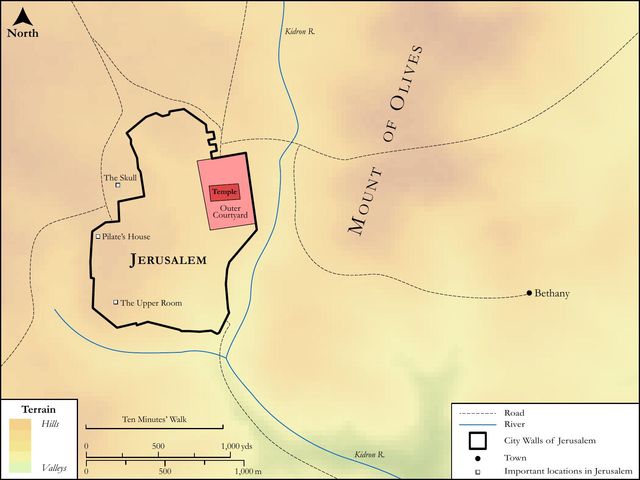
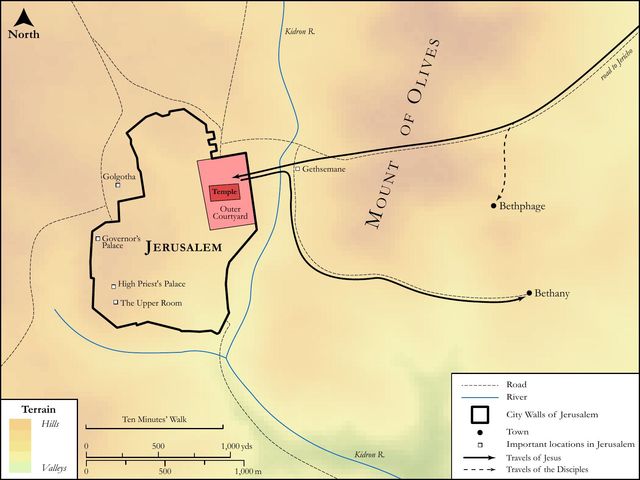
Mark 11:1 initiates the pivotal narrative of Jesus' final week in Jerusalem, often termed Passion Week, setting the geographical and chronological stage for the Triumphal Entry and the momentous events leading to His crucifixion and resurrection. This verse meticulously places Jesus and His disciples at the threshold of Jerusalem, specifically on the eastern slope of the Mount of Olives, near the villages of Bethphage and Bethany, underscoring the deliberate and divinely orchestrated nature of His arrival.
Context
ShowHideLiterary Context
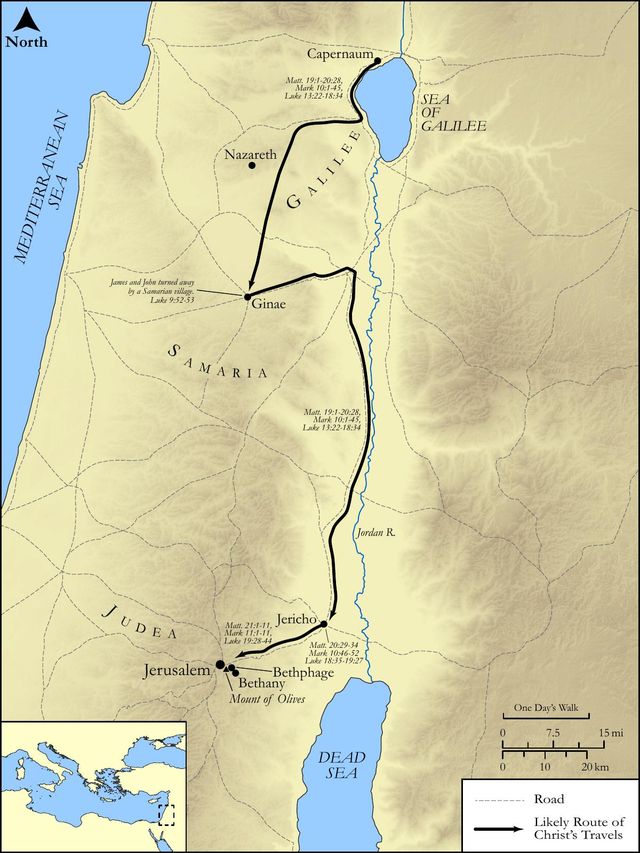
Mark 11:1 transitions the Gospel narrative from Jesus' Galilean ministry and journey towards Jerusalem (culminating in the healing of blind Bartimaeus in Mark 10:46-52) to the climactic events of His final week. The preceding chapters have built anticipation for Jesus' arrival in Jerusalem, foreshadowing His suffering and death. This verse immediately precedes the detailed account of the Triumphal Entry into Jerusalem (Mark 11:2-11), where Jesus intentionally fulfills Old Testament prophecy by riding on a colt. The meticulous geographical details in Mark 11:1 serve to ground the extraordinary theological events that follow in concrete historical reality, emphasizing the intentionality and divine timing of Jesus' actions.
Historical & Cultural Context
Jesus' approach to Jerusalem occurred just prior to the Passover festival, a time when the city would swell with hundreds of thousands of pilgrims. The villages of Bethphage and Bethany were strategically located on the eastern slopes of the Mount of Olives, a short distance from Jerusalem. Bethany, in particular, was significant as the home of Mary, Martha, and Lazarus, whom Jesus had recently raised from the dead (John 11:1-44), a miracle that had significantly increased His public profile and the animosity of the religious authorities. The Mount of Olives itself held profound prophetic significance, being associated with the Lord's return in Zechariah 14:4 and later becoming the site of Jesus' ascension (Acts 1:12). The deliberate approach from this direction, rather than the more common Jericho road, held symbolic weight for those familiar with messianic expectations.
Key Themes
ShowHideMark 11:1 introduces several crucial themes that permeate the Passion narrative. Firstly, it highlights Divine Purpose and Timing, emphasizing that Jesus' journey to Jerusalem was not accidental but a predetermined step in God's redemptive plan. His arrival "nigh to Jerusalem" signals the imminence of His ultimate sacrifice, a theme consistently present throughout Mark's Gospel (e.g., Mark 8:31). Secondly, the verse Sets the Stage for the Passion, marking the definitive beginning of the climactic week that includes the Triumphal Entry, temple cleansing, various teachings and confrontations, the Last Supper, His arrest, trial, crucifixion, and resurrection. This period, often called "Passion Week," is the theological epicenter of Christian faith. Thirdly, while not explicitly detailed in this verse, the subsequent actions of Jesus in sending His disciples with specific instructions (Mark 11:2-3) underscore His Sovereign Foreknowledge and Authority over circumstances, demonstrating His full awareness of His mission and destiny.
Exposition and Analysis
ShowHideKey Word Analysis
ShowHideMeaning "to make near, i.e. (reflexively) approach." This word emphasizes the deliberate and intentional movement of Jesus and His disciples towards Jerusalem. It signifies not merely a casual proximity but a purposeful drawing near to the city where the culmination of His earthly ministry would unfold. The verb's active sense highlights Jesus' agency in fulfilling His divine mission.
Meaning "set apart, i.e. (by implication) to send out (properly, on a mission) literally or figuratively." This term is significant as it denotes a formal commissioning or dispatching. Jesus is not just sending them on an errand but on a specific mission, which, as subsequent verses reveal, is integral to the Triumphal Entry. The use of this verb underscores Jesus' authority and the divine nature of the task.
Meaning "a learner, i.e. pupil." This refers to those who followed Jesus, learning from His teachings and observing His actions. The fact that Jesus sends "two of his disciples" highlights their role as participants in His ministry and witnesses to His messianic claims, preparing them for their future roles as apostles.
Verse Breakdown
ShowHide"¶ And when they came nigh to Jerusalem,"
This clause establishes the critical geographical context and the imminence of the events. The journey to Jerusalem is the ultimate destination of Jesus' earthly ministry, signifying the approaching climax of His redemptive work. The use of "came nigh" (engízō) emphasizes a deliberate, purposeful approach, not a coincidental arrival.
"unto Bethphage and Bethany, at the mount of Olives,"
This provides precise geographical markers. Bethphage ("House of Figs") and Bethany ("House of Dates" or "House of Affliction") were small villages on the eastern slope of the Mount of Olives. This specific approach route from the east, over the Mount of Olives, held profound symbolic and prophetic significance for Jewish audiences, connecting Jesus' arrival to messianic expectations. The Mount of Olives itself was a prominent landmark overlooking the city, deeply embedded in Israel's history and prophecy.
"he sendeth forth two of his disciples,"
This final clause introduces Jesus' immediate action and demonstrates His sovereign foreknowledge and authority. By "sending forth" (apostéllō) two disciples, Jesus initiates the specific preparations for His entry into Jerusalem, revealing His control over the unfolding events and His intentional fulfillment of prophecy. The number "two" often signifies a legal witness or a mission of particular importance in biblical tradition.
Literary Devices
ShowHideMark 11:1 employs several key literary devices. Geographical Specificity is paramount, grounding the narrative in concrete, verifiable locations (Jerusalem, Bethphage, Bethany, Mount of Olives). This precision lends historical credibility to the account and allows for deeper symbolic interpretations, particularly regarding the Mount of Olives. Foreshadowing is subtly present; the deliberate approach to Jerusalem, especially from the Mount of Olives, hints at the fulfillment of messianic prophecies and the impending Passion. The verse also sets a Narrative Pacing that builds anticipation, signaling the beginning of the climactic final week of Jesus' earthly ministry. The phrase "he sendeth forth" introduces Divine Authority and Intentionality, indicating that Jesus is not merely reacting to circumstances but actively orchestrating events according to a divine plan.
Theological and Thematic Connections
ShowHideMark 11:1 serves as a profound theological gateway, ushering in the most significant week in human history. It underscores God's meticulous sovereignty, demonstrating that Jesus' arrival in Jerusalem was not a happenstance but the precise fulfillment of divine prophecy and a necessary step in the unfolding drama of salvation. The approach from the Mount of Olives, a place steeped in eschatological expectation, subtly connects Jesus' present actions to His future return, affirming His identity as the long-awaited Messiah and King. This verse highlights the intentionality of God's plan to redeem humanity through the suffering and triumph of His Son, inviting believers to recognize the profound significance of every detail in God's redemptive narrative.
Reflection and Application
ShowHideMark 11:1 invites us to consider the profound intentionality of God's plan for our salvation. Just as Jesus deliberately and precisely approached Jerusalem to fulfill His redemptive purpose, so too does God orchestrate the details of our lives with perfect timing and divine wisdom. This verse encourages us to trust in God's sovereign hand, even when circumstances seem unclear or challenging. It reminds us that our lives, like Jesus' journey to Jerusalem, are part of a larger, purposeful narrative, and that even the most difficult seasons can be part of God's unfolding plan for growth and glory. We are called to live with a similar intentionality, aligning our steps with God's will and participating in His ongoing mission in the world.
Questions for Reflection
ShowHideFAQ
ShowHideWhat is the significance of the Mount of Olives in this verse?
ShowHideThe Mount of Olives is highly significant for several reasons. Geographically, it's a prominent hill overlooking Jerusalem from the east, making it a natural approach route for pilgrims. Theologically, it holds deep prophetic meaning. Zechariah 14:4 prophesies that the Lord's feet will stand on the Mount of Olives when He returns, splitting it in two. This association with divine presence and eschatological events would have been well-known to Jewish audiences. Furthermore, it was a place Jesus frequently visited for prayer and teaching (Luke 21:37). Later, it was from the Mount of Olives that Jesus ascended into heaven (Acts 1:12). Thus, His approach from this specific location for the Triumphal Entry carried immense symbolic weight, subtly pointing to His identity as the Messiah and His future return.
Why are Bethphage and Bethany mentioned specifically?
ShowHideBethphage and Bethany are small villages on the eastern slope of the Mount of Olives, just outside Jerusalem. Their specific mention provides precise geographical detail, confirming the historical reality of the event. Bethany was particularly significant as the home of Mary, Martha, and Lazarus, whom Jesus had recently raised from the dead (John 11:1-44), an event that had drawn considerable attention to Jesus. Bethphage, meaning "House of Figs," was likely a small agricultural village closer to Jerusalem than Bethany. These locations mark the exact spot where Jesus began the final, pre-ordained leg of His journey into Jerusalem for the Passion Week, underscoring the deliberate nature of His actions.
Christ-Centered Fulfillment
ShowHideMark 11:1, by initiating the Passion narrative, points profoundly to Christ's ultimate fulfillment of His messianic calling and redemptive purpose. Jesus' deliberate approach to Jerusalem, from the Mount of Olives and through Bethphage and Bethany, is not merely a geographical detail but a purposeful act of the Son of God fulfilling ancient prophecies and embracing His destiny as the Suffering Servant and triumphant King. This entry, often called the Triumphal Entry, is a direct fulfillment of Zechariah 9:9, where the King comes "humble and mounted on a donkey." Jesus, the Lamb of God, is intentionally presenting Himself for sacrifice, yet simultaneously asserting His rightful kingship over Israel and all creation. His journey to the cross, initiated in this verse, is the ultimate act of obedience to the Father (Philippians 2:8), securing salvation for all who believe. Every step He takes from this point forward is imbued with the weight of eternal redemption, culminating in His death, resurrection, and ascension, through which He became the High Priest (Hebrews 4:14) and the reigning Lord (Revelation 19:16).