


Mark 11:9
Bible text: King James Version (1769 Blayney text) · Public domain
Bible text: Berean Standard Bible · Public domain
Bible text: American Standard Version (1901) · Public domain
Bible text: World English Bible, Messianic edition · Public domain
Bible text: Geneva Bible (1599) · Public domain
Bible text: Young's Literal Translation · Public domain
- καὶkaiAndG2532CONJConjunction
- οἱhoithoseG3588T-NPMDefinite article Nominative Plural Masculine
- προάγοντεςproagontesgoing beforeG4254V-PAP-NPMVerb Present Active Participle Nominative Plural Masculine
- καὶkaiandG2532CONJConjunction
- οἱhoithoseG3588T-NPMDefinite article Nominative Plural Masculine
- ἀκολουθοῦντεςakolouthountesfollowingG190V-PAP-NPMVerb Present Active Participle Nominative Plural Masculine
- ἔκραζονekrazonwere crying outG2896V-IAI-3PVerb Imperfect Active Indicative 3rd Plural
- λέγοντες·legontessayingG3004V-PAP-NPMVerb Present Active Participle Nominative Plural Masculine
- ὡσαννάhōsannaHosanna!G5614PRTParticle or Disjunctive
- εὐλογημένοςeulogēmenosBlessed [is]G2127V-RPP-NSMVerb Perfect Passive Participle Nominative Singular Masculine
- ὁhothe [One]G3588T-NSMDefinite article Nominative Singular Masculine
- ἐρχόμενοςerchomenoscomingG2064V-PNP-NSMVerb Present Middle Or Passive Deponent Participle Nominative Singular Masculine
- ἐνenin [the]G1722PREPPreposition
- ὀνόματιonomatinameG3686N-DSNNoun Dative Singular Neuter
- κυρίουkuriouof [the] Lord!G2962N-GSM-TNoun Genitive Singular Masculine Title
English is a literal word-by-word gloss of the Greek, not the KJV's wording. Why?
This is the original text the KJV's translators worked from — each Greek word with its own literal English meaning in this verse, prepared by scholars at Tyndale House, Cambridge. The KJV translates whole sentences, not word by word, so its wording differs: one Greek word can become several English words, and the KJV may choose “charity” where the gloss reads “love”. Both are faithful — they answer different questions. For the KJV's own rendering, switch to the KJV text.
Details
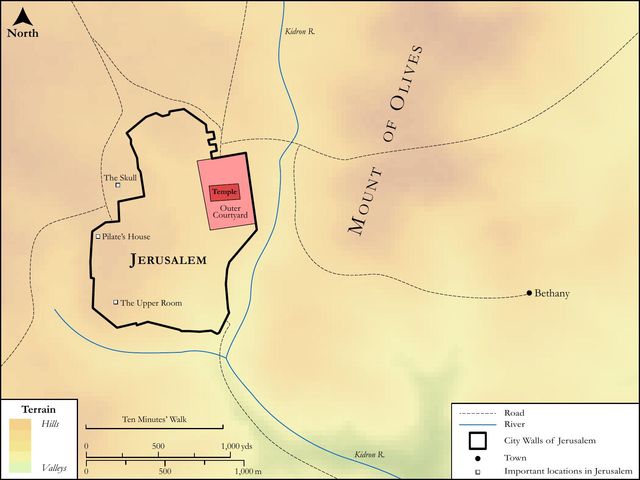
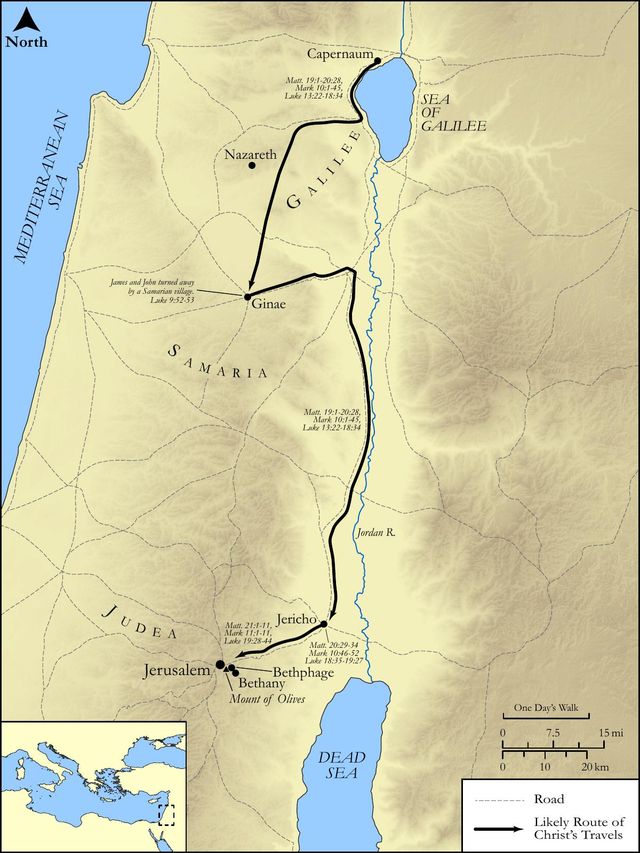
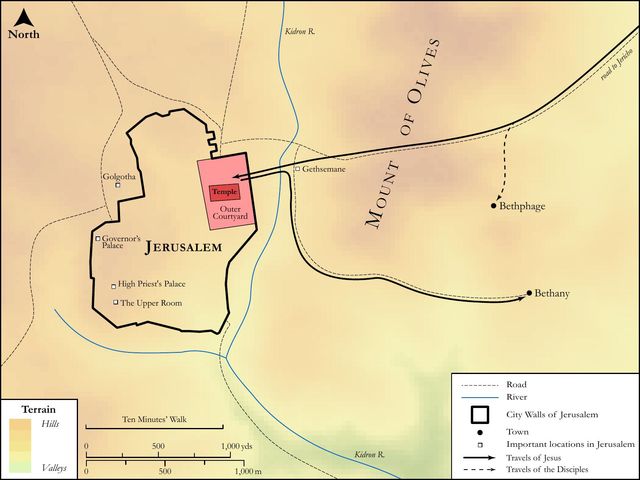
See on the biblical-era maps
Study this verse
Public-domain commentary
Matthew Henry
From his Commentary on the Whole Bible. Henry comments on passages, not single verses — this entry covers Mark 11:1–11. His three-level outline is real structure in the source text, so it is rendered as structure.
We have here the story of the public entry Christ made into Jerusalem, four or five days before his death. And he came into town thus remarkably, 1. To show that he was not afraid of the power and malice of his enemies in Jerusalem. He did not steal into the city incognito, as one that durst not show his face; no, they needed not send spies to search for him, he comes in with observation. This would be an encouragement to his disciples that were timorous, and cowed at the thought of their enemies' power and rage; let them see how bravely their Master sets them all at defiance. 2. To show that he was not cast down or disquieted at the thoughts of his approaching sufferings. He came, not only publicly, but cheerfully, and with acclamations of joy. Though he was now but taking the field, and girding on the harness, yet, being fully assured of a complete victory, he thus triumphs as though he had put it off.
I.The outside of this triumph was very mean; he rode upon an ass's colt, which being an ass, looked contemptible, and made no figure; and, being but a colt, whereon never man sat, we may suppose, was rough and untrimmed, and not only so, but rude and ungovernable, and would disturb and disgrace the solemnity. This colt was borrowed too. Christ went upon the water in a borrowed boat, ate the passover in a borrowed chamber, was buried in a borrowed sepulchre, and here rode on a borrowed ass. Let not Christians scorn to be beholden one to another, and, when need is, to go a borrowing, for our Master did not. He had no rich trappings; they threw their clothes upon the colt, and so he sat upon him, Mar 11:7. The persons that attended, were mean people; and all the show they could make, was, by spreading their garments in the way (Mar 11:8), as they used to do at the feast of tabernacles. All these were marks of his humiliation; even when he would be taken notice of, he would be taken notice of for his meanness; and they are instructions to us, not to mind high things, but to condescend to them of low estate. How ill doth it become Christians to take state, when Christ was so far from affecting it!
II.The inside of this triumph was very great; not only as it was the fulfilling of the scripture (which is not taken notice of here, as it as in Matthew), but as there were several rays of Christ's glory shining forth in the midst of all this meanness.
1.Christ showed his knowledge of things distant, and his power over the wills of men, when he sent his disciples for the colt, Mar 11:1-3. By this it appears that he can do every thing, and no thought can be withholden from him.
2.He showed his dominion over the creatures in riding on a colt that was never backed. The subjection of the inferior part of the creation to man is spoken of with application to Christ (Psa 8:5, Psa 8:6, compared with Heb 2:8); for to him it is owing, and to his mediation, that we have any remaining benefit by the grant God made to man, of a sovereignty in this lower world, Gen 1:28. And perhaps Christ, in riding the ass's colt, would give a shadow of his power over the spirit of man, who is born as the wild ass's colt, Job 11:12.
3.The colt was brought from a place where two ways met (Mar 11:4), as if Christ would show that he came to direct those into the right way, who had two ways before them, and were in danger of taking the wrong.
4.Christ received the joyful hosannas of the people; that is, both the welcome they gave him and their good wishes to the prosperity of his kingdom, Mar 11:9. It was God that put it into the hearts of these people to cry Hosanna, who were not by art and management brought to it, as those were who afterward cried, Crucify, crucify. Christ reckons himself honoured by the faith and praises of the multitude, and it is God that brings people to do him this honour beyond their own intentions.
(1.)They welcomed his person (Mar 11:9); Blessed is he that cometh, the ho erchomenos, he that should come, so often promised, so long expected; he comes in the name of the Lord, as God's Ambassador to the world; Blessed be he: let him have our applauses, and best affections; he is a blessed Saviour, and brings blessings to us, and blessed be he that sent him. Let him be blessed in the name of the Lord, and let all nations and ages call him Blessed, and think and speak highly and honourably of him.
(2.)They wished well to his intent, Mar 11:10. They believed that, mean a figure as he made, he had a kingdom, which should shortly be set up in the world, that it was the kingdom of their father David (that father of his country), the kingdom promised to him and his seed for ever; a kingdom that came in the name of the Lord, supported by a divine authority. Blessed be this kingdom; let it take place, let it get ground, let it come in the power of it, and let all opposing rule, principality, and power, be put down; let it go on conquering, and to conquer. Hosanna to this kingdom; prosperity be to it; all happiness attend it. The proper signification of hosanna is that which we find, Rev 7:10. Salvation to our God, that sitteth on the throne, and to the Lamb; success to religion, both natural and revealed, Hosanna in the highest. Praises be to our God, who is in the highest heavens over all, God blessed for ever; or, Let him be praised by his angels, that are in the highest heavens, let our hosannas be an echo to theirs.
Christ, thus attended, thus applauded, came into the city, and went directly to the temple. Here was no banquet of wine prepared for his entertainment, nor the least refreshment; but he immediately applied himself to his work, for that was his meat and drink. He went to the temple, that the scripture might be fulfilled; "The Lord whom ye seek, shall suddenly come to his temple, without sending any immediate notice before him; he shall surprise you with a day of visitation, for he shall be like a refiner's fire, and like fuller's soap," Mal 3:1-3. He came to the temple, and took a view of the present state of it, Mar 11:11. He looked round about upon all things, but as yet said nothing. He saw many disorders there, but kept silence, Psa 50:21. Though he intended to suppress them, he would not go about the doing of it all on a sudden, lest he should seem to have done it rashly; he let things be as they were for this night, intending the next morning to apply himself to the necessary reformation, and to take the day before him. We may be confident that God sees all the wickedness that is in the world, though he do not presently reckon for it, nor cast it out. Christ, having make his remarks upon what he saw in the temple, retired in the evening to a friend's house at Bethany, because there he would be more out of the noise of the town, and out of the way of being suspected, a designing to head a faction.
Historical interpretation
Seven Centuries of Reception
8 surviving comments on this verse. Each one is dated, so this reads as a timeline rather than a list.
Select a marker to jump to its quote. Markers stagger vertically where authors wrote within a few decades of each other.
They cry out Hosanna, that is save us, that men might be saved by Him who was blessed, and was a conqueror and came in the name of the Lord, that is, of His Father, since the Father is so called because of the Son, and the Son, because of the Father.
Or Hosanna, that is, save in the highest as well as in the lowest, that is, that the just be built on the ruin of Angels, and also that both those on the earth and those under the earth should be saved. In a mystical sense, also, the Lord approaches Jerusalem, which is 'the vision of peace,' in which happiness remains fixed and unmoved, being, as the Apostle says, the mother of all believers. (Gal. 4:26)
The disciples of Christ are called two by two, and sent two by two, since charity implies more than one, as it is written, Woe to him that is alone. (Eccl. 4:10) Two persons lead the Israelites out of Egypt: two bring down the bunch of grapes from the Holy Land, that men in authority might ever join together activity and knowledge, and bring forward two commandments from the Two Tables, and be washed from two fountains, and carry the ark of the Lord on two poles, and know the Lord between the two Cherubim, and sing to Him with both mind and spirit.
But they found the colt tied by the door without, because the Gentile people were bound by the chain of their sins before the door of faith, that is, without the Church.
Or, in a place where two roads meet, that is, in the freedom of will, hesitating between life and death.
But some said, What do ye? as if they would say, Who can remit sins?
Or else, they put upon it their garments, that is, they bring to them the first robe of immortality by the Sacrament of Baptism. And Jesus sat upon it, that is, began to reign in them, so that sin should not reign in their wanton flesh, but righteousness, and peace, and joy in the Holy Ghost. Again, many spread their garments in the way, under the feet of the foal of the ass. What are feet, but those who carry, and the least esteemed, whom the Apostle has set to judge? (v. 1 Cor. 6:4.) And these too, though they are not the back on which the Lord sat, yet are instructed by John with the soldiers.
For the righteous shall flourish as a palm tree, straitened in their roots, but spreading out wide with flowers and fruits; for they are a good odour unto Christ, and strew the way of the commandments of God with their good report. Those who went before are the prophets, and those who followed are the Apostles.
(in Luc. 9, 6) Or else, they found it bound before the door, because whosoever is not in Christ is without, in the way; but he who is in Christ, is not without. He has added in the way, or in a place where two ways meet, where there is no certain possession for any man, nor stall, nor food, nor stable; miserable is his service, whose rights are unfixed; for he who has not the one Master, has many. Strangers bind him that they may possess him, Christ looses him in order to keep him, for He knows that gifts are stronger ties than bonds.
(ubi sup.) Now that the Lord had given sufficient proof of His virtue, and the cross was at hand, even at the door, He did those things which were about to excite them against Him with a greater openness; therefore although He had so often gone up to Jerusalem, He never however had done so in such a conspicuous manner as now.
The boys in the Gospel raised aloft their branches as the Savior entered Jerusalem. They kept on crying: “Hosanna.” … They borrowed these versicles from Psalm 117. Hosanna, moreover, is the Hebrew for “O Lord, grant salvation!”
“Hosanna,” however, is a word of supplicating, as some say who know the Hebrew language, more declaring a feeling than signifying something. Just as in the Latin language there are words which we call interjections, as when in sorrow we say, Heu! Or when we are delighted, we say, Vah! Or when we are amazed, we say, “Oh, what a great thing!” For then oh signifies nothing except the feeling of one who is amazed.
(Cat. in Marc. Oxon.) Not indeed that He was compelled by necessity to ride on a colt from the mount of Olives to Jerusalem, for He had gone over Judæa and all Galilee on foot, but this action of His is typical. It goes on: And many spread their garments in the way: that is, under the feet of the colt; and others cut down branches off the trees, and strawed them in the way. This, however, was rather done to honour Him, and as a Sacrament, than of necessity. It goes on: And they that went before, and they that followed, cried, saying, Hosanna; blessed is he that cometh in the name of the Lord. 2For the multitude, until it was corrupted, knew what was its duty, for which reason each honoured Jesus according to his own strength. Wherefore they praised Him, and took up the hymns of the Levites, saying, Hosanna, which according to some is the same as save me, but according to others means a hymn. I however suppose the former to be more probable, for there is in the 117th Psalm, (Ps. 118:25) Save now, I beseech thee, O Lord, which in the Hebrew is Hosanna.
(Cat. in Marc. Oxon.) Thus then they give glory to God, saying, Blessed is he that cometh in the name of the Lord. They also bless the kingdom of Christ, saying, Blessed be the kingdom of our father David, which cometh.
(Cat. in Marc. Oxon.) Wherefore also the prophets so often call Christ by the name of David, on account of the descent according to the flesh of Christ from David.
(Cat. in Marc. Oxon.) And further, they give glory to God, when they add Hosanna in the highest, that is, praise and glory be to the God of all, Who is in the highest.
(in Marc. 3, 41) Bethany is a little village or town by the side of mount Olivet, where Lazarus was raised from the dead. But in what way He sent His disciples and for what purpose is shown in these words, And saith unto them, Go your way into the village over against you.
(ubi sup.) But Hosanna is a Hebrew word, made out of two, one imperfect the other perfect. For save, or preserve, is in their language, hosy; but anna is a supplicatory interjection, as in Latin heu is an exclamation of grief.
(ubi sup.) Now we read in the Gospel of John that He fled into a mountain, lest they should make him their king. Now, however, when He comes to Jerusalem to suffer, He does not shun those who call Him king, that He might openly teach them that He was King over an empire not temporal and earthly, but everlasting in the heavens, and that the path to this kingdom was through contempt of death. Observe also the agreement of the multitude with the saying of Gabriel, The Lord God will give him the throne of his father David; (Luke 1:32) that is, that He Himself may call by word and deed to a heavenly kingdom the nation to which David once furnished the government of a temporal rule.
(ubi sup.) Bethany again means the house of obedience, because by teaching many before His Passion, he made for Himself a house of obedience; and it is said to be placed on the mount of Olives, because He cherishes His Church with the unction of spiritual gifts, and with the light of piety and knowledge. But He sent His disciples to a hold1, which was over against them, that is, He appointed doctors to penetrate into the ignorant parts of the whole world, into, as it were, the walls of the hold placed against them.
(ubi sup.) For the colt of the ass, wanton and unshackled, denotes the people of the nations, on whom no man had yet sat, because no wise doctor had, by teaching them the things of salvation, put upon them the bridle of correction, to oblige them to restrain their tongues from evil, or to compel them into the narrow path of life.
(ubi sup.) Or else, fitly did the colt stand in a place where two ways meet, because the Gentile people did not hold on in any certain road of life and faith, but followed in its error many doubtful paths of various sects.
(ubi sup.) Or else, the masters of error, who resisted the teachers, when they came to save the Gentiles; but after that the power of the faith of the Lord appeared to believers, the faithful people were freed from the cavils of the adversaries, and were brought to the Lord, whom they bore in their hearts. But by the garments of the Apostles, which they put upon it, we may understand the teaching of virtues, or the interpretation of the Scriptures, or the various doctrines of the Church, by which they clothe the hearts of men, once naked and cold and fit them to become the seats of Christ.
(ubi sup.) Or else, many strew their garments in the way, because the holy martyrs put off from themselves the garment of their own flesh, and prepare a way for the more simple servants of God with their own blood. Many also strew their garments in the way, because they tame their bodies with abstinence, that they may prepare a way for God to the mount, or may give good examples to those who follow them. And they cut down branches from the trees, who in the teaching of the truth cull the sentences of the Fathers from their words, and by their lowly preaching scatter them in the path of God, when He comes into the soul of the hearer.
(ubi sup.) And because all the elect, whether those who were able to become such in Judæa, or those who now are such in the Church, believed and now believe on the Mediator between God and man, both those who go before and those who follow cried out Hosanna.
That thus, if they were willing, they might recognise His glory, and by the prophecies, which were fulfilled concerning Him, know that He is very God; and that if they would not, they might receive a greater judgment, for not having believed so many wonderful miracles. Describing therefore this illustrious entrance, the Evangelist says, And when they came nigh unto Jerusalem, and Bethany, at the mount of Olives, he sendeth forth two of his disciples.
Now consider how many things the Lord foretold to His disciples, that they should find a colt; wherefore it goes on, And as soon as ye be entered into it, ye shall find a colt tied, whereon never man sat, loose him, and bring him; and that they should be impeded in taking it, wherefore there follows, And if any man say unto you, Why do ye this? say ye, The Lord hath need of him; and that on saying this, they should be allowed to take him; wherefore there follows, And straightway he will send him hither; and as the Lord had said, so it was fulfilled. Thus it goes on: And they went their way, and found the colt tied by the door without, in a place where two ways meet; and they loose him.
But they would not have allowed this, if the Divine power had not been upon them, to compel them, especially, as they were country people and farmers, and yet allowed them to take away the colt. It goes on: And they brought the colt to Jesus, and cast their garments on him; and he sat upon him.
But they called the kingdom of Christ, that of David, both because Christ was descended from the seed of David, and because David means a man of a strong hand. For whose hand is stronger than the Lord's, by which so many and so great miracles were wrought.
The colt, however, was not necessary to Him, but He sent for it to show that He would transfer Himself to the Gentiles.
Or else, in a place where two roads meet, that is, in this life, but it was loosed by the disciples, through faith and baptism.
Or else, those who prevent them are the devils, who were weaker than the Apostles.
Let us also strew the way of our life with branches which we cut from the trees, that is, imitate the saints, for these are holy trees, from which, he who imitates their virtues cuts down branches.
But both those of our deeds which go before and those which follow after must be done to the glory of God; for some in their past life make a good beginning, but their following life does not correspond with their former, neither does it end to the glory of God.
Continue studying Mark 11:9 across the web’s major study libraries — every link below opens this exact verse, chapter, or book on the destination site.
Read & Compare
 BibleGatewayThis verse in more than 200 translations and 70 languages.
 Bible.comThe YouVersion reader — hundreds of translations, reading plans, and highlights.
 ESV.orgCrossway's official English Standard Version reader.
 NET BibleThe NET translation with 60,000+ translators' notes on every rendering decision.
 STEP BibleTyndale House's free study tool — original text, vocabulary, and scholarly resources.
 BibliaLogos Bible Software's free web reader.
 USCCBThe New American Bible (Revised Edition) with the U.S. bishops' study notes.
Commentaries
 BibleHub CommentariesDozens of classic commentaries on this verse, gathered on one page.
 StudyLightMore than 100 commentary sets — the largest collection on the web.
 BibleRefPlain-English commentary on what this verse means, verse by verse.
 Enduring WordDavid Guzik's free commentary on this chapter, widely used by Bible teachers.
 Bible Study ToolsVerse commentary alongside Greek and Hebrew study aids.
Original Language & Research
- BibleHub InterlinearThe verse word by word — original language, transliteration, and English.
- BibleHub LexiconEvery word's original-language definition and Strong's entry.
 Blue Letter BibleDeep-study tools — Strong's numbers, concordance, and word studies.
 CNTR CollationThe earliest Greek manuscripts of this verse, collated letter by letter.
Sermons, Hymns & Audio


TrulyRandomVerse is not affiliated with these sites and doesn’t control their content. They’re linked because they’re genuinely useful.
Summary
Mark 11:9 captures the fervent acclamation of the crowds during Jesus' triumphal entry into Jerusalem, a pivotal moment preceding His crucifixion. As Jesus rode into the city, those who went before Him and those who followed joined in a resounding chorus, crying out "Hosanna" and proclaiming a blessing upon "him that cometh in the name of the Lord." This scene vividly portrays the people's deep-seated messianic expectations and their public acknowledgment of Jesus, even if their understanding of His kingship was incomplete.
Context
ShowHideLiterary Context
Mark 11:9 is embedded within the narrative of Jesus' triumphal entry into Jerusalem. This event immediately follows Jesus' departure from Jericho and His healing of blind Bartimaeus in Mark 10:46-52. The entry itself is meticulously described in the preceding verses, detailing Jesus' instruction to His disciples to fetch a young donkey, the spreading of cloaks and branches on the road, and the gathering of the large crowd. This public spectacle serves as a dramatic prelude to the Passion Week, contrasting sharply with Jesus' earlier commands for secrecy regarding His messianic identity. It sets the stage for the escalating conflict with the religious authorities, which will dominate the subsequent chapters of Mark's Gospel.
Historical & Cultural Context
The triumphal entry occurred during the week of Passover, a time when Jerusalem swelled with Jewish pilgrims from across the Roman Empire. Passover commemorated the Israelites' liberation from slavery in Egypt, fostering intense nationalistic and messianic fervor. The crowds' actions—spreading cloaks and palm branches (though Mark specifically mentions "branches" generally, other Gospels specify palms)—were traditional gestures of homage for a king or conquering hero. The cry "Hosanna" and the quotation from Psalm 118:26 were deeply rooted in Jewish liturgical and prophetic tradition, particularly associated with the Hallel psalms sung during Passover. The expectation was for a political deliverer who would overthrow Roman oppression, echoing the Maccabean revolt's success centuries prior. Jesus' entry on a donkey, rather than a warhorse, subtly fulfilled the prophecy of Zechariah 9:9, portraying a humble, peaceable king, yet one with divine authority.
Key Themes
ShowHideMark 11:9 contributes significantly to several key themes in Mark's Gospel. Foremost is the theme of Messianic Identity, as Jesus publicly presents Himself as the long-awaited King, albeit in a way that confounds conventional expectations. The crowd's acclamation, though perhaps misunderstanding the nature of His kingdom, undeniably acknowledges His unique status. This event also highlights the theme of Divine Authority, as Jesus' actions and the crowd's response declare His legitimate claim to kingship and His coming "in the name of the Lord," signifying God's endorsement. Furthermore, the scene underscores the theme of Praise and Adoration, demonstrating the fervent devotion Jesus inspired in His followers, even as this adoration would soon give way to rejection and crucifixion. It also subtly introduces the theme of Prophetic Fulfillment, as the events align with Old Testament prophecies concerning the Messiah's arrival, particularly from Zechariah 9 and Psalm 118.
Exposition and Analysis
ShowHideKey Word Analysis
ShowHideThis exclamation, derived from the Hebrew "hoshia-na" (meaning "save, please!" or "save now!"), had evolved by Jesus' time from a desperate plea for deliverance into an exclamation of fervent praise and adoration. It functions similarly to "Hallelujah" or "Praise the Lord," used to welcome a king or celebrate a victory. Its use here signifies the crowd's recognition of Jesus as a deliverer, even if their understanding of the deliverance He offered was limited to political deliverance.
This word means "to speak well of," or "to bless," implying an invocation of divine favor or prosperity. When applied to Jesus, it signifies the crowd's acknowledgment of His divine favor and the inherent blessedness of His coming. It's a declaration that His arrival is divinely ordained and carries God's approval, affirming His legitimate claim to a unique, divinely appointed role.
This term denotes "supreme in authority," a "controller," or "Master." While it can be a respectful title like "Sir," in the context of "in the name of the Lord," it carries profound theological weight, referring to God Himself. The crowd's cry, quoting Psalm 118:26, identifies Jesus as the one who comes with the authority and backing of Yahweh, the God of Israel. This elevates their acclamation beyond mere human praise to a recognition of His divine commission.
Verse Breakdown
ShowHide"And they that went before, and they that followed, cried, saying,"
This clause emphasizes the overwhelming nature of the crowd's response. It wasn't just a small group, but a multitude encompassing those who preceded Jesus and those who came behind Him, creating a unified, boisterous procession. The verb "cried" (G2896, krázō) suggests a loud, perhaps even clamorous, exclamation, indicating intense emotion and public declaration.
"Hosanna;"
This is the initial, powerful exclamation of adoration and plea for salvation. As discussed in the key word analysis, it reflects both the crowd's hope for deliverance and their praise for Jesus as the one who brings it. It's a direct, urgent, and celebratory cry.
"Blessed [is] he that cometh"
This phrase is a declaration of divine favor upon Jesus. It affirms that His arrival is not accidental or merely human-initiated, but rather divinely sanctioned and brings blessing. The participle "cometh" (G2064, érchomai) highlights His active arrival, emphasizing His presence as the fulfillment of expectation.
"in the name of the Lord:"
This crucial phrase clarifies the source of Jesus' authority and the nature of His mission. To come "in the name of the Lord" (G1722, en G3686, ónoma G2962, kýrios) means to come with the full authority, power, and representation of God Himself. It's not merely a formal title but an assertion of divine commission and identity. The crowd, perhaps unknowingly, was declaring Jesus' divine sonship and His role as God's appointed agent.
Literary Devices
ShowHideMark 11:9 is rich in literary devices that amplify its significance. The most prominent is Quotation/Allusion, as the crowd's cry "Blessed is he that cometh in the name of the Lord" is a direct quotation from Psalm 118:26. This immediate connection to Messianic prophecy and Passover liturgy imbues the scene with profound theological weight, signaling Jesus' fulfillment of ancient expectations. The use of Apostrophe and Direct Address is evident in the cry "Hosanna," as the crowd directly addresses or invokes salvation through Jesus. The entire scene functions as Symbolism: the donkey, the cloaks, and the branches all symbolize Jesus' kingship, albeit a different kind of kingship than expected. The Contrast between the crowd's initial adoration and their later cries for His crucifixion (foreshadowed by Mark's narrative structure) creates dramatic irony. Finally, the Exclamation of "Hosanna" captures the raw emotion and fervent expectation of the moment.
Theological and Thematic Connections
ShowHideMark 11:9 stands as a profound theological statement about Jesus' identity and mission. The crowd's acclamation, though imperfect in its understanding, unequivocally acknowledges Jesus as a divinely sent figure, the one who comes "in the name of the Lord." This phrase is not merely a polite greeting but a declaration of His divine authority and legitimate claim to a unique role in God's redemptive plan. It highlights the tension between popular messianic expectations (a political king) and Jesus' true mission (a suffering servant who would redeem humanity through His sacrifice). The scene underscores the theme of God's sovereign plan unfolding, as ancient prophecies find their fulfillment in this humble yet regal entry. It also foreshadows the ultimate recognition of Jesus' Lordship, even if the path to that recognition involves the cross.
Reflection and Application
ShowHideMark 11:9 invites us to examine the nature of our own praise and understanding of Jesus. The crowd's "Hosanna" was genuine, yet their comprehension of Jesus' true mission was limited; they desired a political deliverer, not a suffering Savior. This challenges us to move beyond superficial adoration to a deeper, more robust understanding of who Jesus truly is and what He accomplished. Do we truly acknowledge Him as the Lord who comes with divine authority, worthy of all praise, even when His path diverges from our expectations? Our worship should not merely be an emotional outburst but a conscious, informed affirmation of His Lordship and His redemptive work. This verse calls us to align our hearts and minds with God's purposes for Jesus, offering Him not just our voices, but our lives in genuine adoration and obedient discipleship, understanding that His kingdom is not of this world, yet it transforms this world.
Questions for Reflection
ShowHideFAQ
ShowHideWhat is the significance of the crowd shouting "Hosanna"?
ShowHideThe cry "Hosanna" (Greek: hōsanná) is a transliteration of the Hebrew phrase hoshi'ah na, which literally means "Save, please!" or "Save now!" While originally a plea for deliverance, by Jesus' time, it had evolved into an exclamation of praise and adoration, akin to "Hallelujah" or "Praise the Lord." It was used in contexts of welcoming a king or celebrating a victory. In Mark 11:9, its significance is twofold: it expresses the crowd's desperate hope for liberation (likely from Roman rule) and their fervent celebration of Jesus as the one they believed could bring that salvation, acknowledging Him as a kingly figure. It also connects to the liturgical use of Psalm 118:25-26 during the Passover festival, further cementing its messianic implications.
Christ-Centered Fulfillment
ShowHideMark 11:9, with its declaration of "Blessed is he that cometh in the name of the Lord," finds its ultimate Christ-centered fulfillment in Jesus' identity as the promised Messiah and divine Son of God. The crowd's acclamation, though rooted in a desire for an earthly king, unwittingly proclaimed a deeper truth: Jesus is the one truly sent by God, bearing divine authority and embodying God's very presence. He is the Lamb of God, as John the Baptist declared in John 1:29, who came not to conquer a political empire but to conquer sin and death through His sacrificial death and resurrection. His entry into Jerusalem was a foreshadowing of His return as the King of Kings and Lord of Lords, as described in Revelation 19:16. The "name of the Lord" in which He comes is ultimately His own name, for Philippians 2:9-11 affirms that God has highly exalted Him and given Him the name that is above every name, "that at the name of Jesus every knee should bow, in heaven and on earth and under the earth, and every tongue confess that Jesus Christ is Lord, to the glory of God the Father." Thus, the shouts of "Hosanna" on that Palm Sunday echo through history, pointing to the eternal reign of the one who truly comes in the name and power of the Lord, Jesus Christ.