


Mark 11:8
- πολλοὶpolloimanyG4183A-NPMAdjective Nominative Plural Masculine
- δὲdenowG1161CONJConjunction
- τὰtatheG3588T-APNDefinite article Accusative Plural Neuter
- ἱμάτιαhimatiacloaksG2440N-APNNoun Accusative Plural Neuter
- αὐτῶνautōnof themG846P-GPMPersonal pronoun Genitive Plural Masculine
- ἔστρωσανestrōsanspreadG4766V-AAI-3PVerb Aorist Active Indicative 3rd Plural
- εἰςeisonG1519PREPPreposition
- τὴνtēntheG3588T-ASFDefinite article Accusative Singular Feminine
- ὁδόνhodonroadG3598N-ASFNoun Accusative Singular Feminine
- ἄλλοιalloiothersG243A-NPMAdjective Nominative Plural Masculine
- δὲdethenG1161CONJConjunction
- στιβάδαςstibadasbranchesG4746N-APFNoun Accusative Plural Feminine
- κόψαντεςkopsantescutting downG2875V-AAP-NPMVerb Aorist Active Participle Nominative Plural Masculine
- ἐκekfromG1537PREPPreposition
- τῶνtōntheG3588T-GPMDefinite article Genitive Plural Masculine
- ἀγρῶνagrōnfieldsG68N-GPMNoun Genitive Plural Masculine
- καὶkaiandG2532CONJConjunction
- ἐστρώννυονestrōnnuonwere spreadingG4766V-IAI-3PVerb Imperfect Active Indicative 3rd Plural
- εἰςeisintoG1519PREPPreposition
- τὴνtēn<the>G3588T-ASFDefinite article Accusative Singular Feminine
- ὁδόνhodonwayG3598N-ASFNoun Accusative Singular Feminine
English is a literal word-by-word gloss of the Greek, not the KJV's wording. Why?
This is the original text the KJV's translators worked from — each Greek word with its own literal English meaning in this verse, prepared by scholars at Tyndale House, Cambridge. The KJV translates whole sentences, not word by word, so its wording differs: one Greek word can become several English words, and the KJV may choose “charity” where the gloss reads “love”. Both are faithful — they answer different questions. For the KJV's own rendering, switch to the KJV text.
Details
See on the biblical-era map
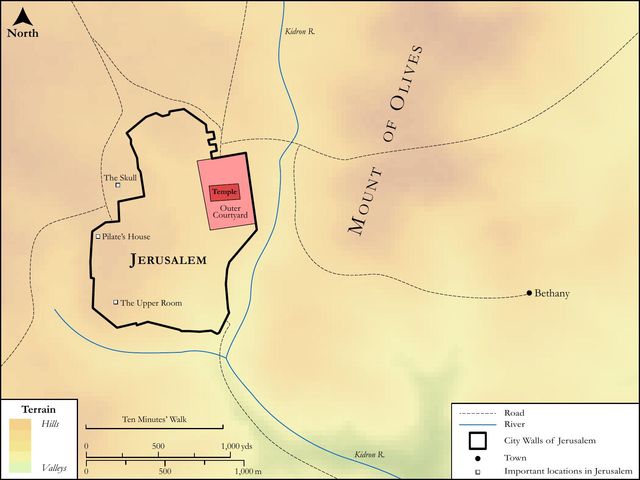
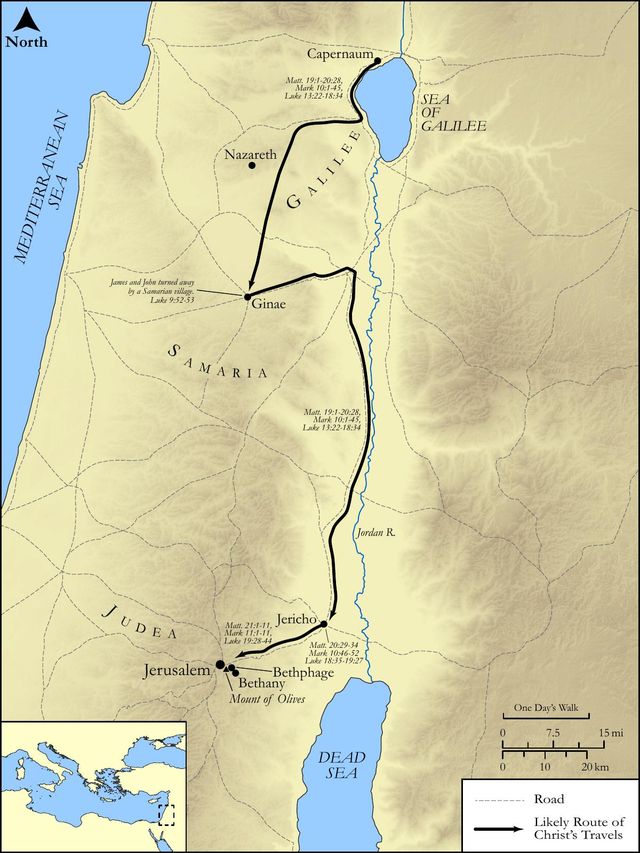
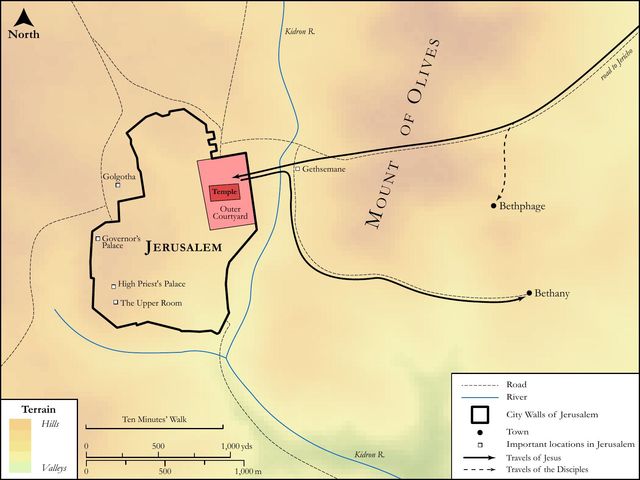
Study this verse
Public-domain commentary
Matthew Henry
From his Commentary on the Whole Bible. Henry comments on passages, not single verses — this entry covers Mark 11:1–11. His three-level outline is real structure in the source text, so it is rendered as structure.
We have here the story of the public entry Christ made into Jerusalem, four or five days before his death. And he came into town thus remarkably, 1. To show that he was not afraid of the power and malice of his enemies in Jerusalem. He did not steal into the city incognito, as one that durst not show his face; no, they needed not send spies to search for him, he comes in with observation. This would be an encouragement to his disciples that were timorous, and cowed at the thought of their enemies' power and rage; let them see how bravely their Master sets them all at defiance. 2. To show that he was not cast down or disquieted at the thoughts of his approaching sufferings. He came, not only publicly, but cheerfully, and with acclamations of joy. Though he was now but taking the field, and girding on the harness, yet, being fully assured of a complete victory, he thus triumphs as though he had put it off.
I.The outside of this triumph was very mean; he rode upon an ass's colt, which being an ass, looked contemptible, and made no figure; and, being but a colt, whereon never man sat, we may suppose, was rough and untrimmed, and not only so, but rude and ungovernable, and would disturb and disgrace the solemnity. This colt was borrowed too. Christ went upon the water in a borrowed boat, ate the passover in a borrowed chamber, was buried in a borrowed sepulchre, and here rode on a borrowed ass. Let not Christians scorn to be beholden one to another, and, when need is, to go a borrowing, for our Master did not. He had no rich trappings; they threw their clothes upon the colt, and so he sat upon him, Mar 11:7. The persons that attended, were mean people; and all the show they could make, was, by spreading their garments in the way (Mar 11:8), as they used to do at the feast of tabernacles. All these were marks of his humiliation; even when he would be taken notice of, he would be taken notice of for his meanness; and they are instructions to us, not to mind high things, but to condescend to them of low estate. How ill doth it become Christians to take state, when Christ was so far from affecting it!
II.The inside of this triumph was very great; not only as it was the fulfilling of the scripture (which is not taken notice of here, as it as in Matthew), but as there were several rays of Christ's glory shining forth in the midst of all this meanness.
1.Christ showed his knowledge of things distant, and his power over the wills of men, when he sent his disciples for the colt, Mar 11:1-3. By this it appears that he can do every thing, and no thought can be withholden from him.
2.He showed his dominion over the creatures in riding on a colt that was never backed. The subjection of the inferior part of the creation to man is spoken of with application to Christ (Psa 8:5, Psa 8:6, compared with Heb 2:8); for to him it is owing, and to his mediation, that we have any remaining benefit by the grant God made to man, of a sovereignty in this lower world, Gen 1:28. And perhaps Christ, in riding the ass's colt, would give a shadow of his power over the spirit of man, who is born as the wild ass's colt, Job 11:12.
3.The colt was brought from a place where two ways met (Mar 11:4), as if Christ would show that he came to direct those into the right way, who had two ways before them, and were in danger of taking the wrong.
4.Christ received the joyful hosannas of the people; that is, both the welcome they gave him and their good wishes to the prosperity of his kingdom, Mar 11:9. It was God that put it into the hearts of these people to cry Hosanna, who were not by art and management brought to it, as those were who afterward cried, Crucify, crucify. Christ reckons himself honoured by the faith and praises of the multitude, and it is God that brings people to do him this honour beyond their own intentions.
(1.)They welcomed his person (Mar 11:9); Blessed is he that cometh, the ho erchomenos, he that should come, so often promised, so long expected; he comes in the name of the Lord, as God's Ambassador to the world; Blessed be he: let him have our applauses, and best affections; he is a blessed Saviour, and brings blessings to us, and blessed be he that sent him. Let him be blessed in the name of the Lord, and let all nations and ages call him Blessed, and think and speak highly and honourably of him.
(2.)They wished well to his intent, Mar 11:10. They believed that, mean a figure as he made, he had a kingdom, which should shortly be set up in the world, that it was the kingdom of their father David (that father of his country), the kingdom promised to him and his seed for ever; a kingdom that came in the name of the Lord, supported by a divine authority. Blessed be this kingdom; let it take place, let it get ground, let it come in the power of it, and let all opposing rule, principality, and power, be put down; let it go on conquering, and to conquer. Hosanna to this kingdom; prosperity be to it; all happiness attend it. The proper signification of hosanna is that which we find, Rev 7:10. Salvation to our God, that sitteth on the throne, and to the Lamb; success to religion, both natural and revealed, Hosanna in the highest. Praises be to our God, who is in the highest heavens over all, God blessed for ever; or, Let him be praised by his angels, that are in the highest heavens, let our hosannas be an echo to theirs.
Christ, thus attended, thus applauded, came into the city, and went directly to the temple. Here was no banquet of wine prepared for his entertainment, nor the least refreshment; but he immediately applied himself to his work, for that was his meat and drink. He went to the temple, that the scripture might be fulfilled; "The Lord whom ye seek, shall suddenly come to his temple, without sending any immediate notice before him; he shall surprise you with a day of visitation, for he shall be like a refiner's fire, and like fuller's soap," Mal 3:1-3. He came to the temple, and took a view of the present state of it, Mar 11:11. He looked round about upon all things, but as yet said nothing. He saw many disorders there, but kept silence, Psa 50:21. Though he intended to suppress them, he would not go about the doing of it all on a sudden, lest he should seem to have done it rashly; he let things be as they were for this night, intending the next morning to apply himself to the necessary reformation, and to take the day before him. We may be confident that God sees all the wickedness that is in the world, though he do not presently reckon for it, nor cast it out. Christ, having make his remarks upon what he saw in the temple, retired in the evening to a friend's house at Bethany, because there he would be more out of the noise of the town, and out of the way of being suspected, a designing to head a faction.
Historical interpretation
Eight Centuries of Reception
10 surviving comments on this verse. Each one is dated, so this reads as a timeline rather than a list.
Select a marker to jump to its quote. Markers stagger vertically where authors wrote within a few decades of each other.
They cry out Hosanna, that is save us, that men might be saved by Him who was blessed, and was a conqueror and came in the name of the Lord, that is, of His Father, since the Father is so called because of the Son, and the Son, because of the Father.
Or Hosanna, that is, save in the highest as well as in the lowest, that is, that the just be built on the ruin of Angels, and also that both those on the earth and those under the earth should be saved. In a mystical sense, also, the Lord approaches Jerusalem, which is 'the vision of peace,' in which happiness remains fixed and unmoved, being, as the Apostle says, the mother of all believers. (Gal. 4:26)
The disciples of Christ are called two by two, and sent two by two, since charity implies more than one, as it is written, Woe to him that is alone. (Eccl. 4:10) Two persons lead the Israelites out of Egypt: two bring down the bunch of grapes from the Holy Land, that men in authority might ever join together activity and knowledge, and bring forward two commandments from the Two Tables, and be washed from two fountains, and carry the ark of the Lord on two poles, and know the Lord between the two Cherubim, and sing to Him with both mind and spirit.
But they found the colt tied by the door without, because the Gentile people were bound by the chain of their sins before the door of faith, that is, without the Church.
Or, in a place where two roads meet, that is, in the freedom of will, hesitating between life and death.
But some said, What do ye? as if they would say, Who can remit sins?
Or else, they put upon it their garments, that is, they bring to them the first robe of immortality by the Sacrament of Baptism. And Jesus sat upon it, that is, began to reign in them, so that sin should not reign in their wanton flesh, but righteousness, and peace, and joy in the Holy Ghost. Again, many spread their garments in the way, under the feet of the foal of the ass. What are feet, but those who carry, and the least esteemed, whom the Apostle has set to judge? (v. 1 Cor. 6:4.) And these too, though they are not the back on which the Lord sat, yet are instructed by John with the soldiers.
For the righteous shall flourish as a palm tree, straitened in their roots, but spreading out wide with flowers and fruits; for they are a good odour unto Christ, and strew the way of the commandments of God with their good report. Those who went before are the prophets, and those who followed are the Apostles.
Instead of our garments, let us spread our hearts before him.
(in Luc. 9, 6) Or else, they found it bound before the door, because whosoever is not in Christ is without, in the way; but he who is in Christ, is not without. He has added in the way, or in a place where two ways meet, where there is no certain possession for any man, nor stall, nor food, nor stable; miserable is his service, whose rights are unfixed; for he who has not the one Master, has many. Strangers bind him that they may possess him, Christ looses him in order to keep him, for He knows that gifts are stronger ties than bonds.
(ubi sup.) Now that the Lord had given sufficient proof of His virtue, and the cross was at hand, even at the door, He did those things which were about to excite them against Him with a greater openness; therefore although He had so often gone up to Jerusalem, He never however had done so in such a conspicuous manner as now.
And others cut boughs … and strewed them in the way. They cut branches from the fruitbearing trees with which the Mount of Olives was planted, and spread them in the way; so as to make the crooked ways straight, and the rough ways smooth, that Christ the conqueror of sin might walk straightly and safely into the hearts of the faithful.… And when they had done all that was to be done by their hands, they offered also the tribute of their voices; and going before and following after they cry, not in a brief and wordless confession, but with all their might: “Hosanna to the son of David. Blessed is he that comes in the name of the Lord.”
(Cat. in Marc. Oxon.) Not indeed that He was compelled by necessity to ride on a colt from the mount of Olives to Jerusalem, for He had gone over Judæa and all Galilee on foot, but this action of His is typical. It goes on: And many spread their garments in the way: that is, under the feet of the colt; and others cut down branches off the trees, and strawed them in the way. This, however, was rather done to honour Him, and as a Sacrament, than of necessity. It goes on: And they that went before, and they that followed, cried, saying, Hosanna; blessed is he that cometh in the name of the Lord. 2For the multitude, until it was corrupted, knew what was its duty, for which reason each honoured Jesus according to his own strength. Wherefore they praised Him, and took up the hymns of the Levites, saying, Hosanna, which according to some is the same as save me, but according to others means a hymn. I however suppose the former to be more probable, for there is in the 117th Psalm, (Ps. 118:25) Save now, I beseech thee, O Lord, which in the Hebrew is Hosanna.
(Cat. in Marc. Oxon.) Thus then they give glory to God, saying, Blessed is he that cometh in the name of the Lord. They also bless the kingdom of Christ, saying, Blessed be the kingdom of our father David, which cometh.
(Cat. in Marc. Oxon.) Wherefore also the prophets so often call Christ by the name of David, on account of the descent according to the flesh of Christ from David.
(Cat. in Marc. Oxon.) And further, they give glory to God, when they add Hosanna in the highest, that is, praise and glory be to the God of all, Who is in the highest.
But many spread their garments on the way. When the Lord was borne on a donkey, many spread their garments on the way, because the holy martyrs, stripping themselves of their own fleshly clothing, prepare the way for the simpler servants of God with their blood, so that, with an unhindered step of mind, they may proceed to the walls of the heavenly city where Jesus leads. Likewise, our Savior tends towards Jerusalem sitting on a donkey when he, ruling the soul of each believer, that is, his beast of burden, leads to the inner vision of peace. He also sits on the beast when he universally presides over the holy Church and inflames it with a desire for heavenly peace. But many spread their garments on the way, for they subjugate their bodies through abstinence to prepare the way to the mind, or they present good examples to those who follow.
But others were cutting branches from the trees and spreading them on the road. And those who went ahead and those who followed were shouting: Hosanna, blessed is he who comes in the name of the Lord. They cut branches or twigs from the trees, who in the teaching of truth extract words and sentences of the Fathers from their eloquence, and submit these on the way of God to the mind of a coming listener with humble preaching. But those who went ahead and those who followed were shouting: Hosanna. Indeed, the Jewish people went ahead, the Gentiles followed. And because all the chosen, whether they could have been in Judea or those who now exist in the Church, believed and believe in the Mediator of God and men, those who go ahead and those who follow shouted Hosanna. Hosanna is said in Latin as save us. From Him, both the former sought salvation, and the present seek. They confess the blessed one who comes in the name of the Lord, because there is one hope, one faith of the preceding and following peoples. For just as they were healed by witnessing His passion and resurrection, so we are saved by His past passion and by His resurrection enduring through the ages. For whom our ancestors from the Jewish people believed and loved to come, this one we believe has come and love, and we are kindled with desire for Him, so that we may behold Him face to face.
(in Marc. 3, 41) Bethany is a little village or town by the side of mount Olivet, where Lazarus was raised from the dead. But in what way He sent His disciples and for what purpose is shown in these words, And saith unto them, Go your way into the village over against you.
(ubi sup.) But Hosanna is a Hebrew word, made out of two, one imperfect the other perfect. For save, or preserve, is in their language, hosy; but anna is a supplicatory interjection, as in Latin heu is an exclamation of grief.
(ubi sup.) Now we read in the Gospel of John that He fled into a mountain, lest they should make him their king. Now, however, when He comes to Jerusalem to suffer, He does not shun those who call Him king, that He might openly teach them that He was King over an empire not temporal and earthly, but everlasting in the heavens, and that the path to this kingdom was through contempt of death. Observe also the agreement of the multitude with the saying of Gabriel, The Lord God will give him the throne of his father David; (Luke 1:32) that is, that He Himself may call by word and deed to a heavenly kingdom the nation to which David once furnished the government of a temporal rule.
(ubi sup.) Bethany again means the house of obedience, because by teaching many before His Passion, he made for Himself a house of obedience; and it is said to be placed on the mount of Olives, because He cherishes His Church with the unction of spiritual gifts, and with the light of piety and knowledge. But He sent His disciples to a hold1, which was over against them, that is, He appointed doctors to penetrate into the ignorant parts of the whole world, into, as it were, the walls of the hold placed against them.
(ubi sup.) For the colt of the ass, wanton and unshackled, denotes the people of the nations, on whom no man had yet sat, because no wise doctor had, by teaching them the things of salvation, put upon them the bridle of correction, to oblige them to restrain their tongues from evil, or to compel them into the narrow path of life.
(ubi sup.) Or else, fitly did the colt stand in a place where two ways meet, because the Gentile people did not hold on in any certain road of life and faith, but followed in its error many doubtful paths of various sects.
(ubi sup.) Or else, the masters of error, who resisted the teachers, when they came to save the Gentiles; but after that the power of the faith of the Lord appeared to believers, the faithful people were freed from the cavils of the adversaries, and were brought to the Lord, whom they bore in their hearts. But by the garments of the Apostles, which they put upon it, we may understand the teaching of virtues, or the interpretation of the Scriptures, or the various doctrines of the Church, by which they clothe the hearts of men, once naked and cold and fit them to become the seats of Christ.
(ubi sup.) Or else, many strew their garments in the way, because the holy martyrs put off from themselves the garment of their own flesh, and prepare a way for the more simple servants of God with their own blood. Many also strew their garments in the way, because they tame their bodies with abstinence, that they may prepare a way for God to the mount, or may give good examples to those who follow them. And they cut down branches from the trees, who in the teaching of the truth cull the sentences of the Fathers from their words, and by their lowly preaching scatter them in the path of God, when He comes into the soul of the hearer.
(ubi sup.) And because all the elect, whether those who were able to become such in Judæa, or those who now are such in the Church, believed and now believe on the Mediator between God and man, both those who go before and those who follow cried out Hosanna.
That thus, if they were willing, they might recognise His glory, and by the prophecies, which were fulfilled concerning Him, know that He is very God; and that if they would not, they might receive a greater judgment, for not having believed so many wonderful miracles. Describing therefore this illustrious entrance, the Evangelist says, And when they came nigh unto Jerusalem, and Bethany, at the mount of Olives, he sendeth forth two of his disciples.
Now consider how many things the Lord foretold to His disciples, that they should find a colt; wherefore it goes on, And as soon as ye be entered into it, ye shall find a colt tied, whereon never man sat, loose him, and bring him; and that they should be impeded in taking it, wherefore there follows, And if any man say unto you, Why do ye this? say ye, The Lord hath need of him; and that on saying this, they should be allowed to take him; wherefore there follows, And straightway he will send him hither; and as the Lord had said, so it was fulfilled. Thus it goes on: And they went their way, and found the colt tied by the door without, in a place where two ways meet; and they loose him.
But they would not have allowed this, if the Divine power had not been upon them, to compel them, especially, as they were country people and farmers, and yet allowed them to take away the colt. It goes on: And they brought the colt to Jesus, and cast their garments on him; and he sat upon him.
But they called the kingdom of Christ, that of David, both because Christ was descended from the seed of David, and because David means a man of a strong hand. For whose hand is stronger than the Lord's, by which so many and so great miracles were wrought.
The colt, however, was not necessary to Him, but He sent for it to show that He would transfer Himself to the Gentiles.
Or else, in a place where two roads meet, that is, in this life, but it was loosed by the disciples, through faith and baptism.
Or else, those who prevent them are the devils, who were weaker than the Apostles.
Let us also strew the way of our life with branches which we cut from the trees, that is, imitate the saints, for these are holy trees, from which, he who imitates their virtues cuts down branches.
But both those of our deeds which go before and those which follow after must be done to the glory of God; for some in their past life make a good beginning, but their following life does not correspond with their former, neither does it end to the glory of God.
Continue studying Mark 11:8 across the web’s major study libraries — every link below opens this exact verse, chapter, or book on the destination site.
Read & Compare
 BibleGatewayThis verse in more than 200 translations and 70 languages.
 Bible.comThe YouVersion reader — hundreds of translations, reading plans, and highlights.
 ESV.orgCrossway's official English Standard Version reader.
 NET BibleThe NET translation with 60,000+ translators' notes on every rendering decision.
 STEP BibleTyndale House's free study tool — original text, vocabulary, and scholarly resources.
 BibliaLogos Bible Software's free web reader.
 USCCBThe New American Bible (Revised Edition) with the U.S. bishops' study notes.
Commentaries
 BibleHub CommentariesDozens of classic commentaries on this verse, gathered on one page.
 StudyLightMore than 100 commentary sets — the largest collection on the web.
 BibleRefPlain-English commentary on what this verse means, verse by verse.
 Enduring WordDavid Guzik's free commentary on this chapter, widely used by Bible teachers.
 Bible Study ToolsVerse commentary alongside Greek and Hebrew study aids.
Original Language & Research
- BibleHub InterlinearThe verse word by word — original language, transliteration, and English.
- BibleHub LexiconEvery word's original-language definition and Strong's entry.
 Blue Letter BibleDeep-study tools — Strong's numbers, concordance, and word studies.
 CNTR CollationThe earliest Greek manuscripts of this verse, collated letter by letter.
Sermons, Hymns & Audio


TrulyRandomVerse is not affiliated with these sites and doesn’t control their content. They’re linked because they’re genuinely useful.
Summary
Mark 11:8 vividly portrays the enthusiastic homage paid to Jesus by the crowd during His Triumphal Entry into Jerusalem. As Jesus rode, many spontaneously removed their outer garments and spread them on the path, while others cut down leafy branches from trees and strewed them along the way. These actions were traditional expressions of profound honor and celebration, typically reserved for an arriving dignitary or victorious king, signifying the crowd's recognition of Jesus' messianic claims and their fervent anticipation.
Context
ShowHideLiterary Context
Mark 11:8 is an integral part of the Triumphal Entry narrative, which immediately precedes Jesus' final week in Jerusalem, culminating in His crucifixion and resurrection. The preceding verses (Mark 11:1-7) describe Jesus' deliberate instruction to His disciples to fetch a young colt, fulfilling ancient prophecy. This verse, therefore, marks the climax of Jesus' public ministry before His Passion, setting the stage for His confrontation with the religious authorities and His ultimate sacrifice. It flows directly into the crowd's acclamations of "Hosanna!" and "Blessed is he that cometh in the name of the Lord!" in Mark 11:9-10, revealing the immediate response to His arrival.
Historical & Cultural Context
This event occurred on what is traditionally known as Palm Sunday, just days before the Passover festival, when Jerusalem would have been teeming with Jewish pilgrims. The actions described in the verse—spreading garments and strewing branches—were ancient customs of honoring an arriving king or victorious military leader. For instance, in 2 Kings 9:13, garments were laid down for Jehu when he was proclaimed king. The branches, particularly palm branches (as explicitly mentioned in John 12:13), held significant symbolism for the Jewish people, representing victory, joy, and national liberation, often associated with the Maccabean revolt against foreign oppression. The crowd's actions thus reflected their deeply held messianic expectations, hoping for a political deliverer who would free them from Roman rule.
Key Themes
ShowHideThe actions in Mark 11:8 contribute significantly to several key themes within Mark's Gospel and the broader biblical narrative. Firstly, it highlights Messianic Kingship, as the crowd's spontaneous homage implicitly acknowledges Jesus' royal identity, even if their understanding of His kingship was largely earthly and political. This moment serves as a partial Prophetic Fulfillment, echoing prophecies such as Zechariah 9:9 concerning the humble arrival of Zion's King. Secondly, it underscores the theme of Popular Acclamation vs. Official Rejection, setting up a dramatic contrast between the crowd's initial fervent enthusiasm and the religious leaders' growing hostility towards Jesus, which will culminate in His arrest and crucifixion. Finally, the "way" (ὁδός) itself becomes a symbolic element, representing not just the literal path Jesus traveled, but also the divine Path of Suffering and Redemption He was embarking upon.
Exposition and Analysis
ShowHideKey Word Analysis
ShowHideRefers to the outer cloak, a significant and often valuable personal possession. Spreading these garments on the road was a deeply symbolic act of profound respect, honor, and submission, akin to rolling out a red carpet for a dignitary. It signified that the path was being prepared for someone of immense importance and authority.
This verb means "to strew" or "to spread out," like a carpet or a couch. Its repetition in the verse emphasizes the deliberate and widespread nature of the crowd's actions. It conveys the visual image of a path being literally covered and made ready for the esteemed arrival of Jesus, highlighting the crowd's active participation in this act of homage.
While literally meaning "road" or "path," in this context, it takes on deeper significance. It is the physical route Jesus takes into Jerusalem, but it also symbolically represents His journey and the "way" of salvation He embodies. The crowd is preparing the way for their perceived king, unaware that this "way" leads to the cross, the ultimate path of God's redemptive plan.
Verse Breakdown
ShowHide"And many spread their garments in the way:"
This clause describes the initial action of a significant portion of the crowd ("many"). Their act of spreading their outer cloaks on the road was a traditional gesture of profound reverence and submission, acknowledging Jesus' royal status. It was a public and visible declaration of honor, transforming the dusty road into a makeshift royal carpet.
"and others cut down branches off the trees, and strawed [them] in the way."
This second clause describes a complementary action, possibly by a different group or a continuation by the same individuals. The "branches" were leafy boughs, likely from palm or olive trees, which were cut down and then "strawed" or strewn along the path. This action added to the festive and celebratory atmosphere, symbolizing joy, victory, and nationalistic fervor, further amplifying the crowd's acclamation of Jesus as a triumphant figure.
Literary Devices
ShowHideMark 11:8 is rich in Symbolism, where the garments and branches are not merely objects but potent signs of honor, homage, and royal recognition. The act of laying them down creates vivid Imagery, painting a picture of a spontaneous, enthusiastic crowd transforming a common road into a processional path fit for a king. There is also an element of dramatic Irony and Foreshadowing present; while the scene appears to be a moment of triumph, it subtly hints at the fleeting nature of popular acclaim and the true path of suffering and sacrifice that Jesus would soon embark upon. The crowd's actions, intended to honor an earthly king, unwittingly prepare the "way" for the Lamb of God who would be led to slaughter, contrasting their immediate, celebratory understanding with the deeper, redemptive purpose of Jesus' entry.
Theological and Thematic Connections
ShowHideThe actions of the crowd in Mark 11:8 are deeply theological, revealing a popular, albeit incomplete, recognition of Jesus' messianic identity. Their spontaneous homage echoes ancient Israelite traditions of welcoming kings and celebrating victories, thereby implicitly declaring Jesus as the long-awaited King of Israel. This public acclamation underscores the tension between popular expectation of a political deliverer and Jesus' true mission as the suffering servant who would establish a spiritual kingdom. It highlights the divine orchestration of events, as Jesus deliberately enters Jerusalem in a manner that fulfills prophecy, even as the crowd's understanding of His kingship remains largely earthly. This scene sets the stage for the ultimate revelation of Jesus' kingship, not through military might, but through self-sacrificial love on the cross.
Reflection and Application
ShowHideMark 11:8 challenges us to examine the depth and consistency of our own allegiance to Jesus. The crowd's fervent display of honor, while genuine in the moment, proved to be superficial for many, quickly turning to cries for crucifixion. This serves as a potent reminder that true discipleship goes beyond outward expressions of devotion or fleeting emotional highs. It calls for a sustained, radical commitment to Jesus as Lord and King, even when His kingdom values diverge from our worldly expectations or when following Him leads to unpopularity or sacrifice. Our "garments" and "branches" today are not literal items, but represent our willingness to lay down our pride, ambitions, resources, and even our very lives at His feet, making His path our priority and His will our ultimate guide. It prompts us to consider if our worship is merely performative or if it flows from a heart truly surrendered to His sovereign rule, even when His path leads to places we might not expect or desire.
Questions for Reflection
ShowHideFAQ
ShowHideWhy did the crowd spread their garments and branches in the way?
ShowHideThis act was a traditional and deeply symbolic gesture of homage and honor reserved for an arriving dignitary, especially a king or victorious leader. Spreading garments (outer cloaks) on the path was akin to rolling out a red carpet, signifying submission and profound respect. The strewing of branches, particularly palm branches (as specified in John 12:13), was a sign of joy, celebration, and national victory, echoing ancient Jewish customs like those seen in the Feast of Tabernacles. By performing these actions, the crowd was publicly acclaiming Jesus as their long-awaited Messiah and King, fulfilling prophecies like that found in Zechariah 9:9.
Were these actions unique to Jesus, or was there historical precedent?
ShowHideWhile the Triumphal Entry was unique in its fulfillment of prophecy and its subject, the actions themselves had historical precedent. For example, in 2 Kings 9:13, when Jehu was proclaimed king, his officers "hasted, and took every man his garment, and put it under him on the top of the stairs, and blew with trumpets, saying, Jehu is king." This demonstrates that spreading garments was a recognized act of royal acclamation. Similarly, the use of branches, especially palm branches, was associated with national celebrations and victories, as seen in the Maccabean period, making the crowd's actions culturally recognizable as an act of royal welcome.
Christ-Centered Fulfillment
ShowHideMark 11:8, depicting the crowd's acclamation of Jesus as King, finds its ultimate Christ-centered fulfillment not merely in a temporary earthly triumph, but in Jesus' enduring and eternal reign. While the crowd mistakenly anticipated a political liberator, Jesus' entry into Jerusalem was a deliberate step towards His true coronation: His sacrificial death and resurrection. The "way" they prepared for Him led directly to the cross, where He would conquer sin and death, not Rome. This moment foreshadows the universal recognition He will receive as the King of kings and Lord of lords. His humble entry on a donkey (Matthew 21:5) reveals the nature of His kingdom—one of servanthood and sacrifice, not earthly power. The garments and branches laid before Him prefigure the worship of all creation before the Lamb who was slain (Revelation 5:12-14), whose path of suffering leads to eternal glory and the establishment of a kingdom that is not of this world (John 18:36). Thus, Mark 11:8 is a poignant image of humanity's initial, flawed recognition of the Messiah, ultimately fulfilled in His cosmic reign as the Savior of the world.