


Mark 11:11
Bible text: King James Version (1769 Blayney text) · Public domain
Bible text: King James Version with Strong's numbers · Public domain
Bible text: Berean Standard Bible · Public domain
Bible text: American Standard Version (1901) · Public domain
Bible text: World English Bible, Messianic edition · Public domain
Bible text: Geneva Bible (1599) · Public domain
Bible text: Young's Literal Translation · Public domain
- ΚαὶKaiAndG2532CONJConjunction
- εἰσῆλθενeisēlthenHe enteredG1525V-2AAI-3SVerb 2nd Aorist Active Indicative 3rd Singular
- εἰςeisintoG1519PREPPreposition
- ἹεροσόλυμαHi'erosolumaJerusalemG2414N-APN-LNoun Accusative Plural Neuter Location
- ὁho<the>G3588T-NSMDefinite article Nominative Singular Masculine
- ἸησοῦςIēsousJesusG2424N-NSM-PNoun Nominative Singular Masculine Individual
- καὶkaiandG2532CONJConjunction
- εἰςeisintoG1519PREPPreposition
- τὸtotheG3588T-ASNDefinite article Accusative Singular Neuter
- ἱερόνhi'erontempleG2411N-ASNNoun Accusative Singular Neuter
- καὶkaiandG2532CONJConjunction
- περιβλεψάμενοςperiblepsamenoshaving looked around onG4017V-AMP-NSMVerb Aorist Middle Participle Nominative Singular Masculine
- πάνταpantaall thingsG3956A-APNAdjective Accusative Plural Neuter
- ὀψίαςopsiaswhen late [evening]G3798A-GSFAdjective Genitive Singular Feminine
- ἤδηēdēalreadyG2235ADVAdverb
- οὔσηςousēsbeingG1510V-PAP-GSFVerb Present Active Participle Genitive Singular Feminine
- τῆςtēstheG3588T-GSFDefinite article Genitive Singular Feminine
- ὥραςhōrashourG5610N-GSFNoun Genitive Singular Feminine
- ἐξῆλθενexēlthenHe went outG1831V-2AAI-3SVerb 2nd Aorist Active Indicative 3rd Singular
- εἰςeistoG1519PREPPreposition
- ΒηθανίανBēthanianBethanyG963N-ASF-LNoun Accusative Singular Feminine Location
- μετὰmetawithG3326PREPPreposition
- τῶνtōntheG3588T-GPMDefinite article Genitive Plural Masculine
- δώδεκαdōdekaTwelveG1427A-NUIAdjective
English is a literal word-by-word gloss of the Greek, not the KJV's wording. Why?
This is the original text the KJV's translators worked from — each Greek word with its own literal English meaning in this verse, prepared by scholars at Tyndale House, Cambridge. The KJV translates whole sentences, not word by word, so its wording differs: one Greek word can become several English words, and the KJV may choose “charity” where the gloss reads “love”. Both are faithful — they answer different questions. For the KJV's own rendering, switch to the KJV text.
Details
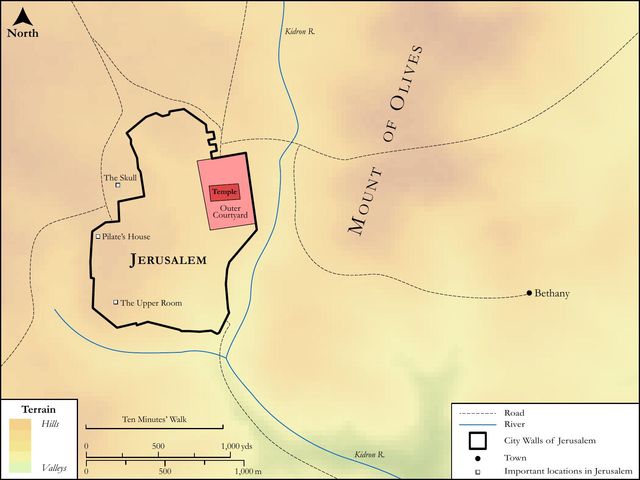
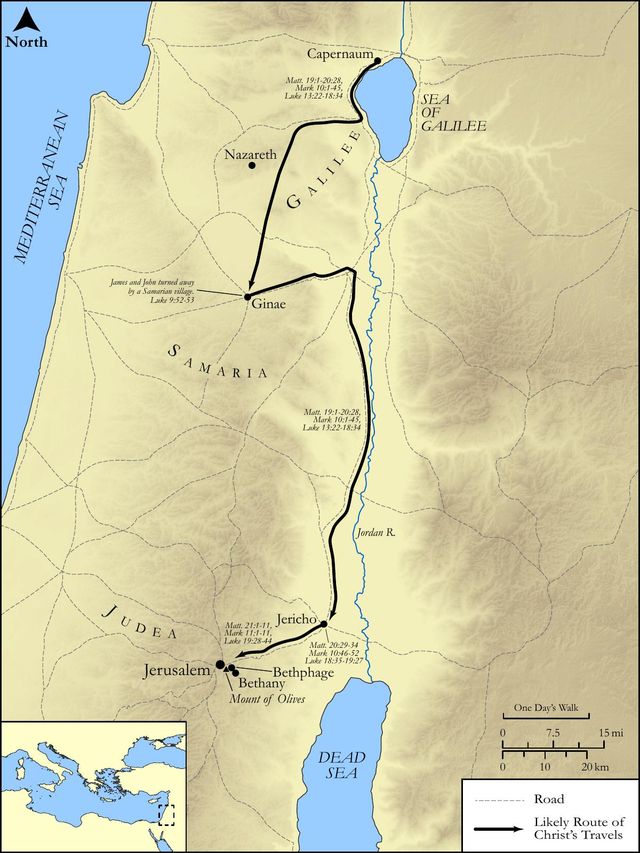
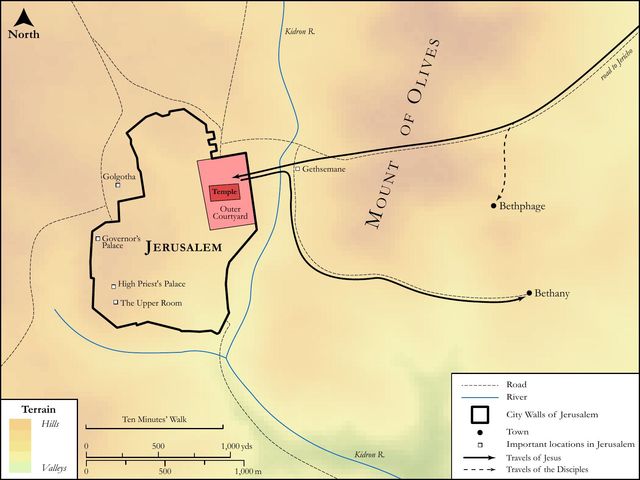
See on the biblical-era maps
Study this verse
Public-domain commentary
Matthew Henry
From his Commentary on the Whole Bible. Henry comments on passages, not single verses — this entry covers Mark 11:1–11. His three-level outline is real structure in the source text, so it is rendered as structure.
We have here the story of the public entry Christ made into Jerusalem, four or five days before his death. And he came into town thus remarkably, 1. To show that he was not afraid of the power and malice of his enemies in Jerusalem. He did not steal into the city incognito, as one that durst not show his face; no, they needed not send spies to search for him, he comes in with observation. This would be an encouragement to his disciples that were timorous, and cowed at the thought of their enemies' power and rage; let them see how bravely their Master sets them all at defiance. 2. To show that he was not cast down or disquieted at the thoughts of his approaching sufferings. He came, not only publicly, but cheerfully, and with acclamations of joy. Though he was now but taking the field, and girding on the harness, yet, being fully assured of a complete victory, he thus triumphs as though he had put it off.
I.The outside of this triumph was very mean; he rode upon an ass's colt, which being an ass, looked contemptible, and made no figure; and, being but a colt, whereon never man sat, we may suppose, was rough and untrimmed, and not only so, but rude and ungovernable, and would disturb and disgrace the solemnity. This colt was borrowed too. Christ went upon the water in a borrowed boat, ate the passover in a borrowed chamber, was buried in a borrowed sepulchre, and here rode on a borrowed ass. Let not Christians scorn to be beholden one to another, and, when need is, to go a borrowing, for our Master did not. He had no rich trappings; they threw their clothes upon the colt, and so he sat upon him, Mar 11:7. The persons that attended, were mean people; and all the show they could make, was, by spreading their garments in the way (Mar 11:8), as they used to do at the feast of tabernacles. All these were marks of his humiliation; even when he would be taken notice of, he would be taken notice of for his meanness; and they are instructions to us, not to mind high things, but to condescend to them of low estate. How ill doth it become Christians to take state, when Christ was so far from affecting it!
II.The inside of this triumph was very great; not only as it was the fulfilling of the scripture (which is not taken notice of here, as it as in Matthew), but as there were several rays of Christ's glory shining forth in the midst of all this meanness.
1.Christ showed his knowledge of things distant, and his power over the wills of men, when he sent his disciples for the colt, Mar 11:1-3. By this it appears that he can do every thing, and no thought can be withholden from him.
2.He showed his dominion over the creatures in riding on a colt that was never backed. The subjection of the inferior part of the creation to man is spoken of with application to Christ (Psa 8:5, Psa 8:6, compared with Heb 2:8); for to him it is owing, and to his mediation, that we have any remaining benefit by the grant God made to man, of a sovereignty in this lower world, Gen 1:28. And perhaps Christ, in riding the ass's colt, would give a shadow of his power over the spirit of man, who is born as the wild ass's colt, Job 11:12.
3.The colt was brought from a place where two ways met (Mar 11:4), as if Christ would show that he came to direct those into the right way, who had two ways before them, and were in danger of taking the wrong.
4.Christ received the joyful hosannas of the people; that is, both the welcome they gave him and their good wishes to the prosperity of his kingdom, Mar 11:9. It was God that put it into the hearts of these people to cry Hosanna, who were not by art and management brought to it, as those were who afterward cried, Crucify, crucify. Christ reckons himself honoured by the faith and praises of the multitude, and it is God that brings people to do him this honour beyond their own intentions.
(1.)They welcomed his person (Mar 11:9); Blessed is he that cometh, the ho erchomenos, he that should come, so often promised, so long expected; he comes in the name of the Lord, as God's Ambassador to the world; Blessed be he: let him have our applauses, and best affections; he is a blessed Saviour, and brings blessings to us, and blessed be he that sent him. Let him be blessed in the name of the Lord, and let all nations and ages call him Blessed, and think and speak highly and honourably of him.
(2.)They wished well to his intent, Mar 11:10. They believed that, mean a figure as he made, he had a kingdom, which should shortly be set up in the world, that it was the kingdom of their father David (that father of his country), the kingdom promised to him and his seed for ever; a kingdom that came in the name of the Lord, supported by a divine authority. Blessed be this kingdom; let it take place, let it get ground, let it come in the power of it, and let all opposing rule, principality, and power, be put down; let it go on conquering, and to conquer. Hosanna to this kingdom; prosperity be to it; all happiness attend it. The proper signification of hosanna is that which we find, Rev 7:10. Salvation to our God, that sitteth on the throne, and to the Lamb; success to religion, both natural and revealed, Hosanna in the highest. Praises be to our God, who is in the highest heavens over all, God blessed for ever; or, Let him be praised by his angels, that are in the highest heavens, let our hosannas be an echo to theirs.
Christ, thus attended, thus applauded, came into the city, and went directly to the temple. Here was no banquet of wine prepared for his entertainment, nor the least refreshment; but he immediately applied himself to his work, for that was his meat and drink. He went to the temple, that the scripture might be fulfilled; "The Lord whom ye seek, shall suddenly come to his temple, without sending any immediate notice before him; he shall surprise you with a day of visitation, for he shall be like a refiner's fire, and like fuller's soap," Mal 3:1-3. He came to the temple, and took a view of the present state of it, Mar 11:11. He looked round about upon all things, but as yet said nothing. He saw many disorders there, but kept silence, Psa 50:21. Though he intended to suppress them, he would not go about the doing of it all on a sudden, lest he should seem to have done it rashly; he let things be as they were for this night, intending the next morning to apply himself to the necessary reformation, and to take the day before him. We may be confident that God sees all the wickedness that is in the world, though he do not presently reckon for it, nor cast it out. Christ, having make his remarks upon what he saw in the temple, retired in the evening to a friend's house at Bethany, because there he would be more out of the noise of the town, and out of the way of being suspected, a designing to head a faction.
Historical interpretation
Seven Centuries of Reception
6 surviving comments on this verse. Each one is dated, so this reads as a timeline rather than a list.
Select a marker to jump to its quote. Markers stagger vertically where authors wrote within a few decades of each other.
He went in the morning to the Jews, and visits us in the eventide of the world.
(in Matt. Hom. 67) How is it that He was hungry in the morning, as Matthew says, if it were not that by an economy He permitted it to His flesh? There follows, And seeing a fig tree afar off having leaves, he came, if haply he might find any thing thereon. Now it is evident that this expresses a conjecture of the disciples, who thought that it was for this reason that Christ came to the fig tree, and that it was cursed, because He found no fruit upon it. For it goes on: And when he came to it, he found nothing but leaves; for the time of figs was not yet. And Jesus answered and said unto it, No man eat fruit of thee hereafter for ever. He therefore curses the fig tree for His disciples sake, that they might have faith in Him. For He every where distributed blessings, and punished no one, yet at the same time, it was right to give them a proof of His chastising power, that they might learn that He could even cause the persecuting Jews to wither away; He was however unwilling to give this proof on men, wherefore He showed them on a plant a sign of His power of punishing. This proves that He came to the fig tree principally for this reason, and not on account of His hunger, for who is so silly as to suppose that in the morning He felt so greatly the pains of hunger, or what prevented the Lord from eating before He left Bethany? Nor can it be said that the sight of the figs excited His appetite to hunger, for it was not the season of figs; and if He were hungry, why did He not seek food elsewhere, rather than from a fig-tree which could not yield fruit before its time? What punishment also did a fig tree deserve for not having fruit before its time? From all this then we may infer, that He wished to show His power, that their minds might not be broken by His Passion.
(non occ.) We may also say, in another sense, that the Lord sought for fruit on the fig tree before its time, and not finding it, cursed it, because all who fulfil the commandments of the Law, are said to bear fruit in their own time, as, for instance, that commandment, Thou shalt not commit adultery; but he who not only abstains from adultery but remains a virgin, which is a greater thing, excels them in virtue. But the Lord exacts from the perfect not only the observance of virtue, but also that they bear fruit over and above the commandments.
And he entered Jerusalem into the temple. Having entered the city, he first went to the temple, showing us the form of religion which we should follow. So that when by chance we enter a village or town or any other place where there is a house dedicated to the worship of God, we first go to this; and, after we have commended ourselves to the Lord through the duty of prayers, we then withdraw to attend to the temporal business for which we came. However, as the time of the Passion approached, the Lord wished to draw near to the place of the Passion and remain there, where at the appointed and predetermined time he could be found by those through whom the Passion was to be accomplished. Through this, he also intimated to all those hearing that he would face death not unwillingly, as the profane thought, but of his own will. When the hour was approaching, he boldly went to the place where he had foretold far in advance through himself and his prophets that he would suffer. It should be noted that this entry of his into Jerusalem occurred five days before Passover, during which he decided to fulfill the mystery of his most holy Passion. For John narrates that six days before Passover, he came to Bethany, where a supper was made for him, and many reclining at the table, Mary, the sister of Lazarus, anointed him with mystical ointment; and the next day, sitting on a donkey, with a large crowd meeting him with palms, he came to Jerusalem. Here, not only the harmony in things but also in the times of the Old and New Testaments, the shadow and the truth, the law and the Gospel, must not be passed over in silence. For it is written in the law, with the Lord speaking to Moses and Aaron: "This month shall be for you the beginning of months; it shall be the first month of the year for you. Speak to the whole congregation of Israel, and say to them: On the tenth day of this month, every man shall take a lamb according to their ancestral houses, a lamb for each household." And shortly after: "And you shall keep it until the fourteenth day of this month, and the whole assembly of the congregation of Israel shall kill it at twilight" (Exodus 12). Therefore, on the tenth day of the first month, the lamb to be sacrificed at Passover was commanded to be brought into the house, because also on the tenth day of the same month, that is, five days before Passover, the Lord was to enter the city in which he would suffer. And just as the lamb chosen from the whole flock awaited the certain day of its sacrifice, so also the Lord, as the whole council of elders and leaders conspired against him, steadfastly awaited the hour in which he would offer himself as a sacrifice to God and a victim in the odor of sweetness for the salvation of the world. The lamb was sacrificed on the fourteenth day of the first month at twilight, and the Lord, at the same hour, eating the lamb with his disciples, where he completed the decrees of the legal Passover, immediately went out with them to the place of prayer, where, being captured and bound by the Jews, he began at once the mysteries of his blessed suffering.
(ubi sup.) As the time of His Passion approached, the Lord wished to approach to the place of His Passion, in order to intimate that He underwent death of His own accord: wherefore it is said, And Jesus entered into Jerusalem, and into the temple. And by His going to the temple on first entering the city, He shows us beforehand a form of religion, which we are to follow, that if by chance we enter a place, where there is a house of prayer, we should first turn aside to it. We should also understand from this, that such was the poverty of the Lord, and so far was He from flattering man, that in so large a city, He found no one to be His host, no abiding place, but lived in a small country place with Lazarus and his sisters; for Bethany is a hamlet of the Jews. Wherefore there follows: And when he had looked round about upon all things, (that is, to see whether any one would take Him in,) and now the eventide was come, he went out into Bethany with the twelve. Nor did He do this once only, but during all the five days, from the time that He came to Jerusalem, to the day of His Passion, He used always to do the same thing; during the day He taught in the temple, but at night, He went out and dwelt in the mount of Olives. It goes on, And on the morrow, when they were come from Bethany, he was hungry.
(ubi sup.) Farther, He looks round about upon the hearts of all, and when in those who opposed the truth, He found no place to lay His head, He retires to the faithful, and takes up His abode with those who obey Him. For Bethany means the house of obedience.
(ubi sup.) Just in the same way as He speaks parables, so also His deeds are parables; therefore He comes hungry to seek fruit off the fig tree, and though He knew the time of figs was not yet, He condemns it to perpetual barrenness, that He might show that the Jewish people could not be saved through the leaves, that is, the words of righteousness which it had, without fruit, that is, good works, but should be cut down and cast into the fire. Hungering therefore, that is, desiring the salvation of mankind, He saw the fig tree, which is, the Jewish people, having leaves, or, the words of the Law and the Prophets, and He sought upon it the fruit of good works, by teaching them, by rebuking them, by working miracles, and He found it not, and therefore condemned it. Do thou too, unless thou wouldest be condemned by Christ in the judgment, beware of being a barren tree, but rather offer to Christ the fruit of piety which He requires.
And having looked around at everything, since it was already evening, he went out to Bethany with the twelve. He did not do this just once; but for all five days after he had gone up to Jerusalem until the time of the Passion, he was accustomed to do this very thing: that during the day he would teach in the temple, but at night he would go out and spend the night on the Mount of Olives, as we read in Luke. For by teaching the unbelievers, he diligently fulfilled the duty of correction. However, by staying among the faithful, he graciously exhibited the kindness of his favor to them. It is well noted that, after looking around at everything, he went out to Bethany. Indeed, the internal judge examines the hearts of all, and when he does not find a place to rest his head among those who oppose and resist the truth, he withdraws to the faithful and rejoices in making a dwelling with the Father in those who obey the word. For Bethany is called the house of obedience. This also must be understood, that the Lord was of such great poverty, and so did not flatter anyone, that he found no host, no lodging in that greatest city, but stayed in the small country place with Lazarus and his sisters. For their village is Bethany.
Wishing to show His disciples that if He chose He could in a moment exterminate those who were about to crucify Him. In a mystical sense, however, the Lord entered into the temple, but came out of it again, to show that He left it desolate, and open to the spoiler.
Continue studying Mark 11:11 across the web’s major study libraries — every link below opens this exact verse, chapter, or book on the destination site.
Read & Compare
 BibleGatewayThis verse in more than 200 translations and 70 languages.
 Bible.comThe YouVersion reader — hundreds of translations, reading plans, and highlights.
 ESV.orgCrossway's official English Standard Version reader.
 NET BibleThe NET translation with 60,000+ translators' notes on every rendering decision.
 STEP BibleTyndale House's free study tool — original text, vocabulary, and scholarly resources.
 BibliaLogos Bible Software's free web reader.
 USCCBThe New American Bible (Revised Edition) with the U.S. bishops' study notes.
Commentaries
 BibleHub CommentariesDozens of classic commentaries on this verse, gathered on one page.
 StudyLightMore than 100 commentary sets — the largest collection on the web.
 BibleRefPlain-English commentary on what this verse means, verse by verse.
 Enduring WordDavid Guzik's free commentary on this chapter, widely used by Bible teachers.
 Bible Study ToolsVerse commentary alongside Greek and Hebrew study aids.
Original Language & Research
- BibleHub InterlinearThe verse word by word — original language, transliteration, and English.
- BibleHub LexiconEvery word's original-language definition and Strong's entry.
 Blue Letter BibleDeep-study tools — Strong's numbers, concordance, and word studies.
 CNTR CollationThe earliest Greek manuscripts of this verse, collated letter by letter.
Sermons, Hymns & Audio


TrulyRandomVerse is not affiliated with these sites and doesn’t control their content. They’re linked because they’re genuinely useful.
Summary
Mark 11:11 provides a concise yet profoundly significant account of Jesus' initial actions and observations upon entering Jerusalem and the Temple on the day following His triumphal entry. It captures His deliberate survey of the Temple precincts as evening descended, culminating in His strategic withdrawal to Bethany with His twelve disciples, setting the stage for the dramatic events of the ensuing days of Passion Week.
Context
ShowHideLiterary Context
This verse immediately follows Jesus' triumphal entry into Jerusalem, described in Mark 11:1-10. The crowds have acclaimed Him as the coming King, shouting "Hosanna!" and laying cloaks and branches on His path. Rather than immediately engaging in public teaching or confrontation, Jesus' first act upon reaching the city's spiritual heart, the Temple, is one of silent observation. This quiet assessment stands in stark contrast to the preceding jubilant procession and serves as a crucial narrative bridge, building anticipation for the dramatic Temple cleansing that will occur the very next day, as detailed in Mark 11:15-19. The terse nature of this verse, particularly Mark's characteristic "immediately" (though not present here, the swift transition is implied), underscores the purposeful nature of Jesus' actions.
Historical & Cultural Context
Jerusalem, at the time of Passover, would have been teeming with pilgrims, swelling its population significantly. The Temple, as the spiritual and economic heart of Jewish life, was a bustling hub of activity, including sacrifices, offerings, and the exchange of currency necessary for Temple dues. The "eventide" (evening) marked the end of the day's official activities, a time when many pilgrims would seek lodging outside the city walls due to the immense crowds within. Bethany, a village on the eastern slope of the Mount of Olives, about two miles from Jerusalem, was a familiar and safe haven for Jesus, often serving as His base during His visits to the capital. It was home to His close friends Mary, Martha, and Lazarus, providing a place of rest and respite from the intense public scrutiny and spiritual warfare unfolding in Jerusalem.
Key Themes
ShowHideMark 11:11 contributes to several significant themes within the Gospel of Mark and the broader biblical narrative. Firstly, it highlights Jesus' Authority and Discernment. His direct entry into the Temple, the heart of Jewish worship, underscores His unique claim and divine right to assess its condition. His "looking round about upon all things" is not a casual glance but a deliberate, judicial survey, implying a profound discernment of the spiritual state and practices within its courts. Secondly, the verse emphasizes Observation Before Action, a pattern seen throughout Jesus' ministry. He does not immediately act but first observes, allowing His subsequent actions, particularly the Temple cleansing, to be understood as a direct and informed response to what He witnessed. This strategic pause underscores His wisdom and measured approach. Finally, Jesus' Strategic Withdrawal to Bethany underscores His humanity and reliance on rest and fellowship, even amidst the escalating tension of Passion Week. It also subtly hints at His messianic role, as He, the true King, enters His capital, surveys His domain, and prepares for the decisive confrontation.
Exposition and Analysis
ShowHideKey Word Analysis
ShowHideFrom eis (into) and erchomai (to come), this verb signifies a purposeful movement into a place. In this context, it emphasizes Jesus' deliberate and authoritative arrival into Jerusalem and, specifically, the Temple. It is not a casual stroll but a significant entry, marking His presence at the epicenter of Jewish religious and national life, consistent with His messianic claims.
This term refers to the entire sacred precinct of the Temple complex, including the outer courts, rather than the inner sanctuary (which would be naos). Jesus' survey of "all things" within the hierón indicates His comprehensive assessment of the commercial activities, the worship practices, and the overall spiritual atmosphere of the entire Temple area, which was meant to be a "house of prayer for all nations" (Mark 11:17).
Composed of peri (around) and blepō (to look), this verb denotes a thorough, comprehensive, and searching gaze. It implies more than a superficial glance; it suggests a careful inspection, a discerning survey, and perhaps even a judicial assessment. Jesus was taking everything in, observing the corruption and misuse of God's house, which would provoke His actions the following day.
Verse Breakdown
ShowHide"And Jesus entered into Jerusalem, and into the temple:"
This clause establishes the immediate aftermath of the triumphal entry. Jesus' destination is not merely the city but specifically the Temple, signaling its central importance to His mission and the unfolding events of Passion Week. His direct movement into the Temple asserts His authority and rightful presence within God's house.
"and when he had looked round about upon all things,"
This is the pivotal action of the verse. Jesus' comprehensive survey of the entire Temple complex indicates a deliberate and discerning assessment. He is not merely observing casually but inspecting, evaluating, and perhaps even judging the spiritual and physical state of the Temple, noting the activities and conditions within its courts. This silent observation is pregnant with meaning, setting the stage for His decisive action the next day.
"and now the eventide was come,"
This phrase marks the passage of time and the close of the day. "Eventide" signifies the late afternoon or early evening, a time when daily activities at the Temple would be winding down. This temporal marker explains why Jesus did not immediately act, but rather withdrew, awaiting the next day for His intervention.
"he went out unto Bethany with the twelve."
Jesus' departure from Jerusalem to Bethany with His disciples highlights His strategic withdrawal. Bethany served as His customary place of lodging during His visits to Jerusalem, offering a quiet refuge from the city's intensity. This retreat underscores His humanity, His need for rest, and His pattern of seeking private time with His disciples, even amidst the most critical moments of His ministry.
Literary Devices
ShowHideMark's concise narrative style is evident in Mark 11:11, which employs Narrative Economy to convey significant meaning in few words. The verse acts as a Transition from the celebratory triumphal entry to the confrontational Temple cleansing. The silent observation of Jesus functions as powerful Foreshadowing, building dramatic tension and preparing the reader for the righteous indignation and decisive action that will follow. The Temple itself serves as a potent Symbolism, representing the religious establishment and the spiritual condition of Israel. Jesus' "looking round about upon all things" is a symbolic act of divine judgment and assessment, a prelude to the purification of His Father's house.
Theological and Thematic Connections
ShowHideMark 11:11, though brief, is rich with theological implications. It underscores Jesus' divine authority and His role as the discerning Son who inspects His Father's house. His silent observation of the Temple is not passive but an active, judicial assessment of its spiritual health and practices. This act reveals God's patient yet penetrating gaze upon His people and their worship. The subsequent withdrawal to Bethany highlights Jesus' strategic wisdom, demonstrating that divine action is often preceded by careful observation and a measured, divinely appointed timing. This scene foreshadows the ultimate judgment and purification that Jesus, as the true Temple and High Priest, would enact, not just upon a physical building but upon the very heart of worship and the spiritual state of humanity.
Reflection and Application
ShowHideMark 11:11 invites us to consider the profound significance of observation and discernment in our own spiritual lives. Like Jesus, we are called to be attentive to the spiritual condition of our surroundings, particularly within places of worship and our own hearts. His patient, comprehensive survey of the Temple, even in the face of its corruption, teaches us the importance of understanding before acting, of discerning the true state of affairs before engaging in correction or change. Furthermore, Jesus' strategic withdrawal to Bethany reminds us of the critical need for rest, solitude, and spiritual replenishment, especially when facing demanding circumstances or preparing for significant spiritual battles. It is in these moments of quiet reflection and communion that we can gain clarity, strength, and divine perspective, enabling us to act with wisdom and purpose, just as Jesus did.
Questions for Reflection
ShowHideFAQ
ShowHideWhy did Jesus not cleanse the Temple immediately upon entering, but waited until the next day?
ShowHideJesus' actions in Mark 11:11 demonstrate a deliberate, purposeful approach rather than impulsive reaction. His "looking round about upon all things" was a judicial survey, a comprehensive assessment of the Temple's spiritual and physical state. This observation was not casual; it was a divine inspection, allowing Him to fully grasp the extent of the corruption and misuse. By waiting until the next day, Jesus underscored the gravity of His subsequent actions. The delay allowed His observation to serve as a silent condemnation, a prelude to the public and prophetic act of cleansing the Temple, which would occur in the full light of day, maximizing its impact and demonstrating His authority as the Son of God. This strategic timing also highlights His sovereignty over events, acting not on human impulse but according to divine appointment.
Christ-Centered Fulfillment
ShowHideMark 11:11, though seemingly a simple narrative detail, profoundly foreshadows Christ's ultimate role as the true Temple and the final purifier. When Jesus enters the physical Temple and observes its corruption, He is implicitly asserting His authority over it, not merely as a prophet but as the very presence of God among His people. The Temple, intended as God's dwelling place and a house of prayer for all nations (Isaiah 56:7), had become a place of commercial exploitation. Jesus' silent, discerning gaze anticipates His ultimate judgment and renewal, not just of a building, but of the very system of worship. He Himself would declare, "Destroy this temple, and in three days I will raise it up" (John 2:19), speaking of His body as the true Temple, the ultimate meeting place between God and humanity. His cleansing of the Temple on the following day is a powerful enacted parable, demonstrating His mission to purify worship and to establish a new covenant where access to God is through His own sacrifice, not through animal offerings in a corrupted physical structure. Thus, Jesus' observation in Mark 11:11 is a Christ-centered moment, pointing to Him as the One who would perfectly fulfill the Temple's purpose, offering Himself as the spotless Lamb whose blood truly cleanses and makes atonement, ushering in a new era of worship "in spirit and truth" (John 4:23-24).