


Luke 19:40
- καὶkaiAndG2532CONJConjunction
- ἀποκριθεὶςapokritheisansweringG611V-AOP-NSMVerb Aorist Passive Deponent Participle Nominative Singular Masculine
- εἶπενeipenHe saidG2036V-2AAI-3SVerb 2nd Aorist Active Indicative 3rd Singular
- αὐτοῖς·autoisto themG846P-DPMPersonal pronoun Dative Plural Masculine
- λέγωlegōI sayG3004V-PAI-1SVerb Present Active Indicative 1st Singular
- ὑμῖνhuminto youG4771P-2DPPersonal pronoun Dative 2nd Plural
- ὅτιhotithatG3754CONJConjunction
- ἐὰνeanifG1437CONDConjunction
- οὗτοιhoutoitheseG3778D-NPMDemonstrative pronoun Nominative Plural Masculine
- σιωπήσουσινsiōpēsousinwill be silentG4623V-FAI-3PVerb Future Active Indicative 3rd Plural
- οἱhoitheG3588T-NPMDefinite article Nominative Plural Masculine
- λίθοιlithoistonesG3037N-NPMNoun Nominative Plural Masculine
- κράξουσινkraxousinwill cry outG2896V-FAI-3PVerb Future Active Indicative 3rd Plural
English is a literal word-by-word gloss of the Greek, not the KJV's wording. Why?
This is the original text the KJV's translators worked from — each Greek word with its own literal English meaning in this verse, prepared by scholars at Tyndale House, Cambridge. The KJV translates whole sentences, not word by word, so its wording differs: one Greek word can become several English words, and the KJV may choose “charity” where the gloss reads “love”. Both are faithful — they answer different questions. For the KJV's own rendering, switch to the KJV text.
Details
See on the biblical-era map
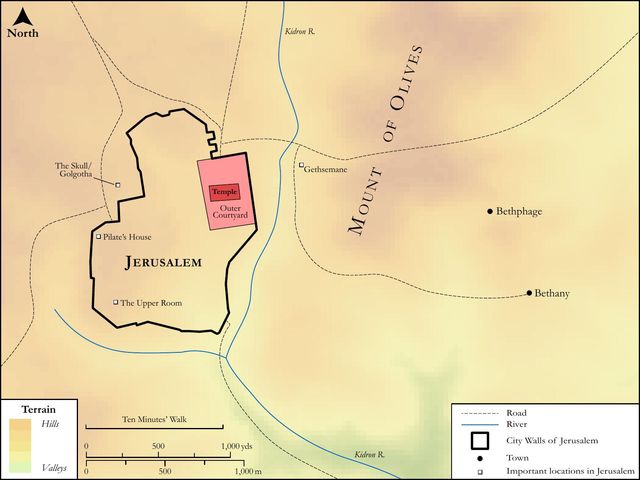
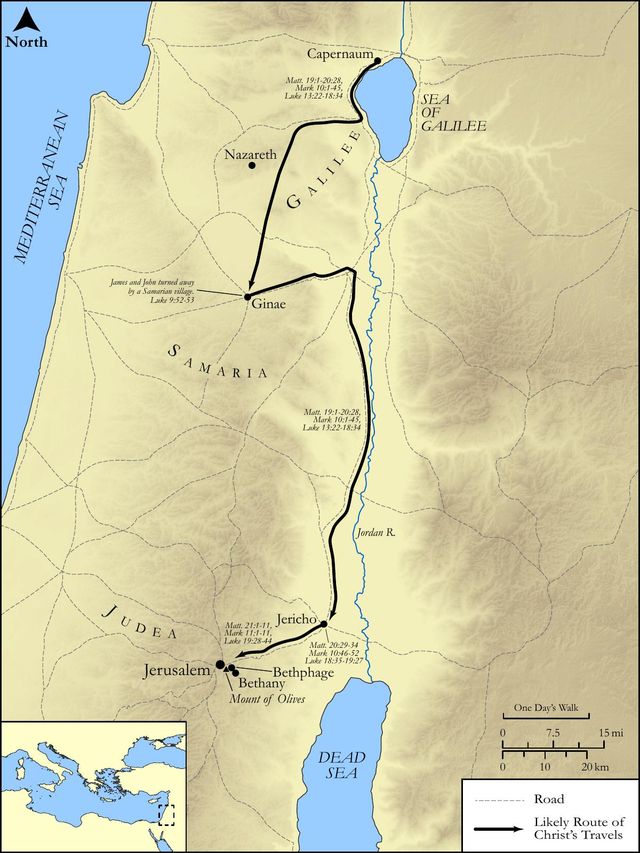
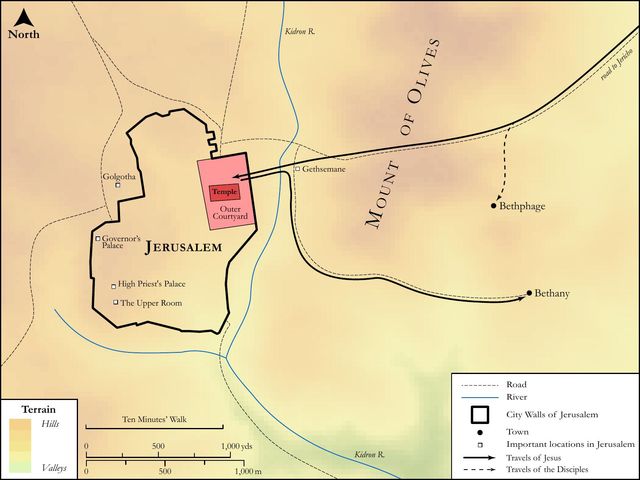
Study this verse
Public-domain commentary
Matthew Henry
From his Commentary on the Whole Bible. Henry comments on passages, not single verses — this entry covers Luke 19:28–40. His two-level outline is real structure in the source text, so it is rendered as structure.
We have here the same account of Christ's riding in some sort of triumph (such as it was) into Jerusalem which we had before in Matthew and Mark; let us therefore here only observe,
I.Jesus Christ was forward and willing to suffer and die for us.
He went forward, bound in the spirit, to Jerusalem, knowing very well the things that should befall him there, and yet he went before, ascending up to Jerusalem, Luk 19:28. He was the foremost of the company, as if he longed to be upon the spot, longed to engage, to take the field, and to enter upon action. Was he so forward to suffer and die for us, and shall we draw back from any service we are capable of doing for him?
II.It was no ways inconsistent either with Christ's humility or with his present state of humiliation to make a public entry into Jerusalem a little before he died. Thus he made himself to be the more taken notice of, that the ignominy of his death might appear the greater.
III.Christ is entitled to a dominion over all the creatures, and may use them when and as he pleases.
No man has a property in his estate against Christ, but that his title is prior and superior. Christ sent to fetch an ass and her colt from their owner's and master's crib, when he had occasion for their service, and might do so, for all the beasts of the forest are his, and the tame beasts too.
IV.Christ has all men's hearts both under his eye and in his hand.
He could influence those to whom the ass and the colt belonged to consent to their taking them away, as soon as they were told that the Lord had occasion for them.
V.Those that go on Christ's errands are sure to speed (Luk 19:32):
They that were sent found what he told them they should find, and the owners willing to part with them. It is a comfort to Christ's messengers that they shall bring what they are sent for, if indeed the Lord has occasion for it.
VI.The disciples of Christ, who fetch that for him from others which he has occasion for, and which they have not, should not think that enough, but, whatever they have themselves wherewith he may be served and honoured, they should be ready to serve him with it. Many can be willing to attend Christ at other people's expense who care not to be at any charge upon him themselves; but those disciples not only fetched the ass's colt for him, but cast their own garments upon the colt, and were willing that they should be used for his trappings.
VII.Christ's triumphs are the matter of his disciples' praises.
When Christ came nigh to Jerusalem, God put it of a sudden into the hearts of the whole multitude of the disciples, not of the twelve only, but abundance more, that were disciples at large, to rejoice and praise God (Luk 19:37), and the spreading of their clothes in the way (Luk 19:36) was a common expression of joy, as at the feast of tabernacles. Observe,
1.What was the matter or occasion of their joy and praise. They praised God for all the mighty works they had seen, all the miracles Christ had wrought, especially the raising of Lazarus, which is particularly mentioned, Joh 12:17, Joh 12:18. That brought others to mind, for fresh miracles and mercies should revive the remembrance of the former.
2.How they expressed their joy and praise (Luk 19:38): Blessed be the king that cometh in the name of the Lord. Christ is the king; he comes in the name of the Lord, clothed with a divine authority, commissioned from heaven to give law and treat of peace. Blessed be he. Let us praise him, let God prosper him. He is blessed for ever, and we will speak well of him. Peace in heaven. Let the God of heaven send peace and success to his undertaking, and then there will be glory in the highest. It will redound to the glory of the most high God; and the angels, the glorious inhabitants of the upper world, will give him the glory of it. Compare this song of the saints on earth with that of the angels, Luk 2:14. They both agree to give glory to God in the highest. There the praises of both centre; the angels say, On earth peace, rejoicing in the benefit which men on earth have by Christ; the saints say, Peace in heaven, rejoicing in the benefit which the angels have by Christ. Such is the communion we have with the holy angels that, as they rejoice in the peace on earth, so we rejoice in the peace in heaven, the peace God makes in his high places (Job 25:2), and both in Christ, who hath reconciled all things to himself, whether things on earth or things in heaven.
VIII.Christ's triumph's, and his disciples' joyful praises of them, are the vexation of proud Pharisees, that are enemies to him and his kingdom.
There were some Pharisees among the multitude who were so far from joining with them that they were enraged at them, and, Christ being a famous example of humility, they thought that he would not admit such acclamations as these, and therefore expected that he should rebuke his disciples, Luk 19:39. But it is the honour of Christ that, as he despises the contempt of the proud, so he accepts the praises of the humble.
IX.Whether men praise Christ or no he will, and shall, and must be praised (Luk 19:40):
If these should hold their peace, and not speak the praises of the Messiah's kingdom, the stones would immediately cry out, rather than that Christ should not be praised. This was, in effect, literally fulfilled, when, upon men's reviling Christ upon the cross, instead of praising him, and his own disciples' sinking into a profound silence, the earth did quake and the rocks rent. Pharisees would silence the praises of Christ, but they cannot gain their point; for as God can out of stones raise up children unto Abraham, so he can out of the mouths of those children perfect praise.
Historical interpretation
Nine Centuries of Reception
10 surviving comments on this verse. Each one is dated, so this reads as a timeline rather than a list.
Select a marker to jump to its quote. Markers stagger vertically where authors wrote within a few decades of each other.
When we also are silent, (that is, when the love of many waxeth cold,) the stones cry out, for God can from stones raise up children to Abraham.
For this reason the divine rebuke does not cease to chastise us night nor day. For besides the visions of the night, by day also, the innocent age of boys is among us filled with the Holy Spirit, seeing in an ecstasy with their eyes, and hearing and speaking those things whereby the Lord condescends to warn and instruct us. And you shall hear all things when the Lord, who bade me withdraw, shall bring me back again to you. In the meanwhile, let those certain ones among you who are rash and incautious and boastful, and who do not regard man, at least fear God, knowing that, if they shall persevere still in the same course, I shall use that power of admonition which the Lord bids me use; so that they may meanwhile be withheld from offering, and have to plead their cause both before me and before the confessors themselves and before the whole people, when, with God's permission, we begin to be gathered together once more into the bosom of the Church, our Mother. Concerning this matter, I have written to the martyrs and confessors, and to the people, letters; both of which I have bidden to be read to you. I wish you, dearly beloved brethren and earnestly longed-for, ever heartily farewell in the Lord; and have me in remembrance.
The children were shouting and saying, “Hosanna to the Son of David!” This displeased the chief priests and the scribes, and they said to him, “Do you not hear what these are saying?” That means, “If these praises do not please you, make them keep silent.” At his birth and at his death, children were intertwined in the crown of his sufferings. When he met Christ, the infant John jumped for joy within the womb. Children were murdered at his birth. They were like the grapes of his wedding feast. Children also proclaimed his praise when the time of his death approached. Jerusalem was in turmoil at his birth, just as it was in turmoil again and trembling the day that he entered it. When the scribes heard, they were displeased, and they were saying to him, “Stop them!” he said to them, “If these become silent, the stones will cry out.” The scribes preferred that the children would cry out rather than the stones. This, however, was reserved for later, because the stones were crying out at the time of his crucifixion, but those with words were silent. Speechless things proclaimed his greatness.
It is not strange if the rocks would respond against their nature with praises of the Lord since murderers, harder than rocks, also proclaim them. Perhaps this means when the Jews are speechless after the Lord's passion, the living stones, according to Peter, will cry out. Even with mixed emotions, the crowd nevertheless leads God to his temple with praise.
Nor is it wonderful that the stones against their nature should chaunt forth the praises of the Lord, whom His murderers, harder than the rocks, proclaim aloud, that is, the multitude, in a little while about to crucify their God, denying Him in their hearts, whom with their mouths they confess. Or perhaps it is said, because, when the Jews were struck silent after the Lord's Passion, the living stones, as Peter calls them, (1 Pet. 2:5.) were about to cry out.
Rightly we read that the crowds praising God met Him at the descent of the mountain, that they might signify that the works of the heavenly mystery had come to them from heaven.
What does Christ answer to these things? "I tell you that if these be silent, the stones will cry out."It is impossible for God not to be glorified, although those of the race of Israel refuse to do so. The worshipers of idols were once as stones and hardened, but they have been delivered from their former error and rescued from the hand of the enemy. They have escaped from devilish darkness. They have been called to the light of truth. They have awakened as from drunkenness. They have acknowledged the Creator. They do not praise him secretly, in concealment, in a hidden way and silently, but with freedom of speech and a loud voice. They praise him diligently, as it were, calling out to one another and saying, "Come, let us praise the Lord and sing psalms to God our Savior." They acknowledged Christ the Savior of all.
But the Lord forbade not them that glorified Him as God, but rather forbade those that blamed them, so bearing witness to Himself concerning the glory of the Godhead. Hence it follows, He answered and said unto them, I tell you, if these should hold their peace, the stones would immediately cry out.
To whom He Himself says: I tell you that if these should keep silent, the stones would cry out. All His acquaintances stood at a distance when the Lord was crucified, fearing to confess God whom they saw fixed to the wood, but while these were silent, the stones and rocks with a great voice proclaimed the King who comes in the name of the Lord. For when He gave up the spirit, behold, the earth shook, and the rocks were split, and the tombs were opened: what humans hesitate to confess either out of fear or treachery, even the hardest elements of creation openly proclaim as the God and Lord of the world. Truly, in a higher mystery, He indicates the unbelieving and hard-hearted nations of the Gentiles under the name of stones, to whom, having removed the heart of stone, He gave a heart of flesh (Ezek. XI), that is, sensible and human, by which they could believe in, praise, and see their God and Creator. Therefore, even if the crowds of men should keep silent, the stones will cry out, because blindness in part has happened to Israel until the fullness of the Gentiles has come in, and thus all Israel shall be saved (Rom. III).
They beheld indeed many of our Lord's miracles, but marvelled most at the resurrection of Lazarus. For as John says, For this cause the people also met him, for that they heard that he had done this miracle. For it must be observed that this was not the first time of our Lord's coming to Jerusalem, but He came often before, as John relates.
That is, in the name of God the Father, although it might be taken "in His own name," since He Himself is the Lord. But His own words are better guides to the meaning when He says, I am come in my Father's name. For Christ is the Master of humility. Christ is not called King as one who exacts tribute, or arms His forces with the sword, or visibly crushes His enemies, but because He rules men's minds, and brings them believing, hoping, and loving into the kingdom of heaven. For Ho was willing to be King of Israel, to show His compassion, not to increase His power. But because Christ appeared in the flesh, as the redemption and light of the whole world, well do both the heaven and earth, each in their turn, chaunt His praises. When He is born into the world, the heavenly hosts sing; when He is about to return to heaven, men send back their note of praise. As it follows, Peace in heaven.
O the strange folly of the envious; they scruple not to call Him Master, because they knew He taught the truth, but His disciples, as though themselves were better taught, they deem worthy of rebuke.
And so at the crucifixion of our Lord, when His kinsfolk were silent from fear, the stones and rocks sang forth, while after that He gave up the ghost, the earth was moved, and the rocks were rent, and the graves opened.
Again, when our Lord descends from the mount of Olives, the multitude descend also, because since the Author of mercy has suffered humiliation, it is necessary that all those who need His mercy should follow His footsteps.
He calls by the name of disciples not only the twelve, or the seventy-two, but all who followed Christ, whether for the sake of the miracles, or from a certain charm in His teaching, and to them may be added the children, as the other Evangelists relate. Hence it follows, For all the mighty works which they had seen.
That is, the ancient warfare, wherein we were at enmity against God, has ceased. And glory in the highest, inasmuch as Angels are glorifying God for such a reconciliation. For this very thing, that God visibly walks in the land of His enemies, shows that He has peace with us. But the Pharisees when they heard that the crowd called Him King, and praised Him as God, murmured, imputing the name of King to sedition, the name of God to blasphemy. And some of the Pharisees said, Master, rebuke thy disciples.
As if He said, Not without cause do men praise me thus, but being constrained by the mighty works which they have seen.
Continue studying Luke 19:40 across the web’s major study libraries — every link below opens this exact verse, chapter, or book on the destination site.
Read & Compare
 BibleGatewayThis verse in more than 200 translations and 70 languages.
 Bible.comThe YouVersion reader — hundreds of translations, reading plans, and highlights.
 ESV.orgCrossway's official English Standard Version reader.
 NET BibleThe NET translation with 60,000+ translators' notes on every rendering decision.
 STEP BibleTyndale House's free study tool — original text, vocabulary, and scholarly resources.
 BibliaLogos Bible Software's free web reader.
 USCCBThe New American Bible (Revised Edition) with the U.S. bishops' study notes.
Commentaries
 BibleHub CommentariesDozens of classic commentaries on this verse, gathered on one page.
 StudyLightMore than 100 commentary sets — the largest collection on the web.
 BibleRefPlain-English commentary on what this verse means, verse by verse.
 Enduring WordDavid Guzik's free commentary on this chapter, widely used by Bible teachers.
 Bible Study ToolsVerse commentary alongside Greek and Hebrew study aids.
Original Language & Research
- BibleHub InterlinearThe verse word by word — original language, transliteration, and English.
- BibleHub LexiconEvery word's original-language definition and Strong's entry.
 Blue Letter BibleDeep-study tools — Strong's numbers, concordance, and word studies.
 CNTR CollationThe earliest Greek manuscripts of this verse, collated letter by letter.
Sermons, Hymns & Audio


TrulyRandomVerse is not affiliated with these sites and doesn’t control their content. They’re linked because they’re genuinely useful.
Summary
Luke 19:40 captures Jesus' emphatic declaration during His triumphal entry into Jerusalem, asserting the undeniable and divinely ordained necessity of His public recognition and praise. In response to the Pharisees' demand to silence His praising disciples, Jesus states that if His followers were to cease their acclamations, the very stones of the earth would spontaneously erupt in worship, underscoring the universal and inherent truth of His messianic identity and the unstoppable nature of God's redemptive plan.
Context
ShowHideLiterary Context
This pivotal verse is embedded within the narrative of Jesus' triumphal entry into Jerusalem. Following His journey from Jericho and the parable of the minas, Jesus sends disciples to procure a colt, fulfilling ancient prophecy (Zechariah 9:9). As He approaches the city, a large multitude of His disciples, overflowing with joy, begins to praise God loudly for all the mighty works they had witnessed, shouting, "Blessed be the King that cometh in the name of the Lord: peace in heaven, and glory in the highest" (Luke 19:37-38). This public acclamation, laden with messianic implications, provokes a sharp reaction from some Pharisees present, who demand that Jesus rebuke His disciples (Luke 19:39). Jesus' response in verse 40, therefore, serves as a direct and powerful defense of the praise, asserting its divine necessity and inevitability, even as He immediately proceeds to lament over Jerusalem's impending destruction due to its rejection of Him (Luke 19:41-44).
Historical & Cultural Context
Jesus' entry into Jerusalem on a donkey, rather than a warhorse, was a deliberate act echoing the humble, peace-bringing king prophesied in Zechariah 9:9. This event occurred just days before Passover, a time when Jerusalem would be teeming with Jewish pilgrims, many of whom harbored fervent hopes for a messianic deliverer who would liberate them from Roman oppression. The crowd's joyous shouts, "Blessed be the King that cometh in the name of the Lord," were deeply significant, directly applying messianic titles to Jesus. The Pharisees, as religious leaders and guardians of the law, were particularly sensitive to any claims of kingship or divine authority that did not align with their interpretations or threatened the delicate political balance with Rome. They perceived the disciples' praise as blasphemous or politically seditious, hence their demand for Jesus to silence them. Jesus' reply challenges their understanding of divine sovereignty and the nature of the Messiah, asserting that His identity and mission were so profoundly true that even inanimate creation would bear witness if humanity failed to do so.
Key Themes
ShowHideLuke 19:40 powerfully articulates several crucial themes. Firstly, it highlights the Divine Necessity of Praise, asserting that the recognition and adoration of Jesus as Messiah is not optional but an essential, divinely ordained reality. His identity and mission are so fundamental to God's plan that creation itself is poised to testify if humanity fails. Secondly, the verse underscores Messianic Authority and Identity, affirming Jesus' unique role as the promised King. The spontaneous praise from the crowd, and Jesus' defense of it, confirm His rightful claim to messianic kingship, a truth so profound that even the inanimate world would acknowledge it, contrasting sharply with the spiritual blindness of the religious leaders. Finally, the passage emphasizes the Futility of Silencing Truth. The Pharisees' attempt to suppress the proclamation of Jesus' kingship is met with a declaration that divine truth cannot be contained or suppressed; it will inevitably find a voice, demonstrating God's sovereign control over His redemptive purposes, which cannot be thwarted by human opposition (Psalm 118:22-23).
Exposition and Analysis
ShowHideKey Word Analysis
ShowHideFrom a root meaning "silence" or "hush," this verb means "to be dumb" or "to hold peace." It implies a cessation of speech, often voluntary, but here used hypothetically to describe a forced or unnatural silence. In this context, it emphasizes the absurdity of the Pharisees' request—that the joyous, divinely inspired praise should be suppressed.
This is a primary word meaning "a stone," used literally or figuratively. In Luke 19:40, it refers literally to the physical stones of the road or the surrounding terrain. Its use here is highly figurative, personifying inanimate objects to convey the absolute certainty and undeniable nature of Jesus' messianic identity and the necessity of His praise.
A primary verb meaning "to croak" or "scream," generally "to call aloud" or "shriek," often denoting an urgent, public, or emotionally charged proclamation. The image of stones "crying out" vividly conveys an immediate, loud, and undeniable declaration, highlighting the inherent and overwhelming truth of who Jesus is, a truth that cannot remain silent.
Verse Breakdown
ShowHide"And he answered and said unto them"
This phrase establishes Jesus' direct response to the Pharisees' demand in Luke 19:39. It signifies that Jesus is not merely making a general statement but is specifically refuting their attempt to silence the praise directed at Him. His answer carries the weight of divine authority.
"I tell you that"
This is an emphatic declaration, signaling the importance and certainty of what Jesus is about to say. It's a common introductory phrase in Jesus' teaching, often preceding a profound truth or a revelation of His divine perspective, demanding attention and belief from His audience.
"if these should hold their peace"
This sets up a hypothetical condition, referring to His disciples who are currently praising Him. The phrase "hold their peace" implies a cessation of their joyous acclamations, a silence imposed either by external force (as the Pharisees desired) or by their own will. Jesus posits this as an impossible or unnatural scenario in light of the truth.
"the stones would immediately cry out"
This is the startling and climactic declaration. It means that if human beings, particularly His disciples, were to fail in their God-given duty to praise Him, creation itself—represented by the most basic and inanimate elements, stones—would be compelled by divine necessity to vocalize the praise due to Him. The word "immediately" (G2896 krázō) emphasizes the swift and undeniable nature of this spontaneous, divinely orchestrated testimony.
Literary Devices
ShowHideLuke 19:40 is rich with powerful literary devices that amplify its profound theological message. The most prominent is Hyperbole, where Jesus uses extreme exaggeration ("the stones would immediately cry out") not to deceive, but to underscore the absolute certainty and divine necessity of His praise. This vivid overstatement emphasizes that the truth of His messianic identity is so self-evident and foundational that even inanimate objects would be compelled to acknowledge it if humans remained silent. Closely related is Personification, as Jesus attributes the human action of "crying out" to inanimate "stones." This imbues the natural world with a conscious awareness and capacity for worship, highlighting that all creation inherently recognizes its Creator and King. Furthermore, there is an element of Irony present. The religious leaders, who should have been the first to recognize and welcome the Messiah, are attempting to suppress the very praise that is due to Him, while Jesus implies that even the unthinking, unfeeling stones possess a greater capacity for spiritual discernment and spontaneous worship than these spiritually blind individuals. This creates a stark contrast between human resistance and divine inevitability.
Theological and Thematic Connections
ShowHideLuke 19:40 profoundly underscores the sovereignty of God and the inherent, undeniable truth of Jesus' messianic identity. It reveals that God's redemptive plan is unstoppable and will be fulfilled, regardless of human opposition or spiritual blindness. The praise directed towards Jesus is not merely an emotional outburst but a divinely ordained response to the King of Glory, a truth so fundamental that if humanity fails to acknowledge it, creation itself will bear witness. This highlights the concept of creation's inherent witness to its Creator, a theme found throughout Scripture, where the natural world testifies to God's glory and power. The verse challenges believers to consider their own responsibility to praise and proclaim Christ, recognizing that silence in the face of such truth is unnatural, even blasphemous, and that God will ensure His glory is revealed through whatever means necessary.
Reflection and Application
ShowHideLuke 19:40 serves as a powerful call to reflection for every believer. It reminds us that our praise of Jesus is not merely an option, but a profound and necessary response to who He is and what He has done. If the very stones would cry out, how much more should those who have been redeemed by His grace and enlightened by His Spirit be vocal in their adoration and witness? This verse challenges us to examine the authenticity and boldness of our own praise. Are we allowing fear of man, social pressure, or spiritual apathy to silence our testimony? The passage also serves as a stark warning against spiritual blindness and hardened hearts. The Pharisees, with all their religious knowledge, missed the obvious signs of God's work right before them. We must guard against allowing our preconceived notions, traditions, or even our comfort to prevent us from recognizing and responding to God's active presence and truth in our lives and in the world. Ultimately, Luke 19:40 encourages us to be unashamed, vibrant voices for Christ, knowing that His truth is so undeniable that creation itself stands ready to proclaim Him if we falter.
Questions for Reflection
ShowHideFAQ
ShowHideWhy would Jesus say "the stones would immediately cry out"?
ShowHideJesus uses this vivid hyperbole to emphasize the absolute certainty and divine necessity of His messianic identity and the praise due to Him. It's a way of saying that His kingship and the truth of His mission are so fundamental and undeniable that if His human followers were to remain silent, God would ensure that even inanimate creation would spontaneously bear witness. It highlights that God's plan cannot be thwarted by human resistance and that the truth of Christ will always find a way to be proclaimed.
Does this verse imply that inanimate objects have consciousness or the ability to praise?
ShowHideNo, the verse does not imply that stones literally possess consciousness or the ability to speak. This is a powerful example of personification and hyperbole, literary devices used to convey a profound spiritual truth. Jesus is using an extreme, figurative image to underscore the undeniable nature of His messianic identity and the divine imperative for His praise. It means that the truth of who He is is so self-evident and universally significant that even the most basic elements of creation would, by divine intervention, be compelled to acknowledge it if humans failed to do so.
How does this verse relate to our responsibility to evangelize and praise God?
ShowHideLuke 19:40 serves as a powerful motivator for believers to actively praise God and share the Gospel. If the stones would cry out, how much more should those who have experienced God's grace and salvation proclaim His glory? The verse implies that silence in the face of God's manifest truth is unnatural and unacceptable for those who know Him. It encourages boldness in witness, reminding us that our message is not a human invention but a divine reality, so powerful that it demands expression, even from creation itself (Romans 10:14-15).
Christ-Centered Fulfillment
ShowHideLuke 19:40 stands as a profound Christ-centered declaration, revealing the very essence of Jesus' identity and mission. His statement that "the stones would immediately cry out" is not merely a retort to the Pharisees but an affirmation of His unique status as the universally acclaimed King, whose reign is so inherent to creation that it cannot be suppressed. This scene foreshadows the ultimate triumph of Christ, where every knee will bow and every tongue confess that Jesus Christ is Lord (Philippians 2:10-11). Jesus, the Word made flesh (John 1:14), is the one through whom all things were created (Colossians 1:16), and therefore, all creation inherently bears witness to Him. His triumphal entry, though met with human resistance, points to His ultimate victory over sin and death through His crucifixion and resurrection, ensuring that His name will be praised forever. The "stones crying out" symbolizes the undeniable truth of His divine authority and the cosmic scope of His redemptive work, a truth that will ultimately be fully revealed when He returns in glory, and all creation will join in the chorus of praise for the Lamb who was slain (Revelation 5:13).