


Luke 19:36
- πορευομένουporeuomenouWhen is goingG4198V-PNP-GSMVerb Present Middle Or Passive Deponent Participle Genitive Singular Masculine
- δὲdethenG1161CONJConjunction
- αὐτοῦautouHeG846P-GSMPersonal pronoun Genitive Singular Masculine
- ὑπεστρώννυονhupestrōnnuonthey were spreadingG5291V-IAI-3PVerb Imperfect Active Indicative 3rd Plural
- τὰtatheG3588T-APNDefinite article Accusative Plural Neuter
- ἱμάτιαhimatiagarmentsG2440N-APNNoun Accusative Plural Neuter
- αὐτῶνautōnof themG846P-GPMPersonal pronoun Genitive Plural Masculine
- ἐνenonG1722PREPPreposition
- τῇtēatheG3588T-DSFDefinite article Dative Singular Feminine
- ὁδῷhodōroadG3598N-DSFNoun Dative Singular Feminine
English is a literal word-by-word gloss of the Greek, not the KJV's wording. Why?
This is the original text the KJV's translators worked from — each Greek word with its own literal English meaning in this verse, prepared by scholars at Tyndale House, Cambridge. The KJV translates whole sentences, not word by word, so its wording differs: one Greek word can become several English words, and the KJV may choose “charity” where the gloss reads “love”. Both are faithful — they answer different questions. For the KJV's own rendering, switch to the KJV text.
Details
See on the biblical-era map
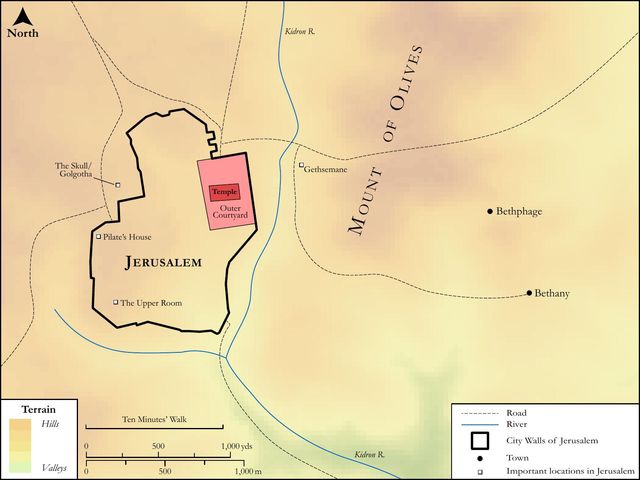
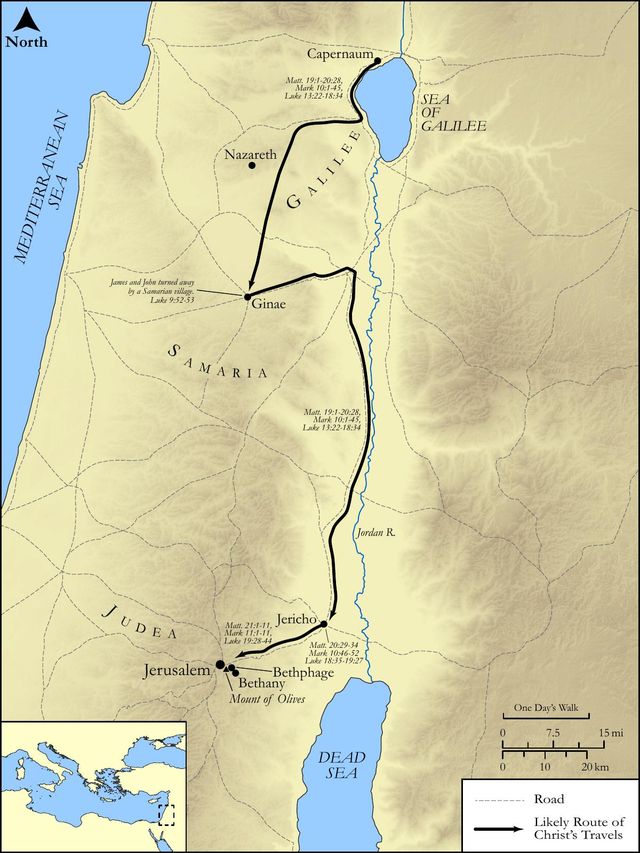
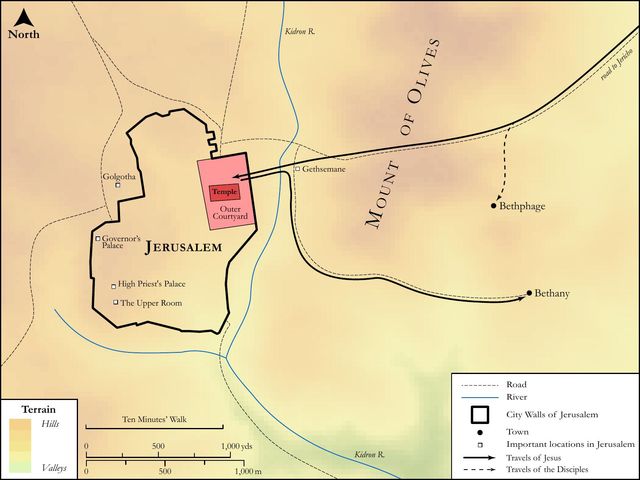
Study this verse
Public-domain commentary
Matthew Henry
From his Commentary on the Whole Bible. Henry comments on passages, not single verses — this entry covers Luke 19:28–40. His two-level outline is real structure in the source text, so it is rendered as structure.
We have here the same account of Christ's riding in some sort of triumph (such as it was) into Jerusalem which we had before in Matthew and Mark; let us therefore here only observe,
I.Jesus Christ was forward and willing to suffer and die for us.
He went forward, bound in the spirit, to Jerusalem, knowing very well the things that should befall him there, and yet he went before, ascending up to Jerusalem, Luk 19:28. He was the foremost of the company, as if he longed to be upon the spot, longed to engage, to take the field, and to enter upon action. Was he so forward to suffer and die for us, and shall we draw back from any service we are capable of doing for him?
II.It was no ways inconsistent either with Christ's humility or with his present state of humiliation to make a public entry into Jerusalem a little before he died. Thus he made himself to be the more taken notice of, that the ignominy of his death might appear the greater.
III.Christ is entitled to a dominion over all the creatures, and may use them when and as he pleases.
No man has a property in his estate against Christ, but that his title is prior and superior. Christ sent to fetch an ass and her colt from their owner's and master's crib, when he had occasion for their service, and might do so, for all the beasts of the forest are his, and the tame beasts too.
IV.Christ has all men's hearts both under his eye and in his hand.
He could influence those to whom the ass and the colt belonged to consent to their taking them away, as soon as they were told that the Lord had occasion for them.
V.Those that go on Christ's errands are sure to speed (Luk 19:32):
They that were sent found what he told them they should find, and the owners willing to part with them. It is a comfort to Christ's messengers that they shall bring what they are sent for, if indeed the Lord has occasion for it.
VI.The disciples of Christ, who fetch that for him from others which he has occasion for, and which they have not, should not think that enough, but, whatever they have themselves wherewith he may be served and honoured, they should be ready to serve him with it. Many can be willing to attend Christ at other people's expense who care not to be at any charge upon him themselves; but those disciples not only fetched the ass's colt for him, but cast their own garments upon the colt, and were willing that they should be used for his trappings.
VII.Christ's triumphs are the matter of his disciples' praises.
When Christ came nigh to Jerusalem, God put it of a sudden into the hearts of the whole multitude of the disciples, not of the twelve only, but abundance more, that were disciples at large, to rejoice and praise God (Luk 19:37), and the spreading of their clothes in the way (Luk 19:36) was a common expression of joy, as at the feast of tabernacles. Observe,
1.What was the matter or occasion of their joy and praise. They praised God for all the mighty works they had seen, all the miracles Christ had wrought, especially the raising of Lazarus, which is particularly mentioned, Joh 12:17, Joh 12:18. That brought others to mind, for fresh miracles and mercies should revive the remembrance of the former.
2.How they expressed their joy and praise (Luk 19:38): Blessed be the king that cometh in the name of the Lord. Christ is the king; he comes in the name of the Lord, clothed with a divine authority, commissioned from heaven to give law and treat of peace. Blessed be he. Let us praise him, let God prosper him. He is blessed for ever, and we will speak well of him. Peace in heaven. Let the God of heaven send peace and success to his undertaking, and then there will be glory in the highest. It will redound to the glory of the most high God; and the angels, the glorious inhabitants of the upper world, will give him the glory of it. Compare this song of the saints on earth with that of the angels, Luk 2:14. They both agree to give glory to God in the highest. There the praises of both centre; the angels say, On earth peace, rejoicing in the benefit which men on earth have by Christ; the saints say, Peace in heaven, rejoicing in the benefit which the angels have by Christ. Such is the communion we have with the holy angels that, as they rejoice in the peace on earth, so we rejoice in the peace in heaven, the peace God makes in his high places (Job 25:2), and both in Christ, who hath reconciled all things to himself, whether things on earth or things in heaven.
VIII.Christ's triumph's, and his disciples' joyful praises of them, are the vexation of proud Pharisees, that are enemies to him and his kingdom.
There were some Pharisees among the multitude who were so far from joining with them that they were enraged at them, and, Christ being a famous example of humility, they thought that he would not admit such acclamations as these, and therefore expected that he should rebuke his disciples, Luk 19:39. But it is the honour of Christ that, as he despises the contempt of the proud, so he accepts the praises of the humble.
IX.Whether men praise Christ or no he will, and shall, and must be praised (Luk 19:40):
If these should hold their peace, and not speak the praises of the Messiah's kingdom, the stones would immediately cry out, rather than that Christ should not be praised. This was, in effect, literally fulfilled, when, upon men's reviling Christ upon the cross, instead of praising him, and his own disciples' sinking into a profound silence, the earth did quake and the rocks rent. Pharisees would silence the praises of Christ, but they cannot gain their point; for as God can out of stones raise up children unto Abraham, so he can out of the mouths of those children perfect praise.
Historical interpretation
Eleven Centuries of Reception
14 surviving comments on this verse. Each one is dated, so this reads as a timeline rather than a list.
Select a marker to jump to its quote. Markers stagger vertically where authors wrote within a few decades of each other.
And the prophecy, "He shall be the expectation of the nations," signified that there would be some of all nations who should look for Him to come again. And this indeed you can see for yourselves, and be convinced of by fact. For of all races of men there are some who look for Him who was crucified in Judaea, and after whose crucifixion the land was straightway surrendered to you as spoil of war. And the prophecy, "binding His foal to the vine, and washing His robe in the blood of the grape," was a significant symbol of the things that were to happen to Christ, and of what He was to do. For the foal of an ass stood bound to a vine at the entrance of a village, and He ordered His acquaintances to bring it to Him then; and when it was brought, He mounted and sat upon it, and entered Jerusalem, where was the vast temple of the Jews which was afterwards destroyed by you.
(in Luc. 37.) The disciples next place their garments upon the ass, and cause the Saviour to sit thereon, inasmuch as they take upon themselves the word of God, and make it to rest upon the souls of their hearers. They divest themselves of their garments, and strew them in the way, for the clothing of the Apostles is their good works. And truly does the ass loosened by the disciples and carrying Jesus, walk upon the garments of the Apostles, when it imitates their doctrine. Which of us is so blessed, that Jesus should rest upon him?
“Untie the donkey and bring it to me.” He began with a manger and finished with a donkey, in Bethlehem with a manger, in Jerusalem with a donkey.
Because the Lord had said, The kingdom of heaven is at hand, they that saw Him going up to Jerusalem thought that He was going then to commence the kingdom of God. When then the parable was finished in which He reproved the error above mentioned, and showed plainly that He had not yet vanquished that death which was plotting against him, he proceeded forth to His passion, going up to Jerusalem.
Here it was evident that there would be a divine summons. For no one can resist God calling for what is His own. But the disciples when ordered to fetch the colt refused not the office as a slight one, but went to bring him.
They who had tied the ass are struck dumb, because of the greatness of His mighty power, and are unable to resist the words of the Saviour; for "the Lord" is a name of majesty, and as a King was He about to come in the sight of all the people.
So likewise should we set about even the lowest works with the greatest zeal and affection, knowing that whatever is done with God before our eyes is not slight, but meet for the kingdom of heaven.
The apostles threw down their own garments before Christ. By their preaching of the gospel, they would present the glory of their action. In Holy Scripture, very often garments are virtues, which are to soften the hardness of the Gentiles to some extent by their own virtue, so that with zealous good will they may show the undisturbed obedience of a joyful passage. The Lord of the world was not happy to be carried in a public spectacle on the back of a donkey. With the generalship of piety, he subdued the accustomed disposition of the Gentile people. The mystic Rider therefore could cover the inmost places of our mind with the hidden mystery. He would take his seat in an inward possession of the secret places of the spirits, as if infused with the Godhead, ruling the footprints of the mind and curbing the lusts of the flesh. Those who received such a Rider in their inmost hearts are happy. A heavenly bridle curbed those mouths, or else they would be unloosed in a multitude of words.
Mystically, our Lord came to Mount Olivet, that he might plant new olive trees on the heights of virtue. And perhaps the mountain itself is Christ, for who else could bear such fruit of olives abounding in the fulness of the Spirit?
For they were in the village, and the colt was tied with its mother, nor could it be loosed except by the command of the Lord. The apostle's hand looses it. Such was the act, such the life, such the grace. Be such, that thou mayest be able to loose those that are bound. In the ass indeed Matthew represented the mother of error, but in the colt Luke has described the general character of the Gentile people. And rightly, whereon yet never man sat, for none before Christ called the nations of the Gentiles into the Church. But this people was tied and bound by the chains of iniquity, being subject to an unjust master, the servant of error, and could not claim to itself authority whom not nature but crime had made guilty. Since the Lord is spoken of, one master is recognised. O wretched bondage under a doubtful mastery! For he has many masters who has not one. Others bind that they may possess, Christ looses that he may keep, for He knew that gifts are more powerful than chains.
Nor is it for nothing that two disciples are directed thither; Peter to Cornelius, Paul to the rest. And therefore He did not mark out the persons, but determined the number. Still should any one require the persons, he may believe it to be spoken of Philip, whom the Holy Spirit sent to Gaza, when he baptized the eunuch of Queen Candace. (Acts 8:38.)
For it pleased not the Lord of the world to be borne upon the ass's back, save that in a hidden mystery by a more inward sitting, the mystical Ruler might take His seat in the secret depths of men's souls, guiding the footsteps of the mind, bridling the wantonness of the heart. His word is a rein, His word is a goad.
He came to the Mount of Olivet so that he could plant new olive trees on the heights of virtue, the mother of which is the Jerusalem that is above. The heavenly Gardener is on this mountain so that all those who are planted in the house of the Lord may say, “But I am as a fruitful olive in the house of the Lord.” Perhaps that mountain is Christ himself. Who else could produce such fruits, not in many round berries but in the fullness of spirit in the fruitful Gentiles? We ascend by him, and we ascend to him. He is the Door and the Way that is opened and which opens. Those entering knock on it, and those leaving worship it.
(Hom. 66. in Matt.) At the beginning of His ministry our Lord showed Himself indifferent to the Jews, but when He had given sufficient token of His power, He transacts every thing with the highest authority. Many are the miracles which then took place. He foretold to them, ye shall find an unbroken colt. He foretels also that no one should hinder them, but as soon as they heard it, should hold their peace.
What then was the sign? He sat on a colt, as we have just heard the blessed Evangelist clearly telling us. Perhaps someone will say, “When he traveled all Judea—for he taught in their synagogues and added the working of miracles to his words—he did not ask for an animal on which to ride. When Christ could have purchased one, he would not, although he often was wearied by his long journeys on the way. When passing through Samaria, he was wearied with his journey, as it is written. Who can make us believe that when he was going from the Mount of Olives to Jerusalem, places separated from one another by so short an interval, that he would require a colt? Since the mother accompanied the colt, why did he not take the mother instead of choosing the colt? The donkey that bore the colt was brought to him also. We learn this from the words of Matthew, who says that he sent the disciples to a village opposite them. He said to them, “You will find a donkey tied and a colt with her. Untie and bring them to me.” “They brought,” it says, “the donkey and the colt with her.” We must consider, therefore, what are the explanations and the benefits that we derive from this occurrence and how we make Christ riding on the colt a type of the calling of the Gentiles. The colt of a donkey is mounted on which none has sat, because no one before Christ called the peoples of the nations to the church.
Proving at the same time that the parable had been pronounced concerning the end of that city which was about both to slay Him, and to perish itself by the scourge of the enemy. It follows, And it came to pass, when he was come nigh to Bethphage, &c. Bethphage was a small village belonging to the priests on Mount Olivet. Bethany was also a little town or hamlet on the side of the same mountain, about fifteen stades from Jerusalem.
According to the other Evangelists, not the disciples only, but very many also out of the crowds scattered their garments in the way.
Rightly are the towns described as placed on Mount Olivet, that is, on the Lord Himself, who rekindles the unction of spiritual graces with the light of knowledge and piety.
And as he went, they spread their garments in the way. As the Lord is carried by the donkey, the disciples lay their garments in the path, because by stripping away their own bodily attire, they prepare the way for the simpler servants of God with their own blood, so that they may walk with an undisturbed step of the mind towards Jerusalem, where Jesus leads. For Jesus, sitting on the donkey, heads towards Jerusalem when, governing the soul of each faithful one, He leads His donkey to the vision of inner peace, or also when He presides universally over the holy Church and kindles in it the desire for the peace of heaven. But because according to other evangelists, not only disciples but also many from the crowd spread their garments on the road, those may be understood as well who, following the examples of the martyrs, discipline their bodies through abstinence, to prepare a path for the Lord towards the mind, or offer good examples for those who might follow.
Or the two sent imply this, that the Prophets and Apostles make up the two steps to the bringing in of the Gentiles, and their subjection to Christ. But they bring the colt from a certain village, that it may be known to us that this people was rude and unlearned.
(non occ.) The disciples waited upon Christ not only in bringing the colt of another, but also with their own garments, some of which they placed upon the ass, others they strewed in the way.
Continue studying Luke 19:36 across the web’s major study libraries — every link below opens this exact verse, chapter, or book on the destination site.
Read & Compare
 BibleGatewayThis verse in more than 200 translations and 70 languages.
 Bible.comThe YouVersion reader — hundreds of translations, reading plans, and highlights.
 ESV.orgCrossway's official English Standard Version reader.
 NET BibleThe NET translation with 60,000+ translators' notes on every rendering decision.
 STEP BibleTyndale House's free study tool — original text, vocabulary, and scholarly resources.
 BibliaLogos Bible Software's free web reader.
 USCCBThe New American Bible (Revised Edition) with the U.S. bishops' study notes.
Commentaries
 BibleHub CommentariesDozens of classic commentaries on this verse, gathered on one page.
 StudyLightMore than 100 commentary sets — the largest collection on the web.
 BibleRefPlain-English commentary on what this verse means, verse by verse.
 Enduring WordDavid Guzik's free commentary on this chapter, widely used by Bible teachers.
 Bible Study ToolsVerse commentary alongside Greek and Hebrew study aids.
Original Language & Research
- BibleHub InterlinearThe verse word by word — original language, transliteration, and English.
- BibleHub LexiconEvery word's original-language definition and Strong's entry.
 Blue Letter BibleDeep-study tools — Strong's numbers, concordance, and word studies.
 CNTR CollationThe earliest Greek manuscripts of this verse, collated letter by letter.
Sermons, Hymns & Audio


TrulyRandomVerse is not affiliated with these sites and doesn’t control their content. They’re linked because they’re genuinely useful.
Summary
Luke 19:36 vividly captures a pivotal moment in Jesus' final journey to Jerusalem, often recognized as the Triumphal Entry. As Jesus proceeded, His enthusiastic followers spontaneously laid their outer garments on the road before Him, an ancient and profound act of homage that signified royal welcome and profound reverence, setting the stage for the fervent acclamations that immediately followed.
Context
ShowHideLiterary Context
This verse is deeply embedded within Luke's narrative of Jesus' determined journey towards Jerusalem, a journey that began much earlier (Luke 9:51). Just prior to this verse, Jesus has sent disciples to retrieve a colt on which He would ride, fulfilling ancient prophecy. The act of spreading clothes directly precedes the crowd's joyous shouts of "Blessed is the King who comes in the name of the Lord!" (Luke 19:38). It marks the climax of Jesus' public ministry before His passion, contrasting sharply with the growing hostility of the religious leaders who would soon demand His crucifixion.
Historical & Cultural Context
In the ancient Near East, spreading garments or carpets on the ground before a dignitary was a well-established custom signifying profound honor, submission, and royal acclamation. It was a symbolic act of paving the way for a king or a conquering hero, treating the ground he walked or rode upon as sacred. A notable Old Testament precedent is found when Jehu was proclaimed king, and his followers "hastily took every man his garment, and put it under him on the top of the stairs, and blew with trumpets, saying, Jehu is king!" (2 Kings 9:13). This act by the crowd in Jerusalem, therefore, was not merely a gesture of enthusiasm but a clear, culturally understood declaration of Jesus' perceived royal status, even if their understanding of His kingship was primarily political and earthly, rather than spiritual.
Key Themes
ShowHideThis verse contributes significantly to several key themes in Luke's Gospel. Firstly, it underscores the theme of Royal Acclamation, as the crowd, albeit with a limited understanding, acknowledges Jesus as a king. This public declaration is a dramatic fulfillment of messianic expectations. Secondly, it highlights Spontaneous Devotion, demonstrating the genuine, unprompted adoration of the common people for Jesus, contrasting with the skepticism and opposition of the religious elite (Luke 19:39-40). Thirdly, the entire scene, including the donkey and the crowd's actions, serves as a powerful Fulfillment of Prophecy, particularly Zechariah 9:9, which foretold the humble yet triumphant entry of Zion's King.
Exposition and Analysis
ShowHideKey Word Analysis
ShowHideThis verb signifies to traverse, travel, or go, often implying a deliberate journey or progress. In this context, it emphasizes Jesus' active movement towards Jerusalem, highlighting His intentionality and the forward momentum of the unfolding divine plan. It's not a casual stroll but a purposeful advance.
Derived from "under" (hypo) and "to strew" (stronnumi), this word literally means "to strew underneath" or "to spread under." It vividly describes the physical act of laying something down on the path. The choice of this specific verb underscores the deliberate and sacrificial nature of the crowd's action, creating a makeshift carpet for Jesus.
This term refers to an outer garment or cloak, a significant and often valuable possession in ancient times. It was used for warmth, as a blanket, or even as collateral for a loan. The fact that people were willing to remove and lay down their outer garments, exposing themselves and potentially damaging their clothing, speaks volumes about the depth of their reverence and the intensity of their belief in Jesus' royal identity.
Verse Breakdown
ShowHide"And as he went"
This phrase establishes the setting and the ongoing action. Jesus is actively moving forward, fulfilling His divine purpose to enter Jerusalem. The narrative focuses on His progression, making the crowd's response an immediate reaction to His presence.
"they spread their clothes"
This is the core action of the verse. "They" refers to the multitude of disciples and the larger crowd accompanying Jesus. Their act of spreading their outer garments signifies an extraordinary display of honor and homage, a spontaneous and deeply symbolic gesture of welcoming a king or a revered leader. It indicates their recognition, however incomplete, of Jesus' authority and status.
"in the way"
This specifies the location of their action – on the road or path directly in front of Jesus. It emphasizes the public and visible nature of their devotion, transforming the ordinary path into a royal carpet. This public display served as a clear declaration to all who witnessed it that Jesus was being received as a king.
Literary Devices
ShowHideLuke 19:36, while seemingly simple, is rich in literary devices that amplify its significance. The most prominent is Symbolism. The act of spreading clothes on the road is a powerful symbol of royal homage and profound respect, transforming a mundane path into a ceremonial carpet fit for a king. This gesture foreshadows Jesus' true kingship, even as the crowd's understanding of that kingship remains earthly. There is also a subtle Irony in this scene; the crowd acclaims Jesus as king with earthly expectations, yet Jesus' entry is humble (on a colt, not a warhorse) and ultimately leads not to an earthly throne but to a cross, which is His true path to cosmic kingship. The Imagery of garments laid down creates a vivid mental picture of a spontaneous, heartfelt, and public declaration of allegiance.
Theological and Thematic Connections
ShowHideThis singular act of devotion in Luke 19:36 resonates deeply with broader theological themes of worship, recognition of divine authority, and the nature of Christ's kingship. The crowd's spontaneous offering of their garments symbolizes a profound surrender and honor, reflecting the human desire to acknowledge and exalt a rightful sovereign. While their understanding of Jesus' kingship was limited to an earthly, political Messiah, their actions unwittingly pointed to a deeper truth: Jesus is indeed the King, worthy of ultimate adoration and submission. This scene serves as a powerful reminder that true worship involves laying down what is valuable to us, paving the way for Christ to reign supremely in our lives and in the world.
Reflection and Application
ShowHideLuke 19:36 invites us to consider the depth of our own devotion and the ways in which we make room for Christ in our lives. The crowd's act was one of costly and public homage, a visible declaration of their allegiance. For believers today, "spreading our clothes in the way" can be understood metaphorically as preparing our hearts and lives for Jesus' reign, removing obstacles that hinder His sovereignty. It calls us to offer our most valuable possessions—our time, talents, resources, and even our very selves—as an act of worship and service to Him. This verse challenges us to move beyond mere intellectual assent to a vibrant, public, and sacrificial acknowledgment of Jesus as Lord, demonstrating our allegiance not just in private devotion but through our actions in the world, thereby paving the way for His kingdom to advance.
Questions for Reflection
ShowHideFAQ
ShowHideWhy did the people spread their clothes on the road for Jesus?
ShowHideThe act of spreading clothes on the road was a traditional and highly symbolic gesture of profound honor, respect, and royal acclamation in the ancient Near East. It was a way of welcoming a king or a conquering hero, treating the ground he walked or rode upon as sacred, effectively creating a makeshift royal carpet. By doing this for Jesus, the crowd was publicly declaring their belief that He was a king, the Messiah they had long awaited, fulfilling prophecies like the one found in Zechariah 9:9. This was not merely a spontaneous burst of enthusiasm but a culturally understood act of homage.
Christ-Centered Fulfillment
ShowHideLuke 19:36, depicting the Triumphal Entry, stands as a profound Christ-centered moment, fulfilling Old Testament prophecy and foreshadowing Jesus' ultimate kingship. The crowd's act of spreading their garments, a gesture reserved for royalty, visibly declared Jesus as King, albeit a king whose immediate path led not to an earthly throne but to the cross. This humble entry on a donkey, rather than a warhorse, perfectly embodies the nature of His reign—one of peace and sacrifice, not worldly conquest. The "way" they paved for Him ultimately led to Golgotha, where He would lay down His life as the Lamb of God who takes away the sin of the world. His death, resurrection, and ascension to the right hand of God (Acts 2:33) reveal Him as the true cosmic King, to whom every knee will one day bow (Philippians 2:9-11). Thus, the Triumphal Entry, initiated by the spreading of clothes, is a powerful prefigurement of the universal homage due to the resurrected and reigning Christ, who will return in glory to establish His eternal kingdom (Revelation 19:11-16).