


John 12:18
“The Triumphal Entry”John 12:12–19
Bible text: King James Version (1769 Blayney text) · Public domain
Bible text: Berean Standard Bible · Public domain
Bible text: American Standard Version (1901) · Public domain
Bible text: World English Bible, Messianic edition · Public domain
Bible text: Geneva Bible (1599) · Public domain
Bible text: Young's Literal Translation · Public domain
- διὰdiaOn account ofG1223PREPPreposition
- τοῦτοtoutothisG3778D-ASNDemonstrative pronoun Accusative Singular Neuter
- καὶkaialsoG2532CONJConjunction
- ὑπήντησενhupēntēsenmetG5221V-AAI-3SVerb Aorist Active Indicative 3rd Singular
- αὐτῷautōwith HimG846P-DSMPersonal pronoun Dative Singular Masculine
- ὁhotheG3588T-NSMDefinite article Nominative Singular Masculine
- ὄχλοςochloscrowdG3793N-NSMNoun Nominative Singular Masculine
- ὅτιhotibecauseG3754CONJConjunction
- ἤκουσανēkousanthey heardG191V-AAI-3PVerb Aorist Active Indicative 3rd Plural
- τοῦτοtoutothisG3778D-ASNDemonstrative pronoun Accusative Singular Neuter
- αὐτὸνautonof HisG846P-ASMPersonal pronoun Accusative Singular Masculine
- πεποιηκέναιpepoiēkenaito have doneG4160V-RANVerb Perfect Active Infinitive
- τὸtotheG3588T-ASNDefinite article Accusative Singular Neuter
- σημεῖονsēmeionsignG4592N-ASNNoun Accusative Singular Neuter
English is a literal word-by-word gloss of the Greek, not the KJV's wording. Why?
This is the Greek text the KJV’s translators worked from, with each word given its own literal English meaning in this verse. The word-by-word meanings were prepared by scholars at Tyndale House, Cambridge. The KJV translates whole sentences rather than single words, so its wording often differs: one Greek word can become several English words, and the KJV may say “charity” where the word-by-word meaning reads “love”. The two are made for different purposes, and both are faithful to the Greek. To read the KJV’s own wording, switch to the KJV text.
Words in [ ] are added by the English.
- miracle (KJV) / sign (BSB) σημεῖον
Details
See on the biblical-era maps
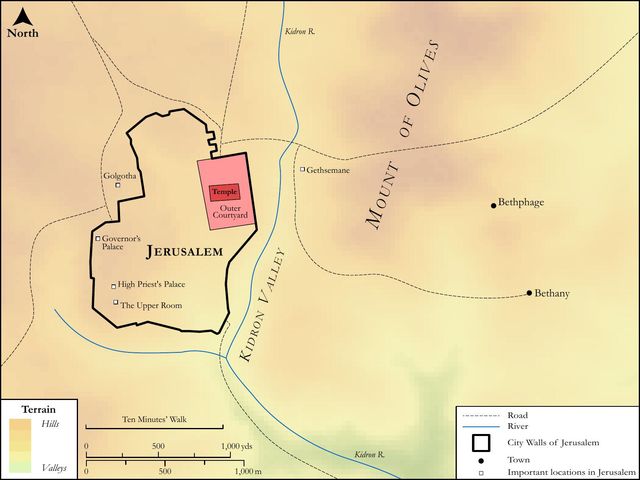
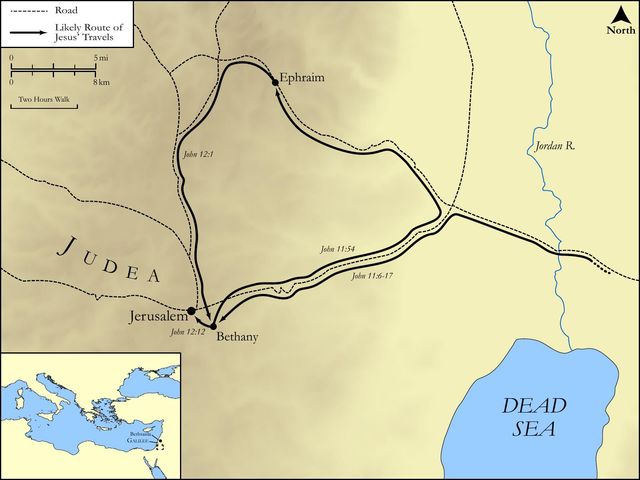
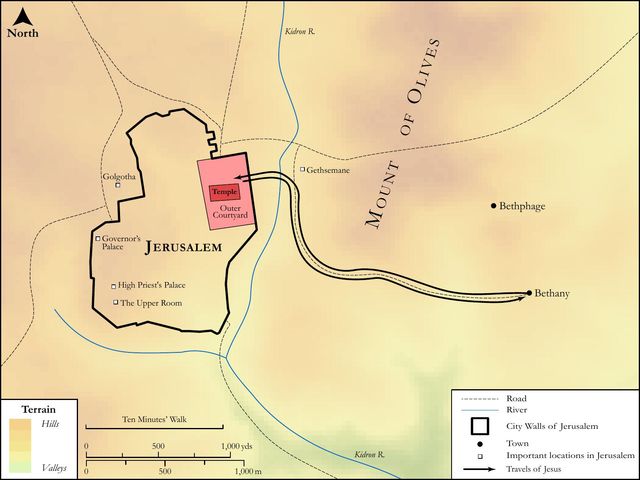
Study this verse
Public-domain commentary
Matthew Henry
From his Commentary on the Whole Bible. Henry wrote on whole passages, and this entry covers John 12:12–19. He set out his notes in a four-level outline, kept here as he numbered it.
This story of Christ's riding in triumph to Jerusalem is recorded by all the evangelists, as worthy of special remark; and in it we may observe,
I.The respect that was paid to our Lord Jesus by the common people, John 12:12, John 12:13, where we are told,
1.Who they were that paid him this respect: much people, ochlos polus - a great crowd of those that came up to the feast; not the inhabitants of Jerusalem, but the country people that came from remote parts to worship at the feast; the nearer the temple of the Lord, the further from the Lord of the temple. They were such as came up to the feast.
(1.)Perhaps they had been Christ's hearers in the country, and great admirers of him there, and therefore were forward to testify their respect to him at Jerusalem, where they knew he had many enemies. Note, Those that have a true value and veneration for Christ will neither be ashamed nor afraid to own him before men in any instance whereby they may do him honour.
(2.)Perhaps they were those more devout Jews that came up to the feast some time before, to purify themselves, that were more inclined to religion than their neighbours, and these were they that were so forward to honour Christ. Note, The more regard men have to God and religion in general, the better disposed they will be to entertain Christ and his religion, which is not destructive but perfective of all previous discoveries and institutions. They were not the rulers, nor the great men, that went out to meet Christ, but the commonalty; some would have called them a mob, a rabble: but Christ has chosen the weak and foolish things (1 Corinthians 1:27), and is honoured more by the multitude than by the magnificence of his followers; for he values men by their souls, not their names and titles of honour.
2.On what occasion they did it: They heard that Jesus was coming to Jerusalem. They had enquired for him (John 11:55, John 11:56): Will he not come up to the feast? And now they hear he is coming; for none that seek Christ seek in vain. Now when they heard he was coming, they bestirred themselves, to give him an agreeable reception. Note, Tidings of the approach of Christ and his kingdom should awaken us to consider what is the work of the day, that it may be done in the day. Israel must prepare to meet their God (Amos 4:12), and the virgins to meet the bridegroom.
3.In what way they expressed their respect; they had not the keys of the city to present to him, nor the sword nor mace to carry before him, none of the city music to compliment him with, but such as they had they gave him; and even this despicable crowd was a faint resemblance of that glorious company which John saw before the throne, and before the Lamb, Revelation 7:9, Revelation 7:10. Though these were not before the throne, they were before the Lamb, the paschal Lamb, who now, according to the usual ceremony, four days before the feast, was set apart to be sacrificed for us. There it is said of that celestial choir,
(1.)That they had palms in their hands, and so had these branches of palm-trees. The palm-tree has ever been an emblem of victory and triumph; Cicero calls one that had won many prizes plurimarum palmarum homo - a man of many palms. Christ was now by his death to conquer principalities and powers, and therefore it was fit that he should have the victor's palm borne before him; though he was but girding on the harness, yet he could boast as though he had put it off. But this was not all; the carrying of palm-branches was part of the ceremony of the feast of tabernacles (Leviticus 23:40; Nehemiah 8:15), and their using this expression of joy in the welcome given to our Lord Jesus intimates that all the feasts pointed at his gospel, had their accomplishment in it, and particularly that of the feast of tabernacles, Zechariah 14:16.
(2.)That they cried with a loud voice, saying, Salvation to our God (Revelation 7:10); so did these here, they shouted before him, as is usual in popular welcomes, Hosanna, blessed is the king of Israel, that comes in the name of the Lord; and hosanna signifies salvation. It is quoted from Psalm 118:25, Psalm 118:26. See how well acquainted these common people were with the scripture, and how pertinently they apply it to the Messiah. High thoughts of Christ will be best expressed in scripture-words. Now in their acclamations,
[1.]They acknowledge our Lord Jesus to be the king of Israel, that comes in the name of the Lord. Though he went now in poverty and disgrace, yet, contrary to the notions their scribes had given them of the Messiah, they own him to be a king, which bespeaks both his dignity and honour, which we must adore; and his dominion and power, to which we must submit. They own him to be, First, A rightful king, coming in the name of the Lord (Psalm 2:6), sent of God, not only as a prophet, but as a king. Secondly, The promised and long-expected king, Messiah the prince, for he is king of Israel. According to the light they had, they proclaimed him king of Israel in the streets of Jerusalem; and, they themselves being Israelites, hereby they avouched him for their king.
[2.]They heartily wish well to his kingdom, which is the meaning of hosanna; let the king of Israel prosper, as when Solomon was crowned they cried, God save king Solomon, 1 Kings 1:39. In crying hosanna they prayed for three things: - First, That his kingdom might come, in the light and knowledge of it, and in the power and efficacy of it. God speed the gospel plough. Secondly, That it might conquer, and be victorious over all opposition, Revelation 6:2. Thirdly, That it might continue. Hosanna is, Let the king live for ever; though his kingdom may be disturbed, let it never be destroyed, Psalm 72:17.
[3.]They bid him welcome into Jerusalem: "Welcome is he that cometh; we are heartily glad to see him; come in thou blessed of the Lord; and well may we attend with our blessings him who meets us with his." This welcome is like that (Psalm 24:7-9), Lift up your heads, O ye gates. Thus we must every one of us bid Christ welcome into our hearts, that is, we must praise him, and be well pleased in him. As we should be highly pleased with the being and attributes of God, and his relation to us, so we should be with the person and offices of the Lord Jesus, and his meditation between us and God. Faith saith, Blessed is he that cometh.
II.The posture Christ puts himself into for receiving the respect that was paid him (John 12:14):
When he had found, or procured, a young ass, he sat thereon. It was but a poor sort of figure he made, he alone upon an ass, and a crowd of people about him shouting Hosanna.
1.This was much more of state than he used to take; he used to travel on foot, but now was mounted. Though his followers should be willing to take up with mean things, and not affect any thing that looks like grandeur, yet they are allowed to use the service of the inferior creatures, according as God in his providence gives particular possession of those things over which, by his covenant with Noah and his sons, he has given to man a general dominion.
2.Yet it was much less of state than the great ones of the world usually take. If he would have made a public entry, according to the state of a man of high degree, he should have rode in a chariot like that of Solomon's (Song of Solomon 3:9, Song of Solomon 3:10), with pillars of silver, the bottom of gold, and the covering of purple; but, if we judge according to the fashion of this world, to be introduced thus was rather a disparagement than any honour to the king of Israel, for it seemed as if he would look great, and knew not how. His kingdom was not of this world, and therefore came not with outward pomp. He was now humbling himself, but in his exalted state John sees him in a vision on a white horse, with a bow and a crown.
III.The fulfilling of the scripture in this:
As it is written, Fear not, daughter of Sion, John 12:15. This is quoted from Zechariah 9:9. To him bore all the prophets witness, and particularly to this concerning him.
1.It was foretold that Zion's king should come, should come thus, sitting on an ass's colt; even this minute circumstance was foretold, and Christ took care it should be punctually fulfilled. Note,
(1.)Christ is Zion's king; the holy hill of Zion was of old destined to be the metropolis or royal city of the Messiah.
(2.)Zion's king does and will look after her, and come to her; though for a short time he retires, in due time he returns.
(3.)Though he comes but slowly (an ass is slow-paced), yet he comes surely, and with such expressions of humility and condescension as greatly encourage the addresses and expectations of his loyal subjects. Humble supplicants may reach to speak with him. If this be a discouragement to Zion, that her king appears in no greater state or strength, let her know that though he comes to her riding on an ass's colt, yet he goes forth against her enemies riding on the heavens for her help, Deuteronomy 33:26.
2.The daughter of Zion is therefore called upon to behold her king, to take notice of him and his approaches; behold and wonder, for he comes with observation, though not with outward show, Song of Solomon 3:11. Fear not. In the prophecy, Zion is told to rejoice greatly, and to shout, but here it is rendered, Fear not. Unbelieving fears are enemies to spiritual joys; if they be cured, if they be conquered, joy will come of course; Christ comes to his people to silence their fears. If the case be so that we cannot reach to the exultations of joy, yet we should labour to get from under the oppressions of fear. Rejoice greatly; at least, fear not.
IV.The remark made by the evangelist respecting the disciples (John 12:16):
They understood not at first why Christ did this, and how the scripture was fulfilled; but when Jesus was glorified, and thereupon the Spirit poured out, then they remembered that these things were written of him in the Old Testament, and that they and others had, in pursuance thereof, done these things to him.
1.See here the imperfection of the disciples in their infant state; even they understood not these things at first. They did not consider, when they fetched the ass and set him thereon, that they were performing the ceremony of the inauguration of Zion's king. Now observe,
(1.)The scripture is often fulfilled by the agency of those who have not themselves an eye to the scripture in what they do, Isaiah 45:4.
(2.)There are many excellent things, both in the word and providence of God, which the disciples themselves do not at first understand: not at their first acquaintance with the things of God, while they see men as trees walking; not at the first proposal of the things to their view and consideration. That which afterwards is clear was at first dark and doubtful.
(3.)It well becomes the disciples of Christ, when they are grown up to maturity in knowledge, frequently to reflect upon the follies and weaknesses of their first beginning, that free grace may have the glory of their proficiency, and they may have compassion on the ignorant. When I was a child, I spoke as a child.
2.See here the improvement of the disciples in their adult state. Though they had been children, they were not always so, but went on to perfection. Observe,
(1.)When they understood it: When Jesus was glorified; for,
[1.]Till then they did not rightly apprehend the nature of his kingdom, but expected it to appear in external pomp and power, and therefore knew not how to apply the scriptures which spoke of it to so mean an appearance. Note, The right understanding of the spiritual nature of Christ's kingdom, of its powers, glories, and victories, would prevent our misinterpreting and misapplying the scriptures that speak of it.
[2.]Till then the Spirit was not poured out, who was to lead them into all truth. Note, The disciples of Christ are enabled to understand the scriptures by the same Spirit that indited the scriptures. The spirit of revelation is to all the saints a spirit of wisdom, Ephesians 1:17, Ephesians 1:18.
(2.)How they understood it; they compared the prophecy with the event, and put them together, that they might mutually receive light from each other, and so they came to understand both: Then remembered they that these things were written of him by the prophets, consonant to which they were done to him. Note, Such an admirable harmony there is between the word and works of God that the remembrance of what is written will enable us to understand what is done, and the observation of what is done will help us to understand what is written. As we have heard, so have we seen. The scripture is every day fulfilling.
V.The reason which induced the people to pay this respect to our Lord Jesus upon his coming into Jerusalem, though the government was so much set against him. It was because of the illustrious miracle he had lately wrought in raising Lazarus.
1.See here what account and what assurance they had of this miracle; no doubt, the city rang of it, the report of it was in all people's mouths. But those who considered it as a proof of Christ's mission, and a ground of their faith in him, that they might be well satisfied of the matter of fact, traced the report to those who were eye-witnesses of it, that they might know the certainty of it by the utmost evidence the thing was capable of: The people therefore that stood by when he called Lazarus out of his grave, being found out and examined, bore record, John 12:17. They unanimously averred the thing to be true, beyond dispute or contradiction, and were ready, if called to it, to depose it upon oath, for so much is implied in the word Emarturei. Note, The truth of Christ's miracles was evidenced by incontestable proofs. It is probable that those who had seen this miracle did not only assert it to those who asked them, but published it unasked, that this might add to the triumphs of this solemn day; and Christ's coming in now from Bethany, where it was done, would put them in mind of it. Note, Those who wish well to Christ's kingdom should be forward to proclaim what they know that may redound to his honour.
2.What improvement they made of it, and what influence it had upon them (John 12:18): For this cause, as much as any other, the people met him.
(1.)Some, out of curiosity, were desirous to see one that had done such a wonderful work. Many a good sermon he had preached in Jerusalem, which drew not such crowds after him as this one miracle did. But,
(2.)Others, out of conscience, studied to do him honour, as one sent of God. This miracle was reserved for one of the last, that it might confirm those which went before, and might gain him this honour just before his sufferings; Christ's works were all not only well done (Mark 7:7) but well timed.
VI.The indignation of the Pharisees at all this; some of them, probably, saw, and they all soon heard of, Christ's public entry.
The committee appointed to find out expedients to crush him thought they had gained their point when he had retired unto privacy, and that he would soon be forgotten in Jerusalem, but they now rage and fret when they see they imagined but a vain thing.
1.They own that they had got no ground against him; it was plainly to be perceived that they prevailed nothing. They could not, with all their insinuations, alienate the people's affections from him, nor with their menaces restrain them from showing their affection to him. Note, Those who oppose Christ, and fight against his kingdom, will be made to perceive that they prevail nothing. God will accomplish his own purposes in spite of them, and the little efforts of their impotent malice. You prevail nothing, ouk ōpheleite - you profit nothing. Note, There is nothing got by opposing Christ.
2.They own that he had got ground: The world is gone after him; there is a vast crowd attending him, a world of people: an hyperbole common in most languages. Yet here, like Caiaphas, ere they were aware, they prophesied that the world would go after him; some of all sorts, some from all parts; nations shall be discipled. But to what intent was this said?
(1.)Thus they express their own vexation at the growth of his interest; their envy makes them fret. If the horn of the righteous be exalted with honour, the wicked see it, and are grieved (Psalm 112:9, Psalm 112:10); considering how great these Pharisees were, and what abundance of respect was paid them, one would think they needed not grudge Christ so inconsiderable a piece of honour as was now done him; but proud men would monopolize honour, and have none share with them, like Haman.
(2.)Thus they excite themselves and one another, to a more vigorous carrying on of the war against Christ. As if they should say, "Dallying and delaying thus will never do. We must take some other and more effectual course, to put a stop to this infection; it is time to try our utmost skill and force, before the grievance grows past redress." Thus the enemies of religion are made more resolute and active by being baffled; and shall its friends be disheartened with every disappointment, who know its cause is righteous and will at last be victorious?
Historical interpretation
Seven Centuries of Reception
5 surviving comments on this verse. Each one is dated, so this reads as a timeline rather than a list.
Select a marker to jump to its quote. Markers stagger vertically where authors wrote within a few decades of each other.
Since through Adam death came, which subjected everyone, they had heard through their prophets and believed that death would be defeated. When they saw that this had been done by our Lord, who raised a man dead for four days, they took branches of palm trees and went out to meet him as the victor over death, which oppresses humankind, and praised him with appropriate hymns. Since the Pharisees did not like this, they reproached them by saying that they followed him in vain, but it was their reproach that was in vain, since all the people went after him anyway.
"The people, therefore, that was with Him when He called Lazarus out of his tomb, and raised him from the dead, bare record. For this cause the crowd also met Him, for that they heard that He had done this miracle. The Pharisees, therefore, said among themselves: Perceive ye that we prevail nothing? Behold, the whole world is gone after Him." Mob set mob in motion. "But why art thou, blinded mob that thou art, filled with envy because the world has gone after its Maker?"
(Tr. li. 7) The crowd was disturbed by the crowd. (Turba turbavit turbam) But why grudgeth that blind crowd, that the world should go after Him, by Whom the world was made?
The gathering of the common people, having heard what had happened, were readily persuaded by those who had witnessed that the Christ had raised Lazarus to life and annulled the power of death, as the prophets said. This is why they too went and met him.
See then the consequences of our Lord's passion. It was not to no purpose that He had reserved His greatest miracle for the last. For the resurrection of Lazarus it was that made the crowd believe in Him. The people therefore that was with Him when He called Lazarus out of his grave, and raised him from the dead, bare record. For this cause the people also met Him, for that they heard that He had done this miracle. Hence the spite and plotting of the Pharisees: The Pharisees therefore said among themselves, Perceive ye how ye prevail nothing? behold the world is gone after Him.
As if they said, The more you attack Him, the more will His power and reputation increase. What use then of these attempts?
Continue studying John 12:18 across the web’s major study libraries — every link below opens this exact verse, chapter, or book on the destination site.
Read & Compare
 BibleGatewayThis verse in more than 200 translations and 70 languages.
 Bible.comThe YouVersion reader — hundreds of translations, reading plans, and highlights.
 ESV.orgCrossway's official English Standard Version reader.
 NET BibleThe NET translation with 60,000+ translators' notes on every rendering decision.
 STEP BibleTyndale House's free study tool — original text, vocabulary, and scholarly resources.
 BibliaLogos Bible Software's free web reader.
 USCCBThe New American Bible (Revised Edition) with the U.S. bishops' study notes.
Commentaries
 BibleHub CommentariesDozens of classic commentaries on this verse, gathered on one page.
 StudyLightMore than 100 commentary sets — the largest collection on the web.
 BibleRefPlain-English commentary on what this verse means, verse by verse.
 Enduring WordDavid Guzik's free commentary on this chapter, widely used by Bible teachers.
 Bible Study ToolsVerse commentary alongside Greek and Hebrew study aids.
Original Language & Research
- BibleHub InterlinearThe verse word by word — original language, transliteration, and English.
- BibleHub LexiconEvery word's original-language definition and Strong's entry.
 Blue Letter BibleDeep-study tools — Strong's numbers, concordance, and word studies.
 CNTR CollationThe earliest Greek manuscripts of this verse, collated letter by letter.
Sermons, Hymns & Audio


TrulyRandomVerse is not affiliated with these sites and does not control their content.
Written with AI assistance. Always check it against Scripture.
This verse
The crowd went out to meet Jesus because they had heard that he had done this sign, the raising of Lazarus.
“For this cause the people also met him,”
The cause is the raising of Lazarus.
“for that they heard that he had done this miracle.”
They had heard it from the witnesses, and the sign drew them out to meet him.
Passage studyJohn 12:12–19
The King of Israel Rides into Jerusalem
Summary
The day after Mary anointed him at Bethany, Jesus comes to Jerusalem at the Passover. A great crowd of pilgrims hears that he is on the way, takes branches of palm trees and goes out to meet him, crying, “Hosanna: Blessed is the King of Israel that cometh in the name of the Lord.” Many of them have heard about Lazarus from people who stood at the tomb when Jesus called him out. Jesus sits on a young ass, and John sets beside it the words of Zechariah: “Fear not, daughter of Sion: behold, thy King cometh, sitting on an ass’s colt.” His disciples understand what it all meant only after he is glorified, and the Pharisees admit to one another that “the world is gone after him.” Here the King Israel had waited for comes to his city, meek and riding on a colt, on his way to the cross where he would save his people.
Passover Pilgrims Hear That Jesus Is Coming
“On the next day” translates epaúrion, the morrow or the day following. It ties the entry to the supper at Bethany, where Mary anointed Jesus and many came to see both him and Lazarus, whom he had raised from the dead (John 12:1–11). That raising is told in John 11, and the stir it caused carries straight into this scene. With the entry, the last week of Jesus’ earthly ministry begins, the week that leads to his cross and his resurrection.
“The feast” (heortḗ, a festival or holy day) is the Passover. It was one of three yearly feasts, with Pentecost and Tabernacles, at which every Jewish man was to go up to Jerusalem, so the city was full of pilgrims from across the Roman world and beyond. The Passover remembered how God brought Israel out of slavery in Egypt, and among a people under Roman rule it fed the hope that God would send his King to set them free once more. John calls the crowd “much people”, óchlos, a throng or multitude, with polýs, much or many. News of Jesus’ miracles, and above all of Lazarus, had spread through that crowd, and when they hear that he is coming they go out to him.
God chose the time. His Son rode into Jerusalem at the very feast that remembered Israel’s deliverance and the Passover lamb, and John the Baptist had long before pointed to Jesus and said, “Behold the Lamb of God, which taketh away the sin of the world” (John 1:29). The King the crowd welcomes is the Lamb whose sacrifice the feast foreshadowed. The other Gospels tell of the same entry (Matthew 21:1–11, Mark 11:1–11, Luke 19:28–44).
Hosanna to the King of Israel
The people “took branches of palm trees”. The Greek joins baḯon, a palm twig or branch, to phoînix, the palm tree. Then they “went forth to meet him”, an eager welcome of the kind given to a great man as he arrives.
Why palm branches?
Palm branches stood for victory and rejoicing. They belonged to Israel’s festivals, among them the Feast of Tabernacles, and they had been carried when the Maccabees celebrated the freeing of the nation from its Greek rulers. So the branches spoke of triumph and of the hope of national freedom, and the crowd was greeting Jesus as a victorious king. We still remember this day as Palm Sunday, after these branches, and it opens Holy Week, the week that leads to Easter.
The cry of the crowd
They “cried”, krázō, to call aloud or cry out, and the cry was “Hosanna”. Hōsanná comes from the Hebrew for “oh save!”, and it became an exclamation of adoration. It is the prayer of Psalm 118:25–26: “Save now, I beseech thee, O LORD ... Blessed be he that cometh in the name of the LORD.” By this time the plea had also become a shout of joyful praise and welcome for a deliverer, so the crowd was asking God for salvation and hailing the one they hoped would bring it in the same breath.
“Blessed” is eulogéō, to speak well of, to praise or to bless. “King” is basileús, a king, one with authority to rule, and Israḗl is the name given to Jacob and to the nation that came from him. “King of Israel” was the title of the promised son of David, whose throne God had pledged to establish for ever (2 Samuel 7:12–16). Many hoped this King would drive out Rome and restore David’s kingdom, and the crowd’s words carried that hope.
“In the name of the Lord” (en, ónoma, kýrios) means that he comes with the Lord’s authority, sent by God and acting for him. John stresses this all through his Gospel, where Jesus says, “The Son can do nothing of himself, but what he seeth the Father do” (John 5:19).
The crowd spoke truer than it knew. Jesus is the King of Israel, and his kingdom reaches far wider than Israel. Before Pilate he said, “My kingdom is not of this world” (John 18:36). The cry “save” was answered too, for he had come to save his people from sin and death.
Thy King Cometh, Sitting on an Ass’s Colt
“And Jesus, when he had found a young ass, sat thereon”. John tells this in a few words. The other Gospels tell how Jesus sent his disciples ahead to bring the animal to him (Matthew 21:2, Mark 11:2, Luke 19:30), and “found” (heurískō, to find or obtain) covers it all. The animal is an onárion, a little ass. In the prophecy of verse 15 it is a pōlos, a foal or young ass, of an ónos, a donkey.
“As it is written” uses gráphō, to write, and it is the usual way the New Testament points to a passage of Scripture. Here it points to Zechariah: “Rejoice greatly, O daughter of Zion; shout, O daughter of Jerusalem: behold, thy King cometh unto thee: he is just, and having salvation; lowly, and riding upon an ass, and upon a colt the foal of an ass” (Zechariah 9:9). Matthew says the same of this day: “All this was done, that it might be fulfilled which was spoken by the prophet” (Matthew 21:4–5). By sitting on the colt, Jesus openly takes the place of Zion’s promised King before the whole Passover crowd.
Why did Jesus ride a donkey and not a horse?
Jesus rode a young ass because Zechariah had foretold that Zion’s King would come “lowly, and riding upon an ass”, and in fulfilling it he showed what kind of King he is. Kings rode horses to war and to display their might. The donkey belonged to peace and humility, and to a king’s rule in peacetime, as when Solomon rode King David’s own mule to be made king (1 Kings 1:33). So Jesus came as the King of peace, whose kingdom would be won by his own sacrifice. The crowds hoped for a conqueror, and he came meek, on his way to the cross.
Paul describes the same humility. Christ “made himself of no reputation, and took upon him the form of a servant”, and “humbled himself, and became obedient unto death, even the death of the cross. Wherefore God also hath highly exalted him” (Philippians 2:5–11).
“Fear not, daughter of Sion”
“Daughter of Sion” pairs thygátēr, daughter, with Siṓn, Zion, a hill of Jerusalem. The prophets use it as a tender name for Jerusalem and its people (Isaiah 62:11, Micah 4:8). “Fear not” joins phobéō, to be afraid, with the negative mḗ. John gives Zechariah’s words in a shorter form that opens with “Fear not” where the prophet opens with “Rejoice greatly”, and both tell Jerusalem that her King’s coming is good news for her. “Behold” (idoú, lo, see) calls her to look, and “thy King” tells her that he is her own. A conqueror on a warhorse would give a city reason to dread him. This King comes gentle and lowly, bringing peace and salvation, and by his death and rising he frees his people from the fear of judgment.
The Disciples Understood Afterward
“These things understood not his disciples at the first”. Ginṓskō means to know, come to know, perceive or understand. The disciples saw it all and took part in it, and still they did not see at the time that Scripture was being fulfilled before them. Like the people around them they looked for a king who would restore Israel on earth, and even after the resurrection they asked the risen Lord, “wilt thou at this time restore again the kingdom to Israel?” (Acts 1:6–8).
“But (allá) when Jesus was glorified” marks the change. Doxázō means to render or esteem glorious, and in John’s Gospel Jesus is glorified in his death, his resurrection and his return to the Father. Then they “remembered” (mnáomai, to call to mind). The risen Christ “opened he their understanding, that they might understand the scriptures” (Luke 24:44–45). Jesus had promised that the Holy Ghost “shall teach you all things, and bring all things to your remembrance, whatsoever I have said unto you” (John 14:26), and that the Comforter would come once he had gone away (John 16:7). At Pentecost Peter proclaimed that the exalted Jesus had poured out the Spirit (Acts 2:33), and the bewildered followers became bold witnesses.
They remembered two things. “These things were written of him” uses gráphō again, the verb of verse 14, and so they saw Zechariah’s prophecy fulfilled in Jesus. And “they had done these things unto him”: they had brought the colt and joined the welcome, carrying out what Scripture foretold before they knew it. God worked his purpose through their actions on that day, long before they grasped it. John writes as one of those disciples, looking back with the understanding God gave them afterward.
The Witnesses of Lazarus
Verse 17 explains the size of the welcome. “The people therefore that was with him when he called Lazarus out of his grave, and raised him from the dead, bare record.” Oûn (“therefore”) links this to what has just been told. Phōnéō means to call, summon or cry out, and at the tomb Jesus “cried with a loud voice, Lazarus, come forth” (John 11:38–44). “Out of his grave” and “from the dead” both use ek, from or out of. The grave is a mnēmeîon, a tomb or sepulchre, and “the dead” is nekrós. “Raised” is egeírō, to waken or raise, the same verb used of Christ being raised by God.
The people who saw it “bare record”, martyréō, to be a witness, to testify or give evidence. Lazarus had lain in the tomb four days, so his death was beyond doubt, and many Jews of the time held that the soul left the body after three days. Bethany lay about two miles from Jerusalem (John 11:18), and many had come out from the city to comfort Mary and Martha (John 11:19), so a great many saw what happened, and many of them believed on him (John 11:45). Jesus had told Martha, “I am the resurrection, and the life” (John 11:25–26), and the sign showed it in plain sight.
Bearing witness runs all through John’s writings. John the Baptist “came for a witness, to bear witness of the Light” (John 1:7), Jesus sent the apostles to be his witnesses to the uttermost part of the earth (Acts 1:8), and John writes of what “we have heard, which we have seen with our eyes ... and our hands have handled, of the Word of life” (1 John 1:1–3). Lazarus came back to a mortal life and would die again. Christ, “being raised from the dead dieth no more” (Romans 6:9), and the crowd’s record about Lazarus points ahead to the apostles’ witness that God raised Jesus up, “having loosed the pains of death” (Acts 2:24). The voice that called Lazarus will call the dead on the last day, when “all that are in the graves shall hear his voice, and shall come forth” (John 5:28–29).
The sign that drew the crowd
“For this cause the people also met him, for that they heard that he had done this miracle.” They heard (akoúō, to hear) and came. “Miracle” is sēmeîon, a sign, mark or token, something that points beyond itself. John calls Jesus’ mighty works signs, from the first at Cana (John 2:11) to the raising of Lazarus, the seventh sign he records. He tells us why he wrote them: “that ye might believe that Jesus is the Christ, the Son of God; and that believing ye might have life through his name” (John 20:30–31). This sign was as public as the healing about which the council later had to admit, “we cannot deny it” (Acts 4:16).
The same sign worked two ways. It drew the crowd out to hail Jesus as King, and it hardened the council’s resolve to kill him (John 11:47–53). The chief priests even planned to put Lazarus to death, because on account of him many believed on Jesus.
Was the crowd’s welcome shallow?
John gives the crowd’s reason plainly: they had heard of the sign and came to meet the one who did it. He shows elsewhere that excitement over signs can stop short of faith in Jesus himself. After Jesus fed the multitude he told those who followed him, “Ye seek me, not because ye saw the miracles, but because ye did eat of the loaves, and were filled” (John 6:26–27). Many in this crowd wanted a king who would free them from Rome, and within days the cry before Pilate was “Away with him, away with him, crucify him” (John 19:15). Yet what they shouted on the road was true, and many who saw Lazarus raised had truly believed. Their Hosanna stands as a true word about Jesus.
“The World Is Gone After Him”
The Pharisees, Pharisaîos, a name of Hebrew origin meaning a separatist, were a strict party who held fast to the Law of Moses and to their traditions, and they had great influence with the people. They had already joined the chief priests in council against Jesus, afraid of what would follow if he were let alone: “all men will believe on him: and the Romans shall come and take away both our place and nation” (John 11:47–53).
Now they speak “among themselves”, in private. “Perceive ye how ye prevail nothing?” is a question asked in exasperation. Ōpheléō means to be useful, to benefit or profit, and with ou and oudeís behind “nothing” it says that all their plotting has gained them nothing. “Behold” here is íde, and like idoú in verse 15 it comes from the verb “to see” and means “lo, behold, see”. “The world” (kósmos) means the huge crowds of local people and pilgrims, an overstatement born of alarm. “Is gone after him” joins apérchomai, to go off or go away, with opísō, behind or after, the word used of following a leader. The people have gone off after Jesus as their leader.
Their complaint says more than they meant. Later in this chapter Jesus says, “And I, if I be lifted up from the earth, will draw all men unto me” (John 12:32). He “came unto his own, and his own received him not” (John 1:11), yet the gospel goes out to every nation, for “there is no difference between the Jew and the Greek: for the same Lord over all is rich unto all that call upon him” (Romans 10:12). The world they feared would follow him is the world he came to save.
Their failure also shows that every plan of man against God comes to nothing. “There is no wisdom nor understanding nor counsel against the LORD” (Proverbs 21:30). When the kings of the earth take counsel against the LORD and his anointed, “He that sitteth in the heavens shall laugh” (Psalm 2:1–4), and Gamaliel later warned the council that if a work be of God, “ye cannot overthrow it” (Acts 5:38–39). Their plotting carried Jesus toward the very cross by which he would save. Their refusal to come to him after so plain a sign is what Jesus described when he said that “light is come into the world, and men loved darkness rather than light, because their deeds were evil” (John 3:19–20).
The King Who Came to Save
The entry opens the last days before the cross, and Jesus goes on at once to speak of his death and his glory (John 12:20–50). The crowd cried “save now”, and within the week he went to the cross to do exactly that. Isaiah had foretold the Servant who “was wounded for our transgressions” (Isaiah 53), and Paul says that Jesus “was delivered for our offences, and was raised again for our justification” (Romans 4:25). He ascended into heaven, and the angels promised that this same Jesus would come again in like manner (Acts 1:9–11). He “is set down at the right hand of the throne of God” (Hebrews 12:2). When he comes again, Revelation shows him riding a white horse, with the name written “KING OF KINGS, AND LORD OF LORDS” (Revelation 19:11–16). The King who came meek and lowly on a colt will come in glory, and every knee shall bow to him.
Our Hosanna and His Answer
God kept his word in every detail here, down to the young ass Zechariah named long before, and the same God has promised the return of this King. The King who comes is gentle, and the word to his people is still “Fear not”. His disciples understood only after he was glorified, and the Spirit he sent still opens the Scriptures to his people, so that what was dim at first becomes clear in his time. The cry of Hosanna has been answered at the cross and the empty tomb, and all who are joined to Christ are raised with him to “walk in newness of life” (Romans 6:4). Like the people who saw Lazarus come out of the tomb, those to whom he has given life have something true to tell about him.
John 12:12
“On the next day”
The morrow after the supper at Bethany, so the welcome follows close on the news of Lazarus.
“much people that were come to the feast,”
Pilgrims already in Jerusalem for the Passover, when the city was at its fullest.
“when they heard that Jesus was coming to Jerusalem,”
The news reached them in the city, the centre of Israel’s worship and rule, and they went out to him.
John 12:13
“Took branches of palm trees,”
Signs of victory and festal joy, carried to greet a king.
“and went forth to meet him,”
They went out along the road to meet him, an honour shown to a revered arrival.
“and cried, Hosanna:”
A prayer for salvation from Psalm 118 that had become a shout of praise.
“Blessed is the King of Israel”
The crowd hails him with the title of David’s promised heir.
“that cometh in the name of the Lord.”
The words of Psalm 118:26. He comes with God’s authority, sent by him.
John 12:14
“And Jesus, when he had found a young ass,”
Jesus himself provided the colt, through the disciples he sent to bring it.
“sat thereon;”
By riding in on it he openly took the place of Zion’s King.
“as it is written,”
John points to Zechariah 9:9 and shows the entry happening as God’s word had said.
John 12:15
“Fear not, daughter of Sion:”
Jerusalem is told not to dread her King’s coming, because he comes for her good.
“behold, thy King cometh,”
A call to look, for her own King has arrived.
“sitting on an ass’s colt.”
The lowly mount Zechariah named, the mark of a King who comes in peace.
John 12:16
“These things understood not his disciples at the first:”
Even those closest to Jesus missed the meaning at the time.
“but when Jesus was glorified,”
After his death, resurrection and ascension.
“then remembered they that these things were written of him,”
Recalling the day, they saw Zechariah’s words fulfilled in it.
“and that they had done these things unto him.”
Their own part in the day had fulfilled what was written.
John 12:17
“The people therefore that was with him”
These are the people who had been at Bethany when Lazarus was raised.
“when he called Lazarus out of his grave,”
Jesus called him by name, and the dead man came out.
“and raised him from the dead,”
A man four days dead, brought back to life.
“bare record.”
They told what they had seen, and the news spread through the Passover crowds.
John 12:18 This verse
“For this cause the people also met him,”
The cause is the raising of Lazarus.
“for that they heard that he had done this miracle.”
They had heard it from the witnesses, and the sign drew them out to meet him.
John 12:19
“The Pharisees therefore said among themselves,”
A private exchange, after the public welcome.
“Perceive ye how ye prevail nothing?”
They admit that all their efforts against him have failed.
“behold, the world is gone after him.”
An alarmed overstatement that spoke truer than they knew of the world he came to save.
Last revised