


Matthew 21:2
- λέγωνlegōnsayingG3004V-PAP-NSMVerb Present Active Participle Nominative Singular Masculine
- αὐτοῖς·autoisto themG846P-DPMPersonal pronoun Dative Plural Masculine
- πορεύεσθεporeuesthedo goG4198V-PNM-2PVerb Present Middle Or Passive Deponent Imperative 2nd Plural
- εἰςeisintoG1519PREPPreposition
- τὴνtēntheG3588T-ASFDefinite article Accusative Singular Feminine
- κώμηνkōmēnvillageG2968N-ASFNoun Accusative Singular Feminine
- τὴνtēnwhich [is]G3588T-ASFDefinite article Accusative Singular Feminine
- κατέναντιkatenantiin frontG2713PREPPreposition
- ὑμῶνhumōnof youG4771P-2GPPersonal pronoun Genitive 2nd Plural
- καὶkaiandG2532CONJConjunction
- εὐθέωςeutheōsimmediatelyG2112ADVAdverb
- εὑρήσετεheurēseteyou will findG2147V-FAI-2PVerb Future Active Indicative 2nd Plural
- ὄνονonona donkeyG3688N-ASFNoun Accusative Singular Feminine
- δεδεμένηνdedemenēntiedG1210V-RPP-ASFVerb Perfect Passive Participle Accusative Singular Feminine
- καὶkaiandG2532CONJConjunction
- πῶλονpōlona coltG4454N-ASMNoun Accusative Singular Masculine
- μετ᾽met᾽withG3326PREPPreposition
- αὐτῆς·autēsherG846P-GSFPersonal pronoun Genitive Singular Feminine
- λύσαντεςlusanteshaving untied [them]G3089V-AAP-NPMVerb Aorist Active Participle Nominative Plural Masculine
- ἀγάγετέagagetedo bring [them]G71V-2AAM-2PVerb 2nd Aorist Active Imperative 2nd Plural
- μοιmoito MeG3165P-1DSPersonal pronoun Dative 1st Singular
English is a literal word-by-word gloss of the Greek, not the KJV's wording. Why?
This is the original text the KJV's translators worked from — each Greek word with its own literal English meaning in this verse, prepared by scholars at Tyndale House, Cambridge. The KJV translates whole sentences, not word by word, so its wording differs: one Greek word can become several English words, and the KJV may choose “charity” where the gloss reads “love”. Both are faithful — they answer different questions. For the KJV's own rendering, switch to the KJV text.
Details
See on the biblical-era map
Study this verse
Historical interpretation
Ten Centuries of Reception
15 surviving comments on this verse. Each one is dated, so this reads as a timeline rather than a list.
Select a marker to jump to its quote. Markers stagger vertically where authors wrote within a few decades of each other.
Whence also, when He ascended into heaven, He gave command to His disciples that they should loose sinners, for which also He gave them the Holy Spirit. But being loosed, and making progress, and being nourished by the Divinity of the Word, they are held worthy to be sent back to the place whence they were taken, but no more to their former labours, but to preach to them the Son of God, and this is what He signifies when He says, And straightway He will send them.
The words of their song of praise, express His power of redemption; in calling Him the Son of David, they acknowledge His hereditary title to the kingdom.
Or by the ass and the colt is shown the twofold calling from among the Gentiles. For the Samaritans did serve after a certain fashion of obedience, and they are signified by the ass; but the other Gentiles wild and unbroken are signified by the colt. Therefore two are sent to loose them that are bound by the chains of error; Samaria believed through Philip, and Cornelius as the first-fruits of the Gentiles was brought by Peter to Christ.
And think not this a little thing which was now done, for who was it that wrought with the owners of the beasts that they refused not, but yielded them? By this also He instructs His disciples that He could have restrained the Jews, but would not; and further teaches them that they should grant whatever is asked of them; for if they who knew not Christ, now granted this, much more it becomes His disciples to give unto all. For that which is said, But will straightway let them go,
To me it seems that He was mounted upon the ass, not only because of the mystery, but to give us a lesson of wisdom, teaching us therein that it needs not to be mounted on horses, but that it is sufficient to employ an ass, and be content with that which is necessary. But enquire of the Jews, what King has entered Jerusalem mounted upon an ass? They can name none other, but this one only.
But these things He did, not as displaying any pomp, but at once, as I have said, both fulfilling a prophecy, and teaching self-denial, and at the same time also comforting His disciples, who were grieving for His death, and showing them that He suffers all these things willingly. And mark thou, I pray thee, the accuracy of the prophet, how he foretold all things. And some things David, some things Zechariah, had proclaimed beforehand. Let us also do likewise, and let us sing hymns, and give up our garments to them that bear Him. For what should we deserve, when some clothe the ass on which He was set, and others strew the garments even under her feet; but we, seeing him naked, and not being even commanded to strip ourselves, but to spend of what is laid by, not even so are liberal? And when they indeed attend upon Him before and behind, but we, when He cometh unto us, send Him away, and thrust Him off and insult Him.
And do not account what was done to be a small thing. For who persuaded them, when their own property was taken from them, and that, when they were perhaps poor men and husbandmen, not to forbid it? Why say I not to forbid it? not to ask, or even if they asked, to hold their peace, and give it up. For indeed both things were alike marvellous, as well, if they said nothing, when their beasts were dragged away, or if having spoken, and heard, "The Lord hath need of them," they yielded and withstood not, and this when they see not Him, but His disciples.
By these things He teaches them, that it was in His power to have entirely hindered the Jews also, even against their will, when they were proceeding to attack Him, and to have made them speechless, but He would not.
And another thing again together with these doth He teach the disciples, to give whatever He should ask; and, though he should require them to yield up their very life, to give even this, and not to gainsay. For if even strangers gave up to Him, much more ought they to strip themselves of all things.
And besides what we have said, He was fulfilling also another prophecy, one which was twofold, one part in words, and another in deeds. And that in deeds was, by the sitting on the ass; and that by words, the prediction of Zacharias; because he had said, that the King should sit on an ass. And He, having sat and having fulfilled it, gave to the prophecy another beginning again, by what He was doing typifying beforehand the things to come.
How and in what manner? He proclaimed beforehand the calling of the unclean Gentiles, and that He should rest upon them, and that they should yield to Him and follow Him, and prophecy succeeded to prophecy.
But to me He seemeth not for this object only to sit on the ass, but also as affording us a standard of self-denial. For not only did He fulfill prophecies, nor did He only plant the doctrines of the truth, but by these very things He was correcting our practice for us, everywhere setting us rules of necessary use, and by all means amending our life.
And yet He had often entered Jerusalem before, but never with so much circumstance. What then is the cause? It was the beginning then of the dispensation; and neither was He very well known, nor the time of His passion near; wherefore He mixed with them with less distinction, and more disguising Himself. For He would not have been held in admiration, had He so appeared, and He would have excited them to greater anger. But when He had both given them sufficient proof of His power, and the cross was at the doors, He makes Himself then more conspicuous, and doeth with greater circumstance all the things that were likely to inflame them. For it was indeed possible for this to have been done at the beginning also; but it was not profitable nor expedient it should be so.
But do thou observe, I pray thee, how many miracles are done, and how many prophecies are fulfilled. He said, "Ye shall find an ass;" He foretold that no man should hinder them, but that all, when they heard, should hold their peace.
But this is no small condemnation of the Jews, if them that were never known to Him, neither had appeared before Him, He persuades to give up their own property, and to say nothing against it, and that by His disciples, while these, being present with Him at the working of His miracles, were not persuaded.
But He did these things, as I said, signifying beforehand the things to come. For here the church is signified by the colt, and the new people, which was once unclean, but which, after Jesus sat on them, became clean. And see the image preserved throughout. I mean that the disciples loose the asses. For by the apostles, both they and we were called; by the apostles were we brought near. But because our acceptance provoked them also to emulation, therefore the ass appears following the colt. For after Christ hath sat on the Gentiles, then shall they also come moving us to emulation. And Paul declaring this, said, "That blindness in part is happened to Israel, until the fullness of the Gentiles be come in; and so all Israel shall be saved." For that it was a prophecy is evident from what is said. For neither would the prophet have cared to express with such great exactness the age of the ass, unless this had been so.
But not these things only are signified by what is said, but also that the apostles should bring them with ease. For as here, no man gainsaid them so as to keep the asses, so neither with regard to the Gentiles was any one able to prevent them, of those who were before masters of them.
But He doth not sit on the bare colt, but on the apostles' garments. For after they had taken the colt, they then gave up all, even as Paul also said, "I will very gladly spend and be spent for your souls."
But mark how tractable the colt, how being unbroken, and having never known the rein, he was not restive, but went on orderly; which thing itself was a prophecy of the future, signifying the submissiveness of the Gentiles, and their sudden conversion to good order. For all things did that word work, which said, "Loose him, and bring him to me:" so that the unmanageable became orderly, and the unclean thenceforth clean.
Again, setting measures of sorrow, when He had need to mourn, He weeps moderately, everywhere setting us rules, as I have said, and limits how far one ought to proceed, and not any further. So for this intent now also, since it happens that some are weak and have need of beasts to carry them, in this too He fixes a measure, showing that one ought not to yoke horses or mules to be borne by them, but to use an ass, and not to proceed further, and everywhere to be limited by the want.
But let us look also at the prophecy, that by words, that by acts. What then is the prophecy? "Behold, thy King cometh to thee, meek, and riding on an ass, and a young colt;" not driving chariots, like the rest of the kings, not demanding tributes, not thrusting men off, and leading about guards, but displaying His great meekness even hereby.
Ask then the Jew, what King came to Jerusalem borne on an ass? Nay, he could not mention, but this alone.
But it seems that the Lord could not in so short a distance have sate upon both animals; seeing then that the history has either an impossibility or a meanness, we are sent to higher things, that is, to the figurative sense.
The multitudes that came out of Jericho, and followed the Saviour, cast down their garments, and strewed the way with branches of trees; and therefore it follows, But the multitudes spread their garments in the way; that is, beneath the feet of the ass, that it should not stumble against a stone, nor tread upon a thorn, nor fall into a ditch. Others cut down branches from the trees, and strewed them in the way; from the fruit-trees, that is, with which mount Olivet was clothed. And when all that could be done was done, they added also the tribute of the tongue, as it follows, And the multitudes that went before, and that followed, cried, saying, Hosanna to the Son of David. I shall shortly examine what is the meaning of this word Hosanna. In the hundred and seventeenth Psalm, which is clearly written of the Saviour's coming, we read this among other things; Save me now, O Lord; O Lord, send now prosperity. Blessed art thou that art to come in the name of the Lord. (Ps. 118:25.), For that which the LXX give Ω Κύριε σω̄σον δὴ, Save now, O Lord; we read in the Hebrew, 'Anna, adonai osianna,' which Symmachus renders more plainly, I pray thee, O Lord, save, I pray thee. Let none think that it is a word made up of two words, one. Greek and one Hebrew, for it is pure Hebrew.
For it signifies that the coming of Christ is the salvation of the world, whence it follows, Blessed is he that cometh in the name of the Lord. Which same thing the Saviour in the Gospel confirms, I am come in my Father's name. (John 5:43.)
Or by that which is added, Hosanna, that is, Salvation, in the highest, it is clearly shown that the coming of Christ is not the salvation of man only, but of the whole world, joining earthly things to things heavenly.
Mystically; The Lord draws near to Jerusalem departing from Jericho, and taking great multitudes with Him, because great and laden with great wares, that is, the salvation of believers that has been entrusted to Him, He seeks to enter the city of peace, the place of the beholding of God. And He comes to Bethphage, that is, to The house of the jawbones; He bare also the type of confession; and halted on Mount Olivet, where is the light of knowledge, and the repose from toils and pains. By the village over against the Apostles is denoted this world; for that was against the Apostles, and was not willing to receive the light of their teaching.
Or, because there is theory and practice, that is, knowledge and works. By the ass which had been under the yoke, and was broken, the synagogue is understood. By the ass's colt wild and unbroken, the Gentile people; for the Jewish nation is towards God the mother of the Gentiles.
The Apostles clothes which are laid upon the beasts may be understood either as the teaching of virtues, or discernment of Scriptures, or verities of ecclesiastical dogmas, with which, unless the soul be furnished and instructed, it deserves not to have the Lord take His seat there.
When He says, The multitudes that went before and that followed, He shows that both people, those who before the Gospel, and those who after the Gospel, believed on the Lord, praise Jesus with the harmonious voice of confession.
(Chapter 21, verses 1 onwards) And when he drew near to Jerusalem and came to Bethphage, to the Mount of Olives, then Jesus sent two disciples, saying to them, 'Go into the village opposite you, and immediately you will find a donkey tied, and a colt with her. Untie them and bring them to me. If anyone says anything to you, you shall say, 'The Lord needs them,' and he will send them at once.' He went out of Jericho, with a multitude following him, and many blind people were healed, and he approached Jerusalem, greatly enriched with merchandise. The greeting of the believers was returned, he desired to enter the city of peace and the site of God's vision, and the fortress of the watchtower. And when he was approaching Jerusalem, and had come to Bethphage to the house of the jaws (which was a village of the priests, and bore the type of confession; and it was situated on the mount of Olives, where the light of knowledge, where the rest of labors and sorrows), he sent two of his disciples, the contemplative and the active, that is, knowledge and work, to enter the fortress. And he said to them: Go into the fortress that is opposite you. For it was opposite to the apostles, and he did not want to accept the yoke of teachings. And immediately, he says, you will find a donkey tied, and a colt with her: untie them and bring them to me. The donkey was tied with many chains of sins. The colt, too, was wild and impatient with the reins, as according to the Gospel of Luke (Chapter 19), it had many owners, not subject to one error and doctrine: and yet many owners who claimed illegal power for themselves, seeing the true Lord and his servants who had been sent to untie, dared not resist. We will explain what a female donkey is, and the offspring of a female donkey, in the following sections.
(de Cons. Ev. ii. 66.) In this quotation from the Prophet, there is some variety in the different Gospels. Matthew quotes it as if the Prophet had expressly mentioned the she-ass; but it is not so quoted by John, nor in the Church-copies of the translation in common use. (John 12:15) This seems to me to be accounted for by the account, that Matthew wrote his Gospel in the Hebrew language. And it is clear that the translation called the LXX, has some things different from what are found in the Hebrew, by those who know that tongue, and who have rendered the same books out of the Hebrew. If the reason of this discrepancy be asked, I consider nothing more likely than that the LXX interpreted with the selfsame spirit with which the original was written, which is confirmed by that wonderful agreement among them of which we are told. By thus varying the expression, while they did not depart from the meaning of that God whose words they were, they convey to us the very same thing as we gather from this agreement, with slight variety, among the Evangelists. This shows us that it is no lie, when one relates any thing with such diversities in detail, as that he does not depart from his intention with whom he ought to agree. To know this is useful in morals in avoiding lies; and for faith itself, that we should not suppose that the truth is secured in sacred sounds, as though God imparted to us not the matter only, but the words in which the matter is conveyed. Rather the matter is in such sort conveyed in words, that we ought not to want words at all, if it were possible that the matter could be known by us without words, as God and His Angels know it. It follows, But the disciples went and did as Jesus commanded them, and brought the ass, and the colt. The other Evangelists say nothing of the ass. And if Matthew had not mentioned the colt, as they do not mention the ass, the reader ought not to have been surprised. How much less then should it move him, when one has so mentioned the ass which the others have omitted, as not to forget the colt which they have mentioned. For there is no discrepancy where both circumstances may have occurred, though one only related one, and another another; how much less then where one mentions both, though another mentions only one? It follows, And they put on them their clothes, and set him thereon.
He said not to His disciples, Say, Thy Lord, or Your Lord, hath need of them; that they may understand, that He is Lord alone, not of the beasts only, but of all men; for even sinners are by the law of nature His, though by their own will they are the Devil's.
it is to be understood, that after He had entered into Jerusalem, the beast was returned by Christ to its owner.
For the Prophet knowing the malice of the Jews, that they would speak against Christ when He went up to the Temple, gave them this sign beforehand, whereby they might know their King, Say ye to the daughter of Sion.
Behold, is a word used in pointing out any thing; look, that is, not with the bodily eye, but with the spiritual understanding, at the works of His power. Also aforetimes He oft said, Behold, that He might show that He of whom He spake before He was born was even then thy King. When then ye shall see Him, say not, We have no King but Cæsar. He cometh to thee, (John 19:15.) if thou wilt apprehend Him, that He may save thee; if thou wilt not apprehend Him, He cometh against thee; Meek, so that He is not to be feared for His power, but loved for His meekness; wherefore He sitteth not on a golden car, refulgent in costly purple, nor is mounted on a mettled steed, rejoicing in strife and battle, but upon a she-ass, that loves peace and quiet.
Hosanna, some interpret 'glory,' some 'redemption;' and glory is His due, and redemption belongs to Him who has redeemed all men.
Never before had the Lord employed the services of beasts, nor surrounded Himself with the ornaments of green boughs, till now when He is going up to Jerusalem to suffer. He moved them that beheld to do that which they had before desired to do; so it was opportunity that was now given them, not their purpose that was changed.
Men are likened to animals, from some resemblance they bear in their not recognising the Son of God. And this animal is unclean, and beyond all other brutes incapable of reasoning, a stupid, helpless, ignoble drudge. Such were men before the coming of Christ, unclean with divers passions; unreasoning, that is lacking the reason of the Word, stupid, in their disregard of God; weak in soul, ignoble, because forgetting their heavenly birth they became slaves of their passions, and of the dæmons; drudges, because they toiled under the load of error laid upon them by the dæmons, or the Pharisees. The ass was tied, that is, bound in the chain of diabolic error, so that it had not liberty to go whither it would; for before we do any sin we have free will to follow, or not, the will of the Devil, but if once by sinning we have bound ourselves to do his works, we are no longer able to escape by our own strength, but, like a vessel that has lost its rudder is tossed at the mercy of the storm, so man, when by sin he has forfeited the aid of Divine grace, no longer acts as he wills, but as the Devil wills. And if God, by the mighty arm of His mercy, do not loose him, he will abide till death in the chain of his sins. Therefore He saith to His disciples, Loose them, that is, by your teaching and miracles, for all the Jews and Gentiles were loosed by the Apostles; and bring them to me, that is, convert them to My glory.
Those prophesying spoke of Christ who was to come; these speak in praise of the coming of Christ already fulfilled.
The Evangelist related above that the Lord departed from Galilee, and began to go up to Jerusalem. Being now occupied with telling what He did by the way, he proceeds in his purpose, saying, And when they drew nigh to Jerusalem, and were come to Bethphage. Bethphage was a small village of the priests, situated on the declivity of Mount Olivet, one mile distant from Jerusalem. For the priests who ministered in the temple their apportioned time, when their office of ministration was discharged, withdrew to this village to abide; as also did they who were to take their place. Because it was commanded by their Law that none should travel on the Sabbath more than a mile.
Notwithstanding, it was possible that the Lord might have sate upon both animals.
And it is confounded of one perfect and one imperfect word. For 'Hosi' signifies 'save;' 'anna' is an interjection used in entreating.
Because, namely, in all His good actions, He sought not His own but His Father's glory.
The Lord therefore sent His disciples from mount Olivet to the village, when He guided the preachers forth from the primitive Church into the world. He sent two, because there were two orders of preachers, as the Apostle shows, saying, He that wrought in Peter to the Apostleship of circumcision, the same was mighty in me towards the Gentiles; (Gal. 2:8.) or, because the precepts of charity are two; or, because there are two testaments; or, because there is letter and spirit.
But as it was then said to the Apostles, If any man sag ought to you, say ye, The Lord hath need of them; so now it is commanded to the preachers, that though any opposition be made to them, they should not slack to preach.
The Lord sitting upon the ass goes towards Jerusalem, because presiding over the Holy Church, or the faithful soul, He both guides it in this life, and after this life leads it to the view of the heavenly country. But the Apostles and other teachers set their garments upon the ass, when they gave to the Gentiles the glory which they had received from Christ. The multitudes spread their garments in the way, when they of the circumcision who believed, despised the glory which they had by the Law. They cut down branches from the trees, because out of the Prophets they had heard of the green Branch as an emblem of Christ. (Is. 11:1. Jer. 23:5.) Or, the multitudes who spread their garments in the way, are the martyrs who gave to martyrdom for Christ their bodies, which are the clothing of their minds. Or, they are signified, who subdue their bodies by abstinence. They who cut down the branches of the trees, are they who seek out the sayings and examples of the holy fathers for their own or their children's salvation.
In history, Daughter of Sion is the name given to the city of Jerusalem, which stands on mount Sion. But mystically, it is the Church of the faithful pertaining to the Jerusalem which is above.
Whence Matthew, who wrote his Gospel to the Jews, is the only one who mentions that the ass was brought to the Lord, to show that this same Hebrew nation, if it repent, need not despair of salvation,
(ap. Anselm) Or, The owner of the beasts will straightway send them to be engaged for Christ's service. Hereto is added the testimony of the Prophet, that it may be shown that the Lord fulfilled all things which were written of Him, but that the Scribes and Pharisees, blinded by envy, would not understand the things that they read; All this was done, that it might be fulfilled which was spoken by the Prophet; (Zech. 9:9.) to wit, Zacharias.
(ap. Anselm.) And the meaning is, Blessed, that is, Glorious, is He that cometh, that is, is incarnate; in the name of the Lord; that is, of the Father, by glorifying Him. Again they repeat, Hosanna, that is, Save, I pray thee, and define whither they would bo saved, in the highest, that is in the heavenly, not in the earthly places.
Continue studying Matthew 21:2 across the web’s major study libraries — every link below opens this exact verse, chapter, or book on the destination site.
Read & Compare
 BibleGatewayThis verse in more than 200 translations and 70 languages.
 Bible.comThe YouVersion reader — hundreds of translations, reading plans, and highlights.
 ESV.orgCrossway's official English Standard Version reader.
 NET BibleThe NET translation with 60,000+ translators' notes on every rendering decision.
 STEP BibleTyndale House's free study tool — original text, vocabulary, and scholarly resources.
 BibliaLogos Bible Software's free web reader.
 USCCBThe New American Bible (Revised Edition) with the U.S. bishops' study notes.
Commentaries
 BibleHub CommentariesDozens of classic commentaries on this verse, gathered on one page.
 StudyLightMore than 100 commentary sets — the largest collection on the web.
 BibleRefPlain-English commentary on what this verse means, verse by verse.
 Enduring WordDavid Guzik's free commentary on this chapter, widely used by Bible teachers.
 Bible Study ToolsVerse commentary alongside Greek and Hebrew study aids.
Original Language & Research
- BibleHub InterlinearThe verse word by word — original language, transliteration, and English.
- BibleHub LexiconEvery word's original-language definition and Strong's entry.
 Blue Letter BibleDeep-study tools — Strong's numbers, concordance, and word studies.
 CNTR CollationThe earliest Greek manuscripts of this verse, collated letter by letter.
Sermons, Hymns & Audio


TrulyRandomVerse is not affiliated with these sites and doesn’t control their content. They’re linked because they’re genuinely useful.
Summary
Matthew 21:2 captures Jesus' precise and divinely orchestrated instructions to His disciples just before His triumphal entry into Jerusalem. This seemingly simple command to retrieve a specific donkey and its colt reveals Jesus' profound foreknowledge and sovereign control over all circumstances, serving as a pivotal moment that publicly declares His Messiahship and intentionally fulfills ancient prophecies concerning the humble nature of Israel's King.
Context
ShowHideLiterary Context
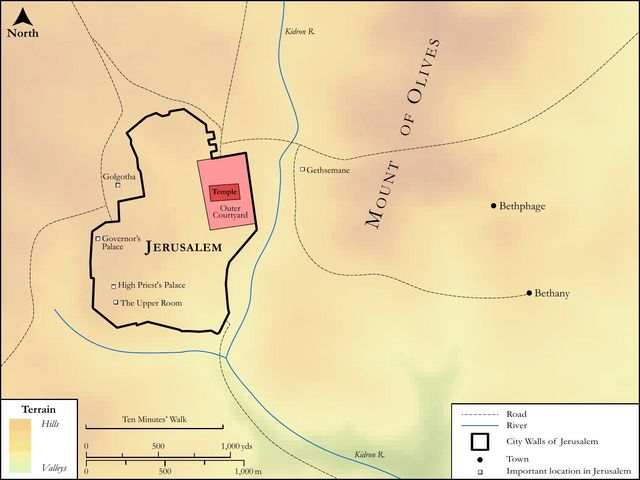
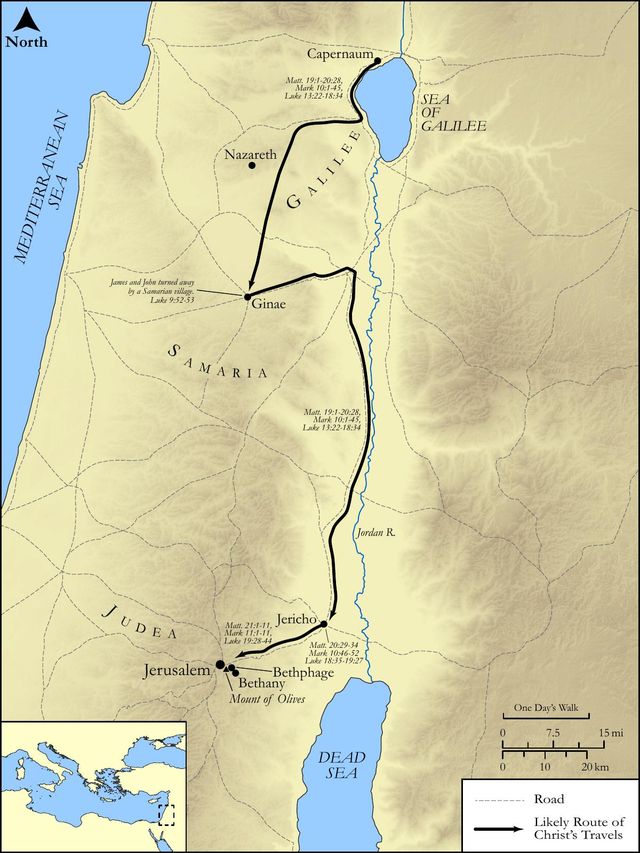
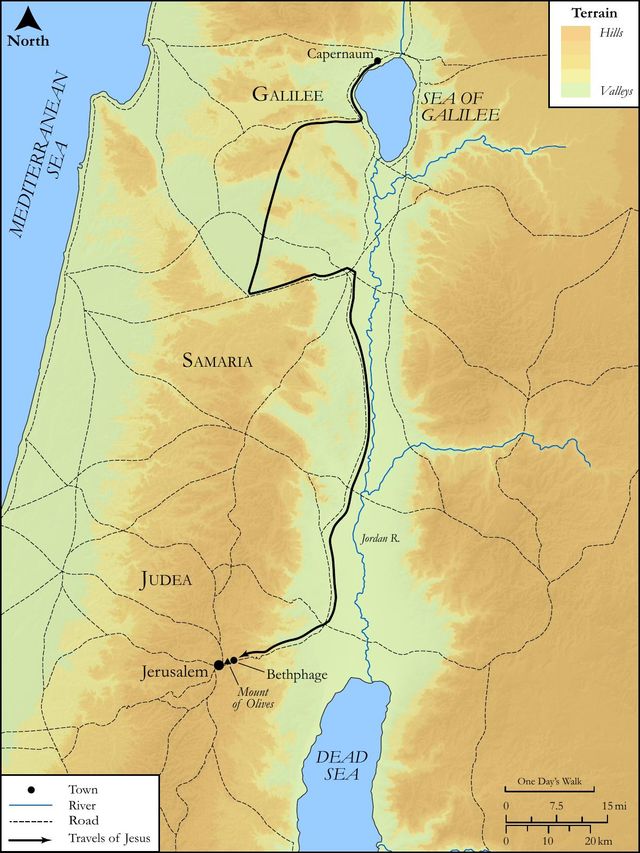
This verse is the immediate prelude to Jesus' Triumphal Entry into Jerusalem, a foundational event marking the commencement of Passion Week. Following His journey from Jericho and the healing of two blind men (Matthew 20:29-34), Jesus and His disciples arrive near Bethphage and Bethany, on the Mount of Olives. The instruction to retrieve the donkeys is not a casual request but a deliberate and significant act, setting the stage for Jesus' public presentation as the long-awaited King of Israel, directly leading into His confrontation with the religious authorities and ultimately, His crucifixion. The narrative in Matthew 21 is structured to emphasize Jesus' authority and the fulfillment of prophecy.
Historical & Cultural Context
In ancient Near Eastern cultures, riding a donkey was a recognized symbol of peace and royalty. Unlike a warhorse, which signified military conquest, a donkey was often associated with kings arriving in peace, as seen with figures like Abraham, Moses, and the judges. Notably, Israelite kings like David and Solomon rode mules, a close relative of the donkey, for their coronations and public appearances. Therefore, Jesus' choice of a donkey was a deliberate, symbolic act. It communicated His kingship, but also the nature of His kingdom—one of peace, humility, and spiritual authority, challenging the popular Jewish expectation of a conquering military Messiah who would overthrow Roman rule. The village mentioned, likely Bethphage, was a small settlement on the eastern slope of the Mount of Olives, just a short distance from Jerusalem.
Key Themes
ShowHideMatthew 21:2 contributes significantly to several key themes within the Gospel. Foremost is Divine Foreknowledge and Sovereignty, as Jesus demonstrates His omniscience by knowing the exact location and circumstances of the animals ("ye shall find an ass tied, and a colt with her"). This powerfully illustrates His complete control over every detail, even seemingly mundane ones, in the unfolding of God's plan. Secondly, it underscores the Fulfillment of Prophecy, particularly Zechariah 9:9, which Matthew explicitly references later in the chapter (Matthew 21:4-5). This emphasis on prophetic fulfillment is crucial for Matthew's Jewish audience, affirming Jesus' identity as the Messiah. Thirdly, the choice of a donkey highlights Humility and Kingship, presenting Jesus not as a worldly conqueror but as a humble, peaceful King whose authority is spiritual rather than earthly. Finally, the Obedience of the Disciples is a subtle but important theme, as their immediate and unquestioning response to Jesus' unusual command demonstrates their faith and submission to His divine authority.
Exposition and Analysis
ShowHideKey Word Analysis
ShowHideThis verb signifies "to bind" or "to tie," often implying a state of restriction or captivity. In this context, it literally describes the physical state of the donkey and colt, but it also subtly highlights Jesus' power to command their release. The fact that they are "tied" makes their immediate availability upon Jesus' command even more miraculous, underscoring His sovereignty over all circumstances.
An adverb meaning "directly," "at once," or "immediately." Its inclusion emphasizes the certainty and immediacy of the disciples' discovery. It reinforces Jesus' precise foreknowledge, indicating that the animals would be found without delay or difficulty, exactly as He described. This word contributes to the sense of divine orchestration and the effortless unfolding of God's plan.
This noun refers to a "foal" or "filly," specifically a young ass. Matthew's unique mention of both the "ass" (female donkey) and the "colt" (young donkey) is significant. While Mark and Luke mention only the colt, Matthew's inclusion of both animals directly corresponds to the dual imagery found in Zechariah 9:9, which speaks of "an ass, and upon a colt the foal of an ass." This detail serves to underscore the precise and complete fulfillment of prophecy, a major theme in Matthew's Gospel.
Verse Breakdown
ShowHide"Saying unto them, Go into the village over against you"
Jesus initiates the action with a direct command to His disciples. The phrase "over against you" indicates a village directly opposite their current position, likely Bethphage. This specificity highlights Jesus' precise knowledge of their surroundings and the exact location where the animals would be found, demonstrating His divine omniscience.
"and straightway ye shall find an ass tied, and a colt with her"
This clause reveals Jesus' foreknowledge in astonishing detail. The use of "straightway" (Greek: euthéōs) emphasizes the immediate and certain nature of their discovery. The mention of both a mature "ass" (female donkey) and a "colt" (young male donkey) is crucial for Matthew, as it directly aligns with the dual imagery of the prophecy in Zechariah 9:9, reinforcing the precise fulfillment of Scripture. The fact that they are "tied" implies a state of readiness, awaiting His command.
"loose [them], and bring [them] unto me"
This is the explicit instruction for the disciples' action. The command to "loose them" implies that the animals were tethered, and their release was necessary for Jesus' purpose. The final directive, "bring them unto me," underscores that these animals were specifically for Jesus' use in His entry, highlighting His authority and the divine purpose behind this seemingly mundane task.
Literary Devices
ShowHideMatthew 21:2 effectively employs several literary devices to convey its profound meaning. Foreshadowing is evident as Jesus' precise instructions and foreknowledge hint at the greater divine plan unfolding, leading to His Passion and resurrection. The very act of commanding the retrieval of the donkey and colt symbolizes Jesus' sovereign authority, not only over animals but over all circumstances, demonstrating His divine nature. The choice of a donkey itself is rich in symbolism, representing peace and humility, contrasting sharply with the worldly expectations of a conquering king on a warhorse. This choice also carries irony, as the King of the Universe chooses the most humble of mounts for His royal procession. Furthermore, the detailed instruction and its immediate fulfillment serve as a form of divine authentication, confirming Jesus' claims and prophetic identity to His disciples and, by extension, to the reader.
Theological and Thematic Connections
ShowHideMatthew 21:2 stands as a powerful testament to the absolute sovereignty and meticulous foreknowledge of Jesus Christ. It demonstrates that not only does God orchestrate grand historical events, but He also attends to the minutiae, down to the location and state of two animals in a small village. This divine precision underscores the reliability of God's prophetic word and the certainty of its fulfillment in Christ. The passage invites believers to trust in a God who is intimately aware of every detail of their lives and whose plans, though sometimes unconventional, are always perfect and purposeful. It also highlights the nature of Christ's kingdom—one established not through worldly power or military might, but through humble service and spiritual authority, fulfilling the ancient vision of a peaceful King.
Reflection and Application
ShowHideMatthew 21:2 offers profound encouragement and practical guidance for contemporary believers. It reminds us that our Lord is not distant or unaware but intimately involved in the details of our lives, possessing perfect foreknowledge and orchestrating events for His divine purposes. Just as Jesus knew exactly where the donkey and colt would be and what their circumstances were, He knows our needs, our struggles, and the precise path for our lives. This should cultivate a deep sense of trust, even when His instructions or the circumstances of our lives seem unusual or unclear. The disciples' immediate and unquestioning obedience serves as a powerful model for our own walk of faith, challenging us to respond with prompt submission to Christ's commands, even when we don't fully understand the "why." Ultimately, reflecting on this verse deepens our understanding of Christ's humble yet sovereign kingship, calling us to align our expectations and desires with the nature of His kingdom—a kingdom of peace, service, and spiritual authority, rather than worldly power.
Questions for Reflection
ShowHideFAQ
ShowHideWhy did Jesus need two animals, an ass and a colt, when the prophecy in Zechariah 9:9 seems to refer to one?
ShowHideMatthew's Gospel uniquely mentions both an "ass" (a female donkey) and a "colt" (a young donkey or foal) in Matthew 21:2. This detail is significant because it directly reflects the poetic parallelism found in the Hebrew text of Zechariah 9:9, which reads: "riding upon an ass, and upon a colt the foal of an ass." While the prophecy can be interpreted as referring to a single animal described with parallel terms, Matthew, writing to a Jewish audience, emphasizes the precise fulfillment of the dual imagery to underscore Jesus' Messiahship. It's plausible that the colt had never been ridden, as mentioned in Mark 11:2 and Luke 19:30, and the mother donkey was brought along to keep the young, unbroken colt calm. This detail further highlights Jesus' miraculous control, as He was able to ride a colt that had never been ridden before.
What is the deeper significance of Jesus riding a donkey rather than a more majestic animal like a horse?
ShowHideJesus' choice to ride a donkey into Jerusalem, rather than a warhorse, carries profound symbolic and theological significance. In ancient cultures, a king riding a warhorse symbolized military conquest and triumph through force, as depicted in Revelation 19:11. However, a king riding a donkey or a mule was a symbol of peace, humility, and righteous kingship, as seen in the coronations of Israelite kings like Solomon (1 Kings 1:33). By choosing a donkey, Jesus deliberately presented Himself as the Prince of Peace, fulfilling the prophecy of Zechariah 9:9-10, who would come "humble, and riding on a donkey." This act underscored the nature of His kingdom: not one built on worldly power, military might, or political overthrow, but one founded on humility, service, and spiritual authority, bringing salvation and peace to humanity. It was a stark contrast to the prevailing Jewish expectation of a conquering Messiah who would liberate them from Roman rule.
Christ-Centered Fulfillment
ShowHideMatthew 21:2, in its detailed account of Jesus' instructions for the donkey and colt, profoundly reveals Christ as the sovereign King, whose every action is purposeful and divinely orchestrated, culminating in His redemptive mission. This passage is not merely about a logistical detail; it is a deliberate unveiling of the Messiah, fulfilling the ancient prophecy of Zechariah 9:9 with precise accuracy. Jesus' foreknowledge of the animals' location and state ("an ass tied, and a colt with her") underscores His omniscience and absolute control, demonstrating that He is indeed God incarnate, the one "upholding all things by the word of His power" (Hebrews 1:3). His humble entry on a donkey, rather than a warhorse, powerfully foreshadows His ultimate mission: to conquer sin and death not through worldly might, but through self-sacrificial love and humility, embodying the very essence of His incarnation where He "emptied himself, by taking the form of a servant" (Philippians 2:7). This event, therefore, points to Christ as the promised King, whose reign is characterized by peace and righteousness, and whose ultimate triumph is achieved through the cross, securing eternal salvation for all who believe, a stark contrast to the worldly kings who enter on steeds of war, as the Lamb of God would later ride forth to ultimate victory (Revelation 19:11-16).