


John 12:17
Bible text: King James Version (1769 Blayney text) · Public domain
Bible text: King James Version with Strong's numbers · Public domain
Bible text: Berean Standard Bible · Public domain
Bible text: American Standard Version (1901) · Public domain
Bible text: World English Bible, Messianic edition · Public domain
Bible text: Geneva Bible (1599) · Public domain
Bible text: Young's Literal Translation · Public domain
- ἘμαρτύρειEmartureiwas bearing witnessG3140V-IAI-3SVerb Imperfect Active Indicative 3rd Singular
- οὖνounthereforeG3767CONJConjunction
- ὁhotheG3588T-NSMDefinite article Nominative Singular Masculine
- ὄχλοςochloscrowdG3793N-NSMNoun Nominative Singular Masculine
- ὁhowhichG3588T-NSMDefinite article Nominative Singular Masculine
- ὢνōnis beingG1510V-PAP-NSMVerb Present Active Participle Nominative Singular Masculine
- μετ᾽met᾽withG3326PREPPreposition
- αὐτοῦautouHimG846P-GSMPersonal pronoun Genitive Singular Masculine
- ὅτεhotewhenG3753CONJConjunction
- τὸνton<the>G3588T-ASMDefinite article Accusative Singular Masculine
- ΛάζαρονLazaronLazarusG2976N-ASM-PNoun Accusative Singular Masculine Individual
- ἐφώνησενephōnēsenHe calledG5455V-AAI-3SVerb Aorist Active Indicative 3rd Singular
- ἐκekout ofG1537PREPPreposition
- τοῦtoutheG3588T-GSNDefinite article Genitive Singular Neuter
- μνημείουmnēmeioutombG3419N-GSNNoun Genitive Singular Neuter
- καὶkaiandG2532CONJConjunction
- ἤγειρενēgeirenraisedG1453V-AAI-3SVerb Aorist Active Indicative 3rd Singular
- αὐτὸνautonhimG846P-ASMPersonal pronoun Accusative Singular Masculine
- ἐκekout fromG1537PREPPreposition
- νεκρῶνnekrōn[the] deadG3498A-GPMAdjective Genitive Plural Masculine
English is a literal word-by-word gloss of the Greek, not the KJV's wording. Why?
This is the original text the KJV's translators worked from — each Greek word with its own literal English meaning in this verse, prepared by scholars at Tyndale House, Cambridge. The KJV translates whole sentences, not word by word, so its wording differs: one Greek word can become several English words, and the KJV may choose “charity” where the gloss reads “love”. Both are faithful — they answer different questions. For the KJV's own rendering, switch to the KJV text.
Details
See on the biblical-era maps
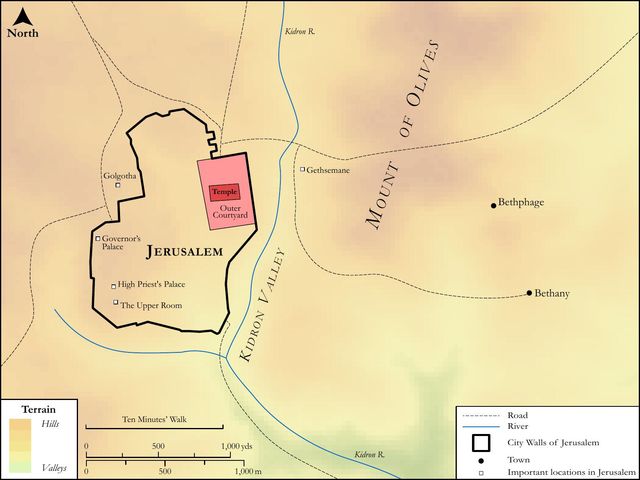
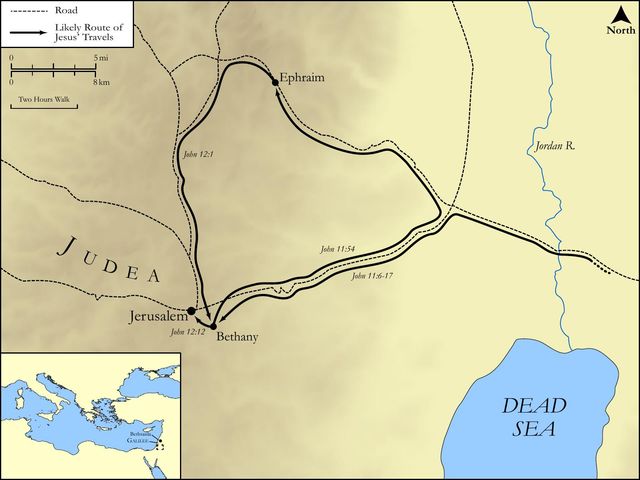
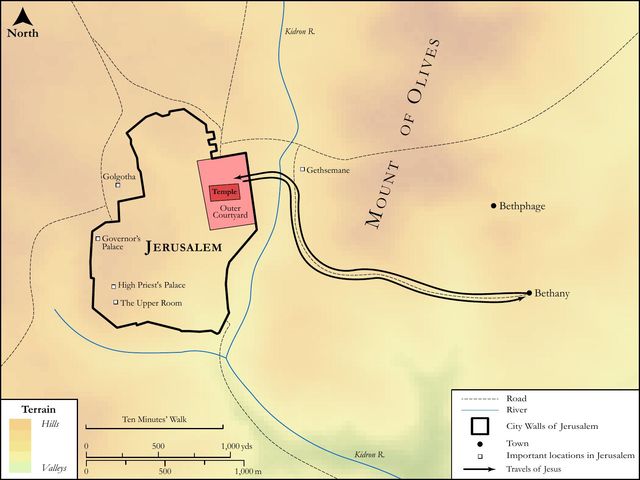
Study this verse
Public-domain commentary
Matthew Henry
From his Commentary on the Whole Bible. Henry comments on passages, not single verses — this entry covers John 12:12–19. His four-level outline is real structure in the source text, so it is rendered as structure.
This story of Christ's riding in triumph to Jerusalem is recorded by all the evangelists, as worthy of special remark; and in it we may observe,
I.The respect that was paid to our Lord Jesus by the common people, Joh 12:12, Joh 12:13, where we are told,
1.Who they were that paid him this respect: much people, ochlos polus - a great crowd of those that came up to the feast; not the inhabitants of Jerusalem, but the country people that came from remote parts to worship at the feast; the nearer the temple of the Lord, the further from the Lord of the temple. They were such as came up to the feast.
(1.)Perhaps they had been Christ's hearers in the country, and great admirers of him there, and therefore were forward to testify their respect to him at Jerusalem, where they knew he had many enemies. Note, Those that have a true value and veneration for Christ will neither be ashamed nor afraid to own him before men in any instance whereby they may do him honour.
(2.)Perhaps they were those more devout Jews that came up to the feast some time before, to purify themselves, that were more inclined to religion than their neighbours, and these were they that were so forward to honour Christ. Note, The more regard men have to God and religion in general, the better disposed they will be to entertain Christ and his religion, which is not destructive but perfective of all previous discoveries and institutions. They were not the rulers, nor the great men, that went out to meet Christ, but the commonalty; some would have called them a mob, a rabble: but Christ has chosen the weak and foolish things (Co1 1:27), and is honoured more by the multitude than by the magnificence of his followers; for he values men by their souls, not their names and titles of honour.
2.On what occasion they did it: They heard that Jesus was coming to Jerusalem. They had enquired for him (Joh 11:55, Joh 11:56): Will he not come up to the feast? And now they hear he is coming; for none that seek Christ seek in vain. Now when they heard he was coming, they bestirred themselves, to give him an agreeable reception. Note, Tidings of the approach of Christ and his kingdom should awaken us to consider what is the work of the day, that it may be done in the day. Israel must prepare to meet their God (Amo 4:12), and the virgins to meet the bridegroom.
3.In what way they expressed their respect; they had not the keys of the city to present to him, nor the sword nor mace to carry before him, none of the city music to compliment him with, but such as they had they gave him; and even this despicable crowd was a faint resemblance of that glorious company which John saw before the throne, and before the Lamb, Rev 7:9, Rev 7:10. Though these were not before the throne, they were before the Lamb, the paschal Lamb, who now, according to the usual ceremony, four days before the feast, was set apart to be sacrificed for us. There it is said of that celestial choir,
(1.)That they had palms in their hands, and so had these branches of palm-trees. The palm-tree has ever been an emblem of victory and triumph; Cicero calls one that had won many prizes plurimarum palmarum homo - a man of many palms. Christ was now by his death to conquer principalities and powers, and therefore it was fit that he should have the victor's palm borne before him; though he was but girding on the harness, yet he could boast as though he had put it off. But this was not all; the carrying of palm-branches was part of the ceremony of the feast of tabernacles (Lev 23:40; Neh 8:15), and their using this expression of joy in the welcome given to our Lord Jesus intimates that all the feasts pointed at his gospel, had their accomplishment in it, and particularly that of the feast of tabernacles, Zac 14:16.
(2.)That they cried with a loud voice, saying, Salvation to our God (Rev 7:10); so did these here, they shouted before him, as is usual in popular welcomes, Hosanna, blessed is the king of Israel, that comes in the name of the Lord; and hosanna signifies salvation. It is quoted from Psa 118:25, Psa 118:26. See how well acquainted these common people were with the scripture, and how pertinently they apply it to the Messiah. High thoughts of Christ will be best expressed in scripture-words. Now in their acclamations,
[1.]They acknowledge our Lord Jesus to be the king of Israel, that comes in the name of the Lord. Though he went now in poverty and disgrace, yet, contrary to the notions their scribes had given them of the Messiah, they own him to be a king, which bespeaks both his dignity and honour, which we must adore; and his dominion and power, to which we must submit. They own him to be, First, A rightful king, coming in the name of the Lord (Psa 2:6), sent of God, not only as a prophet, but as a king. Secondly, The promised and long-expected king, Messiah the prince, for he is king of Israel. According to the light they had, they proclaimed him king of Israel in the streets of Jerusalem; and, they themselves being Israelites, hereby they avouched him for their king.
[2.]They heartily wish well to his kingdom, which is the meaning of hosanna; let the king of Israel prosper, as when Solomon was crowned they cried, God save king Solomon, Kg1 1:39. In crying hosanna they prayed for three things: - First, That his kingdom might come, in the light and knowledge of it, and in the power and efficacy of it. God speed the gospel plough. Secondly, That it might conquer, and be victorious over all opposition, Rev 6:2. Thirdly, That it might continue. Hosanna is, Let the king live for ever; though his kingdom may be disturbed, let it never be destroyed, Psa 72:17.
[3.]They bid him welcome into Jerusalem: "Welcome is he that cometh; we are heartily glad to see him; come in thou blessed of the Lord; and well may we attend with our blessings him who meets us with his." This welcome is like that (Psa 24:7-9), Lift up your heads, O ye gates. Thus we must every one of us bid Christ welcome into our hearts, that is, we must praise him, and be well pleased in him. As we should be highly pleased with the being and attributes of God, and his relation to us, so we should be with the person and offices of the Lord Jesus, and his meditation between us and God. Faith saith, Blessed is he that cometh.
II.The posture Christ puts himself into for receiving the respect that was paid him (Joh 12:14):
When he had found, or procured, a young ass, he sat thereon. It was but a poor sort of figure he made, he alone upon an ass, and a crowd of people about him shouting Hosanna.
1.This was much more of state than he used to take; he used to travel on foot, but now was mounted. Though his followers should be willing to take up with mean things, and not affect any thing that looks like grandeur, yet they are allowed to use the service of the inferior creatures, according as God in his providence gives particular possession of those things over which, by his covenant with Noah and his sons, he has given to man a general dominion.
2.Yet it was much less of state than the great ones of the world usually take. If he would have made a public entry, according to the state of a man of high degree, he should have rode in a chariot like that of Solomon's (Sol 3:9, Sol 3:10), with pillars of silver, the bottom of gold, and the covering of purple; but, if we judge according to the fashion of this world, to be introduced thus was rather a disparagement than any honour to the king of Israel, for it seemed as if he would look great, and knew not how. His kingdom was not of this world, and therefore came not with outward pomp. He was now humbling himself, but in his exalted state John sees him in a vision on a white horse, with a bow and a crown.
III.The fulfilling of the scripture in this:
As it is written, Fear not, daughter of Sion, Joh 12:15. This is quoted from Zac 9:9. To him bore all the prophets witness, and particularly to this concerning him.
1.It was foretold that Zion's king should come, should come thus, sitting on an ass's colt; even this minute circumstance was foretold, and Christ took care it should be punctually fulfilled. Note,
(1.)Christ is Zion's king; the holy hill of Zion was of old destined to be the metropolis or royal city of the Messiah.
(2.)Zion's king does and will look after her, and come to her; though for a short time he retires, in due time he returns.
(3.)Though he comes but slowly (an ass is slow-paced), yet he comes surely, and with such expressions of humility and condescension as greatly encourage the addresses and expectations of his loyal subjects. Humble supplicants may reach to speak with him. If this be a discouragement to Zion, that her king appears in no greater state or strength, let her know that though he comes to her riding on an ass's colt, yet he goes forth against her enemies riding on the heavens for her help, Deu 33:26.
2.The daughter of Zion is therefore called upon to behold her king, to take notice of him and his approaches; behold and wonder, for he comes with observation, though not with outward show, Sol 3:11. Fear not. In the prophecy, Zion is told to rejoice greatly, and to shout, but here it is rendered, Fear not. Unbelieving fears are enemies to spiritual joys; if they be cured, if they be conquered, joy will come of course; Christ comes to his people to silence their fears. If the case be so that we cannot reach to the exultations of joy, yet we should labour to get from under the oppressions of fear. Rejoice greatly; at least, fear not.
IV.The remark made by the evangelist respecting the disciples (Joh 12:16):
They understood not at first why Christ did this, and how the scripture was fulfilled; but when Jesus was glorified, and thereupon the Spirit poured out, then they remembered that these things were written of him in the Old Testament, and that they and others had, in pursuance thereof, done these things to him.
1.See here the imperfection of the disciples in their infant state; even they understood not these things at first. They did not consider, when they fetched the ass and set him thereon, that they were performing the ceremony of the inauguration of Zion's king. Now observe,
(1.)The scripture is often fulfilled by the agency of those who have not themselves an eye to the scripture in what they do, Isa 45:4.
(2.)There are many excellent things, both in the word and providence of God, which the disciples themselves do not at first understand: not at their first acquaintance with the things of God, while they see men as trees walking; not at the first proposal of the things to their view and consideration. That which afterwards is clear was at first dark and doubtful.
(3.)It well becomes the disciples of Christ, when they are grown up to maturity in knowledge, frequently to reflect upon the follies and weaknesses of their first beginning, that free grace may have the glory of their proficiency, and they may have compassion on the ignorant. When I was a child, I spoke as a child.
2.See here the improvement of the disciples in their adult state. Though they had been children, they were not always so, but went on to perfection. Observe,
(1.)When they understood it: When Jesus was glorified; for,
[1.]Till then they did not rightly apprehend the nature of his kingdom, but expected it to appear in external pomp and power, and therefore knew not how to apply the scriptures which spoke of it to so mean an appearance. Note, The right understanding of the spiritual nature of Christ's kingdom, of its powers, glories, and victories, would prevent our misinterpreting and misapplying the scriptures that speak of it.
[2.]Till then the Spirit was not poured out, who was to lead them into all truth. Note, The disciples of Christ are enabled to understand the scriptures by the same Spirit that indited the scriptures. The spirit of revelation is to all the saints a spirit of wisdom, Eph 1:17, Eph 1:18.
(2.)How they understood it; they compared the prophecy with the event, and put them together, that they might mutually receive light from each other, and so they came to understand both: Then remembered they that these things were written of him by the prophets, consonant to which they were done to him. Note, Such an admirable harmony there is between the word and works of God that the remembrance of what is written will enable us to understand what is done, and the observation of what is done will help us to understand what is written. As we have heard, so have we seen. The scripture is every day fulfilling.
V.The reason which induced the people to pay this respect to our Lord Jesus upon his coming into Jerusalem, though the government was so much set against him. It was because of the illustrious miracle he had lately wrought in raising Lazarus.
1.See here what account and what assurance they had of this miracle; no doubt, the city rang of it, the report of it was in all people's mouths. But those who considered it as a proof of Christ's mission, and a ground of their faith in him, that they might be well satisfied of the matter of fact, traced the report to those who were eye-witnesses of it, that they might know the certainty of it by the utmost evidence the thing was capable of: The people therefore that stood by when he called Lazarus out of his grave, being found out and examined, bore record, Joh 12:17. They unanimously averred the thing to be true, beyond dispute or contradiction, and were ready, if called to it, to depose it upon oath, for so much is implied in the word Emarturei. Note, The truth of Christ's miracles was evidenced by incontestable proofs. It is probable that those who had seen this miracle did not only assert it to those who asked them, but published it unasked, that this might add to the triumphs of this solemn day; and Christ's coming in now from Bethany, where it was done, would put them in mind of it. Note, Those who wish well to Christ's kingdom should be forward to proclaim what they know that may redound to his honour.
2.What improvement they made of it, and what influence it had upon them (Joh 12:18): For this cause, as much as any other, the people met him.
(1.)Some, out of curiosity, were desirous to see one that had done such a wonderful work. Many a good sermon he had preached in Jerusalem, which drew not such crowds after him as this one miracle did. But,
(2.)Others, out of conscience, studied to do him honour, as one sent of God. This miracle was reserved for one of the last, that it might confirm those which went before, and might gain him this honour just before his sufferings; Christ's works were all not only well done (Mar 7:7) but well timed.
VI.The indignation of the Pharisees at all this; some of them, probably, saw, and they all soon heard of, Christ's public entry.
The committee appointed to find out expedients to crush him thought they had gained their point when he had retired unto privacy, and that he would soon be forgotten in Jerusalem, but they now rage and fret when they see they imagined but a vain thing.
1.They own that they had got no ground against him; it was plainly to be perceived that they prevailed nothing. They could not, with all their insinuations, alienate the people's affections from him, nor with their menaces restrain them from showing their affection to him. Note, Those who oppose Christ, and fight against his kingdom, will be made to perceive that they prevail nothing. God will accomplish his own purposes in spite of them, and the little efforts of their impotent malice. You prevail nothing, ouk ōpheleite - you profit nothing. Note, There is nothing got by opposing Christ.
2.They own that he had got ground: The world is gone after him; there is a vast crowd attending him, a world of people: an hyperbole common in most languages. Yet here, like Caiaphas, ere they were aware, they prophesied that the world would go after him; some of all sorts, some from all parts; nations shall be discipled. But to what intent was this said?
(1.)Thus they express their own vexation at the growth of his interest; their envy makes them fret. If the horn of the righteous be exalted with honour, the wicked see it, and are grieved (Psa 112:9, Psa 112:10); considering how great these Pharisees were, and what abundance of respect was paid them, one would think they needed not grudge Christ so inconsiderable a piece of honour as was now done him; but proud men would monopolize honour, and have none share with them, like Haman.
(2.)Thus they excite themselves and one another, to a more vigorous carrying on of the war against Christ. As if they should say, "Dallying and delaying thus will never do. We must take some other and more effectual course, to put a stop to this infection; it is time to try our utmost skill and force, before the grievance grows past redress." Thus the enemies of religion are made more resolute and active by being baffled; and shall its friends be disheartened with every disappointment, who know its cause is righteous and will at last be victorious?
Historical interpretation
Seven Centuries of Reception
7 surviving comments on this verse. Each one is dated, so this reads as a timeline rather than a list.
Select a marker to jump to its quote. Markers stagger vertically where authors wrote within a few decades of each other.
Since through Adam death came, which subjected everyone, they had heard through their prophets and believed that death would be defeated. When they saw that this had been done by our Lord, who raised a man dead for four days, they took branches of palm trees and went out to meet him as the victor over death, which oppresses humankind, and praised him with appropriate hymns. Since the Pharisees did not like this, they reproached them by saying that they followed him in vain, but it was their reproach that was in vain, since all the people went after him anyway.
"The people, therefore, that was with Him when He called Lazarus out of his tomb, and raised him from the dead, bare record. For this cause the crowd also met Him, for that they heard that He had done this miracle. The Pharisees, therefore, said among themselves: Perceive ye that we prevail nothing? Behold, the whole world is gone after Him." Mob set mob in motion. "But why art thou, blinded mob that thou art, filled with envy because the world has gone after its Maker?"
(Tr. li. 7) The crowd was disturbed by the crowd. (Turba turbavit turbam) But why grudgeth that blind crowd, that the world should go after Him, by Whom the world was made?
The gathering of the common people, having heard what had happened, were readily persuaded by those who had witnessed that the Christ had raised Lazarus to life and annulled the power of death, as the prophets said. This is why they too went and met him.
So tell me, where did you learn that you did not belong to those who are foreknown and predestined to become conformed to the image of God’s glory? Tell me, who told you this? Was it, maybe, God Who announced this to you, Himself, or by one of His prophets, or through an angel? “No,” you say, “but I do suppose that I am not predestined to salvation, and that all my effort would be in vain.” And why do you not believe instead with all your soul that God has sent His only-begotten Son on the earth for your sake alone, and for your salvation, that He knew you beforehand and predestined you to become His brother and co-heir? Why are you not eager to love Him with all your heart and to honor His saving commandments? Why do you not rather believe that, having been slaughtered for your sake, He will never abandon you, nor allow you to perish? Do you not hear Him saying: “Can a woman forget her suckling child . . . yet I will not forget you” [Isaiah 49:15]? So, if by anticipation you judge yourself unworthy, and willfully separate yourself from the flock of Christ’s sheep, you should understand that it is none other than you who are the cause of your own damnation.
Therefore, casting out of our souls all faithlessness, sloth, and hesitation, let us draw near with all our heart, with unhesitating faith and burning desire, like slaves who have been newly purchased with precious blood. Indeed, with reverence for the price paid on our behalf, and with love for our Master Who paid it, and as having accepted His love for us, let us recognize that, if He had not wished to save by means of Himself us who have been purchased, He would not have come down to earth, nor would He have been slain for our sake. But, as it is written, He has done this because He wills that all should be saved. Listen to Him say it Himself: “I did not come to judge the world, but to save the world” (John 12:17). - "Second Ethical Discourse"
The Evangelist is saying that the people who saw the miracle which He worked for Lazarus were witnesses and heralds of His power. This is why He was met with glory by the people who had heard, that is, believed, that He had done this miracle. If they had not believed, they would not have congregated so swiftly.
See then the consequences of our Lord's passion. It was not to no purpose that He had reserved His greatest miracle for the last. For the resurrection of Lazarus it was that made the crowd believe in Him. The people therefore that was with Him when He called Lazarus out of his grave, and raised him from the dead, bare record. For this cause the people also met Him, for that they heard that He had done this miracle. Hence the spite and plotting of the Pharisees: The Pharisees therefore said among themselves, Perceive ye how ye prevail nothing? behold the world is gone after Him.
As if they said, The more you attack Him, the more will His power and reputation increase. What use then of these attempts?
Continue studying John 12:17 across the web’s major study libraries — every link below opens this exact verse, chapter, or book on the destination site.
Read & Compare
 BibleGatewayThis verse in more than 200 translations and 70 languages.
 Bible.comThe YouVersion reader — hundreds of translations, reading plans, and highlights.
 ESV.orgCrossway's official English Standard Version reader.
 NET BibleThe NET translation with 60,000+ translators' notes on every rendering decision.
 STEP BibleTyndale House's free study tool — original text, vocabulary, and scholarly resources.
 BibliaLogos Bible Software's free web reader.
 USCCBThe New American Bible (Revised Edition) with the U.S. bishops' study notes.
Commentaries
 BibleHub CommentariesDozens of classic commentaries on this verse, gathered on one page.
 StudyLightMore than 100 commentary sets — the largest collection on the web.
 BibleRefPlain-English commentary on what this verse means, verse by verse.
 Enduring WordDavid Guzik's free commentary on this chapter, widely used by Bible teachers.
 Bible Study ToolsVerse commentary alongside Greek and Hebrew study aids.
Original Language & Research
- BibleHub InterlinearThe verse word by word — original language, transliteration, and English.
- BibleHub LexiconEvery word's original-language definition and Strong's entry.
 Blue Letter BibleDeep-study tools — Strong's numbers, concordance, and word studies.
 CNTR CollationThe earliest Greek manuscripts of this verse, collated letter by letter.
Sermons, Hymns & Audio


TrulyRandomVerse is not affiliated with these sites and doesn’t control their content. They’re linked because they’re genuinely useful.
Summary
John 12:17 provides a crucial explanation for the large crowds that greeted Jesus upon His entry into Jerusalem, directly linking their fervent reception to the widely witnessed miracle of Lazarus's resurrection. It underscores the powerful impact of eyewitness testimony concerning Christ's authority over life and death, setting the stage for the dramatic events of Passion Week and highlighting the public's burgeoning recognition of Jesus as a figure of immense significance.
Context
ShowHideLiterary Context
This verse immediately follows the account of Jesus' triumphal entry into Jerusalem, as described in John 12:12-16. The preceding narrative in John 11 details the astonishing resurrection of Lazarus, a pivotal event that profoundly impacted both Jesus' followers and His adversaries. The crowd mentioned in John 12:17 is explicitly identified as those who were present during this miracle, establishing a direct causal link between their witnessing of Lazarus's raising and their enthusiastic welcome of Jesus. This verse serves as an explanatory bridge, clarifying why such a large multitude gathered and celebrated Jesus, emphasizing the undeniable evidence of His divine power. It also sets up the subsequent discussion among the Pharisees, who lament that "the whole world has gone after him" (John 12:19).
Historical & Cultural Context
The setting is just outside Jerusalem, specifically Bethany, where Lazarus lived, and then on the road leading into the city. The timing is crucial: it is shortly before Passover, a major pilgrimage festival that drew vast numbers of Jews to Jerusalem from all over the Roman world. This influx of people created a highly charged atmosphere, ripe for messianic expectation and political fervor. The miracle of Lazarus's resurrection, performed publicly and undeniably, would have spread like wildfire among these pilgrims. Jewish culture placed a high value on eyewitness testimony for validating claims and events, especially those of a miraculous nature. The fact that Lazarus had been dead for four days (John 11:39) was significant, as it was widely believed that the soul departed the body after three days, thus precluding any natural resuscitation. This made the miracle even more irrefutable and astounding to the Jewish populace, directly challenging the dominion of death.
Key Themes
ShowHideJohn 12:17 contributes significantly to several major themes in John's Gospel. Foremost is the authority and identity of Jesus as the Son of God, particularly His power over life and death, supremely demonstrated in the raising of Lazarus. This miracle serves as a tangible sign, confirming Jesus' declaration in John 11:25, "I am the resurrection and the life." Another key theme is the importance of eyewitness testimony in establishing truth and fostering belief. The crowd's "record" or testimony is presented as a powerful, organic form of evangelism, validating Jesus' claims and drawing others to Him. This contrasts sharply with the unbelief and plotting of the religious authorities, who, despite the overwhelming evidence, sought to kill both Jesus and Lazarus (John 11:47-53 and John 12:10-11). The verse also highlights the growing public recognition of Jesus, which, while celebratory for the crowds, intensified the opposition from the Jewish leaders, ultimately leading to the Passion.
Exposition and Analysis
ShowHideKey Word Analysis
ShowHideThis word (G5455) means "to emit a sound," "to address in words or by name," or "to call." In the context of Lazarus, it highlights Jesus' authoritative command. It wasn't a plea or a request, but a powerful, life-giving summons that penetrated the grave and brought the dead to life. This emphasizes Jesus' inherent authority over death, as the very sound of His voice carries creative and restorative power, echoing the divine word that brought creation into being.
This term (G1453) signifies "to waken," "to rouse," or "to lift up." It is used here to describe the act of bringing Lazarus back from the state of death. The choice of this verb underscores the active, powerful intervention of Jesus. It's not a passive reanimation but a dynamic, purposeful act of raising someone from a state of non-existence or profound inactivity. This verb is also frequently used to describe Jesus' own resurrection, creating a thematic link between Lazarus's raising and Christ's ultimate victory over the grave.
This verb (G3140) means "to be a witness," "to testify," or "to give evidence." It implies a formal, authoritative declaration, not mere gossip. The people who "bare record" were not simply recounting a story; they were actively affirming the truth of what they had seen, serving as living, credible witnesses to a profound divine act. This concept of bearing witness is central to John's Gospel, where the testimony of various individuals (John the Baptist, the Samaritan woman, the disciples) validates Jesus' identity and mission.
Verse Breakdown
ShowHide"The people therefore that was with him"
This clause identifies the specific group of individuals whose testimony is central to the verse. They are not just any crowd, but those who had direct, personal experience with Jesus during the miraculous event. The "therefore" (G3767, oûn) indicates a logical consequence, linking their presence at the miracle to their subsequent action of bearing witness.
"when he called Lazarus out of his grave"
This specifies the precise event that these people witnessed. The emphasis is on Jesus' direct action—His "calling" (G5455, phōnéō)—and the dramatic location, "out of his grave" (G1537, ek G3419, mnēmeîon). This highlights the public and undeniable nature of the miracle, as Lazarus emerged from a tomb, a place of certain death.
"and raised him from the dead"
This phrase further elaborates on the miracle, emphasizing the outcome of Jesus' call. Lazarus was not merely revived from a coma but "raised" (G1453, egeírō) "from the dead" (G1537, ek G3498, nekrós), signifying a complete reversal of death's dominion. This clause underscores the magnitude of the event, confirming Jesus' power over the ultimate human enemy.
"bare record"
This final clause describes the active response of the eyewitnesses. To "bare record" (G3140, martyréō) means to testify or give evidence. It implies a deliberate and public declaration of what they had seen, serving as living proof of Jesus' divine power. Their testimony was not passive observation but an active proclamation that fueled the public's excitement and recognition of Jesus.
Literary Devices
ShowHideThe primary literary device at play in John 12:17 is Eyewitness Testimony. The narrative explicitly highlights the presence of those who "was with him" during the raising of Lazarus, emphasizing their direct observation of the miracle. This device functions to establish the veracity and irrefutability of the event, lending credibility to Jesus' divine power. The phrase "bare record" underscores the active role of these witnesses in disseminating the truth, functioning as a form of Narrative Emphasis on the power of personal witness. The verse also employs Cause and Effect, directly linking the witnessed miracle to the crowd's subsequent actions and the widespread public attention Jesus received, thereby explaining the fervor of the Triumphal Entry.
Theological and Thematic Connections
ShowHideJohn 12:17 profoundly illustrates the power of divine action witnessed by humanity and the subsequent human response of testimony. The resurrection of Lazarus was not merely a display of power, but a sign pointing to Jesus' identity as the Lord of life, the one who holds dominion over death itself. This event, and the public's "bearing record" of it, served as a crucial catalyst in the unfolding of God's redemptive plan, drawing vast numbers to Jesus just before His crucifixion. It underscores the biblical principle that God often works through visible signs and human witnesses to reveal His truth and invite belief. The widespread testimony created a groundswell of public opinion that the religious authorities could not ignore, forcing their hand in the events leading to the cross.
Reflection and Application
ShowHideJohn 12:17 offers a powerful reminder of the enduring significance of personal testimony in the Christian faith. Just as the crowd who witnessed Lazarus's resurrection became living advertisements for Christ's power, so too are believers called to share their own experiences of God's transforming work. Our testimonies are not merely stories; they are powerful, Spirit-anointed declarations of what we have seen, heard, and experienced of Jesus Christ. They are tangible evidence of His living presence and active power in the world today. This verse challenges us to consider: Are we actively "bearing record" of the miracles, big and small, that God has performed in our lives? Is our witness compelling enough to draw others to inquire about the source of our hope? The truth of the Gospel is not abstract doctrine alone, but a living reality grounded in the historical acts of Jesus and His ongoing work through His Spirit.
Questions for Reflection
ShowHideFAQ
ShowHideWhy was the resurrection of Lazarus so significant compared to other miracles Jesus performed?
ShowHideThe resurrection of Lazarus was uniquely significant for several reasons. Firstly, it was performed after Lazarus had been dead for four days (John 11:39), a period culturally understood to signify irreversible death, thus eliminating any possibility of a natural explanation or a mere coma. Secondly, it was a highly public miracle, witnessed by many Jews who had come to mourn with Mary and Martha (John 11:19). This widespread witnessing led directly to the public testimony mentioned in John 12:17 and fueled the fervor of the Triumphal Entry. The miracle solidified Jesus' claim as "the resurrection and the life" (John 11:25) in a dramatic, undeniable way, forcing the religious authorities to confront His growing influence and ultimately leading to their decision to put Him to death (John 11:47-53).
Christ-Centered Fulfillment
ShowHideThe resurrection of Lazarus, and the crowd's subsequent testimony in John 12:17, serves as a powerful foreshadowing and demonstration of Christ's ultimate victory over death, culminating in His own resurrection. While Lazarus was raised to mortal life and would eventually die again, Jesus' resurrection was a unique, eternal triumph, securing victory over sin and death for all who believe. The "record" borne by the crowd about Lazarus points forward to the far greater "record" that the apostles would bear about Jesus' own resurrection, which became the cornerstone of the early Christian message (Acts 2:24). Jesus' call to Lazarus, "Lazarus, come forth!" (John 11:43), echoes the future call that will raise all believers from their graves at the last day, for "the hour is coming in which all who are in the graves will hear His voice and come forth" (John 5:28-29). Thus, Lazarus's resurrection is a tangible sign of Jesus' divine power as the Giver of life, a power fully realized and eternally secured through His death and glorious resurrection, offering hope and new life to all who trust in Him (Romans 6:4).