


Mark 10:32
- ἮσανĒsanThey wereG1510V-IAI-3PVerb Imperfect Active Indicative 3rd Plural
- δὲdethenG1161CONJConjunction
- ἐνenonG1722PREPPreposition
- τῇtēatheG3588T-DSFDefinite article Dative Singular Feminine
- ὁδῷhodōwayG3598N-DSFNoun Dative Singular Feminine
- ἀναβαίνοντεςanabainontesgoing upG305V-PAP-NPMVerb Present Active Participle Nominative Plural Masculine
- εἰςeistoG1519PREPPreposition
- ἹεροσόλυμαHi'erosolumaJerusalemG2414N-APN-LNoun Accusative Plural Neuter Location
- καὶkaiandG2532CONJConjunction
- ἦνēnwasG1510V-IAI-3SVerb Imperfect Active Indicative 3rd Singular
- προάγωνproagōngoing on beforeG4254V-PAP-NSMVerb Present Active Participle Nominative Singular Masculine
- αὐτοὺςautousthemG846P-APMPersonal pronoun Accusative Plural Masculine
- ὁho<the>G3588T-NSMDefinite article Nominative Singular Masculine
- ἸησοῦςIēsousJesusG2424N-NSM-PNoun Nominative Singular Masculine Individual
- καὶkaiandG2532CONJConjunction
- ἐθαμβοῦντο·ethambountothey were astonishedG2284V-IPI-3PVerb Imperfect Passive Indicative 3rd Plural
- δὲdethenG1161CONJConjunction
- ἀκολουθοῦντεςakolouthountesfollowingG190V-PAP-NPMVerb Present Active Participle Nominative Plural Masculine
- ἐφοβοῦντοephobountowere afraidG5399V-INI-3PVerb Imperfect Middle Or Passive Deponent Indicative 3rd Plural
- ΚαὶKaiAndG2532CONJConjunction
- παραλαβὼνparalabōnhaving brought to [Himself]G3880V-2AAP-NSMVerb 2nd Aorist Active Participle Nominative Singular Masculine
- πάλινpalinagainG3825ADVAdverb
- τοὺςtoustheG3588T-APMDefinite article Accusative Plural Masculine
- δώδεκαdōdekaTwelveG1427A-NUIAdjective
- ἤρξατοērxatoHe beganG757V-ADI-3SVerb Aorist Middle Deponent Indicative 3rd Singular
- αὐτοῖςautoisthemG846P-DPMPersonal pronoun Dative Plural Masculine
- λέγεινlegeinto tellG3004V-PANVerb Present Active Infinitive
- τὰtathe [things]G3588T-APNDefinite article Accusative Plural Neuter
- μέλλονταmellontaare being soonG3195V-PAP-APNVerb Present Active Participle Accusative Plural Neuter
- αὐτῷautōto HimG846P-DSMPersonal pronoun Dative Singular Masculine
- συμβαίνεινsumbaineinto happenG4819V-PANVerb Present Active Infinitive
English is a literal word-by-word gloss of the Greek, not the KJV's wording. Why?
This is the original text the KJV's translators worked from — each Greek word with its own literal English meaning in this verse, prepared by scholars at Tyndale House, Cambridge. The KJV translates whole sentences, not word by word, so its wording differs: one Greek word can become several English words, and the KJV may choose “charity” where the gloss reads “love”. Both are faithful — they answer different questions. For the KJV's own rendering, switch to the KJV text.
Details
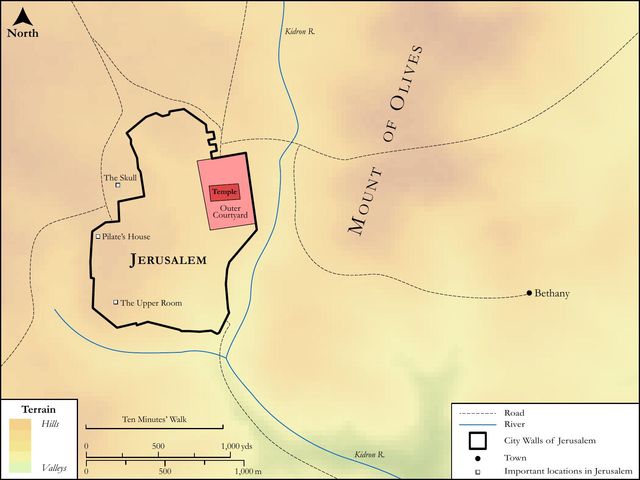
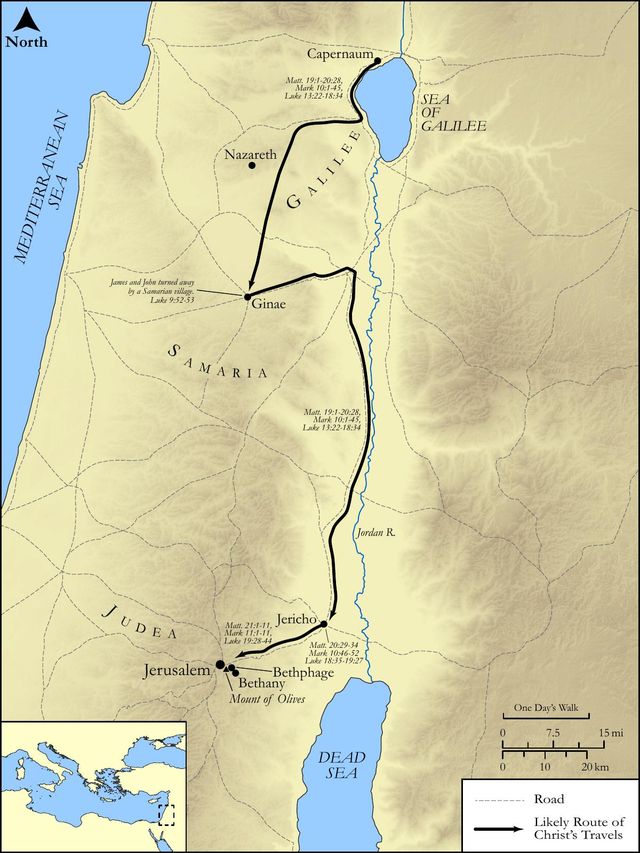
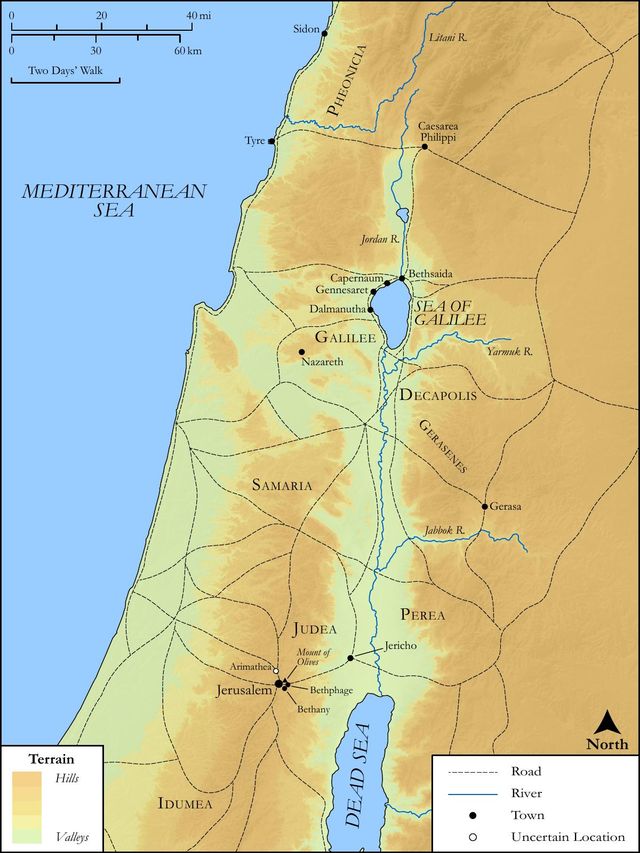
See on the biblical-era map
Study this verse
Public-domain commentary
Matthew Henry
From his Commentary on the Whole Bible. Henry comments on passages, not single verses — this entry covers Mark 10:32–45. His three-level outline is real structure in the source text, so it is rendered as structure.
Here is, I. Christ's prediction of his own sufferings; this string he harped much upon, though in the ears of his disciples it sounded very harsh and unpleasing.
1.See here how bold he was; when they were going up to Jerusalem, Jesus went before them, as the captain of our salvation, that was now to be made perfect through sufferings, Mar 10:32. Thus he showed himself forward to go on with his undertaking, even when he came to the hardest part of it. Now that the time was at hand, he said, Lo, I come; so far was he from drawing back, that now, more than ever, he pressed forward. Jesus went before them, and they were amazed. They began now to consider what imminent danger they ran themselves into, when they went to Jerusalem; how very malicious the Sanhedrim which sat there was against their Master and them; and they were ready to tremble at the thought of it. To hearten them, therefore, Christ went before them. "Come," saith he, "surely you will venture where your Master ventures." Note, When we see ourselves entering upon sufferings, it is encouraging to see our Master go before us. Or, He went before them, and therefore they were amazed; they admired to see with what cheerfulness and alacrity he went on, though he knew he was going to suffer and die. Note, Christ's courage and constancy in going on with his undertaking for our salvation, are, and will be, the wonder of all his disciples.
2.See here how timorous and faint-hearted his disciples were; As they followed, they were afraid, afraid for themselves, as being apprehensive of their own danger; and justly might they be ashamed of their being thus afraid. Their Master's courage should have put spirit into them.
3.See here what method he took to silence their fears. He did not go about to make the matter better than it was, nor to feed them with hopes that he might escape the storm, but told them again what he had often told them before, the things that should happen to him. He knew the worst of it, and therefore went on thus boldly, and he will let them know the worst of it. Come, be not afraid; for,
(1.)There is no remedy, the matter is determined, and cannot be avoided.
(2.)It is only the Son of man that shall suffer; their time of suffering was now at hand, he will now provide for their security.
(3.)He shall rise again; the issue of his sufferings will be glorious to himself, and advantageous to all that are his, Mar 10:33, Mar 10:34. The method and particulars of Christ's sufferings are more largely foretold here than in any other of the predictions - that he shall first be delivered up by Judas to the chief priests and the scribes; that they shall condemn him to death, but, not having the power to put him to death, shall deliver him to the Gentiles, to the Roman powers, and they shall mock him, and scourge him, and spit upon him, and kill him. Christ had a perfect foresight, not only of his own death, but of all the aggravating circumstances of it; and yet he thus went forth to meet it.
II.The check he gave to two of his disciples for their ambitious request.
This story is much the same here as we had it Mat 20:20. Only there they are said to have made their request by their mother, here they are said to make it themselves; she introduced them, and presented their petition, and then they seconded it, and assented to it.
Note, 1. As, on the one hand, there are some that do not use, so, on the other hand, there are some that abuse, the great encouragements Christ has given us in prayer. He hath said, Ask, and it shall be given you; and it is a commendable faith to ask for the great things he has promised; but it was a culpable presumption in these disciples to make such a boundless demand upon their Master; We would that thou shouldest do for us whatsoever we shall desire. We had much better leave it to him to do for us what he sees fit, and he will do more than we can desire, Eph 3:20.
2.We must be cautious how we make general promises. Christ would not engage to do for them whatever they desired, but would know from them what it was they did desire; What would ye that I should do for you? He would have them go on with their suit, that they might be made ashamed of it.
3.Many have been led into a snare by false notions of Christ's kingdom, as if it were of this world, and like the kingdoms of the potentates of this world. James and John conclude, If Christ rise again, he must be a king, and if he be a king, his apostles must be peers, and one of these would willingly be the Primus par regni - The first peer of the realm, and the other next him, like Joseph in Pharaoh's court, or Daniel in Darius's.
4.Worldly honour is a glittering thing, with which the eyes of Christ's own disciples have many a time been dazzled. Whereas to be good should be more our care than to look great, or to have the pre-eminence.
5.Our weakness and short-sightedness appear as much in our prayers as in any thing. We cannot order our speech, when we speak to God, by reason of darkness, both concerning him and concerning ourselves. It is folly to prescribe to God, and wisdom to subscribe.
6.It is the will of Christ that we should prepare for sufferings, and leave it to him to recompense us for them. He needs not be put in mind, as Ahasuerus did, of the services of his people, nor can he forget their work of faith and labour of love. Our care must be, that we may have wisdom and grace to know how to suffer with him, and then we may trust him to provide in the best manner how we shall reign with him, and when, and where, and what, the degrees of our glory shall be.
III.The check he gave to the rest of the disciples, for their uneasiness at it.
They began to be much displeased, to have indignation about James and John, Mar 10:41. They were angry at them for affecting precedency, not because it did so ill become the disciples of Christ, but because each of them hoped to have it himself. When the Cynic trampled on Alexander's foot-cloth, with Calco fastum Alexandri - Now I tread on Alexander's pride, he was seasonably checked with Sed majori fastu - But with a greater pride of thine own. So these discovered their own ambition, in their displeasure at the ambition of James and John; and Christ took this occasion to warn them against it, and all their successors in the ministry of the gospel, Mar 10:42-44. He called them to him in a familiar way, to give them an example of condescension, then when he was reproving their ambition, and to teach them never to bid their disciples keep their distance. He shows them,
1.That dominion was generally abused in the world (Mar 10:42); That they seemed to rule over the Gentiles, that have the name and title of rulers, they exercise lordship over them, that is all they study and aim at, not so much to protect them, and provide for their welfare, as to exercise authority upon them; they will be obeyed, aim to be arbitrary, and to have their will in every thing. Sic volo, sic jubeo, stat pro ratione voluntas - Thus I will, thus I command; my good pleasure is my law. Their care is, what they shall get by their subjects to support their own pomp and grandeur, not what they shall do for them.
2.That therefore it ought not to be admitted into the church; "It shall not be so among you; those that shall be put under your charge, must be as sheep under the charge of the shepherd, who is to tend them and feed them, and be a servant to them, not as horses under the command of the driver, that works them and beats them, and gets his pennyworths out of them. He that affects to be great and chief, that thrusts himself into a secular dignity and dominion, he shall be servant of all, he shall be mean and contemptible in the eyes of all that are wise and good; he that exalteth himself shall be abased." Or rather, "He that would be truly great and chief, he must lay out himself to do good to all, must stoop to the meanest services, and labour in the hardest services. Those not only shall be most honoured hereafter, but are most honourable now, who are most useful." To convince them of this, he sets before them his own example (Mar 10:45); "The Son of man submits first to the greatest hardships and hazards, and then enters into his glory, and can you expect to come to it any other way; or to have more ease and honour than he has?" (1.) He takes upon him the form of a servant, comes not to be ministered to, and waited upon, but to minister, and wait to be gracious. (2.) He comes obedient to death, and to its dominion, for he gives his life a ransom for many; did he die for the benefit of good people, and shall not we study to live for their benefit?
Historical interpretation
Nine Centuries of Reception
7 surviving comments on this verse. Each one is dated, so this reads as a timeline rather than a list.
Select a marker to jump to its quote. Markers stagger vertically where authors wrote within a few decades of each other.
(Vict. Ant. e Cat. in Marc. sed v. Chrys. Hom. 65) And He enumerates each thing that was to happen to Him; lest if He should pass any thing over, they should be troubled afterwards at suddenly seing it; wherefore he adds, Behold, we go up to Jerusalem, and the Son of Man.
(Hom. in Matt. 65) But that when they were saddened on account of His Passion and death, they should then also look for His resurrection, He adds, And the third day he shall rise again; for since He had not hid from them the sorrows and insults which happened, it was fitting that they should believe Him on other points.
Our Redeemer, foreseeing that the souls of the disciples would be troubled by His passion, foretold to them long beforehand both the suffering of that same passion and the glory of His resurrection, so that when they saw Him dying, as had been predicted, they would not doubt that He would also rise again. But because the disciples, still carnal, were by no means able to grasp the words of the mystery, a miracle is performed. Before their eyes a blind man receives light, so that those who could not grasp the words of the heavenly mystery might be strengthened in faith by heavenly deeds.
And taking the twelve again, he began to tell them what was going to happen to him. 'Behold, we are going up to Jerusalem, and the Son of Man will be delivered to the chief priests and the scribes, and they will condemn him to death, and will deliver him to the Gentiles, and they will mock him, and will spit on him, and will scourge him, and will kill him, and after three days he will rise again.' Our Redeemer, foreseeing that his passion would disturb the spirits of his disciples, foretold to them both the penalty of his passion and the glory of his resurrection well in advance, so that when they saw him dying (as had been foretold), they might not doubt that he would also rise again. Here he most clearly refutes the madness of the pagans, who are accustomed to ridicule his cross, when he shows both the time of his approaching passion as if he were foreseeing future events, and approaches the place of his death as if he were unafraid."
(ubi sup.) The disciples remembered the discourse in which the Lord had foretold that He was about to suffer many things from the chief priests and scribes, and therefore in going up to Jerusalem, they were amazed. And this is what is meant, when it is said, And they were in the way going up to Jerusalem, and Jesus went before them.
(ubi sup.) Either lest they themselves should perish with Him, or at all events lest He, whose life and ministry was their joy, should fall under the hand of His enemies. But the Lord, foreseeing that the minds of His disciples would be troubled by His Passion, foretels to them both the pain of His Passion, and the glory of His resurrection; wherefore there follows, And he took again the twelve, and began to tell them what things should happen unto him.
And they were on the way going up to Jerusalem, and Jesus was going ahead of them, and they were amazed, and those who followed were afraid. Therefore, the disciples, proceeding with the Lord towards Jerusalem, were amazed and afraid because they remembered his word in which he had predicted that he would suffer much from the chief priests and scribes and would be killed, fearing that they themselves might be killed with him, or at least that he whose life and teaching they rejoiced in, would fall into the hands of his enemies.
To show that He runs to meet His Passion, and that He does not refuse death, for the sake of our salvation; and they were amazed, and as they followed, they were afraid.
He did this to confirm the hearts of the disciples, that from hearing these things beforehand, they might the better bear them afterwards, and might not be alarmed at their suddenness, and also in order to show them that He suffered voluntarily; for he who foreknows a danger, and flies not, though flight is in his power, evidently of his own will gives himself up to suffering. But He takes His disciples apart, because it was fitting that He should reveal the mystery of His Passion to those who were more closely connected with Him.
(interlin.) That is, He to whom suffering belongs; for the Godhead cannot suffer. Shall be delivered, that is, by Judas, unto the Chief Priests, and unto the Scribes, and they shall condemn him to death; judging Him to be guilty of death; and shall deliver him to the Gentiles, that is, to Pilate the Gentile; and his soldiers shall mock him, and shall spit upon him, and scourge him, and put him to death.
Continue studying Mark 10:32 across the web’s major study libraries — every link below opens this exact verse, chapter, or book on the destination site.
Read & Compare
 BibleGatewayThis verse in more than 200 translations and 70 languages.
 Bible.comThe YouVersion reader — hundreds of translations, reading plans, and highlights.
 ESV.orgCrossway's official English Standard Version reader.
 NET BibleThe NET translation with 60,000+ translators' notes on every rendering decision.
 STEP BibleTyndale House's free study tool — original text, vocabulary, and scholarly resources.
 BibliaLogos Bible Software's free web reader.
 USCCBThe New American Bible (Revised Edition) with the U.S. bishops' study notes.
Commentaries
 BibleHub CommentariesDozens of classic commentaries on this verse, gathered on one page.
 StudyLightMore than 100 commentary sets — the largest collection on the web.
 BibleRefPlain-English commentary on what this verse means, verse by verse.
 Enduring WordDavid Guzik's free commentary on this chapter, widely used by Bible teachers.
 Bible Study ToolsVerse commentary alongside Greek and Hebrew study aids.
Original Language & Research
- BibleHub InterlinearThe verse word by word — original language, transliteration, and English.
- BibleHub LexiconEvery word's original-language definition and Strong's entry.
 Blue Letter BibleDeep-study tools — Strong's numbers, concordance, and word studies.
 CNTR CollationThe earliest Greek manuscripts of this verse, collated letter by letter.
Sermons, Hymns & Audio


TrulyRandomVerse is not affiliated with these sites and doesn’t control their content. They’re linked because they’re genuinely useful.
Summary
Mark 10:32 presents a profound and pivotal moment in Jesus' ministry, capturing His resolute and intentional journey toward Jerusalem, a path He knows will lead to His suffering and death. In stark contrast to His unwavering determination, the disciples are depicted as being filled with a mixture of amazement and fear, sensing the gravity of the impending events but not yet grasping their divine necessity. This verse serves as a solemn prelude to Jesus' third explicit prediction of His passion, underscoring both His sovereign control over His destiny and the human struggle of those called to follow Him on a difficult road.
Context
ShowHideLiterary Context
Mark 10:32 marks a significant turning point in Mark's Gospel, signaling the final leg of Jesus' journey to Jerusalem and the climax of His earthly ministry. It immediately follows a series of crucial teachings on discipleship, including the encounter with the rich young ruler, Jesus' discourse on the dangers of wealth, and Peter's question about the disciples' reward. This verse directly precedes Jesus' third and most detailed passion prediction (Mark 10:33-34), building upon the earlier predictions in Mark 8:31 and Mark 9:31. The narrative flow emphasizes Jesus' purposeful movement towards His ultimate destiny, contrasting with the disciples' continued misunderstanding and apprehension.
Historical & Cultural Context
The phrase "going up to Jerusalem" carries significant weight. Geographically, Jerusalem is situated at a higher elevation, necessitating an ascent. Culturally, it was the destination for major Jewish festivals, particularly Passover, which is the implicit context for Jesus' final entry. Jerusalem was the religious and political capital, the seat of the Temple and the Sanhedrin, and thus a place of both pilgrimage and potential confrontation. For Jesus, this journey was not merely a physical ascent but a theological and eschatological one, fulfilling ancient prophecies regarding the Messiah's suffering and triumph. His decision to lead the way underscored His sovereignty and commitment to His divine mission, even as He walked into certain conflict.
Key Themes
ShowHideThis verse powerfully highlights several key themes central to Mark's Gospel. Firstly, Jesus' Intentionality and Resolve is paramount; He is not a passive victim but actively and purposefully walks ahead, demonstrating His unwavering commitment to the Father's will, as foreshadowed in Luke 9:51. Secondly, the Disciples' Fear and Amazement reveals their human limitations and spiritual immaturity. They sense the profound gravity of the situation and the impending confrontation, yet they struggle to grasp the divine necessity and redemptive purpose of Jesus' suffering. This serves to underscore the profound mystery of Christ's sacrifice. Lastly, the verse functions as a clear Foreshadowing of Suffering and Passion, setting the stage for the detailed prediction that follows and emphasizing Jesus' consistent preparation of His disciples for the events to come, despite their limited understanding until after the resurrection.
Exposition and Analysis
ShowHideKey Word Analysis
ShowHideDerived from thambos, meaning "stupefaction with surprise," this word conveys a profound astonishment, often mixed with awe, dread, or bewilderment. It suggests the disciples were overwhelmed and perhaps even paralyzed by the gravity of Jesus' demeanor and the unspoken significance of their journey. It's more than simple surprise; it implies a deep unsettling of their expectations.
This term literally means "to be in the same way with" or "to accompany." In the context of discipleship, it signifies adherence and commitment to a teacher. Here, it highlights the disciples' physical proximity to Jesus, yet their emotional and spiritual distance from His understanding of the journey. They are physically following, but emotionally struggling with the path He is taking.
From phobos (fear), this word indicates a more straightforward and intense emotional state of being frightened or alarmed. While "amazed" suggests a bewildered awe, "afraid" points to a genuine sense of apprehension and dread regarding the unknown dangers or consequences awaiting them in Jerusalem, particularly given Jesus' resolute, almost grim, advance.
Verse Breakdown
ShowHide"¶ And they were in the way going up to Jerusalem;"
This clause establishes the setting and the direction of travel, emphasizing the significant journey towards the capital city. The "way" (Greek hodos) is not just a physical path but often carries symbolic weight as a journey of destiny or purpose. The ascent to Jerusalem is both literal and metaphorical, leading to the climax of Jesus' mission.
"and Jesus went before them:"
This phrase highlights Jesus' leadership, initiative, and resolute determination. He is not being led or compelled but is actively and purposefully advancing. His position "before them" signifies His divine foresight and unwavering commitment to the Father's will, even in the face of certain suffering.
"and they were amazed; and as they followed, they were afraid."
This describes the disciples' dual emotional response. Their "amazement" (awe, bewilderment, dread) suggests they sensed the profound, perhaps ominous, significance of Jesus' demeanor and the journey. Their "fear" indicates a more direct apprehension about what awaited them. They were physically following Jesus, yet their hearts were troubled by the gravity of the situation, sensing danger but not fully comprehending its redemptive purpose.
"And he took again the twelve, and began to tell them what things should happen unto him,"
This signifies Jesus' deliberate action to draw His inner circle aside for private instruction. The phrase "took again" implies a repetition of previous attempts to prepare them. He initiates the third major passion prediction, indicating His sovereign knowledge of future events and His commitment to equipping His disciples, even if their understanding remains limited at this stage.
Literary Devices
ShowHideMark 10:32 effectively employs several literary devices to convey its powerful message. Foreshadowing is prominent, as Jesus' resolute journey to Jerusalem and the disciples' fear subtly hint at the impending suffering and crucifixion that await Him. The verse sets a somber tone, preparing the reader for the tragic yet redemptive events to follow. Contrast is also a key device, starkly juxtaposing Jesus' unwavering determination and purposeful stride with the disciples' bewildered "amazement" and palpable "fear." This highlights the vast difference in their understanding and spiritual readiness. Furthermore, Symbolism is at play with "Jerusalem" representing not just a geographical location but the destined place of ultimate sacrifice and the fulfillment of God's redemptive plan. The "way" itself can be seen as symbolic of the path of costly discipleship.
Theological and Thematic Connections
ShowHideMark 10:32 profoundly illustrates the intersection of divine sovereignty and human response in the unfolding of God's redemptive plan. Jesus' deliberate advance toward Jerusalem underscores His complete submission to the Father's will and His active participation in His own destiny, rather than being a passive victim. This highlights the theological truth of the necessity of the cross for salvation. The disciples' fear and amazement, while understandable, reveal their limited grasp of divine purpose and the cost of true discipleship. Their reaction serves as a reminder that following Christ often leads to paths that are daunting, challenging, and even frightening, requiring faith beyond full comprehension. The verse thus invites reflection on our own willingness to follow Jesus, even when the path is unclear or fraught with difficulty, trusting in His perfect knowledge and ultimate victory.
Reflection and Application
ShowHideMark 10:32 offers a powerful mirror for contemporary believers, challenging us to examine our own posture in following Christ. Just as Jesus resolutely walked toward Jerusalem, knowing the suffering that awaited Him, we are called to follow Him on a path that may involve personal sacrifice, misunderstanding, or even fear. His example of intentionality and obedience, even unto death, provides a profound model for navigating life's daunting challenges. When we face uncertainty, opposition, or the call to step into uncomfortable situations for the sake of the Gospel, we can draw strength from Jesus' unwavering resolve. The disciples' fear reminds us that it is human to feel apprehension, but our focus must remain on the One who leads the way, trusting that His path, though difficult, ultimately leads to life and glory. This verse encourages us to press forward in faith, even when we don't fully comprehend God's intricate plan, knowing that He is sovereign and His purposes are good.
Questions for Reflection
ShowHideFAQ
ShowHideWhy were the disciples amazed and afraid as Jesus went before them?
ShowHideThe disciples' reaction stemmed from a combination of factors. They were likely "amazed" (Greek thambéō) by Jesus' resolute, almost grim, determination and the palpable sense of gravity surrounding His journey. They sensed a profound, perhaps ominous, significance in His unwavering advance towards Jerusalem, which was known as a place of confrontation for prophets. Their "fear" (Greek phobéō) was a more direct apprehension, likely fueled by a growing awareness of the dangers awaiting Jesus in the capital city, perhaps recalling His previous warnings or sensing the escalating tension with religious authorities. They intuitively grasped that this journey was different, fraught with peril, even if they didn't yet comprehend the full redemptive purpose of His mission, as evidenced by their continued misunderstanding of the passion predictions (e.g., Mark 9:32).
What is the significance of Jesus going "before them" on the way to Jerusalem?
ShowHideJesus going "before them" (Greek proágō) is highly significant. It underscores His divine initiative, sovereignty, and purposeful intent. He is not being forced or passively led to Jerusalem; rather, He is actively and resolutely leading the way, fully aware of the suffering and death that await Him there. This demonstrates His unwavering commitment to fulfilling the Father's will and the prophetic scriptures. It highlights His role as the Good Shepherd who leads His flock, even into danger, and as the obedient Son who sets His face toward His ultimate destiny (Luke 9:51). This action emphasizes His control over the events, even as they unfold according to God's predetermined plan.
How many times did Jesus predict His passion before His crucifixion?
ShowHideIn Mark's Gospel, Jesus explicitly predicts His passion (His suffering, death, and resurrection) three distinct times to His disciples. The first prediction occurs in Mark 8:31 after Peter's confession at Caesarea Philippi. The second is found in Mark 9:31 following the Transfiguration. Mark 10:32 directly precedes the third and most detailed prediction, found in Mark 10:33-34, as they are on the way to Jerusalem. These repeated predictions highlight Jesus' foreknowledge and His consistent effort to prepare His disciples for the climactic events of His ministry, despite their persistent struggle to comprehend.
Christ-Centered Fulfillment
ShowHideMark 10:32 powerfully foreshadows the Christ-centered fulfillment of God's redemptive plan through Jesus' suffering and resurrection. Jesus' resolute march towards Jerusalem is not merely a journey to a city, but a deliberate advance towards His atoning work on the cross. He is the ultimate Suffering Servant, who willingly sets His face like flint (as prophesied in Isaiah 50:7) to accomplish the Father's will. His knowledge of "what things should happen unto him" reveals His divine foresight and His active participation in His own sacrifice, laying down His life freely (as He declared in John 10:17-18). The disciples' fear and amazement, though understandable, underscore their initial inability to grasp the divine necessity of the cross—that the Messiah must suffer and die to enter His glory (as Jesus later explained in Luke 24:25-27). Ultimately, Jesus' journey to Jerusalem culminates in His death, burial, and glorious resurrection, which is the cornerstone of the Christian faith, fulfilling the scriptures and providing salvation for all who believe (as proclaimed in 1 Corinthians 15:3-4). He is the pioneer and perfecter of our faith, who for the joy set before Him endured the cross (as described in Hebrews 12:2), providing the ultimate example of obedience and love.