


Mark 10:48
Bible text: King James Version (1769 Blayney text) · Public domain
Bible text: Berean Standard Bible · Public domain
Bible text: American Standard Version (1901) · Public domain
Bible text: World English Bible, Messianic edition · Public domain
Bible text: Geneva Bible (1599) · Public domain
Bible text: Young's Literal Translation · Public domain
- καὶkaiAndG2532CONJConjunction
- ἐπετίμωνepetimōnwere rebukingG2008V-IAI-3PVerb Imperfect Active Indicative 3rd Plural
- αὐτῷautōhimG846P-DSMPersonal pronoun Dative Singular Masculine
- πολλοὶpolloimanyG4183A-NPMAdjective Nominative Plural Masculine
- ἵναinathatG2443CONJConjunction
- σιωπήσῃsiōpēsēhe may be silentG4623V-AAS-3SVerb Aorist Active Subjunctive 3rd Singular
- ὁho<the>G3588T-NSMDefinite article Nominative Singular Masculine
- δὲdebutG1161CONJConjunction
- πολλῷpollōmuchG4183A-DSNAdjective Dative Singular Neuter
- μᾶλλονmallonmoreG3123ADVAdverb
- ἔκραζεν·ekrazenhe was crying outG2896V-IAI-3SVerb Imperfect Active Indicative 3rd Singular
- υἱὲhuieSonG5207N-VSMNoun Vocative Singular Masculine
- ΔαυίδDauidof DavidG1138N-GSM-PNoun Genitive Singular Masculine Individual
- ἐλέησόνeleēsondo have mercy onG1653V-AAM-2SVerb Aorist Active Imperative 2nd Singular
- μεmemeG3165P-1ASPersonal pronoun Accusative 1st Singular
English is a literal word-by-word gloss of the Greek, not the KJV's wording. Why?
This is the original text the KJV's translators worked from — each Greek word with its own literal English meaning in this verse, prepared by scholars at Tyndale House, Cambridge. The KJV translates whole sentences, not word by word, so its wording differs: one Greek word can become several English words, and the KJV may choose “charity” where the gloss reads “love”. Both are faithful — they answer different questions. For the KJV's own rendering, switch to the KJV text.
Details
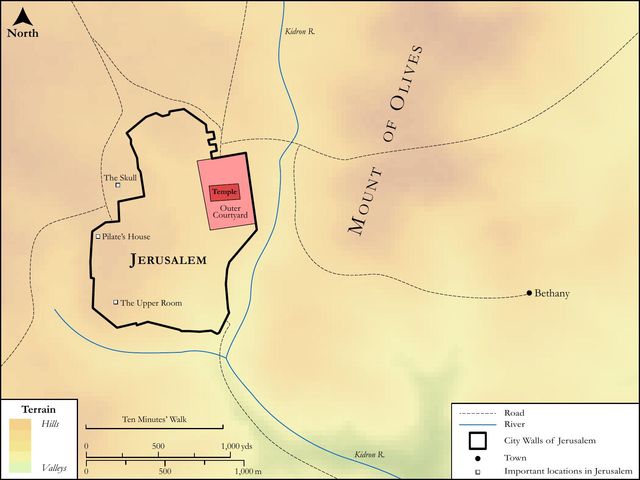
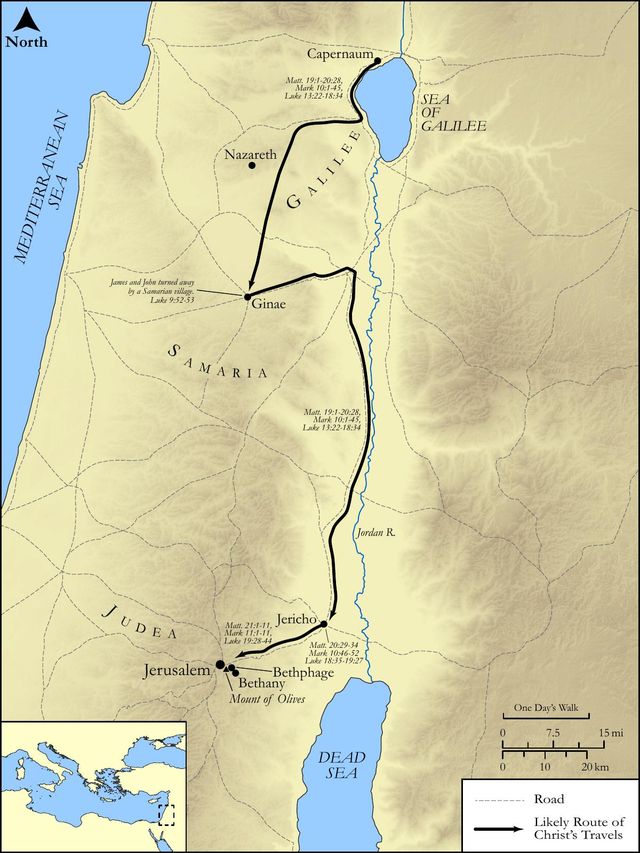
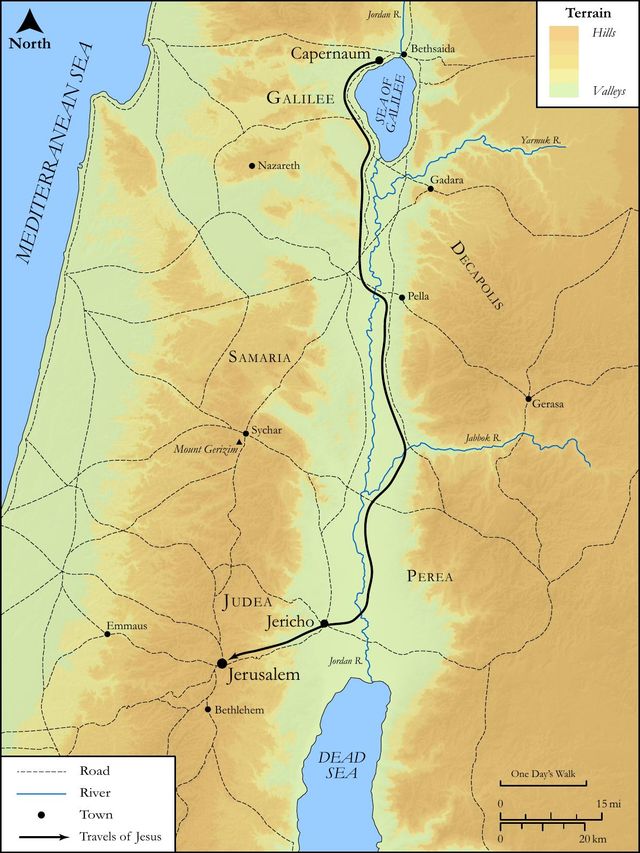
See on the biblical-era maps
Study this verse
Public-domain commentary
Matthew Henry
From his Commentary on the Whole Bible. Henry comments on passages, not single verses — this entry covers Mark 10:46–52. His two-level outline is real structure in the source text, so it is rendered as structure.
This passage of story agrees with that, Mat 20:29, etc. Only that there were told of two blind men; here, and Luk 18:35, only of one: but if there were two, there was one. This one is named here, being a blind beggar that was much talked of; he was called Bartimeus, that is, the son of Timeus; which, some think, signifies the son of a blind man; he was the blind son of a blind father, which made the case worse, and the cure more wonderful, and the more proper to typify the spiritual cures wrought by the grace of Christ, on those that not only are born blind, but are born of those that are blind.
I.This blind man sat begging; as they do with us.
Note, Those who by the providence of God are disabled to get a livelihood by their own labour, and have not any other way of subsisting, are the most proper objects of charity; and particular care ought to be taken of them.
II.He cried out to the Lord Jesus for mercy; Have mercy on me, O Lord, thou Son of David.
Misery is the object of mercy, his own miserable case he recommends to the compassion of the Son of David, of whom it was foretold, that, when he should come to save us, the eyes of the blind should be opened, Isa 35:5. In coming to Christ for help and healing, we should have an eye to him as the promised Messiah, the Trustee of mercy and grace.
III.Christ encouraged him to hope that he should find mercy; for he stood still, and commanded him to be called.
We must never reckon it a hindrance to us in our way, to stand still, when it is to do a good work. Those about him, who had discouraged him at first, perhaps were now the persons that signified to him the gracious call of Christ; "Be of good comfort, rise, he calls thee; and if he calls thee, he will cure thee." Note, The gracious invitations Christ gives us to come to him, are great encouragements to our hope, that we shall speed well if we come to him, and shall have what we come for. Let the guilty, the empty, the tempted, the hungry, the naked, be of good comfort, for he calls them to be pardoned, to be supplied, to be succoured, to be filled, to be clothed, to have all that done for them, which their case calls for.
IV.The poor man, hereupon, made the best of his way to Christ; He cast away his loose upper garment, and came to Jesus (Mar 10:50); he cast away every thing that might be in danger of throwing him down, or might in any way hinder him in coming to Christ, or retard his motion. Those who would come to Jesus, must cast away the garment of their own sufficiency, must strip themselves of all conceit of that, and must free themselves from every weight, and the sin that, like long garments, doth most easily beset them, Heb 12:1.
V.The particular favour he begged, was, that his eyes might be opened; that so he might be able to work for his living, and might be no longer burthensome to others. It is a very desirable thing to be in a capacity of earning our own bread; and where God has given men their limbs and senses, it is a shame for men by their foolishness and slothfulness to make themselves, in effect, blind and lame.
VI.This favour he received; his eyes were opened (Mar 10:52); and two things Mark here adds, which intimate,
1.How Christ made it a double favour to him, by putting the honour of it upon his faith; "Thy faith hath made thee whole; faith in Christ as the Son of David, and in his pity and power; not thy importunity, but thy faith, setting Christ on work, or rather Christ setting thy faith on work." Those supplies are most comfortable, that are fetched in by our faith.
2.How he made it a double favour to himself; When he had received his sight, he followed Jesus by the way. By this he made it appear that he was thoroughly cured, that he no more needed one to lead him, but could go himself; and by this he evidenced the grateful sense he had of Christ's kindness to him, that, when he had his sight, he made this use of it. It is not enough to come to Christ for spiritual healing, but, when we are healed, we must continue to follow him; that we may do honour to him, and receive instruction from him. Those that have spiritual eye-sight, see that beauty in Christ, that will effectually draw them to run after him.
Historical interpretation
Nine Centuries of Reception
8 surviving comments on this verse. Each one is dated, so this reads as a timeline rather than a list.
Select a marker to jump to its quote. Markers stagger vertically where authors wrote within a few decades of each other.
But Jesus, considering his ready will, rewards him with the fulfilment of his desire.
But the blindness in part, brought upon the Jews, will in the end be enlightened when He sends unto them the Prophet Elias. (Rom. 11:25)
The people of the Jews also, because it kept the Scriptures and did not fulfil them, begs and starves by the wayside; but he cries out, Son of David, have mercy upon me, because the Jewish people is enlightened by the merits of the Prophets. Many rebuke him that he may hold his peace, that is, sins and devils restrain the cry of the poor; and he cried the more, because when the battle waxes great, hands are to be lifted up with crying to the Rock of help, that is, Jesus of Nazareth.
Again, the Jewish people comes leaping, stripped of the old man, as a hart leaping on the mountains, that is, laying aside sloth, it meditates on Patriarchs, Prophets, and Apostles on high, and raises itself to heights of holiness. How consistent also is the order of salvation. First we heard by the Prophets, then we cry aloud by faith, next we are called by Apostles, we rise up by penitence, we are stripped of our old garment by baptism, and of our choice we are questioned. Again, the blind man when asked requires, that he may see the will of the Lord.
Or, this is the way of which He said, I am the Way, the Truth, and the Life. This is the narrow way, which leads to the heights of Jerusalem, and Bethany, to the mount of Olives, which is the mount of light and consolation.
(in Matt. tom. xvi. 13) As if he said, Those who were foremost in believing rebuked him when he cried, Thou Son of David, that he might hold his peace, and cease to call Him by a contemptible name, when he ought to say, Son of God, have pity upon me. He however did not cease; wherefore it goes on: But he cried the more a great deal, Thou Son of David, have mercy upon me; and the Lord heard his cry; wherefore there follows: And Jesus stood still, and commanded him to be called. But observe, that the blind man, of whom Luke speaks, is inferior to this one; for neither did Jesus call him, nor order him to be called, but He commanded him to be brought to Him, as though unable to come by himself; but this blind man by the command of our Lord is called to Him. Wherefore it goes on: And they call the blind man, saying unto him, Be of good comfort, rise, he calleth thee; but he casting away his garment, comes to Him. It goes on: And he casting away his garment, rose, and came to Jesus. Perchance, the garment of the blind man means the veil of blindness and poverty, with which he was surrounded, which he cast away and came to Jesus; and the Lord questions him, as he is approaching. Wherefore there follows: And Jesus answered and said unto him, What will thou that I should do unto thee.
The name of the city agrees with the approaching Passion of our Lord; for it is said, And they came to Jericho. Jericho means moon or anathema; but the failing of the flesh of Christ is the preparation of the heavenly Jerusalem. It goes on: And as he went out of Jericho with his disciples, and a great number of people, blind Bartimæus, the son of Timæus, sat by the wayside begging.
(Vict. Ant. e Cat. in Marc.) The blind man calls the Lord, the Son of David, hearing the way in which the passing multitude praised Him, and feeling sure that the expectation of the prophets was fulfilled. There follows: And many charged him that he should hold his peace.t
Those who precede Jesus as he comes—what do they signify but the crowds of carnal desires and the tumults of vices, which, before Jesus comes to our heart, scatter our thoughts with their temptations and disturb the voice of the heart in prayer? For often when we wish to turn to the Lord after committing sins, when we strive to pray against those very vices we have committed, the phantoms of the sins we have done rush upon the heart, strike back against the vision of our mind, confuse the soul, and suppress the voice of our entreaty. Those who went before, therefore, were rebuking him to be silent, because before Jesus comes to the heart, the evils we have done, thrust upon our thoughts through their images, disturb us in the very midst of our prayer.
But the one whom the crowd rebukes to be silent cries out more and more, because the more heavily we are pressed by the tumult of carnal thoughts, the more ardently we ought to persist in prayer.
When he heard that it was Jesus of Nazareth, he began to cry out and say, "Jesus, Son of David, have mercy on me." And many rebuked him, telling him to be silent. But he cried out all the more, "Son of David, have mercy on me." Hearing Jesus, the blind man prays for mercy, and many were trying to prevent him from calling out, but he does not desist. For the people of the nations, having recognized the fame of the name of Christ, sought to become His partakers; many opposed, first the Jews, as we read in the Acts of the Apostles, then also the Gentiles frequently exerted a sharper and stronger persecution so that the world, destined to receive light and healing from Christ, would not call upon Him. Nevertheless, the insane fury of those attacking could not deprive those who were predestined to eternal life of the salvation arranged for them.
(ubi sup.) He did not say, however, that He gave His life a ransom for all, but for many, that is, for those who would believe on Him.
(ubi sup.) Matthew says, that there were two blind men sitting by the wayside, who cried to the Lord, and received their sight; but Luke relates that one blind man was enlightened by Him, with a like order of circumstances, as He was going into Jericho; where no one, at least no wise man, will suppose that the Evangelists wrote things contrary to one another, but that one wrote more fully, what another has left out. We must therefore understand that one of them was the more important, which appears from this circumstance, that Mark has related his name and the name of his father.
(ubi sup.) Could He who was able to restore sight be ignorant of what the blind man wanted? His reason then for asking is that prayer may be made to Him; He puts the question, to stir up the blind man's heart to pray.
For the blind man looks down upon every gift except light, because, whatever a blind man may possess, without light he cannot see what he possesses.
(ubi sup.) In a mystical sense, however, Jericho, which means the moon, points out the waning of our fleeting race. The Lord restored sight to the blind man, when drawing near to Jericho, because coming in the flesh and drawing near to His Passion, He brought many to the faith; for it was not in the first years of His Incarnation, but in the few years before He suffered, that He showed the mystery of the Word to the world.
(ubi sup.) Now in that on approaching Jericho, He restored sight to one man, and on quitting it to two, He intimated, that before His Passion He preached only to one nation, the Jews, but after His resurrection and ascension, through His Apostles He opened the mysteries both of His Divinity and His Humanity to Jews and Gentiles. Mark indeed, in writing that one received his sight, refers to the saving of the Gentiles, that the figure might agree with the salvation of those, whom he instructed in the faith; but Matthew, who wrote his Gospel to the faithful among the Jews, because it was also to reach the knowledge of the Gentiles, fitly says that two received their sight, that He might teach us that the grace of faith belonged to each people. Therefore, as the Lord was departing with His disciples and a great multitude from Jericho, the blind man was sitting, begging by the way-side; that is, when the Lord ascended into heaven, and many of the faithful followed Him, yea when all the elect from the beginning of the world entered together with Him the gate of heaven,u, presently the Gentile people began to have hope of its own illumination; for it now sits begging by the wayside, because it has not entered upon and reached the path of truth.
Again, the people of the Gentiles, having heard of the fame of the name of Christ, sought to be made a partaker of Him, but many spoke against Him, first the Jews, then also the Gentiles, lest the world which was to be enlightened should call upon Christ. The fury of those who attacked Him, however, could not deprive of salvation those who were fore-ordained to life. And He heard the blind man's cry as He was passing, but stood when He restored his sight, because by His Humanity He pitied him, who by the power of His Divinity has driven away the darkness from our mind; for in that Jesus was born and suffered for our sakes, He as it were passed by, because this action is temporal; but when God is said to stand, it means, that, Himself without change, He sets in order all changeable things. But the Lord calls the blind man, who cries to Him, when He sends the word of faith to the people of the Gentiles by preachers; and they call on the blind man to be of good cheer and to rise, and bid him come to the Lord, when by preaching to the simple, they bid them have hope of salvation, and rise from the sloth of vice, and gird themselves for a life of virtue. Again, he throws away his garment and leaps, who, throwing aside the bands of the world, with unencumbered pace hastens to the Giver of eternal light.
(ubi sup.) Therefore let us also imitate him, let us not seek for riches, earthly goods, or honours from the Lord, but for that Light, which we alone with the Angels can see, the way to which is faith; wherefore also Christ answers to the blind man, Thy faith hath saved thee. But he sees and follows who works what his understanding tells him is good; for he follows Jesus, who understands and executes what is good, who imitates Him, who had no wish to prosper in this world, and bore reproach and derision. And because we have fallen from inward joy, by delight in the things of the body, He shows us what bitter feelings the return thither will cost us.
The mind of the blind man is grateful, for when he was made whole, he did not leave Jesus, but followed Him.
Further, it says that he followed the Lord in the way, that is, in this life, because after it all are excluded who follow Him not here, by working His commandments.
Continue studying Mark 10:48 across the web’s major study libraries — every link below opens this exact verse, chapter, or book on the destination site.
Read & Compare
 BibleGatewayThis verse in more than 200 translations and 70 languages.
 Bible.comThe YouVersion reader — hundreds of translations, reading plans, and highlights.
 ESV.orgCrossway's official English Standard Version reader.
 NET BibleThe NET translation with 60,000+ translators' notes on every rendering decision.
 STEP BibleTyndale House's free study tool — original text, vocabulary, and scholarly resources.
 BibliaLogos Bible Software's free web reader.
 USCCBThe New American Bible (Revised Edition) with the U.S. bishops' study notes.
Commentaries
 BibleHub CommentariesDozens of classic commentaries on this verse, gathered on one page.
 StudyLightMore than 100 commentary sets — the largest collection on the web.
 BibleRefPlain-English commentary on what this verse means, verse by verse.
 Enduring WordDavid Guzik's free commentary on this chapter, widely used by Bible teachers.
 Bible Study ToolsVerse commentary alongside Greek and Hebrew study aids.
Original Language & Research
- BibleHub InterlinearThe verse word by word — original language, transliteration, and English.
- BibleHub LexiconEvery word's original-language definition and Strong's entry.
 Blue Letter BibleDeep-study tools — Strong's numbers, concordance, and word studies.
 CNTR CollationThe earliest Greek manuscripts of this verse, collated letter by letter.
Sermons, Hymns & Audio


TrulyRandomVerse is not affiliated with these sites and doesn’t control their content. They’re linked because they’re genuinely useful.
Summary
Mark 10:48 presents a pivotal moment in the narrative of blind Bartimaeus, an overlooked beggar whose unwavering faith and persistent outcry for mercy cut through the crowd's attempts to silence him. This verse encapsulates the intense spiritual struggle between the world's dismissiveness and the fervent, Spirit-empowered plea of one who recognizes Jesus's true messianic identity and divine authority, setting the stage for a miraculous encounter and a profound display of Christ's compassion.
Context
ShowHideLiterary Context
This event immediately follows Jesus's third and most explicit prediction of His suffering, death, and resurrection (Mark 10:32-34), and the disciples' self-serving request for positions of power (Mark 10:35-45). Bartimaeus's story serves as a powerful counterpoint, illustrating true discipleship: one who humbly recognizes Jesus's authority, cries out in desperate faith, and is willing to cast aside everything to follow Him (Mark 10:49-52). It is the final healing miracle recorded by Mark before Jesus's triumphal entry into Jerusalem and the Passion week, underscoring the spiritual blindness of many who followed Jesus, contrasting it with the profound insight of a physically blind man.
Historical & Cultural Context
Jericho was an ancient city, strategically located on the main road from Galilee to Jerusalem, making it a common stop for pilgrims. Blindness in that day often led to begging, as it severely limited one's ability to work and participate in society. Beggars typically sat by roadsides or temple gates, relying on charity. The title "Son of David" was a highly significant messianic title, evoking the promises made to King David regarding an eternal kingdom and a righteous ruler (2 Samuel 7:12-16). For Bartimaeus to use this title publicly was not merely a polite address but a profound theological declaration, acknowledging Jesus as the long-awaited Messiah who would bring deliverance and healing, a recognition often missed by the religious elite.
Key Themes
ShowHideThe verse profoundly contributes to several key themes in Mark's Gospel. Persistent Faith is vividly displayed by Bartimaeus, who, despite being rebuked by the crowd, intensifies his cry, demonstrating an unwavering conviction in Jesus's power and willingness to help. This contrasts with the wavering faith and worldly ambitions of the disciples. Messianic Acknowledgment is central, as Bartimaeus's use of "Son of David" highlights Jesus's true identity as the promised Messiah, a spiritual insight that surpasses the understanding of the physically sighted crowd. This theme is further developed as Jesus questions the scribes about the "Son of David" in Mark 12:35-37. Furthermore, the narrative underscores Jesus's Compassion and Authority, as He stops amidst the clamor to respond to the cry of an overlooked individual, demonstrating His divine power to heal and His profound care for the outcast. This act reinforces the upside-down kingdom values Jesus taught, where the last are first and the humble are exalted.
Exposition and Analysis
ShowHideKey Word Analysis
ShowHideThis word (G2008) means "to tax upon, i.e. censure or admonish; by implication, forbid." It suggests a strong rebuke, an attempt to silence Bartimaeus with authority or severity. The crowd was not merely annoyed; they were actively trying to suppress his plea, perhaps viewing him as a nuisance or a disruption to their procession with Jesus.
This verb (G2896) literally means "to 'croak' (as a raven) or scream, i.e. to call aloud (shriek, exclaim, intreat)." It denotes a loud, often desperate, and uninhibited cry. Bartimaeus's cry was not a polite request but a fervent, urgent, and unrestrained shout, reflecting the depth of his need and the intensity of his faith.
Derived from éleos (G1653), this term means "to compassionate (by word or deed, specially, by divine grace)." It signifies a deep emotional response that leads to active help for someone in distress. Bartimaeus is not just asking for healing but for an act of divine compassion, recognizing that his need goes beyond physical sight to a deeper spiritual and existential longing for God's grace.
Verse Breakdown
ShowHide"And many charged him that he should hold his peace"
As Jesus was leaving Jericho with a large crowd, Bartimaeus's loud cries were perceived as disruptive. "Many" in the crowd, perhaps motivated by a desire to maintain order, to protect Jesus from interruption, or simply by annoyance, sternly rebuked Bartimaeus, commanding him to be silent. This highlights the social pressure and obstacles Bartimaeus faced in seeking Jesus.
"but he cried the more a great deal"
This phrase marks a powerful turning point and reveals Bartimaeus's extraordinary persistence and faith. Instead of being deterred or silenced by the crowd's rebuke, he intensified his cries. The Greek phrase "the more a great deal" (G3123 mâllon + G4183 polýs) emphasizes the increasing volume and urgency of his plea, demonstrating an unyielding determination to reach Jesus.
"[Thou] Son of David, have mercy on me."
This is Bartimaeus's repeated, fervent plea. His address "Son of David" is a direct and profound acknowledgment of Jesus's messianic identity, recognizing Him not just as a prophet or healer, but as the long-awaited King from David's lineage. His request for "mercy" (G1653 eleéō) is a comprehensive appeal for divine compassion, encompassing not only physical healing but also spiritual deliverance and a restoration of dignity.
Literary Devices
ShowHideMark employs several powerful literary devices in this verse. Contrast is prominent, highlighting the tension between the crowd's desire to silence Bartimaeus and his defiant, amplified cry. This contrast underscores the spiritual insight of the blind man versus the spiritual blindness of the sighted crowd. Irony is also at play, as the physically blind Bartimaeus is the one who "sees" Jesus's true identity as the "Son of David," while those with physical sight fail to grasp it. The Repetition of Bartimaeus's cry (implied from the intensity of "cried the more a great deal") and the specific title "Son of David" emphasizes his unwavering faith and the profound significance of his acknowledgment. The entire scene serves as a Symbolism of spiritual seeking: just as Bartimaeus, from the margins, desperately cries out for physical sight, so too are believers called to cry out for spiritual sight and the mercy of Christ amidst the distractions and discouragements of the world.
Theological and Thematic Connections
ShowHideMark 10:48 is a profound theological statement on the nature of faith, divine compassion, and the true identity of Jesus. Bartimaeus's persistent and bold cry for mercy, despite societal pressure, exemplifies the kind of faith that truly apprehends Christ. His recognition of Jesus as the "Son of David" reveals a spiritual insight that transcends mere physical perception, acknowledging Jesus's messianic authority and royal lineage. This encounter underscores that Jesus's kingdom is open to the lowly and those who humbly and fervently seek Him, demonstrating His boundless compassion for the needy and His willingness to interrupt His journey to respond to a cry of genuine faith. It teaches that access to God's grace is not through social standing or outward conformity, but through a heart of desperate and expectant trust.
Reflection and Application
ShowHideMark 10:48 offers a powerful paradigm for our spiritual journey, urging us to cultivate a faith that is both persistent and perceptive. In a world often filled with distractions, discouragement, or even direct opposition, Bartimaeus's unwavering cry reminds us that genuine spiritual breakthrough often requires pushing past external noise and internal doubt. His example encourages us to be bold in our prayers, not shrinking back when faced with challenges, but rather intensifying our plea to the Lord. It calls us to recognize Jesus not merely as a historical figure or a good teacher, but as the "Son of David," the reigning Messiah who has the power to bring profound healing and mercy into every area of our lives. We are invited to cast aside anything that hinders our approach to Christ, just as Bartimaeus cast off his cloak (Mark 10:50), and to approach Him with the confident expectation that He hears and responds to the cries of those who genuinely seek Him.
Questions for Reflection
ShowHideFAQ
ShowHideWhy did the crowd try to silence Bartimaeus?
ShowHideThe crowd likely tried to silence Bartimaeus for several reasons. They may have found his loud cries disruptive to their procession with Jesus, viewing him as a nuisance or an unwelcome interruption. In that culture, a blind beggar was often considered of low social status, and his public outcry might have been seen as undignified or inappropriate in the presence of a respected teacher like Jesus. Some might have genuinely believed that Jesus was too busy or too important to be bothered by a beggar. Their actions reflect a common human tendency to control or dismiss those among the outcasts, failing to recognize the spiritual significance of Bartimaeus's desperate plea.
What is the significance of Bartimaeus calling Jesus "Son of David"?
ShowHideBartimaeus's address, "Thou Son of David," is profoundly significant because it is a direct and public acknowledgment of Jesus's messianic identity. The title "Son of David" was a well-known messianic expectation in Judaism, referring to the promised heir of King David who would restore Israel and reign as Messiah (Isaiah 9:6-7). By using this title, Bartimaeus demonstrated a spiritual insight that many others, including the religious leaders, lacked. He recognized Jesus not just as a prophet or healer, but as the long-awaited King and Deliverer, the one who could truly bring salvation and mercy. This recognition of Jesus's true identity is a hallmark of genuine faith throughout the Gospels.
What can we learn from Bartimaeus's persistence in this verse?
ShowHideBartimaeus's persistence teaches us several vital lessons about faith and prayer. First, it demonstrates that true faith is not easily deterred by obstacles, whether they are external pressures from others or internal doubts. Second, it highlights the importance of earnestness and urgency in our prayers; Bartimaeus's "cried the more a great deal" shows a desperate, unyielding pursuit of God's mercy. Third, his persistence underscores the truth that God hears the cries of the humble and overlooked, and that our fervent prayers can break through barriers that seem insurmountable. His example encourages us to never give up on seeking God's intervention, no matter how dire our circumstances or how much opposition we face.
Christ-Centered Fulfillment
ShowHideMark 10:48, with Bartimaeus's fervent cry for mercy to the "Son of David," finds its ultimate fulfillment in the person and work of Jesus Christ. Bartimaeus's physical blindness and his desperate plea for sight symbolize humanity's spiritual blindness and our inherent need for divine intervention. Jesus, the "Son of David," is revealed as the true King and Messiah, not merely a political ruler, but the one who brings spiritual sight and mercy to a lost and broken world. His willingness to stop and respond to Bartimaeus's cry foreshadows His ultimate mission to seek and save the lost (Luke 19:10). The mercy Bartimaeus receives is a tangible expression of the greater spiritual mercy offered through Christ's atoning work on the cross, where He bore the sin of the world to grant us not just physical healing, but reconciliation with God and eternal life (John 1:29). Through His death and resurrection, Jesus, the compassionate Son of David, opens the eyes of the spiritually blind, grants forgiveness, and offers the boundless grace that leads to true freedom and new life in Him (Ephesians 2:4-5). Bartimaeus's story is a microcosm of the gospel: a desperate cry for help met by the sovereign, compassionate King who came to give sight to the blind and set the captives free.