


Mark 16:9
Bible text: King James Version (1769 Blayney text) · Public domain
Bible text: King James Version with Strong's numbers · Public domain
Bible text: Berean Standard Bible · Public domain
Bible text: American Standard Version (1901) · Public domain
Bible text: World English Bible, Messianic edition · Public domain
Bible text: Geneva Bible (1599) · Public domain
Bible text: Young's Literal Translation · Public domain
- ἈναστὰςAnastasHaving risenG450V-2AAP-NSMVerb 2nd Aorist Active Participle Nominative Singular Masculine
- δὲdenowG1161CONJConjunction
- πρωῒprōiearlyG4404ADVAdverb
- πρώτῃprōtēon [the] first [day]G4413A-DSFAdjective Dative Singular Feminine
- σαββάτουsabbatouof the weekG4521N-GSNNoun Genitive Singular Neuter
- ἐφάνηephanēHe appearedG5316V-2API-3SVerb 2nd Aorist Passive Indicative 3rd Singular
- πρῶτονprōtonfirstG4413A-ASNAdjective Accusative Singular Neuter
- ΜαρίᾳMariato MaryG3137N-DSF-PNoun Dative Singular Feminine Individual
- τῇtēa<the>G3588T-DSFDefinite article Dative Singular Feminine
- ΜαγδαληνῇMagdalēnēaMagdaleneG3094N-DSF-LGNoun Dative Singular Feminine Location Gentilic
- παρ᾽par᾽from withG3844PREPPreposition
- ἧςhēswhomG3739R-GSFRelative pronoun Genitive Singular Feminine
- ἐκβεβλήκειekbeblēkeiHe had cast outG1544V-LAI-3SVerb Pluperfect Active Indicative 3rd Singular
- ἑπτὰheptasevenG2033A-NUIAdjective
- δαιμόνιαdaimoniademonsG1140N-APNNoun Accusative Plural Neuter
English is a literal word-by-word gloss of the Greek, not the KJV's wording. Why?
This is the original text the KJV's translators worked from — each Greek word with its own literal English meaning in this verse, prepared by scholars at Tyndale House, Cambridge. The KJV translates whole sentences, not word by word, so its wording differs: one Greek word can become several English words, and the KJV may choose “charity” where the gloss reads “love”. Both are faithful — they answer different questions. For the KJV's own rendering, switch to the KJV text.
Details
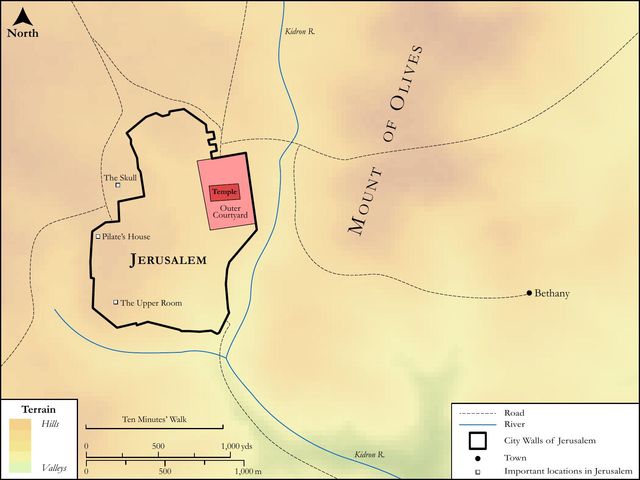
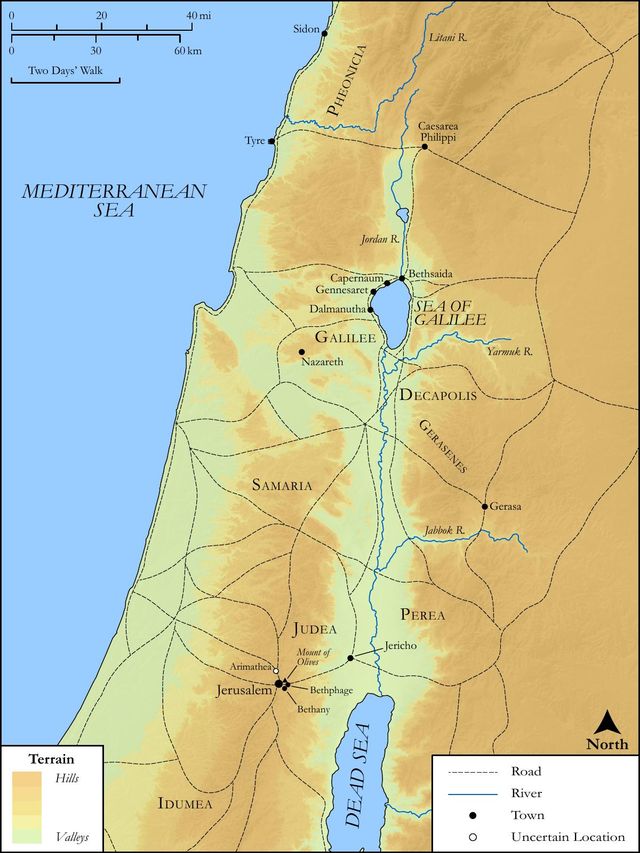
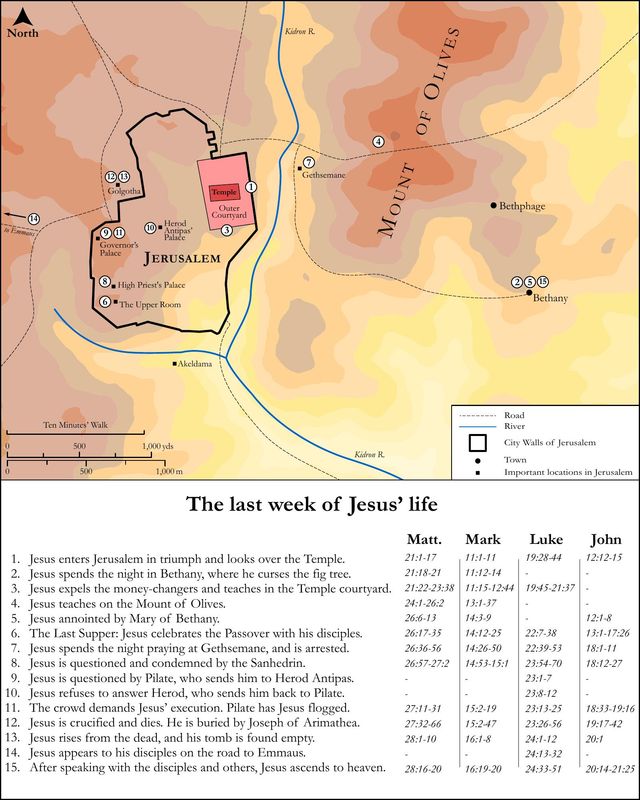
See on the biblical-era maps
Study this verse
Public-domain commentary
Matthew Henry
From his Commentary on the Whole Bible. Henry comments on passages, not single verses — this entry covers Mark 16:9–13. His two-level outline is real structure in the source text, so it is rendered as structure.
We have here a very short account of two of Christ's appearances, and the little credit which the report of them gained with the disciples.
I.He appeared to Mary Magdalene, to her first in the garden, which we have a particular narrative of, Joh 20:14.
It was she out of whom he had cast seven devils; much was forgiven her, and much was given her, and done for her, and she loved much; and this honour Christ did her, that she was the first that saw him after his resurrection. The closer we cleave to Christ, the sooner we may expect to see him, and the more to see of him.
Now, 1. She brings notice of what she had seen, to the disciples; not only to the eleven, but to the rest that followed him, as they mourned and wept, Mar 16:10. Now was the time of which Christ had told them, that they should mourn and lament, Joh 16:20. And it was an evidence of their great love to Christ, and the deep sense they had of their loss of him. But when their weeping had endured a night or two, comfort returned, as Christ has promised; I will see you again, and your heart shall rejoice. Better news cannot be brought to disciples in tears, than to tell them of Christ's resurrection. And we should study to be comforters to disciples that are mourners, by communicating to them our experiences, and what we have seen of Christ.
2.They could not give credit to the report she brought them. They heard that he was alive, and had been seen of her. The story was plausible enough, and yet they believed not. They would not say that she made the story herself, or designed to deceive them; but they fear that she is imposed upon, and that it was but a fancy that she saw him. Had they believed the frequent predictions of it from his own mouth, they would not have been now so incredulous of the report of it.
II.He appeared to two of the disciples, as they went into the country, Mar 16:12.
This refers, no doubt, to that which is largely related (Luk 24:13, etc.), of which passed between Christ and the two disciples going to Emmaus. He is here said to have appeared to them in another form, in another dress than what he usually wore, in the form of a traveller, as, in the garden, in such a dress, that Mary Magdalene took him for the gardener; but that he had really his own countenance, appears by this, that their eyes were holden, that they should not know him; and when that restrain on their eyes was taken off, immediately they knew him, Lu. 24:16-31. Now,
1.These two witnesses gave in their testimony to this proof of Christ's resurrection; They went and told it to the residue, Mar 16:13. Being satisfied themselves, they were desirous to give their brethren the satisfaction they had, that they might be comforted as they were.
2.This did not gain credit with all; Neither believed they them. They suspected that their eyes also deceived them. Now there was a wise providence in it, the proofs of Christ's resurrection were given in thus gradually, and admitted thus cautiously, that so the assurance with which the apostles preached this doctrine afterward, when they ventured their all upon it, might be the more satisfying. We have the more reason to believe those who did themselves believe so slowly: had they swallowed it presently, they might have been thought credulous, and their testimony the less to be regarded; but their disbelieving at first, shows that they did not believe it afterward but upon a full conviction.
Historical interpretation
Ten Centuries of Reception
13 surviving comments on this verse. Each one is dated, so this reads as a timeline rather than a list.
Select a marker to jump to its quote. Markers stagger vertically where authors wrote within a few decades of each other.
Again, He is shown to her, out of whom He had cast seven devils, because harlots and publicans shall go before the synagogue into the kingdom of heaven, as the thief reached it before the Apostles.
They mourn and weep because they had not yet seen, but after a short time they shall receive a consolation. For blessed are they that weep now, for they shall be comforted.
But in a mystic sense we may understand that faith here labours, leading the active life, but there it reigns secure in the contemplative vision. Here we see His face through a glass, there we shall see the truth face to face, wherefore He was shown to them as they were walking, that is, labouring, in another form. And when it was told, the disciples did not believe, because they saw, like Moses, that which was not enough for them, for he said, show me thyself; (Exod. 33:18. Sept.) forgetting his flesh, he prays in this life for that which we hope for in the life to come.
The day of preparation, then, comprises the suffering death, the Sabbath embraces the burial, the Lord’s day contains the resurrection.
If, however, there be any one who, like Plato, supposes that two souls cannot, more than two bodies could, co-exist in the same individual, I, on the contrary, could show him not merely the co-existence of two souls in one person, as also of two bodies in the same womb, but likewise the combination of many other things in natural connection with the soul-for instance, of demoniacal possession; and that not of one only, as in the case of Socrates' own demon; but of seven spirits as in the case of the Magdalene; and of a legion in number, as in the Gadarene.
(de Con. Evan. iii. 25) Now we must consider how the Lord appeared after the resurrection. For Mark says, Now when Jesus was risen early the first day of the week, he appeared first to Mary Magdalene, out of whom he had cast seven devils.
(Chrysologus ubi sup.) It is said also in a marked manner, that they said nothing to any one, because it is the part of women to hear, and not to speak, to learn, not to teach.
(Chrysologus ubi sup.) Mary brings the news, not now as a woman, but in the person of the Church, so that, as above woman was silent, here as the Church she might bring tidings and speak. There follows, And they when they heard that he was alive and had been seen by her, believed not.
(Chrysologus ubi sup.) But let no one suppose that Christ changed the form of His face by His resurrection, but the form is changed when of mortal it becomes immortal, so that this means that He gained a glorious countenance, not that He lost the substance of His countenance. But He was seen of two; because faith in the resurrection is to be preached and shown to two people, that is, the Gentiles and the Jews. There follows, And they went and told it unto the residue, neither believed they them. How are we to understand the words of Mark compared with the account of Luke, that they then said, The Lord hath risen indeed, and hath appeared unto Simon, (Luke 24:34) if we do not suppose that there were some there who would not believe?
This woman whom Luke calls a sinful woman, John names Mary, and we believe her to be that Mary from whom Mark testifies seven demons were cast out. And what is signified by seven demons, except all vices? For since all time is comprised in seven days, rightly by the number seven is universality represented. Therefore Mary had seven demons, because she was full of all vices. But behold, because she perceived the stains of her own shame, she ran to the fountain of mercy to be washed.
(ubi sup.) For as Samson at midnight not only left Gaza, but also carried away the gates of it, so also our Redeemer rising before the light, did not only come out free from hell, but destroyed also the very gates of hell. 1But Mark here testifies that seven devils were cast out of Mary; and what is meant by seven devils save all vices? for as by seven days is understood all time, so by the number seven 2 a whole is fitly figured.
(Hom. in Evan. xxix.) That the disciples were slow in believing our Lord's resurrection was not so much a weakness of theirs as it is our strength. For the resurrection itself through their doubts was manifested by many proofs; and whilst we read and acknowledge them, what do we but become firmer through their doubting? There follows, After this he appeared in another form unto two of them as they walked and went to a farm house.
The sacredness of the Lord’s Day is apparent from the holy Scripture. This was the first day of the world. On this day the elements of the creation were formed. On this day the angels were created. On this day Christ rose from the dead. On this day the Holy Ghost came down from heaven on the apostles. On this same day the manna in the wilderness was first given.
(ubi sup.) John tells us most fully how and when this appearance took place. But the Lord rose in the morning from the sepulchre in which He had been laid in the evening, that those words of the Psalm might be fulfilled, Heaviness may endure for a night, but joy cometh in the morning. (Ps. 30:5)
(ubi sup.) In the beginning also woman brought man into sin, now she, who first tasted death, first sees the resurrection, lest she should have to bear the reproach of perpetual guilt amongst men; and she who had been the channel of guilt to man, now has become the first channel of grace. For it goes on: And she went and told them that had been with him as they mourned and wept.
(ubi sup.) Fitly too is this woman, who was the first to announce the joy of our Lord's resurrection, said to have been cured of seven devils, lest any one worthily repenting of his sins should despair of pardon for what he had done, and that it might be shown that where sin abounded, grace did much more abound. (Rom. 5:20)
It was also a woman who first announced to the disciples that the Lord had come forth from the confinement of the grave, so that “where sin abounded grace might more abound.”
He appeared first, he says, to Mary Magdalene, from whom he had expelled seven demons. She went and announced it to those who had been with him and were mourning and weeping. Just as at the beginning the woman was the author of sin for the man, and the man the executor of error, so now she who first brought and tasted death, saw the resurrection first. And lest she who had transferred guilt to the man should bear perpetual reproach among men, she also transferred grace. Hence, rightly, this woman who first announced to the mourning and weeping men the joy of the Lord’s resurrection, is remembered to have been cured of seven demons, so that it is marked that she was full of all sins, but by divine gift was cleansed from all of them, and where sin abounded, grace abounded all the more. For the number seven is customarily mystically placed for entirety. Therefore, she who was cured of seven demons, that is, was liberated from all sins, first saw the Lord rising from the dead, so that no one who repents worthily might despair of the pardon for their misdeeds, seeing her who was once subject to so many and great vices being suddenly advanced to such a pinnacle by the merit of faith and love, that she first evangelized the miracle of the accomplished resurrection to the very evangelists and apostles of Christ.
Now, rising early on the first day of the week, Jesus appeared first to Mary Magdalene. How and where this appearance of the Lord took place, John teaches most fully. But the Lord rose early from the tomb, in which he had been laid late the day before, so that what was written in the Psalms might be fulfilled: Weeping may tarry for the night, but joy comes with the morning (Psalm 30). Therefore, having been buried on the sixth day of the week, which is called Preparation Day, around the evening hour, he was placed in the tomb on the following night and day of the Sabbath with the subsequent night, and thus on the third day, that is early on the first day of the week, he rose. Further, he did not lie in the tomb for one day and two nights only justly, because he deliberately joined the light of his singular death to the darkness of our double death. For he came to us, who were held in death of both the spirit and the flesh. He endured his own death, that is, of the flesh, and dissolved the double death that he found in us. For if he had borne both, he would have freed us from neither. But he mercifully accepted one, and justly condemned both. He joined his singular death to our double death, and by dying he conquered our double death.
Or else put a stop at, Now when Jesus was risen, and then read, early the first day of the week he appeared, &c.
But Mary had seven devils, because she was filled with all vices. Or else, by seven devils are meant seven spirits contrary to the seven virtues, as a spirit without fear, without wisdom, without understanding, and whatsoever else is opposed to the gifts of the Holy Ghost.
For he does not say this of the eleven, but of some others, whom He calls the residue.
Continue studying Mark 16:9 across the web’s major study libraries — every link below opens this exact verse, chapter, or book on the destination site.
Read & Compare
 BibleGatewayThis verse in more than 200 translations and 70 languages.
 Bible.comThe YouVersion reader — hundreds of translations, reading plans, and highlights.
 ESV.orgCrossway's official English Standard Version reader.
 NET BibleThe NET translation with 60,000+ translators' notes on every rendering decision.
 STEP BibleTyndale House's free study tool — original text, vocabulary, and scholarly resources.
 BibliaLogos Bible Software's free web reader.
 USCCBThe New American Bible (Revised Edition) with the U.S. bishops' study notes.
Commentaries
 BibleHub CommentariesDozens of classic commentaries on this verse, gathered on one page.
 StudyLightMore than 100 commentary sets — the largest collection on the web.
 BibleRefPlain-English commentary on what this verse means, verse by verse.
 Enduring WordDavid Guzik's free commentary on this chapter, widely used by Bible teachers.
 Bible Study ToolsVerse commentary alongside Greek and Hebrew study aids.
Original Language & Research
- BibleHub InterlinearThe verse word by word — original language, transliteration, and English.
- BibleHub LexiconEvery word's original-language definition and Strong's entry.
 Blue Letter BibleDeep-study tools — Strong's numbers, concordance, and word studies.
 CNTR CollationThe earliest Greek manuscripts of this verse, collated letter by letter.
Sermons, Hymns & Audio


TrulyRandomVerse is not affiliated with these sites and doesn’t control their content. They’re linked because they’re genuinely useful.
Summary
Mark 16:9 powerfully asserts the historical reality of Jesus' resurrection, detailing His first post-resurrection appearance. It specifies the timing as "early the first day of the week" and identifies Mary Magdalene as the initial witness, notably highlighting her past deliverance from "seven devils." This verse underscores the profound significance of the resurrection, the divine choice of a transformed individual as its first herald, and the continuing demonstration of Christ's redemptive power.
Context
ShowHideLiterary Context
Mark 16:9 initiates what is widely known as the "longer ending" of Mark's Gospel (verses 9-20). This section, while absent from some of the earliest and most reliable manuscripts, has been embraced by the Church for centuries, providing crucial narratives of Jesus' post-resurrection appearances and the Great Commission. Immediately preceding this verse, the women who visited the tomb (Mary Magdalene, Mary the mother of James, and Salome) found it empty and received a message from a young man in white, who instructed them to tell Peter and the disciples that Jesus was going ahead of them to Galilee (Mark 16:1-8). The women, however, fled in fear and said nothing to anyone, leaving the initial narrative with an abrupt and unsettling conclusion. Mark 16:9 thus bridges this gap, providing the much-needed account of Jesus' actual appearances, beginning with Mary Magdalene, and setting the stage for the disciples' subsequent encounters and mission.
Historical & Cultural Context
The "first day of the week" (Sunday) was significant for early Christians, marking the day of Christ's resurrection and eventually becoming the primary day for Christian worship, distinguishing it from the Jewish Sabbath (Saturday). The concept of "devils" or "demons" (Greek: daimonia) was prevalent in the ancient world, referring to malevolent spiritual beings believed to cause physical and mental afflictions. Jesus' ability to cast out demons was a clear sign of His divine authority and the inauguration of God's kingdom, demonstrating His power over the forces of evil (Mark 1:27). Mary Magdalene, having been delivered from "seven devils," would have been seen as someone profoundly afflicted and then profoundly transformed, making her an extraordinary choice for the first witness, challenging societal norms that often overlooked women and those with such pasts.
Key Themes
ShowHideThis verse contributes significantly to several key themes within Mark's Gospel and the broader New Testament. Firstly, it emphatically affirms the reality and historicity of the resurrection, the cornerstone of Christian faith (1 Corinthians 15:3-4). Secondly, it highlights Jesus' profound compassion and redemptive power, choosing a woman with a severe past affliction as the first recipient of the most glorious news. This choice underscores that God's grace extends to the lowly and transformed, demonstrating His willingness to use those whom He has radically changed (Luke 8:2). Finally, it emphasizes the pivotal role of witnesses in the proclamation of the Gospel, with Mary Magdalene becoming the "apostle to the apostles," entrusted with the initial message of Christ's victory over death (John 20:17-18).
Exposition and Analysis
ShowHideKey Word Analysis
ShowHideThis verb, meaning "to stand up," "to arise," or "to raise up again," unequivocally declares Jesus' physical resurrection from the dead. It signifies not merely a spiritual awakening or a memory, but a literal, bodily rising from the grave, affirming the victory over death. The perfect tense implies a completed action with ongoing results, emphasizing the permanent state of Christ's resurrection.
Derived from a root meaning "to lighten" or "to shine," this word means "to show," "to make visible," or "to be seen." It emphasizes that Jesus' post-resurrection presence was a tangible, observable reality, not a mere vision or hallucination. He intentionally revealed Himself, making His resurrected body evident to His chosen witnesses.
This term refers to "a demonic being" or an evil spirit. The mention of "seven devils" indicates a severe and complete spiritual bondage or affliction from which Mary Magdalene was delivered. The number seven often symbolizes completeness or totality in biblical contexts, suggesting that Mary was entirely under the influence of these malevolent forces before Jesus' intervention.
Verse Breakdown
ShowHide"Now when Jesus was risen early the first day of the week,"
This clause establishes the precise timing of the resurrection and Jesus' subsequent appearance. "Early the first day of the week" refers to Sunday morning, signifying the dawn of a new creation and the inauguration of the new covenant era. The active voice "was risen" (though a passive construction in English, the Greek verb anistēmi can be intransitive, meaning "to rise") emphasizes Jesus' own power in His resurrection, not merely being raised by another.
"he appeared first to Mary Magdalene,"
This highlights the profound and intentional choice of Jesus. Despite societal norms or the expectations of His male disciples, Jesus chose a woman, and specifically Mary Magdalene, as the premier witness to His resurrection. This act elevates her status and underscores the inclusive nature of the Gospel message.
"out of whom he had cast seven devils."
This descriptive phrase provides crucial background about Mary Magdalene, reminding the reader of her past and the profound transformation she experienced through Jesus' power. It serves as a powerful testament to Jesus' authority over spiritual forces and His ability to bring complete deliverance and healing, making her a living example of His redemptive work and a fitting first witness.
Literary Devices
ShowHideMark 16:9 employs several effective Literary Devices. The Emphasis on Timing ("early the first day of the week") not only provides a specific historical marker but also carries theological weight, symbolizing the new creation inaugurated by Christ's triumph over death. There is a strong element of Juxtaposition and Contrast in the verse: the glorious, triumphant appearance of the resurrected Christ is immediately followed by the description of Mary Magdalene's past, a woman out of whom "he had cast seven devils." This contrast highlights the depth of Christ's redemptive power and His grace in choosing such a transformed individual. Furthermore, the number "seven" in "seven devils" functions as Symbolism, likely indicating a complete or severe affliction, underscoring the totality of Jesus' deliverance in her life. This detail also serves as a powerful Testimony to Jesus' authority and the radical transformation He brings.
Theological and Thematic Connections
ShowHideMark 16:9 stands as a foundational theological statement, affirming the bodily resurrection of Jesus Christ, which is the bedrock of Christian faith and hope. The choice of Mary Magdalene as the first witness reveals God's profound grace and counter-cultural values, demonstrating that His favor is not based on social standing or a blemish-free past, but on devotion and transformation. This verse connects the power of Christ's resurrection to His ongoing work of deliverance and restoration, showing that the same power that conquered death is available to conquer spiritual bondage and equip transformed individuals for His service. It underscores the universal call to witness, empowering even those with significant pasts to proclaim the greatest news in history.
Reflection and Application
ShowHideMark 16:9 offers profound encouragement and practical application for every believer. It reminds us that the resurrection of Jesus is not merely an ancient historical event but a living reality that continues to impact lives today. Just as Jesus transformed Mary Magdalene from deep spiritual bondage into a primary herald of His resurrection, He possesses the power to deliver us from our past struggles, sins, and any spiritual strongholds. Our personal testimonies of His redemptive work are not hindrances but powerful platforms for proclaiming His grace. This verse challenges us to embrace our own stories of transformation, recognizing that God delights in using the redeemed, the overlooked, and the transformed to accomplish His greatest purposes. It calls us to be bold witnesses, sharing the good news of Christ's victory over sin and death, knowing that the same power that raised Jesus from the dead is at work within us.
Questions for Reflection
ShowHideFAQ
ShowHideWhy is Mark 16:9-20 sometimes called the "longer ending" of Mark, and what is its significance?
ShowHideMark 16:9-20 is referred to as the "longer ending" because these verses are absent from some of the earliest and most significant Greek manuscripts of Mark's Gospel (e.g., Codex Vaticanus and Codex Sinaiticus). Other manuscripts end abruptly at Mark 16:8. Despite scholarly debate regarding its original authorship, this section has been widely accepted and used by the Christian church throughout history, appearing in the vast majority of manuscripts and lectionaries. Its significance lies in providing crucial post-resurrection appearances of Jesus, including His commission to the disciples to preach the Gospel to all creation (Mark 16:15), thus offering a more complete narrative of the resurrection and the early church's mission.
Christ-Centered Fulfillment
ShowHideMark 16:9, though a post-resurrection account, profoundly fulfills and illuminates the Christ-centered narrative of the Gospels. Jesus' resurrection "early the first day of the week" is the ultimate triumph of the Messiah over sin and death, fulfilling Old Testament prophecies of a new creation and a new covenant inaugurated by God Himself. His appearance to Mary Magdalene, a woman previously bound by "seven devils," powerfully demonstrates the scope of His redemptive work. Christ, the Lamb of God who takes away the sin of the world, not only paid the penalty for humanity's sin on the cross but also utterly defeated the power of the devil and his forces (Colossians 2:15). Mary Magdalene's deliverance and subsequent commissioning as the first witness underscore that the resurrected Christ's power is not merely theoretical but actively transforms lives, setting captives free and empowering them to proclaim His victory. This act foreshadows the universal call to discipleship and mission, where all who are redeemed by Christ are invited to participate in bearing witness to His glorious resurrection and the new life found in Him (2 Corinthians 5:17).