


Mark 16:13
Bible text: King James Version (1769 Blayney text) · Public domain
Bible text: Berean Standard Bible · Public domain
Bible text: American Standard Version (1901) · Public domain
Bible text: World English Bible, Messianic edition · Public domain
Bible text: Geneva Bible (1599) · Public domain
Bible text: Young's Literal Translation · Public domain
- κἀκεῖνοιkakeinoiAnd theyG1565CONJ + G1565=D-NPM
- ἀπελθόντεςapelthonteshaving goneG565V-2AAP-NPMVerb 2nd Aorist Active Participle Nominative Plural Masculine
- ἀπήγγειλανapēngeilantold [it]G518V-AAI-3PVerb Aorist Active Indicative 3rd Plural
- τοῖςtoisto theG3588T-DPMDefinite article Dative Plural Masculine
- λοιποῖς·loipoisrestG3062A-DPMAdjective Dative Plural Masculine
- οὐδὲoudeneitherG3761CONJ-NConjunction Negative
- ἐκείνοιςekeinoisthemG1565D-DPMDemonstrative pronoun Dative Plural Masculine
- ἐπίστευσανepisteusandid they believeG4100V-AAI-3PVerb Aorist Active Indicative 3rd Plural
English is a literal word-by-word gloss of the Greek, not the KJV's wording. Why?
This is the original text the KJV's translators worked from — each Greek word with its own literal English meaning in this verse, prepared by scholars at Tyndale House, Cambridge. The KJV translates whole sentences, not word by word, so its wording differs: one Greek word can become several English words, and the KJV may choose “charity” where the gloss reads “love”. Both are faithful — they answer different questions. For the KJV's own rendering, switch to the KJV text.
Details
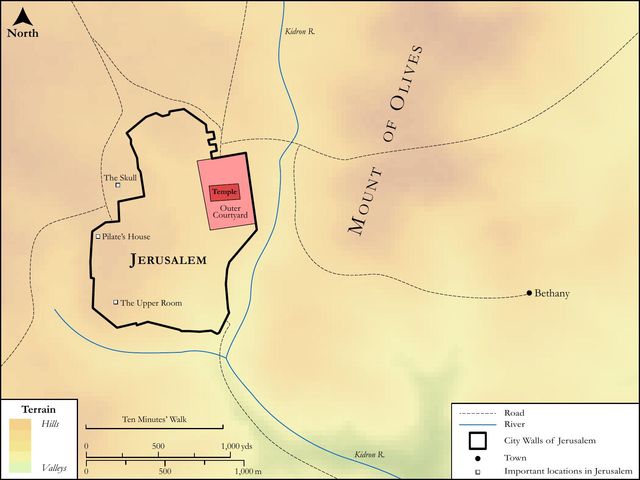
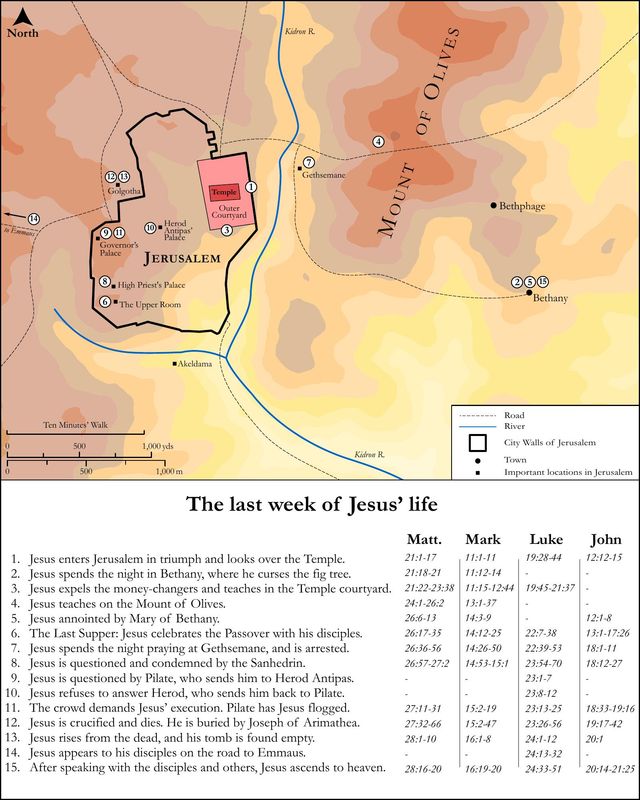
See on the biblical-era maps

Study this verse
Public-domain commentary
Matthew Henry
From his Commentary on the Whole Bible. Henry comments on passages, not single verses — this entry covers Mark 16:9–13. His two-level outline is real structure in the source text, so it is rendered as structure.
We have here a very short account of two of Christ's appearances, and the little credit which the report of them gained with the disciples.
I.He appeared to Mary Magdalene, to her first in the garden, which we have a particular narrative of, Joh 20:14.
It was she out of whom he had cast seven devils; much was forgiven her, and much was given her, and done for her, and she loved much; and this honour Christ did her, that she was the first that saw him after his resurrection. The closer we cleave to Christ, the sooner we may expect to see him, and the more to see of him.
Now, 1. She brings notice of what she had seen, to the disciples; not only to the eleven, but to the rest that followed him, as they mourned and wept, Mar 16:10. Now was the time of which Christ had told them, that they should mourn and lament, Joh 16:20. And it was an evidence of their great love to Christ, and the deep sense they had of their loss of him. But when their weeping had endured a night or two, comfort returned, as Christ has promised; I will see you again, and your heart shall rejoice. Better news cannot be brought to disciples in tears, than to tell them of Christ's resurrection. And we should study to be comforters to disciples that are mourners, by communicating to them our experiences, and what we have seen of Christ.
2.They could not give credit to the report she brought them. They heard that he was alive, and had been seen of her. The story was plausible enough, and yet they believed not. They would not say that she made the story herself, or designed to deceive them; but they fear that she is imposed upon, and that it was but a fancy that she saw him. Had they believed the frequent predictions of it from his own mouth, they would not have been now so incredulous of the report of it.
II.He appeared to two of the disciples, as they went into the country, Mar 16:12.
This refers, no doubt, to that which is largely related (Luk 24:13, etc.), of which passed between Christ and the two disciples going to Emmaus. He is here said to have appeared to them in another form, in another dress than what he usually wore, in the form of a traveller, as, in the garden, in such a dress, that Mary Magdalene took him for the gardener; but that he had really his own countenance, appears by this, that their eyes were holden, that they should not know him; and when that restrain on their eyes was taken off, immediately they knew him, Lu. 24:16-31. Now,
1.These two witnesses gave in their testimony to this proof of Christ's resurrection; They went and told it to the residue, Mar 16:13. Being satisfied themselves, they were desirous to give their brethren the satisfaction they had, that they might be comforted as they were.
2.This did not gain credit with all; Neither believed they them. They suspected that their eyes also deceived them. Now there was a wise providence in it, the proofs of Christ's resurrection were given in thus gradually, and admitted thus cautiously, that so the assurance with which the apostles preached this doctrine afterward, when they ventured their all upon it, might be the more satisfying. We have the more reason to believe those who did themselves believe so slowly: had they swallowed it presently, they might have been thought credulous, and their testimony the less to be regarded; but their disbelieving at first, shows that they did not believe it afterward but upon a full conviction.
Historical interpretation
Seven Centuries of Reception
5 surviving comments on this verse. Each one is dated, so this reads as a timeline rather than a list.
Select a marker to jump to its quote. Markers stagger vertically where authors wrote within a few decades of each other.
Again, He is shown to her, out of whom He had cast seven devils, because harlots and publicans shall go before the synagogue into the kingdom of heaven, as the thief reached it before the Apostles.
They mourn and weep because they had not yet seen, but after a short time they shall receive a consolation. For blessed are they that weep now, for they shall be comforted.
But in a mystic sense we may understand that faith here labours, leading the active life, but there it reigns secure in the contemplative vision. Here we see His face through a glass, there we shall see the truth face to face, wherefore He was shown to them as they were walking, that is, labouring, in another form. And when it was told, the disciples did not believe, because they saw, like Moses, that which was not enough for them, for he said, show me thyself; (Exod. 33:18. Sept.) forgetting his flesh, he prays in this life for that which we hope for in the life to come.
(Chrysologus ubi sup.) It is said also in a marked manner, that they said nothing to any one, because it is the part of women to hear, and not to speak, to learn, not to teach.
(Chrysologus ubi sup.) Mary brings the news, not now as a woman, but in the person of the Church, so that, as above woman was silent, here as the Church she might bring tidings and speak. There follows, And they when they heard that he was alive and had been seen by her, believed not.
(Chrysologus ubi sup.) But let no one suppose that Christ changed the form of His face by His resurrection, but the form is changed when of mortal it becomes immortal, so that this means that He gained a glorious countenance, not that He lost the substance of His countenance. But He was seen of two; because faith in the resurrection is to be preached and shown to two people, that is, the Gentiles and the Jews. There follows, And they went and told it unto the residue, neither believed they them. How are we to understand the words of Mark compared with the account of Luke, that they then said, The Lord hath risen indeed, and hath appeared unto Simon, (Luke 24:34) if we do not suppose that there were some there who would not believe?
(ubi sup.) For as Samson at midnight not only left Gaza, but also carried away the gates of it, so also our Redeemer rising before the light, did not only come out free from hell, but destroyed also the very gates of hell. 1But Mark here testifies that seven devils were cast out of Mary; and what is meant by seven devils save all vices? for as by seven days is understood all time, so by the number seven 2 a whole is fitly figured.
(Hom. in Evan. xxix.) That the disciples were slow in believing our Lord's resurrection was not so much a weakness of theirs as it is our strength. For the resurrection itself through their doubts was manifested by many proofs; and whilst we read and acknowledge them, what do we but become firmer through their doubting? There follows, After this he appeared in another form unto two of them as they walked and went to a farm house.
(ubi sup.) John tells us most fully how and when this appearance took place. But the Lord rose in the morning from the sepulchre in which He had been laid in the evening, that those words of the Psalm might be fulfilled, Heaviness may endure for a night, but joy cometh in the morning. (Ps. 30:5)
(ubi sup.) In the beginning also woman brought man into sin, now she, who first tasted death, first sees the resurrection, lest she should have to bear the reproach of perpetual guilt amongst men; and she who had been the channel of guilt to man, now has become the first channel of grace. For it goes on: And she went and told them that had been with him as they mourned and wept.
(ubi sup.) Fitly too is this woman, who was the first to announce the joy of our Lord's resurrection, said to have been cured of seven devils, lest any one worthily repenting of his sins should despair of pardon for what he had done, and that it might be shown that where sin abounded, grace did much more abound. (Rom. 5:20)
Or else put a stop at, Now when Jesus was risen, and then read, early the first day of the week he appeared, &c.
But Mary had seven devils, because she was filled with all vices. Or else, by seven devils are meant seven spirits contrary to the seven virtues, as a spirit without fear, without wisdom, without understanding, and whatsoever else is opposed to the gifts of the Holy Ghost.
For he does not say this of the eleven, but of some others, whom He calls the residue.
Continue studying Mark 16:13 across the web’s major study libraries — every link below opens this exact verse, chapter, or book on the destination site.
Read & Compare
 BibleGatewayThis verse in more than 200 translations and 70 languages.
 Bible.comThe YouVersion reader — hundreds of translations, reading plans, and highlights.
 ESV.orgCrossway's official English Standard Version reader.
 NET BibleThe NET translation with 60,000+ translators' notes on every rendering decision.
 STEP BibleTyndale House's free study tool — original text, vocabulary, and scholarly resources.
 BibliaLogos Bible Software's free web reader.
 USCCBThe New American Bible (Revised Edition) with the U.S. bishops' study notes.
Commentaries
 BibleHub CommentariesDozens of classic commentaries on this verse, gathered on one page.
 StudyLightMore than 100 commentary sets — the largest collection on the web.
 BibleRefPlain-English commentary on what this verse means, verse by verse.
 Enduring WordDavid Guzik's free commentary on this chapter, widely used by Bible teachers.
 Bible Study ToolsVerse commentary alongside Greek and Hebrew study aids.
Original Language & Research
- BibleHub InterlinearThe verse word by word — original language, transliteration, and English.
- BibleHub LexiconEvery word's original-language definition and Strong's entry.
 Blue Letter BibleDeep-study tools — Strong's numbers, concordance, and word studies.
 CNTR CollationThe earliest Greek manuscripts of this verse, collated letter by letter.
Sermons, Hymns & Audio


TrulyRandomVerse is not affiliated with these sites and doesn’t control their content. They’re linked because they’re genuinely useful.
Summary
Mark 16:13 recounts the immediate aftermath of Jesus' post-resurrection appearance to two disciples, likely on the road to Emmaus, as they return to Jerusalem and share their astonishing news with the remaining disciples. Despite their earnest testimony, the "residue"—the primary group of apostles and their companions—responded with profound skepticism and outright disbelief, highlighting the initial human struggle to grasp the reality of Christ's triumph over death.
Context
ShowHideLiterary Context
Mark 16:13 is situated within the "Longer Ending of Mark" (Mark 16:9-20), a debated but historically significant section that details Jesus' post-resurrection appearances and final commission to His disciples. This verse immediately follows the account of Jesus appearing "in another form unto two of them" (Mark 16:12), which is widely understood to be a concise reference to the Emmaus Road encounter described more fully in Luke 24:13-35. The narrative flow in Mark's ending rapidly progresses through a series of rejected testimonies, beginning with Mary Magdalene's report in Mark 16:9-11, followed by this verse's account of the two disciples, all culminating in Jesus' direct rebuke of the eleven for their unbelief in Mark 16:14. This sequence emphasizes the profound difficulty even His closest followers had in accepting the resurrection.
Historical & Cultural Context
The period immediately following Jesus' crucifixion was one of immense confusion, grief, and fear for His disciples. Their hopes had been shattered by His death, and their understanding of messianic prophecy was largely shaped by expectations of a conquering king, not a suffering servant who would die and rise again. Resurrection from the dead, while a concept present in some Jewish thought (e.g., the Pharisees believed in a general resurrection at the end of time), was not anticipated for an individual in the middle of history, especially not one who had been executed as a criminal. Thus, the idea of Jesus' bodily resurrection was not only counter-cultural but also deeply counter-intuitive to their current theological framework. Their initial disbelief was a natural human response to an unprecedented and utterly astonishing claim, challenging their deepest assumptions about life, death, and God's plan.
Key Themes
ShowHideMark 16:13 contributes significantly to several key themes within the broader book of Mark and the New Testament. Foremost among these is the theme of initial disbelief and the struggle for faith. Despite Jesus' clear predictions of His death and resurrection (e.g., Mark 8:31, Mark 9:31, Mark 10:33-34), the disciples consistently failed to grasp the full implications until after the resurrection. This verse underscores the human tendency to doubt even profound truths, especially those that defy conventional understanding. It also highlights the importance of eyewitness testimony as a foundational element of the Gospel message, even when that testimony is initially rejected. Finally, it subtly introduces the theme of divine patience and persistence, as Jesus Himself would later appear to these disbelieving disciples to overcome their skepticism, demonstrating His commitment to bringing them to full faith, as seen in Mark 16:14.
Exposition and Analysis
ShowHideKey Word Analysis
ShowHideFrom apó (from) and the base of ángelos (messenger), this verb means "to announce," "to report," or "to bring word." It implies a formal or significant declaration, not just casual conversation. In this context, it emphasizes the intentional act of the two disciples to convey the momentous news of Jesus' appearance to them, underscoring the gravity and importance of their message.
This masculine plural term derives from leípō (to leave, to remain) and literally means "the remaining ones" or "the rest." In Mark 16:13, it specifically refers to the remaining group of disciples, likely the eleven apostles (minus Judas) and perhaps other close followers who were gathered together, as indicated by parallel accounts in the Gospels. It highlights that the message was delivered to the core group who were expected to be the primary recipients and future witnesses.
From pístis (faith), this verb means "to have faith (in, upon, or with respect to, a person or thing)," "to credit," or "to entrust." The use of this word, negated by oudé ("neither," "not even"), powerfully conveys the absolute lack of faith or conviction on the part of the "residue." It indicates not merely a momentary hesitation, but a fundamental rejection of the truth of the two disciples' testimony regarding Jesus' resurrection.
Verse Breakdown
ShowHide"And they went and told [it] unto the residue"
This clause describes the action of the two disciples who had encountered the resurrected Jesus. Having recognized Him on the road to Emmaus and witnessed His disappearance, they immediately returned to Jerusalem, driven by the urgency and joy of their discovery. Their act of "telling" was a direct, earnest attempt to share the life-altering news with their fellow disciples, who were likely still in hiding and mourning. The "residue" refers to the main body of the disciples, indicating that this crucial message was delivered to the core group of Jesus' followers.
"neither believed they them."
This stark and concise statement reveals the immediate, negative reaction of the "residue." Despite the personal, eyewitness testimony of two trusted companions, the main group of disciples remained steeped in disbelief. The strong negative particle "neither" (Greek oudé) emphasizes their absolute refusal to credit the report, underscoring the profound skepticism and the formidable barrier of their preconceived notions and grief that prevented them from accepting the unprecedented reality of the resurrection.
Literary Devices
ShowHideMark 16:13 employs several literary devices to convey its powerful message. There is a strong sense of Contrast between the joyful, urgent testimony of the two disciples and the stubborn, immediate disbelief of the "residue." This juxtaposition highlights the profound human struggle to accept truths that challenge deeply held assumptions, especially after such a traumatic event as the crucifixion. Furthermore, there is an element of Irony, as those who had spent years with Jesus, heard His prophecies, and were designated to be His future witnesses, are the very ones who initially reject the foundational truth of His resurrection. This irony serves to underscore the extraordinary nature of the resurrection and the necessity of divine intervention to overcome human skepticism. The verse also functions as a Foreshadowing of Jesus' subsequent direct appearance and rebuke in Mark 16:14, demonstrating that human testimony, while crucial, often needs to be supplemented by direct divine revelation to fully establish faith.
Theological and Thematic Connections
ShowHideMark 16:13 profoundly illustrates the initial human struggle with the reality of the resurrection, even among those closest to Jesus. It reveals that faith is not always an immediate or automatic response to evidence, no matter how compelling. The disciples' disbelief underscores the unprecedented nature of the resurrection and the radical shift in understanding it required. Theologically, this verse sets the stage for Jesus' subsequent appearances, emphasizing that His post-resurrection ministry included patiently overcoming the disciples' skepticism, not merely confirming His victory. It teaches us that God meets us in our doubts, providing further revelation and encounter to solidify our faith, rather than abandoning us in our unbelief. This narrative also validates the humanity of the disciples, showing that their journey to full conviction was a process, making their eventual witness all the more powerful and relatable.
Reflection and Application
ShowHideMark 16:13 offers a poignant reminder that doubt is a deeply human experience, even for those who earnestly seek to follow Christ. The initial disbelief of the "residue" of disciples, despite hearing compelling eyewitness accounts, normalizes our own struggles with faith in the face of challenging truths or difficult circumstances. This verse encourages us to approach our own doubts, and those of others, with patience and understanding, rather than condemnation. Just as Jesus did not abandon His disciples in their unbelief but patiently revealed Himself to them, we are called to persevere in seeking truth and to trust that God will meet us in our journey. It also underscores the enduring power of personal testimony; even when initially rejected, the faithful sharing of our encounter with Christ remains a vital part of spreading the Gospel, trusting that the Holy Spirit will ultimately open hearts to believe. Our faith journey is often one of wrestling with truth, receiving evidence, and ultimately, a divine revelation that transforms skepticism into conviction.
Questions for Reflection
ShowHideFAQ
ShowHideWhy did the disciples not believe the testimony of their own companions?
ShowHideThe disciples' disbelief stemmed from several factors. Firstly, the concept of a bodily resurrection in the middle of history was entirely outside their Jewish theological framework, which typically envisioned a general resurrection at the end of time. They were still processing the trauma of Jesus' crucifixion and the shattering of their messianic hopes. Secondly, their minds were likely clouded by grief and fear, making it difficult to accept such an extraordinary claim. Even though Jesus had predicted His resurrection multiple times, they had not fully understood or accepted these prophecies. The news was simply too good, too radical, and too contrary to their current reality to be immediately credited, even from trusted friends. Their disbelief highlights the profound human difficulty in accepting truths that defy all prior experience and expectation, underscoring the miraculous nature of the resurrection itself.
Christ-Centered Fulfillment
ShowHideMark 16:13, with its stark portrayal of the disciples' disbelief, powerfully sets the stage for the Christ-centered fulfillment of God's redemptive plan. The initial human inability to believe the resurrection testimony underscores the profound spiritual blindness and hardened hearts that only Christ Himself can overcome. Just as the disciples needed Jesus to appear to them directly, opening their minds to understand the Scriptures (Luke 24:44-45), so too does humanity require the illuminating work of the Holy Spirit, sent by Christ, to truly apprehend the truth of His victory over sin and death. The very disbelief recorded here highlights the necessity of the resurrected Christ's continued work, not only in overcoming death but also in conquering the skepticism of human hearts. He is the one who transforms doubt into conviction, fear into faith, and despair into hope, ultimately fulfilling the promise of a new covenant where God's law is written on hearts, enabling true belief (Jeremiah 31:33). The disciples' journey from unbelief to bold proclamation, empowered by the Spirit, becomes a prototype for all who would come to faith in the risen Lord, demonstrating that faith is ultimately a gift and work of Christ Himself (Ephesians 2:8-9).