


Mark 1:18
- καὶkaiAndG2532CONJConjunction
- εὐθὺςeuthusimmediatelyG2112ADVAdverb
- ἀφέντεςaphenteshaving leftG863V-2AAP-NPMVerb 2nd Aorist Active Participle Nominative Plural Masculine
- τὰtatheG3588T-APNDefinite article Accusative Plural Neuter
- δίκτυαdiktuanetsG1350N-APNNoun Accusative Plural Neuter
- αὐτῶνautōnof themG846P-GPMPersonal pronoun Genitive Plural Masculine
- ἠκολούθησανēkolouthēsanthey followedG190V-AAI-3PVerb Aorist Active Indicative 3rd Plural
- αὐτῷautōHimG846P-DSMPersonal pronoun Dative Singular Masculine
English is a literal word-by-word gloss of the Greek, not the KJV's wording. Why?
This is the original text the KJV's translators worked from — each Greek word with its own literal English meaning in this verse, prepared by scholars at Tyndale House, Cambridge. The KJV translates whole sentences, not word by word, so its wording differs: one Greek word can become several English words, and the KJV may choose “charity” where the gloss reads “love”. Both are faithful — they answer different questions. For the KJV's own rendering, switch to the KJV text.
Details
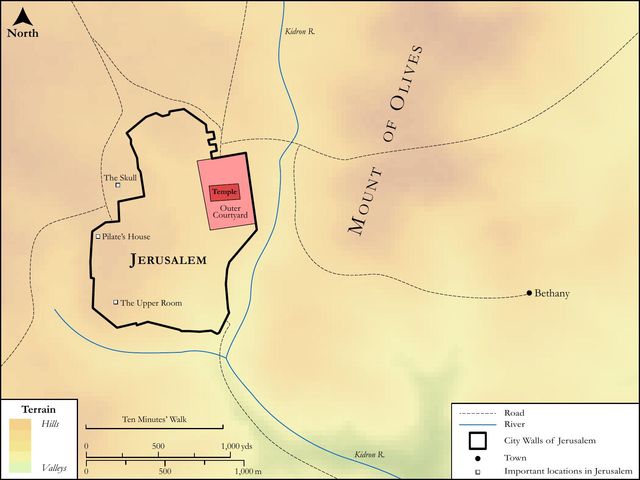
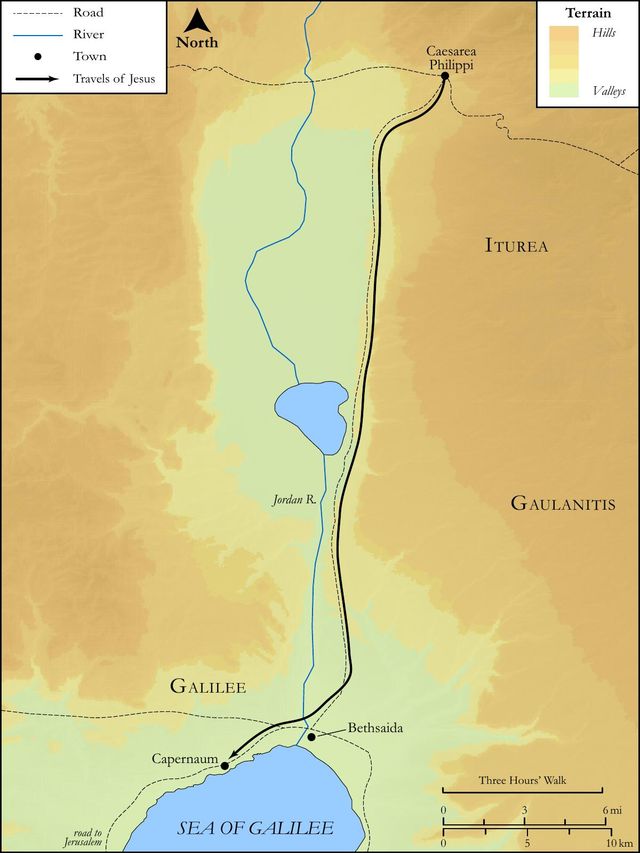
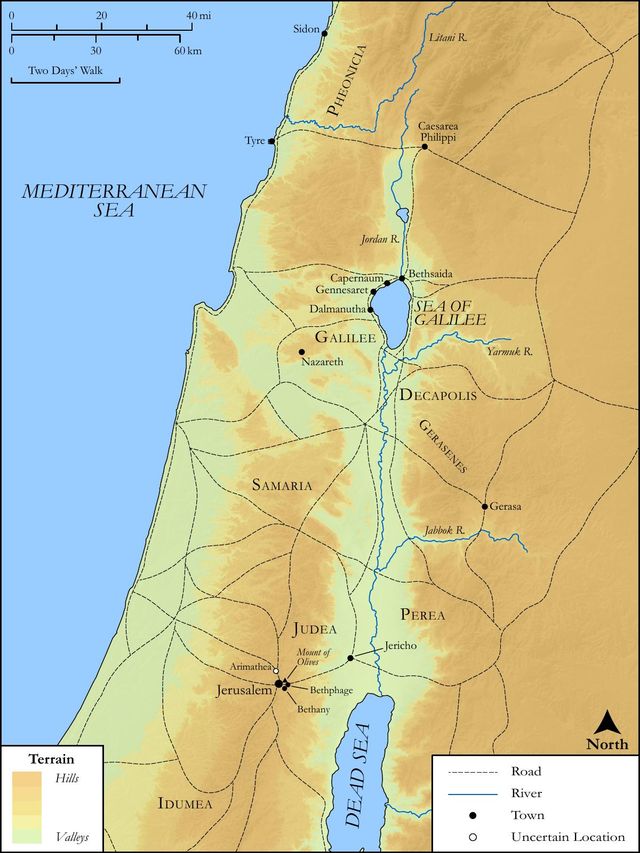
See on the biblical-era map
Study this verse
Public-domain commentary
Matthew Henry
From his Commentary on the Whole Bible. Henry comments on passages, not single verses — this entry covers Mark 1:14–22. His three-level outline is real structure in the source text, so it is rendered as structure.
Here is, I. A general account of Christ's preaching in Galilee. John gives an account of his preaching in Judea, before this (ch. 2 and 3), which the other evangelists had omitted, who chiefly relate what occurred in Galilee, because that was least known at Jerusalem. Observe,
1.When Jesus began to preach in Galilee; After that John was put in prison. When he had finished his testimony, then Jesus began his. Note, The silencing of Christ's ministers shall not be the suppressing of Christ's gospel; if some be laid aside, others shall be raised up, perhaps mightier than they, to carry on the same work.
2.What he preached; The gospel of the kingdom of God. Christ came to set up the kingdom of God among men, that they might be brought into subjection to it, and might obtain salvation in it; and he set it up by the preaching of his gospel, and a power going along with it.
Observe, (1.) The great truths Christ preached; The time is fulfilled, and the kingdom of God is at hand. This refers to the Old Testament, in which the kingdom of the Messiah was promised, and the time fixed for the introducing of it. They were not so well versed in those prophecies, nor did they so well observe the signs of the times, as to understand it themselves, and therefore Christ gives them notice of it; "The time prefixed is now at hand; glorious discoveries of divine light, life, and love, are now to be made; a new dispensation far more spiritual and heavenly than that which you have hitherto been under, is now to commence." Note, God keeps time; when the time is fulfilled, the kingdom of God is at hand, for the vision is for an appointed time, which will be punctually observed, though it tarry past our time.
(2.)The great duties inferred from thence. Christ gave them to understand the times, that they might know what Israel ought to do; they fondly expected the Messiah to appear in external pomp and power, not only to free the Jewish nation from the Roman yoke, but to make it have dominion over all its neighbours, and therefore thought, when that kingdom of God was at hand, they must prepare for war, and for victory and preferment, and great things in the world; but Christ tells them, in the prospect of that kingdom approaching, they must repent, and believe the gospel. They had broken the moral law, and could not be saved by a covenant of innocency, for both Jew and Gentile are concluded under guilt. They must therefore take the benefit of a covenant of grace, must submit to a remedial law, and this is it - repentance towards God, and faith towards our Lord Jesus Christ. They had not made use of the prescribed preservatives, and therefore must have recourse to the prescribed restoratives. By repentance we must lament and forsake our sins, and by faith we must receive the forgiveness of them. By repentance we must give glory to our Creator whom we have offended; by faith we must give glory to our Redeemer who came to save us from our sins. Both these must go together; we must not think either that reforming our lives will save us without trusting in the righteousness and grace of Christ, or that trusting in Christ will save us without the reformation of our hearts and lives. Christ hath joined these two together, and let no man think to put them asunder. They will mutually assist and befriend each other. Repentance will quicken faith, and faith will make repentance evangelical; and the sincerity of both together must be evidenced by a diligent conscientious obedience to all God's commandments. Thus the preaching of the gospel began, and thus it continues; still the call is, Repent, and believe, and live a life of repentance and a life of faith.
II.Christ appearing as a teacher, here is next his calling of disciples, Mar 1:16-20. Observe,
1.Christ will have followers. If he set up a school, he will have scholars; if he set up his standard, he will have soldiers; if he preach, he will have hearers. He has taken an effectual course to secure this; for all that the Father has given him, shall, without fail, come to him.
2.The instruments Christ chose to employ in setting up his kingdom, were the weak and foolish things of the world; not called from the great sanhedrim, or the schools of the rabbin, but picked up from among the tarpaulins by the sea-side, that the excellency of the power might appear to be wholly of God, and not at all of them.
3.Though Christ needs not the help of man, yet he is pleased to make use of it in setting up his kingdom, that he might deal with us not in a formidable but in a familiar way, and that in his kingdom the nobles and governors may be of ourselves, Jer 31:21.
4.Christ puts honour upon those who, though mean in the world, are diligent in their business, and loving to one another; so those were, whom Christ called. He found them employed, and employed together. Industry and unity are good and pleasant, and there the Lord Jesus commands the blessing, even this blessing, Follow me.
5.The business of ministers is to fish for souls, and win them to Christ. The children of men, in their natural condition, are lost, wander endlessly in the great ocean of this world, and are carried down the stream of its course and way; they are unprofitable. Like leviathan in the waters, they play therein; and often, like the fishes of the sea, they devour one another. Ministers, in preaching the gospel, cast the net into the waters, Mat 13:47. Some are enclosed and brought to shore, but far the greater number escape. Fishermen take great pains, and expose themselves to great perils, so do ministers; and they have need of wisdom. If many a draught brings home nothing, yet they must go on.
6.Those whom Christ called, must leave all, to follow him; and by his grace he inclines them to do so. Not that we must needs go out of the world immediately, but we must sit loose to the world, and forsake every thing that is inconsistent with our duty to Christ, and that cannot be kept without prejudice to our souls. Mark takes notice of James and John, that they left not only their father (which we had in Matthew), but the hired servants, whom perhaps they loved as their own brethren, being their fellow-labourers and pleasant comrades; not only relations, but companions, must be left for Christ, and old acquaintance. Perhaps it is an intimation of their care for their father; they did not leave him without assistance, they left the hired servants with him. Grotius thinks it is mentioned as an evidence that their calling was gainful to them, for it was worth while to keep servants in pay, to help them in it, and their hands would be much missed, and yet they left it.
III.Here is a particular account of his preaching in Capernaum, one of the cities of Galilee; for though John Baptist chose to preach in a wilderness, and did well, and did good, yet it doth not therefore follow, that Jesus must do so too; the inclinations and opportunities of ministers may very much differ, and yet both be in the way of their duty, and both useful. Observe,
1.When Christ came into Capernaum, he straightway applied himself to his work there, and took the first opportunity of preaching the gospel. Those will think themselves concerned not to lose time, who consider what a deal of work they have to do, and what a little time to do it in.
2.Christ religiously observed the sabbath day, though not by tying himself up to the tradition of the elders, in all the niceties of the sabbath-rest, yet (which was far better) by applying himself to, and abounding in, the sabbath-work, in order to which the sabbath-rest was instituted.
3.Sabbaths are to be sanctified in religious assemblies, if we have opportunity; it is a holy day, and must be honoured with a holy convocation; this was the good old way, Act 13:27; Act 15:21. On the sabbath-day, tois sabbasin - on the sabbath-days; every sabbath-day, as duly as it returned, he went into the synagogue.
4.In religious assemblies on sabbath-days, the gospel is to be preached, and those to be taught, who are willing to learn the truth as it is in Jesus.
5.Christ was a non-such preacher; he did not preach as the scribes, who expounded the law of Moses by rote, as a school-boy says his lesson, but were neither acquainted with it (Paul himself, when a Pharisee, was ignorant of the law), nor affected with it; it came not from the heart, and therefore came not with authority. But Christ taught as one that had authority, as one that knew the mind of God, and was commissioned to declare it.
6.There is much in the doctrine of Christ, that is astonishing; the more we hear it, the more cause we shall see to admire it.
Historical interpretation
Eleven Centuries of Reception
8 surviving comments on this verse. Each one is dated, so this reads as a timeline rather than a list.
Select a marker to jump to its quote. Markers stagger vertically where authors wrote within a few decades of each other.
Further, we are mystically carried away to heaven, like Elias, by this chariot, drawn by these fishers, as by four horses. On these four corner-stones the first Church is built; in these, as in the four Hebrew letters, (יהוה) we acknowledge the tetragrammaton, the name of the Lord, we who are commanded, after their example, to hear the voice of the Lord, and to forget (Ps. 45:11) the people of wickedness, and the house of our fathers' conversation, which is folly before God, and the spider's net, in the meshes of which we, like gnats, were all but fallen, and were confined by things vain as the air, which hangs on nothing; loathing also the ship of our former walk. For Adam, our forefather according to the flesh, is clothed with the skins of dead beasts; but now, having put off the old man, with his deeds, following the new man we are clothed with those skins of Solomon, with which the bride rejoices that she has been made beautiful. (Cant. 1:4. Vulg.) Again, Simon, means obedient; Andrew, manly; James, supplanter;f John, grace; by which four names, we are knit together into God's host;g by obedience, that we may listen; by manliness, that we do battle; by overthrowing, that we may persevere; by grace, that we may be preserved. (supplantatione) Which four virtues are called cardinal; for by prudence, we obey; by justice, we bear ourselves manfully; by temperance, we tread the serpent underfoot; by fortitude, we earn the grace of God.
Do you hesitate about your business and professions for the sake of your children and parents? It has been demonstrated to us in Scripture that any too dear relations, crafts and trades are to be quite left behind for the Lord’s sake. For James and John, called by the Lord, immediately leave quite behind both father and ship. Matthew is roused from the tollbooth. Even burying a father was too tardy a business for faith! None of those whom the Lord chose to him said, “I have no means to live.”
And from that day they adhered to him so resolutely that they did not depart…. Let us, also, ourselves build a house in our heart and make a place where he may come and teach us.
For by the net of holy preaching they drew fish, that is, men, from the depths of the sea, that is, of infidelity, to the light of faith. Wonderful indeed is this fishing! for fishes when they are caught, soon after die; when men are caught by the word of preaching, they rather are made alive.
You have heard, dearest brothers, that at the voice of a single command, Peter and Andrew, leaving their nets, followed the Redeemer. They had seen him perform no miracles yet, they had heard nothing from him about the reward of eternal recompense; and yet at one command of the Lord they forgot what they seemed to possess. How many of his miracles do we see, with how many scourges are we afflicted, by how many harsh threats are we deterred, and yet we disdain to follow him when he calls? He who admonishes us about conversion already sits in heaven; he has already subjected the necks of the nations to the yoke of faith, he has already laid low the glory of the world, he already announces, as its ruins multiply, that the day of his strict judgment draws near; and yet our proud mind does not wish to abandon willingly what it loses daily against its will. What then, dearest ones, what shall we say at his judgment, we who are neither bent by commands nor corrected by blows from the love of the present age?
But perhaps someone may say to himself in silent thoughts: At the Lord's voice, what or how much did each of these fishermen leave behind, who had almost nothing? But in this matter, dearest brothers, we ought to weigh the affection rather than the wealth. He left much who retained nothing for himself; he left much who, however little it was, abandoned everything. Certainly we both possess what we have with love, and seek from desire those things we do not have at all. Therefore Peter and Andrew left much, since each also abandoned the desires of having. He left much who renounced his longings along with the thing he possessed. Therefore those who followed gave up as much as could be desired by those who did not follow. Let no one therefore, even when he sees that certain people have left many things behind, say to himself: I want to imitate these despisers of the world, but I have nothing to leave behind. You leave many things, brothers, if you renounce earthly desires. For our external possessions, however small, are sufficient for the Lord. For he weighs the heart, not the substance; nor does he consider how much is offered in his sacrifice, but from how much it is brought forth. For if we weigh external substance, behold, our holy merchants purchased the perpetual life of angels by giving up their nets and boat. Indeed it has no estimation of price, yet the kingdom of God is worth as much as you have. For it was worth half his substance to Zacchaeus, because he reserved the other half to restore fourfold what he had unjustly taken. It was worth the abandoned nets and boat to Peter and Andrew; it was worth two small coins to the widow; it was worth a cup of cold water to another. The kingdom of God, therefore, as we said, is worth as much as you have.
(ubi sup.) Repent, therefore, and believe; that is, renounce dead works; for of what use is believing without good works? The merit of good works does not, however, bring to faith, but faith begins, that good works may follow.
(in Marc. i. 6) Now fishers and unlettered men are sent to preach, that the faith of believers might be thought to lie in the power of God, not in eloquence or in learning. It goes on to say, and immediately they left their nets, and followed him.
(ubi sup.) It may be asked, how he could call two fishers from each of the boats, (first, Peter and Andrew, then having gone a little further, the two others, sons of Zebedee,) when Luke says that James and John were called to help Peter and Andrew, and that it was to Peter only that Christ said, Fear not, from this time thou shalt catch men; (Luke 5:10) he also says, that at the same time, when they had brought their ships to land, they followed him. We must therefore understand that that transaction which Luke intimates happened first, and afterwards that they, as their custom was, had returned to their fishing. So that what Mark here relates happened afterwards; for in this case they followed the Lord, without drawing their boats ashore, (which they would have done had they meant to return,) and followed Him, as one calling them, and ordering them to follow.
As the Evangelist John relates, Peter and Andrew were disciples of the Forerunner, but seeing that John had borne witness to Jesus, they joined themselves to him; afterwards, grieving that John had been cast into prison, they returned to their trade. Wherefore there follows, casting nets into the sea, for they were fishers. Look then upon them, living on their own labours, not on the fruits of iniquity; for such men were worthy to become the first disciples of Christ; whence it is subjoined, And Jesus said unto them, Come ye after me. Now He calls them for the second time; for this is the second calling in respect of that, of which we read in John. But it is shown to what they were called, when it is added, I will make you become fishers of men.
For we must not allow any time to lapse, but at once follow the Lord. After these again, He catches James and John, because they also, though poor, supported the old age of their father. Wherefore there follows, And when he had gone a little farther thence, he saw James the son of Zebedee, &c. But they left their father, because he would have hindered them in following Christ. Do thou, also, when thou art hindered by thy parents, leave them, and come to God. It is shown by this that Zebedee was not a believer; but the mother of the Apostles believed, for she followed Christ, when Zebedee was dead.
We must know also, that action is first called, then contemplation; for Peter is the type of the active life, for he was more ardent than the others, just as the active life is the more bustling; but John is the type of the contemplative life, for he speaks more fully of divine things.
(non occ.) The Evangelist, having mentioned the preaching of Christ to the multitude, goes on to the calling of the disciples, whom he made ministers of his preaching, whence it follows, And passing along the sea of Galilee, &c.
Continue studying Mark 1:18 across the web’s major study libraries — every link below opens this exact verse, chapter, or book on the destination site.
Read & Compare
 BibleGatewayThis verse in more than 200 translations and 70 languages.
 Bible.comThe YouVersion reader — hundreds of translations, reading plans, and highlights.
 ESV.orgCrossway's official English Standard Version reader.
 NET BibleThe NET translation with 60,000+ translators' notes on every rendering decision.
 STEP BibleTyndale House's free study tool — original text, vocabulary, and scholarly resources.
 BibliaLogos Bible Software's free web reader.
 USCCBThe New American Bible (Revised Edition) with the U.S. bishops' study notes.
Commentaries
 BibleHub CommentariesDozens of classic commentaries on this verse, gathered on one page.
 StudyLightMore than 100 commentary sets — the largest collection on the web.
 BibleRefPlain-English commentary on what this verse means, verse by verse.
 Enduring WordDavid Guzik's free commentary on this chapter, widely used by Bible teachers.
 Bible Study ToolsVerse commentary alongside Greek and Hebrew study aids.
Original Language & Research
- BibleHub InterlinearThe verse word by word — original language, transliteration, and English.
- BibleHub LexiconEvery word's original-language definition and Strong's entry.
 Blue Letter BibleDeep-study tools — Strong's numbers, concordance, and word studies.
 CNTR CollationThe earliest Greek manuscripts of this verse, collated letter by letter.
Sermons, Hymns & Audio


TrulyRandomVerse is not affiliated with these sites and doesn’t control their content. They’re linked because they’re genuinely useful.
Summary
Mark 1:18 powerfully depicts the immediate and radical obedience of Simon Peter and Andrew to Jesus' call. Following Jesus' transformative invitation to become "fishers of men," this verse highlights their decisive action in abandoning their established livelihood to embark on a new path of discipleship. It serves as a foundational example of the profound commitment and instantaneous response demanded by the Lord's authoritative summons.
Context
ShowHideLiterary Context
This verse is an integral part of the opening narrative in Mark's Gospel, which is characterized by its fast pace and emphasis on Jesus' immediate authority and impact. Preceding this, in Mark 1:16-17, Jesus encounters Simon (later known as Peter) and his brother Andrew by the Sea of Galilee, where they are engaged in their trade as fishermen. Jesus issues a direct and transformative call: "Come ye after me, and I will make you to become fishers of men." Mark 1:18 records their immediate and unhesitating response, underscoring the compelling nature of Jesus' presence and the disciples' readiness to forsake their former lives. This swift transition sets the tone for the entire Gospel, emphasizing action and divine initiative.
Historical & Cultural Context
First-century Galilee was a region heavily reliant on fishing, particularly around the Sea of Galilee. Fishermen like Simon and Andrew were skilled laborers whose nets were not merely tools but represented their entire livelihood, family security, and social standing. Abandoning their nets meant relinquishing their economic stability, their family business, and their familiar way of life without a clear understanding of what lay ahead, beyond Jesus' enigmatic promise. Rabbinic discipleship typically involved students seeking out a rabbi, but here, Jesus initiates the call, demonstrating His unique authority. The act of "following" a rabbi implied a complete dedication to his teachings and way of life, often involving travel and a shared existence.
Key Themes
ShowHideMark 1:18 contributes significantly to several overarching themes within Mark's Gospel and the broader biblical narrative. The theme of Immediate Obedience is paramount, underscored by the adverb "straightway" (Greek: euthéōs), a hallmark of Mark's writing style that appears frequently throughout the book, emphasizing the urgency and decisiveness of Jesus' ministry and the responses it elicits. This verse also introduces Radical Discipleship, demonstrating that following Jesus often requires a complete relinquishment of one's former life, as seen in their act of forsaking their nets—a theme echoed in Jesus' later teachings about the cost of discipleship in passages like Luke 9:23. Furthermore, it highlights Divine Authority, as the readiness of these seasoned fishermen to abandon their trade for a relatively unknown rabbi speaks volumes about the compelling power and presence of Jesus' call, which was not a suggestion but a powerful summons. Finally, it foreshadows the Transformation of Purpose, moving from catching literal fish to "fishing for men," a metaphor for evangelism and bringing people into God's kingdom, as Jesus explicitly stated in Mark 1:17.
Exposition and Analysis
ShowHideKey Word Analysis
ShowHideThis adverb signifies "directly, at once or soon; forthwith, immediately." Its prominent use in Mark's Gospel (over 40 times) emphasizes the rapid pace of events and the urgent, decisive nature of Jesus' actions and the responses He evokes. Here, it highlights the disciples' instantaneous and unhesitating obedience.
Meaning "to send forth, to lay aside, leave, let go, abandon, put away." This word implies a decisive and complete act of relinquishment. It is not a temporary pause or a casual departure, but a definitive abandonment of their former livelihood and way of life in response to Jesus' call.
Derived from Greek roots meaning "to be in the same way with," this verb signifies more than merely walking behind someone. It denotes accompanying, adhering to, and becoming a disciple of someone. In this context, it implies a commitment to Jesus' teachings, mission, and lifestyle, marking a profound change of allegiance and direction.
Verse Breakdown
ShowHide"And straightway"
This opening phrase, characteristic of Mark's Gospel, immediately conveys the urgency and instantaneous nature of the disciples' response. It emphasizes that there was no hesitation, no deliberation, but an immediate and direct action following Jesus' call. This sets a precedent for the rapid unfolding of events in Jesus' ministry.
"they forsook their nets"
This clause describes a profound and radical act of abandonment. Their "nets" represented their entire livelihood, their economic security, and their established way of life. By forsaking them, Simon and Andrew were not just taking a break from work; they were relinquishing their past identity and source of provision, demonstrating a complete trust in Jesus' call and a willingness to leave everything behind.
"and followed him"
This final clause articulates the new direction and commitment of their lives. "Following" Jesus meant becoming His disciples, learning from Him, participating in His mission, and aligning their lives entirely with His purpose. It signifies a transfer of allegiance and a new vocational calling, moving from a life centered on fishing to one centered on Christ and His kingdom.
Literary Devices
ShowHideMark 1:18 is rich with literary devices that amplify its message. The most prominent is Markan Immediacy, conveyed through the frequent use of the Greek adverb euthéōs ("straightway" or "immediately"). This stylistic hallmark creates a sense of urgency, dynamism, and directness, emphasizing the compelling nature of Jesus' authority and the swift, decisive responses He elicits. The phrase "forsook their nets" employs Metonymy or Symbolism, where "nets" stand in for their entire livelihood, security, and former way of life. This concrete image powerfully symbolizes the radical sacrifice and complete commitment required for discipleship. Furthermore, the verse functions as a classic Call and Response Narrative, a common biblical motif where a divine summons is met with an immediate human action, highlighting the transformative power of the encounter with Jesus.
Theological and Thematic Connections
ShowHideMark 1:18 establishes a foundational principle of radical discipleship: the call to follow Jesus often necessitates a complete reorientation of one's life, involving the abandonment of former securities and priorities. This immediate and decisive response by Simon and Andrew underscores the compelling authority of Jesus and the transformative power of His invitation. Theologically, it points to the sovereignty of God in calling individuals to His service and the necessary human response of faith and obedience. It illustrates that true discipleship is not merely an intellectual assent but a practical, life-altering commitment, where the "nets" of worldly security, ambition, or comfort are laid aside for the sake of the Kingdom.
Reflection and Application
ShowHideMark 1:18 serves as a potent challenge to contemporary believers, urging us to examine the depth and immediacy of our own response to Jesus' call. While few are called to literally abandon a fishing boat, the principle of "forsaking nets" remains profoundly relevant. It compels us to identify and relinquish anything—whether it be comfort, security, personal ambition, or even good things—that might hinder our full devotion and unreserved obedience to Christ. The disciples' "straightway" response encourages us to act on God's promptings without procrastination or endless deliberation, fostering a spirit of trust in His wisdom and provision. Ultimately, following Jesus means aligning our lives with His mission, embracing a new purpose that transcends personal gain, and participating in the divine work of extending His kingdom, just as the disciples transitioned from catching fish to "fishing for men." This verse reminds us that genuine discipleship begins with a decisive act of surrender and a willingness to follow Jesus wherever He leads, regardless of the perceived cost.
Questions for Reflection
ShowHideFAQ
ShowHideWhat does "forsook their nets" symbolize for believers today?
ShowHide"Forsaking their nets" symbolizes the act of relinquishing anything that holds us back from complete obedience and devotion to Jesus. For Simon and Andrew, their nets represented their livelihood, security, and established way of life. For believers today, these "nets" can be anything that competes for our ultimate allegiance: material possessions, career ambitions, comfort zones, unhealthy relationships, or even good things that become idols. It represents a radical reordering of priorities, where Christ takes preeminence over all else, as seen in the broader call to discipleship found in passages like Luke 14:33.
Why is the word "straightway" so significant in Mark's Gospel?
ShowHideThe word "straightway" (Greek: euthéōs) is a key stylistic feature of Mark's Gospel, appearing over 40 times. Its significance lies in conveying a sense of urgency, immediacy, and decisive action. It emphasizes the dynamic and authoritative nature of Jesus' ministry, showing that His words and presence demand an immediate response. In Mark 1:18, it highlights the unhesitating obedience of the first disciples, setting a precedent for the rapid unfolding of events and the powerful impact of Jesus throughout the narrative. It underscores that encountering Jesus often leads to an immediate and transformative decision.
Christ-Centered Fulfillment
ShowHideMark 1:18, with its depiction of immediate and radical discipleship, finds its ultimate fulfillment and deepest meaning in Jesus Christ Himself. Jesus is the supreme example of one who "forsook" everything for a greater purpose. As Philippians 2:5-8 beautifully articulates, He "emptied himself, by taking the form of a servant," laying aside His divine prerogatives to fully embrace His mission on earth, ultimately culminating in His obedient death on the cross. The call to "follow him" is a call to emulate this Christ-like self-emptying and obedience. The disciples' abandonment of their nets foreshadows the new covenant reality where believers are called to lay down their lives, take up their cross, and follow Christ (as seen in Luke 9:23), participating in His redemptive work. Their transformation from "fishers of fish" to "fishers of men" (as promised in Mark 1:17) is fulfilled in the Great Commission, where Jesus empowers His followers to make disciples of all nations (Matthew 28:18-20). Thus, Mark 1:18 is not merely a historical account of a past event, but a timeless invitation to encounter the Christ who calls, to forsake all for Him, and to participate in His ongoing mission of redeeming humanity, leading to a new life in Him (2 Corinthians 5:17).