


Mark 1:19
- ΚαὶKaiAndG2532CONJConjunction
- προβὰςprobashaving gone onG4260V-2AAP-NSMVerb 2nd Aorist Active Participle Nominative Singular Masculine
- ἐκεῖθενekeithenfrom thereG1564ADVAdverb
- ὀλίγονoligona littleG3641A-ASNAdjective Accusative Singular Neuter
- εἶδενeidenHe sawG1492V-2AAI-3SVerb 2nd Aorist Active Indicative 3rd Singular
- ἸάκωβονIakōbonJamesG2385N-ASM-PNoun Accusative Singular Masculine Individual
- τὸνtonthe [son]G3588T-ASMDefinite article Accusative Singular Masculine
- τοῦtou<the>G3588T-GSMDefinite article Genitive Singular Masculine
- ΖεβεδαίουZebedaiouof ZebedeeG2199N-GSM-PNoun Genitive Singular Masculine Individual
- καὶkaiandG2532CONJConjunction
- ἸωάννηνIōannēnJohnG2491N-ASM-PNoun Accusative Singular Masculine Individual
- τὸνtontheG3588T-ASMDefinite article Accusative Singular Masculine
- ἀδελφὸνadelphonbrotherG80N-ASMNoun Accusative Singular Masculine
- αὐτοῦautouof himG846P-GSMPersonal pronoun Genitive Singular Masculine
- καὶkaiandG2532CONJConjunction
- αὐτοὺςautoustheyG846P-APMPersonal pronoun Accusative Plural Masculine
- ἐνen[were] inG1722PREPPreposition
- τῷtōtheG3588T-DSNDefinite article Dative Singular Neuter
- πλοίῳploiōboatG4143N-DSNNoun Dative Singular Neuter
- καταρτίζονταςkatartizontasadjustingG2675V-PAP-APMVerb Present Active Participle Accusative Plural Masculine
- τὰtatheG3588T-APNDefinite article Accusative Plural Neuter
- δίκτυαdiktuanetsG1350N-APNNoun Accusative Plural Neuter
English is a literal word-by-word gloss of the Greek, not the KJV's wording. Why?
This is the original text the KJV's translators worked from — each Greek word with its own literal English meaning in this verse, prepared by scholars at Tyndale House, Cambridge. The KJV translates whole sentences, not word by word, so its wording differs: one Greek word can become several English words, and the KJV may choose “charity” where the gloss reads “love”. Both are faithful — they answer different questions. For the KJV's own rendering, switch to the KJV text.
Details
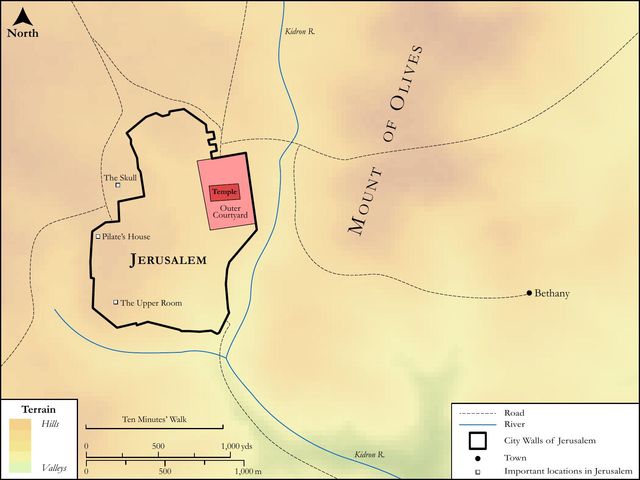
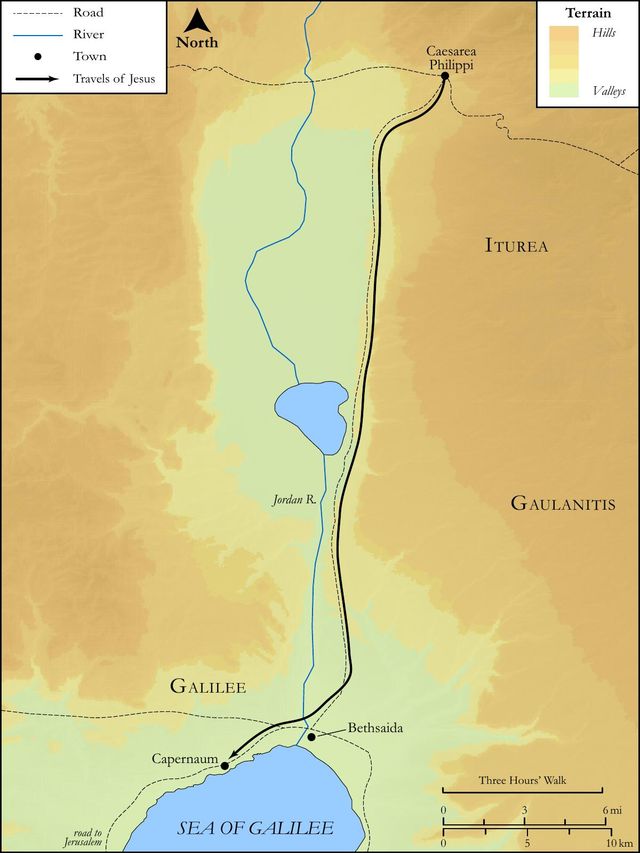
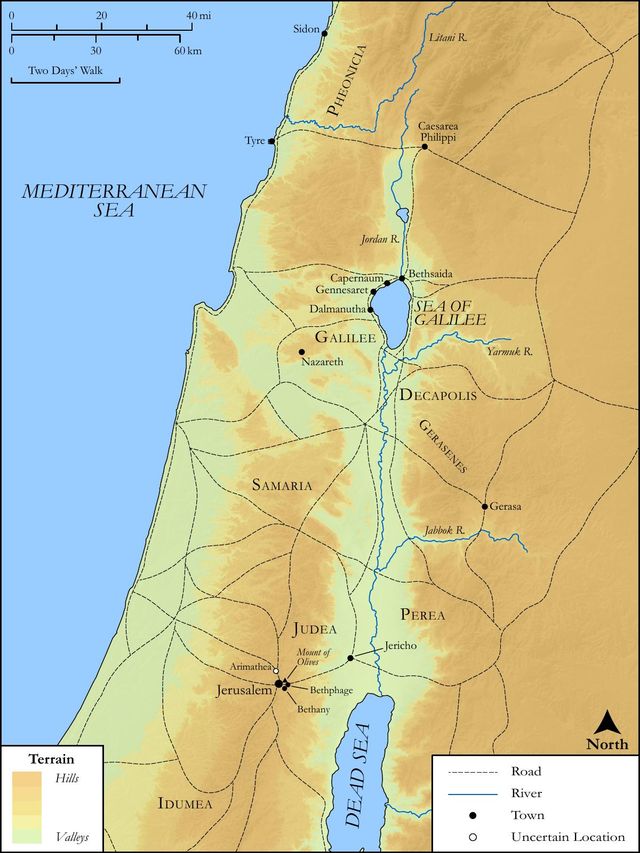
See on the biblical-era map
Study this verse
Public-domain commentary
Matthew Henry
From his Commentary on the Whole Bible. Henry comments on passages, not single verses — this entry covers Mark 1:14–22. His three-level outline is real structure in the source text, so it is rendered as structure.
Here is, I. A general account of Christ's preaching in Galilee. John gives an account of his preaching in Judea, before this (ch. 2 and 3), which the other evangelists had omitted, who chiefly relate what occurred in Galilee, because that was least known at Jerusalem. Observe,
1.When Jesus began to preach in Galilee; After that John was put in prison. When he had finished his testimony, then Jesus began his. Note, The silencing of Christ's ministers shall not be the suppressing of Christ's gospel; if some be laid aside, others shall be raised up, perhaps mightier than they, to carry on the same work.
2.What he preached; The gospel of the kingdom of God. Christ came to set up the kingdom of God among men, that they might be brought into subjection to it, and might obtain salvation in it; and he set it up by the preaching of his gospel, and a power going along with it.
Observe, (1.) The great truths Christ preached; The time is fulfilled, and the kingdom of God is at hand. This refers to the Old Testament, in which the kingdom of the Messiah was promised, and the time fixed for the introducing of it. They were not so well versed in those prophecies, nor did they so well observe the signs of the times, as to understand it themselves, and therefore Christ gives them notice of it; "The time prefixed is now at hand; glorious discoveries of divine light, life, and love, are now to be made; a new dispensation far more spiritual and heavenly than that which you have hitherto been under, is now to commence." Note, God keeps time; when the time is fulfilled, the kingdom of God is at hand, for the vision is for an appointed time, which will be punctually observed, though it tarry past our time.
(2.)The great duties inferred from thence. Christ gave them to understand the times, that they might know what Israel ought to do; they fondly expected the Messiah to appear in external pomp and power, not only to free the Jewish nation from the Roman yoke, but to make it have dominion over all its neighbours, and therefore thought, when that kingdom of God was at hand, they must prepare for war, and for victory and preferment, and great things in the world; but Christ tells them, in the prospect of that kingdom approaching, they must repent, and believe the gospel. They had broken the moral law, and could not be saved by a covenant of innocency, for both Jew and Gentile are concluded under guilt. They must therefore take the benefit of a covenant of grace, must submit to a remedial law, and this is it - repentance towards God, and faith towards our Lord Jesus Christ. They had not made use of the prescribed preservatives, and therefore must have recourse to the prescribed restoratives. By repentance we must lament and forsake our sins, and by faith we must receive the forgiveness of them. By repentance we must give glory to our Creator whom we have offended; by faith we must give glory to our Redeemer who came to save us from our sins. Both these must go together; we must not think either that reforming our lives will save us without trusting in the righteousness and grace of Christ, or that trusting in Christ will save us without the reformation of our hearts and lives. Christ hath joined these two together, and let no man think to put them asunder. They will mutually assist and befriend each other. Repentance will quicken faith, and faith will make repentance evangelical; and the sincerity of both together must be evidenced by a diligent conscientious obedience to all God's commandments. Thus the preaching of the gospel began, and thus it continues; still the call is, Repent, and believe, and live a life of repentance and a life of faith.
II.Christ appearing as a teacher, here is next his calling of disciples, Mar 1:16-20. Observe,
1.Christ will have followers. If he set up a school, he will have scholars; if he set up his standard, he will have soldiers; if he preach, he will have hearers. He has taken an effectual course to secure this; for all that the Father has given him, shall, without fail, come to him.
2.The instruments Christ chose to employ in setting up his kingdom, were the weak and foolish things of the world; not called from the great sanhedrim, or the schools of the rabbin, but picked up from among the tarpaulins by the sea-side, that the excellency of the power might appear to be wholly of God, and not at all of them.
3.Though Christ needs not the help of man, yet he is pleased to make use of it in setting up his kingdom, that he might deal with us not in a formidable but in a familiar way, and that in his kingdom the nobles and governors may be of ourselves, Jer 31:21.
4.Christ puts honour upon those who, though mean in the world, are diligent in their business, and loving to one another; so those were, whom Christ called. He found them employed, and employed together. Industry and unity are good and pleasant, and there the Lord Jesus commands the blessing, even this blessing, Follow me.
5.The business of ministers is to fish for souls, and win them to Christ. The children of men, in their natural condition, are lost, wander endlessly in the great ocean of this world, and are carried down the stream of its course and way; they are unprofitable. Like leviathan in the waters, they play therein; and often, like the fishes of the sea, they devour one another. Ministers, in preaching the gospel, cast the net into the waters, Mat 13:47. Some are enclosed and brought to shore, but far the greater number escape. Fishermen take great pains, and expose themselves to great perils, so do ministers; and they have need of wisdom. If many a draught brings home nothing, yet they must go on.
6.Those whom Christ called, must leave all, to follow him; and by his grace he inclines them to do so. Not that we must needs go out of the world immediately, but we must sit loose to the world, and forsake every thing that is inconsistent with our duty to Christ, and that cannot be kept without prejudice to our souls. Mark takes notice of James and John, that they left not only their father (which we had in Matthew), but the hired servants, whom perhaps they loved as their own brethren, being their fellow-labourers and pleasant comrades; not only relations, but companions, must be left for Christ, and old acquaintance. Perhaps it is an intimation of their care for their father; they did not leave him without assistance, they left the hired servants with him. Grotius thinks it is mentioned as an evidence that their calling was gainful to them, for it was worth while to keep servants in pay, to help them in it, and their hands would be much missed, and yet they left it.
III.Here is a particular account of his preaching in Capernaum, one of the cities of Galilee; for though John Baptist chose to preach in a wilderness, and did well, and did good, yet it doth not therefore follow, that Jesus must do so too; the inclinations and opportunities of ministers may very much differ, and yet both be in the way of their duty, and both useful. Observe,
1.When Christ came into Capernaum, he straightway applied himself to his work there, and took the first opportunity of preaching the gospel. Those will think themselves concerned not to lose time, who consider what a deal of work they have to do, and what a little time to do it in.
2.Christ religiously observed the sabbath day, though not by tying himself up to the tradition of the elders, in all the niceties of the sabbath-rest, yet (which was far better) by applying himself to, and abounding in, the sabbath-work, in order to which the sabbath-rest was instituted.
3.Sabbaths are to be sanctified in religious assemblies, if we have opportunity; it is a holy day, and must be honoured with a holy convocation; this was the good old way, Act 13:27; Act 15:21. On the sabbath-day, tois sabbasin - on the sabbath-days; every sabbath-day, as duly as it returned, he went into the synagogue.
4.In religious assemblies on sabbath-days, the gospel is to be preached, and those to be taught, who are willing to learn the truth as it is in Jesus.
5.Christ was a non-such preacher; he did not preach as the scribes, who expounded the law of Moses by rote, as a school-boy says his lesson, but were neither acquainted with it (Paul himself, when a Pharisee, was ignorant of the law), nor affected with it; it came not from the heart, and therefore came not with authority. But Christ taught as one that had authority, as one that knew the mind of God, and was commissioned to declare it.
6.There is much in the doctrine of Christ, that is astonishing; the more we hear it, the more cause we shall see to admire it.
Historical interpretation
Eleven Centuries of Reception
6 surviving comments on this verse. Each one is dated, so this reads as a timeline rather than a list.
Select a marker to jump to its quote. Markers stagger vertically where authors wrote within a few decades of each other.
Further, we are mystically carried away to heaven, like Elias, by this chariot, drawn by these fishers, as by four horses. On these four corner-stones the first Church is built; in these, as in the four Hebrew letters, (יהוה) we acknowledge the tetragrammaton, the name of the Lord, we who are commanded, after their example, to hear the voice of the Lord, and to forget (Ps. 45:11) the people of wickedness, and the house of our fathers' conversation, which is folly before God, and the spider's net, in the meshes of which we, like gnats, were all but fallen, and were confined by things vain as the air, which hangs on nothing; loathing also the ship of our former walk. For Adam, our forefather according to the flesh, is clothed with the skins of dead beasts; but now, having put off the old man, with his deeds, following the new man we are clothed with those skins of Solomon, with which the bride rejoices that she has been made beautiful. (Cant. 1:4. Vulg.) Again, Simon, means obedient; Andrew, manly; James, supplanter;f John, grace; by which four names, we are knit together into God's host;g by obedience, that we may listen; by manliness, that we do battle; by overthrowing, that we may persevere; by grace, that we may be preserved. (supplantatione) Which four virtues are called cardinal; for by prudence, we obey; by justice, we bear ourselves manfully; by temperance, we tread the serpent underfoot; by fortitude, we earn the grace of God.
Do you hesitate about arts, and trades, and about professions likewise, for the sake of children and parents? Even there was it demonstrated to us, that both "dear pledges," and handicrafts, and trades, are to be quite left behind for the Lord's sake; while James and John, called by the Lord, do leave quite behind both father and ship; while Matthew is roused up from the toll-booth; while even burying a father was too tardy a business for faith.
For by the net of holy preaching they drew fish, that is, men, from the depths of the sea, that is, of infidelity, to the light of faith. Wonderful indeed is this fishing! for fishes when they are caught, soon after die; when men are caught by the word of preaching, they rather are made alive.
(ubi sup.) Repent, therefore, and believe; that is, renounce dead works; for of what use is believing without good works? The merit of good works does not, however, bring to faith, but faith begins, that good works may follow.
(in Marc. i. 6) Now fishers and unlettered men are sent to preach, that the faith of believers might be thought to lie in the power of God, not in eloquence or in learning. It goes on to say, and immediately they left their nets, and followed him.
(ubi sup.) It may be asked, how he could call two fishers from each of the boats, (first, Peter and Andrew, then having gone a little further, the two others, sons of Zebedee,) when Luke says that James and John were called to help Peter and Andrew, and that it was to Peter only that Christ said, Fear not, from this time thou shalt catch men; (Luke 5:10) he also says, that at the same time, when they had brought their ships to land, they followed him. We must therefore understand that that transaction which Luke intimates happened first, and afterwards that they, as their custom was, had returned to their fishing. So that what Mark here relates happened afterwards; for in this case they followed the Lord, without drawing their boats ashore, (which they would have done had they meant to return,) and followed Him, as one calling them, and ordering them to follow.
As the Evangelist John relates, Peter and Andrew were disciples of the Forerunner, but seeing that John had borne witness to Jesus, they joined themselves to him; afterwards, grieving that John had been cast into prison, they returned to their trade. Wherefore there follows, casting nets into the sea, for they were fishers. Look then upon them, living on their own labours, not on the fruits of iniquity; for such men were worthy to become the first disciples of Christ; whence it is subjoined, And Jesus said unto them, Come ye after me. Now He calls them for the second time; for this is the second calling in respect of that, of which we read in John. But it is shown to what they were called, when it is added, I will make you become fishers of men.
For we must not allow any time to lapse, but at once follow the Lord. After these again, He catches James and John, because they also, though poor, supported the old age of their father. Wherefore there follows, And when he had gone a little farther thence, he saw James the son of Zebedee, &c. But they left their father, because he would have hindered them in following Christ. Do thou, also, when thou art hindered by thy parents, leave them, and come to God. It is shown by this that Zebedee was not a believer; but the mother of the Apostles believed, for she followed Christ, when Zebedee was dead.
We must know also, that action is first called, then contemplation; for Peter is the type of the active life, for he was more ardent than the others, just as the active life is the more bustling; but John is the type of the contemplative life, for he speaks more fully of divine things.
(non occ.) The Evangelist, having mentioned the preaching of Christ to the multitude, goes on to the calling of the disciples, whom he made ministers of his preaching, whence it follows, And passing along the sea of Galilee, &c.
Continue studying Mark 1:19 across the web’s major study libraries — every link below opens this exact verse, chapter, or book on the destination site.
Read & Compare
 BibleGatewayThis verse in more than 200 translations and 70 languages.
 Bible.comThe YouVersion reader — hundreds of translations, reading plans, and highlights.
 ESV.orgCrossway's official English Standard Version reader.
 NET BibleThe NET translation with 60,000+ translators' notes on every rendering decision.
 STEP BibleTyndale House's free study tool — original text, vocabulary, and scholarly resources.
 BibliaLogos Bible Software's free web reader.
 USCCBThe New American Bible (Revised Edition) with the U.S. bishops' study notes.
Commentaries
 BibleHub CommentariesDozens of classic commentaries on this verse, gathered on one page.
 StudyLightMore than 100 commentary sets — the largest collection on the web.
 BibleRefPlain-English commentary on what this verse means, verse by verse.
 Enduring WordDavid Guzik's free commentary on this chapter, widely used by Bible teachers.
 Bible Study ToolsVerse commentary alongside Greek and Hebrew study aids.
Original Language & Research
- BibleHub InterlinearThe verse word by word — original language, transliteration, and English.
- BibleHub LexiconEvery word's original-language definition and Strong's entry.
 Blue Letter BibleDeep-study tools — Strong's numbers, concordance, and word studies.
 CNTR CollationThe earliest Greek manuscripts of this verse, collated letter by letter.
Sermons, Hymns & Audio


TrulyRandomVerse is not affiliated with these sites and doesn’t control their content. They’re linked because they’re genuinely useful.
Summary
Mark 1:19 continues the dynamic narrative of Jesus' early Galilean ministry, specifically detailing His second call to discipleship. After summoning Simon and Andrew, Jesus proceeds along the Sea of Galilee where He encounters James and John, the sons of Zebedee. These brothers, like their predecessors, are engaged in their fishing trade, specifically "mending their nets" in their boat, when Jesus calls them to follow Him, initiating their departure from their former lives to become integral members of His burgeoning circle of disciples.
Context
ShowHideLiterary Context
This verse is an immediate continuation of Jesus' initial call to Simon and Andrew in Mark 1:16-18. Mark's Gospel is characterized by its fast-paced narrative, often using "immediately" (εὐθύς, euthys) to convey the urgency and swiftness of Jesus' actions. The rapid succession of these calls—first two brothers, then another pair of brothers—establishes a pattern of divine initiative and immediate human response that is central to Mark's portrayal of discipleship. This passage underscores Jesus' authority to summon individuals from their ordinary lives into extraordinary service, forming the foundational core of His twelve apostles, a group that will be formally established later in Mark 3:13-19.
Historical & Cultural Context
The setting of the Sea of Galilee was a vibrant hub for fishing, a primary industry supporting numerous towns and villages like Capernaum, where Jesus had recently begun His ministry (Mark 1:21). Fishing was a demanding profession, requiring skill, patience, and communal effort. Families often worked together, as seen with James and John, who were likely part of a larger family enterprise involving their father, Zebedee, and possibly hired servants (Mark 1:20). The act of "mending their nets" was a crucial, routine part of a fisherman's life, ensuring the integrity and effectiveness of their primary tools for future catches. This detail highlights their diligence and preparedness in their trade, a state in which Jesus found them.
Key Themes
ShowHideMark 1:19 contributes significantly to several key themes within the Gospel. Firstly, it reinforces the theme of divine initiative in calling disciples; Jesus actively seeks out and summons individuals, rather than waiting to be approached. Secondly, it emphasizes the ordinary nature of those called; like Simon and Andrew, James and John are common laborers, demonstrating that God often chooses the humble and available for His kingdom purposes, a theme echoed in 1 Corinthians 1:26-29. Thirdly, the immediate and decisive response of the disciples (as seen in the following verse, Mark 1:20) highlights the radical nature of true discipleship, which demands leaving behind one's former life and allegiances. Finally, the formation of this core group of four disciples (Simon, Andrew, James, and John) foreshadows the establishment of the Twelve and their pivotal role in Jesus' ministry and the future expansion of the gospel, fulfilling the prophetic vision of being "fishers of men" as declared in Mark 1:17.
Exposition and Analysis
ShowHideKey Word Analysis
ShowHideThis primary verb (G1492) means to see, literally or figuratively, and by implication, to know. In the context of Mark 1:19, Jesus' "seeing" is not a casual glance but an intentional act of perception. It implies a recognition of these individuals and a deliberate choice to engage with them. This seeing is linked to His divine purpose and the sovereign selection of His future apostles.
Derived from katá (down, against) and a derivative of ártios (fit), this verb (G2675) means to complete thoroughly, repair, adjust, or make fit for a purpose. It goes beyond simple patching, suggesting a process of restoring something to its proper, original, or intended condition, making it fully functional and effective. In this literal context, James and John were preparing their nets for optimal use in their trade. Theologically, this word carries significant weight, often used elsewhere to describe the equipping or restoring of people for spiritual purposes, as seen in Galatians 6:1 or Hebrews 13:21.
This noun (G1350), probably from a primary verb meaning "to cast," refers to a seine or fishing net. In the immediate context, it is the essential tool of the fishermen's trade. However, in light of Jesus' earlier declaration to Simon and Andrew that He would make them "fishers of men" (Mark 1:17), the "nets" here become a powerful symbol. They represent not only the means of their former livelihood but also, by extension, the instruments through which they would "catch" people for the Kingdom of God.
Verse Breakdown
ShowHide"And when he had gone a little further thence"
This phrase emphasizes the continuous, purposeful movement of Jesus. Having just called Simon and Andrew, Jesus does not linger but immediately proceeds, indicating the urgency and expansive nature of His mission to gather disciples. The "thence" refers to the place where He had just called the first two brothers, likely along the same shore of the Sea of Galilee.
"he saw James the [son] of Zebedee, and John his brother"
Jesus' gaze falls upon another pair of brothers, highlighting His intentional selection of individuals. James and John are identified by their father, Zebedee, indicating their family lineage and likely their established role within a family fishing business. Their brotherhood underscores the communal aspect of discipleship and the call to follow Jesus together.
"who also were in the ship mending their nets"
This clause provides the immediate context of their encounter with Jesus. They are not idle but diligently engaged in the essential maintenance of their trade. The detail of "mending their nets" is significant, not only showing their industriousness but also subtly foreshadowing the "equipping" they would undergo as disciples, being made "fit" for their new purpose as "fishers of men." Their presence "in the ship" signifies their immersion in their current livelihood, from which they would soon be called away.
Literary Devices
ShowHideMark's Gospel employs several literary devices in this verse to enhance its impact. The rapid Narrative Progression, characterized by the swift transition from the call of Simon and Andrew to James and John, emphasizes the immediate and compelling nature of Jesus' ministry. There is clear Parallelism with the preceding account, as Jesus again calls two brothers who are fishermen, reinforcing a pattern of divine initiative and radical response. The detail of "mending their nets" serves as subtle Foreshadowing, hinting at the process of spiritual restoration and equipping (katartízō) that the disciples would undergo for their new mission. Furthermore, the Symbolism of the ship and nets, common tools of their trade, is implicitly present, soon to be transformed into metaphors for the vehicle of the gospel and the means of gathering people into the Kingdom of God, a concept explicitly stated in Mark 1:17.
Theological and Thematic Connections
ShowHideMark 1:19 powerfully illustrates the sovereign initiative of God in calling individuals to Himself and His service. Jesus, as the embodiment of God's redemptive plan, actively seeks out and summons those He desires, often finding them in the midst of their ordinary lives and occupations. This divine call is not based on pre-existing spiritual qualifications or social status but on God's choosing, transforming common laborers into foundational pillars of His kingdom. The immediate and radical response of James and John, leaving their livelihood and family, exemplifies the cost and commitment required for true discipleship, highlighting that following Jesus demands a reordering of priorities and allegiances. This passage underscores that God's kingdom expands not through human strategy alone, but through the direct, personal invitation of the Lord and the obedient, faith-filled response of those He calls.
Reflection and Application
ShowHideMark 1:19 offers profound insights for contemporary believers, reminding us that Jesus' call is not limited to a select few or to those in overtly "spiritual" professions. He meets us where we are, in the midst of our daily routines, our work, and our responsibilities, just as He found James and John diligently "mending their nets." This invites us to consider our own "nets"—our skills, our occupations, our current commitments—and to recognize that these are the very contexts in which God might be preparing us for a deeper or new calling. The diligence of James and John in their work serves as a metaphor for our own faithfulness in our present tasks; it is often in our commitment to what is currently before us that God cultivates the character and readiness needed for what He will call us to next. We are encouraged to cultivate an attentive spirit, open to the possibility that God's transformative invitation might come at any moment, prompting us to leave behind the familiar for the extraordinary adventure of following Him.
Questions for Reflection
ShowHideFAQ
ShowHideWhat is the significance of James and John being "sons of Zebedee"?
ShowHideThe identification of James and John as "sons of Zebedee" (G2199, Zebedaîos) highlights their familial connection and likely their involvement in a family fishing business. In ancient Jewish society, family lineage and occupation were deeply intertwined. This detail grounds them in a specific, tangible reality, emphasizing that Jesus called ordinary men from established lives. It also sets the stage for the later mention of their father, Zebedee, and hired servants in Mark 1:20, underscoring the significant sacrifice they made in leaving their family enterprise to follow Jesus. Their close relationship as brothers also suggests a potential for strong partnership, though their zealous nature later earned them the nickname "Sons of Thunder" in Mark 3:17.
Why were James and John "mending their nets" when Jesus called them?
ShowHideThe detail that James and John were "mending their nets" (G2675, katartízō) is highly significant. It indicates they were not idle but diligently engaged in an essential, routine, and practical part of their trade. Mending nets was crucial for ensuring their effectiveness in catching fish, representing a commitment to their livelihood and future productivity. Theologically, this act can be seen as a metaphor for preparation and equipping. Just as they were making their physical nets fit for purpose, Jesus' call was an invitation for them to be "mended" or "equipped" for a new, spiritual purpose—to become "fishers of men" (Mark 1:17). It suggests that Jesus often calls people who are faithful and diligent in their current responsibilities, preparing them for greater service.
How does this call relate to the concept of "fishers of men"?
ShowHideThis call is a direct continuation and illustration of Jesus' declaration to Simon and Andrew in Mark 1:17: "I will make you become fishers of men." James and John, as experienced fishermen, understood the intricacies of casting nets, patiently waiting, and gathering a catch. Jesus' call transforms their earthly vocation into a spiritual one, where the "fish" are people, and the "nets" are the gospel message and the disciples' witness. Their skill in catching literal fish would be repurposed for drawing people into the Kingdom of God, highlighting the continuity between their former lives and their new calling, yet emphasizing the radical shift in purpose and allegiance.
Christ-Centered Fulfillment
ShowHideMark 1:19, like the preceding call of Simon and Andrew, profoundly centers on the person and mission of Jesus Christ. It is Christ who initiates the call, demonstrating His divine authority and sovereign purpose in building His Kingdom. He is the one who "sees" (G1492, eídō) these ordinary fishermen, not by chance, but with intentionality, revealing His power to choose and transform. The act of "mending their nets" (G2675, katartízō) takes on a deeper Christological significance; just as the nets were being made fit for purpose, Christ Himself is the ultimate "restorer" and "equipper" who makes His disciples fit for His divine purposes. Through His life, death, and resurrection, Jesus perfects and restores humanity, enabling believers to participate in His ongoing mission. The call to leave everything and follow Him foreshadows the new life offered in Christ, where believers are made new creations (2 Corinthians 5:17) and equipped for every good work (Hebrews 13:21). Ultimately, the gathering of these first disciples by Christ prefigures the Great Commission, where He sends His followers to "make disciples of all nations" (Matthew 28:19-20), extending His saving work through the "nets" of the gospel message to bring all people into His glorious Kingdom.