


Matthew 2:9
Bible text: King James Version (1769 Blayney text) · Public domain
Bible text: King James Version with Strong's numbers · Public domain
Bible text: Berean Standard Bible · Public domain
Bible text: American Standard Version (1901) · Public domain
Bible text: World English Bible, Messianic edition · Public domain
Bible text: Geneva Bible (1599) · Public domain
Bible text: Young's Literal Translation · Public domain
- ΟἱHoi<the>G3588T-NPMDefinite article Nominative Plural Masculine
- δὲdeAndG1161CONJConjunction
- ἀκούσαντεςakousanteshaving heardG191V-AAP-NPMVerb Aorist Active Participle Nominative Plural Masculine
- τοῦtoutheG3588T-GSMDefinite article Genitive Singular Masculine
- βασιλέωςbasileōskingG935N-GSMNoun Genitive Singular Masculine
- ἐπορεύθησανeporeuthēsanthey went awayG4198V-AOI-3PVerb Aorist Passive Deponent Indicative 3rd Plural
- καὶkaiandG2532CONJConjunction
- ἰδοὺidoubeholdG2400INJInterjection
- ὁhotheG3588T-NSMDefinite article Nominative Singular Masculine
- ἀστὴρastērstarG792N-NSMNoun Nominative Singular Masculine
- ὃνhonwhichG3739R-ASMRelative pronoun Accusative Singular Masculine
- εἶδονeidonthey sawG1492V-2AAI-3PVerb 2nd Aorist Active Indicative 3rd Plural
- ἐνeninG1722PREPPreposition
- τῇtēatheG3588T-DSFDefinite article Dative Singular Feminine
- ἀνατολῇanatolēaeastG395N-DSFNoun Dative Singular Feminine
- προῆγενproēgenwas going beforeG4254V-IAI-3SVerb Imperfect Active Indicative 3rd Singular
- αὐτοὺςautousthemG846P-APMPersonal pronoun Accusative Plural Masculine
- ἕωςhe'ōsuntilG2193PREPPreposition
- ἐλθὼνelthōnhaving arrivedG2064V-2AAP-NSMVerb 2nd Aorist Active Participle Nominative Singular Masculine
- ἐστάθηestathēit was stoodG2476V-API-3SVerb Aorist Passive Indicative 3rd Singular
- ἐπάνωepanōoverG1883PREPPreposition
- οὗhouwhereG3757ADVAdverb
- ἦνēnwasG1510V-IAI-3SVerb Imperfect Active Indicative 3rd Singular
- τὸtotheG3588T-NSNDefinite article Nominative Singular Neuter
- παιδίονpaidionChildG3813N-NSNNoun Nominative Singular Neuter
English is a literal word-by-word gloss of the Greek, not the KJV's wording. Why?
This is the original text the KJV's translators worked from — each Greek word with its own literal English meaning in this verse, prepared by scholars at Tyndale House, Cambridge. The KJV translates whole sentences, not word by word, so its wording differs: one Greek word can become several English words, and the KJV may choose “charity” where the gloss reads “love”. Both are faithful — they answer different questions. For the KJV's own rendering, switch to the KJV text.
Details
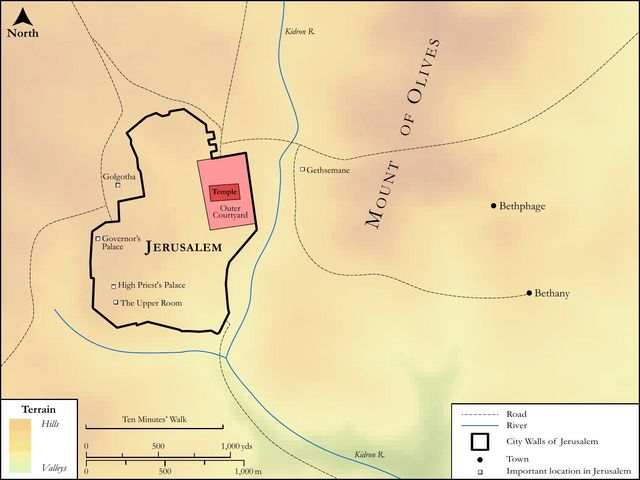
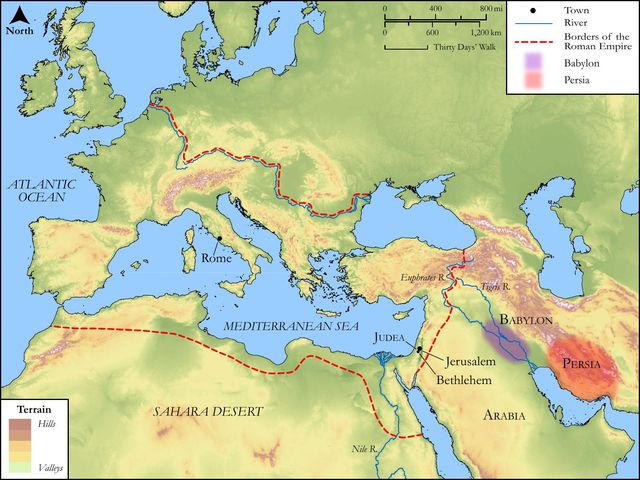
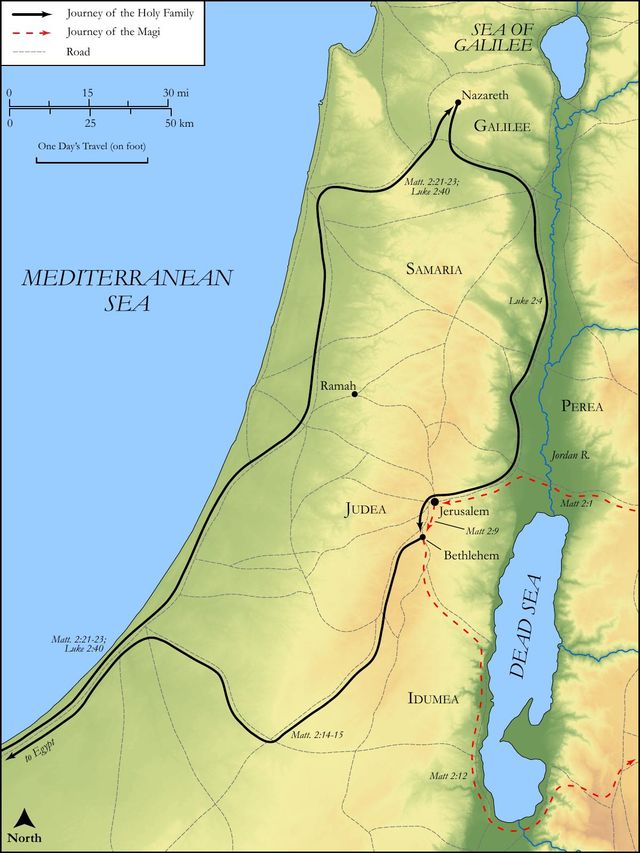
See on the biblical-era maps
Study this verse
Public-domain commentary
Matthew Henry
From his Commentary on the Whole Bible. Henry comments on passages, not single verses — this entry covers Matthew 2:9–12. His two-level outline is real structure in the source text, so it is rendered as structure.
We have here the wise men's humble attendance upon this new-born King of the Jews, and the honours they paid him. From Jerusalem they went to Bethlehem, resolving to seek till they should find; but it is very strange that they went alone; that not one person of the court, church, or city, should accompany them, if not in conscience, yet in civility to them, or touched with a curiosity to see this young prince. As the queen of the south, so the wise men of the east, will rise up in judgment against the men of that generation, and of this too, and will condemn them; for they came from a far country, to worship Christ; while the Jews, his kinsmen, would not stir a step, would not go to the next town to bid him welcome. It might have been a discouragement to these wise men to find him whom they sought thus neglected at home. Are we come so far to honour the King of the Jews, and do the Jews themselves put such a slight upon him and us? Yet they persist in their resolution. Note, We must continue our attendance upon Christ, though we be alone in it; whatever others do, we must serve the Lord; if they will not go to heaven with us, yet we must not go to hell with them. Now,
I.See how they found out Christ by the same star that they had seen in their own country, Mat 2:9, Mat 2:10. Observe,
1.How graciously God directed them. By the first appearance of the star they were given to understand where they might enquire for this King, and then it disappeared, and they were left to take the usual methods for such an enquiry. Note, Extraordinary helps are not to be expected where ordinary means are to be had. Well, they had traced the matter as far as they could; they were upon their journey to Bethlehem, but that is a populous town, where shall they find him when they come thither? Here they were at a loss, at their wit's end, but not at their faith's end; they believed that God, who had brought them thither by his word, would not leave them there; nor did he; for, behold, the star which they saw in the east went before them. Note, If we go on as far as we can in the way of duty, God will direct and enable us to do that which of ourselves we cannot do; Up, and be doing, and the Lord will be with thee. Vigilantibus, non dormientibus, succurit lex - The law affords its aid, not to the idle, but to the active. The star had left them a great while, yet now returns. They who follow God in the dark shall find that light is sown, is reserved, for them. Israel was led by a pillar of fire to the promised land, the wise men by a star to the promised Seed, who is himself the bright and morning Star, Rev 22:16. God would rather create a new thing than leave those at a loss who diligently and faithfully sought him. This star was the token of God's presence with them; for he is light, and goes before his people as their Guide. Note, If we by faith eye God in all our ways, we may see ourselves under his conduct; he guides with his eye (Psa 32:8), and said to them, This is the way, walk in it: and there is a day-star that arises in the hearts of those that enquire after Christ, Pe2 1:19.
2.Observe how joyfully they followed God's direction (Mat 2:10). When they saw the star, they rejoiced with exceeding great joy. Now they saw they were not deceived, and had not taken this long journey in vain. When the desire cometh, it is a tree of life. Now they were sure that God was with them, and the tokens of his presence and favour cannot but fill with joy unspeakable the souls of those that know how to value them. Now they could laugh at the Jews in Jerusalem, who, probably, had laughed at them as coming on a fool's errand. The watchmen can give the spouse no tidings of her beloved; yet it is but a little that she passes from them, and she finds him, Sol 3:3, Sol 3:4. We cannot expect too little from man, nor too much from God. What a transport of joy these wise men were in upon this sight of the star; none know so well as those who, after a long and melancholy night of temptation and desertion, under the power of a Spirit of bondage, at length receive the spirit of adoption, witnessing with their spirits that they are the children of God; this is light out of darkness; it is life from the dead. Now they had reason to hope for a sight of the Lord's Christ speedily, of the Sun of righteousness, for they see the Morning Star. Note, We should be glad of every thing that will show us the way to Christ. This star was sent to meet the wise men, and to conduct them into the presence chamber of the King; by this master of ceremonies they were introduced, to have their audience. Now God fulfills his promise of meeting those that are disposed to rejoice and work righteousness (Isa 64:5), and they fulfill his precept. Let the hearts of those rejoice that seek the Lord, Psa 105:3. Note, God is pleased sometimes to favour young converts with such tokens of his love as are very encouraging to them, in reference to the difficulties they meet with at their setting out of the ways of God.
II.See how they made their address to him when they had found him, Mat 2:11.
We may well imagine their expectations were raised to find this royal babe, though slighted by the nation, yet honourably attended at home; and what a disappointment it was to them when they found a cottage was his palace, and his own poor mother all the retinue he had! Is this the Saviour of the world? Is this the King of the Jews, nay, and the Prince of the kings of the earth? Yes, this is he, who, though he was rich, yet, for our sakes, became thus poor. However, these wise men were so wise as to see through this veil, and in this despised babe to discern the glory as of the Only-begotten of the Father; they did not think themselves balked or baffled in their enquiry; but, as having found the King they sought, they presented themselves first, and then their gifts, to him.
1.They presented themselves to him: they fell down, and worshipped him. We do not read that they gave such honour to Herod, though he was in the height of his royal grandeur; but to this babe they gave this honour, not only as to a king (then they would have done the same to Herod), but as to a God. Note, All that have found Christ fall down before him; they adore him, and submit themselves to him. He is thy Lord, and worship thou him. It will be the wisdom of the wisest of men, and by this it will appear they know Christ, and understand themselves and their true interests, if they be humble, faithful worshippers of the Lord Jesus.
2.They presented their gifts to him. In the eastern nations, when they did homage to their kings, they made them presents; thus the subjection of the kings of Sheba to Christ is spoken of (Psa 72:10), They shall bring presents, and offer gifts. See Isa 60:6. Note, With ourselves, we must give up all that we have to Jesus Christ; and if we be sincere in the surrender of ourselves to him, we shall not be unwilling to part with what is dearest to us, and most valuable, to him and for him; nor are our gifts accepted, unless we first present ourselves to him living sacrifices. God had respect to Abel, and then to his offering. The gifts they presented were, gold, frankincense, and myrrh, money, and money's-worth. Providence sent this for a seasonable relief to Joseph and Mary in their present poor condition. These were the products of their own country; what God favours us with, we must honour him with. Some think there was a significancy in their gifts; they offered him gold, as a king, paying him tribute, to Caesar, the things that are Caesar's; frankincense, as God, for they honoured God with the smoke of incense; and myrrh, as a Man that should die, for myrrh was used in embalming dead bodies.
III.See how they left him when they had made their address to him, Mat 2:12.
Herod appointed them to bring him word what discoveries they had made, and, it is probable, they would have done so, if they had not been countermanded, not suspecting their being thus made his tools in a wicked design. Those that mean honestly and well themselves are easily made to believe that others do so too, and cannot think the world is as bad as it really is; but the Lord knows how to deliver the godly out of temptation. We do not find that the wise men promised to come back to Herod, and, if they had, it must have been with the usual proviso, If God permit; God did not permit them, and prevented the mischief Herod designed to the Child Jesus, and the trouble it would have been to the wise men to have been made involuntarily accessory to it. They were warned of God, chrēmatisthentes - oraculo vel responso accepto - by an oracular intimation. Some think it intimates that they asked counsel of God, and that this was the answer. Note, Those that act cautiously, and are afraid of sin and snares, if they apply themselves to God for direction, may expect to be led in the right way. They were warned not to return to Herod, nor to Jerusalem; those were unworthy to have reports brought them concerning Christ, that might have seen with their own eyes, and would not. They departed into their own country another way, to bring the tidings to their countrymen; but it is strange that we never hear any more of them, and that they or theirs did not afterwards attend him in the temple, whom they had worshipped in the cradle. However, the direction they had from God in their return would be a further confirmation of their faith in this Child, as the Lord from heaven.
Historical interpretation
Nine Centuries of Reception
15 surviving comments on this verse. Each one is dated, so this reads as a timeline rather than a list.
Select a marker to jump to its quote. Markers stagger vertically where authors wrote within a few decades of each other.
(Serm. in App. 131. 3.) The star had been seen, and with great wonder, nearly two years before. We are to understand that it was signified to them whose the star was, which was visible all that time till He, whom it signified, was born. Then as soon as Christ was made known to them they set out, and came and worshipped Him in thirteen days from the easta.
(in Luc. ii. 45.) The star is the way, and the way is Christ; and according to the mystery of the incarnation, Christ is a star. He is a blazing and a morning-star. Thus where Herod is, the star is not seen; where Christ is, there it is again seen, and points out the way.
Or, the star appeared to them long time before, because the journey would take up some time, and they were to stand before Him immediately on His birth, that seeing Him in swaddling clothes, He might seem the more wonderful.
Concerning the young Child, he says, not 'of the King;' he envics Him the regal title.
"And, lo! the star, which they saw in the east, went before them."
For therefore only was it hidden, that having lost their guide, they might come to be obliged to make inquiry of the Jews, and so the matter might be made evident to all. Since after they have made inquiries, and have had His enemies for informants, it appears to them again. And mark how excellent was the order; how in the first place after the star the people of the Jews receives them, and the king, and these bring in the prophecy to explain what had appeared: how next, after the prophet, an angel again took them up and taught them all things; but for a time they journey from Jerusalem to Bethlehem by the guidance of the star, the star again journeying with them from that place also; that hence too thou mightest learn, that this was not one of the ordinary stars, for there is not so much as one star that hath this nature. And it not merely moved, but "went before them," drawing and guiding them on in mid-day.
"But what need of this star any more," one may ask, "when the place was ascertained?" In order that the Child also might be seen. For there was not anything to make Him manifest, since the house was not conspicuous, neither was His mother glorious, or distinguished. There was need then of the star, to set them by the place. Wherefore it re-appears on their coming out of Jerusalem, and stays not, before it hath reached the manger.
And marvel was linked on to marvel; for both were strange things, as well the magi worshipping, as the star going before them; and enough to attract even such as were made all of stone. For if the wise men had said, they had heard prophets say these things, or that angels had discoursed with them in private, they might have been disbelieved; but now, when the vision of the star appeared on high, even they that were exceeding shameless had their mouths stopped.
Moreover, the star, when it stood over the young Child, stayed its course again: which thing itself also was of a greater power than belongs to a star, now to hide itself, now to appear, and having appeared to stand still. Hence they too received an increase of faith. For this cause they rejoiced also, that they had found what they were seeking, that they had proved messengers of truth, that not without fruit had they come so great a journey; so great a longing (so to speak) had they for Christ. For first it came and stood over His very head, showing that what is born is Divine; next standing there, it leads them to worship Him; being not simply barbarians, but the wiser sort amongst them.
Seest thou, with how great fitness the star appeared? Why; because even after the prophecy, and after the interpretation of the chief priests and scribes, they still had their minds turned towards it.
Verse 2. "Wherefore the king commanded that the soothsayers, the magi, the charmers, and the Chaldeans show the king his dream. And when they came, they stood in the presence of the king." Those whom we have translated as "soothsayers" (harioli) others have rendered as epaoidoi, that is, "enchanters." Well then, it seems to me that enchanters are people who perform a thing by means of words; magi are those who pursue individual lines of philosophic enquiry; charmers are those who employ blood and animal sacrifices and often have contact with corpses. Furthermore the term "astrologers" among the Chaldeans signifies, I believe, what the common people call mathematicians. But common usage and ordinary conversation understands the term magi as wicked enchanters . Yet they were regarded differently among their own nation, inasmuch as they were the philosophers of the Chaldeans, and even the kings and princes of this same nation do all they can to acquire a knowledge of this science. Wherefore also it was they who first at the nativity of our Lord and Savior learned of his birth, and who came to holy Bethlehem and adored the child, under the guidance of the star which shone above them (Matthew 2:1-12).
(Serm. 374. 2. 373. 4.) The star that guided the Magi to the spot where was the Infant God with His Virgin Mother, might have conducted them straight to the town; but it vanished, and showed not itself again to them till the Jews themselves had told them the place where Christ should be born; Bethlehem of Judaea. Like in this to those who built the ark for Noah, providing others with a refuge, themselves perished in the flood; or like to the stones by the road that show the miles, but themselves are not able to move. The enquirers heard and departed; the teachers spake and remained still. Even now the Jews show us something similar; for some Pagans, when clear passages of Scripture are shown them, which prophesy of Christ, suspecting them to be forged by the Christians, have recourse to Jewish copies. Thus they leave the Jews to read unprofitably, and go on themselves to believe faithfully.
To perform its due service to the Lord, it advanced slowly, leading them to the spot. It was ministering to Him, and not ruling His fate; its light showed the suppliants and filled the inn, shed over the walls and roof that covered the birth; and thus it disappeared.
As soon as Herod had heard the answer, though doubly authenticated, both by the authority of the Priests, and the passage from the Prophets, he yet turned not to worship the King that was to be born, but sought how he might put Him to death by subtilty. He saw that the Magi were neither to be won by flattery, nor awed by threats, nor bribed by gifts, to consent to this murder; he sought therefore to deceive them; he privily called the wise men; that the Jews, whom he suspected, might not know of it. For he thought they would incline the rather to a King of theirown nation.
To induce them to do this, he put on the colour of devotion, beneath which he whetted the sword, hiding the malice of his heart under colour of humility. Such is the manner of the malicious, when they would hurt any one in secret, they feign meekness and affection.
This passage shows, that when the star had brought the Magi nearly to Jerusalem, it was hidden from them, and so they were compelled to ask in Jerusalem, where Christ should be born? and thus to manifest Him to them; on two accounts, first, to put to confusion the Jews, inasmuch as the Gentiles instructed only by sight of a star sought Christ through strange lands, while the Jews who had read the Prophets from their youth did not receive Him, though born in their country. Secondly, that the Priests, when asked where Christ should be born, might answer to their now condemnation, and while they instructed Herod, they were themselves ignorant of Him. The star went before them, to show them the greatness of the King.
What wonder that a divine star should minister to the Sun of righteousness about to rise. It stood over the Child's head, as it were, saying, 'This is He;' proving by its place what it had no voice to utter.
Diligently enquired; craftily, for he feared they would not return to him, and then he should know how he should do to put the young Child to death.
The Magi obeyed the King so far as to seek the Lord, but not to return to Herod. Like in this to good hearers; the good they hear from wicked preachers, that they do; but do not imitate their evil lives.
But amid these matters it should be known that the Priscillianist heretics believe that each person is born under the configurations of the stars; and they take this in support of their error, that a new star appeared when the Lord appeared in the flesh, and they believe that the star which appeared was his fate. But if we consider the words of the Gospel, where it is said of the same star: "Until it came and stood over where the child was," since the child did not run to the star, but the star ran to the child, if it may be said, the star was not the fate of the child, but the child who appeared was the fate of the star. But far be it from the hearts of the faithful to say that fate is anything real. For the Creator alone who made this life of men governs it. For man was not made for the sake of the stars, but the stars were made for the sake of man. And if a star is called the fate of a man, man is declared to be subject to its own ministrations. Certainly when Jacob, coming forth from the womb, held the heel of his elder brother with his hand, the first could by no means come forth completely unless the second had also begun; and yet although their mother brought forth both at one time and at the same moment, the quality of each one's life was not the same.
But the astrologers are accustomed to respond to this by saying that the power of a constellation is in the instant of a moment. To them we say in reply that the duration of birth is considerable. If therefore a constellation changes in the instant of a moment, it will now be necessary for them to declare as many fates as there are limbs of those being born. The astrologers are also accustomed to affirm that whoever is born under the sign of Aquarius will obtain the occupation of a fisherman in this life. But Getulia, as it is said, has no fishermen. Who then would say that no one is born there under the star of Aquarius, where there is absolutely no fisherman? Again, those whom they assert are born under the sign of Libra, they say will become money-changers; and the provinces of many nations know nothing of money-changers. Therefore they must confess either that this sign is absent among them, or that it has no fated effect whatsoever. In the land of the Persians and Franks, kings come forth from their lineage; and when these are born, who would estimate how many are born at the same moments of hours and times from a servile condition? And yet the sons of kings, born under one and the same star with slaves, advance to the kingdom, while the slaves who were born with them die in servitude. We have spoken briefly about the star, lest we seem to have passed over the foolishness of the astrologers without examination.
(Hom. in Ev. i. 10. 3.) He feigns a wish of worshipping Him only that he may discover Him, and put Him to death.
The Magi were guileless and thought that Herod, too, spoke without guile.
The star was hidden for a time by God’s providence so that they would inquire of the Jews, and Herod would be troubled, and thus the truth would be made all the more apparent. But when they had departed from Jerusalem, it again appeared and guided them; from which it is clear that the star was a divine power.
This, too, was extraordinary. For the star descended from the heights and came closer to the earth to show them the place. For if it had appeared to them from the heights, how would they have been able to know the particular spot where Christ was? For the stars are visible over a great area. So it is that you may see the moon over your house, while it appears to me that it is over my house alone; and, in short, to each one the moon, or a star, appears to stand over them alone. Neither could this star have pointed out where Christ was if it had not descended and all but stood over the head of the Child.
(Anselm.) It is evident that the star must have been in the air, and close above the house where the Child was, else it would not have pointed out the exact house.
(ord.) Or, the star is the illumination of faith, which leads him to the nearest aid; while they turn aside to the Jews, the Magi lose it; so those who seek counsel of the bad, lose the true light.
(non occ.) According to others, the star was first seen on the day of the nativity, and having accomplished its end, ceased to be. Thus Fulgentius says, "The Boy at His birth created a new star." (Serm. de Epiph.) Though they now knew both time and place, he still would not have them ignorant of the person of the Child, Go, he says, and enquire diligently of the young Child; a commission they would have executed even if he had not commanded it.
Continue studying Matthew 2:9 across the web’s major study libraries — every link below opens this exact verse, chapter, or book on the destination site.
Read & Compare
 BibleGatewayThis verse in more than 200 translations and 70 languages.
 Bible.comThe YouVersion reader — hundreds of translations, reading plans, and highlights.
 ESV.orgCrossway's official English Standard Version reader.
 NET BibleThe NET translation with 60,000+ translators' notes on every rendering decision.
 STEP BibleTyndale House's free study tool — original text, vocabulary, and scholarly resources.
 BibliaLogos Bible Software's free web reader.
 USCCBThe New American Bible (Revised Edition) with the U.S. bishops' study notes.
Commentaries
 BibleHub CommentariesDozens of classic commentaries on this verse, gathered on one page.
 StudyLightMore than 100 commentary sets — the largest collection on the web.
 BibleRefPlain-English commentary on what this verse means, verse by verse.
 Enduring WordDavid Guzik's free commentary on this chapter, widely used by Bible teachers.
 Bible Study ToolsVerse commentary alongside Greek and Hebrew study aids.
Original Language & Research
- BibleHub InterlinearThe verse word by word — original language, transliteration, and English.
- BibleHub LexiconEvery word's original-language definition and Strong's entry.
 Blue Letter BibleDeep-study tools — Strong's numbers, concordance, and word studies.
 CNTR CollationThe earliest Greek manuscripts of this verse, collated letter by letter.
Sermons, Hymns & Audio


TrulyRandomVerse is not affiliated with these sites and doesn’t control their content. They’re linked because they’re genuinely useful.
Summary
Matthew 2:9 narrates the miraculous reappearance and precise guidance of the star that led the Magi to the very location of the young child Jesus in Bethlehem. After their unsettling encounter with King Herod and receiving prophetic direction to Bethlehem, the wise men departed Jerusalem, and the celestial sign, which had previously led them from the East, once again became visible and actively guided them, culminating in its precise positioning over the house where the Messiah resided. This verse underscores God's sovereign and supernatural direction in bringing the Gentile seekers to worship His Son.
Context
ShowHideLiterary Context
This verse is a pivotal moment in the narrative of the Magi's quest to find the newborn King of the Jews. It immediately follows their audience with King Herod in Jerusalem, where Herod, feigning a desire to worship, had cunningly extracted information about the Messiah's birthplace from the chief priests and scribes, who cited Micah 5:2. Herod then dispatched the Magi to Bethlehem, instructing them to return with news so he could also "worship him" (Matthew 2:8). The reappearance of the star upon their departure from Jerusalem serves as a divine affirmation and a renewed, direct guide, contrasting sharply with the political intrigue and human machinations they had just experienced. It transitions the narrative from the tension of Herod's court back to the miraculous unfolding of God's plan.
Historical & Cultural Context
The Magi were likely Persian or Babylonian astrologer-priests, respected scholars of their time who observed celestial phenomena. Their journey from the East implies a significant, arduous undertaking, reflecting their earnest desire to find this prophesied king. Among the Gentiles, stars were often associated with the birth of important figures or significant events, and the concept of a "star of a king" was not unknown (Numbers 24:17). Herod the Great, the ruling king of Judea at this time, was known for his paranoia, ruthlessness, and insecurity regarding his throne, having executed members of his own family whom he perceived as threats. The Magi's inquiry about a "king of the Jews" would naturally incite his fear, setting the stage for his murderous plot against the child. Bethlehem, a small town just a few miles south of Jerusalem, was significant as the ancestral home of King David and the prophesied birthplace of the Messiah.
Key Themes
ShowHideMatthew 2:9 powerfully illustrates several key themes central to the early chapters of Matthew and the broader biblical narrative. Firstly, it highlights Divine Guidance and Providence, demonstrating God's active involvement in directing those who seek Him, even through extraordinary means like a moving star. This echoes themes of God's leading found throughout Scripture, such as His guidance of Israel through the wilderness (Exodus 13:21). Secondly, it emphasizes the Miraculous Nature of the Incarnation, as the star's behavior defies natural astronomical phenomena, indicating a supernatural sign accompanying the birth of the Christ. Thirdly, the Magi's Persistent Faith and Obedience are celebrated; despite the detour to Herod and the potential dangers, their continued pursuit of the King is rewarded with clear, divine direction. Finally, the star's precise guidance to Bethlehem directly contributes to the Fulfillment of Old Testament Prophecy concerning the Messiah's birthplace, as articulated by the chief priests and scribes in Matthew 2:4-6.
Exposition and Analysis
ShowHideKey Word Analysis
ShowHideThis word refers to a celestial body, but its usage here, coupled with the description of its behavior, denotes something far beyond a typical astronomical phenomenon. The star is presented not as a fixed point, but as an active, dynamic guide, a direct instrument of divine revelation and direction. Its miraculous nature is central to the narrative.
This verb literally means "to lead forward" or "to go before." In this context, it signifies the star's active, directional movement, preceding the Magi like a guide. It implies a purposeful, intelligent leading, confirming the star's supernatural quality and God's direct involvement in orchestrating the Magi's journey.
This verb means "to stand" or "to cause to stand." Here, it describes the star's final, precise positioning directly above the house where the young child was. This action is crucial, as it pinpoints the exact location, removing any ambiguity for the Magi and highlighting the extraordinary, localized nature of this divine sign.
Verse Breakdown
ShowHide"When they had heard the king, they departed;"
This clause marks the immediate consequence of the Magi's audience with Herod. Having received Herod's deceptive instructions and the prophetic information about Bethlehem, they promptly leave Jerusalem, demonstrating their continued resolve to find the King.
"and, lo, the star, which they saw in the east, went before them, "
The interjection "lo" (Greek: idoú) draws attention to a sudden, significant event. The star, which had initially guided them from their homeland ("in the east"), now reappears and actively leads them. This implies that the star may have been obscured or its guidance less apparent during their time in Jerusalem, possibly to direct them to Herod for the fulfillment of prophecy and to expose his evil intentions. Its reappearance signals a renewed, direct divine leading.
"till it came and stood over where the young child was."
This final phrase describes the star's ultimate purpose and precise action. It continued to move before them until it arrived at and hovered directly above the specific dwelling where Jesus, the "young child" (Greek: paidíon), was. This pinpoint accuracy is a testament to the star's miraculous nature and God's meticulous guidance, ensuring the Magi would find the exact location of the Messiah.
Literary Devices
ShowHideMatthew 2:9 is rich with Symbolism and Divine Intervention. The star itself is a powerful symbol, representing divine guidance and the light of God's revelation breaking into the darkness of the world. Its appearance and movement are not merely natural phenomena but a direct act of Divine Intervention, demonstrating God's sovereign control over creation to fulfill His purposes. The narrative employs Narrative Progression, moving the Magi from the political intrigue of Herod's court to the direct, miraculous leading of God, emphasizing the contrast between human schemes and divine plans. The use of "lo" (Interjection) heightens the dramatic impact of the star's reappearance, drawing the reader's attention to the miraculous nature of the event.
Theological and Thematic Connections
ShowHideMatthew 2:9 powerfully underscores the theme of God's sovereign and meticulous guidance, especially for those who earnestly seek Him. The star's reappearance and precise leading illustrate that God provides clear direction, even when human paths seem obscured by deception or uncertainty. It highlights the divine initiative in bringing Gentiles to worship the Messiah, foreshadowing the universal scope of salvation. The star's miraculous nature also points to the extraordinary identity of the one it leads to—Jesus, the Son of God, whose birth is accompanied by signs that transcend the natural order. This divine guidance is not just for the Magi but serves as an enduring testament to God's faithfulness in revealing Christ to all who earnestly seek Him.
Reflection and Application
ShowHideMatthew 2:9 offers profound encouragement for our own spiritual journeys. Just as the star reappeared to guide the Magi after their detour through Herod's court, God often provides clarity and direction after periods of confusion, doubt, or even misdirection. This passage reminds us that God's guidance is personal, precise, and persistent, leading us directly to Christ and His purposes. It calls us to cultivate a spirit of earnest seeking, vigilance, and obedience, trusting that even when the path seems unclear, God will illuminate the way forward. Our task is to remain attentive to His leading, whether through His Word, His Spirit, or unexpected circumstances, always with the ultimate goal of drawing closer to Jesus and fulfilling His will in our lives. The Magi's persistence, despite the long journey and the dangers posed by Herod, serves as a powerful example for us to press on in faith, knowing that God will reward our diligent pursuit of Him.
Questions for Reflection
ShowHideFAQ
ShowHideWas the star a natural astronomical phenomenon or a miracle?
ShowHideThe description of the star in Matthew 2:9 strongly suggests it was a miraculous, supernatural phenomenon rather than a typical astronomical event. While some theories propose a comet, supernova, or planetary conjunction, none of these natural occurrences can account for the star's ability to "go before" the Magi and then "stand over" a specific house in Bethlehem. Normal celestial bodies appear fixed from the earth's perspective and cannot pinpoint a single dwelling. The text presents it as a dynamic, intelligent guide, a direct instrument of God's will designed to lead the Magi precisely to Jesus. This aligns with the miraculous nature of the events surrounding Jesus' birth, such as the virgin conception (Matthew 1:18-25) and angelic visitations (Luke 2:8-14).
Christ-Centered Fulfillment
ShowHideMatthew 2:9, with its account of the star leading the Magi to Jesus, finds its Christ-centered fulfillment in Jesus Himself as the ultimate "Light of the World" and the divine guide for all humanity. The star, a temporary, external beacon, foreshadows the permanent, internal guidance offered by Christ. Just as the star led the Gentiles to the physical presence of the young child, Jesus, through His life, death, and resurrection, draws all people to a saving relationship with God. He is the true "dayspring from on high" who has "guided our feet into the way of peace" (Luke 1:78-79). The star's precise leading to Bethlehem points to Jesus as the fulfillment of prophecy, the long-awaited Messiah born in David's city (Micah 5:2). Ultimately, Jesus is the one who illuminates the path to God, declaring, "I am the way, the truth, and the life; no one comes to the Father except through Me" (John 14:6). The star's mission concluded upon reaching Jesus; similarly, all divine guidance ultimately leads to a deeper encounter with Christ, who is the beginning and end of our faith.