


Matthew 2:10
Bible text: King James Version (1769 Blayney text) · Public domain
Bible text: Berean Standard Bible · Public domain
Bible text: American Standard Version (1901) · Public domain
Bible text: World English Bible, Messianic edition · Public domain
Bible text: Geneva Bible (1599) · Public domain
Bible text: Young's Literal Translation · Public domain
- ἰδόντεςidontesHaving seenG1492V-2AAP-NPMVerb 2nd Aorist Active Participle Nominative Plural Masculine
- δὲdenowG1161CONJConjunction
- τὸνtontheG3588T-ASMDefinite article Accusative Singular Masculine
- ἀστέραasterastarG792N-ASMNoun Accusative Singular Masculine
- ἐχάρησανecharēsanthey rejoiced [with]G5463V-2AOI-3PVerb 2nd Aorist Passive Deponent Indicative 3rd Plural
- χαρὰνcharanjoyG5479N-ASFNoun Accusative Singular Feminine
- μεγάληνmegalēngreatG3173A-ASFAdjective Accusative Singular Feminine
- σφόδραsphodraexceedinglyG4970ADVAdverb
English is a literal word-by-word gloss of the Greek, not the KJV's wording. Why?
This is the original text the KJV's translators worked from — each Greek word with its own literal English meaning in this verse, prepared by scholars at Tyndale House, Cambridge. The KJV translates whole sentences, not word by word, so its wording differs: one Greek word can become several English words, and the KJV may choose “charity” where the gloss reads “love”. Both are faithful — they answer different questions. For the KJV's own rendering, switch to the KJV text.
Details
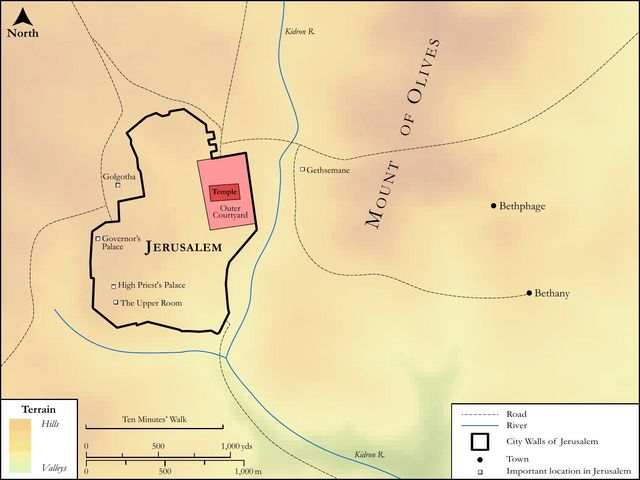
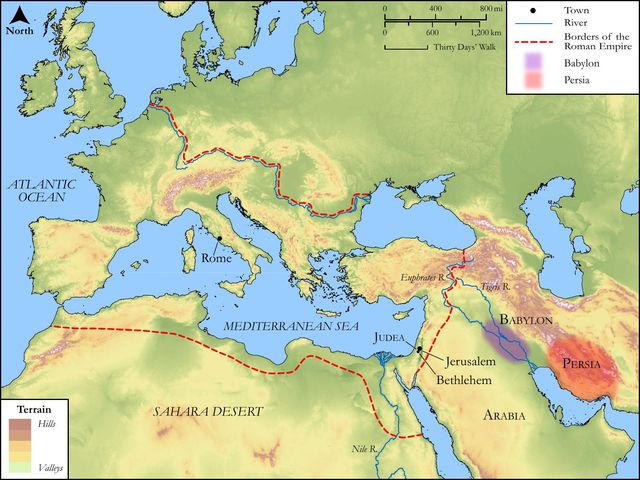
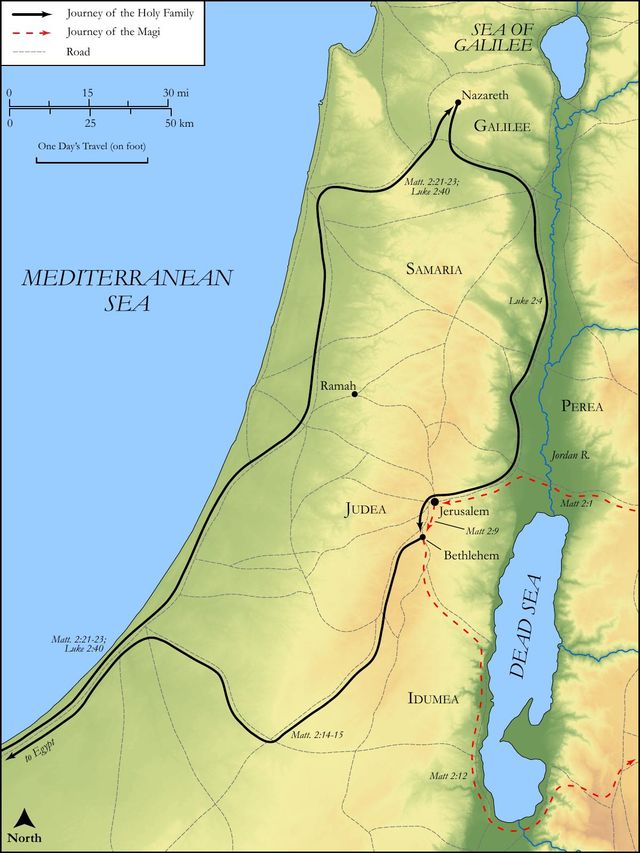
See on the biblical-era maps
Study this verse
Public-domain commentary
Matthew Henry
From his Commentary on the Whole Bible. Henry comments on passages, not single verses — this entry covers Matthew 2:9–12. His two-level outline is real structure in the source text, so it is rendered as structure.
We have here the wise men's humble attendance upon this new-born King of the Jews, and the honours they paid him. From Jerusalem they went to Bethlehem, resolving to seek till they should find; but it is very strange that they went alone; that not one person of the court, church, or city, should accompany them, if not in conscience, yet in civility to them, or touched with a curiosity to see this young prince. As the queen of the south, so the wise men of the east, will rise up in judgment against the men of that generation, and of this too, and will condemn them; for they came from a far country, to worship Christ; while the Jews, his kinsmen, would not stir a step, would not go to the next town to bid him welcome. It might have been a discouragement to these wise men to find him whom they sought thus neglected at home. Are we come so far to honour the King of the Jews, and do the Jews themselves put such a slight upon him and us? Yet they persist in their resolution. Note, We must continue our attendance upon Christ, though we be alone in it; whatever others do, we must serve the Lord; if they will not go to heaven with us, yet we must not go to hell with them. Now,
I.See how they found out Christ by the same star that they had seen in their own country, Mat 2:9, Mat 2:10. Observe,
1.How graciously God directed them. By the first appearance of the star they were given to understand where they might enquire for this King, and then it disappeared, and they were left to take the usual methods for such an enquiry. Note, Extraordinary helps are not to be expected where ordinary means are to be had. Well, they had traced the matter as far as they could; they were upon their journey to Bethlehem, but that is a populous town, where shall they find him when they come thither? Here they were at a loss, at their wit's end, but not at their faith's end; they believed that God, who had brought them thither by his word, would not leave them there; nor did he; for, behold, the star which they saw in the east went before them. Note, If we go on as far as we can in the way of duty, God will direct and enable us to do that which of ourselves we cannot do; Up, and be doing, and the Lord will be with thee. Vigilantibus, non dormientibus, succurit lex - The law affords its aid, not to the idle, but to the active. The star had left them a great while, yet now returns. They who follow God in the dark shall find that light is sown, is reserved, for them. Israel was led by a pillar of fire to the promised land, the wise men by a star to the promised Seed, who is himself the bright and morning Star, Rev 22:16. God would rather create a new thing than leave those at a loss who diligently and faithfully sought him. This star was the token of God's presence with them; for he is light, and goes before his people as their Guide. Note, If we by faith eye God in all our ways, we may see ourselves under his conduct; he guides with his eye (Psa 32:8), and said to them, This is the way, walk in it: and there is a day-star that arises in the hearts of those that enquire after Christ, Pe2 1:19.
2.Observe how joyfully they followed God's direction (Mat 2:10). When they saw the star, they rejoiced with exceeding great joy. Now they saw they were not deceived, and had not taken this long journey in vain. When the desire cometh, it is a tree of life. Now they were sure that God was with them, and the tokens of his presence and favour cannot but fill with joy unspeakable the souls of those that know how to value them. Now they could laugh at the Jews in Jerusalem, who, probably, had laughed at them as coming on a fool's errand. The watchmen can give the spouse no tidings of her beloved; yet it is but a little that she passes from them, and she finds him, Sol 3:3, Sol 3:4. We cannot expect too little from man, nor too much from God. What a transport of joy these wise men were in upon this sight of the star; none know so well as those who, after a long and melancholy night of temptation and desertion, under the power of a Spirit of bondage, at length receive the spirit of adoption, witnessing with their spirits that they are the children of God; this is light out of darkness; it is life from the dead. Now they had reason to hope for a sight of the Lord's Christ speedily, of the Sun of righteousness, for they see the Morning Star. Note, We should be glad of every thing that will show us the way to Christ. This star was sent to meet the wise men, and to conduct them into the presence chamber of the King; by this master of ceremonies they were introduced, to have their audience. Now God fulfills his promise of meeting those that are disposed to rejoice and work righteousness (Isa 64:5), and they fulfill his precept. Let the hearts of those rejoice that seek the Lord, Psa 105:3. Note, God is pleased sometimes to favour young converts with such tokens of his love as are very encouraging to them, in reference to the difficulties they meet with at their setting out of the ways of God.
II.See how they made their address to him when they had found him, Mat 2:11.
We may well imagine their expectations were raised to find this royal babe, though slighted by the nation, yet honourably attended at home; and what a disappointment it was to them when they found a cottage was his palace, and his own poor mother all the retinue he had! Is this the Saviour of the world? Is this the King of the Jews, nay, and the Prince of the kings of the earth? Yes, this is he, who, though he was rich, yet, for our sakes, became thus poor. However, these wise men were so wise as to see through this veil, and in this despised babe to discern the glory as of the Only-begotten of the Father; they did not think themselves balked or baffled in their enquiry; but, as having found the King they sought, they presented themselves first, and then their gifts, to him.
1.They presented themselves to him: they fell down, and worshipped him. We do not read that they gave such honour to Herod, though he was in the height of his royal grandeur; but to this babe they gave this honour, not only as to a king (then they would have done the same to Herod), but as to a God. Note, All that have found Christ fall down before him; they adore him, and submit themselves to him. He is thy Lord, and worship thou him. It will be the wisdom of the wisest of men, and by this it will appear they know Christ, and understand themselves and their true interests, if they be humble, faithful worshippers of the Lord Jesus.
2.They presented their gifts to him. In the eastern nations, when they did homage to their kings, they made them presents; thus the subjection of the kings of Sheba to Christ is spoken of (Psa 72:10), They shall bring presents, and offer gifts. See Isa 60:6. Note, With ourselves, we must give up all that we have to Jesus Christ; and if we be sincere in the surrender of ourselves to him, we shall not be unwilling to part with what is dearest to us, and most valuable, to him and for him; nor are our gifts accepted, unless we first present ourselves to him living sacrifices. God had respect to Abel, and then to his offering. The gifts they presented were, gold, frankincense, and myrrh, money, and money's-worth. Providence sent this for a seasonable relief to Joseph and Mary in their present poor condition. These were the products of their own country; what God favours us with, we must honour him with. Some think there was a significancy in their gifts; they offered him gold, as a king, paying him tribute, to Caesar, the things that are Caesar's; frankincense, as God, for they honoured God with the smoke of incense; and myrrh, as a Man that should die, for myrrh was used in embalming dead bodies.
III.See how they left him when they had made their address to him, Mat 2:12.
Herod appointed them to bring him word what discoveries they had made, and, it is probable, they would have done so, if they had not been countermanded, not suspecting their being thus made his tools in a wicked design. Those that mean honestly and well themselves are easily made to believe that others do so too, and cannot think the world is as bad as it really is; but the Lord knows how to deliver the godly out of temptation. We do not find that the wise men promised to come back to Herod, and, if they had, it must have been with the usual proviso, If God permit; God did not permit them, and prevented the mischief Herod designed to the Child Jesus, and the trouble it would have been to the wise men to have been made involuntarily accessory to it. They were warned of God, chrēmatisthentes - oraculo vel responso accepto - by an oracular intimation. Some think it intimates that they asked counsel of God, and that this was the answer. Note, Those that act cautiously, and are afraid of sin and snares, if they apply themselves to God for direction, may expect to be led in the right way. They were warned not to return to Herod, nor to Jerusalem; those were unworthy to have reports brought them concerning Christ, that might have seen with their own eyes, and would not. They departed into their own country another way, to bring the tidings to their countrymen; but it is strange that we never hear any more of them, and that they or theirs did not afterwards attend him in the temple, whom they had worshipped in the cradle. However, the direction they had from God in their return would be a further confirmation of their faith in this Child, as the Lord from heaven.
Historical interpretation
Nine Centuries of Reception
12 surviving comments on this verse. Each one is dated, so this reads as a timeline rather than a list.
Select a marker to jump to its quote. Markers stagger vertically where authors wrote within a few decades of each other.
How then saith Luke, that He was lying in the manger? Because at the birth indeed she presently laid Him there (for, as was not unlikely, in that large assemblage for the taxing, they could find no house; which Luke also signifies, by saying, "Because there was no room, she laid Him" there); but afterwards she took Him up, and held Him on her knees. For no sooner was she arrived at Bethlehem than she brought her pangs to an end, that thou mayest thence also learn the whole dispensation, and that these things were not done at random, or by chance, but that they all were in course of accomplishment, according to some Divine foreknowledge, and prophetic order.
But what was it that induced them to worship? For neither was the Virgin conspicuous, nor the house distinguished, nor was any other of the things which they saw apt to amaze or attract them. Yet they not only worship, but also "open their treasures," and "offer gifts;" and gifts, not as to a man, but as to God. For the frankincense and the myrrh were a symbol of this. What then was their inducement? That which wrought upon them to set out from home and to come so long a journey; and this was both the star, and the illumination wrought of God in their mind, guiding them by little and little to the more perfect knowledge. For, surely, had it not been so, all that was in sight being ordinary, they would not have shown so great honor. Therefore none of the outward circumstances was great in that instance, but it was a manger, and a shed, and a mother in poor estate; to set before thine eyes, naked and bare, those wise men's love of wisdom, and to prove to thee, that not as mere man they approached Him, but as a God, and Benefactor. Wherefore neither were they offended by ought of what they saw outwardly, but even worshipped, and brought gifts; gifts not only free from Judaical grossness, in that they sacrificed not sheep and calves, but also coming nigh to the self-devotion of the Church, for it was knowledge and obedience and love that they offered unto Him.
Let us then also follow the magi, let us separate ourselves from our barbarian customs, and make our distance therefrom great, that we may see Christ, since they too, had they not been far from their own country, would have missed seeing Him. Let us depart from the things of earth. For so the wise men, while they were in Persia, saw but the star, but after they had departed from Persia, they beheld the Sun of Righteousness. Or rather, they would not have seen so much as the star, unless they had readily risen up from thence. Let us then also rise up; though all men be troubled, let us run to the house of the young Child; though kings, though nations, though tyrants interrupt this our path, let not our desire pass away. For so shall we thoroughly repel all the dangers that beset us. Since these too, except they had seen the young Child, would not have escaped their danger from the king. Before seeing the young Child, fears and dangers and troubles pressed upon them from every side; but after the adoration, it is calm and security; and no longer a star but an angel receives them, having become priests from the act of adoration; for we see that they offered gifts also.
Do thou therefore likewise leave the Jewish people, the troubled city, the blood-thirsty tyrant, the pomp of the world, and hasten to Bethlehem, where is the house of the spiritual Bread. For though thou be a shepherd, and come hither, thou wilt behold the young Child in an inn: though thou be a king, and approach not here, thy purple robe will profit thee nothing; though thou be one of the wise men, this will be no hindrance to thee; only let thy coming be to honor and adore, not to spurn the Son of God; only do this with trembling and joy: for it is possible for both of these to concur in one.
But take heed that thou be not like Herod, and say, "that I may come and worship Him," and when thou art come, be minded to slay Him. For him do they resemble, who partake of the mysteries unworthily: it being said, that such a one "shall be guilty of the Body and Blood of the Lord." Yes; for they have in themselves the tyrant who is grieved at Christ's kingdom, him that is more wicked than Herod of old, even Mammon. For he would fain have the dominion, and sends them that are his own to worship in appearance, but slaying while they worship. Let us fear then, lest at any time, while we have the appearance of suppliants and worshippers, we should in deed show forth the contrary.
And let us cast everything out of our hands when we are to worship; though it be gold that we have, let us offer it unto him and not bury it. For if those barbarians then offered it for honor, what will become of thee, not giving even to Him that hath need? If those men journeyed so far to see Him newly born, what sort of excuse wilt thou have, not going out of thy way one alley's length, that thou mayest visit Him sick or in bonds? And yet when they are sick or in bonds, even our enemies have our pity; thine is denied even to thy Benefactor and Lord. And they offered gold, thou hardly givest bread. They saw the star and were glad, thou, seeing Christ Himself a stranger and naked, art not moved.
Let Marcion and Paul of Samosata then blush, who will not see what the Magi saw, those progenitors of the Church adoring God in the flesh. That He was truly in the flesh, the swaddling clothes and the stall prove; yet that they worshipped Him not as mere man, but as God, the gifts prove which it was becoming to offer to a God. Let the Jews also be ashamed, seeing the Magi coming before them, and themselves not even earnest to tread in their path.
Shame upon Marcion, shame upon Paul of Samosata, for refusing to see what those wise men saw, the forefathers of the Church; for I am not ashamed so to call them. Let Marcion be ashamed, beholding God worshipped in the flesh. Let Paul be ashamed, beholding Him worshipped as not being merely a man. As to His being in the flesh, that first is signified by the swaddling clothes and the manger; as to their not worshipping Him as a mere man, they declare it, by offering Him, at that unripe age, such gifts as were meet to be offered to God. And together with them let the Jews also be ashamed, seeing themselves anticipated by barbarians and magi, whilst they submit not so much as to come after them. For indeed what happened then was a type of the things to come, and from the very beginning it was shown that the Gentiles would anticipate their nation.
"But how was it," one may ask, "that not at the beginning, but afterwards, He said, 'Go ye, and make disciples of all nations'?" Because the occurrence was a type, as I said, of the future, and a sort of declaration of it beforehand. For the natural order was that Jews should come unto Him first; but forasmuch as they of their own choice gave up their proper benefit, the order of things was inverted. Since not even in this instance should the wise men have come before the Jews, nor should persons from so great a distance have anticipated those who were settled about the very city, nor should those who had heard nothing have prevented them that were nurtured in so many prophecies. But because they were exceedingly ignorant of their own blessings, those from Persia anticipate those at Jerusalem. And this indeed is what Paul also saith: "It was necessary that the word of the Lord should first have been spoken to you, but seeing ye have judged yourselves unworthy, lo, we turn to the Gentiles." For even though before they did not obey, at any rate when they heard it from the wise men, they ought to have made all haste; but they would not. Therefore, while those are slumbering, these run before.
Verse 2. "Wherefore the king commanded that the soothsayers, the magi, the charmers, and the Chaldeans show the king his dream. And when they came, they stood in the presence of the king." Those whom we have translated as "soothsayers" (harioli) others have rendered as epaoidoi, that is, "enchanters." Well then, it seems to me that enchanters are people who perform a thing by means of words; magi are those who pursue individual lines of philosophic enquiry; charmers are those who employ blood and animal sacrifices and often have contact with corpses. Furthermore the term "astrologers" among the Chaldeans signifies, I believe, what the common people call mathematicians. But common usage and ordinary conversation understands the term magi as wicked enchanters . Yet they were regarded differently among their own nation, inasmuch as they were the philosophers of the Chaldeans, and even the kings and princes of this same nation do all they can to acquire a knowledge of this science. Wherefore also it was they who first at the nativity of our Lord and Savior learned of his birth, and who came to holy Bethlehem and adored the child, under the guidance of the star which shone above them (Matthew 2:1-12).
(Serm. in Epiph. s. 4. 3.) Though in stature a babe, needing the aid of others, unable to speak, and different in nothing from other infants, yet such faithful witnesses, showing the unseen Divine Majesty which was in Him, ought to have proved most certainly that that was the Eternal Essence of the Son of God that had taken upon Him the true human nature.
They rejoiced, because their hopes were not falsified but confirmed, and because the toil of so great travel had not been undertaken in vain.
By the mystery of this star they understood that the dignity of the King then born exceeded the measure of all worldly kings.
Mary His mother, not crowned with a diadem or laying on a golden couch; but with barely one garment, not for ornament but for covering, and that such as the wife of a carpenter when abroad might have. Had they therefore come to seek an earthly king, they would have been more confounded than rejoiced, deeming their pains thrown away. But now they looked for a heavenly King; so that though they saw nought of regal state, that star's witness sufficed them, and their eyes rejoiced to behold a despised Boy, the Spirit showing Him to their hearts in all His wonderful power, they fell down and worshipped, seeing the man, they acknowledged the God.
And though it were not then understood what these several gifts mystically signified, that is no difficulty; the same grace that instigated them to the deed, ordained the whole.
And it was not enough to say, They rejoiced, but they rejoiced with exceeding great joy.
He adds greatly, showing that men rejoice more over what they have lost than over what they possess.
And it is to be known that each did not offer a different gift, but each one the three things, each one thus proclaiming the King, the God, and the man.
(Hom. in Evang. i. 106.) Gold, as to a King; frankincense, as sacrifice to God; myrrh, as embalming the body of the dead.
(ubi sup.) Something further may yet be meant here. Wisdom is typified by gold; as Solomon saith in the Proverbs, A treasure to be desired is in the mouth of the wise. (Prov. 21:20.) By frankincense, which is burnt before God, the power of prayer is intended, as in the Psalms, Let my speech come before thee as incense. (Ps. 141:2.) In myrrh is figured mortification of the flesh. To a king at his birth we offer gold, if we shine in his sight with the light of wisdom; we offer frankincense, if we have power before God by the sweet savour of our prayers; we offer myrrh, when we mortify by abstinence the lusts of the flesh.
Joseph was absent by Divine command, that no wrong suspicions might occur to the Gentiles.
They rejoiced that they had not been led astray but had found what they were seeking.
(ord.) Or, the star is the illumination of faith, which leads him to the nearest aid; while they turn aside to the Jews, the Magi lose it; so those who seek counsel of the bad, lose the true light.
This service of the star is followed by the rejoicing of the Magi.
(ord.) He rejoices indeed who rejoices on God's account, who is the true joy. With great joy, he says, for they had great cause.
(Anselm.) In these offerings we observe their national customs, gold, frankincense, and various spices abounding among the Arabians; yet they intended thereby to signify something in mystery.
(Anselm.) The three men who offer, signify the nations who come from the three quarters of the earth. They open their treasures, i. e. manifest the faith of their hearts by confession. Rightly in the house, teaching that we should not vain-gloriously display the treasure of a good conscience. They bring three (vid. sup. note g, p. 18.) gifts, i. e. the faith in the Holy Trinity. Or opening the stores of Scripture, they offer its threefold sense, historical, moral, and allegorical; or Logic, Physic, and Ethics, making them all serve the faith.
Continue studying Matthew 2:10 across the web’s major study libraries — every link below opens this exact verse, chapter, or book on the destination site.
Read & Compare
 BibleGatewayThis verse in more than 200 translations and 70 languages.
 Bible.comThe YouVersion reader — hundreds of translations, reading plans, and highlights.
 ESV.orgCrossway's official English Standard Version reader.
 NET BibleThe NET translation with 60,000+ translators' notes on every rendering decision.
 STEP BibleTyndale House's free study tool — original text, vocabulary, and scholarly resources.
 BibliaLogos Bible Software's free web reader.
 USCCBThe New American Bible (Revised Edition) with the U.S. bishops' study notes.
Commentaries
 BibleHub CommentariesDozens of classic commentaries on this verse, gathered on one page.
 StudyLightMore than 100 commentary sets — the largest collection on the web.
 BibleRefPlain-English commentary on what this verse means, verse by verse.
 Enduring WordDavid Guzik's free commentary on this chapter, widely used by Bible teachers.
 Bible Study ToolsVerse commentary alongside Greek and Hebrew study aids.
Original Language & Research
- BibleHub InterlinearThe verse word by word — original language, transliteration, and English.
- BibleHub LexiconEvery word's original-language definition and Strong's entry.
 Blue Letter BibleDeep-study tools — Strong's numbers, concordance, and word studies.
 CNTR CollationThe earliest Greek manuscripts of this verse, collated letter by letter.
Sermons, Hymns & Audio


TrulyRandomVerse is not affiliated with these sites and doesn’t control their content. They’re linked because they’re genuinely useful.
Summary
Matthew 2:10 vividly portrays the overwhelming elation of the Magi upon rediscovering the guiding star that would lead them directly to the newborn King. This moment of profound joy underscores the divine validation of their arduous journey and unwavering faith, culminating in the imminent fulfillment of their quest to worship the Messiah.
Context
ShowHideLiterary Context
This verse is a pivotal moment following the Magi's initial arrival in Jerusalem, where their inquiry about the "King of the Jews" had troubled King Herod and all Jerusalem (Matthew 2:1-3). After consulting with the chief priests and scribes, who cited Micah 5:2 as the prophecy for the Messiah's birthplace in Bethlehem, Herod secretly met with the Magi. He deceptively instructed them to find the child and report back to him, feigning a desire to worship the child himself (Matthew 2:7-8). As the Magi departed Jerusalem, the star, which had initially guided them from the East, reappeared, now specifically leading them to the very house where Jesus was. Their "exceeding great joy" in Matthew 2:10 is a direct response to this renewed, precise divine guidance after a period of uncertainty and potential danger in Herod's court.
Historical & Cultural Context
The Magi were likely Persian or Babylonian astrologers and wise men, possibly priestly advisors, who studied the stars and interpreted dreams. Their journey from the East would have been long and arduous, spanning hundreds of miles and taking months or even years. Among the nations of that day, the appearance of a new star or celestial phenomenon was often interpreted as a sign of a significant birth, especially of a king or deity. Their understanding of Jewish prophecy, perhaps through the Jewish diaspora communities established after the Babylonian exile, likely informed their interpretation of this particular star as signaling the birth of the "King of the Jews." Their arrival in Jerusalem, a foreign delegation seeking a new king, would have been highly unusual and politically charged, especially under the paranoid rule of Herod the Great, who was known for his ruthlessness in eliminating perceived threats to his throne.
Key Themes
ShowHideThe narrative of the Magi in Matthew 2 highlights several profound themes. Divine Guidance and Providence is central, with the miraculous star serving as God's unmistakable hand leading humble seekers to His Son, contrasting sharply with the earthly powers of Herod who sought to destroy Him. The theme of Worship and Adoration is evident in the Magi's persistent quest and their ultimate response of bowing down and offering gifts to Jesus (Matthew 2:11). This also introduces the theme of Universal Salvation, as these Gentile wise men are among the first to acknowledge and worship the Messiah, foreshadowing the inclusion of all nations into God's kingdom. Finally, the narrative contrasts Faith and Obedience (the Magi's response to divine leading) with Hostility and Deception (Herod's reaction to the news of a rival king).
Exposition and Analysis
ShowHideKey Word Analysis
ShowHideThis verb signifies not merely a physical act of seeing, but often implies a perception that leads to understanding or knowledge. In this context, the Magi didn't just visually observe the star; they recognized its significance as the divine sign they had been seeking, confirming their mission and guiding them to their destination. This seeing leads to profound conviction and joy.
Derived from a root suggesting something "strown over the sky," this refers to a celestial body. Here, it is no ordinary star but a unique, divinely appointed phenomenon that actively guided the Magi. Its reappearance and specific movement to stand over the child's location underscore its miraculous nature, functioning as a direct instrument of God's providence.
This noun denotes cheerfulness, calm delight, or gladness. Paired with the verb "rejoiced" (from chaírō, "to be cheerful"), it forms a cognate construction ("rejoiced with joy") that intensely emphasizes the emotion. Further amplified by "exceeding great" (sphódra megalēn), it describes an overwhelming, profound, and perhaps even spiritual elation that transcends mere happiness, indicating a deep satisfaction and confirmation of God's faithfulness.
Verse Breakdown
ShowHide"When they saw the star"
This clause establishes the catalyst for the Magi's reaction. The reappearance and specific guidance of the star, after their uncertain stop in Jerusalem, served as a clear, unmistakable sign of God's continued and precise leading. It was the visual confirmation they needed to proceed with confidence.
"they rejoiced"
This indicates their immediate and spontaneous emotional response to the star's re-emergence. It was a natural outburst of gladness, relief, and affirmation, signifying the end of their uncertainty and the renewed clarity of their divine mission.
"with exceeding great joy"
This phrase intensifies the nature of their rejoicing, emphasizing its extraordinary magnitude. The Greek uses a cognate construction (verb and noun from the same root for "joy") along with strong adverbs ("exceeding great") to convey an overwhelming, profound, and perhaps even ecstatic delight. It suggests a joy born not merely of finding their way, but of the spiritual significance of nearing the presence of the Messiah.
Literary Devices
ShowHideMatthew employs several literary devices in this concise verse to convey the profound significance of the Magi's experience. The most prominent is Hyperbole, seen in the phrase "exceeding great joy." This isn't just happiness; it's an extreme, almost immeasurable delight, emphasizing the overwhelming nature of their relief and spiritual elation. Furthermore, the Greek original utilizes a Cognate Accusative ("rejoiced with joy" - echarēsan charan), where the verb and its direct object share the same root. This grammatical construction serves to intensify the action, underscoring the completeness and depth of their rejoicing. Finally, the Symbolism of the star is crucial; it represents divine guidance, prophetic fulfillment, and the dawning of a new era with the birth of the Messiah. Its reappearance is not just a navigational aid but a powerful symbol of God's active presence and faithfulness.
Theological and Thematic Connections
ShowHideThe Magi's "exceeding great joy" upon seeing the star once more is a powerful theological statement about the nature of divine guidance and the profound delight found in drawing near to Christ. Their joy is not a fleeting emotion but a deep spiritual elation, born from the confirmation of God's providence and the imminent fulfillment of their long-held hope. It contrasts sharply with the fear and malice of Herod, demonstrating that the birth of the Messiah evokes vastly different responses depending on one's spiritual posture. This joy is a foretaste of the spiritual satisfaction and peace that comes from faithfully seeking and encountering the Savior, serving as a model for all who genuinely pursue God's truth.
Reflection and Application
ShowHideThe Magi's experience in Matthew 2:10 offers profound lessons for the contemporary believer. Their journey was marked by diligent seeking, perseverance through uncertainty (the stop in Jerusalem), and ultimately, an overwhelming joy when God's guidance became clear again. This mirrors our own spiritual walk, which often involves periods of seeking, waiting, and even doubt. The Magi's "exceeding great joy" reminds us that genuine encounters with God's presence and clear manifestations of His leading should evoke a profound and enthusiastic response from our hearts. It challenges us to cultivate a spirit of expectant faith, knowing that God delights to reveal Himself to those who earnestly seek Him. When we experience His faithfulness, whether through answered prayer, clear direction, or a renewed sense of His presence, our response should be one of deep gratitude and worship, a joy that transcends mere circumstance and points to the ultimate source of our hope.
Questions for Reflection
ShowHideFAQ
ShowHideWho were the Magi, and why were they seeking the "King of the Jews"?
ShowHideThe Magi were likely astrologers or wise men from the East, possibly Persia or Babylon, who were skilled in interpreting celestial phenomena and perhaps ancient prophecies. They were not kings, as often depicted in popular tradition, but respected scholars or priests. They were seeking the "King of the Jews" because they had observed a unique star, which they interpreted as a divine sign indicating the birth of a significant king, likely the promised Messiah of Jewish prophecy. Their knowledge may have come from Jewish communities in the diaspora, who had preserved prophetic texts like Numbers 24:17, which speaks of a "star" coming out of Jacob.
What was the significance of the star, and how did it guide them?
ShowHideThe star was a miraculous sign, divinely appointed to guide the Magi. It was not a natural astronomical event, as it "went before them, till it came and stood over where the young child was" (Matthew 2:9). This indicates a supernatural movement and a specific stopping point, functioning as a direct instrument of God's providence. Its significance lay in its role as a celestial beacon confirming the birth of the Messiah, leading Gentile seekers to worship Him, and fulfilling ancient prophecies. It served as a visible manifestation of God's active involvement in bringing people to His Son.
Why did the Magi experience "exceeding great joy" specifically when they saw the star again?
ShowHideTheir "exceeding great joy" stemmed from several factors. Firstly, it was a profound sense of relief and confirmation. After their journey to Jerusalem and the unsettling encounter with Herod, the reappearance of the star provided clear, unambiguous divine guidance, dispelling any uncertainty. Secondly, it signified the imminent fulfillment of their long and arduous quest. The star was now leading them directly to the child, confirming their faith and validating their perseverance. This joy was not merely about finding a destination but about nearing the presence of the promised King, the Messiah, whose birth they had traveled so far to witness and worship.
Christ-Centered Fulfillment
ShowHideThe Magi's "exceeding great joy" in Matthew 2:10 is a profound prefigurement of the ultimate joy found in Christ. The star, a physical light guiding them to the infant Jesus, symbolizes Jesus Himself as the true light of the world, the one who illuminates the path to salvation. Just as the Magi's long journey culminated in the joy of beholding the Messiah, so too does the spiritual journey of every believer find its ultimate fulfillment and deepest joy in encountering and embracing Jesus Christ. He is the very source of "joy in the Holy Spirit" (Romans 14:17), the one who promises that our "sorrow will turn into joy" (John 16:20). The Magi's worship and offering of gifts to the child Jesus (Matthew 2:11) further emphasize that true joy is found not just in seeking Him, but in worshipping Him as Lord. Their experience foreshadows the global reach of the Gospel, where people from every nation will be drawn to Christ, the "bright morning star" (Revelation 22:16), and find in Him the fullness of joy and eternal life.