


Jeremiah 51:64
Bible text: King James Version (1769 Blayney text) · Public domain
Bible text: King James Version with Strong's numbers · Public domain
Bible text: Berean Standard Bible · Public domain
Bible text: American Standard Version (1901) · Public domain
Bible text: World English Bible, Messianic edition · Public domain
Bible text: Geneva Bible (1599) · Public domain
Bible text: Young's Literal Translation · Public domain
- וְאָמַרְתָּve·'a·mar·Taand you will sayH559Conj-w ¦ V-Qal-ConsecPerf-2msVerb Qal Consecutive Perfect 2nd Singular Masculineוְandאָמַרְתָּyou will say
- כָּכָהKa·khahthusH3602AdvAdverb
- תִּשְׁקַעtish·Ka'it will sinkH8257V-Qal-Imperf-3fsVerb Qal Imperfect 3rd Singular Feminine
- בָּבֶלba·VelBabylonH894N-properNoun Proper Location
- וְלֹאve·lo'and notH3808Conj-w ¦ NegParticle Negativeוְandלֹאnot
- תָקוּםta·Kumit will riseH6965V-Qal-Imperf-3fsVerb Qal Imperfect 3rd Singular Feminine
- מִפְּנֵיmi·pe·Nei<from> because ofH6440Prep-m ¦ N-mpcNoun Plural Masculine Constructמִ<from>פְּנֵיbecause of
- הָרָעָהha·ra·'Ahthe calamityH7451Art ¦ N-fsNoun Singular Feminine Absoluteהָtheרָעָהcalamity
- אֲשֶׁר'a·SherwhichH834RelParticle Relative
- אָנֹכִי'a·no·KhiIH595Pro-1csPronoun Personal 1st Singular common gender
- מֵבִיאme·Vi'[am] about to bringH935V-Hiphil-Prtcpl-msVerb Hiphil Participle Singular Masculine Absolute
- עָלֶיהָ'a·Lei·haon itH5921Prep ¦ 3fsPreposition Definiteעָלֶיonהָit
- וְיָעֵפוּve·ya·'E·fuand they will grow wearyH3286Conj-w ¦ V-Qal-ConsecPerf-3cpVerb Qal Consecutive Perfect 3rd Plural common genderוְandיָעֵפוּthey will grow weary
- עַד'ad[are] toH5704PrepPreposition
- הֵנָּהHe·nahhereH2008AdvAdverb
- דִּבְרֵיdiv·Rei[the] words ofH1697N-mpcNoun Plural Masculine Construct
- יִרְמְיָהוּyir·me·Ya·huJeremiahH3414N-proper-mNoun Proper Masculine
English is a literal word-by-word gloss of the Hebrew, not the KJV's wording. Why?
This is the original text the KJV's translators worked from — each Hebrew word with its own literal English meaning in this verse, prepared by scholars at Tyndale House, Cambridge. The KJV translates whole sentences, not word by word, so its wording differs: one Hebrew word can become several English words, and the KJV may choose “the LORD” where the gloss reads “Yahweh”. Both are faithful — they answer different questions. For the KJV's own rendering, switch to the KJV text.
Details
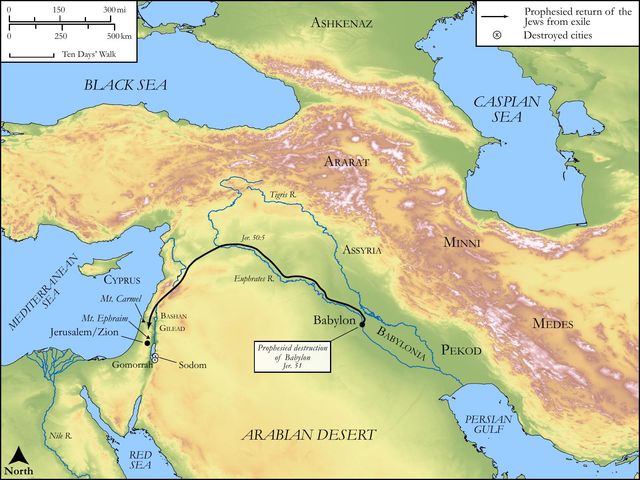
See on the biblical-era map
Study this verse
Public-domain commentary
Matthew Henry
From his Commentary on the Whole Bible. Henry comments on passages, not single verses — this entry covers Jeremiah 51:59–64.
We have been long attending the judgment of Babylon in this and the foregoing chapter; now here we have the conclusion of that whole matter. 1. A copy is taken of this prophecy, it should seem by Jeremiah himself, for Baruch his scribe is not mentioned here (Jer 51:60): Jeremiah wrote in a book all these words that are here written against Babylon. He received this notice that he might give it to all whom it might concern. It is of great advantage both to the propagating and to the perpetuating of the word of God to have it written, and to have copies taken of the law, prophets, and epistles. 2. It is sent to Babylon, to the captives there, by the hand of Seraiah, who went there attendant on or ambassador for king Zedekiah, in the fourth year of his reign, Jer 51:59. He went with Zedekiah, or (as the margin reads it) on the behalf of Zedekiah, into Babylon. The character given of him is observable, that this Seraiah was a quiet prince, a prince of rest. He was in honour and power, but not, as most f the princes then were, hot and heady, making parties, and heading factions, and driving things furiously. He was of a calm temper, studied the things that made for peace, endeavoured to preserve a good understanding between the king his master and the king of Babylon, and to keep his master from rebelling. He was no persecutor of God's prophets, but a moderate man. Zedekiah was happy in the choice of such a man to be his envoy to the king of Babylon, and Jeremiah might safely entrust such a man with his errand too. Note, it is the real honour of great men to be quiet men, and it is the wisdom of princes to put such into places of trust. 3. Seraiah is desired to read it to his countrymen that had already gone into captivity: "When thou shalt come to Babylon, and shalt see what a magnificent place it is, how large a city, how strong, how rich, and how well fortified, and shalt therefore be tempted to think, Surely, it will stand forever" (as the disciples, when they observed the buildings of the temple, concluded that nothing would throw them down but the end of the world, Mat 24:3), "then thou shalt read all these words to thyself and thy particular friends, for their encouragement in their captivity: let them with an eye of faith see to the end of these threatening powers, and comfort themselves and one another herewith." 4. He is directed to make a solemn protestation of the divine authority and unquestionable certainty of that which he had read (Jer 51:62): Then thou shalt look up to God, and say, O Lord! it is thou that hast spoken against this place, to cut it off. This is like the angel's protestation concerning the destruction of the New Testament Babylon. These are the true sayings of God, Rev 19:9. These words are true and faithful, Rev 21:5. Though Seraiah sees Babylon flourishing, having read this prophecy he must foresee Babylon falling, and by virtue of it must curse its habitation, though it be taking root (Job 5:3): "O Lord! thou hast spoken against this place, and I believe what thou hast spoken, that, as thou knowest every thing, so thou canst do every thing. Thou hast passed sentence upon Babylon, and it shall be executed. Thou hast spoken against this place, to cut it off, and therefore we will neither envy its pomp nor fear its power." When we see what this world is, how glittering its shows are and how flattering its proposals, let us read in the book of the Lord that its fashion passes away, and it shall shortly be cut off and be desolate for ever, and we shall learn to look upon it with a holy contempt. Observe here, When we have been reading the word of God it becomes us to direct to him whose word it is a humble believing acknowledgment of the truth, equity, and goodness, of what we have read. 5. He must then tie a stone to the book and throw it into the midst of the river Euphrates, as a confirming sign of the things contained in it, saying, "Thus shall Babylon sink, and not rise; for they shall be weary, they shall perfectly succumb, as men tired with a burden, under the load of the evil that I will bring upon them, which they shall never shake off, nor get from under," Jer 51:53, Jer 51:64. In the sign it was the stone that sunk the book, which otherwise would have swum. But in the thing signified it was rather the book that sunk the stone; it was the divine sentence passed upon Babylon in this prophecy that sunk that city, which seemed as firm as a stone. The fall of the New Testament Babylon was represented by something like this, but much more magnificent, Rev 18:21. A mighty angel cast a great millstone into the sea, saying, Thus shall Babylon fall. Those that sink under the weight of God's wrath and curse sink irrecoverably. The last words of the chapter seal up the vision and prophecy of this book: Thus far are the words of Jeremiah. Not that this prophecy against Babylon was the last of his prophecies; for it was dated in the fourth year of Zedekiah (Jer 51:59), long before he finished his testimony; but this is recorded last of his prophecies because it was to be last accomplished of all his prophecies against the Gentiles, Jer 46:1. And the chapter which remains is purely historical, and, as some think, was added by some other hand.
Historical interpretation
Historical reception
2 surviving comments on this verse. Each one is dated, so this reads as a timeline rather than a list.
Select a marker to jump to its quote. Markers stagger vertically where authors wrote within a few decades of each other.
And with regard to Babylon Jeremiah said, Babylon shall fall and shall not rise. And behold! To this day it continues in desolation and will do so forever.
The Lord ordered these things to happen to comfort the Judean captives so that, when they had learned about Babylon’s capture and their own freedom, they might have as their consolation the hope of these good things.
Continue studying Jeremiah 51:64 across the web’s major study libraries — every link below opens this exact verse, chapter, or book on the destination site.
Read & Compare
 BibleGatewayThis verse in more than 200 translations and 70 languages.
 Bible.comThe YouVersion reader — hundreds of translations, reading plans, and highlights.
 ESV.orgCrossway's official English Standard Version reader.
 NET BibleThe NET translation with 60,000+ translators' notes on every rendering decision.
 STEP BibleTyndale House's free study tool — original text, vocabulary, and scholarly resources.
 BibliaLogos Bible Software's free web reader.
 USCCBThe New American Bible (Revised Edition) with the U.S. bishops' study notes.
Commentaries
 BibleHub CommentariesDozens of classic commentaries on this verse, gathered on one page.
 StudyLightMore than 100 commentary sets — the largest collection on the web.
 BibleRefPlain-English commentary on what this verse means, verse by verse.
 Enduring WordDavid Guzik's free commentary on this chapter, widely used by Bible teachers.
 Bible Study ToolsVerse commentary alongside Greek and Hebrew study aids.
Original Language & Research
- BibleHub InterlinearThe verse word by word — original language, transliteration, and English.
- BibleHub LexiconEvery word's original-language definition and Strong's entry.
 Blue Letter BibleDeep-study tools — Strong's numbers, concordance, and word studies.
 SefariaThe Hebrew text with Rashi and centuries of Jewish commentary.
Sermons, Hymns & Audio


TrulyRandomVerse is not affiliated with these sites and doesn’t control their content. They’re linked because they’re genuinely useful.
Summary
Jeremiah 51:64 serves as the climactic and definitive declaration of Babylon's utter and irreversible destruction, concluding a lengthy prophetic oracle against the oppressive empire. It vividly portrays Babylon's demise as a permanent sinking, from which it will never recover, emphasizing the absolute certainty of divine judgment. The verse also functions as an editorial marker, signaling the completion of Jeremiah's primary prophetic messages concerning the nations, particularly those directed against Babylon.
Context
ShowHideLiterary Context
This verse provides the dramatic and conclusive statement to the extensive prophetic oracle against Babylon, spanning Jeremiah chapters 50-51. Immediately preceding it, Jeremiah 51:59-63 describes a powerful symbolic act: Jeremiah instructs his aide, Seraiah, to read the entire scroll of prophecy against Babylon aloud in Babylon itself, then to tie a stone to it and cast it into the Euphrates River. This physical act of sinking the scroll directly prefigures and illustrates the spiritual truth proclaimed in verse 64 – Babylon's permanent downfall. The final phrase, "Thus far are the words of Jeremiah," acts as a colophon, a concluding statement or editorial note, marking the end of this major prophetic section within the book, before the historical appendix of Jeremiah 52.
Historical & Cultural Context
The prophecies in Jeremiah 50-51 were delivered during a tumultuous period when Babylon had risen as the dominant world power, having conquered Judah, destroyed Jerusalem, and exiled its people (as recounted in 2 Kings 25). For the exiled Judeans, Babylon represented the epitome of oppression and idolatry. The Euphrates River was central to Babylon's identity, providing its lifeblood through irrigation and serving as a key defensive feature. The act of casting the scroll into the Euphrates was not merely symbolic but deeply culturally resonant, as rivers were often associated with national identity and prosperity. The destruction of such a mighty empire, the "hammer of the whole earth" (Jeremiah 50:23), would have seemed impossible from a human perspective, yet Jeremiah's prophecy assures its certain and irreversible ruin, demonstrating God's sovereign control over world empires and His commitment to justice for His people.
Key Themes
ShowHideJeremiah 51:64 powerfully encapsulates several key themes prevalent throughout the book of Jeremiah and the broader prophetic literature. The most prominent is Divine Judgment and Sovereignty, asserting God's absolute authority over nations and His righteous retribution against those who defy Him and oppress His chosen people. Babylon's "sinking" signifies an irreversible and total destruction, a stark contrast to the temporary exiles or partial defeats experienced by other nations. This reinforces the theme of God's Unwavering Word and Prophetic Fulfillment, demonstrating that God's spoken word, even when seemingly impossible, will come to pass. The symbolic act of casting the scroll into the Euphrates (as described in Jeremiah 51:63) highlights the Power of Symbolic Action in conveying prophetic truth, making the abstract reality of judgment tangible. Finally, the concluding phrase serves as a Literary Colophon, marking the completion of a significant prophetic collection and underscoring the finality of Jeremiah's message concerning Babylon.
Exposition and Analysis
ShowHideKey Word Analysis
ShowHideA primitive root meaning "to say" with great latitude, encompassing to answer, appoint, bid, command, declare, speak, tell, or utter. In this context, it signifies a direct divine imperative given to Seraiah, emphasizing the authority and certainty of the pronouncement concerning Babylon's fate. It's not merely a suggestion but a declarative statement of God's will.
A primitive root meaning "to subside"; by implication, "to be overflowed, cease." Causatively, it means "to abate, subdue"; "make deep, let down, drown, quench." This word vividly portrays Babylon's destruction not as a mere defeat or decline, but as a complete submersion, like a heavy object sinking into water, from which there is no recovery or resurgence.
A primitive root meaning "to rise" in various applications, literal, figurative, intensive, and causative. It can mean to abide, confirm, endure, get up, help, lift up, ordain, perform, or stand up. In the negative "shall not rise," it powerfully conveys the absolute finality of Babylon's fall, emphasizing that it will never regain its former power, glory, or even its existence as a significant entity.
Verse Breakdown
ShowHide"And thou shalt say, Thus shall Babylon sink,"
This opening clause establishes the divine command given to Seraiah, the messenger, to declare God's judgment. The phrase "Thus shall Babylon sink" immediately introduces the central metaphor of irreversible destruction, likening the mighty empire to something heavy being submerged, never to resurface. It is a prophetic decree, not a prediction of possibility.
"and shall not rise from the evil that I will bring upon her:"
This expands on the initial declaration, explicitly stating the permanence of Babylon's downfall. The "evil" refers to the calamitous judgment and destruction that God Himself will inflict. The phrase "shall not rise" underscores the absolute finality, contrasting with the cyclical rise and fall of other empires; Babylon's end is portrayed as unique and definitive.
"and they shall be weary."
This short clause, though seemingly an afterthought, can be interpreted in several ways. It might refer to the Babylonians themselves, exhausted and helpless in the face of God's overwhelming judgment, or to those who would attempt to rebuild or resist, indicating their futility and weariness in the face of an impossible task. It emphasizes the complete and debilitating nature of the divine wrath.
"Thus far [are] the words of Jeremiah."
This concluding statement serves as a colophon, an ancient editorial marker signifying the end of this specific prophetic scroll or section. It authenticates the preceding prophecies as originating from Jeremiah, given by divine inspiration, and marks the completion of the extensive oracle against Babylon and, by extension, the main body of Jeremiah's prophetic messages concerning the nations within the book.
Literary Devices
ShowHideJeremiah 51:64 employs several potent Literary Devices. The most prominent is Symbolism, where the act of "sinking" (prefigured by the stone and scroll in Jeremiah 51:63) vividly represents the complete and irreversible destruction of Babylon. This is not merely a military defeat but an existential collapse. The phrase "shall not rise" functions as Hyperbole to emphasize the absolute finality of this judgment, conveying that Babylon's power and influence will be utterly extinguished without any hope of resurgence. The entire verse is a Prophetic Oracle, a divinely inspired declaration of future events, characterized by its authoritative tone and certainty. The concluding phrase, "Thus far [are] the words of Jeremiah," acts as a Colophon or Editorial Marker, a common ancient literary device used to signify the end of a written section, authenticate authorship, and provide a sense of closure to this major prophetic segment of the book.
Theological and Thematic Connections
ShowHideJeremiah 51:64 profoundly underscores the theological truth of God's absolute sovereignty over human history and nations. It reveals a God who not only foresees but actively orchestrates the rise and fall of empires, holding them accountable for their actions, particularly their oppression of His people. The irreversible judgment pronounced upon Babylon serves as a powerful testament to divine justice, assuring the exiled Israelites that their suffering at the hands of their oppressors would not go unpunished. This certainty of judgment is inextricably linked to the faithfulness of God's word; what He declares, He will bring to pass. The "sinking" of Babylon, from which it "shall not rise," offers a profound message of hope to the oppressed, affirming that no earthly power, however mighty, can ultimately thwart the purposes of the Almighty. It foreshadows a day when all forms of evil and oppression will face a similar, definitive end.
Reflection and Application
ShowHideJeremiah 51:64 offers profound truths for contemporary reflection. In a world where powerful nations and systems often seem invincible, this verse reminds us that all earthly powers are ultimately finite and subject to God's sovereign will and righteous judgment. It calls us to place our ultimate trust not in human might or political structures, but in the unchanging character and promises of God. For those who feel oppressed, overlooked, or despairing in the face of injustice, this passage offers a powerful assurance that God sees, hears, and will act. It is a reminder that evil, no matter how pervasive, has a divinely appointed expiration date. Conversely, for those in positions of power, it serves as a sobering warning against arrogance, oppression, and defiance of God's moral law. Our actions, whether individual or corporate, have eternal consequences, and God's justice will ultimately prevail. This verse encourages us to live with an eternal perspective, investing in God's kingdom which "shall never be destroyed" (Daniel 2:44), rather than in transient earthly empires.
Questions for Reflection
ShowHideFAQ
ShowHideWhat is the significance of the phrase "Thus far are the words of Jeremiah"?
ShowHideThis phrase functions as a colophon, an ancient scribal or editorial mark indicating the conclusion of a specific section or scroll. In this context, it signifies the completion of Jeremiah's extensive prophetic messages concerning Babylon and, by extension, the major collection of his prophecies against foreign nations within the book. It authenticates the preceding text as Jeremiah's inspired words and provides a definitive end to this significant portion of his ministry, setting the stage for the historical appendix in Jeremiah 52.
Did Babylon truly "sink" and "not rise" as prophesied?
ShowHideHistorically, yes, Babylon experienced a definitive and irreversible decline. While the city itself continued to exist for some time after its conquest by Cyrus the Great in 539 BC, it never regained its imperial power or prominence. It gradually faded into obscurity, its canals dried up, its buildings crumbled, and its population dwindled. Unlike other ancient cities that were rebuilt and re-emerged, Babylon became a desolate ruin, fulfilling the prophecy that it would "not rise from the evil" that God brought upon it. This historical outcome stands as a powerful testimony to the accuracy of biblical prophecy, as also foretold in Isaiah 13:19-22.
Christ-Centered Fulfillment
ShowHideJeremiah 51:64, with its dramatic declaration of Babylon's irreversible downfall, finds its ultimate Christ-centered fulfillment in the triumph of God's kingdom over all earthly powers and the definitive defeat of evil through Jesus Christ. Just as ancient Babylon, the oppressor of God's people, was destined to "sink" and "not rise," so too will all systems of sin, injustice, and rebellion against God ultimately be vanquished. The New Testament book of Revelation picks up this theme, portraying a symbolic "Babylon the Great" as the embodiment of all worldly opposition to God and His people, whose fall is announced with a similar, resounding finality: "Fallen, fallen is Babylon the great!" (Revelation 18:2). Jesus, the Lamb of God, through His sacrificial death and victorious resurrection, has already triumphed over the powers of darkness (Colossians 2:15) and will return to establish His eternal kingdom, where there will be no more sorrow, crying, or pain, for the old order of things will have passed away (Revelation 21:4). Thus, Jeremiah's prophecy of Babylon's sinking foreshadows the glorious reality that Christ's reign ensures the ultimate and irreversible "sinking" of all evil, paving the way for the new heavens and new earth where righteousness dwells (2 Peter 3:13).