


2 Chronicles 34:19
Bible text: King James Version (1769 Blayney text) · Public domain
Bible text: Berean Standard Bible · Public domain
Bible text: American Standard Version (1901) · Public domain
Bible text: World English Bible, Messianic edition · Public domain
Bible text: Geneva Bible (1599) · Public domain
Bible text: Young's Literal Translation · Public domain
- וַיְהִיvay·Hiand it wasH1961Conj-w ¦ V-Qal-ConsecImperf-3msVerb Qal Consecutive Imperfect 3rd Singular Masculineוַandיְהִיit was
- כִּשְׁמֹעַkish·Mo·a'when heardH8085Prep-k ¦ V-Qal-InfVerb Qal Infinitive Constructכִּwhenשְׁמֹעַheard
- הַמֶּלֶךְha·Me·lekhthe kingH4428Art ¦ N-msNoun Singular Masculine Absoluteהַtheמֶּלֶךְking
- אֵת'et<obj.>H853DirObjMParticle Object Indicator
- דִּבְרֵיdiv·Rei[the] words ofH1697N-mpcNoun Plural Masculine Construct
- הַתּוֹרָהha·to·Rahthe lawH8451Art ¦ N-fsNoun Singular Feminine Absoluteהַtheתּוֹרָהlaw
- וַיִּקְרַעvai·yik·Ra'and he toreH7167Conj-w ¦ V-Qal-ConsecImperf-3msVerb Qal Consecutive Imperfect 3rd Singular Masculineוַandיִּקְרַעhe tore
- אֶת'et<obj.>H853DirObjMParticle Object Indicator
- בְּגָדָיוbe·ga·Davhis clothesH899N-mpc ¦ 3msNoun Plural Masculine Constructבְּגָדָיclothesוhis
English is a literal word-by-word gloss of the Hebrew, not the KJV's wording. Why?
This is the original text the KJV's translators worked from — each Hebrew word with its own literal English meaning in this verse, prepared by scholars at Tyndale House, Cambridge. The KJV translates whole sentences, not word by word, so its wording differs: one Hebrew word can become several English words, and the KJV may choose “the LORD” where the gloss reads “Yahweh”. Both are faithful — they answer different questions. For the KJV's own rendering, switch to the KJV text.
Details
See on the biblical-era map
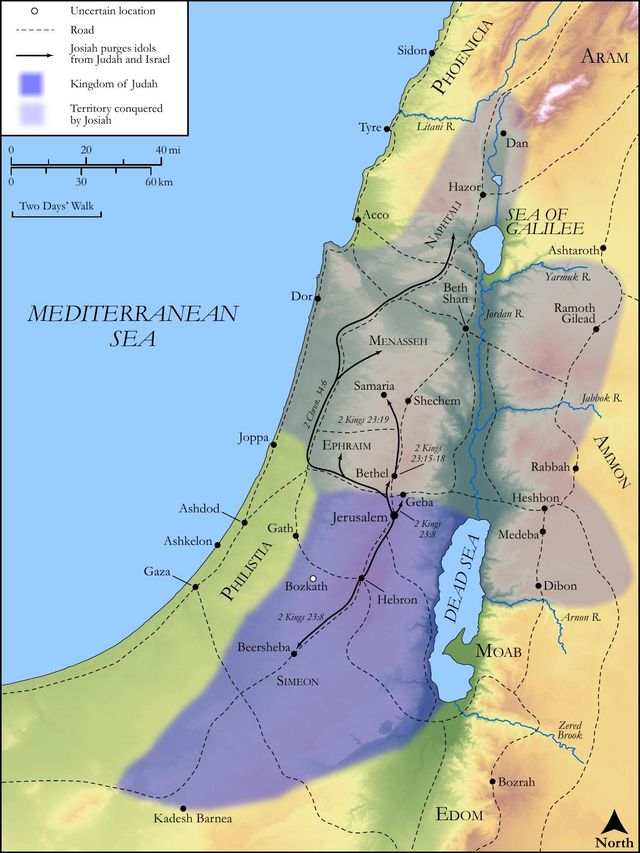
Study this verse
Public-domain commentary
Matthew Henry
From his Commentary on the Whole Bible. Henry comments on passages, not single verses — this entry covers 2 Chronicles 34:14–28.
This whole paragraph we had, just as it is here related, Kg2 22:8-20, and have nothing to add here to what was there observed. But, 1. We may hence take occasion to bless God that we have plenty of Bibles, and that they are, or may be, in all hands, - that the book of the law and gospel is not lost, is not scarce, - that, in this sense, the word of the Lord is not precious. Bibles are jewels, but, thanks be to God, they are not rarities. The fountain of the waters of life is not a spring shut up or a fountain sealed, but the streams of it, in all places, make glad the city of our God. Usus communis aquarum - These waters flow for general use. What a great deal shall we have to answer for if the great things of God's law, being thus made common, should be accounted by us as strange things! 2. We may hence learn, whenever we read or hear the word of God, to affect our hearts with it, and to get them possessed with a holy fear of that wrath of God which is there revealed against all ungodliness and unrighteousness of men, as Josiah's tender heart was. When he heard the words of the law he rent his clothes (Ch2 34:19), and God was well pleased with his doing so, Ch2 34:27. Were the things contained in the scripture new to us, as they were here to Josiah, surely they would make deeper impressions upon us than commonly they do; but they are not the less weighty, and therefore should not be the less considered by us, for their being well known. Rend the heart therefore, not the garments. 3. We are here directed when we are under convictions of sin, and apprehensions of divine wrath, to enquire of the Lord; so Josiah did, Ch2 34:21. It concerns us to ask (as they did, Act 2:37), Men and brethren, what shall we do? and more particularly (as the jailor), What must I do to be saved? Act 16:30. If you will thus enquire, enquire (Isa 21:12); and, blessed be God, we have the lively oracles to which to apply with these enquiries. 4. We are here warned of the ruin that sin brings upon nations and kingdoms. Those that forsake God bring evil upon themselves (Ch2 34:24, Ch2 34:25), and kindle a fire which shall not be quenched. Such will the fire of God's wrath be when the decree has gone forth against those that obstinately and impenitently persist in their wicked ways. 5. We are here encouraged to humble ourselves before God and seek unto him, as Josiah did. If we cannot prevail thereby to turn away God's wrath from our land, yet we shall deliver our own souls, Ch2 34:27, Ch2 34:28. And good people are here taught to be so far from fearing death as to welcome it rather when it takes them away from the evil to come. See how the property of it is altered by making it the matter of a promise: Thou shalt be gathered to thy grave in peace, housed in that ark, as Noah, when a deluge is coming.
Continue studying 2 Chronicles 34:19 across the web’s major study libraries — every link below opens this exact verse, chapter, or book on the destination site.
Read & Compare
 BibleGatewayThis verse in more than 200 translations and 70 languages.
 Bible.comThe YouVersion reader — hundreds of translations, reading plans, and highlights.
 ESV.orgCrossway's official English Standard Version reader.
 NET BibleThe NET translation with 60,000+ translators' notes on every rendering decision.
 STEP BibleTyndale House's free study tool — original text, vocabulary, and scholarly resources.
 BibliaLogos Bible Software's free web reader.
 USCCBThe New American Bible (Revised Edition) with the U.S. bishops' study notes.
Commentaries
 BibleHub CommentariesDozens of classic commentaries on this verse, gathered on one page.
 StudyLightMore than 100 commentary sets — the largest collection on the web.
 BibleRefPlain-English commentary on what this verse means, verse by verse.
 Enduring WordDavid Guzik's free commentary on this chapter, widely used by Bible teachers.
 Bible Study ToolsVerse commentary alongside Greek and Hebrew study aids.
Original Language & Research
- BibleHub InterlinearThe verse word by word — original language, transliteration, and English.
- BibleHub LexiconEvery word's original-language definition and Strong's entry.
 Blue Letter BibleDeep-study tools — Strong's numbers, concordance, and word studies.
 SefariaThe Hebrew text with Rashi and centuries of Jewish commentary.
Sermons, Hymns & Audio


TrulyRandomVerse is not affiliated with these sites and doesn’t control their content. They’re linked because they’re genuinely useful.
Summary
King Josiah's visceral reaction in marks a profound turning point in Judah's spiritual trajectory. Upon hearing the rediscovered Book of the Law, the young monarch immediately tore his garments, a deeply symbolic act in Israel signifying overwhelming grief, profound repentance, and humble submission before divine revelation. This dramatic display underscored his immediate recognition of the nation's grievous departure from God's covenant commands and the impending judgment, catalyzing a sweeping spiritual reformation that permeated every aspect of Judahite society.
Context
ShowHideLiterary Context
This pivotal verse is situated within the narrative of King Josiah's reign, specifically during his eighteenth year (2 Chronicles 34:8). Unlike many of his apostate predecessors, Josiah began seeking God early in his life, initiating significant reforms—purging idolatry and restoring proper worship—even before the Law's discovery (2 Chronicles 34:3-7). The immediate preceding verses detail the extensive Temple repair project, during which the High Priest Hilkiah miraculously discovered the "Book of the Law" (2 Chronicles 34:14). This discovery was not merely an archaeological find but a divinely orchestrated intervention, bringing God's forgotten covenant stipulations back into the national consciousness. Shaphan, the scribe, then read its contents directly to Josiah (2 Chronicles 34:18), leading directly to the king's visceral and immediate response described in this verse. This act of tearing clothes serves as the narrative's emotional and theological climax, setting the stage for Josiah's subsequent radical reforms and the national covenant renewal detailed in the remainder of 2 Chronicles 34.
Historical & Cultural Context
Josiah reigned over Judah from 640-609 BC, a period marked by profound spiritual decline following the reigns of his grandfather Manasseh and father Amon, who had promoted widespread idolatry, child sacrifice, and the systematic neglect of Yahweh worship. The "Book of the Law," likely a substantial portion of Deuteronomy, had been lost or deliberately suppressed for generations, indicating a deep national apostasy and ignorance of God's revealed will. In ancient Israel, the act of "tearing one's clothes" was a deeply ingrained cultural expression. It was not a casual act but a public, unmistakable sign of extreme grief, distress, horror, or, as in Josiah's case, profound spiritual conviction and repentance. This gesture signified a complete shattering of one's composure, a visible manifestation of intense inner turmoil, and often an appeal to divine mercy in the face of overwhelming calamity or the realization of egregious sin and impending judgment. This cultural understanding amplifies the gravity and sincerity of Josiah's reaction, demonstrating a king who truly humbled himself before God's authority.
Key Themes
ShowHideThe impact of 2 Chronicles 34:19 resonates with several pervasive themes throughout Chronicles and the broader Old Testament. Firstly, it powerfully illustrates the transformative power of God's Word. The mere hearing of the Law, after generations of neglect, immediately convicts and moves the king to radical action, demonstrating that God's word is "living and active" and sharper than any two-edged sword, as later described in Hebrews 4:12. Secondly, it highlights the theme of genuine repentance and humility. Josiah's tearing of his clothes is a visible manifestation of a "broken and contrite heart," which God does not despise, as articulated in Psalm 51:17. His personal conviction becomes the catalyst for a national spiritual awakening and reform, demonstrating how individual responsiveness to God's truth can initiate widespread renewal. This aligns with the Chronicler's emphasis on Israel's covenant relationship with Yahweh and the direct consequences of obedience or disobedience, showing that even in the darkest times, a return to God's Word can bring about profound change.
Exposition and Analysis
ShowHideKey Word Analysis
ShowHideThis verb (H8085) signifies more than mere auditory perception; it implies intelligent hearing, often with the implication of attention, comprehension, and a readiness to obey. For Josiah, "hearing" the words of the Law meant internalizing their meaning, understanding their implications for Judah's covenant relationship with God, and recognizing the nation's profound failure to adhere to divine commands. It was a hearing that penetrated his heart and conscience, leading to a transformative realization.
This noun (H8451) refers to divine instruction, teaching, or revelation, encompassing God's precepts, statutes, and His prescribed way of life for His people. It is not merely a legal code but the comprehensive expression of God's will and covenant stipulations. Josiah's reaction was not to a dry set of rules but to the very voice and expectation of God, revealing the nation's profound covenant unfaithfulness and the severe consequences outlined within the Law itself.
This primitive root (H7167) denotes a violent tearing or ripping. In the context of garments, it is a deliberate and dramatic action, distinct from accidental damage. It conveys a sense of profound shock, grief, horror, or, as here, overwhelming conviction and spiritual anguish. It is an outward, public expression of an intense internal state, indicating a complete shattering of composure and a recognition of a catastrophic spiritual reality, specifically the dire state of Judah before God.
Verse Breakdown
ShowHide"And it came to pass, when the king had heard the words of the law,"
This clause establishes the catalyst for Josiah's dramatic response: the direct encounter with God's revealed Word. The phrase "it came to pass" emphasizes the immediate and direct consequence of this hearing. The act of "hearing" here is not passive but implies an active reception and profound comprehension of the Law's content, particularly its demands, its blessings for obedience, and its severe warnings of judgment for disobedience. The words were not just read but heard in a way that deeply penetrated Josiah's heart and conscience, revealing the stark contrast between God's holy standards and Judah's idolatrous and disobedient reality.
"that he rent his clothes."
This is the immediate, visceral, and culturally understood response to the hearing. It is a powerful, non-verbal sign of profound grief, horror, and repentance. For Josiah, this act signified deep sorrow over the nation's pervasive sin, a recognition of God's righteous judgment that Judah had incurred, and a humble acknowledgment of his own and his people's unworthiness. It was a public declaration of a broken spirit and a contrite heart, demonstrating a readiness to respond decisively and radically to God's revealed truth, initiating a path of national repentance and reform.
Literary Devices
ShowHideThe narrative of 2 Chronicles 34:19 is rich with Symbolism. Josiah's act of tearing his clothes is not merely an emotional outburst but a highly symbolic gesture representing profound spiritual anguish, humility, and repentance. It symbolizes the tearing of the nation's spiritual fabric due to generations of covenant unfaithfulness, the breaking of their relationship with God, and Josiah's own brokenness and contrition before divine holiness. There is also an element of Dramatic Irony in the discovery of the Law; what was "lost" and forgotten by generations is suddenly found, bringing both the revelation of impending judgment and the potential for profound restoration. This discovery, coupled with Josiah's response, serves as a Peripeteia, a dramatic turning point in the narrative, shifting Judah from a path of continued apostasy towards a period of intense spiritual reform. Furthermore, Josiah's immediate and radical response Foreshadows the sweeping reforms and covenant renewal that he will initiate, demonstrating the direct link between personal conviction and national transformation.
Theological and Thematic Connections
ShowHideJosiah's response to the Book of the Law serves as a profound theological statement on the nature of divine revelation and human accountability. The Law, as God's holy standard, powerfully exposes sin and reveals the depth of human depravity and rebellion against a righteous God. Josiah's tearing of his clothes is a quintessential model of true repentance: a visceral, immediate, and humble acknowledgment of guilt and a turning towards God with a broken and contrite heart. This act underscores the biblical truth that God is drawn to genuine humility and a repentant spirit, not to outward rituals without inner transformation. It highlights the absolute necessity of God's Word in bringing conviction, leading to genuine spiritual awakening, and initiating a path of restoration and covenant faithfulness. Without the rediscovery and hearing of the Law, Judah would have continued its descent into idolatry, utterly unaware of its perilous spiritual state and the impending divine wrath.
Reflection and Application
ShowHideJosiah's encounter with the Book of the Law provides a timeless paradigm for our own engagement with God's Word. His immediate and profound reaction challenges us to move beyond superficial reading or mere intellectual assent to Scripture. When we truly "hear" the words of the Lord, allowing them to penetrate our hearts and expose our own shortcomings, areas of disobedience, and the subtle idolatries of our age, a similar conviction should arise. This conviction is not meant to condemn us but to lead to genuine repentance—a turning away from sin and a turning back to God with humility, a desire for obedience, and a renewed commitment to His will. Like Josiah, our personal spiritual awakenings, fueled by the transformative power of God's Word, have the potential to initiate broader spiritual renewal within our families, churches, and communities. This verse powerfully reminds us that true spiritual reform, whether personal or corporate, begins with a humble heart that trembles at God's Word and is willing to act decisively in response to its convicting truth.
Questions for Reflection
ShowHideFAQ
ShowHideWhat was the "Book of the Law" that Josiah heard?
ShowHideWhile the Bible doesn't explicitly state the entire content, scholarly consensus suggests it was most likely a significant portion, if not the entirety, of the Book of Deuteronomy. Deuteronomy contains a comprehensive restatement of the Law given at Mount Sinai, including profound blessings for obedience and severe curses for disobedience (e.g., Deuteronomy 28). The specific details of the curses and the covenant stipulations within Deuteronomy would have been particularly jarring and convicting to Josiah, given the rampant idolatry and neglect of God's commands in Judah during the preceding generations. The discovery of this foundational text was a divine act, bringing forgotten truth back into the national consciousness and serving as the catalyst for Judah's last great spiritual revival.
Why did Josiah "rent his clothes"? Was it a common practice?
ShowHideYes, "renting one's clothes" was a deeply ingrained and culturally significant practice in ancient Israel, used to express extreme emotional states. It was a public, non-verbal declaration of profound grief (e.g., Genesis 37:34), horror (e.g., 2 Kings 18:37), despair, or, as in Josiah's case, overwhelming conviction and repentance. It symbolized a breaking of one's composure and a humble acknowledgment of a catastrophic situation or egregious sin. For Josiah, it was an outward sign of his inner anguish over Judah's pervasive covenant unfaithfulness and the impending divine judgment revealed in the Law, demonstrating a king who truly humbled himself before God.
How did Josiah's reaction lead to such a widespread reform in Judah?
ShowHideJosiah's personal, visceral reaction to the Law was the direct catalyst for a national spiritual awakening because he was the king and his response set the example. His humility and immediate conviction modeled genuine repentance for the entire nation. Unlike many previous kings who ignored or suppressed God's word, Josiah embraced it fully and immediately. His act of tearing his clothes demonstrated profound sincerity, which then motivated him to take decisive action. He immediately consulted the prophetess Huldah (2 Chronicles 34:22-28), who confirmed the impending judgment but also affirmed God's mercy due to Josiah's humble response (2 Chronicles 34:27-28). Empowered by this divine confirmation, Josiah then initiated a sweeping reform, eradicating idolatry, restoring the Temple worship, and leading the people in a renewed covenant with God (2 Chronicles 34:29-33). His personal conviction became the undeniable driving force behind a corporate transformation.
Christ-Centered Fulfillment
ShowHideKing Josiah's profound conviction upon hearing the words of the Law beautifully foreshadows humanity's ultimate encounter with God's perfect Law and its complete fulfillment in Jesus Christ. The Law, as heard by Josiah, served primarily to reveal sin and the dire consequences of disobedience, leading to a desperate, humble response. This points to the universal human condition: our inherent inability to perfectly keep God's commands and our desperate need for a Savior. While Josiah's tearing of his clothes symbolized his brokenness and repentance, it was a temporary, human act, a poignant but ultimately insufficient response to the depth of sin. In Christ, we see the ultimate fulfillment of the Law's demands and the perfect, divine response to God's holiness. Jesus, the living Word of God (John 1:1), perfectly fulfilled the Law in every respect (Matthew 5:17) and, by His atoning sacrifice on the cross, bore the curses that the Law pronounced upon sin (Galatians 3:13). The "renting of clothes" in the Old Testament, a sign of human distress, finds its ultimate divine counterpart in the tearing of the temple veil from top to bottom at the moment of Christ's death (Matthew 27:51), signifying that the way to God, once restricted by the Law and its rituals, was now opened wide and made accessible through His perfect, once-for-all sacrifice. Through faith in Him, we receive not merely a temporary reprieve, but a new heart and a new spirit, where God's Law is written, not on tablets of stone, but on our hearts by the indwelling Holy Spirit (Jeremiah 31:33 and Hebrews 8:10), enabling us to walk in newness of life (Romans 6:4) and truly respond to God's word with genuine, Spirit-empowered obedience and worship.