


2 Chronicles 34:20
Bible text: King James Version (1769 Blayney text) · Public domain
Bible text: King James Version with Strong's numbers · Public domain
Bible text: Berean Standard Bible · Public domain
Bible text: American Standard Version (1901) · Public domain
Bible text: World English Bible, Messianic edition · Public domain
Bible text: Geneva Bible (1599) · Public domain
Bible text: Young's Literal Translation · Public domain
- וַיְצַוvay·Tzavand he commandedH6680Conj-w ¦ V-Piel-ConsecImperf-3msVerb Piel Consecutive Imperfect 3rd Singular Masculineוַandיְצַוhe commanded
- הַמֶּלֶךְha·Me·lekhthe kingH4428Art ¦ N-msNoun Singular Masculine Absoluteהַtheמֶּלֶךְking
- אֶת'et<obj.>H853DirObjMParticle Object Indicator
- חִלְקִיָּהוּchil·ki·Ya·huHilkiahH2518N-proper-mNoun Proper Masculine
- וְאֶתve·'Etand <obj.>H853Conj-w ¦ DirObjMParticle Object Indicatorוְandאֶת<obj.>
- אֲחִיקָם'a·chi·KamAhikamH296N-proper-mNoun Proper Masculine
- בֶּןbe·no·Sha[the] son ofH1121N-mscNoun Singular Masculine Construct
- שָׁפָןSha·fanShaphanH8227N-proper-mNoun Proper Masculine
- וְאֶתve·'Etand <obj.>H853Conj-w ¦ DirObjMParticle Object Indicatorוְandאֶת<obj.>
- עַבְדּוֹןav·DonAbdonH5658N-proper-mNoun Proper Masculine
- בֶּןben[the] son ofH1121N-mscNoun Singular Masculine Construct
- מִיכָהmi·KhahMicahH4318N-proper-mNoun Proper Masculine
- וְאֵתve·'Etand <obj.>H853Conj-w ¦ DirObjMParticle Object Indicatorוְandאֵת<obj.>
- שָׁפָןsha·FanShaphanH8227N-proper-mNoun Proper Masculine
- הַסּוֹפֵרha·so·Ferthe scribeH5608Art ¦ N-msNoun Singular Masculine Absoluteהַtheסּוֹפֵרscribe
- וְאֵתve·'Etand <obj.>H853Conj-w ¦ DirObjMParticle Object Indicatorוְandאֵת<obj.>
- עֲשָׂיָה'a·sa·YahAsaiahH6222N-proper-mNoun Proper Masculine
- עֶבֶד'e·ved[the] servant ofH5650N-mscNoun Singular Masculine Construct
- הַמֶּלֶךְha·Me·lekhthe kingH4428Art ¦ N-msNoun Singular Masculine Absoluteהַtheמֶּלֶךְking
- לֵאמֹרle·Mor<to> sayingH559Prep-l ¦ V-Qal-InfVerb Qal Infinitive Constructלֵ<to>אמֹרsaying
English is a literal word-by-word gloss of the Hebrew, not the KJV's wording. Why?
This is the original text the KJV's translators worked from — each Hebrew word with its own literal English meaning in this verse, prepared by scholars at Tyndale House, Cambridge. The KJV translates whole sentences, not word by word, so its wording differs: one Hebrew word can become several English words, and the KJV may choose “the LORD” where the gloss reads “Yahweh”. Both are faithful — they answer different questions. For the KJV's own rendering, switch to the KJV text.
Details
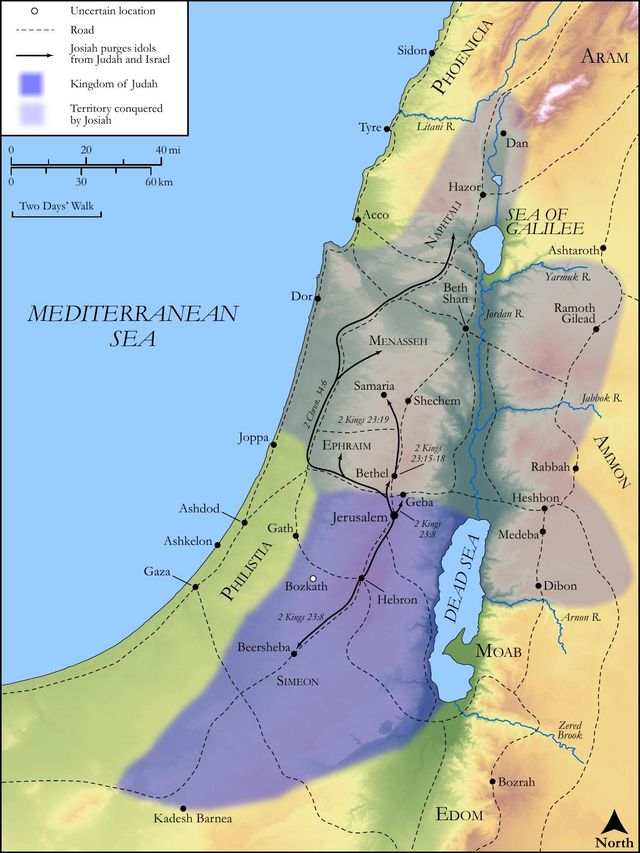
See on the biblical-era map
Study this verse
Public-domain commentary
Matthew Henry
From his Commentary on the Whole Bible. Henry comments on passages, not single verses — this entry covers 2 Chronicles 34:14–28.
This whole paragraph we had, just as it is here related, Kg2 22:8-20, and have nothing to add here to what was there observed. But, 1. We may hence take occasion to bless God that we have plenty of Bibles, and that they are, or may be, in all hands, - that the book of the law and gospel is not lost, is not scarce, - that, in this sense, the word of the Lord is not precious. Bibles are jewels, but, thanks be to God, they are not rarities. The fountain of the waters of life is not a spring shut up or a fountain sealed, but the streams of it, in all places, make glad the city of our God. Usus communis aquarum - These waters flow for general use. What a great deal shall we have to answer for if the great things of God's law, being thus made common, should be accounted by us as strange things! 2. We may hence learn, whenever we read or hear the word of God, to affect our hearts with it, and to get them possessed with a holy fear of that wrath of God which is there revealed against all ungodliness and unrighteousness of men, as Josiah's tender heart was. When he heard the words of the law he rent his clothes (Ch2 34:19), and God was well pleased with his doing so, Ch2 34:27. Were the things contained in the scripture new to us, as they were here to Josiah, surely they would make deeper impressions upon us than commonly they do; but they are not the less weighty, and therefore should not be the less considered by us, for their being well known. Rend the heart therefore, not the garments. 3. We are here directed when we are under convictions of sin, and apprehensions of divine wrath, to enquire of the Lord; so Josiah did, Ch2 34:21. It concerns us to ask (as they did, Act 2:37), Men and brethren, what shall we do? and more particularly (as the jailor), What must I do to be saved? Act 16:30. If you will thus enquire, enquire (Isa 21:12); and, blessed be God, we have the lively oracles to which to apply with these enquiries. 4. We are here warned of the ruin that sin brings upon nations and kingdoms. Those that forsake God bring evil upon themselves (Ch2 34:24, Ch2 34:25), and kindle a fire which shall not be quenched. Such will the fire of God's wrath be when the decree has gone forth against those that obstinately and impenitently persist in their wicked ways. 5. We are here encouraged to humble ourselves before God and seek unto him, as Josiah did. If we cannot prevail thereby to turn away God's wrath from our land, yet we shall deliver our own souls, Ch2 34:27, Ch2 34:28. And good people are here taught to be so far from fearing death as to welcome it rather when it takes them away from the evil to come. See how the property of it is altered by making it the matter of a promise: Thou shalt be gathered to thy grave in peace, housed in that ark, as Noah, when a deluge is coming.
Continue studying 2 Chronicles 34:20 across the web’s major study libraries — every link below opens this exact verse, chapter, or book on the destination site.
Read & Compare
 BibleGatewayThis verse in more than 200 translations and 70 languages.
 Bible.comThe YouVersion reader — hundreds of translations, reading plans, and highlights.
 ESV.orgCrossway's official English Standard Version reader.
 NET BibleThe NET translation with 60,000+ translators' notes on every rendering decision.
 STEP BibleTyndale House's free study tool — original text, vocabulary, and scholarly resources.
 BibliaLogos Bible Software's free web reader.
 USCCBThe New American Bible (Revised Edition) with the U.S. bishops' study notes.
Commentaries
 BibleHub CommentariesDozens of classic commentaries on this verse, gathered on one page.
 StudyLightMore than 100 commentary sets — the largest collection on the web.
 BibleRefPlain-English commentary on what this verse means, verse by verse.
 Enduring WordDavid Guzik's free commentary on this chapter, widely used by Bible teachers.
 Bible Study ToolsVerse commentary alongside Greek and Hebrew study aids.
Original Language & Research
- BibleHub InterlinearThe verse word by word — original language, transliteration, and English.
- BibleHub LexiconEvery word's original-language definition and Strong's entry.
 Blue Letter BibleDeep-study tools — Strong's numbers, concordance, and word studies.
 SefariaThe Hebrew text with Rashi and centuries of Jewish commentary.
Sermons, Hymns & Audio


TrulyRandomVerse is not affiliated with these sites and doesn’t control their content. They’re linked because they’re genuinely useful.
Summary
Following the momentous discovery of the Book of the Law during the temple renovations, 2 Chronicles 34:20 details King Josiah's immediate and decisive action. Deeply convicted by the Law's words, the king prudently assembled a distinguished delegation of his most trusted spiritual and administrative officials—including the high priest, a prominent scribe, and other key royal servants—to embark on a critical mission: to inquire of the Lord concerning the implications of the rediscovered divine commands for himself and the nation of Judah. This verse underscores Josiah's exemplary leadership in responding to God's revelation with both humility and strategic wisdom.
Context
ShowHideLiterary Context
This verse is a pivotal moment in the narrative of Josiah's reforms, directly following the profound impact of the Book of the Law's discovery. In 2 Chronicles 34:14, Hilkiah the high priest finds the book during temple repairs. Shaphan the scribe then reads it to the king in 2 Chronicles 34:18, prompting Josiah's immediate and dramatic response of repentance, tearing his clothes in 2 Chronicles 34:19. Verse 20 sets the stage for the next crucial step in Josiah's response: the formal inquiry to the Lord through the prophetess Huldah, detailed in 2 Chronicles 34:21-28. It marks the transition from personal conviction to collective action, demonstrating Josiah's resolve to align the nation with God's revealed will and to seek divine counsel for its implementation.
Historical & Cultural Context
King Josiah reigned over Judah from 640-609 BC, a period marked by significant religious decline following the idolatrous reigns of his grandfather Manasseh and father Amon. Josiah began his reforms early, seeking the Lord from his youth (2 Chronicles 34:3). The discovery of the Book of the Law (widely believed to be a copy of Deuteronomy) was a monumental event, revealing the extent of Judah's deviation from God's covenant and the severe consequences of their disobedience. In Israel, kings often enquired of the LORD through his prophets for guidance on matters of national importance. Josiah's delegation of high-ranking officials—including the high priest, a royal scribe, and other trusted royal servants—reflects the established protocol for addressing such weighty spiritual and administrative concerns, ensuring that the inquiry carried the full authority and representation of the kingdom.
Key Themes
ShowHideThis verse powerfully illustrates several key themes central to the book of 2 Chronicles. Firstly, it highlights Divine Revelation and Human Response, showing how God's Word, once rediscovered, demands an immediate and profound reaction, leading to conviction and a desire for obedience. Secondly, it exemplifies Wise and Godly Leadership, as Josiah does not act impulsively but thoughtfully delegates the critical task of seeking divine counsel to a diverse group of trusted advisors, demonstrating humility and a reliance on collective wisdom. This action is part of the broader theme of Repentance and Reform, where Josiah's personal contrition in 2 Chronicles 34:19 leads directly to a national effort to understand and implement God's commands. Finally, it underscores the critical importance of Seeking Divine Counsel, as the king prioritizes inquiring of the Lord through His appointed channels, acknowledging God's ultimate authority over the nation's destiny.
Exposition and Analysis
ShowHideKey Word Analysis
ShowHideThe name means "rock rabbit" or "hyrax," though its significance here lies in the person. Shaphan (H8227) was a highly influential and trusted royal scribe, likely holding the position of secretary of state. His presence in this delegation, alongside his son Ahikam, underscores his continued importance and integrity within Josiah's court. He was the one who initially received the discovered Book of the Law from Hilkiah and read it to King Josiah, making him central to the entire narrative of reform.
In ancient Israel, a "scribe" (H5608) was far more than a mere copyist. The sopher was a highly educated and influential official, often serving as a royal secretary, administrator, and advisor. Shaphan's role as "the scribe" indicates his high-ranking status and intellectual capabilities, making him an indispensable member of any delegation seeking to interpret and apply legal or spiritual texts. His ability to "score with a mark as a tally or record" and "inscribe" made him vital for the preservation and understanding of sacred texts.
This term (H5650), applied to Asaiah as "a servant of the king's," denotes a high-ranking official or minister in the royal administration, not a mere domestic servant. Such individuals held positions of significant trust and responsibility, often serving as close advisors or administrators of royal affairs. Their inclusion in this delegation emphasizes the gravity and official nature of the mission, signifying that the king's most trusted personnel were involved in this crucial spiritual and national undertaking.
Verse Breakdown
ShowHide"And the king commanded Hilkiah"
This opening clause immediately establishes King Josiah's direct authority and initiative. Hilkiah, as the high priest, was the one who discovered the Book of the Law, making his inclusion in this delegation essential for spiritual authority and continuity. His leadership in the temple reforms positioned him as a key figure in the nation's spiritual renewal.
"and Ahikam the son of Shaphan"
Ahikam is identified by his lineage, linking him to the influential scribe Shaphan, who is also part of the delegation. Ahikam himself was a trusted royal official, later known for protecting the prophet Jeremiah (Jeremiah 26:24). His presence signifies the involvement of reliable figures from the royal administration, ensuring a breadth of expertise and influence.
"and Abdon the son of Micah"
Abdon is another royal official, also referred to as Achbor the son of Micaiah in the parallel account in 2 Kings 22:12. His inclusion further broadens the representation of trusted royal advisors in the delegation, indicating Josiah's desire for comprehensive counsel.
"and Shaphan the scribe"
Shaphan's direct inclusion in the delegation, having been the one who read the Law to Josiah, reinforces his central role in the discovery and its immediate aftermath. His expertise as a scribe would be crucial for understanding and interpreting the newly found text, providing scholarly insight into the divine commands.
"and Asaiah a servant of the king's, saying,"
Asaiah, as another high-ranking "servant of the king," completes this distinguished group. The concluding "saying" serves as a narrative bridge, introducing the specific command or mission that Josiah entrusted to these officials, which is fully elaborated in the subsequent verses. This phrase builds anticipation for the weighty instructions that follow.
Literary Devices
ShowHideThe verse primarily employs Enumeration or Listing, meticulously naming each individual chosen by King Josiah for this vital mission. This detailed listing emphasizes the careful, deliberate, and official nature of Josiah's response to the rediscovered Law. By naming each member—Hilkiah the high priest, Ahikam, Abdon, Shaphan the scribe, and Asaiah—the text underscores the collective authority, diverse expertise, and high trustworthiness of the delegation. This precise Nomenclature also serves to establish the credibility and significance of the upcoming prophetic inquiry, ensuring the reader understands the gravity of the king's actions. Furthermore, the concluding word "saying" acts as a device of Anticipation, creating a narrative pause that builds suspense and directs the reader's attention to the command itself, which is revealed in 2 Chronicles 34:21, highlighting the urgency and gravity of their task.
Theological and Thematic Connections
ShowHideThis verse highlights the profound theological principle that divine revelation demands a serious and immediate human response. Josiah's command to inquire of the Lord, following his deep conviction, models a leadership that prioritizes God's Word and seeks His will above all else. It demonstrates that true repentance is not merely an emotional reaction but leads to decisive action aimed at understanding and aligning with God's commands. The selection of a diverse and trusted group of officials underscores the wisdom of seeking counsel in matters of spiritual and national importance, reflecting a communal responsibility to God's truth. This act of seeking God's face through His appointed channels is a testament to Josiah's humility and his profound reverence for the Lord's authority, setting a precedent for how individuals and nations should respond to the unveiling of divine truth.
Reflection and Application
ShowHideKing Josiah's immediate and strategic response to the Book of the Law provides a powerful model for believers today. When God's Word convicts us, whether through personal reading, preaching, or study, our response should be one of earnestness, humility, and decisive action. Just as Josiah did not bear the burden of understanding and responding to the Law alone, we are called to seek wise, godly counsel when faced with weighty truths or significant decisions. This might involve consulting trusted spiritual mentors, engaging in community Bible study, or seeking guidance from church leaders. True spiritual leadership, whether in personal life, family, or community, involves acknowledging one's limitations and humbly seeking God's guidance through His Word and His people. It reminds us that our encounter with divine truth should always lead to a desire to inquire further, understand more deeply, and live more faithfully in accordance with God's revealed will.
Questions for Reflection
ShowHideFAQ
ShowHideWho were these individuals, and why were they chosen?
ShowHideThe individuals commanded by King Josiah were Hilkiah the high priest, Ahikam the son of Shaphan, Abdon the son of Micah, Shaphan the scribe, and Asaiah a servant of the king's. They were chosen for their high office, proven trustworthiness, and likely their spiritual integrity, representing a cross-section of the highest echelons of both spiritual and administrative authority in Judah. Hilkiah was central to the discovery of the Law, Shaphan was the influential royal scribe who read it to the king, and Ahikam, Abdon, and Asaiah were trusted royal officials. Their collective inclusion ensured that the inquiry would be taken with utmost seriousness, its findings respected, and its implementation carried out with the full backing of the kingdom's leadership.
What was the "Book of the Law" that was discovered?
ShowHideWhile the text does not explicitly name the "Book of the Law," scholarly consensus strongly suggests it was a copy of the book of Deuteronomy, or at least a significant portion thereof. The commands and curses detailed in Deuteronomy 28 align perfectly with Josiah's reaction of repentance and his subsequent reforms. Its rediscovery was pivotal because its commands had been largely forgotten or ignored for generations, leading to national apostasy. The book detailed the covenant obligations between God and Israel, outlining the blessings for obedience and the severe consequences for disobedience, profoundly impacting King Josiah and setting in motion the most significant religious revival in Judah's history.
Christ-Centered Fulfillment
ShowHideKing Josiah's profound response to the rediscovery of the Book of the Law, leading him to humbly inquire of the Lord and initiate sweeping reforms, powerfully foreshadows the ultimate fulfillment found in Jesus Christ. The Law, though holy and good, revealed humanity's inability to perfectly obey God's righteous standards, bringing conviction and demonstrating the need for a perfect mediator and a new covenant. Josiah's zeal for the Law and his desire to align his kingdom with God's will reflect, in a limited way, Christ's perfect obedience to the Law, for He declared He came not to abolish but to fulfill the Law. While Josiah sent a delegation to inquire of the Lord through a prophetess, Christ is the very Word of God, the ultimate and complete revelation of God to humanity, through whom all divine counsel is now perfectly given. The Law brought a curse for disobedience, but Christ became a curse for us, redeeming us from its condemnation (Galatians 3:13). Josiah's reforms sought to bring Judah back into alignment with the old covenant, but Jesus inaugurated a new covenant through His blood, writing God's laws not on tablets of stone but on the hearts of His people (Hebrews 8:10). Thus, Josiah's earnest inquiry points forward to the One who is the very embodiment of God's perfect will and the source of true spiritual life and transformation.