


Jeremiah 40:9
Bible text: King James Version (1769 Blayney text) · Public domain
Bible text: King James Version with Strong's numbers · Public domain
Bible text: Berean Standard Bible · Public domain
Bible text: American Standard Version (1901) · Public domain
Bible text: World English Bible, Messianic edition · Public domain
Bible text: Geneva Bible (1599) · Public domain
Bible text: Young's Literal Translation · Public domain
- וַיִּשָּׁבַעvai·yi·sha·Va'and he swore an oathH7650Conj-w ¦ V-Niphal-ConsecImperf-3msVerb Niphal Consecutive Imperfect 3rd Singular Masculineוַandיִּשָּׁבַעhe swore an oath
- לָהֶםla·Hemto <the> themPrep-l ¦ 3mpSuffix Personal 3rd Plural Masculineלָto <the>הֶםthem
- גְּדַלְיָהוּge·dal·Ya·huGedaliahH1436N-proper-mNoun Proper Masculine
- בֶןven[the] son ofH1121N-mscNoun Singular Masculine Construct
- אֲחִיקָם'a·chi·KamAhikamH296N-proper-mNoun Proper Masculine
- בֶּןben[the] son ofH1121N-mscNoun Singular Masculine Construct
- שָׁפָןsha·FanShaphanH8227N-proper-mNoun Proper Masculine
- וּלְאַנְשֵׁיהֶםu·le·'an·shei·Hemand to their menH582Conj-w ¦ Prep-l ¦ N-mpc ¦ 3mpNoun Plural Masculine Constructוּandלְtoאַנְשֵׁיmenהֶםtheir
- לֵאמֹרle·Mor<to> sayingH559Prep-l ¦ V-Qal-InfVerb Qal Infinitive Constructלֵ<to>אמֹרsaying
- אַל'almay notH408NegParticle Negative
- תִּירְאוּti·re·'Uyou be afraidH3372V-Qal-Imperf-2mpVerb Qal Imperfect 2nd Plural Masculine
- מֵעֲבוֹדme·'a·Vodfrom servingH5647Prep-m ¦ V-Qal-InfVerb Qal Infinitive Constructמֵfromעֲבוֹדserving
- הַכַּשְׂדִּיםha·kas·Dimthe ChaldeansH3778Art ¦ N-mpNoun Gentilic Plural Masculine AbsoluteהַtheכַּשְׂדִּיםChaldeans
- שְׁבוּshe·VuremainH3427V-Qal-Imp-2mpVerb Qal Imperative 2nd Plural Masculine
- בָאָרֶץva·'A·retzin the landH776Prep-b ¦ N-fsNoun Singular Feminine Absoluteבָin theאָרֶץland
- וְעִבְדוּve·'iv·Duand serveH5647Conj-w ¦ V-Qal-Imp-2mpVerb Qal Imperative 2nd Plural Masculineוְandעִבְדוּserve
- אֶת'et<obj.>H853DirObjMParticle Object Indicator
- מֶלֶךְMe·lekh[the] king ofH4428N-mscNoun Singular Masculine Construct
- בָּבֶלba·VelBabylonH894N-properNoun Proper Location
- וְיִיטַבve·yi·Tavso it may go wellH3190Conj-w ¦ V-Qal-ConjImperf-3msVerb Qal Conjunction+Imperfect 3rd Singular Masculineוְsoיִיטַבit may go well
- לָכֶםla·Khemfor <the> youPrep-l ¦ 2mpSuffix Personal 2nd Plural Masculineלָfor <the>כֶםyou
English is a literal word-by-word gloss of the Hebrew, not the KJV's wording. Why?
This is the original text the KJV's translators worked from — each Hebrew word with its own literal English meaning in this verse, prepared by scholars at Tyndale House, Cambridge. The KJV translates whole sentences, not word by word, so its wording differs: one Hebrew word can become several English words, and the KJV may choose “the LORD” where the gloss reads “Yahweh”. Both are faithful — they answer different questions. For the KJV's own rendering, switch to the KJV text.
Details
See on the biblical-era map
Study this verse
Public-domain commentary
Matthew Henry
From his Commentary on the Whole Bible. Henry comments on passages, not single verses — this entry covers Jeremiah 40:7–16. His three-level outline is real structure in the source text, so it is rendered as structure.
We have in these verses,
I.A bright sky opening upon the remnant of the Jews that were left in their own land, and a comfortable prospect given them of some peace and quietness after the many years of trouble and terror with which they had been afflicted. Jeremiah indeed had never in his prophecies spoken of any such good days reserved for the Jews immediately after the captivity; but Providence seemed to raise and encourage such an expectation, and it would be to that miserable people as life from the dead. Observe the particulars.
1.Gedaliah, one of themselves, is made governor in the land, by the king of Babylon, Jer 40:7. To show that he designed to make and keep them easy he did not give this commission to one of the princes of Babylon, but to one of their brethren, who, they might be sure, would seek their peace. He was the son of Ahikam, the son of Shaphan, one of the princes. We read of his father (Jer 26:24) that he took Jeremiah's part against the people. He seems to have been a man of great wisdom and a mild temper, and under whose government the few that were left might have been very happy. The king of Babylon had a good opinion of him and reposed a confidence in him, for to him he committed all that were left behind.
2.There is great resort to him from all parts, and all those that were now the Jews of the dispersion came and put themselves under his government and protection.
(1.)The great men that had escaped the Chaldeans by force came and quietly submitted to Gedaliah, for their own safety and common preservation. Several are here named, Jer 40:8. They came with their men, their servants, their soldiers, and so strengthened one another; and the king of Babylon had such a good opinion of Gedaliah his delegate that he was not at all jealous of the increase of their numbers, but rather pleased with it.
(2.)The poor men that had escaped by flight into the neighbouring countries of Moab, Ammon, and Edom, were induced by the love they bore to their own land to return to it again as soon as they heard that Gedaliah was in authority there, Jer 40:11, Jer 40:12. Canaan itself would be an unsafe unpleasant country if there were no government nor governors there, and those that loved it dearly would not come back to it till they heard there were. It would be a great reviving to those that were dispersed to come together again, to those that were dispersed into foreign countries to come together in their own country, to those that were under strange kings to be under a governor of their own nation. See here in wrath God remembered mercy, and yet admitted some of them upon a further trial of their obedience.
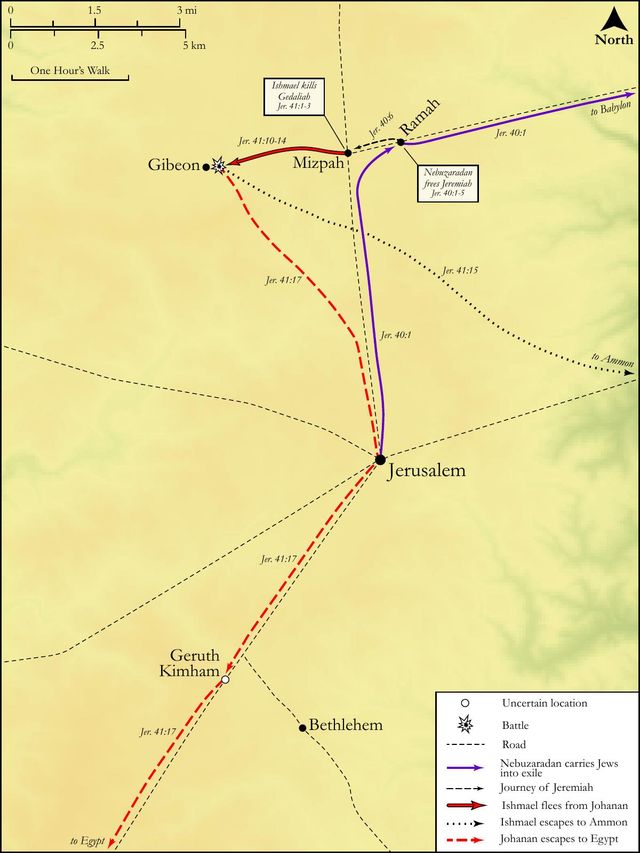
3.The model of this new government is drawn up and settled by an original contract, which Gedaliah confirmed with an oath, a solemn oath (Jer 40:9): He swore to them and to their men, it is probably according to the warrant and instructions he had received from the king of Babylon, who empowered him to give them these assurances.
(1.)They must own the property of their lands to be in the Chaldeans. "Come" (says Gedaliah), "fear not to serve the Chaldeans. Fear not the sin of it." Though the divine law had forbidden them to make leagues with the heathen, yet the divine sentence had obliged them to yield to the king of Babylon. "Fear not the reproach of it, and the disparagement it will be to your nation; it is what God has brought you to, has bound you to, and it is no disgrace to any to comply with him. Fear not the consequences of it, as if it would certainly make you and yours miserable; no, you will find the king of Babylon not so hard a landlord as you apprehend him to be; if you will but live peaceably, peaceably you shall live; disturb not the government, and it will not disturb you. Serve the king of Babylon and it shall be well with you." If they should make any difficulty of doing personal homage, or should be apprehensive of danger when the Chaldeans should come among them, Gedaliah, probably by instruction from the king of Babylon, undertakes upon all occasions to act for them, and make their application acceptable to the king (Jer 40:10): "As for me, behold, I will dwell at Mizpah, to serve the Chaldeans, to do homage to them in the name of the whole body if there be occasion, to receive orders, and to pay them their tribute when the come to us." All that passes between them and the Chaldeans shall pass through his hand; and, if the Chaldeans put such a confidence in him, surely his own countrymen may venture to do it. Gedaliah is willing thus to give them the assurance of an oath that he will do his part in protecting them, but, being apt to err (as many good men are) on the charitable side, he did not require an oath from them that they would be faithful to him, else the following mischief might have been prevented. However, protection draws allegiance though it be not sworn, and by joining in with Gedaliah they did, in effect, consent to the terms of government, that they should serve the king of Babylon. But,
(2.)Though they own the property of their lands to be in the Chaldeans, yet, upon that condition, they shall have the free enjoyment of them and all the profits of them (Jer 40:10): "Gather you wine and summer fruits, and take them for your own use; put them in your vessels, to be laid up for winter-store, as those do that live in a land of peace and hope to eat the labour of your hand, nay, the labour of other people's hands, for you reap what they sowed." Or perhaps they were the spontaneous products of that fertile soil, for which none had laboured. And accordingly we find (Jer 40:12) that they gathered wine and summer fruits very much, such as were at present upon the ground, for their corn-harvest was over some time before Jerusalem was taken. While Gedaliah was in care for the public safety he left them to enjoy the advantages of the public plenty, and, for aught that appears, demanded no tribute from them; for he sought not his own profit, but the profit of many.
II.Here is a dark cloud gathering over this infant state, and threatening a dreadful storm.
How soon is this hopeful prospect blasted! For when God begins in judgment he will make an end. It is here intimated to us,
1.That Baalis the king of the Ammonites had a particular spite at Gedaliah, and was contriving to take him off, either out of malice to the nation of the Jews, whose welfare he hated the thought of, or a personal pique against Gedaliah, Jer 40:14. Some make Baalis to signify the queen-mother of the king of the Ammonites, or queen-dowager, as if she were the first mover of the bloody and treacherous design. One would have thought this little remnant might be safe when the great king of Babylon protected it; and ye it is ruined by the artifices of this petty prince or princess. happy are those that have the King of kings of their side, who can take the wise in their own craftiness; for the greatest earthly king cannot with all his power secure us against fraud and treachery.
2.That he employed Ishmael, the son of Nethaniah, as the instrument of his malice, instigated him to murder Gedaliah, and, that he might have a fair opportunity to do it, directed him to go and enrol himself among his subjects and promise him fealty. Nothing could be more barbarous than the design itself, nor more base than the method of compassing it. How wretchedly is human nature corrupted and degenerated (even in those that pretend to the best blood) when it is capable of admitting the thought of such abominable wickedness! Ishmael was of the seed royal, and would therefore be easily tempted to envy and hate one that set up for a governor in Judah, who was not, as he was, of David's line, though he had ever so much of David's spirit.
3.That Johanan, a brisk and active man, having got scent of this plot, informed Gedaliah of it, yet taking it for granted he could not but know of it before, the proofs of the matter being so very plain: Dost thou certainly know? surely thou dost, Jer 40:14. He gave him private intelligence of it (Jer 40:15), hoping he would then take the more notice of it. He proffered his service to prevent it, by taking off Ishmael, whose very name was ominous to all the seed of Isaac: I will slay him. Wherefore should he slay thee? Herein he showed more courage and zeal than sense of justice; for, if it be lawful to kill for prevention, who then can be safe, since malice always suspects the worst?
4.That Gedaliah, being a man of sincerity himself, would by no means give credit to the information given him of Ishmael's treachery. He said, Thou speakest falsely of Ishmael. Herein he discovered more good humour than discretion, more of the innocency of the dove than the wisdom of the serpent. Princes become uneasy to themselves and all about them when they are jealous. Queen Elizabeth said that she would believe no more evil of her people than a mother would believe of her own children; yet many have been ruined by being over-confident of the fidelity of those about them.
Continue studying Jeremiah 40:9 across the web’s major study libraries — every link below opens this exact verse, chapter, or book on the destination site.
Read & Compare
 BibleGatewayThis verse in more than 200 translations and 70 languages.
 Bible.comThe YouVersion reader — hundreds of translations, reading plans, and highlights.
 ESV.orgCrossway's official English Standard Version reader.
 NET BibleThe NET translation with 60,000+ translators' notes on every rendering decision.
 STEP BibleTyndale House's free study tool — original text, vocabulary, and scholarly resources.
 BibliaLogos Bible Software's free web reader.
 USCCBThe New American Bible (Revised Edition) with the U.S. bishops' study notes.
Commentaries
 BibleHub CommentariesDozens of classic commentaries on this verse, gathered on one page.
 StudyLightMore than 100 commentary sets — the largest collection on the web.
 BibleRefPlain-English commentary on what this verse means, verse by verse.
 Enduring WordDavid Guzik's free commentary on this chapter, widely used by Bible teachers.
 Bible Study ToolsVerse commentary alongside Greek and Hebrew study aids.
Original Language & Research
- BibleHub InterlinearThe verse word by word — original language, transliteration, and English.
- BibleHub LexiconEvery word's original-language definition and Strong's entry.
 Blue Letter BibleDeep-study tools — Strong's numbers, concordance, and word studies.
 SefariaThe Hebrew text with Rashi and centuries of Jewish commentary.
Sermons, Hymns & Audio


TrulyRandomVerse is not affiliated with these sites and doesn’t control their content. They’re linked because they’re genuinely useful.
Summary
Jeremiah 40:9 records the crucial moment when Gedaliah, appointed by Babylon as governor over the remaining Jewish remnant in Judah, delivered a solemn oath and exhortation. In the wake of Jerusalem's devastating fall and widespread exile, Gedaliah urged the traumatized survivors and their military leaders not to fear serving the Chaldeans. Instead, he commanded them to settle peacefully in the desolate land and serve the king of Babylon, assuring them that compliance would lead to their well-being. This verse encapsulates a pivotal call for pragmatic submission to divine judgment, offering a conditional promise of stability and hope amidst national catastrophe.
Context
ShowHideLiterary Context
Jeremiah 40:9 is situated immediately after the traumatic fall of Jerusalem, detailed in Jeremiah 39. The preceding chapters have meticulously chronicled the siege, destruction, and the exile of King Zedekiah and many of Judah's inhabitants. Chapters 39-41 specifically describe the immediate aftermath of this cataclysmic event, focusing on the establishment of Gedaliah as the Babylonian-appointed governor over the remaining poor and scattered population. This verse marks Gedaliah's inaugural address and primary act of leadership, a desperate attempt to bring order, stability, and reassurance to a deeply traumatized and disoriented remnant. It sets the stage for the brief, hopeful, yet ultimately tragic period of Gedaliah's governorship, which culminates in his assassination and the subsequent flight of the remnant to Egypt, as narrated in Jeremiah 41 and Jeremiah 42. The narrative here shifts from the grand sweep of judgment to the fragile efforts to rebuild a semblance of life in the desolated land.
Historical & Cultural Context
The historical setting is approximately 586 BCE, a period of unprecedented national catastrophe for the Kingdom of Judah. Jerusalem, the spiritual and political heart of the nation, had been utterly destroyed, the Temple burned, and the Davidic monarchy brought to an end. The majority of the population, including the skilled artisans, priests, and elite, had been forcibly exiled to Babylon. The people remaining in the land were primarily the poorest, those deemed of no economic or strategic value, along with scattered soldiers and refugees emerging from hiding. Nebuchadnezzar, the powerful Babylonian king, appointed Gedaliah, a trusted figure from a prominent pro-Jeremiah family (his father Ahikam had protected Jeremiah in Jeremiah 26:24), to govern this vulnerable remnant. Culturally, the surviving Judahites were grappling with profound theological questions: Had God abandoned them? Was their covenant with Yahweh broken? Gedaliah's counsel to "serve the Chaldeans" directly challenged any lingering hopes of immediate rebellion or divine intervention for a quick restoration, aligning instead with Jeremiah's long-standing, unpopular prophecies of submission to Babylon as God's instrument of judgment (e.g., Jeremiah 27:6-8).
Key Themes
ShowHideThis verse contributes significantly to several overarching themes within the book of Jeremiah and the broader Old Testament narrative. Firstly, it powerfully underscores the theme of Divine Sovereignty and Judgment, demonstrating that even the actions of a pagan empire like Babylon were orchestrated by God to fulfill His purposes against a rebellious Judah, as repeatedly prophesied by Jeremiah (e.g., Jeremiah 25:9-11). God's judgment, though severe, was not arbitrary but a consequence of Judah's persistent idolatry and covenant breaking. Secondly, it highlights the theme of Submission and Obedience, not just to God directly, but to the earthly authorities He allows to be in power, even if they are foreign oppressors. Gedaliah's advice echoes Jeremiah's consistent message that submission was the divinely ordained path to survival and eventual restoration, while resistance would only bring further suffering and complete annihilation. Thirdly, the phrase "it shall be well with you" introduces the theme of Conditional Blessing and Hope amidst Judgment. Despite the utter devastation, a measure of peace, stability, and well-being was still possible for those who chose obedience and pragmatism over futile rebellion. This fragile hope for the remnant, however brief, is a recurring motif in prophetic literature, pointing to God's enduring faithfulness even in the midst of His righteous judgment, preserving a seed for future restoration.
Exposition and Analysis
ShowHideKey Word Analysis
ShowHideThis name means "Jah has become great." Gedaliah's name itself carries a theological weight, suggesting God's greatness even in the midst of national humiliation. As the newly appointed governor, his name might have offered a subtle reminder to the remnant that God was still sovereign, despite the devastating circumstances. His lineage (son of Ahikam, son of Shaphan) further connects him to a family known for its integrity and for protecting Jeremiah, lending him credibility and a measure of trust among the people.
This primitive root means "to fear," "to revere," or causatively "to frighten." In this specific context, Gedaliah uses the imperative "Fear not!" This is a common biblical idiom of reassurance, often spoken by divine messengers or leaders to calm profound anxiety. Here, it directly addresses the natural terror, apprehension, and despair of a defeated people facing a new, foreign administration. Gedaliah's exhortation aims to calm their immediate anxieties about their safety and future under Babylonian rule, encouraging them to trust in the possibility of peace rather than succumbing to despair or rash, rebellious actions.
This primitive root signifies "to work (in any sense)," "to serve," "to till," or "to enslave." Used twice in this verse, it emphasizes the necessity of active submission and loyalty to the Babylonian king. It implies not just passive acceptance but a functional participation in the new political order. This "serving" is presented as the prescribed path for the remnant to "dwell in the land" and achieve "well-being," directly linking their actions to their welfare. The term carries the profound weight of Jeremiah's prior prophecies, where serving Babylon was explicitly declared as God's decreed will and the only way to survive the judgment.
This primitive root means "to be (causative) make well," "sound," "beautiful," or figuratively "happy," "successful," "right." The promise "it shall be well with you" (וְטוב לָכֶם, ve'tov lachem) extends beyond mere physical safety or survival. It encompasses a holistic sense of prosperity, favor, peace, and general flourishing under the given circumstances. This was a profound promise to a people who had just experienced the antithesis of "well-being" through war, destruction, and exile, offering a glimmer of hope for a stable future if they complied with the divine mandate to submit.
Verse Breakdown
ShowHide"And Gedaliah the son of Ahikam the son of Shaphan sware unto them and to their men, saying,"
This initial clause establishes the speaker, Gedaliah, whose distinguished lineage (son of Ahikam, who protected Jeremiah, and grandson of Shaphan, a trusted scribe under King Josiah) would have lent significant credibility and authority to his words among the remnant. The act of "swearing" (H7650, shâbaʻ) underscores the profound solemnity and binding nature of his promise and counsel. It was an attempt to assure a deeply fearful, suspicious, and disoriented people that his words were trustworthy and carried significant weight. "Their men" refers to the scattered Jewish soldiers and captains who had been hiding and were now emerging.
"Fear not to serve the Chaldeans:"
This is Gedaliah's primary exhortation, directly addressing the pervasive fear (H3372, yârêʼ) among the Jewish remnant. "Chaldeans" (H3778, Kasdîy) is a common designation for the Babylonians, the conquering power. The command "Fear not" is a recurring biblical idiom of encouragement, often used in moments of crisis. It urges the people to overcome their natural apprehension and accept the reality of their new overlords, implying that resistance, distrust, or a continuation of futile rebellion would only be counterproductive to their survival and future.
"dwell in the land, and serve the king of Babylon,"
This clause outlines the specific actions required for their well-being and stability. "Dwell in the land" (H3427, yâshab in H776, ʼerets) encourages them to settle down, resume normal life, and cultivate the land that remained, fostering a sense of permanence and rebuilding. This was a practical instruction for survival and stability in a devastated country. The repetition of "serve" (H5647, ʻâbad) emphasizes the absolute necessity of submitting to the "king of Babylon" (H4428, melek of H894, Bâbel). This was not merely pragmatic political advice but a profound theological imperative, as Jeremiah had long declared that God had sovereignly given all lands into the hand of Nebuchadnezzar (Jeremiah 27:6).
"and it shall be well with you."
This final clause presents the conditional promise and the incentive for their obedience. The phrase "it shall be well with you" (H3190, yâṭab) is the divinely assured outcome of their compliance and submission. It offers a tangible hope for peace, stability, and a measure of prosperity in a land ravaged by war and judgment. This promise was designed to motivate the remnant to comply with Gedaliah's instructions, implying that their future welfare and ability to rebuild their lives were directly tied to their acceptance of the new political reality and their willingness to serve the divinely appointed authority.
Literary Devices
ShowHideThe verse primarily employs Direct Address and Exhortation, as Gedaliah directly speaks to the Jewish remnant and their military leaders, offering clear commands and reassurances. His words function as a Conditional Promise, where the well-being and stability of the people are explicitly linked to their obedience to the command to "serve the Chaldeans" and "serve the king of Babylon." The repetition of the verb "serve" (H5647, ʻâbad) acts as a form of Emphasis, reinforcing the singular, crucial action required of the people for their survival and flourishing. Furthermore, the phrase "Fear not" is a common Idiom in biblical literature, frequently used by divine messengers or leaders to calm anxiety and encourage trust, lending a sense of authority and comfort to Gedaliah's words in a time of extreme national distress and uncertainty.
Theological and Thematic Connections
ShowHideJeremiah 40:9 powerfully illustrates the theological principle that God's sovereignty extends even over pagan rulers and their conquests, using them as instruments of His divine will. The call to "serve the king of Babylon" was not a mere political expediency but a profound divine command, reflecting God's use of Nebuchadnezzar as an instrument of judgment against Judah's persistent idolatry and rebellion. This submission, though humiliating and deeply painful, was presented as the only path to a measure of peace, preservation of a remnant, and the eventual fulfillment of God's redemptive purposes. It underscores the difficult truth that sometimes God's will involves accepting circumstances that are far from ideal or even deeply undesirable, trusting that His ultimate purposes for restoration and good will prevail through obedience. This passage also highlights the theme of faithful leadership in crisis, as Gedaliah, despite the immense pressure and the unpopularity of his message, delivers God's difficult truth with an oath of reassurance, seeking the true welfare of his people.
Reflection and Application
ShowHideGedaliah's counsel in Jeremiah 40:9 offers profound and timeless lessons for believers navigating challenging and undesirable circumstances in their own lives. It calls us to discern God's sovereign hand even in situations that seem chaotic, oppressive, or contrary to our desires, recognizing that His authority extends over all earthly powers and events. In times of personal or collective upheaval, the natural temptation to resist, complain, or succumb to despair can be overwhelming. However, this verse encourages a posture of pragmatic obedience and trust, suggesting that sometimes, the path to true "well-being" and stability lies not in futilely fighting against what God has allowed, but in accepting current realities and faithfully engaging within them. It challenges us to find hope not in our preferred outcomes or immediate comfort, but in God's enduring presence and His ultimate promises, even when His path for us is difficult, counter-intuitive, or requires significant personal sacrifice. This requires profound humility, unwavering faith, and a willingness to surrender our own desires for control and understanding to His greater wisdom.
Questions for Reflection
ShowHideFAQ
ShowHideWas Gedaliah's advice to serve the Chaldeans a betrayal of his people or a sign of weakness?
ShowHideFrom a purely nationalistic or militaristic perspective, Gedaliah's counsel might appear to be a betrayal or a sign of weakness, as it involved submission to an occupying power that had just devastated Judah. However, from a prophetic and theological standpoint, Gedaliah's advice was in direct alignment with the word of the Lord delivered by Jeremiah for decades. Jeremiah consistently prophesied that Judah's defeat and subjugation by Babylon were God's righteous judgment for their persistent idolatry, covenant breaking, and rebellion against Him (e.g., Jeremiah 25:9-11). He had repeatedly warned that resistance would only lead to further destruction and complete annihilation. Therefore, Gedaliah's counsel was not a betrayal but a faithful adherence to God's revealed will, offering the only path to survival and a measure of peace for the remnant. He was urging them to accept God's judgment and find the best possible outcome within it, rather than continuing a hopeless and divinely condemned rebellion.
Christ-Centered Fulfillment
ShowHideJeremiah 40:9, with its call to submission to an earthly authority and the conditional promise of well-being, finds its ultimate fulfillment and deepest meaning in Jesus Christ. Gedaliah's counsel to "serve the king of Babylon" foreshadows the greater, spiritual call for believers to submit to God's sovereign will, even when it involves suffering, difficult circumstances, or the surrender of personal autonomy, knowing that true "well-being" and ultimate peace are found in obedience to Him. Christ Himself perfectly embodied this radical submission, humbling Himself and becoming obedient to death, even death on a cross, for the redemption of humanity (Philippians 2:8). He taught His followers to render to Caesar what is Caesar's, and to God what is God's (Matthew 22:21), acknowledging the legitimate authority of earthly rulers while prioritizing divine allegiance. The "well-being" promised by Gedaliah for physical survival in the land points to the far greater spiritual and eternal well-being offered through Christ's atoning sacrifice and resurrection. Through Him, believers receive a true peace that transcends all earthly circumstances (John 14:27) and are promised an eternal dwelling in a new heaven and new earth, where righteousness dwells and all suffering is no more (2 Peter 3:13 and Revelation 21:4). Christ is the ultimate leader who, unlike Gedaliah whose governorship was tragically cut short, perfectly secures the eternal well-being of His people through His unwavering faithfulness, ultimate triumph over sin and death, and His eternal reign as King of kings (Revelation 19:16).