


Jeremiah 40:8
Bible text: King James Version (1769 Blayney text) · Public domain
Bible text: King James Version with Strong's numbers · Public domain
Bible text: Berean Standard Bible · Public domain
Bible text: American Standard Version (1901) · Public domain
Bible text: World English Bible, Messianic edition · Public domain
Bible text: Geneva Bible (1599) · Public domain
Bible text: Young's Literal Translation · Public domain
- וַיָּבֹאוּvai·ya·Vo·'uand they cameH935Conj-w ¦ V-Qal-ConsecImperf-3mpVerb Qal Consecutive Imperfect 3rd Plural Masculineוַandיָּבֹאוּthey came
- אֶל'eltoH413PrepPreposition
- גְּדַלְיָהge·dal·YahGedaliahH1436N-proper-mNoun Proper Masculine
- הַמִּצְפָּתָהha·mitz·Pa·tah<the> Mizpah towardsH4709Art ¦ N-proper ¦ SfxNoun Proper Locationהַ<the>מִּצְפָּתָMizpahהtowards
- וְיִשְׁמָעֵאלve·yish·ma·'Eland IshmaelH3458Conj-w ¦ N-proper-mNoun Proper MasculineוְandיִשְׁמָעֵאלIshmael
- בֶּןben[the] sonH1121N-mscNoun Singular Masculine Construct
- נְתַנְיָהוּne·tan·Ya·huNethaniahH5418N-proper-mNoun Proper Masculine
- וְיוֹחָנָןve·yo·cha·Nanand JohananH3110Conj-w ¦ N-proper-mNoun Proper MasculineוְandיוֹחָנָןJohanan
- וְיוֹנָתָןve·yo·na·Tanand JonathanH3129Conj-w ¦ N-proper-mNoun Proper MasculineוְandיוֹנָתָןJonathan
- בְּנֵיbe·nei[the] sons ofH1121N-mpcNoun Plural Masculine Construct
- קָרֵחַKa·re·achKareahH7143N-proper-mNoun Proper Masculine
- וּשְׂרָיָהu·se·ra·Yahand SeraiahH8304Conj-w ¦ N-proper-mNoun Proper MasculineוּandשְׂרָיָהSeraiah
- בֶןven[the] son ofH1121N-mscNoun Singular Masculine Construct
- תַּנְחֻמֶתtan·Chu·metTanhumethH8576N-proper-mNoun Proper Masculine
- וּבְנֵיu·ve·Neiand [the] sons ofH1121Conj-w ¦ N-mpcNoun Plural Masculine Constructוּandבְנֵי[the] sons of
- עֵיפַיo·faiEphaiH5778N-proper-mNoun Proper Masculine
- הַנְּטֹפָתִיha·ne·to·fa·Tithe NetophathiteH5200Art ¦ N-msNoun Gentilic Singular Masculine AbsoluteהַtheנְּטֹפָתִיNetophathite
- וִיזַנְיָהוּvi·zan·Ya·huand JezaniahH2970Conj-w ¦ N-proper-mNoun Proper MasculineוִandיזַנְיָהוּJezaniah
- בֶּןben[the] son ofH1121N-mscNoun Singular Masculine Construct
- הַמַּעֲכָתִיha·Ma·'a·kha·Tithe MaacathiteH4602Art ¦ N-msNoun Gentilic Singular Masculine AbsoluteהַtheמַּעֲכָתִיMaacathite
- הֵמָּהHe·mahtheyH1992Pro-3mpPronoun Personal 3rd Plural Masculine
- וְאַנְשֵׁיהֶםve·'an·shei·Hemand their menH582Conj-w ¦ N-mpc ¦ 3mpNoun Plural Masculine Constructוְandאַנְשֵׁיmenהֶםtheir
English is a literal word-by-word gloss of the Hebrew, not the KJV's wording. Why?
This is the original text the KJV's translators worked from — each Hebrew word with its own literal English meaning in this verse, prepared by scholars at Tyndale House, Cambridge. The KJV translates whole sentences, not word by word, so its wording differs: one Hebrew word can become several English words, and the KJV may choose “the LORD” where the gloss reads “Yahweh”. Both are faithful — they answer different questions. For the KJV's own rendering, switch to the KJV text.
Details
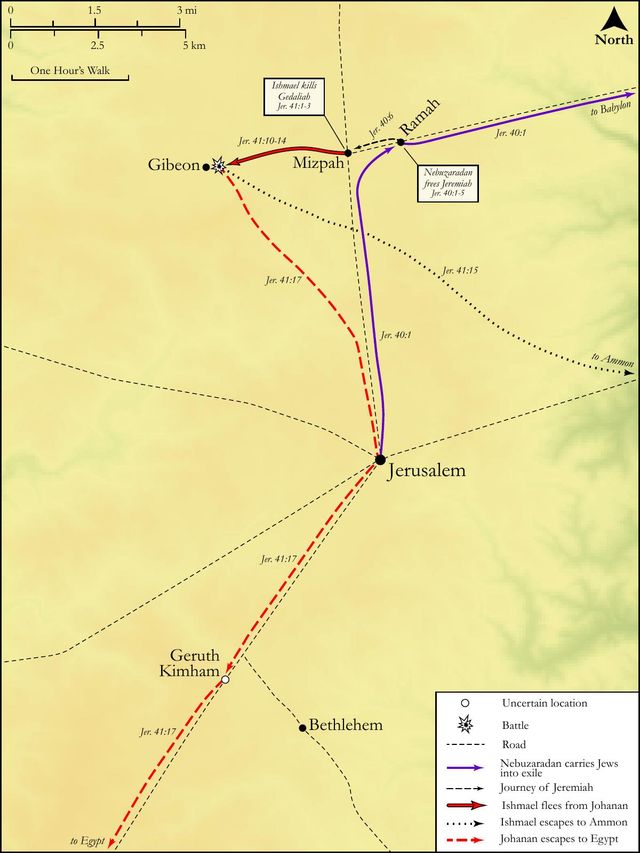
See on the biblical-era map
Study this verse
Public-domain commentary
Matthew Henry
From his Commentary on the Whole Bible. Henry comments on passages, not single verses — this entry covers Jeremiah 40:7–16. His three-level outline is real structure in the source text, so it is rendered as structure.
We have in these verses,
I.A bright sky opening upon the remnant of the Jews that were left in their own land, and a comfortable prospect given them of some peace and quietness after the many years of trouble and terror with which they had been afflicted. Jeremiah indeed had never in his prophecies spoken of any such good days reserved for the Jews immediately after the captivity; but Providence seemed to raise and encourage such an expectation, and it would be to that miserable people as life from the dead. Observe the particulars.
1.Gedaliah, one of themselves, is made governor in the land, by the king of Babylon, Jer 40:7. To show that he designed to make and keep them easy he did not give this commission to one of the princes of Babylon, but to one of their brethren, who, they might be sure, would seek their peace. He was the son of Ahikam, the son of Shaphan, one of the princes. We read of his father (Jer 26:24) that he took Jeremiah's part against the people. He seems to have been a man of great wisdom and a mild temper, and under whose government the few that were left might have been very happy. The king of Babylon had a good opinion of him and reposed a confidence in him, for to him he committed all that were left behind.
2.There is great resort to him from all parts, and all those that were now the Jews of the dispersion came and put themselves under his government and protection.
(1.)The great men that had escaped the Chaldeans by force came and quietly submitted to Gedaliah, for their own safety and common preservation. Several are here named, Jer 40:8. They came with their men, their servants, their soldiers, and so strengthened one another; and the king of Babylon had such a good opinion of Gedaliah his delegate that he was not at all jealous of the increase of their numbers, but rather pleased with it.
(2.)The poor men that had escaped by flight into the neighbouring countries of Moab, Ammon, and Edom, were induced by the love they bore to their own land to return to it again as soon as they heard that Gedaliah was in authority there, Jer 40:11, Jer 40:12. Canaan itself would be an unsafe unpleasant country if there were no government nor governors there, and those that loved it dearly would not come back to it till they heard there were. It would be a great reviving to those that were dispersed to come together again, to those that were dispersed into foreign countries to come together in their own country, to those that were under strange kings to be under a governor of their own nation. See here in wrath God remembered mercy, and yet admitted some of them upon a further trial of their obedience.
3.The model of this new government is drawn up and settled by an original contract, which Gedaliah confirmed with an oath, a solemn oath (Jer 40:9): He swore to them and to their men, it is probably according to the warrant and instructions he had received from the king of Babylon, who empowered him to give them these assurances.
(1.)They must own the property of their lands to be in the Chaldeans. "Come" (says Gedaliah), "fear not to serve the Chaldeans. Fear not the sin of it." Though the divine law had forbidden them to make leagues with the heathen, yet the divine sentence had obliged them to yield to the king of Babylon. "Fear not the reproach of it, and the disparagement it will be to your nation; it is what God has brought you to, has bound you to, and it is no disgrace to any to comply with him. Fear not the consequences of it, as if it would certainly make you and yours miserable; no, you will find the king of Babylon not so hard a landlord as you apprehend him to be; if you will but live peaceably, peaceably you shall live; disturb not the government, and it will not disturb you. Serve the king of Babylon and it shall be well with you." If they should make any difficulty of doing personal homage, or should be apprehensive of danger when the Chaldeans should come among them, Gedaliah, probably by instruction from the king of Babylon, undertakes upon all occasions to act for them, and make their application acceptable to the king (Jer 40:10): "As for me, behold, I will dwell at Mizpah, to serve the Chaldeans, to do homage to them in the name of the whole body if there be occasion, to receive orders, and to pay them their tribute when the come to us." All that passes between them and the Chaldeans shall pass through his hand; and, if the Chaldeans put such a confidence in him, surely his own countrymen may venture to do it. Gedaliah is willing thus to give them the assurance of an oath that he will do his part in protecting them, but, being apt to err (as many good men are) on the charitable side, he did not require an oath from them that they would be faithful to him, else the following mischief might have been prevented. However, protection draws allegiance though it be not sworn, and by joining in with Gedaliah they did, in effect, consent to the terms of government, that they should serve the king of Babylon. But,
(2.)Though they own the property of their lands to be in the Chaldeans, yet, upon that condition, they shall have the free enjoyment of them and all the profits of them (Jer 40:10): "Gather you wine and summer fruits, and take them for your own use; put them in your vessels, to be laid up for winter-store, as those do that live in a land of peace and hope to eat the labour of your hand, nay, the labour of other people's hands, for you reap what they sowed." Or perhaps they were the spontaneous products of that fertile soil, for which none had laboured. And accordingly we find (Jer 40:12) that they gathered wine and summer fruits very much, such as were at present upon the ground, for their corn-harvest was over some time before Jerusalem was taken. While Gedaliah was in care for the public safety he left them to enjoy the advantages of the public plenty, and, for aught that appears, demanded no tribute from them; for he sought not his own profit, but the profit of many.
II.Here is a dark cloud gathering over this infant state, and threatening a dreadful storm.
How soon is this hopeful prospect blasted! For when God begins in judgment he will make an end. It is here intimated to us,
1.That Baalis the king of the Ammonites had a particular spite at Gedaliah, and was contriving to take him off, either out of malice to the nation of the Jews, whose welfare he hated the thought of, or a personal pique against Gedaliah, Jer 40:14. Some make Baalis to signify the queen-mother of the king of the Ammonites, or queen-dowager, as if she were the first mover of the bloody and treacherous design. One would have thought this little remnant might be safe when the great king of Babylon protected it; and ye it is ruined by the artifices of this petty prince or princess. happy are those that have the King of kings of their side, who can take the wise in their own craftiness; for the greatest earthly king cannot with all his power secure us against fraud and treachery.
2.That he employed Ishmael, the son of Nethaniah, as the instrument of his malice, instigated him to murder Gedaliah, and, that he might have a fair opportunity to do it, directed him to go and enrol himself among his subjects and promise him fealty. Nothing could be more barbarous than the design itself, nor more base than the method of compassing it. How wretchedly is human nature corrupted and degenerated (even in those that pretend to the best blood) when it is capable of admitting the thought of such abominable wickedness! Ishmael was of the seed royal, and would therefore be easily tempted to envy and hate one that set up for a governor in Judah, who was not, as he was, of David's line, though he had ever so much of David's spirit.
3.That Johanan, a brisk and active man, having got scent of this plot, informed Gedaliah of it, yet taking it for granted he could not but know of it before, the proofs of the matter being so very plain: Dost thou certainly know? surely thou dost, Jer 40:14. He gave him private intelligence of it (Jer 40:15), hoping he would then take the more notice of it. He proffered his service to prevent it, by taking off Ishmael, whose very name was ominous to all the seed of Isaac: I will slay him. Wherefore should he slay thee? Herein he showed more courage and zeal than sense of justice; for, if it be lawful to kill for prevention, who then can be safe, since malice always suspects the worst?
4.That Gedaliah, being a man of sincerity himself, would by no means give credit to the information given him of Ishmael's treachery. He said, Thou speakest falsely of Ishmael. Herein he discovered more good humour than discretion, more of the innocency of the dove than the wisdom of the serpent. Princes become uneasy to themselves and all about them when they are jealous. Queen Elizabeth said that she would believe no more evil of her people than a mother would believe of her own children; yet many have been ruined by being over-confident of the fidelity of those about them.
Continue studying Jeremiah 40:8 across the web’s major study libraries — every link below opens this exact verse, chapter, or book on the destination site.
Read & Compare
 BibleGatewayThis verse in more than 200 translations and 70 languages.
 Bible.comThe YouVersion reader — hundreds of translations, reading plans, and highlights.
 ESV.orgCrossway's official English Standard Version reader.
 NET BibleThe NET translation with 60,000+ translators' notes on every rendering decision.
 STEP BibleTyndale House's free study tool — original text, vocabulary, and scholarly resources.
 BibliaLogos Bible Software's free web reader.
 USCCBThe New American Bible (Revised Edition) with the U.S. bishops' study notes.
Commentaries
 BibleHub CommentariesDozens of classic commentaries on this verse, gathered on one page.
 StudyLightMore than 100 commentary sets — the largest collection on the web.
 BibleRefPlain-English commentary on what this verse means, verse by verse.
 Enduring WordDavid Guzik's free commentary on this chapter, widely used by Bible teachers.
 Bible Study ToolsVerse commentary alongside Greek and Hebrew study aids.
Original Language & Research
- BibleHub InterlinearThe verse word by word — original language, transliteration, and English.
- BibleHub LexiconEvery word's original-language definition and Strong's entry.
 Blue Letter BibleDeep-study tools — Strong's numbers, concordance, and word studies.
 SefariaThe Hebrew text with Rashi and centuries of Jewish commentary.
Sermons, Hymns & Audio


TrulyRandomVerse is not affiliated with these sites and doesn’t control their content. They’re linked because they’re genuinely useful.
Summary
Jeremiah 40:8 records the crucial assembly of various Judean military captains and their contingents at Mizpah, where they presented themselves to Gedaliah, the newly appointed Babylonian governor over the remnant of Judah. This gathering signifies a pivotal, yet ultimately fragile, attempt to re-establish order and leadership among the survivors in the aftermath of Jerusalem's devastating fall, highlighting both the immediate need for governance and the complex loyalties at play in a conquered land.
Context
ShowHideLiterary Context
This verse immediately follows the harrowing account of Jerusalem's destruction and the subsequent appointment of Gedaliah by Nebuchadnezzar as governor over the remaining poor people in Judah, as detailed in Jeremiah 39 and Jeremiah 40:1-7. Jeremiah himself has just been released from chains and given the option to go to Babylon or stay with Gedaliah, choosing the latter. Jeremiah 40:8 carries forward the narrative of the post-exilic remnant's attempt to rebuild, setting the stage for the subsequent internal conflicts and ultimate dispersion that would plague Gedaliah's short-lived administration. It transitions the focus from the grand catastrophe of the nation's fall to the micro-level struggles of its survivors, highlighting the initial, albeit temporary, consolidation of power under a new, foreign-appointed authority.
Historical & Cultural Context
Historically, this period is immediately after the final Babylonian siege and destruction of Jerusalem in 586 BC, which marked the definitive end of the Kingdom of Judah and the beginning of the Babylonian exile for many of its inhabitants. Nebuchadnezzar's strategic policy was to remove the elite, the skilled, and the influential, leaving behind the poorest and least threatening to manage the desolate land. Gedaliah, a Judean nobleman from a family known to be sympathetic to Jeremiah and perhaps to Babylonian rule (his grandfather Shaphan was a scribe under Josiah, and his father Ahikam protected Jeremiah), was appointed to govern this remnant. Mizpah, a significant historical and religious site (e.g., Judges 20:1), became the administrative center, likely chosen for its strategic location and its lack of the painful associations of destroyed Jerusalem. The arrival of these military captains, who had likely scattered during the siege, reflects a common pattern in conquest where local leadership, often with mixed loyalties, would emerge or be appointed to maintain order under imperial oversight.
Key Themes
ShowHideThis verse contributes to several key themes within Jeremiah and the broader prophetic literature. Firstly, it underscores the theme of the remnant, a small portion of Israel preserved by God, even in judgment. The gathering at Mizpah represents this fragile continuation of God's people in the land, despite the devastating fulfillment of prophetic warnings (e.g., Jeremiah 25:8-11). Secondly, it highlights the theme of leadership in crisis, as Gedaliah attempts to govern a traumatized population under foreign dominion, a task fraught with immense challenges and internal treachery. The subsequent events (e.g., Jeremiah 41) reveal the profound difficulties of establishing peace and obedience to God's will in the face of human sin and political instability. Finally, it subtly introduces the theme of human agency and responsibility within divine judgment, as the choices made by these leaders—some for order, others for chaos—directly impact the fate of the remaining community and the unfolding of God's purposes.
Exposition and Analysis
ShowHideKey Word Analysis
ShowHideThis verb (H935) signifies "to go or come," but in this context, it carries the weight of a deliberate act of assembly or submission. It implies a conscious decision by these scattered military leaders to present themselves to Gedaliah, signaling an initial recognition of his authority and a desire to consolidate forces under the new, albeit imposed, order. Their "coming" suggests a move towards establishing a new, albeit fragile, social and political structure in the devastated land.
Derived from "Jah has become great" (H1436), this name is highly significant. Gedaliah was the son of Ahikam, a man who had previously protected Jeremiah (Jeremiah 26:24). His appointment by Babylon was likely seen as an attempt to establish a sympathetic, yet controlled, local administration. His name, "Jah has become great," stands in poignant contrast to the tragic end of his rule, highlighting the ultimate sovereignty of God even amidst human failure and the fleeting nature of human greatness.
Meaning "God will hear" (H3458), this name is ironically juxtaposed with the character's subsequent actions. Ishmael, the son of Nethaniah, appears here as one of the leaders coming to Gedaliah, seemingly in submission. However, he later becomes the primary antagonist, betraying and assassinating Gedaliah (Jeremiah 41:2). His presence from the outset subtly introduces a note of impending treachery and the internal threats that would undermine the fragile peace and the very survival of the remnant.
Verse Breakdown
ShowHide"Then they came to Gedaliah to Mizpah"
This initial clause establishes the central action and location. "They" refers to the various military captains and their men, indicating a deliberate movement towards the newly established administrative center under Gedaliah's authority. This signifies an initial, hopeful, yet ultimately ill-fated, attempt to consolidate power and establish order in the devastated land, recognizing Gedaliah as the legitimate, albeit Babylonian-appointed, leader.
"even Ishmael the son of Nethaniah, and Johanan and Jonathan the sons of Kareah, and Seraiah the son of Tanhumeth, and the sons of Ephai the Netophathite, and Jezaniah the son of a Maachathite"
This lengthy list provides a detailed roster of the key military leaders who gathered. Each name represents a distinct faction or family group, underscoring the fragmented nature of the surviving Judean leadership. The meticulous enumeration highlights the scope of the gathering and the diverse elements attempting to coalesce. The inclusion of Ishmael, who would later prove treacherously murderous, creates profound dramatic irony for the reader, foreshadowing the internal conflict that will soon erupt and shatter this fragile peace.
"they and their men"
This concluding phrase emphasizes that these were not just individuals but leaders accompanied by their respective contingents, signifying a substantial consolidation of military and social power around Gedaliah. It highlights the scale of the attempt to re-establish a functioning society and the inherent dangers of bringing together diverse groups, some with hidden agendas and conflicting loyalties, in a time of profound national trauma and vulnerability.
Literary Devices
ShowHideJeremiah 40:8 primarily employs a literary device known as Cataloging or Listing, where a series of names or items are enumerated. This detailed roster of military leaders—Ishmael, Johanan, Jonathan, Seraiah, the sons of Ephai, and Jezaniah—serves to establish the immediate cast of characters crucial to the unfolding narrative of the Judean remnant. The meticulous listing lends a sense of historical veracity and gravity to the moment, emphasizing the significance of this gathering as a pivotal attempt to re-establish order. Furthermore, the inclusion of Ishmael's name within this list, given his subsequent betrayal and assassination of Gedaliah (as detailed in Jeremiah 41), creates a powerful sense of Dramatic Irony. The reader, aware of future events, perceives the inherent danger and profound fragility of this assembly, even as the characters within the narrative are initially unaware of the impending treachery. This subtle foreshadowing heightens the tragic dimension of Gedaliah's brief and ill-fated governorship.
Theological and Thematic Connections
ShowHideThis verse, though seemingly a simple historical record of names, carries profound theological weight. It illustrates the immediate aftermath of divine judgment, where God, through Nebuchadnezzar, has brought about the prophesied destruction of Jerusalem and the exile. Yet, even in the midst of this devastation, God preserves a remnant in the land, demonstrating His faithfulness to His covenant promises, even if that remnant is small and vulnerable. The attempt to establish order under Gedaliah, though ultimately failed by human treachery, speaks to the enduring human need for leadership and community, and God's continued, albeit often hidden, work of preservation. It also foreshadows the internal struggles and spiritual blindness that would continue to plague Israel, even after experiencing such severe discipline, highlighting the persistent challenge of human sin and rebellion against divine will.
Reflection and Application
ShowHideJeremiah 40:8 serves as a poignant reminder that even in the wake of profound national or personal catastrophe, the human spirit often seeks to rebuild and find stability. The gathering at Mizpah, despite its tragic outcome, reflects an innate desire for order, community, and leadership. For us today, this passage encourages us to consider how we respond to moments of crisis and devastation, whether personal or communal. Do we seek to unite under wise and godly leadership, or do we allow internal divisions and hidden agendas to fester, leading to further fragmentation? The story of Gedaliah's short-lived administration is a cautionary tale about the fragility of peace when trust is broken and self-interest prevails over the common good. It challenges us to cultivate discernment, to be wary of those who appear to align but harbor destructive intentions, and to strive for genuine unity rooted in integrity, transparency, and a shared purpose that prioritizes the well-being of the whole community and obedience to God, especially within the church or any group seeking to serve God faithfully.
Questions for Reflection
ShowHideFAQ
ShowHideWho was Gedaliah and why was he appointed governor?
ShowHideGedaliah was the son of Ahikam, a prominent Judean nobleman whose family had a history of supporting the prophet Jeremiah. His grandfather, Shaphan, was a scribe under King Josiah, and his father, Ahikam, had previously protected Jeremiah from assassination (Jeremiah 26:24). Nebuchadnezzar, the Babylonian king, appointed Gedaliah as governor over the remaining Jewish population in Judah after the destruction of Jerusalem and the exile of the elite. This appointment was likely a strategic move by Babylon to establish a local, sympathetic administration that could maintain order and collect tribute without needing a large occupying force, trusting in Gedaliah's family's perceived loyalty or pragmatism towards Babylonian rule.
What was the significance of Mizpah as the gathering place?
ShowHideMizpah (H4708, Mitspeh), meaning "watchtower," was a historically significant site in Israel, often serving as a place of assembly, worship, and national decision-making (e.g., Judges 20:1, 1 Samuel 7:5-6). After Jerusalem's destruction, it became the new administrative center for the remnant. Its choice was likely practical—it was a fortified town that had not been destroyed like Jerusalem, and its central location made it accessible to the scattered survivors. Symbolically, it represented a new, albeit fragile, beginning for the Jewish presence in the land, a place where the scattered survivors could attempt to re-establish some form of national identity and governance under the shadow of Babylonian rule.
Why is Ishmael's presence in this verse particularly noteworthy?
ShowHideIshmael (H3458, Yishmâʻêʼl), meaning "God will hear," appears here among the captains who came to Gedaliah, seemingly in submission. However, his presence is highly significant due to his subsequent actions. The narrative immediately following this verse reveals his treacherous nature: he later assassinates Gedaliah and many others at Mizpah (Jeremiah 41:1-3), plunging the fragile remnant into further chaos and ultimately leading to their flight to Egypt against God's command. His inclusion in this list serves as a powerful dramatic foreshadowing, highlighting the internal threats and the deep-seated divisions that would ultimately undermine any hope of stability for the post-exilic community, despite the initial attempt at consolidation.
Christ-Centered Fulfillment
ShowHideJeremiah 40:8, depicting the gathering of a scattered remnant under a human governor, finds its ultimate fulfillment and transformation in the person and work of Jesus Christ. While Gedaliah's attempt to gather and lead the remnant ended in tragic failure due to human treachery, Jesus is the true and faithful Shepherd who perfectly gathers His people. He is the one who declares, "I am the good shepherd. The good shepherd lays down his life for the sheep," a stark contrast to the fate of Gedaliah, who was murdered by those he sought to govern. Just as the remnant in Judah sought a leader in a time of devastation, humanity, devastated by sin, longs for a true deliverer. Jesus, through His atoning sacrifice, gathers a new spiritual remnant, His church, from every nation, tribe, and tongue (Revelation 7:9). Unlike the temporary and flawed human leadership of Gedaliah, Christ's reign is eternal and perfectly just (Hebrews 7:24). He is the true "son" (H1121, bên) of God, the ultimate builder of God's spiritual family, who brings genuine peace and security to all who come to Him, establishing a kingdom that will never be destroyed (Daniel 2:44). The hope for a gathered people, tragically dashed at Mizpah, is gloriously realized in the unified body of Christ, where "there is neither Jew nor Gentile, neither slave nor free, nor is there male and female, for you are all one in Christ Jesus".