


Ezra 2:22
Bible text: King James Version (1769 Blayney text) · Public domain
Bible text: Berean Standard Bible · Public domain
Bible text: American Standard Version (1901) · Public domain
Bible text: World English Bible, Messianic edition · Public domain
Bible text: Geneva Bible (1599) · Public domain
Bible text: Young's Literal Translation · Public domain
- אַנְשֵׁי'an·Shei[the] men ofH582N-mpcNoun Plural Masculine Construct
- נְטֹפָהne·to·FahNetophahH5199N-properNoun Proper Location
- חֲמִשִּׁיםcha·mi·ShimfiftyH2572Adj-mpAdjective Numerical Plural Masculine Absolute
- וְשִׁשָּׁהve·shi·Shahand sixH8337Conj-w ¦ Adj-csAdjective Numerical Singular common gender Absoluteוְandשִׁשָּׁהsix
English is a literal word-by-word gloss of the Hebrew, not the KJV's wording. Why?
This is the original text the KJV's translators worked from — each Hebrew word with its own literal English meaning in this verse, prepared by scholars at Tyndale House, Cambridge. The KJV translates whole sentences, not word by word, so its wording differs: one Hebrew word can become several English words, and the KJV may choose “the LORD” where the gloss reads “Yahweh”. Both are faithful — they answer different questions. For the KJV's own rendering, switch to the KJV text.
Details
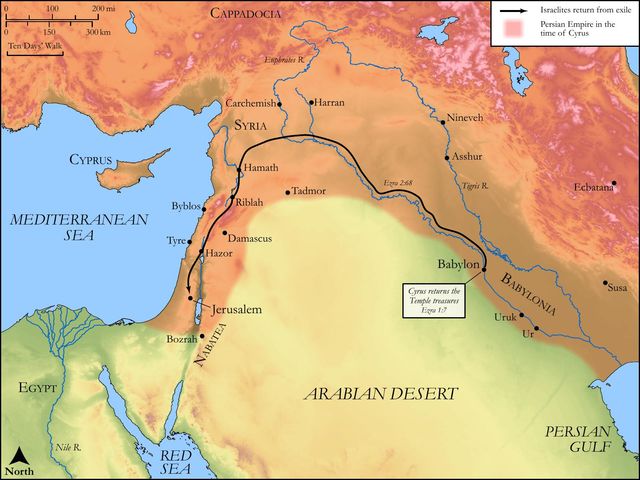
See on the biblical-era map
Study this verse
Public-domain commentary
Matthew Henry
From his Commentary on the Whole Bible. Henry comments on passages, not single verses — this entry covers Ezra 2:1–35.
We may observe here, 1. That an account was kept in writing of the families that came up out of captivity, and the numbers of each family. This was done for their honour, as part of their recompence for their faith and courage, their confidence in God and their affection to their own land, and to stir up others to follow their good example. Those that honour God he will thus honour. The names of all those Israelites indeed that accept the offer of deliverance by Christ shall be found, to their honour, in a more sacred record than this, even in the Lamb's book of life. The account that was kept of the families that came up from the captivity was intended also for the benefit of posterity, that they might know from whom they descended and to whom they were allied. 2. That they are called children of the province. Judah, which had been an illustrious kingdom, to which other kingdoms had been made provinces, subject to it and dependent on it, was now itself made a province, to receive laws and commissions from the king of Persia and to be accountable to him. See how sin diminishes and debases a nation, which righteousness would exalt. But by thus being made servants (as the patriarchs by being sojourners in a country which was theirs by promise) they were reminded of the better country, that is, the heavenly (Heb 11:16), a kingdom which cannot be moved, or changed into a province. 3. That they are said to come every one to his city, that is, the city appointed them, in which appointment an eye, no doubt, was had to their former settlement by Joshua; and to that, as near as might be, they returned: for it does not appear that any others, at least any that were able to oppose them, had possessed them in their absence. 4. That the leaders are first mentioned, v. 2. Zerubbabel and Jeshua were their Moses and Aaron, the former their chief prince, the latter their chief priest. Nehemiah and Mordecai are mentioned here; some think not the same with the famous men we afterwards meet with of those names: probably they were the same, but afterwards returned to court for the service of their country. 5. Some of these several families are named from the persons that were their ancestors, others from the places in which they had formerly resided; as with us many surnames are the proper names of persons, others of places. 6. Some little difference there is between the numbers of some of the families here and in Neh. 7, where this catalogue is repeated, which might arise from this, that some who had given in their names at first to come afterwards drew back - said, I go, Sir, but went not, which would lessen the number of the families they belonged to; others that declined, at first, afterwards repented and went, and so increased the number. 7. Here are two families that are called the children of Elam (one Ezr 2:7, another Ezr 2:31), and, which is strange, the number of both is the same, 1254. 8. The children of Adonikam, which signifies a high lord, were 666, just the number of the beast (Rev 13:18), which is there said to be the number of a man, which, Mr. Hugh Broughton thinks, has reference to this man. 9. The children of Bethlehem (Ezr 2:21) were but 123, though it was David's city; for Bethlehem was little among the thousands of Judah, yet there must the Messiah arise, Mic 5:2. 10. Anathoth had been a famous place in the tribe of Benjamin and yet here it numbered but 128 (v. 23), which is to be imputed to the divine curse which the men of Anathoth brought upon themselves by persecuting Jeremiah, who was of their city. Jer 11:21, Jer 11:23, There shall be no remnant of them, for I will bring evil upon the men of Anathoth. And see Isa 10:30, O poor Anathoth! Nothing brings ruin on a people sooner than persecution.
Continue studying Ezra 2:22 across the web’s major study libraries — every link below opens this exact verse, chapter, or book on the destination site.
Read & Compare
 BibleGatewayThis verse in more than 200 translations and 70 languages.
 Bible.comThe YouVersion reader — hundreds of translations, reading plans, and highlights.
 ESV.orgCrossway's official English Standard Version reader.
 NET BibleThe NET translation with 60,000+ translators' notes on every rendering decision.
 STEP BibleTyndale House's free study tool — original text, vocabulary, and scholarly resources.
 BibliaLogos Bible Software's free web reader.
 USCCBThe New American Bible (Revised Edition) with the U.S. bishops' study notes.
Commentaries
 BibleHub CommentariesDozens of classic commentaries on this verse, gathered on one page.
 StudyLightMore than 100 commentary sets — the largest collection on the web.
 BibleRefPlain-English commentary on what this verse means, verse by verse.
 Enduring WordDavid Guzik's free commentary on this chapter, widely used by Bible teachers.
 Bible Study ToolsVerse commentary alongside Greek and Hebrew study aids.
Original Language & Research
- BibleHub InterlinearThe verse word by word — original language, transliteration, and English.
- BibleHub LexiconEvery word's original-language definition and Strong's entry.
 Blue Letter BibleDeep-study tools — Strong's numbers, concordance, and word studies.
 SefariaThe Hebrew text with Rashi and centuries of Jewish commentary.
Sermons, Hymns & Audio


TrulyRandomVerse is not affiliated with these sites and doesn’t control their content. They’re linked because they’re genuinely useful.
Summary
Ezra 2:22 is a precise entry within a comprehensive census of Jewish exiles who returned to Judah from Babylonian captivity following King Cyrus's decree. This verse specifically records "The men of Netophah, fifty and six," detailing the number of adult males from the village of Netophah who participated in this pivotal first wave of repatriation. As part of a larger list, it underscores the meticulousness with which the post-exilic community documented its members, vital for re-establishing tribal identities, land claims, and the foundational structure of a restored nation under divine providence.
Context
ShowHideLiterary Context
Ezra 2:22 is situated within a lengthy and detailed register that comprises the entirety of Ezra 2. This chapter meticulously lists the families, groups, and individuals, along with their numbers, who returned to Jerusalem and Judah under the leadership of Zerubbabel and Jeshua. This census immediately follows the decree of King Cyrus mentioned in Ezra 1, which permitted the Jewish exiles to return and rebuild the Temple. The chapter functions as a foundational document, establishing the legitimate members of the returning community and setting the stage for the subsequent rebuilding efforts described in Ezra 3. The list's parallel in Nehemiah 7 further emphasizes its historical and administrative importance, serving as a vital record for the re-establishment of the Jewish commonwealth.
Historical & Cultural Context
The return described in Ezra 2 occurred around 538 BC, marking the end of the 70-year Babylonian exile prophesied by Jeremiah (Jeremiah 29:10). The exiles, descendants of those deported by Nebuchadnezzar, were now permitted to return to their ancestral lands. This was a monumental undertaking, involving a long and arduous journey from Babylon to Judah. Culturally, the meticulous recording of names, families, and numbers was paramount in ancient Israel. Lineage determined tribal affiliation, land ownership, and eligibility for priestly or Levitical service. For a community emerging from exile, accurately documenting who returned was crucial for re-establishing social order, legitimate claims to property, and the purity of religious offices. Netophah was a known village located south of Bethlehem in the territory of Judah, and its mention here indicates the re-settlement of specific ancestral lands.
Key Themes
ShowHideThis verse, as part of the larger census in Ezra 2, contributes to several overarching themes. Firstly, it powerfully illustrates Divine Faithfulness and Restoration. After decades of exile, God fulfills His promise to bring His people back to their land, demonstrating His unwavering covenant loyalty. Secondly, it highlights the profound importance of Identity and Lineage. The detailed enumeration of families and their origins underscores the significance of knowing one's heritage, not just for social structure but also for maintaining the distinct identity of God's chosen people. Thirdly, the meticulous nature of the record speaks to Order and Meticulousness in God's work and in the human response to it. Every individual and group is accounted for, signifying the careful planning and organization involved in the post-exilic restoration. Finally, the return of specific groups like "the men of Netophah" emphasizes the theme of Community Rebuilding, as these individuals formed the nucleus of the re-established society and contributed to the collective effort of restoring Jewish life and worship in Jerusalem and Judah.
Exposition and Analysis
ShowHideKey Word Analysis
ShowHideRefers to adult males, often implying mortality or humanity in general. In this census context, it specifically denotes the male heads of households or eligible males who were counted as part of the returning community. This term highlights the foundational demographic of the repatriated group, emphasizing those capable of contributing to the physical rebuilding and re-establishment of the nation. The inclusion of 'men' in the count underscores the practical, labor-oriented aspect of the restoration.
A specific village located in the territory of Judah, south of Bethlehem. The name itself, derived from a root meaning "to drip" or "distillation," might allude to its geographical features or agricultural produce. Its mention here is crucial, as it signifies the return not just to the general land of Judah, but to specific ancestral towns and regions. This detail underscores the re-establishment of local communities and the re-population of particular geographical areas, vital for the reassertion of Israelite presence and claims to the land.
This precise numerical count (56) of adult males from Netophah exemplifies the meticulous nature of the census. In Israel, such detailed lists were indispensable for administrative purposes, including land allocation, taxation, and military conscription. The exact number provides a verifiable record, lending historical credibility to the account and highlighting the tangible, measurable scale of the repatriation. This precision emphasizes the value placed on each individual and group in the process of rebuilding the nation and underscores the organized, divinely orchestrated return.
Verse Breakdown
ShowHide"The men of Netophah"
This phrase identifies a specific group of returnees by their geographical origin, linking them to a particular village or region within Judah. It signifies the importance of place and communal identity for the returning exiles, who were re-establishing their roots in the land. This indicates a return not just to the general land of Judah, but to specific ancestral towns and territories.
"fifty and six"
This numerical component provides the exact count of adult males from Netophah who participated in the return. It highlights the meticulous record-keeping of the scribes and leaders, emphasizing the verifiable and organized nature of the post-exilic community's re-establishment. The precision underscores the value placed on each individual and family in the process of rebuilding the nation.
Literary Devices
ShowHideEzra 2:22, as part of a larger census, primarily employs Enumeration, a literary device characterized by the detailed listing of items, names, or numbers. This meticulous counting serves to provide a comprehensive and verifiable record of the returning exiles. The entire chapter functions as a form of Documentation, serving as an official historical record that legitimizes the claims and identities of the post-exilic community. The Repetition of the formula "The men of [place], [number]" throughout the chapter creates a rhythmic, authoritative tone, reinforcing the thoroughness of the census. Furthermore, while seemingly dry, the very act of listing and numbering carries Symbolism of re-establishment, order, and the divine act of gathering a scattered people. It symbolizes the tangible reality of God's promise of restoration taking concrete form, person by person, community by community.
Theological and Thematic Connections
ShowHideEzra 2:22, though a seemingly mundane statistical entry, carries profound theological weight. It is a testament to God's meticulous faithfulness in fulfilling His promises to His people, bringing them back from exile as prophesied. The careful counting of each group, including the "fifty and six" from Netophah, underscores that God's plan is not vague but precise, involving every individual. This detail reflects God's intimate knowledge and care for each person, valuing their identity and their place within His larger redemptive narrative. It speaks to the importance of belonging to a community, a people called by God, and the tangible reality of God's restoration at a communal and individual level.
Reflection and Application
ShowHideThe detailed census in Ezra 2, including the specific mention of "the men of Netophah, fifty and six," offers a powerful reminder that God is a God of precision and purpose, who values every individual and every contribution, no matter how seemingly small. In a world that often feels chaotic or where individuals can feel lost in the crowd, this verse reassures us that God sees and knows each one of us by name. Just as these returnees were essential for rebuilding the physical nation and Temple, so too is every believer vital to the spiritual building of God's kingdom today. Our unique gifts, our specific callings, and our very presence are counted and valued by God. This passage encourages us to embrace our identity within the community of faith and to faithfully contribute to God's ongoing work of restoration and redemption in the world, trusting that He orchestrates every detail.
Questions for Reflection
ShowHideFAQ
ShowHideWhy is such a detailed list, like Ezra 2:22, included in the biblical text?
ShowHideThe inclusion of such a detailed list, specifying groups like "the men of Netophah, fifty and six," serves several crucial purposes. Historically, it provides a verifiable record of the first wave of returnees from Babylonian exile, underscoring the authenticity of the account. Culturally and administratively, these lists were vital for re-establishing tribal identities, confirming land ownership claims, and ensuring the purity of priestly and Levitical lineages upon their resettlement in Judah. Theologically, it demonstrates God's meticulous faithfulness in fulfilling His prophetic promises to restore His people, showing that His plan is precise and involves a tangible, countable remnant. It also highlights the importance of order and community in God's redemptive work.
Christ-Centered Fulfillment
ShowHideWhile Ezra 2:22 meticulously counts the physical descendants returning to a geographical land, it ultimately points forward to a greater, spiritual restoration centered in Christ. The "men of Netophah" were part of a remnant returning to rebuild a physical temple and nation, but Jesus Christ is the true Temple and the head of a new, spiritual Israel. In Christ, the meticulous counting shifts from physical lineage and geographical origin to a spiritual census of all who are "counted" as righteous by faith, regardless of their earthly background. Ephesians 2:19 declares that believers are no longer foreigners but "fellow citizens with God's people and members of God's household." The ultimate restoration is not merely to a land but to a relationship with God through Christ, where all who believe are brought into one new humanity (Ephesians 2:15). The precise number of returnees in Ezra foreshadows the countless multitude from every tribe, tongue, people, and nation who will stand before the throne of the Lamb, fulfilling God's ultimate purpose of gathering His people into His eternal kingdom, not by human enumeration, but by divine grace.