


2 Chronicles 34:21
- לְכוּle·KhugoH1980V-Qal-Imp-2mpVerb Qal Imperative 2nd Plural Masculine
- דִרְשׁוּdir·ShuconsultH1875V-Qal-Imp-2mpVerb Qal Imperative 2nd Plural Masculine
- אֶת'et<obj.>H853DirObjMParticle Object Indicator
- יְהוָהYah·wehYahwehH3068N-properNoun Proper Title
- בַּעֲדִיba·'a·Difor meH1157Adj-csc ¦ 1csAdjective Numerical Singular common gender Constructבַּעֲדִforיme
- וּבְעַדu·ve·'Adand forH1157Conj-w ¦ Adj-cscAdjective Numerical Singular common gender Constructוּandבְעַדfor
- הַנִּשְׁאָרha·nish·'Arthe remnantH7604Art ¦ V-Niphal-Prtcpl-msVerb Niphal Participle Singular Masculine Absoluteהַtheנִּשְׁאָרremnant
- בְּיִשְׂרָאֵלbe·Yis·ra·'Elamong IsraelH3478Prep-b ¦ N-properNoun Proper LocationבְּamongיִשְׂרָאֵלIsrael
- וּבִיהוּדָהu·vi·hu·Dahand among JudahH3063Conj-w ¦ Prep-b ¦ N-properNoun Proper LocationוּandבִamongיהוּדָהJudah
- עַל'alonH5921PrepPreposition
- דִּבְרֵיdiv·Rei[the] words ofH1697N-mpcNoun Plural Masculine Construct
- הַסֵּפֶרha·Se·ferthe scrollH5612Art ¦ N-msNoun Singular Masculine Absoluteהַtheסֵּפֶרscroll
- אֲשֶׁר'a·SherwhichH834RelParticle Relative
- נִמְצָאnim·Tza'it has been foundH4672V-Niphal-Perf-3msVerb Niphal Perfect 3rd Singular Masculine
- כִּיkiforH3588PrtParticle Conditional
- גְדוֹלָהge·do·Lah[is] greatH1419Adj-fsAdjective Singular Feminine Absolute
- חֲמַתcha·mat[the] anger ofH2534N-fscNoun Singular Feminine Construct
- יְהוָהYah·wehYahwehH3068N-properNoun Proper Title
- אֲשֶׁר'a·SherwhichH834RelParticle Relative
- נִתְּכָהni·te·Khahit has been poured outH5413V-Niphal-Perf-3fsVerb Niphal Perfect 3rd Singular Feminine
- בָנוּVa·nuon usPrep-b ¦ 1cpSuffix Personal 1st Plural common genderבָonנוּus
- עַל'alonH5921PrepPreposition
- אֲשֶׁר'a·SherthatH834RelParticle Relative
- לֹאlo'notH3808NegParticle Negative
- שָׁמְרוּsha·me·Ruthey took careH8104V-Qal-Perf-3cpVerb Qal Perfect 3rd Plural common gender
- אֲבוֹתֵינוּ'a·vo·Tei·nuour ancestorsH1N-fpc ¦ 1cpNoun Plural Feminine Constructאֲבוֹתֵיancestorsנוּour
- אֶת'et<obj.>H853DirObjMParticle Object Indicator
- דְּבַרde·Var[the] word ofH1697N-mscNoun Singular Masculine Construct
- יְהוָהYah·wehYahwehH3068N-properNoun Proper Title
- לַעֲשׂוֹתla·'a·Sotto observeH6213Prep-l ¦ V-Qal-InfVerb Qal Infinitive Constructלַtoעֲשׂוֹתobserve
- כְּכָלke·kholaccording to everyH3605Prep-k ¦ N-msNoun Singular Masculine Absoluteכְּaccording toכָלevery
- הַכָּתוּבha·ka·Tuv<the> [thing] writtenH3789Art ¦ V-Qal-PassPrtcpl-msVerb Qal Participle Passive Singular Masculine Absoluteהַ<the>כָּתוּב[thing] written
- עַל'alonH5921PrepPreposition
- הַסֵּפֶרha·Se·ferthe scrollH5612Art ¦ N-msNoun Singular Masculine Absoluteהַtheסֵּפֶרscroll
- הַזֶּהha·Zeh<the> thisH2088Art ¦ PrtParticle Demonstrativeהַ<the>זֶּהthis
English is a literal word-by-word gloss of the Hebrew, not the KJV's wording. Why?
This is the original text the KJV's translators worked from — each Hebrew word with its own literal English meaning in this verse, prepared by scholars at Tyndale House, Cambridge. The KJV translates whole sentences, not word by word, so its wording differs: one Hebrew word can become several English words, and the KJV may choose “the LORD” where the gloss reads “Yahweh”. Both are faithful — they answer different questions. For the KJV's own rendering, switch to the KJV text.
Details
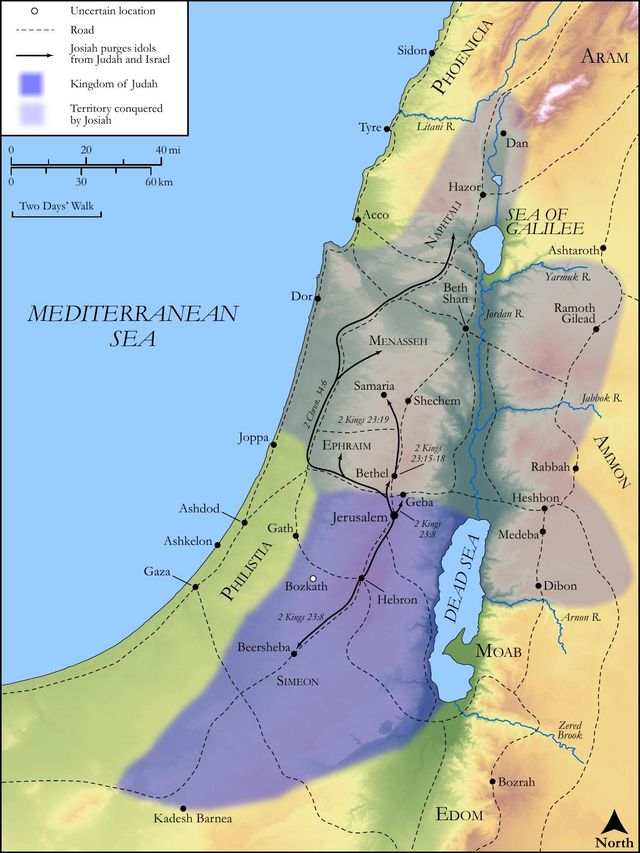
See on the biblical-era map
Study this verse
Public-domain commentary
Matthew Henry
From his Commentary on the Whole Bible. Henry comments on passages, not single verses — this entry covers 2 Chronicles 34:14–28.
This whole paragraph we had, just as it is here related, Kg2 22:8-20, and have nothing to add here to what was there observed. But, 1. We may hence take occasion to bless God that we have plenty of Bibles, and that they are, or may be, in all hands, - that the book of the law and gospel is not lost, is not scarce, - that, in this sense, the word of the Lord is not precious. Bibles are jewels, but, thanks be to God, they are not rarities. The fountain of the waters of life is not a spring shut up or a fountain sealed, but the streams of it, in all places, make glad the city of our God. Usus communis aquarum - These waters flow for general use. What a great deal shall we have to answer for if the great things of God's law, being thus made common, should be accounted by us as strange things! 2. We may hence learn, whenever we read or hear the word of God, to affect our hearts with it, and to get them possessed with a holy fear of that wrath of God which is there revealed against all ungodliness and unrighteousness of men, as Josiah's tender heart was. When he heard the words of the law he rent his clothes (Ch2 34:19), and God was well pleased with his doing so, Ch2 34:27. Were the things contained in the scripture new to us, as they were here to Josiah, surely they would make deeper impressions upon us than commonly they do; but they are not the less weighty, and therefore should not be the less considered by us, for their being well known. Rend the heart therefore, not the garments. 3. We are here directed when we are under convictions of sin, and apprehensions of divine wrath, to enquire of the Lord; so Josiah did, Ch2 34:21. It concerns us to ask (as they did, Act 2:37), Men and brethren, what shall we do? and more particularly (as the jailor), What must I do to be saved? Act 16:30. If you will thus enquire, enquire (Isa 21:12); and, blessed be God, we have the lively oracles to which to apply with these enquiries. 4. We are here warned of the ruin that sin brings upon nations and kingdoms. Those that forsake God bring evil upon themselves (Ch2 34:24, Ch2 34:25), and kindle a fire which shall not be quenched. Such will the fire of God's wrath be when the decree has gone forth against those that obstinately and impenitently persist in their wicked ways. 5. We are here encouraged to humble ourselves before God and seek unto him, as Josiah did. If we cannot prevail thereby to turn away God's wrath from our land, yet we shall deliver our own souls, Ch2 34:27, Ch2 34:28. And good people are here taught to be so far from fearing death as to welcome it rather when it takes them away from the evil to come. See how the property of it is altered by making it the matter of a promise: Thou shalt be gathered to thy grave in peace, housed in that ark, as Noah, when a deluge is coming.
Continue studying 2 Chronicles 34:21 across the web’s major study libraries — every link below opens this exact verse, chapter, or book on the destination site.
Read & Compare
 BibleGatewayThis verse in more than 200 translations and 70 languages.
 Bible.comThe YouVersion reader — hundreds of translations, reading plans, and highlights.
 ESV.orgCrossway's official English Standard Version reader.
 NET BibleThe NET translation with 60,000+ translators' notes on every rendering decision.
 STEP BibleTyndale House's free study tool — original text, vocabulary, and scholarly resources.
 BibliaLogos Bible Software's free web reader.
 USCCBThe New American Bible (Revised Edition) with the U.S. bishops' study notes.
Commentaries
 BibleHub CommentariesDozens of classic commentaries on this verse, gathered on one page.
 StudyLightMore than 100 commentary sets — the largest collection on the web.
 BibleRefPlain-English commentary on what this verse means, verse by verse.
 Enduring WordDavid Guzik's free commentary on this chapter, widely used by Bible teachers.
 Bible Study ToolsVerse commentary alongside Greek and Hebrew study aids.
Original Language & Research
- BibleHub InterlinearThe verse word by word — original language, transliteration, and English.
- BibleHub LexiconEvery word's original-language definition and Strong's entry.
 Blue Letter BibleDeep-study tools — Strong's numbers, concordance, and word studies.
 SefariaThe Hebrew text with Rashi and centuries of Jewish commentary.
Sermons, Hymns & Audio


TrulyRandomVerse is not affiliated with these sites and doesn’t control their content. They’re linked because they’re genuinely useful.
Summary
Upon the dramatic rediscovery of the Book of the Law, King Josiah, deeply convicted by the nation's long history of covenant disobedience, immediately sought divine counsel. Recognizing the severe implications of their ancestral and current sin, he acknowledged the "great wrath of the LORD" justly being poured out upon them due to their fathers' failure to keep God's commands as written in the sacred text. This urgent inquiry marked a pivotal moment in Judah's spiritual awakening, initiating comprehensive reforms and a renewed pursuit of God's will.
Context
ShowHideLiterary Context
This verse stands as King Josiah's urgent and profound response to the rediscovery of the "Book of the Law" during the extensive temple renovations he initiated. The narrative in 2 Chronicles 34 meticulously details Josiah's fervent commitment to purging idolatry from Judah and restoring the pure worship of Yahweh. The pivotal moment occurs in 2 Chronicles 34:14, where Hilkiah the priest finds the book. Upon hearing its contents read aloud, Josiah's immediate and dramatic reaction of tearing his clothes, as recorded in 2 Chronicles 34:19, powerfully signifies his deep repentance, distress, and recognition of the nation's grave sin. Verse 21 then captures his decisive command to his officials to "enquire of the LORD," setting in motion the consultation with Huldah the prophetess, detailed in 2 Chronicles 34:22, which confirms the impending judgment while also offering a promise of peace for Josiah due to his humble heart.
Historical & Cultural Context
Josiah's reign (640-609 BC) followed decades of profound spiritual apostasy under his grandfather Manasseh and father Amon, who had actively promoted pagan worship, including horrific practices like child sacrifice. This period saw the virtual disappearance of the Book of the Law from public knowledge and practice, leading to widespread ignorance of God's covenant requirements. The temple itself, neglected and defiled, served as a stark symbol of the nation's spiritual decay. The "Book of the Law" discovered was almost certainly a copy of Deuteronomy, or a substantial portion of the Pentateuch, which contained the foundational covenant stipulations, including detailed blessings for obedience and severe curses for disobedience (e.g., Deuteronomy 28). Josiah's actions reflect a deep understanding of the covenant relationship between God and Israel, where national prosperity and security were intrinsically linked to faithfulness to the Law. His concern for "them that are left in Israel and in Judah" underscores his desire for the spiritual welfare of all descendants of Jacob, even those from the northern kingdom who had been scattered.
Key Themes
ShowHideThis verse powerfully underscores several major theological and narrative themes within 2 Chronicles and the broader biblical narrative:
The Authority and Transformative Power of God's Word
The discovery of the Book of the Law was not merely an archaeological find; it was a divine revelation that brought profound conviction and initiated national change. Josiah's reaction, from tearing his clothes (2 Chronicles 34:19) to immediately seeking God's will, underscores the immense, transformative power of Scripture to expose sin, reveal God's righteous character, and call for radical repentance. This theme resonates throughout the biblical narrative, emphasizing that God's word is living and active (Hebrews 4:12).
National Sin and Divine Wrath
Josiah clearly understood that the nation's ancestors had failed to obey God's commands, leading to the "great wrath of the LORD" being poured out upon them. This emphasizes the serious consequences of covenant disobedience and the reality of God's righteous judgment. The concept of God's wrath is not capricious but a holy and just response to persistent rebellion and unfaithfulness, often detailed in covenant curses like those found in Deuteronomy 28:15-68.
Humility, Repentance, and Seeking God
Josiah's directive to "enquire of the LORD" demonstrates profound humility and a desperate desire for divine guidance for himself and the remaining people of Israel and Judah. This act of seeking God's face, acknowledging national sin, and pursuing repentance is a cornerstone of true spiritual revival, mirroring the call in 2 Chronicles 7:14.
Exposition and Analysis
ShowHideKey Word Analysis
ShowHideThis verb signifies a diligent, earnest seeking or searching, often implying a deep desire to understand God's will, involving prayer, meditation, and seeking prophetic counsel. Josiah's use of this word indicates not a casual curiosity but a desperate, urgent need for divine insight into the implications of the Law for the nation's present and future, reflecting a profound sense of responsibility and a desire for reconciliation with God.
Derived from a root meaning "heat," this term figuratively denotes intense anger, indignation, or fury. When applied to God, it describes His righteous and holy indignation against sin and rebellion. The "great" wrath signifies its severity and the cumulative nature of the nation's offenses, indicating a just and inevitable judgment as a consequence of their persistent unfaithfulness to the covenant.
This word refers to a written document, scroll, or volume. In this context, it specifically denotes the "Book of the Law," which Josiah recognized as the authoritative, divinely inspired word of God. Its discovery was not merely an archaeological find but a revelatory moment, bringing to light the forgotten covenant stipulations and exposing the nation's profound spiritual negligence and the resulting divine displeasure.
Verse Breakdown
ShowHide"Go, enquire of the LORD for me, and for them that are left in Israel and in Judah, concerning the words of the book that is found:"
This opening clause reveals Josiah's immediate, decisive, and comprehensive response to the rediscovered Law. His command is urgent ("Go") and encompasses not only his own spiritual state as king but also the entire remnant of God's people, acknowledging both the northern (Israel) and southern (Judah) kingdoms. The focus on understanding the "words of the book" underscores his recognition of its divine authority and the critical need to discern its implications for their lives and future, indicating a desire for national repentance and restoration.
"for great [is] the wrath of the LORD that is poured out upon us,"
Josiah's conviction here is palpable and deeply personal. He understands that the consequences of their disobedience are not theoretical but are already manifesting as God's "great wrath." The imagery of wrath being "poured out" suggests an overflowing, inescapable, and already active judgment, reflecting the severity of God's righteous anger against their unfaithfulness and covenant breaking. It conveys a sense of overwhelming, impending doom.
"because our fathers have not kept the word of the LORD, to do after all that is written in this book."
This final clause provides the explicit and devastating reason for God's wrath: the historical and ongoing disobedience of the nation's ancestors. It highlights a generational pattern of neglecting and failing to "keep" (obey, guard, observe) the divine commands. Josiah recognizes that the current generation is inheriting the dire consequences of this pervasive covenant breaking, underscoring the corporate responsibility and the cumulative weight of sin that has brought them to this critical juncture.
Literary Devices
ShowHideThe verse employs several powerful literary devices to convey its urgency, theological weight, and emotional impact. The immediate, imperative command "Go, enquire" conveys Urgency and highlights Josiah's decisive, repentant leadership in the face of crisis. The phrase "great is the wrath of the LORD that is poured out upon us" uses Hyperbole to emphasize the extreme severity and overwhelming nature of God's judgment, while the verb "poured out" functions as a vivid Metaphor for the abundant, inescapable, and active nature of this divine indignation, like a flood or torrent. Furthermore, the verse implicitly uses Contrast by juxtaposing Josiah's humble, obedient response with the long history of his "fathers" who "have not kept the word of the LORD," thereby highlighting the generational sin that has led to the current crisis. The "book that is found" serves as a potent Symbol of God's forgotten covenant, His enduring truth, and the divine standard against which Judah's actions are measured, bringing both conviction and the potential for renewal.
Theological and Thematic Connections
ShowHideThis pivotal verse encapsulates the profound theological truth that God's Word is living, active, and carries immense authority, capable of exposing sin and demanding a response. Josiah's reaction demonstrates the necessary humility and repentance required when confronted with divine truth. It underscores the biblical principle that covenant disobedience inevitably leads to divine judgment, not as an arbitrary act, but as a righteous consequence of breaking faith with a holy God. The "wrath of the LORD" is a consistent theme throughout Scripture, signifying God's just opposition to all unrighteousness and His commitment to upholding His covenant. Yet, Josiah's immediate act of seeking God's counsel also points to the hope of mercy and the possibility of averting or mitigating judgment through sincere repentance and a return to obedience, a theme beautifully articulated in prophetic calls for national repentance and divine grace.
Reflection and Application
ShowHideKing Josiah's response to the rediscovered Book of the Law serves as a timeless and powerful model for believers today. His profound conviction, immediate repentance, and urgent pursuit of God's will highlight the transformative power of Scripture in our lives. When we encounter God's Word, whether through personal reading, faithful preaching, or diligent study, it should not be treated as mere information but as a divine revelation that calls for a heartfelt response. Like Josiah, we must allow the Word to expose our sin, both individual and corporate, and lead us to humble repentance. This verse reminds us that there are real, often severe, consequences for neglecting God's commands, both in our personal lives and in the broader society. However, it also offers profound hope: genuine seeking of God, accompanied by sincere repentance, can lead to mercy, forgiveness, and a path toward spiritual renewal and revival. We are called to diligently "enquire of the LORD" through prayer, dedicated study, and seeking wise, godly counsel, trusting in His guidance even when confronted with uncomfortable truths about our own failings or the spiritual state of the world around us.
Questions for Reflection
ShowHideFAQ
ShowHideWhat was "the book that is found" that caused such a strong reaction?
ShowHideWhile the text does not explicitly name it, scholarly consensus suggests that "the book that is found" was most likely a copy of the Book of Deuteronomy, or at least a significant portion of the Pentateuch. Deuteronomy contains the core covenant stipulations, including detailed laws, blessings for obedience, and severe curses for disobedience (e.g., Deuteronomy 28). Its rediscovery would have brought to light the full extent of Israel's covenant obligations and the dire consequences of their long-standing unfaithfulness, which had been largely forgotten or ignored during generations of idolatry and spiritual decline.
Why did Josiah tear his clothes upon hearing the words of the book?
ShowHideTearing one's clothes was a deeply symbolic and culturally understood act in ancient Israel, signifying profound distress, grief, mourning, or repentance. For King Josiah, hearing the words of the Law and recognizing how far the nation, including his ancestors, had strayed from God's commands, produced overwhelming conviction. It was an outward manifestation of his inward anguish, humility, and immediate repentance in the face of God's holy requirements and the impending judgment. This act is also seen in other biblical figures, such as Job (Job 1:20) and the high priest Caiaphas, albeit for different reasons (Matthew 26:65).
Who was Huldah the prophetess, and why did Josiah send his officials to her?
ShowHideHuldah was a prophetess living in Jerusalem during Josiah's reign, as mentioned in 2 Chronicles 34:22. Josiah sent his officials to her to "enquire of the LORD" because she was recognized as a legitimate spokesperson for God, endowed with divine authority. In a time when male prophets like Jeremiah and Zephaniah were also active, Josiah's choice to consult Huldah demonstrates that God used both men and women to deliver His messages. Her confirmation of the words of the book and the impending judgment, along with a special word of grace for Josiah due to his humble heart, validated the divine authority of the discovered scroll and affirmed Josiah's righteous response.
Christ-Centered Fulfillment
ShowHideThe "great wrath of the LORD" that Josiah feared for his people, revealed by the rediscovered Law, finds its ultimate and most profound resolution in the person and redemptive work of Jesus Christ. The Law, while exposing the depth of Judah's sin and the just judgment it incurred, could not provide a remedy for that sin; rather, it served as a "tutor to bring us to Christ" (Galatians 3:24). The wrath that was "poured out upon us" due to ancestral and national disobedience was fully and perfectly absorbed by the Lamb of God on the cross. Jesus, the ultimate Son of David, did what no earthly king could: He bore the full weight of God's righteous indignation against sin, becoming a propitiation for our transgressions (Romans 3:25). Through His atoning sacrifice, those who believe are saved from the wrath to come (Romans 5:9). Furthermore, Josiah's desperate act of "enquiring of the LORD" foreshadows Christ as our ultimate High Priest and Intercessor, through whom we can confidently approach God's throne of grace (Hebrews 4:16). The "word of the LORD" that was found and brought conviction is ultimately fulfilled in Christ, who is the Living Word (John 1:1), embodying all that is written and bringing about the true and lasting spiritual transformation and reconciliation that Josiah longed for.