


2 Chronicles 34:22
Bible text: King James Version (1769 Blayney text) · Public domain
Bible text: King James Version with Strong's numbers · Public domain
Bible text: Berean Standard Bible · Public domain
Bible text: American Standard Version (1901) · Public domain
Bible text: World English Bible, Messianic edition · Public domain
Bible text: Geneva Bible (1599) · Public domain
Bible text: Young's Literal Translation · Public domain
- וַיֵּלֶךְvai·Ye·lekhand he wentH1980Conj-w ¦ V-Qal-ConsecImperf-3msVerb Qal Consecutive Imperfect 3rd Singular Masculineוַandיֵּלֶךְhe went
- חִלְקִיָּהוּchil·ki·Ya·huHilkiahH2518N-proper-mNoun Proper Masculine
- וַאֲשֶׁרva·'a·Sherand [those] whomH834Conj-w ¦ RelParticle Relativeוַandאֲשֶׁר[those] whom
- הַמֶּלֶךְha·Me·lekhthe kingH4428Art ¦ N-msNoun Singular Masculine Absoluteהַtheמֶּלֶךְking
- אֶל'eltoH413PrepPreposition
- חֻלְדָּהchul·DahHuldahH2468N-proper-fNoun Proper Feminine
- הַנְּבִיאָהha·ne·vi·'Ahthe prophetessH5031Art ¦ N-fsNoun Singular Feminine Absoluteהַtheנְּבִיאָהprophetess
- אֵשֶׁת'E·shet[the] wife ofH802N-fscNoun Singular Feminine Construct
- שַׁלֻּםsha·LumShallumH7967N-proper-mNoun Proper Masculine
- בֶּןben[the] son ofH1121N-mscNoun Singular Masculine Construct
- תָּקְהַתtok·hatTokhathH8616N-proper-mNoun Proper Masculine
- בֶּןben[the] son ofH1121N-mscNoun Singular Masculine Construct
- חַסְרָהchas·RahHasrahH2641N-proper-mNoun Proper Masculine
- שׁוֹמֵרsho·Mer[the] keeper ofH8104V-Qal-Prtcpl-msVerb Qal Participle Singular Masculine Construct
- הַבְּגָדִיםha·be·ga·Dimthe garmentsH899Art ¦ N-mpNoun Plural Masculine Absoluteהַtheבְּגָדִיםgarments
- וְהִיאve·Hi'and sheH1931Conj-w ¦ Pro-3fsPronoun Personal 3rd Singular Feminineוְandהִיאshe
- יוֹשֶׁבֶתyo·She·vet[was] dwellingH3427V-Qal-Prtcpl-fsVerb Qal Participle Singular Feminine Absolute
- בִּירוּשָׁלִַםbi·ru·sha·Limin JerusalemH3389Prep-b ¦ N-properNoun Proper LocationבִּinירוּשָׁלִַםJerusalem
- בַּמִּשְׁנֶהba·mish·Nehin the second districtH4932Prep-b ¦ N-msNoun Singular Masculine Absoluteבַּin theמִּשְׁנֶהsecond district
- וַיְדַבְּרוּvay·da·be·Ruand they spokeH1696Conj-w ¦ V-Piel-ConsecImperf-3mpVerb Piel Consecutive Imperfect 3rd Plural Masculineוַandיְדַבְּרוּthey spoke
- אֵלֶיהָ'e·Lei·hato herH413Prep ¦ 3fsPrepositionאֵלֶיtoהָher
- כָּזֹאתka·Zotlike thisH2063Prep-k ¦ PrtParticle Demonstrativeכָּlikeזֹאתthis
English is a literal word-by-word gloss of the Hebrew, not the KJV's wording. Why?
This is the original text the KJV's translators worked from — each Hebrew word with its own literal English meaning in this verse, prepared by scholars at Tyndale House, Cambridge. The KJV translates whole sentences, not word by word, so its wording differs: one Hebrew word can become several English words, and the KJV may choose “the LORD” where the gloss reads “Yahweh”. Both are faithful — they answer different questions. For the KJV's own rendering, switch to the KJV text.
Details
See on the biblical-era map
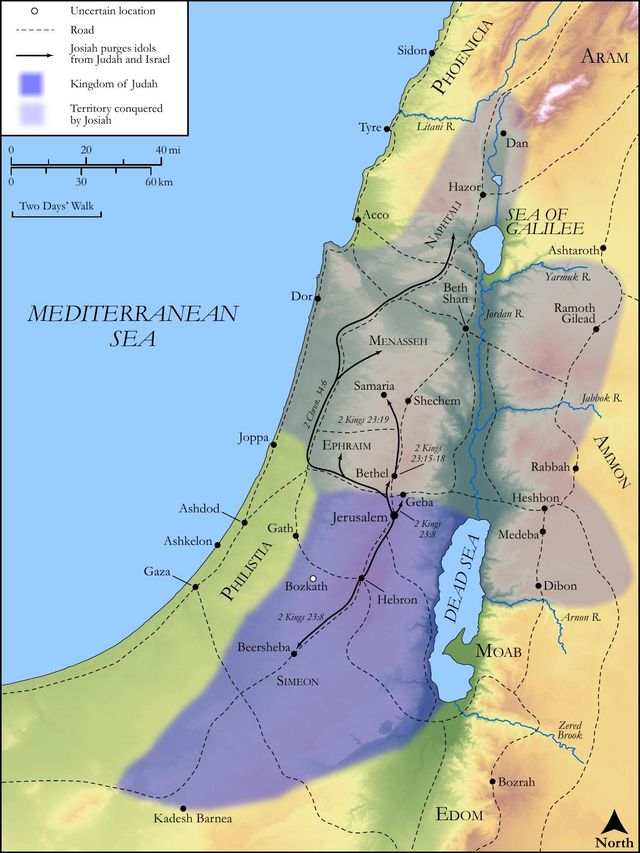
Study this verse
Public-domain commentary
Matthew Henry
From his Commentary on the Whole Bible. Henry comments on passages, not single verses — this entry covers 2 Chronicles 34:14–28.
This whole paragraph we had, just as it is here related, Kg2 22:8-20, and have nothing to add here to what was there observed. But, 1. We may hence take occasion to bless God that we have plenty of Bibles, and that they are, or may be, in all hands, - that the book of the law and gospel is not lost, is not scarce, - that, in this sense, the word of the Lord is not precious. Bibles are jewels, but, thanks be to God, they are not rarities. The fountain of the waters of life is not a spring shut up or a fountain sealed, but the streams of it, in all places, make glad the city of our God. Usus communis aquarum - These waters flow for general use. What a great deal shall we have to answer for if the great things of God's law, being thus made common, should be accounted by us as strange things! 2. We may hence learn, whenever we read or hear the word of God, to affect our hearts with it, and to get them possessed with a holy fear of that wrath of God which is there revealed against all ungodliness and unrighteousness of men, as Josiah's tender heart was. When he heard the words of the law he rent his clothes (Ch2 34:19), and God was well pleased with his doing so, Ch2 34:27. Were the things contained in the scripture new to us, as they were here to Josiah, surely they would make deeper impressions upon us than commonly they do; but they are not the less weighty, and therefore should not be the less considered by us, for their being well known. Rend the heart therefore, not the garments. 3. We are here directed when we are under convictions of sin, and apprehensions of divine wrath, to enquire of the Lord; so Josiah did, Ch2 34:21. It concerns us to ask (as they did, Act 2:37), Men and brethren, what shall we do? and more particularly (as the jailor), What must I do to be saved? Act 16:30. If you will thus enquire, enquire (Isa 21:12); and, blessed be God, we have the lively oracles to which to apply with these enquiries. 4. We are here warned of the ruin that sin brings upon nations and kingdoms. Those that forsake God bring evil upon themselves (Ch2 34:24, Ch2 34:25), and kindle a fire which shall not be quenched. Such will the fire of God's wrath be when the decree has gone forth against those that obstinately and impenitently persist in their wicked ways. 5. We are here encouraged to humble ourselves before God and seek unto him, as Josiah did. If we cannot prevail thereby to turn away God's wrath from our land, yet we shall deliver our own souls, Ch2 34:27, Ch2 34:28. And good people are here taught to be so far from fearing death as to welcome it rather when it takes them away from the evil to come. See how the property of it is altered by making it the matter of a promise: Thou shalt be gathered to thy grave in peace, housed in that ark, as Noah, when a deluge is coming.
Historical interpretation
Historical reception
1 surviving comment on this verse from the historical church.
It is written in the book of Days: “Hezekiah fell because his heart was lifted up.” Certainly, no one but the ungodly will deny that Hezekiah was a just man. You may say, “He sinned in certain things, and, therefore, he ceased to be just.” But Scripture does not say this. For he did not lose the title of just because he committed small sins, but he possessed the title of just because he performed many good deeds. Say all this to prove, with the testimonies of sacred Scripture, that the just are not sinners simply because they have sinned on occasions, but they remain just because they flourish in many virtues. Of Josiah it is written, “He did that which was right in the sight of the Lord, and walked in the way of David his father. He declined neither to the right nor to the left”; and yet, although he was a just man, in a time of need and dire necessity, he sent Hilkiah to Huldah, the prophet, the wife of Shallum, the son of Tokhath, the son of Hasrah, keeper of the wardrobe. “And she dwelled,” he says, “in Jerusalem in the second part” (a reference, undoubtedly, to that part of the city that is enclosed by an inner wall). “And she answered, ‘Thus says the Lord the God of Israel: Go and tell the man that sent you to me.’ ” There is contained in these words a secret reproof of the king and priests and all men, because never was there any saint found among people who could predict the future.
Continue studying 2 Chronicles 34:22 across the web’s major study libraries — every link below opens this exact verse, chapter, or book on the destination site.
Read & Compare
 BibleGatewayThis verse in more than 200 translations and 70 languages.
 Bible.comThe YouVersion reader — hundreds of translations, reading plans, and highlights.
 ESV.orgCrossway's official English Standard Version reader.
 NET BibleThe NET translation with 60,000+ translators' notes on every rendering decision.
 STEP BibleTyndale House's free study tool — original text, vocabulary, and scholarly resources.
 BibliaLogos Bible Software's free web reader.
 USCCBThe New American Bible (Revised Edition) with the U.S. bishops' study notes.
Commentaries
 BibleHub CommentariesDozens of classic commentaries on this verse, gathered on one page.
 StudyLightMore than 100 commentary sets — the largest collection on the web.
 BibleRefPlain-English commentary on what this verse means, verse by verse.
 Enduring WordDavid Guzik's free commentary on this chapter, widely used by Bible teachers.
 Bible Study ToolsVerse commentary alongside Greek and Hebrew study aids.
Original Language & Research
- BibleHub InterlinearThe verse word by word — original language, transliteration, and English.
- BibleHub LexiconEvery word's original-language definition and Strong's entry.
 Blue Letter BibleDeep-study tools — Strong's numbers, concordance, and word studies.
 SefariaThe Hebrew text with Rashi and centuries of Jewish commentary.
Sermons, Hymns & Audio


TrulyRandomVerse is not affiliated with these sites and doesn’t control their content. They’re linked because they’re genuinely useful.
Summary
Following the profound discovery of the Book of the Law during the Temple's restoration, King Josiah, deeply convicted by its pronouncements of judgment, dispatched a delegation of his most trusted officials—including High Priest Hilkiah—to seek divine counsel. This pivotal verse details their journey to Huldah the prophetess, a woman of recognized spiritual authority residing in Jerusalem's "second quarter," indicating the king's urgent and humble desire to ascertain the Lord's will concerning Judah's spiritual state and the implications of the rediscovered divine revelation.
Context
ShowHideLiterary Context
This verse is situated at a critical juncture in the narrative of King Josiah's sweeping religious reforms. Immediately preceding it, 2 Chronicles 34:14-18 describes the momentous discovery of the Book of the Law by Hilkiah the high priest during the Temple repairs. 2 Chronicles 34:19 then vividly portrays Josiah's profound reaction: tearing his clothes in grief and repentance upon hearing the Law's words, realizing the depth of Judah's apostasy and the impending divine wrath. His immediate response, as stated in 2 Chronicles 34:21, is to send Hilkiah and other high-ranking officials to "inquire of the Lord for me, and for them that are left in Israel and in Judah, concerning the words of the book that is found." This verse, 2 Chronicles 34:22, records the precise execution of that command, specifying the chosen prophetess and her location, setting the stage for the crucial divine pronouncement that follows in 2 Chronicles 34:23-28.
Historical & Cultural Context
King Josiah reigned from 640-609 BC, a period marked by the decline of the mighty Assyrian Empire, which had long exerted oppressive control over Judah. This decline created a crucial window of opportunity for Judah to reassert its independence and, more importantly, to return wholeheartedly to Yahwistic worship. Josiah, unlike many of his idolatrous predecessors (e.g., Manasseh in 2 Chronicles 33), was a righteous king who began his reforms early in his reign (2 Chronicles 34:3). The discovery of the Book of the Law (widely believed to be a significant portion of Deuteronomy) occurred in the eighteenth year of his reign, providing a definitive divine standard against which Judah's practices were measured. In ancient Israel, prophets and prophetesses served as direct conduits for God's word, offering guidance, rebuke, and comfort. The fact that Hilkiah and the king's men sought out Huldah, a woman, despite the presence of prominent male prophets like Jeremiah and Zephaniah at the time, underscores her recognized spiritual authority and the cultural acceptance of women in prophetic roles within Israelite society. Her dwelling "in the college" or "second quarter" of Jerusalem suggests she was a known and accessible figure, not operating in obscurity.
Key Themes
ShowHideThe verse significantly contributes to several overarching themes within 2 Chronicles and the broader Deuteronomistic history. Firstly, it highlights the theme of Seeking Divine Counsel, demonstrating Josiah's exemplary humility and wisdom in prioritizing God's word when faced with a national crisis. His immediate and urgent inquiry underscores the belief that true reform must be rooted in divine revelation and guidance. Secondly, it powerfully illustrates God's Sovereignty in Choosing His Messengers. The king's men went to Huldah the prophetess, and through her the LORD gave His word to Josiah. This echoes the broader biblical principle that God often uses the humble and overlooked to confound the wise (1 Corinthians 1:27). Thirdly, the entire episode, culminating in this consultation, reinforces the Authority and Transformative Power of God's Word. The rediscovered Law sparked a national spiritual awakening, and the delegation's visit to Huldah was to fully grasp its implications, demonstrating their reverence for divine revelation and their commitment to understanding and obeying God's commands, leading to widespread repentance and reform throughout Judah, as detailed in 2 Chronicles 34:29-33.
Exposition and Analysis
ShowHideKey Word Analysis
ShowHideFrom the Hebrew meaning "portion of Jah" or "my portion is Yahweh," Hilkiah was the high priest during Josiah's reign. His name itself is significant, reflecting a theological statement of trust in God. As high priest, he was responsible for the Temple and its sacred duties, including the discovery of the Book of the Law. His leading of the delegation to Huldah signifies the highest religious authority seeking divine counsel, underscoring the gravity of the situation and the recognized spiritual standing of Huldah.
This term denotes a female individual who speaks for God, serving as a divinely inspired messenger. Huldah's designation as a "prophetess" signifies her direct connection to the divine will and her recognized authority to deliver God's oracles. Her inclusion in this critical moment underscores the fact that God used both men and women to convey His messages in ancient Israel, as seen with Miriam (Exodus 15:20) and Deborah (Judges 4:4).
A primitive root meaning "to arrange" but used figuratively "to speak." In this context, it refers to the act of the delegation communicating their urgent inquiry to Huldah, seeking a divine pronouncement. This word emphasizes the verbal transmission of the king's concern and the expectation of a spoken word from God in response. It highlights the direct, personal nature of prophetic communication, where God's will is articulated through a human vessel.
Verse Breakdown
ShowHide"And Hilkiah, and they that the king had appointed, went to Huldah the prophetess"
This initial clause details the composition and destination of the royal delegation. Hilkiah, the high priest and discoverer of the Law, leads the group, accompanied by other high-ranking officials specifically appointed by King Josiah. Their journey to Huldah signifies the king's profound humility and earnest desire for divine guidance, prioritizing God's word above all else. The choice of Huldah, a prophetess, highlights God's sovereign choice of messengers.
"the wife of Shallum the son of Tikvath, the son of Hasrah, keeper of the wardrobe"
This parenthetical detail provides Huldah's lineage and her husband's occupation. Shallum's role as "keeper of the wardrobe" suggests a position of some responsibility within the royal administration, overseeing the royal vestments and perhaps treasures. This detail grounds Huldah within the social fabric of Jerusalem, indicating she was not an obscure or isolated figure, but part of a recognized household, further validating the delegation's choice to consult her and lending historical credibility to the narrative.
"(now she dwelt in Jerusalem in the college:) and they spake to her to that effect."
This final part clarifies Huldah's residence and the precise purpose of the visit. Her dwelling in "the college" (the "second quarter" or "second district" of Jerusalem) confirms her accessibility and known location within the capital. The phrase "to that effect" indicates that the delegation presented their urgent inquiry regarding the recently discovered Book of the Law and its implications for Judah, seeking a direct word from the Lord through her prophetic office concerning the impending judgment and the path to national repentance.
Literary Devices
ShowHideThe narrative of 2 Chronicles 34:22 employs several subtle literary devices that enrich its meaning. There is a notable element of Irony in the fact that amidst a time when prominent male prophets like Jeremiah and Zephaniah were active, it is Huldah, a relatively lesser-known prophetess, who is consulted by the highest authorities of the land. This subtly underscores God's freedom to use whomever He chooses, often confounding human expectations and societal norms. The detailed genealogical information about Huldah's husband, Shallum, "the son of Tikvath, the son of Hasrah, keeper of the wardrobe," serves as a form of Authentication, lending credibility and historical grounding to her identity and the legitimacy of the encounter. It roots the divine encounter in a concrete, verifiable human context, emphasizing the historical reality of the event. Furthermore, the very act of seeking a prophetic word after the discovery of the Law acts as a Catalyst within the narrative, setting in motion the full scope of Josiah's reforms and the national covenant renewal, highlighting the immediate and transformative power of divine revelation when humbly received.
Theological and Thematic Connections
ShowHideThe consultation with Huldah in 2 Chronicles 34:22 is a profound testament to the necessity of seeking divine counsel, especially when confronted with the gravity and implications of God's Word. Josiah's immediate and humble response to the rediscovered Law—sending a high-level delegation to inquire of the Lord—models a posture of genuine repentance and a deep reverence for God's authority. This event underscores that understanding and obeying God's commands requires not just intellectual apprehension but also spiritual discernment, often mediated through those gifted with prophetic insight. It also powerfully illustrates God's impartiality in choosing His messengers, demonstrating that His Spirit empowers individuals who are faithful vessels for His truth. The emphasis on Huldah's role reinforces the biblical precedent of women serving in significant spiritual capacities, reminding us that God's anointing is not bound by human conventions.
Reflection and Application
ShowHideThe account of Hilkiah and the king's officials seeking Huldah's counsel offers timeless lessons for believers today. When we encounter the truth of God's Word, particularly passages that expose our sin or highlight societal disobedience, our response should mirror Josiah's: one of profound humility, conviction, and an earnest desire to understand and align with God's will. This involves not only personal reflection and prayer but also, at times, seeking wise, Spirit-led counsel from trusted spiritual leaders within the community of faith. The fact that God used Huldah, a woman, as His mouthpiece reminds us that God is sovereign in His choice of messengers; we must be open to hearing His voice through diverse channels, recognizing that His truth transcends human expectations or biases. Our ultimate aim, like Josiah's, should be to fully grasp the implications of God's revelation and to commit ourselves wholeheartedly to obedience, leading to personal and communal transformation and revival.
Questions for Reflection
ShowHideFAQ
ShowHideWhy did Josiah send to Huldah the prophetess instead of Jeremiah or Zephaniah, who were also prophets at the time?
ShowHideThe biblical text does not explicitly state Josiah's reasoning, but several factors are commonly proposed. Firstly, Huldah's residence "in the college" (or "second quarter") of Jerusalem suggests she was readily accessible within the capital city, perhaps more so than Jeremiah, who was from Anathoth (a village outside Jerusalem), or Zephaniah, whose precise location is not specified. The urgency of the situation, spurred by Josiah's profound conviction after hearing the Book of the Law (2 Chronicles 34:19), likely necessitated a swift and reliable prophetic word. Secondly, Huldah may have been recognized as a prophetess of established authority and wisdom, particularly concerning matters of the Law, or perhaps she was known for her direct and immediate access to divine revelation. The Chronicler's emphasis on her consultation highlights God's freedom to use whomever He chooses, and underscores her recognized spiritual standing in the community at that specific moment of crisis.
Christ-Centered Fulfillment
ShowHideThe consultation with Huldah the prophetess, where the king's delegation sought a definitive word from God concerning the rediscovered Law, powerfully foreshadows the ultimate and perfect revelation of God in Jesus Christ. While Huldah served as a temporary conduit for God's message, Christ Himself is the very Word of God incarnate (John 1:1, John 1:14). The people of Judah, through Josiah, sought to understand the implications of the Law for their lives; similarly, humanity is called to come to Christ, who perfectly fulfills the Law (Matthew 5:17) and fully reveals the Father's will (Hebrews 1:1-3). Just as Huldah's prophecy brought clarity and a call to repentance and judgment, so too does Christ's life, death, and resurrection provide the ultimate clarity on God's justice and mercy, offering the path to true repentance and reconciliation with God (Acts 3:19). In Christ, we no longer need to send a delegation to a prophetess for a word, for He is the Living Word who dwells among us, accessible to all who seek Him in spirit and truth (John 4:24), and the ultimate source of divine wisdom and guidance for all generations.