


2 Chronicles 34:23
Bible text: King James Version (1769 Blayney text) · Public domain
Bible text: Berean Standard Bible · Public domain
Bible text: American Standard Version (1901) · Public domain
Bible text: World English Bible, Messianic edition · Public domain
Bible text: Geneva Bible (1599) · Public domain
Bible text: Young's Literal Translation · Public domain
- וַתֹּאמֶרva·To·merand she saidH559Conj-w ¦ V-Qal-ConsecImperf-3fsVerb Qal Consecutive Imperfect 3rd Singular Feminineוַandתֹּאמֶרshe said
- לָהֶםla·Hemto themPrep-l ¦ 3mpSuffix Personal 3rd Plural Masculineלָtoהֶםthem
- כֹּהkohthusH3541AdvAdverb
- אָמַר'a·Marhe saysH559V-Qal-Perf-3msVerb Qal Perfect 3rd Singular Masculine
- יְהוָהYah·wehYahwehH3068N-properNoun Proper Title
- אֱלֹהֵי'e·lo·Hei[the] God ofH430N-mpcNoun Plural Masculine Construct
- יִשְׂרָאֵלYis·ra·'ElIsraelH3478N-properNoun Proper Location
- אִמְרוּ'im·RusayH559V-Qal-Imp-2mpVerb Qal Imperative 2nd Plural Masculine
- לָאִישׁla·'Ishto the manH376Prep-l ¦ N-msNoun Singular Masculine Absoluteלָto theאִישׁman
- אֲשֶׁר'a·SherwhoH834RelParticle Relative
- שָׁלַחsha·Lachhe sentH7971V-Qal-Perf-3msVerb Qal Perfect 3rd Singular Masculine
- אֶתְכֶם'et·Khem<obj.> youH853DirObjM ¦ 2mpParticle Object Indicatorאֶתְ<obj.>כֶםyou
- אֵלָי'e·Laito meH413Prep ¦ 1csPreposition Definiteאֵלָtoיme
English is a literal word-by-word gloss of the Hebrew, not the KJV's wording. Why?
This is the original text the KJV's translators worked from — each Hebrew word with its own literal English meaning in this verse, prepared by scholars at Tyndale House, Cambridge. The KJV translates whole sentences, not word by word, so its wording differs: one Hebrew word can become several English words, and the KJV may choose “the LORD” where the gloss reads “Yahweh”. Both are faithful — they answer different questions. For the KJV's own rendering, switch to the KJV text.
Details
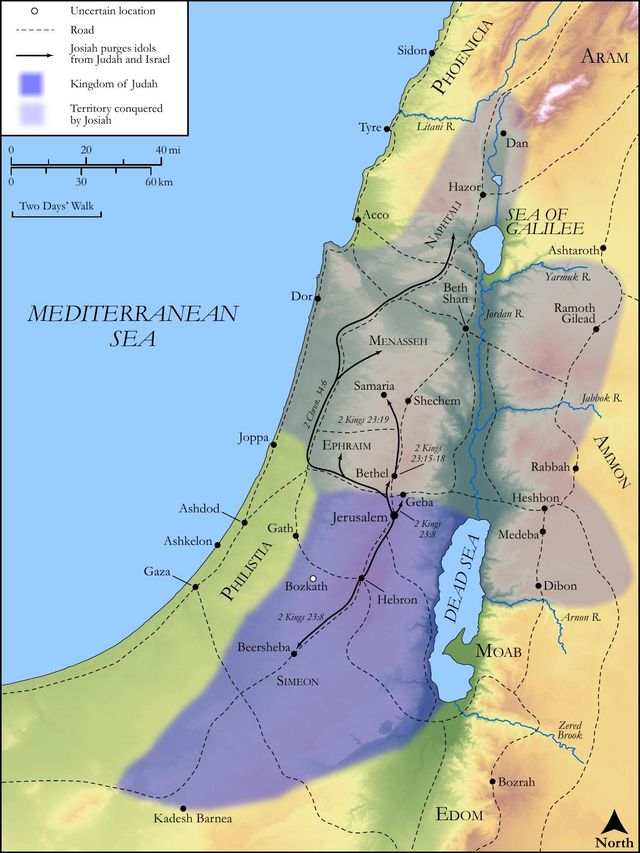
See on the biblical-era map
Study this verse
Public-domain commentary
Matthew Henry
From his Commentary on the Whole Bible. Henry comments on passages, not single verses — this entry covers 2 Chronicles 34:14–28.
This whole paragraph we had, just as it is here related, Kg2 22:8-20, and have nothing to add here to what was there observed. But, 1. We may hence take occasion to bless God that we have plenty of Bibles, and that they are, or may be, in all hands, - that the book of the law and gospel is not lost, is not scarce, - that, in this sense, the word of the Lord is not precious. Bibles are jewels, but, thanks be to God, they are not rarities. The fountain of the waters of life is not a spring shut up or a fountain sealed, but the streams of it, in all places, make glad the city of our God. Usus communis aquarum - These waters flow for general use. What a great deal shall we have to answer for if the great things of God's law, being thus made common, should be accounted by us as strange things! 2. We may hence learn, whenever we read or hear the word of God, to affect our hearts with it, and to get them possessed with a holy fear of that wrath of God which is there revealed against all ungodliness and unrighteousness of men, as Josiah's tender heart was. When he heard the words of the law he rent his clothes (Ch2 34:19), and God was well pleased with his doing so, Ch2 34:27. Were the things contained in the scripture new to us, as they were here to Josiah, surely they would make deeper impressions upon us than commonly they do; but they are not the less weighty, and therefore should not be the less considered by us, for their being well known. Rend the heart therefore, not the garments. 3. We are here directed when we are under convictions of sin, and apprehensions of divine wrath, to enquire of the Lord; so Josiah did, Ch2 34:21. It concerns us to ask (as they did, Act 2:37), Men and brethren, what shall we do? and more particularly (as the jailor), What must I do to be saved? Act 16:30. If you will thus enquire, enquire (Isa 21:12); and, blessed be God, we have the lively oracles to which to apply with these enquiries. 4. We are here warned of the ruin that sin brings upon nations and kingdoms. Those that forsake God bring evil upon themselves (Ch2 34:24, Ch2 34:25), and kindle a fire which shall not be quenched. Such will the fire of God's wrath be when the decree has gone forth against those that obstinately and impenitently persist in their wicked ways. 5. We are here encouraged to humble ourselves before God and seek unto him, as Josiah did. If we cannot prevail thereby to turn away God's wrath from our land, yet we shall deliver our own souls, Ch2 34:27, Ch2 34:28. And good people are here taught to be so far from fearing death as to welcome it rather when it takes them away from the evil to come. See how the property of it is altered by making it the matter of a promise: Thou shalt be gathered to thy grave in peace, housed in that ark, as Noah, when a deluge is coming.
Historical interpretation
Historical reception
1 surviving comment on this verse from the historical church.
It is written in the book of Days: “Hezekiah fell because his heart was lifted up.” Certainly, no one but the ungodly will deny that Hezekiah was a just man. You may say, “He sinned in certain things, and, therefore, he ceased to be just.” But Scripture does not say this. For he did not lose the title of just because he committed small sins, but he possessed the title of just because he performed many good deeds. Say all this to prove, with the testimonies of sacred Scripture, that the just are not sinners simply because they have sinned on occasions, but they remain just because they flourish in many virtues. Of Josiah it is written, “He did that which was right in the sight of the Lord, and walked in the way of David his father. He declined neither to the right nor to the left”; and yet, although he was a just man, in a time of need and dire necessity, he sent Hilkiah to Huldah, the prophet, the wife of Shallum, the son of Tokhath, the son of Hasrah, keeper of the wardrobe. “And she dwelled,” he says, “in Jerusalem in the second part” (a reference, undoubtedly, to that part of the city that is enclosed by an inner wall). “And she answered, ‘Thus says the Lord the God of Israel: Go and tell the man that sent you to me.’ ” There is contained in these words a secret reproof of the king and priests and all men, because never was there any saint found among people who could predict the future.
Continue studying 2 Chronicles 34:23 across the web’s major study libraries — every link below opens this exact verse, chapter, or book on the destination site.
Read & Compare
 BibleGatewayThis verse in more than 200 translations and 70 languages.
 Bible.comThe YouVersion reader — hundreds of translations, reading plans, and highlights.
 ESV.orgCrossway's official English Standard Version reader.
 NET BibleThe NET translation with 60,000+ translators' notes on every rendering decision.
 STEP BibleTyndale House's free study tool — original text, vocabulary, and scholarly resources.
 BibliaLogos Bible Software's free web reader.
 USCCBThe New American Bible (Revised Edition) with the U.S. bishops' study notes.
Commentaries
 BibleHub CommentariesDozens of classic commentaries on this verse, gathered on one page.
 StudyLightMore than 100 commentary sets — the largest collection on the web.
 BibleRefPlain-English commentary on what this verse means, verse by verse.
 Enduring WordDavid Guzik's free commentary on this chapter, widely used by Bible teachers.
 Bible Study ToolsVerse commentary alongside Greek and Hebrew study aids.
Original Language & Research
- BibleHub InterlinearThe verse word by word — original language, transliteration, and English.
- BibleHub LexiconEvery word's original-language definition and Strong's entry.
 Blue Letter BibleDeep-study tools — Strong's numbers, concordance, and word studies.
 SefariaThe Hebrew text with Rashi and centuries of Jewish commentary.
Sermons, Hymns & Audio


TrulyRandomVerse is not affiliated with these sites and doesn’t control their content. They’re linked because they’re genuinely useful.
Summary
2 Chronicles 34:23 captures the immediate and authoritative divine response delivered by Huldah the prophetess to King Josiah's delegation. This pivotal verse unequivocally declares her subsequent message to be a direct revelation from "the LORD God of Israel," thereby establishing the divine origin and infallible truth of the prophecy. It powerfully underscores God's active responsiveness to sincere inquiry and the crucial role of His chosen messengers in guiding His people during times of national crisis and spiritual renewal.
Context
ShowHideLiterary Context
This verse is intricately woven into the narrative of King Josiah's righteous reign, immediately following his profound encounter with the newly rediscovered Book of the Law. Earlier in 2 Chronicles 34, Josiah, demonstrating remarkable piety from a young age, initiated comprehensive reforms to purge idolatry from Judah and meticulously repair the Temple, as detailed in 2 Chronicles 34:3-7. During these renovations, Hilkiah the high priest made the momentous discovery of "the Book of the Law of the LORD given by Moses" (2 Chronicles 34:14). Upon hearing its words, particularly the severe curses pronounced against disobedience, Josiah was overcome with conviction, tearing his clothes and humbling himself before God (2 Chronicles 34:19). In his distress and earnest desire to understand God's will for himself and the nation, he dispatched a high-level delegation to inquire of the LORD. This verse marks the precise commencement of Huldah's divinely inspired prophecy, which directly addresses Josiah's deep repentance and the nation's impending judgment.
Historical & Cultural Context
Josiah reigned in Judah during a period of significant geopolitical upheaval, as the once-dominant Assyrian Empire was in rapid decline, creating a strategic window of opportunity for Judah to reassert its religious and political independence. The discovery of the Book of the Law—widely believed by scholars to be a form of Deuteronomy—was a monumental event, as it brought the covenant stipulations, blessings, and curses back into sharp focus after generations of neglect and pervasive idolatry. In ancient Israel, prophets and prophetesses served as God's direct spokespersons, delivering divine messages to kings and the populace. Huldah's prominent role, being consulted by the king's top officials (including the high priest and royal secretary), shows the standing she had as one through whom the word of the LORD was sought. Her residence "in the college" (or "second quarter") of Jerusalem further suggests her recognized status and integration within the prophetic community of her time.
Key Themes
ShowHideThis verse profoundly contributes to several overarching themes within 2 Chronicles and the broader biblical narrative. Firstly, it underscores Divine Authority and Revelation, as Huldah's opening declaration, "Thus saith the LORD God of Israel," unequivocally establishes the source of her message as God Himself, not human wisdom or political expediency. This highlights the absolute necessity of divine truth for guiding human affairs and the nation's destiny, echoing principles found in Deuteronomy 18:18-22. Secondly, it exemplifies God's Responsiveness to Sincere Inquiry and Repentance. Josiah's deep humility and earnest seeking of God's will, prompted by the Law's revelation, directly led to this divine communication. God demonstrates His readiness to engage with those who genuinely turn to Him in contrition, as vividly seen in Josiah's response to the Law in 2 Chronicles 34:19. Finally, the verse illuminates The Enduring Role of the Prophet/Prophetess as a vital conduit for God's word. Huldah, though perhaps less famous than other prophets like Jeremiah or Isaiah, was sovereignly chosen by God for this critical moment, demonstrating God's freedom in selecting His messengers and the vital importance of heeding prophetic counsel, even in the presence of the written Law, a theme also explored in Amos 3:7.
Exposition and Analysis
ShowHideKey Word Analysis
ShowHideThis is the sacred, covenantal name of God, often rendered "LORD" (in all caps) in English translations. Derived from the verb "to be," it signifies God's self-existence, eternal nature, and His personal, relational commitment to His people, Israel. Its use here emphasizes that the message originates from the God who has bound Himself to Israel through covenant, and whose character is consistent with His revealed will in the Law.
This is the generic Hebrew term for God, often used in a plural form but with a singular meaning when referring to the one true God. It emphasizes God's power, sovereignty, and creative might. When combined with "Yᵉhôvâh," as "the LORD God," it forms a powerful and comprehensive title that underscores both God's covenant faithfulness and His universal dominion, particularly in relation to His chosen nation.
This primitive root verb signifies "to say" or "to speak" with broad application, encompassing answering, declaring, commanding, and reporting. In the context of "Thus saith the LORD," it functions as a definitive declaration of divine utterance. Its presence here unequivocally establishes Huldah not as offering her own opinion, but as directly relaying the very words of God, stamping the message with absolute authority and infallibility.
Verse Breakdown
ShowHide"And she answered them,"
This opening clause immediately establishes Huldah's direct and deliberate engagement with the delegation sent by King Josiah. It signifies that her response is not a spontaneous or personal opinion, but a divinely-prompted answer to a specific, earnest inquiry from the highest authority in the land. The delegation's act of seeking a prophetess underscores their understanding that God's will needed to be discerned through a recognized spiritual authority.
"Thus saith the LORD God of Israel,"
This is the quintessential prophetic formula, known as a "messenger formula." It serves as an unequivocal declaration that the words which follow are not Huldah's own insights or interpretations, but a direct, verbatim message from the Almighty God. The full title "the LORD God of Israel" powerfully emphasizes both God's covenant relationship with His people (Yᵉhôvâh) and His universal sovereignty and might (ʼĕlôhîym), specifically in relation to the nation of Israel. This formula stamps the message with absolute divine authority and infallibility, demanding the delegation's and Josiah's full attention and obedience.
"Tell ye the man that sent you to me,"
This clear directive specifies the precise recipient of the divine message: King Josiah. The phrasing "the man that sent you to me" is a formal and respectful way of referring to the king, maintaining a proper distance while clearly identifying the intended audience. It highlights that Huldah is merely the divinely appointed conduit; the message is from God, through her, directly to Josiah, addressing his specific inquiry regarding the newly discovered Book of the Law and its profound implications for himself and the nation.
Literary Devices
ShowHideThe primary literary device powerfully employed in 2 Chronicles 34:23 is Formulaic Language, specifically the Prophetic Messenger Formula ("Thus saith the LORD God of Israel"). This established and highly recognizable phrase functions as a potent Authoritative Declaration, immediately signaling to the audience that the subsequent words are not human counsel or wisdom but rather direct, unadulterated divine revelation. It acts as a crucial literary marker, clearly distinguishing God's direct speech from the surrounding narrative or human dialogue. This formula lends immense weight, solemnity, and unquestionable credibility to Huldah's words, underscoring the absolute truth and binding nature of the prophecy she is about to deliver. Furthermore, the verse employs Direct Address, as God, through Huldah, directly speaks to "the man that sent you to me," thereby creating an immediate, personal, and impactful connection between the divine message and King Josiah's earnest inquiry.
Theological and Thematic Connections
ShowHide2 Chronicles 34:23 profoundly illustrates God's active and personal engagement with humanity, particularly in response to sincere seeking and genuine repentance. It affirms that God is not silent or distant but desires to communicate His will, especially when His people are in crisis, seeking direction, or facing the consequences of disobedience. The verse highlights the enduring principle that divine revelation, whether delivered through prophets or, preeminently, through the inspired Scriptures, is the authoritative and infallible guide for individual life and national destiny. Josiah's profound humility in seeking God's word, even through a prophetess, underscores the importance of a contrite and receptive spirit as a prerequisite for hearing and obeying God. This pivotal moment is a powerful testament to God's unwavering faithfulness to His covenant, even in the face of widespread national apostasy, demonstrating His readiness to extend grace, guidance, and a pathway to restoration to those who genuinely turn back to Him.
Reflection and Application
ShowHideThe scene depicted in 2 Chronicles 34:23 offers profound and enduring lessons for contemporary believers. Like King Josiah, we are often confronted with the profound and convicting truth of God's Word, which can expose our sin, highlight our shortcomings, and reveal our distance from His perfect will. Our response should mirror Josiah's: not despair, but humble repentance and an earnest, diligent desire to understand and obey. This verse powerfully reminds us that God is always willing to speak to those who genuinely seek Him with a contrite heart. While we no longer seek prophets in the same way, God's authoritative voice is supremely and infallibly found in the Bible, His inspired and inerrant Word, which remains our primary and sufficient source of divine guidance, correction, and instruction for righteousness. We are called to diligently study it, allowing its truth to convict and transform us, and then humbly inquire of the Lord through prayer and the wisdom of godly counsel, trusting that He will illuminate our path and reveal His sovereign purposes for our lives.
Questions for Reflection
ShowHideFAQ
ShowHideWho was Huldah, and why was she chosen to deliver this crucial message to King Josiah?
ShowHideHuldah was a prophetess living in Jerusalem during the reign of King Josiah, specifically residing "in the college" or "second quarter" of the city. While perhaps less widely known in biblical history than figures like Jeremiah or Isaiah, her inclusion in this pivotal narrative underscores her significant standing and divine anointing. She was chosen because she was a recognized and respected conduit for God's word, known for her faithfulness and accurate prophecy. The high-level delegation, which included the high priest Hilkiah and the royal secretary Shaphan, sought her out specifically to "inqure of the LORD" (2 Chronicles 34:21) regarding the newly discovered Book of the Law and its implications. Her selection powerfully demonstrates God's sovereignty and freedom in choosing His messengers, emphasizing that divine authority rests solely on God's call and anointing, not human status or convention.
What is the profound significance of the phrase "Thus saith the LORD God of Israel"?
ShowHideThe phrase, "Thus saith the LORD God of Israel," is a classic and profoundly significant "messenger formula" used throughout the Old Testament by prophets. Its significance is multifaceted: Firstly, it unequivocally declares the divine origin of the message, leaving no doubt that the words are God's own, not the prophet's personal opinion, interpretation, or human wisdom. Secondly, it establishes the absolute authority and infallibility of the message, demanding immediate and reverent attention and obedience from the audience. Thirdly, the specific title "the LORD God of Israel" emphasizes God's unique covenant relationship with His people (Yᵉhôvâh, the LORD) and His supreme sovereignty and power (ʼĕlôhîym, God) over them, reminding both the prophet and the audience of the specific covenant obligations, promises, and consequences that are at stake. It functions as a divine seal, authenticating the prophecy as direct, inerrant revelation from the Almighty. This formula is a hallmark of true prophecy, differentiating it from human speculation or false claims, as seen in passages like Jeremiah 23:31.
Christ-Centered Fulfillment
ShowHide2 Chronicles 34:23, with its profound emphasis on divine revelation delivered through a chosen messenger in response to earnest human inquiry, powerfully foreshadows the ultimate and complete revelation of God in the person of Jesus Christ. Huldah, as a faithful prophetess, served as a temporary and partial conduit for God's word, pointing forward to the greater Prophet who was to come. In the New Testament, we are taught that "God, who at various times and in various ways spoke in time past to the fathers by the prophets, has in these last days spoken to us by His Son" (Hebrews 1:1-2). Jesus is far more than merely a messenger; He is the very message itself, the eternal "Word made flesh" (John 1:14), in whom "dwells all the fullness of the Godhead bodily" (Colossians 2:9). Josiah's humble and desperate seeking of God's will, prompted by the Law's conviction, finds its ultimate and perfect answer in Christ, who authoritatively declares, "I am the way, the truth, and the life. No one comes to the Father except through Me" (John 14:6). The very Law that convicted Josiah and brought him to repentance is perfectly fulfilled in Christ, who came "not to destroy the Law or the Prophets... but to fulfill them" (Matthew 5:17). Thus, Huldah's authoritative declaration, "Thus saith the LORD God of Israel," finds its eternal echo, its complete embodiment, and its ultimate fulfillment in the person and redemptive work of Jesus, who is the final, supreme, and glorious revelation of God to humanity, the very voice of God made manifest.