


2 Kings 22:15
Bible text: King James Version (1769 Blayney text) · Public domain
Bible text: Berean Standard Bible · Public domain
Bible text: American Standard Version (1901) · Public domain
Bible text: World English Bible, Messianic edition · Public domain
Bible text: Geneva Bible (1599) · Public domain
Bible text: Young's Literal Translation · Public domain
- וַתֹּאמֶרva·To·merand she saidH559Conj-w ¦ V-Qal-ConsecImperf-3fsVerb Qal Consecutive Imperfect 3rd Singular Feminineוַandתֹּאמֶרshe said
- אֲלֵיהֶם'a·lei·Hemto themH413Prep ¦ 3mpPrepositionאֲלֵיtoהֶםthem
- כֹּהkohthusH3541AdvAdverb
- אָמַר'a·Marhe saysH559V-Qal-Perf-3msVerb Qal Perfect 3rd Singular Masculine
- יְהוָהYah·wehYahwehH3068N-properNoun Proper Title
- אֱלֹהֵי'e·lo·Hei[the] God ofH430N-mpcNoun Plural Masculine Construct
- יִשְׂרָאֵלYis·ra·'ElIsraelH3478N-properNoun Proper Location
- אִמְרוּ'im·RusayH559V-Qal-Imp-2mpVerb Qal Imperative 2nd Plural Masculine
- לָאִישׁla·'Ishto the manH376Prep-l ¦ N-msNoun Singular Masculine Absoluteלָto theאִישׁman
- אֲשֶׁר'a·SherwhoH834RelParticle Relative
- שָׁלַחsha·Lachhe sentH7971V-Qal-Perf-3msVerb Qal Perfect 3rd Singular Masculine
- אֶתְכֶם'et·Khem<obj.> youH853DirObjM ¦ 2mpParticle Object Indicatorאֶתְ<obj.>כֶםyou
- אֵלָי'e·Laito meH413Prep ¦ 1csPreposition Definiteאֵלָtoיme
English is a literal word-by-word gloss of the Hebrew, not the KJV's wording. Why?
This is the original text the KJV's translators worked from — each Hebrew word with its own literal English meaning in this verse, prepared by scholars at Tyndale House, Cambridge. The KJV translates whole sentences, not word by word, so its wording differs: one Hebrew word can become several English words, and the KJV may choose “the LORD” where the gloss reads “Yahweh”. Both are faithful — they answer different questions. For the KJV's own rendering, switch to the KJV text.
Details
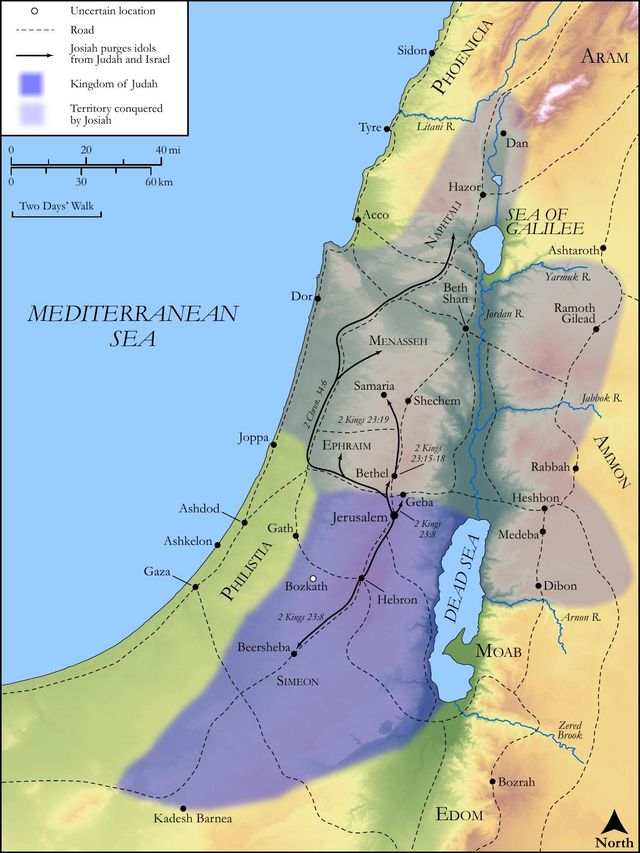
See on the biblical-era map
Study this verse
Public-domain commentary
Matthew Henry
From his Commentary on the Whole Bible. Henry comments on passages, not single verses — this entry covers 2 Kings 22:11–20. His three-level outline is real structure in the source text, so it is rendered as structure.
We hear no more of the repairing of the temple: no doubt that good work went on well; but the book of the law that was found in it occupies us now, and well it may. It is not laid up in the king's cabinet as a piece of antiquity, a rarity to be admired, but it is read before the king. Those put the truest honour upon their Bibles that study them and converse with them daily, feed on that bread and walk by that light. Men of honour and business must look upon an acquaintance with God's word to be their best business and honour. Now here we have,
I.The impressions which the reading of the law made upon Josiah.
He rent his clothes, as one ashamed of the sin of his people and afraid of the wrath of God; he had long thought the case of his kingdom bad, by reason of the idolatries and impieties that had been found among them, but he never thought it so bad as he perceived it to be by the book of the law now read to him. The rending of his clothes signified the rending of his heart for the dishonour done to God, and the ruin he saw coming upon his people.
II.The application he made to God hereupon: Go, enquire of the Lord for me, Kg2 22:13.
1.Two things we may suppose he desired to know: - "Enquire, (1.) What we shall do; what course we shall take to turn away God's wrath and prevent the judgments which our sins have deserved." Convictions of sin and wrath should put us upon this enquiry, What shall we do to be saved? Wherewithal shall we come before the Lord? If you will thus enquire, enquire quickly, before it be too late. (2.) "What we may expect and must provide for." He acknowledges, "Our fathers have not hearkened to the words of this book; if this be the rule of right, certainly our fathers have been much in the wrong." Now that the commandment came sin revived, and appeared sin; in the glass of the law, he saw the sins of his people more numerous and more heinous than he had before seen them, and more exceedingly sinful. He infers hence, "Certainly great is the wrath that is kindled against us; if this be the word of God, as no doubt it is, and he will be true to his word, as no doubt he will be, we are all undone. I never thought the threatenings of the law so severe, and the curses of the covenant so terrible, as now I find them to be; it is time to look about us if these be in force against us." Note, Those who are truly apprehensive of the weight of God's wrath cannot but be very solicitous to obtain his favour, and inquisitive how they may make their peace with him. Magistrates should enquire for their people, and study how to prevent the judgments of God that they see hanging over them.
2.This enquiry Josiah sent,
(1.)By some of his great men, who are named Kg2 22:12, and again Kg2 22:14. Thus he put an honour upon the oracle, by employing those of the first rank to attend it.
(2.)To Huldah the prophetess, Kg2 22:14. The spirit of prophecy, that inestimable treasure, was sometimes put not only into earthen vessels, but into the weaker vessels, that the excellency of the power might be of God. Miriam helped to lead Israel out of Egypt (Mic 6:4), Deborah judged them, and now Huldah instructed them in the mind of God, and her being a wife was no prejudice at all to her being a prophetess; marriage is honourable in all. It was a mercy to Jerusalem that when Bibles were scarce they had prophets, as afterwards, when prophecy ceased, that they had more Bibles; for God never leaves himself without witness, because he will leave sinners without excuse. Jeremiah and Zephaniah prophesied at this time, yet the king's messengers made Huldah their oracle, probably because her husband having a place at court (for he was keeper of the wardrobe) they had had more and longer acquaintance with her and greater assurances of her commission than of any other; they had, it is likely, consulted her upon other occasions, and had found that the word of God in her mouth was truth. She was near, for she dwelt at Jerusalem, in a place called Mishneh, the second rank of buildings from the royal palace. The Jews say that she prophesied among the women, the court ladies, being herself one of them, who it is probable had their apartments in that place. Happy the court that had a prophetess within the verge of it, and knew how to value her.
III.The answer he received from God to his enquiry.
Huldah returned it not in the language of a courtier - "Pray give my humble service to his Majesty, and let him know that this is the message I have for him from the God of Israel;" but in the dialect of a prophetess, speaking from him before whom all stand upon the same level - Tell the man that sent you to me, Kg2 22:15. Even kings, though gods to us, are men to God, and shall so be dealt with; for with him there is no respect of persons.
1.She let him know what judgments God had in store for Judah and Jerusalem (Kg2 22:16, Kg2 22:17): My wrath shall be kindled against this place; and what is hell itself but the fire of God's wrath kindled against sinners? Observe,
(1.)The degree and duration of it. It is so kindled that it shall not be quenched; the decree has gone forth; it is too late now to think of preventing it; the iniquity of Jerusalem shall not be purged with sacrifice or offering. Hell is unquenchable fire.
(2.)The reference it has, [1.] To their sins: "They have committed them, as it were, with design, and on purpose to provoke me to anger. It is a fire of their own kindling; they would provoke me, and at length I am provoked." [2.] To God's threatenings: "The evil I bring is according to the words of the book which the king of Judah has read; the scripture is fulfilled in it. Those that would not be bound by the precept shall be bound by the penalty." God will be found no less terrible to impenitent sinners than his word makes him to be.
2.She let him know what mercy God had in store for him.
(1.)Notice is taken of his great tenderness and concern for the glory of God and the welfare of his kingdom (Kg2 22:19): Thy heart was tender. Note, God will distinguish those that distinguish themselves. The generality of the people were hardened and their hearts unhumbled, so were the wicked kings his predecessors, but Josiah's heart was tender. He received the impressions of God's word, trembled at it and yielded to it; he was exceedingly grieved for the dishonour done to God by the sins of his fathers and of his people; he was afraid of the judgments of God, which he saw coming upon Jerusalem, and earnestly deprecated them. This is tenderness of heart, and thus he humbled himself before the Lord, and expressed these pious affections by rending his clothes and weeping before God, probably in his closet; but he that sees in secret says it was before him, and he heard it, and put every tear of tenderness into his bottle. Note, Those that most fear God's wrath are least likely to feel it. It should seem that those words (Lev 26:32) much affected Josiah, I will bring the land into desolation; for when he heard of the desolation and of the curse, that is, that God would forsake them and separate them to evil (for till it came to that they were neither desolate nor accursed), then he rent his clothes: the threatening went to his heart.
(2.)A reprieve is granted till after his death (Kg2 22:20): I will gather thee to thy fathers. The saints then, no doubt, had a comfortable prospect of happiness on the other side death, else being gathered to their fathers would not have been so often made the matter of a promise as we find it was. Josiah could not prevail to prevent the judgment itself, but God promised him he should not live to see it, which (especially considering that he died in the midst of his days, before he was forty years old) would have been but a small reward for his eminent piety if there had not been another world in which he should be abundantly recompensed, Heb 11:16. When the righteous is taken away from the evil to come he enters into peace, Isa 57:1, Isa 57:2. This is promised to Josiah here: Thou shalt go to thy grave in peace, which refers not to the manner of his death (for he was killed in a battle), but to the time of it; it was a little before the captivity in Babylon, that great trouble, in comparison with which the rest were as nothing, so that he might be truly said to die in peace that did not live to share in that. He died in the love and favour of God, which secure such a peace as no circumstances of dying, no, not dying in the field of war, could alter the nature of, or break in upon.
Continue studying 2 Kings 22:15 across the web’s major study libraries — every link below opens this exact verse, chapter, or book on the destination site.
Read & Compare
 BibleGatewayThis verse in more than 200 translations and 70 languages.
 Bible.comThe YouVersion reader — hundreds of translations, reading plans, and highlights.
 ESV.orgCrossway's official English Standard Version reader.
 NET BibleThe NET translation with 60,000+ translators' notes on every rendering decision.
 STEP BibleTyndale House's free study tool — original text, vocabulary, and scholarly resources.
 BibliaLogos Bible Software's free web reader.
 USCCBThe New American Bible (Revised Edition) with the U.S. bishops' study notes.
Commentaries
 BibleHub CommentariesDozens of classic commentaries on this verse, gathered on one page.
 StudyLightMore than 100 commentary sets — the largest collection on the web.
 BibleRefPlain-English commentary on what this verse means, verse by verse.
 Enduring WordDavid Guzik's free commentary on this chapter, widely used by Bible teachers.
 Bible Study ToolsVerse commentary alongside Greek and Hebrew study aids.
Original Language & Research
- BibleHub InterlinearThe verse word by word — original language, transliteration, and English.
- BibleHub LexiconEvery word's original-language definition and Strong's entry.
 Blue Letter BibleDeep-study tools — Strong's numbers, concordance, and word studies.
 SefariaThe Hebrew text with Rashi and centuries of Jewish commentary.
Sermons, Hymns & Audio


TrulyRandomVerse is not affiliated with these sites and doesn’t control their content. They’re linked because they’re genuinely useful.
Summary
2 Kings 22:15 initiates the solemn divine oracle delivered by Huldah the prophetess to King Josiah's delegation. This pivotal moment of direct divine communication responds to Josiah's profound repentance and distress following the discovery of the Book of the Law. The verse establishes the authoritative nature of Huldah's message, unequivocally declaring that her words are not her own, but a direct pronouncement from the LORD God of Israel, thereby setting the stage for a message encompassing both impending judgment and personal grace.
Context
ShowHideLiterary Context
This verse immediately follows King Josiah's profound act of contrition, expressed by tearing his clothes upon hearing the words of the newly discovered Book of the Law (likely Deuteronomy), which exposed Judah's severe deviation from God's covenant commands. In response to his broken and contrite heart, Josiah dispatched a high-level delegation—comprising Hilkiah the high priest, Shaphan the scribe, Ahikam, Achbor, and Asaiah—with the specific instruction to "inquire of the LORD" regarding the implications of the Law for Judah and its people. Their journey to Huldah the prophetess, as detailed in 2 Kings 22:14, sets the precise narrative scene for this divine pronouncement. The subsequent message, found in 2 Kings 22:16-20, directly addresses this inquiry, affirming the impending judgment on Judah due to its persistent idolatry while simultaneously offering a personal reprieve to Josiah because of his humility and repentance.
Historical & Cultural Context
King Josiah reigned over Judah from 640-609 BCE, a period marked by significant religious and political upheaval. Following generations of widespread idolatry under his predecessors Manasseh and Amon, Josiah initiated a sweeping religious reform aimed at purging Judah of pagan worship and restoring the exclusive worship of Yahweh. The discovery of the Book of the Law during Temple repairs (see 2 Kings 22:8) served as a profound catalyst for this reform, providing a clear and authoritative blueprint for covenant faithfulness. The delegation's decision to consult a prophetess like Huldah, rather than prominent male prophets such as Jeremiah or Zephaniah (who were active during this era), underscores the diverse ways God communicated with His people. Despite Judah being a patriarchal society, the biblical record consistently highlights women whom God called as prophetesses (e.g., Miriam in Exodus 15:20 and Deborah in Judges 4:4), and here Josiah's men went to Huldah to enquire of the LORD. Huldah's accessibility within Jerusalem and her recognized spiritual authority likely contributed to her selection by the royal delegation.
Key Themes
ShowHideThis verse powerfully introduces several crucial theological and narrative themes. Firstly, it emphatically highlights Divine Revelation, as the phrase "Thus saith the LORD God of Israel" functions as the quintessential prophetic formula, unequivocally declaring that the words conveyed are not Huldah's personal insights but a direct, authoritative message originating from God Himself. This underscores the divine origin and infallible nature of the subsequent prophecy. Secondly, it speaks profoundly to Prophetic Authority, demonstrating God's sovereign prerogative in choosing His messengers based solely on His divine will, rather than human criteria or societal expectations. Huldah, a woman operating within a male-dominated religious landscape, is nonetheless recognized and respected as a legitimate and powerful conduit for God's word, thereby emphasizing God's impartiality in selecting those through whom He chooses to speak. Lastly, the verse showcases God's Responsiveness to sincere repentance. Josiah's profound humility and earnest inquiry elicit an immediate and direct divine answer, powerfully illustrating God's attentiveness and compassion toward those who seek Him with a contrite heart, particularly when distressed over sin and earnestly desiring righteousness, a truth beautifully articulated in Psalm 51:17.
Exposition and Analysis
ShowHideKey Word Analysis
ShowHideFrom the primitive root H559, this word is central to the quintessential prophetic formula "Thus saith the LORD." It signifies that the message being delivered is not merely human opinion, wisdom, or counsel, but a direct, authoritative, and binding word from God Himself. Its use here immediately elevates Huldah's words to the status of an unchallengeable divine decree, removing any doubt about the origin or veracity of the prophecy she is about to deliver. It functions as a declaration of divine authorship and absolute truth.
This is the sacred, personal, covenant name of God, often transliterated as Yahweh. It signifies God's self-existent, eternal, and unchanging nature, emphasizing His faithfulness to His covenant promises. In this context, the use of "LORD" underscores that the message comes from the sovereign, covenant-keeping God who has a unique and binding relationship with Israel, and whose word is therefore utterly reliable and authoritative for His people.
This plural noun is used here, especially with the article, to refer to the supreme God. While it can refer to gods in a general sense or even human judges, its combination with "LORD" (Yahweh) and "of Israel" unequivocally identifies Him as the one, true, and supreme God. This title emphasizes His power, majesty, and universal sovereignty, reinforcing the immense authority behind the message Huldah is about to deliver.
Verse Breakdown
ShowHide"And she said unto them,"
This opening clause serves as a narrative transition, clearly identifying Huldah as the speaker and the delegation sent by King Josiah as the immediate recipients of her words. It marks the commencement of her direct response to their urgent inquiry, setting the stage for the delivery of a message of paramount importance. This simple statement underscores her recognized role as a legitimate prophetess whose words are eagerly anticipated by the king's representatives.
"Thus saith the LORD God of Israel,"
This is the theological core of the verse, functioning as the authoritative prophetic formula. It immediately and unequivocally identifies the ultimate source and supreme authority of the message that follows. By declaring that the words are from "the LORD God of Israel," Huldah makes it clear that this is not her personal opinion or advice, but a direct, verbatim message from Yahweh, the covenant God who has chosen Israel and is sovereign over their destiny. This phrase demands immediate attention and reverence, signaling the very voice of God speaking through His chosen messenger.
"Tell the man that sent you to me,"
This directive specifies the ultimate intended recipient of the divine message: King Josiah. The phrase "the man that sent you to me" personally addresses Josiah through his representatives, underscoring that God has heard his specific inquiry and is now providing a direct, personal answer to his heart's distress and profound repentance. It confirms that the delegation's mission has been successful in eliciting a divine response tailored to Josiah's earnest seeking.
Literary Devices
ShowHideThe verse employs several significant literary devices to convey its powerful and authoritative message. The most prominent is the Prophetic Formula ("Thus saith the LORD God of Israel"), which immediately establishes the divine authority and inerrancy of Huldah's subsequent words. This formula is a hallmark of Old Testament prophecy, signaling that the speaker is merely a faithful mouthpiece for God, ensuring the message's divine origin. The use of Direct Address ("Tell the man that sent you to me") creates a powerful sense of immediacy and personal engagement, even though the message is relayed through intermediaries. This directness underscores God's personal attention to Josiah's contrite heart and his specific inquiry. There is also an element of Synecdoche in the phrase "the man," where "the man" (Josiah) stands in for the entire royal and national inquiry, focusing the divine response directly on the individual whose profound repentance initiated the inquiry. This device emphasizes the personal nature of God's response to Josiah's humility and earnest desire for truth.
Theological and Thematic Connections
ShowHide2 Kings 22:15 serves as a profound testament to God's active engagement in human affairs and His unwavering responsiveness to sincere repentance. It highlights the enduring biblical principle that God speaks through chosen vessels, and that His revealed word carries ultimate and undeniable authority. The immediate divine response to Josiah's distress over the discovered Law underscores the paramount importance of God's revealed word as the unchangeable standard for life and the primary catalyst for genuine spiritual awakening and reform. Furthermore, it powerfully reinforces the dynamic tension between God's justice and His mercy: while the nation of Judah faced impending judgment for its long-standing unfaithfulness and idolatry, individual repentance, as exemplified by King Josiah, could indeed elicit personal grace and a measure of protection from the immediate outpouring of divine wrath. This recurring motif of corporate judgment balanced by individual grace is a consistent theme throughout the biblical narrative.
Reflection and Application
ShowHideThis verse offers profound encouragement and a challenging call to action for believers today. Just as King Josiah earnestly sought an authoritative word from God in a time of profound national and personal crisis, we are likewise called to prioritize seeking God's will and truth with a similar earnestness, especially when confronted with our own spiritual failings or the deep brokenness of the world around us. The immediate and clear response from God through Huldah reminds us that our God is not distant or indifferent, but is intimately attentive to the cries of a humble and repentant heart. It challenges us to cultivate a posture of active listening and unwavering obedience to God's voice, which is primarily and infallibly found in His inspired Word, the Bible. Moreover, Huldah's unexpected role as God's chosen messenger reminds us that God sovereignly sends whom He will to communicate His eternal truth. This calls us to discern the divine origin of a message rather than focusing solely on the messenger's outward appearance or conventional standing, fostering humility and a readiness to hear God's truth from potentially unexpected sources. Our ultimate focus should always be on the "Thus saith the LORD."
Questions for Reflection
ShowHideFAQ
ShowHideWhy did Josiah's delegation go to Huldah, a prophetess, instead of more prominent prophets like Jeremiah or Zephaniah, who were also active at the time?
ShowHideWhile the biblical text does not explicitly state the precise reason, several factors likely contributed to the delegation's choice of Huldah. Firstly, her residence in Jerusalem, specifically in the "Second Quarter" (or Mishneh), suggests her accessibility and perhaps a recognized, established position within the royal or religious establishment. Jeremiah, though active, may have been outside Jerusalem or not as readily available for an immediate royal consultation. Secondly, Huldah's reputation as a legitimate and authoritative voice of God was clearly established, as evidenced by the king's high-level delegation seeking her out and accepting her prophecy without question. Her status as a prophetess, much like Deborah before her (see Judges 4:4), indicates that God sovereignly chose to speak through women in prophetic roles, and their authority was recognized within Israelite society. It's also plausible that her specific prophetic gift or area of expertise was deemed most appropriate for the king's urgent inquiry regarding the newly discovered Law and its implications for the nation's covenant standing. Ultimately, God sovereignly chooses His messengers according to His divine purpose, and Huldah was His chosen instrument for this pivotal moment in Judah's history, demonstrating His ability to use anyone He wills.
Christ-Centered Fulfillment
ShowHide2 Kings 22:15, with its profound declaration "Thus saith the LORD God of Israel," serves as a powerful Old Testament foreshadowing of the ultimate and complete divine revelation found in Jesus Christ. Huldah, as a prophetess, functioned as a temporary and partial mouthpiece for God's word, delivering a message that brought both impending judgment and personal grace. Her prophetic role points forward to Jesus, who is not merely a messenger from God but the very Word of God incarnate (see John 1:1 and John 1:14). While Huldah spoke for God, Christ is God, embodying the fullness of divine truth, authority, and presence. His teachings are introduced not with the formulaic "Thus saith the LORD," but with His inherent, non-delegated authority, often prefaced by "Truly, truly, I say to you" (e.g., Matthew 5:22). Josiah's profound repentance upon hearing the Law, and his earnest seeking of God's word through Huldah, prefigures the universal human need for repentance in light of God's ultimate and final revelation in Christ. The judgment pronounced through Huldah, though delayed for Josiah, points to the ultimate and righteous judgment for all sin, from which salvation is found exclusively through faith in the atoning work of the Lamb of God, who takes away the sin of the world. Christ is the perfect Prophet, Priest, and King, fulfilling all the types and shadows of the Old Covenant, and through Him, we receive not just a word from God, but God Himself, offering eternal life and complete reconciliation (see Hebrews 1:1-3).