


2 Chronicles 34:24
- כֹּהkohthusH3541AdvAdverb
- אָמַר'a·Marhe saysH559V-Qal-Perf-3msVerb Qal Perfect 3rd Singular Masculine
- יְהוָהYah·wehYahwehH3068N-properNoun Proper Title
- הִנְנִיhi·Nihere IH2005Prt ¦ 1csParticle InterjectionהִנְhereנִיI
- מֵבִיאme·Vi'[am] about to bringH935V-Hiphil-Prtcpl-msVerb Hiphil Participle Singular Masculine Absolute
- רָעָהra·'AhharmH7451N-fsNoun Singular Feminine Absolute
- עַל'alonH5921PrepPreposition
- הַמָּקוֹםha·ma·Komthe placeH4725Art ¦ N-msNoun Singular Masculine Absoluteהַtheמָּקוֹםplace
- הַזֶּהha·Zeh<the> thisH2088Art ¦ PrtParticle Demonstrativeהַ<the>זֶּהthis
- וְעַלve·'aland onH5921Conj-w ¦ PrepPrepositionוְandעַלon
- יוֹשְׁבָיוyo·she·Vavits inhabitantsH3427V-Qal-Prtcpl-mp ¦ 3msVerb Qal Participle Plural Masculine Constructיוֹשְׁבָיinhabitantsוits
- אֵת'et<obj.>H853DirObjMParticle Object Indicator
- כָּלkolallH3605N-mscNoun Singular Masculine Construct
- הָאָלוֹתha·'a·lOtthe cursesH423Art ¦ N-fpNoun Plural Feminine Absoluteהָtheאָלוֹתcurses
- הַכְּתוּבוֹתha·ke·tu·Votwhich are writtenH3789Art ¦ V-Qal-PassPrtcpl-fpVerb Qal Participle Passive Plural Feminine Absoluteהַwhichכְּתוּבוֹתare written
- עַל'alonH5921PrepPreposition
- הַסֵּפֶרha·Se·ferthe scrollH5612Art ¦ N-msNoun Singular Masculine Absoluteהַtheסֵּפֶרscroll
- אֲשֶׁר'a·SherwhichH834RelParticle Relative
- קָרְאוּka·re·'Upeople have read aloudH7121V-Qal-Perf-3cpVerb Qal Perfect 3rd Plural common gender
- לִפְנֵיlif·Nei<to> beforeH6440Prep-l ¦ N-mpcNoun Plural Masculine Constructלִ<to>פְנֵיbefore
- מֶלֶךְMe·lekh[the] king ofH4428N-mscNoun Singular Masculine Construct
- יְהוּדָהye·hu·DahJudahH3063N-properNoun Proper Location
English is a literal word-by-word gloss of the Hebrew, not the KJV's wording. Why?
This is the original text the KJV's translators worked from — each Hebrew word with its own literal English meaning in this verse, prepared by scholars at Tyndale House, Cambridge. The KJV translates whole sentences, not word by word, so its wording differs: one Hebrew word can become several English words, and the KJV may choose “the LORD” where the gloss reads “Yahweh”. Both are faithful — they answer different questions. For the KJV's own rendering, switch to the KJV text.
Details
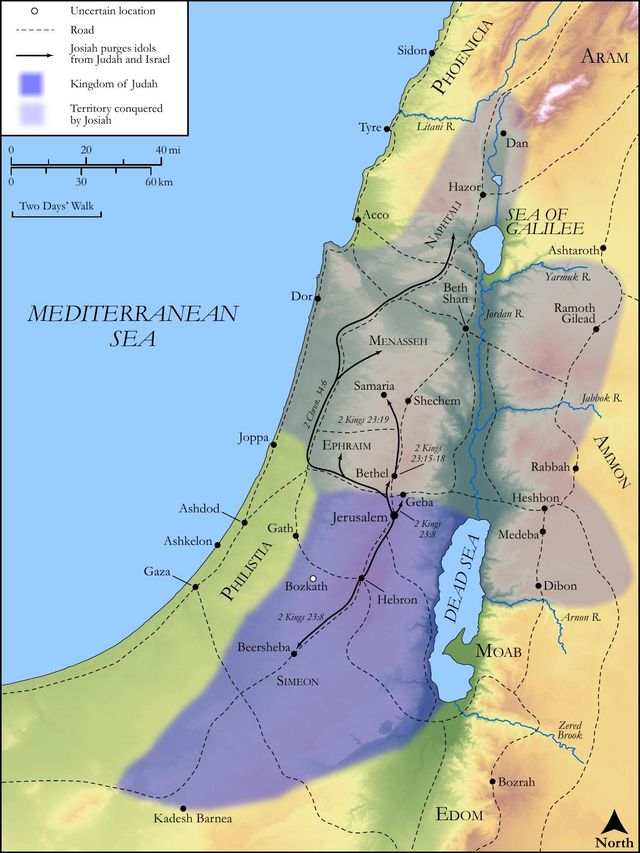
See on the biblical-era map
Study this verse
Public-domain commentary
Matthew Henry
From his Commentary on the Whole Bible. Henry comments on passages, not single verses — this entry covers 2 Chronicles 34:14–28.
This whole paragraph we had, just as it is here related, Kg2 22:8-20, and have nothing to add here to what was there observed. But, 1. We may hence take occasion to bless God that we have plenty of Bibles, and that they are, or may be, in all hands, - that the book of the law and gospel is not lost, is not scarce, - that, in this sense, the word of the Lord is not precious. Bibles are jewels, but, thanks be to God, they are not rarities. The fountain of the waters of life is not a spring shut up or a fountain sealed, but the streams of it, in all places, make glad the city of our God. Usus communis aquarum - These waters flow for general use. What a great deal shall we have to answer for if the great things of God's law, being thus made common, should be accounted by us as strange things! 2. We may hence learn, whenever we read or hear the word of God, to affect our hearts with it, and to get them possessed with a holy fear of that wrath of God which is there revealed against all ungodliness and unrighteousness of men, as Josiah's tender heart was. When he heard the words of the law he rent his clothes (Ch2 34:19), and God was well pleased with his doing so, Ch2 34:27. Were the things contained in the scripture new to us, as they were here to Josiah, surely they would make deeper impressions upon us than commonly they do; but they are not the less weighty, and therefore should not be the less considered by us, for their being well known. Rend the heart therefore, not the garments. 3. We are here directed when we are under convictions of sin, and apprehensions of divine wrath, to enquire of the Lord; so Josiah did, Ch2 34:21. It concerns us to ask (as they did, Act 2:37), Men and brethren, what shall we do? and more particularly (as the jailor), What must I do to be saved? Act 16:30. If you will thus enquire, enquire (Isa 21:12); and, blessed be God, we have the lively oracles to which to apply with these enquiries. 4. We are here warned of the ruin that sin brings upon nations and kingdoms. Those that forsake God bring evil upon themselves (Ch2 34:24, Ch2 34:25), and kindle a fire which shall not be quenched. Such will the fire of God's wrath be when the decree has gone forth against those that obstinately and impenitently persist in their wicked ways. 5. We are here encouraged to humble ourselves before God and seek unto him, as Josiah did. If we cannot prevail thereby to turn away God's wrath from our land, yet we shall deliver our own souls, Ch2 34:27, Ch2 34:28. And good people are here taught to be so far from fearing death as to welcome it rather when it takes them away from the evil to come. See how the property of it is altered by making it the matter of a promise: Thou shalt be gathered to thy grave in peace, housed in that ark, as Noah, when a deluge is coming.
Continue studying 2 Chronicles 34:24 across the web’s major study libraries — every link below opens this exact verse, chapter, or book on the destination site.
Read & Compare
 BibleGatewayThis verse in more than 200 translations and 70 languages.
 Bible.comThe YouVersion reader — hundreds of translations, reading plans, and highlights.
 ESV.orgCrossway's official English Standard Version reader.
 NET BibleThe NET translation with 60,000+ translators' notes on every rendering decision.
 STEP BibleTyndale House's free study tool — original text, vocabulary, and scholarly resources.
 BibliaLogos Bible Software's free web reader.
 USCCBThe New American Bible (Revised Edition) with the U.S. bishops' study notes.
Commentaries
 BibleHub CommentariesDozens of classic commentaries on this verse, gathered on one page.
 StudyLightMore than 100 commentary sets — the largest collection on the web.
 BibleRefPlain-English commentary on what this verse means, verse by verse.
 Enduring WordDavid Guzik's free commentary on this chapter, widely used by Bible teachers.
 Bible Study ToolsVerse commentary alongside Greek and Hebrew study aids.
Original Language & Research
- BibleHub InterlinearThe verse word by word — original language, transliteration, and English.
- BibleHub LexiconEvery word's original-language definition and Strong's entry.
 Blue Letter BibleDeep-study tools — Strong's numbers, concordance, and word studies.
 SefariaThe Hebrew text with Rashi and centuries of Jewish commentary.
Sermons, Hymns & Audio


TrulyRandomVerse is not affiliated with these sites and doesn’t control their content. They’re linked because they’re genuinely useful.
Summary
2 Chronicles 34:24 records the solemn divine pronouncement delivered by the prophetess Huldah to King Josiah, confirming God's impending judgment upon Jerusalem and its inhabitants. This verse underscores the severe consequences of Judah's persistent and widespread rebellion against the Mosaic covenant, affirming that the calamities about to befall the nation are the direct fulfillment of the curses explicitly detailed in the recently rediscovered Book of the Law, which had been read before the king. It serves as a stark reminder of God's unwavering justice and faithfulness to His declared word, both in promise and in warning, revealing the profound ramifications of generations of covenant infidelity.
Context
ShowHideLiterary Context
This prophecy is situated at a pivotal moment in Judah's history, during the eighteenth year of King Josiah's righteous reign. While overseeing the repair of the Temple, the high priest Hilkiah discovered the Book of the Law, likely a copy of Deuteronomy. Upon hearing its contents read, Josiah was deeply convicted, tearing his clothes in profound repentance and recognizing the nation's egregious deviation from God's commands, as detailed in 2 Chronicles 34:19. In response to this spiritual crisis, Josiah immediately dispatched a delegation, including Hilkiah and Shaphan, to inquire of the LORD. Their inquiry led them to Huldah the prophetess, whose message in 2 Chronicles 34:23-28 confirmed the impending divine wrath upon Judah for their idolatry and disobedience, while also granting Josiah a personal reprieve due to his humble repentance. This verse, therefore, serves as the authoritative divine confirmation of the discovered Law's warnings.
Historical & Cultural Context
King Josiah's reign (640-609 BC) followed decades of severe apostasy under his grandfather Manasseh and father Amon, during which idolatry, child sacrifice, and pagan worship had deeply permeated Judahite society. The discovery of the Book of the Law was a watershed moment, revealing the extent of the nation's spiritual decline in stark contrast to the covenant stipulations. Culturally, the concept of a covenant, with its blessings for obedience and curses for disobedience, was foundational to Israelite identity, as outlined in books like Deuteronomy 28. Huldah's role as a prophetess, consulted by the king and high priest, highlights the respect given to prophetic authority in ancient Israel, even amidst widespread spiritual decline. Geographically, Jerusalem was the spiritual and political heart of Judah, making the pronouncement of judgment "upon this place" particularly significant, indicating the impending destruction of the city and its Temple.
Key Themes
ShowHideThe verse powerfully articulates several core themes prevalent in 2 Chronicles and the broader Deuteronomistic history. Firstly, Divine Judgment is unequivocally declared, emphasizing God's righteous response to chronic sin and covenant infidelity. The "evil" is not random misfortune but a direct, punitive consequence. Secondly, the theme of Covenant Curses is central; the judgment is not arbitrary but precisely "all the curses that are written in the book," directly referencing the stipulations of the Mosaic Law, particularly those found in Leviticus 26 and Deuteronomy 28. This highlights God's Faithfulness to His Word, demonstrating that His warnings are as binding as His promises. Finally, the passage underscores the Consequences of Persistent Disobedience, illustrating that while individual repentance (like Josiah's) can bring personal reprieve, a nation's collective and pervasive rejection of God's commands inevitably leads to severe repercussions, ultimately culminating in the Babylonian exile, which is powerfully foreshadowed here. The discovery of the Law and the subsequent prophecy in 2 Chronicles 34 serve as a stark reminder of the enduring nature of God's covenant and its implications.
Exposition and Analysis
ShowHideKey Word Analysis
ShowHideThis is the Tetragrammaton, the personal, covenant name of God, often translated as "Jehovah" or "Yahweh." Its use here signifies that the pronouncement of judgment comes from the self-existent, eternal God who entered into a covenant relationship with Israel. This emphasizes the solemnity and certainty of the message, as it is delivered by the very God who established the covenant and is faithful to its terms, both blessings and curses.
In this context, raʻ does not denote moral evil or wickedness, but rather calamity, disaster, misfortune, or affliction. It refers to the punitive consequences brought by God as a righteous judgment against sin. This distinguishes God's action from human malevolence, emphasizing that the "evil" is a just and deserved outcome for Judah's covenant breaking, a divinely ordained adversity.
This term specifically refers to the solemn pronouncements of judgment, misfortune, or divine retribution outlined within the covenant for disobedience. These are not mere threats but divinely ordained penalties that God, in His justice and faithfulness to His covenant, is bound to execute when His people persistently violate His commands. The use of ʼâlâh here directly links the impending disaster to the specific legal stipulations of the Mosaic Law, emphasizing a formal, covenantal execration.
Verse Breakdown
ShowHide"Thus saith the LORD,"
This is a classic prophetic formula, known as a messenger formula, establishing the divine authority and origin of the message. It signals that the words that follow are not Huldah's personal opinion or interpretation but a direct, unadulterated revelation from Yahweh, the covenant God of Israel. This phrase lends immense weight and certainty to the prophecy, underscoring its absolute truth and inevitability.
"Behold, I will bring evil upon this place, and upon the inhabitants thereof,"
This clause declares God's active intention to initiate judgment. "This place" refers specifically to Jerusalem, the capital and spiritual center of Judah, and by extension, the entire kingdom. The "inhabitants thereof" signifies the people of Judah, collectively responsible for the nation's apostasy. The emphatic declaration "I will bring" emphasizes God's sovereign agency and direct involvement in executing judgment, not merely allowing it to happen passively.
"[even] all the curses that are written in the book"
This clarifies the nature and source of the "evil." It is not random misfortune or arbitrary wrath but the precise and comprehensive fulfillment of the covenant curses. The phrase "all the curses" indicates the exhaustive and complete nature of the impending judgment, leaving no aspect of the promised consequences unfulfilled. This directly links the prophecy to the Mosaic Law, particularly the extensive lists of curses in Deuteronomy 28 and Leviticus 26, affirming God's faithfulness to His own declared word.
"which they have read before the king of Judah:"
This final phrase underscores the immediate context and the undeniable culpability of the people. The "book" (the Book of the Law) had just been discovered and read publicly, making its contents, and therefore the covenant's stipulations and curses, known to the king and, by extension, to the nation's leadership and the people. This highlights that the judgment is not arbitrary but a righteous response to a known and willfully violated covenant, emphasizing the accountability of those who have heard God's word.
Literary Devices
ShowHide2 Chronicles 34:24 primarily employs Divine Oracle, a common prophetic literary device where a message is presented as a direct utterance from God, often introduced by phrases like "Thus saith the LORD." This device imbues the message with absolute authority and certainty, leaving no doubt as to its origin or veracity. The verse also functions as a powerful Prophecy, foretelling future events (the bringing of "evil" and "curses") as a direct, inevitable consequence of past and present actions. Furthermore, there is a strong element of Foreshadowing, as Huldah's words explicitly anticipate the coming Babylonian exile and the destruction of Jerusalem, which would indeed fulfill "all the curses" written in the Law. The specific reference to "the book" and its recent public reading creates a profound sense of Irony and Accountability, as the very words that condemn Judah are those they had neglected for generations, now brought to light at the precipice of their destruction, making their disobedience inexcusable.
Theological and Thematic Connections
ShowHideThis verse profoundly illustrates God's unwavering commitment to His covenant, demonstrating that His warnings are as certain as His promises. It reveals a God who is both merciful (as seen in Josiah's reprieve) and perfectly just, who cannot overlook persistent sin and rebellion without compromising His own holy character. The "evil" brought upon Judah is not an act of arbitrary wrath but a righteous consequence, a necessary outworking of the covenant curses that had been neglected for generations. This judgment serves as a powerful testament to the seriousness of God's law and the profound implications of rejecting His revealed will. It underscores the principle that national and corporate sin has tangible, devastating consequences, even when individuals within that nation strive for righteousness. God's faithfulness extends to the fulfillment of His warnings, ensuring that His word is always true and effective.
Reflection and Application
ShowHide2 Chronicles 34:24 serves as a sobering reminder of the gravity of God's word and the reality of divine justice. For us today, it highlights that God's character is consistent: He is both gracious and righteous. While we live under the new covenant, the principles of sowing and reaping, and the seriousness of sin, remain. This passage calls us to a profound reverence for Scripture, not merely as historical text but as the living word of God that reveals His will and warns of the consequences of disobedience. It urges us to examine our own lives and communities, asking if we are truly living in alignment with God's commands or if we are, like ancient Judah, drifting into spiritual apathy and rebellion. The impending judgment on Judah, despite Josiah's personal piety, also reminds us that corporate sin can have far-reaching consequences that affect generations, prompting us to pray for and actively seek righteousness in our societies and churches. Ultimately, it compels us to respond to God's word with humility, repentance, and a renewed commitment to obedience, trusting in His mercy while respecting His justice.
Questions for Reflection
ShowHideFAQ
ShowHideWhat was "the book" mentioned in this verse, and why was its reading so significant?
ShowHideThe "book" refers to the Book of the Law, which was discovered by the high priest Hilkiah during the Temple repairs initiated by King Josiah. While its exact contents are debated, it is widely believed to be a copy of Deuteronomy, or at least a significant portion of it. Its reading was profoundly significant because it revealed to Josiah and the people the full extent of their covenant violations and the severe curses promised for disobedience, as detailed in passages like Deuteronomy 28. This discovery sparked Josiah's immediate repentance and initiated a widespread religious reform, although Huldah's prophecy confirmed that the national judgment was still inevitable due to generations of ingrained sin.
Why did God still bring judgment ("evil") upon Judah despite King Josiah's righteous reforms?
ShowHideWhile King Josiah's reforms were extensive and sincere, leading to a personal reprieve for him (as seen in 2 Chronicles 34:28), the prophecy in 2 Chronicles 34:24 indicates that the collective and pervasive sin of Judah over generations had reached a point of no return. The nation's idolatry and rebellion were deeply ingrained, and even Josiah's efforts, while commendable, could not fully reverse the spiritual trajectory of a people whose hearts were largely unrepentant. God's judgment was a righteous response to a long history of covenant breaking, demonstrating His faithfulness to His warnings and the principle that persistent sin, both individual and corporate, has inevitable consequences. The people's hearts, unlike Josiah's, were not truly turned back to the Lord, making the judgment a necessary and just outcome.
Christ-Centered Fulfillment
ShowHide2 Chronicles 34:24, with its pronouncement of curses and impending "evil" due to covenant disobedience, finds its ultimate Christ-centered fulfillment in the person and work of Jesus Christ. The "curses that are written in the book" (the Law) were a heavy burden that humanity, specifically Israel, could not bear or escape through their own efforts, as all have sinned and fallen short of God's glory (Romans 3:23). However, the New Testament reveals that Christ became a curse for us, redeeming us from the curse of the Law (as explicitly stated in Galatians 3:13). On the cross, Jesus absorbed the full weight of God's righteous judgment against sin, taking upon Himself the "evil" (calamity, punishment) that was due to humanity. Through His atoning sacrifice, He not only fulfilled the righteous requirements of the Law but also inaugurated a new covenant, where forgiveness and reconciliation are offered not based on perfect adherence to the Law, but on faith in Him (Hebrews 9:15). Thus, while 2 Chronicles 34:24 highlights the just consequences of sin, it ultimately points to the greater redemptive work of Christ, who delivers those who believe from the ultimate "evil" of eternal separation from God (Romans 6:23), offering instead the blessing of eternal life and reconciliation with God (Romans 8:1-4). He is the true King who perfectly obeyed the Law and bore its curses, providing a way for His people to escape the judgment pronounced in verses like this.