


Isaiah 35:9
Bible text: King James Version (1769 Blayney text) · Public domain
Bible text: Berean Standard Bible · Public domain
Bible text: American Standard Version (1901) · Public domain
Bible text: World English Bible, Messianic edition · Public domain
Bible text: Geneva Bible (1599) · Public domain
Bible text: Young's Literal Translation · Public domain
- לֹאlo'notH3808NegParticle Negative
- יִהְיֶהyih·Yehit will beH1961V-Qal-Imperf-3msVerb Qal Imperfect 3rd Singular Masculine
- שָׁםshamthereH8033AdvAdverb
- אַרְיֵה'ar·Yeha lionH738N-msNoun Singular Masculine Absolute
- וּפְרִיץu·fe·Ritzand a violent one ofH6530Conj-w ¦ N-mscNoun Singular Masculine Constructוּandפְרִיץa violent one of
- חַיּוֹתchai·yOtliving creaturesH2416N-fpNoun Plural Feminine Absolute
- בַּלbalnotH1077NegParticle Negative
- יַעֲלֶנָּהya·'a·Le·nahit will go up on itH5927V-Qal-Imperf-3ms ¦ 3fsVerb Qal Imperfect 3rd Singular Masculineיַעֲלֶit will go up onנָּהit
- לֹאlo'notH3808NegParticle Negative
- תִמָּצֵאti·ma·Tze'it will be foundH4672V-Niphal-Imperf-3fsVerb Niphal Imperfect 3rd Singular Feminine
- שָׁםShamthereH8033AdvAdverb
- וְהָלְכוּve·ha·le·Khuand they will walkH1980Conj-w ¦ V-Qal-ConsecPerf-3cpVerb Qal Consecutive Perfect 3rd Plural common genderוְandהָלְכוּthey will walk
- גְּאוּלִיםge·'u·Limredeemed [people]H1350V-Qal-PassPrtcpl-mpVerb Qal Participle Passive Plural Masculine Absolute
English is a literal word-by-word gloss of the Hebrew, not the KJV's wording. Why?
This is the original text the KJV's translators worked from — each Hebrew word with its own literal English meaning in this verse, prepared by scholars at Tyndale House, Cambridge. The KJV translates whole sentences, not word by word, so its wording differs: one Hebrew word can become several English words, and the KJV may choose “the LORD” where the gloss reads “Yahweh”. Both are faithful — they answer different questions. For the KJV's own rendering, switch to the KJV text.
Details
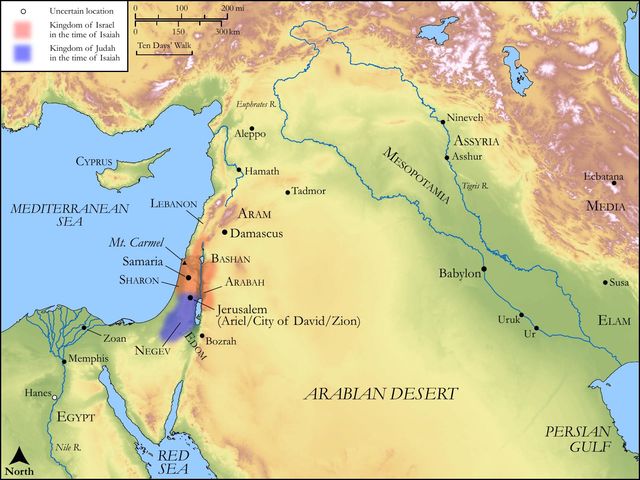
See on the biblical-era map
Study this verse
Public-domain commentary
Matthew Henry
From his Commentary on the Whole Bible. Henry comments on passages, not single verses — this entry covers Isaiah 35:5–10. His two-level outline is real structure in the source text, so it is rendered as structure.
"Then, when your God shall come, even Christ, to set up his kingdom in the world, to which all the prophets bore witness, especially towards the conclusion of their prophecies of the temporal deliverances of the church, and this evangelical prophet especially - then look for great things."
I.Wonders shall be wrought in the kingdoms both of nature and grace, wonders of mercy wrought upon the children of men, sufficient to evince that it is no less than a God that comes to us.
1.Wonders shall be wrought on men's bodies (Isa 35:5, Isa 35:6): The eyes of the blind shall be opened; this was often done by our Lord Jesus when he was here upon earth, with a word's speaking, and one he gave sight to that was born blind, Mat 9:27; Mat 12:22; Mat 20:30; Joh 9:6. By his power the ears of the deaf also were unstopped, with one word. Ephphatha - Be opened, Mar 7:34. Many that were lame had the use of their limbs restored so perfectly that they could not only go, but leap, and with so much joy to them that they could not forbear leaping for joy, as that impotent man, Act 3:8. The dumb also were enabled to speak, and then no marvel that they were disposed to sing for joy, Mat 9:32, Mat 9:33. These miracles Christ wrought to prove that he was sent of God (Joh 3:2), nay, working them by his own power and in his own name, he proved that he was God, the same who at first made man's mouth, the hearing ear, and the seeing eye. When he would prove to John's disciples his divine mission he did it by miracles of this kind, in which this scripture was fulfilled.
2.Wonders, greater wonders, shall be wrought on men's souls. By the word and Spirit of Christ those that were spiritually blind were enlightened (Act 26:18), those that were deaf to the calls of God were made to hear them readily, so Lydia, whose heart the Lord opened, so that she attended, Act 16:14. Those that were impotent to every thing that is good by divine grace are made, not only able for it, but active in it, and run the way of God's commandments. Those also that were dumb, and knew not how to speak of God or to God, having their understandings opened to know him, shall thereby have their lips opened to show forth his praise. The tongue of the dumb shall sing for joy, the joy of God's salvation. Praise shall be perfected out of the mouth of babes and sucklings.
II.The Spirit shall be poured out from on high.
There shall be waters and streams, rivers of living water; when our Saviour spoke of these as the fulfilling of the scripture, and most probably of this scripture, the evangelist tells us, He spoke of the Spirit (Joh 7:38, Joh 7:39), as does also this prophet (ch. 32:15); so here (Isa 35:6), in the wilderness, where one would least expect it, shall waters break out. This was fulfilled when the Holy Ghost fell upon the Gentiles that heard the word (Act 10:44); then were the fountains of life opened, whence streams flowed, that watered the earth abundantly. These waters are said to break out, which denotes a pleasing surprise to the Gentile world, such as brought them, as it were, into a new world. The blessed effect of this shall be that the parched ground shall become a pool, Isa 35:7. Those that laboured and were heavily laden, under the burden of guilt, and were scorched with the sense of divine wrath, found rest, and refreshment, and abundant comforts in the gospel. In the thirsty land, where no water was, nor ordinances (Psa 63:1), there shall be springs of water, a gospel ministry, and by that the administration of all gospel ordinances in their purity and plenty, which are the river that makes glad the city of our God, Psa 46:4. In the habitation of dragons, who chose to dwell in the parched scorched ground (Isa 34:9, Isa 34:13), these waters shall flow, and dispossess them, so that, where each lay shall be grass with reeds and rushes, great plenty of useful productions. Thus it was when Christian churches were planted, and flourished greatly, in the cities of the Gentiles, which, for many ages, had been habitations of dragons, or devils rather, as Babylon (Rev 18:2); when the property of the idols' temples was altered, and they were converted to the service of Christianity, then the habitations of dragons became fruitful fields.
III.The way of religion and godliness shall be laid open:
it is here called the way of holiness (Isa 35:8) the way both of holy worship and a holy conversation. Holiness is the rectitude of the human nature and will, in conformity to the divine nature and will. The way of holiness is that course of religious duties in which men ought to walk and press forward, with an eye to the glory of God and their own felicity in the enjoyment of him. "When our God shall come to save us he shall chalk out to us this way by his gospel, so as it had never been before described." 1. It shall be an appointed way; not a way of sufferance, but a highway, a way into which we are directed by a divine authority and in which we are protected by a divine warrant. It is the King's highway, the King of Kings' highway, in which, though we may be waylaid, we cannot be stopped. The way of holiness is the way of God's commandments; it is (as highways usually are) the good old way, Jer 6:16. 2. It shall be an appropriated way, the way in which God will bring his own chosen to himself, but the unclean shall not pass over it, either to defile it or to disturb those that walk in it. It is a way by itself, distinguished from the way of the world, for it is a way of separation from, and nonconformity to, this world. It shall be for those whom the Lord has set apart for himself (Psa 4:3), shall be reserved for them: The redeemed shall walk there, and the satisfaction they take in these ways of pleasantness shall be out of the reach of molestation from an evil world. The unclean shall not pass over it, for it shall be a fair way; those that walk in it are the undefiled in the way, who escape the pollution that is in the world. 3. It shall be a straight way: The wayfaring men, who choose to travel in it, though fools, of weak capacity in other things, shall have such plain directions from the word and Spirit of God in this way that they shall not err therein; not that they shall be infallible even in their own conduct, or that they shall in nothing mistake, but they shall not be guilty of any fatal misconduct, shall not so miss their way but that they shall recover it again, and get well to their journey's end. Those that are in the narrow way, though some may fall into one path and others into another, not all equally right, but all meeting at last in the same end, shall yet never fall into the broad way again; the Spirit of truth shall lead them into all truth that is necessary for them. Note, The way to heaven is a plain way, and easy to hit. God has chosen the foolish things of the world, and made them wise to salvation. Knowledge is easy to him that understands. 4. It shall be a safe way: No lion shall be there, nor any ravenous beast (Isa 35:9), none to hurt or destroy. Those that keep close to this way keep out of the reach of Satan the roaring lion, that wicked one touches them not. Those that walk in the way of holiness may proceed with a holy security and serenity of mind, knowing that nothing can do them any real hurt; they shall be quiet from the fear of evil. It was in Hezekiah's days, some time after the captivity of the ten tribes, that God, being displeased with the colonies settled there, sent lions among them, Kg2 17:25. But Judah keeps her integrity, and therefore no lions shall be there. Those that walk in the way of holiness must separate themselves from the unclean and the ravenous, must save themselves from an untoward generation; hoping that they themselves are of the redeemed, let them walk with the redeemed who shall walk there.
IV.The end of this way shall be everlasting joy, Isa 35:10.
This precious promise of peace now will end shortly in endless joys and rest for the soul. Here is good news for the citizens of Zion, rest to the weary: The ransomed of the Lord, who therefore ought to follow him wherever he goes (Rev 14:4), shall return and come to Zion,
1.To serve and worship God in the church militant: they shall deliver themselves out of Babylon (Zac 2:7), shall ask the way to Zion (Jer 50:5), and shall find the way Isa 52:12. God will open to them a door of escape out of their captivity, and it shall be an effectual door, though there be many adversaries. They shall join themselves to the gospel church, that Mount Zion, that city of the living God, Heb 12:22. They shall come with songs of joy and praise for their deliverance out of Babylon, where they wept upon every remembrance of Zion, Psa 137:1. Those that by faith are made citizens of the gospel Zion may go on their way rejoicing (Act 8:39); they shall sing in the ways of the Lord, and be still praising him. They rejoice in Christ Jesus, and the sorrows and signs of their convictions are made to flee away by the power of divine consolations. Those that mourn are blessed, for they shall be comforted.
2.To see and enjoy God in the church triumphant; those that walk in the way of holiness, under guidance of their Redeemer, shall come to Zion at last, to the heavenly Zion, shall come in a body, shall all be presented together, faultless, at the coming of Christ's glory with exceeding joy (Jde 1:24; Rev 7:17); they shall come with songs. When God's people returned out of Babylon to Zion they came weeping (Jer 50:4); but they shall come to heaven singing a new song, which no man can learn, Rev 14:3. When they shall enter into the joy of their Lord it shall be what the joys of this world never could be everlasting joy, without mixture, interruption, or period. It shall not only fill their hearts, to their own perfect and perpetual satisfaction, but it shall be upon their heads, as an ornament of grace and a crown of glory, as a garland worn in token of victory. Their joy shall be visible, and no longer a secret thing, as it is here in this world; it shall be proclaimed, to the glory of God and their mutual encouragement. They shall then obtain the joy and gladness which they could never expect on this side heaven; and sorrow and sighing shall flee away for ever, as the shadows of the night before the rising sun. Thus these prophecies, which relate to the Assyrian invasion, conclude, for the support of the people of God under that calamity, and to direct their joy, in their deliverance from it, to something higher. Our joyful hopes and prospects of eternal life should swallow up both all the sorrows and all the joys of this present time.
Continue studying Isaiah 35:9 across the web’s major study libraries — every link below opens this exact verse, chapter, or book on the destination site.
Read & Compare
 BibleGatewayThis verse in more than 200 translations and 70 languages.
 Bible.comThe YouVersion reader — hundreds of translations, reading plans, and highlights.
 ESV.orgCrossway's official English Standard Version reader.
 NET BibleThe NET translation with 60,000+ translators' notes on every rendering decision.
 STEP BibleTyndale House's free study tool — original text, vocabulary, and scholarly resources.
 BibliaLogos Bible Software's free web reader.
 USCCBThe New American Bible (Revised Edition) with the U.S. bishops' study notes.
Commentaries
 BibleHub CommentariesDozens of classic commentaries on this verse, gathered on one page.
 StudyLightMore than 100 commentary sets — the largest collection on the web.
 BibleRefPlain-English commentary on what this verse means, verse by verse.
 Enduring WordDavid Guzik's free commentary on this chapter, widely used by Bible teachers.
 Bible Study ToolsVerse commentary alongside Greek and Hebrew study aids.
Original Language & Research
- BibleHub InterlinearThe verse word by word — original language, transliteration, and English.
- BibleHub LexiconEvery word's original-language definition and Strong's entry.
 Blue Letter BibleDeep-study tools — Strong's numbers, concordance, and word studies.
 SefariaThe Hebrew text with Rashi and centuries of Jewish commentary.
Sermons, Hymns & Audio


TrulyRandomVerse is not affiliated with these sites and doesn’t control their content. They’re linked because they’re genuinely useful.
Summary
Isaiah 35:9 vividly portrays the absolute security and purity of the "Way of Holiness," a divinely ordained path. This prophetic verse assures that no dangerous predators or destructive forces will be present on or threaten this sacred route, guaranteeing that only the redeemed of the Lord will walk upon it. Situated within a broader vision of Israel's glorious restoration and joyous return, the verse underscores God's unwavering commitment to protecting His people on their journey of deliverance and ultimate redemption, foreshadowing an era where all threats are banished and His delivered ones dwell in perfect peace.
Context
ShowHideLiterary Context
Isaiah 35 serves as a dramatic and hopeful transition from the severe pronouncements of judgment against Edom and the nations in Isaiah 34. It shifts the prophetic focus to a glorious vision of restoration and transformation, portraying a desolate wilderness blossoming with the glory of God, as seen in Isaiah 35:1-2. The chapter continues to detail miraculous physical healings, such as the opening of eyes and ears and the lame leaping, in Isaiah 35:5-6. The establishment of a special "highway" or "way" is introduced in Isaiah 35:8, specifically designated for the "redeemed." Verse 9 then elaborates on the unique nature and unparalleled safety of this divine path, emphasizing the complete absence of any danger for those who traverse it, culminating in the joyous return of the ransomed to Zion in Isaiah 35:10.
Historical & Cultural Context
The prophecies within Isaiah, particularly those concerning restoration, deeply resonate with the historical experience of the Israelite people, most notably the Babylonian exile. The vision of a "highway" through the wilderness for returning exiles would have offered profound comfort and hope to a people longing for safe passage back to their homeland. In Israel, lions and other wild beasts were not merely abstract symbols but very real and significant threats to travelers, livestock, and even settled communities. The promise of a path free from such dangers was an extraordinary assurance of divine protection and a powerful reversal of the chaotic, perilous conditions often associated with judgment or arduous wilderness journeys. This imagery also powerfully evokes the Exodus narrative, where God supernaturally protected and guided His people through a dangerous wilderness, providing a safe and miraculous passage.
Key Themes
ShowHideThis verse significantly contributes to several overarching themes present throughout Isaiah and the broader prophetic literature. Divine Protection and Security is a central theme, as God Himself guarantees the absolute safety of this path, removing all natural and spiritual threats. The concept of The Way of Holiness, introduced in Isaiah 35:8, is paramount; it signifies a consecrated, pure, and secure path established by God for His covenant people. This "way" is intrinsically linked to Redemption and Restoration, highlighting God's active and powerful work in delivering His people from bondage and bringing them back into a right relationship with Him, marked by joy and peace. Ultimately, the vision points towards Eschatological Hope and the New Creation, where the redeemed will dwell in a perfected environment, eternally free from the curse and all its dangers, echoing themes found in later chapters of Isaiah, such as Isaiah 65.
Exposition and Analysis
ShowHideKey Word Analysis
ShowHideThis primitive root carries profound theological weight, referring to the act of buying back, delivering, or liberating, often by a "kinsman-redeemer" (go'el). This figure, typically the nearest male relative, had the legal and moral responsibility to restore a family member's lost property, avenge a wrong, or marry a deceased brother's widow to preserve the family line. In this context, it signifies God's powerful, personal, and covenantal intervention to deliver His people from bondage and restore them to their rightful inheritance and relationship with Him. The "redeemed" are those who have experienced God's active, saving work, purchased back from a state of ruin or captivity.
Derived from a root meaning "to break forth," this term denotes something violent, a tyrant, destroyer, or robber. When combined with "beast" (chay, meaning a living thing, often a wild animal), it paints a vivid picture of a living creature that is inherently aggressive, destructive, and predatory. This word powerfully conveys the complete absence of any destructive, life-threatening animal on this holy path, symbolizing the removal of all forces that would seek to harm God's people.
This primitive root signifies movement, often in a continuous, habitual, or unhindered manner. It can refer to literal walking, but also broadly to one's conduct, way of life, or progression. In Isaiah 35:9, it depicts the secure, unhindered, and joyful progression of the redeemed along the Way of Holiness. It implies not just a momentary passage, but a sustained journey in safety, reflecting a new mode of existence where fear and danger are conspicuously absent.
Verse Breakdown
ShowHide"No lion shall be there,"
This clause immediately establishes the absolute safety of the path by negating the presence of the most formidable and feared predator in the land of Israel. The lion, a powerful symbol of strength, danger, and often chaos or evil, is explicitly excluded. This sets an immediate tone of complete and assured divine protection.
"nor [any] ravenous beast shall go up thereon,"
This expands upon the previous negation, assuring that not only lions but no other violent or destructive wild animal will ascend or be found on this specific highway. The phrase "go up thereon" emphasizes that even the most determined and dangerous creatures will be unable to access or traverse this consecrated path, reinforcing its unique and impenetrable security.
"it shall not be found there;"
This is a potent reiteration and emphatic confirmation of the complete absence of danger. It signifies a thorough, total, and permanent removal or non-existence of any threat on this way. The repetition serves to underscore the certainty and comprehensiveness of God's protective promise, leaving no room for doubt.
"but the redeemed shall walk [there]:"
This final clause shifts from what is absent to who is present and what they will do. It provides the positive counterpoint to the preceding negations. The "redeemed" – those whom God has bought back and delivered through His covenantal power – are the exclusive inhabitants of this path. Their ability to "walk" implies a peaceful, unhindered, and joyful journey, free from fear, a stark and glorious contrast to the perilous journeys often faced in the wilderness.
Literary Devices
ShowHideIsaiah 35:9 employs several powerful literary devices to convey its profound message of divine protection and restoration. Negation is prominently featured through the repeated use of "No... nor... it shall not be found there," which emphatically denies the presence of any danger. This creates a strong sense of absolute security and a clear contrast with the perilous world outside this divine path. Symbolism is central, with "lion" and "ravenous beast" representing not only literal dangers but also broader spiritual adversaries, oppressive forces, and the chaos of a fallen world. Their absence symbolizes the eradication of all threats under God's dominion. The "Way" itself is a powerful Symbol of God's provision, a divinely ordained path of salvation and restoration. The verse also utilizes Contrast, setting the terrifying presence of wild beasts (common in the wilderness) against the peaceful, secure walk of the redeemed. This highlights the radical transformation brought about by God's redemptive work and the unique privilege of those who belong to Him.
Theological and Thematic Connections
ShowHideIsaiah 35:9 is a profound declaration of God's redemptive power and His unwavering commitment to His people's safety and flourishing. It speaks to a future reality where God's sovereignty is fully manifest, and His people are brought into a state of perfect peace and security, free from all forms of danger, both physical and spiritual. This vision transcends a mere physical return from exile, pointing to the ultimate eschatological hope of a new heaven and new earth where righteousness dwells and all threats are eternally banished. It underscores that God's redemption is comprehensive, not only delivering from bondage but also providing a secure and holy environment for His delivered ones to dwell and journey.
Reflection and Application
ShowHideIsaiah 35:9 offers immense comfort and a powerful call to trust in God's protective care. For believers today, this verse assures us that as we commit to walking in God's "way of holiness"—a life consecrated to Him, guided by His Word, and empowered by His Spirit—we are under His divine guardianship. The "lions" and "ravenous beasts" of our contemporary experience may manifest as spiritual adversaries, societal pressures, personal temptations, the anxieties of life, or even the destructive forces of sin. Yet, God promises that on His path, these dangers will not ultimately prevail or consume us. This encourages us to continually pursue purity and righteousness, not out of fear, but out of a confident assurance that our journey with God is secure, leading us ultimately to His eternal presence where all threats are forever banished and perfect peace reigns. It reminds us that our security is not in our own strength, but in the unwavering faithfulness of our Redeemer, who has paved the way for our safe passage.
Questions for Reflection
ShowHideFAQ
ShowHideWhat is the "Way of Holiness" mentioned in Isaiah 35?
ShowHideThe "Way of Holiness" (Hebrew: Derekh HaKodesh) described in Isaiah 35:8 is a divinely designated and consecrated path. In its immediate context, it refers to the safe and pure route God would prepare for the exiled Israelites returning from Babylon to Zion. Theologically, it represents a spiritual journey of purity and righteousness, made possible and secure by God Himself. It is a path specifically for the "redeemed" and "ransomed" of the Lord, where no unclean person or dangerous entity can tread, signifying a life lived in covenant with God, free from the defilements and dangers of the world. Ultimately, it points to the path of salvation and sanctification found in Christ.
How do "lions" and "ravenous beasts" apply to believers today?
ShowHideWhile the literal threat of lions and wild beasts was a real danger in ancient times, their mention in Isaiah 35:9 carries significant symbolic weight for believers today. They represent various forms of danger and opposition that threaten the spiritual journey. This can include spiritual adversaries (like the devil, described as a "roaring lion" seeking to devour in 1 Peter 5:8), oppressive practices, moral corruption, tempting desires, or even the anxieties and fears that seek to derail one's faith. The promise is that on God's "Way of Holiness," these spiritual and existential threats will not ultimately prevail or consume those who walk in His truth.
Is this prophecy purely for the future, or does it have present meaning?
ShowHideLike many Old Testament prophecies, Isaiah 35:9 has multiple layers of fulfillment. It had a historical application to the return from Babylonian exile. It also points to an ultimate, eschatological fulfillment in the new heavens and new earth, where all evil, suffering, and danger will be permanently abolished (Revelation 21:4). However, it also holds profound present meaning for believers. As we walk in Christ, who is "the way" (John 14:6), we are on a spiritual "Way of Holiness" now. God's protection, though not always guaranteeing physical immunity from hardship, assures us of His presence, power, and ultimate victory over spiritual foes, enabling us to walk securely in His purposes even amidst a fallen world.
Christ-Centered Fulfillment
ShowHideIsaiah 35:9 finds its ultimate and most profound fulfillment in Jesus Christ, who is Himself the embodiment of the "Way of Holiness." He declared, "I am the way, the truth, and the life. No one comes to the Father except through me" (John 14:6). In Christ, the promise that "no lion shall be there, nor any ravenous beast shall go up thereon" becomes a spiritual reality. Jesus, through His decisive death and glorious resurrection, disarmed the spiritual "ravenous beasts"—Satan and his demonic forces—who held humanity captive, triumphing over them on the cross (Colossians 2:15). He became our Kinsman-Redeemer, performing the ultimate act of gâʼal by purchasing us back from the dominion of sin and death with His own precious blood (1 Peter 1:18-19). Therefore, those who are "the redeemed" by His sacrifice are now enabled to "walk" securely on this new and living way, free from the ultimate power of spiritual adversaries, knowing that their journey leads to eternal life in a new creation where all sorrow, crying, and pain, and indeed all "ravenous beasts," are forever banished (Revelation 21:4).