


Isaiah 35:10
Bible text: King James Version (1769 Blayney text) · Public domain
Bible text: King James Version with Strong's numbers · Public domain
Bible text: Berean Standard Bible · Public domain
Bible text: American Standard Version (1901) · Public domain
Bible text: World English Bible, Messianic edition · Public domain
Bible text: Geneva Bible (1599) · Public domain
Bible text: Young's Literal Translation · Public domain
- וּפְדוּיֵיu·fe·du·Yeiand [the] [people] ransomed ofH6299Conj-w ¦ V-Qal-PassPrtcpl-mpVerb Qal Participle Passive Plural Masculine Constructוּandפְדוּיֵי[the] [people] ransomed of
- יְהוָהYah·wehYahwehH3068N-properNoun Proper Title
- יְשֻׁבוּןye·shu·Vunthey will return !H7725V-Qal-Imperf-3mp ¦ SfxVerb Qal Imperfect 3rd Plural Masculineיְשֻׁבוּthey will returnן!
- וּבָאוּu·Va·'uand they will comeH935Conj-w ¦ V-Qal-ConsecPerf-3cpVerb Qal Consecutive Perfect 3rd Plural common genderוּandבָאוּthey will come
- צִיּוֹןtzi·yOnZionH6726N-properNoun Proper Location
- בְּרִנָּהbe·ri·Nahwith a shout of joyH7440Prep-b ¦ N-fsNoun Singular Feminine Absoluteבְּwithרִנָּהa shout of joy
- וְשִׂמְחַתve·sim·Chatand gladness ofH8057Conj-w ¦ N-fscNoun Singular Feminine Constructוְandשִׂמְחַתgladness of
- עוֹלָםo·LamperpetuityH5769N-msNoun Singular Masculine Absolute
- עַל'al[will be] onH5921PrepPreposition
- רֹאשָׁםro·Shamtheir headH7218N-msc ¦ 3mpNoun Singular Masculine Constructרֹאשָׁheadםtheir
- שָׂשׂוֹןsa·SonjoyH8342N-msNoun Singular Masculine Absolute
- וְשִׂמְחָהve·sim·Chahand gladnessH8057Conj-w ¦ N-fsNoun Singular Feminine Absoluteוְandשִׂמְחָהgladness
- יַשִּׂיגוּya·Si·guthey will overtake [them]H5381V-Hiphil-Imperf-3mpVerb Hiphil Imperfect 3rd Plural Masculine
- וְנָסוּve·Na·suand they will fleeH5127Conj-w ¦ V-Qal-ConsecPerf-3cpVerb Qal Consecutive Perfect 3rd Plural common genderוְandנָסוּthey will flee
- יָגוֹןya·GonsorrowH3015N-msNoun Singular Masculine Absolute
- וַאֲנָחָהva·'a·na·Chahand sighingH585Conj-w ¦ N-fsNoun Singular Feminine Absoluteוַandאֲנָחָהsighing
English is a literal word-by-word gloss of the Hebrew, not the KJV's wording. Why?
This is the original text the KJV's translators worked from — each Hebrew word with its own literal English meaning in this verse, prepared by scholars at Tyndale House, Cambridge. The KJV translates whole sentences, not word by word, so its wording differs: one Hebrew word can become several English words, and the KJV may choose “the LORD” where the gloss reads “Yahweh”. Both are faithful — they answer different questions. For the KJV's own rendering, switch to the KJV text.
Details
See on the biblical-era map
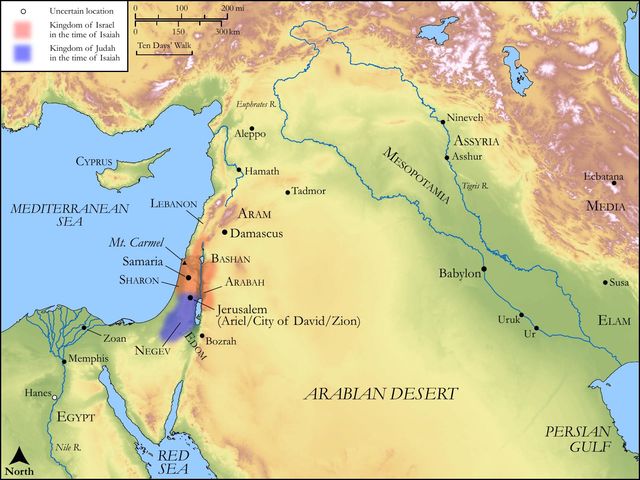
Study this verse
Public-domain commentary
Matthew Henry
From his Commentary on the Whole Bible. Henry comments on passages, not single verses — this entry covers Isaiah 35:5–10. His two-level outline is real structure in the source text, so it is rendered as structure.
"Then, when your God shall come, even Christ, to set up his kingdom in the world, to which all the prophets bore witness, especially towards the conclusion of their prophecies of the temporal deliverances of the church, and this evangelical prophet especially - then look for great things."
I.Wonders shall be wrought in the kingdoms both of nature and grace, wonders of mercy wrought upon the children of men, sufficient to evince that it is no less than a God that comes to us.
1.Wonders shall be wrought on men's bodies (Isa 35:5, Isa 35:6): The eyes of the blind shall be opened; this was often done by our Lord Jesus when he was here upon earth, with a word's speaking, and one he gave sight to that was born blind, Mat 9:27; Mat 12:22; Mat 20:30; Joh 9:6. By his power the ears of the deaf also were unstopped, with one word. Ephphatha - Be opened, Mar 7:34. Many that were lame had the use of their limbs restored so perfectly that they could not only go, but leap, and with so much joy to them that they could not forbear leaping for joy, as that impotent man, Act 3:8. The dumb also were enabled to speak, and then no marvel that they were disposed to sing for joy, Mat 9:32, Mat 9:33. These miracles Christ wrought to prove that he was sent of God (Joh 3:2), nay, working them by his own power and in his own name, he proved that he was God, the same who at first made man's mouth, the hearing ear, and the seeing eye. When he would prove to John's disciples his divine mission he did it by miracles of this kind, in which this scripture was fulfilled.
2.Wonders, greater wonders, shall be wrought on men's souls. By the word and Spirit of Christ those that were spiritually blind were enlightened (Act 26:18), those that were deaf to the calls of God were made to hear them readily, so Lydia, whose heart the Lord opened, so that she attended, Act 16:14. Those that were impotent to every thing that is good by divine grace are made, not only able for it, but active in it, and run the way of God's commandments. Those also that were dumb, and knew not how to speak of God or to God, having their understandings opened to know him, shall thereby have their lips opened to show forth his praise. The tongue of the dumb shall sing for joy, the joy of God's salvation. Praise shall be perfected out of the mouth of babes and sucklings.
II.The Spirit shall be poured out from on high.
There shall be waters and streams, rivers of living water; when our Saviour spoke of these as the fulfilling of the scripture, and most probably of this scripture, the evangelist tells us, He spoke of the Spirit (Joh 7:38, Joh 7:39), as does also this prophet (ch. 32:15); so here (Isa 35:6), in the wilderness, where one would least expect it, shall waters break out. This was fulfilled when the Holy Ghost fell upon the Gentiles that heard the word (Act 10:44); then were the fountains of life opened, whence streams flowed, that watered the earth abundantly. These waters are said to break out, which denotes a pleasing surprise to the Gentile world, such as brought them, as it were, into a new world. The blessed effect of this shall be that the parched ground shall become a pool, Isa 35:7. Those that laboured and were heavily laden, under the burden of guilt, and were scorched with the sense of divine wrath, found rest, and refreshment, and abundant comforts in the gospel. In the thirsty land, where no water was, nor ordinances (Psa 63:1), there shall be springs of water, a gospel ministry, and by that the administration of all gospel ordinances in their purity and plenty, which are the river that makes glad the city of our God, Psa 46:4. In the habitation of dragons, who chose to dwell in the parched scorched ground (Isa 34:9, Isa 34:13), these waters shall flow, and dispossess them, so that, where each lay shall be grass with reeds and rushes, great plenty of useful productions. Thus it was when Christian churches were planted, and flourished greatly, in the cities of the Gentiles, which, for many ages, had been habitations of dragons, or devils rather, as Babylon (Rev 18:2); when the property of the idols' temples was altered, and they were converted to the service of Christianity, then the habitations of dragons became fruitful fields.
III.The way of religion and godliness shall be laid open:
it is here called the way of holiness (Isa 35:8) the way both of holy worship and a holy conversation. Holiness is the rectitude of the human nature and will, in conformity to the divine nature and will. The way of holiness is that course of religious duties in which men ought to walk and press forward, with an eye to the glory of God and their own felicity in the enjoyment of him. "When our God shall come to save us he shall chalk out to us this way by his gospel, so as it had never been before described." 1. It shall be an appointed way; not a way of sufferance, but a highway, a way into which we are directed by a divine authority and in which we are protected by a divine warrant. It is the King's highway, the King of Kings' highway, in which, though we may be waylaid, we cannot be stopped. The way of holiness is the way of God's commandments; it is (as highways usually are) the good old way, Jer 6:16. 2. It shall be an appropriated way, the way in which God will bring his own chosen to himself, but the unclean shall not pass over it, either to defile it or to disturb those that walk in it. It is a way by itself, distinguished from the way of the world, for it is a way of separation from, and nonconformity to, this world. It shall be for those whom the Lord has set apart for himself (Psa 4:3), shall be reserved for them: The redeemed shall walk there, and the satisfaction they take in these ways of pleasantness shall be out of the reach of molestation from an evil world. The unclean shall not pass over it, for it shall be a fair way; those that walk in it are the undefiled in the way, who escape the pollution that is in the world. 3. It shall be a straight way: The wayfaring men, who choose to travel in it, though fools, of weak capacity in other things, shall have such plain directions from the word and Spirit of God in this way that they shall not err therein; not that they shall be infallible even in their own conduct, or that they shall in nothing mistake, but they shall not be guilty of any fatal misconduct, shall not so miss their way but that they shall recover it again, and get well to their journey's end. Those that are in the narrow way, though some may fall into one path and others into another, not all equally right, but all meeting at last in the same end, shall yet never fall into the broad way again; the Spirit of truth shall lead them into all truth that is necessary for them. Note, The way to heaven is a plain way, and easy to hit. God has chosen the foolish things of the world, and made them wise to salvation. Knowledge is easy to him that understands. 4. It shall be a safe way: No lion shall be there, nor any ravenous beast (Isa 35:9), none to hurt or destroy. Those that keep close to this way keep out of the reach of Satan the roaring lion, that wicked one touches them not. Those that walk in the way of holiness may proceed with a holy security and serenity of mind, knowing that nothing can do them any real hurt; they shall be quiet from the fear of evil. It was in Hezekiah's days, some time after the captivity of the ten tribes, that God, being displeased with the colonies settled there, sent lions among them, Kg2 17:25. But Judah keeps her integrity, and therefore no lions shall be there. Those that walk in the way of holiness must separate themselves from the unclean and the ravenous, must save themselves from an untoward generation; hoping that they themselves are of the redeemed, let them walk with the redeemed who shall walk there.
IV.The end of this way shall be everlasting joy, Isa 35:10.
This precious promise of peace now will end shortly in endless joys and rest for the soul. Here is good news for the citizens of Zion, rest to the weary: The ransomed of the Lord, who therefore ought to follow him wherever he goes (Rev 14:4), shall return and come to Zion,
1.To serve and worship God in the church militant: they shall deliver themselves out of Babylon (Zac 2:7), shall ask the way to Zion (Jer 50:5), and shall find the way Isa 52:12. God will open to them a door of escape out of their captivity, and it shall be an effectual door, though there be many adversaries. They shall join themselves to the gospel church, that Mount Zion, that city of the living God, Heb 12:22. They shall come with songs of joy and praise for their deliverance out of Babylon, where they wept upon every remembrance of Zion, Psa 137:1. Those that by faith are made citizens of the gospel Zion may go on their way rejoicing (Act 8:39); they shall sing in the ways of the Lord, and be still praising him. They rejoice in Christ Jesus, and the sorrows and signs of their convictions are made to flee away by the power of divine consolations. Those that mourn are blessed, for they shall be comforted.
2.To see and enjoy God in the church triumphant; those that walk in the way of holiness, under guidance of their Redeemer, shall come to Zion at last, to the heavenly Zion, shall come in a body, shall all be presented together, faultless, at the coming of Christ's glory with exceeding joy (Jde 1:24; Rev 7:17); they shall come with songs. When God's people returned out of Babylon to Zion they came weeping (Jer 50:4); but they shall come to heaven singing a new song, which no man can learn, Rev 14:3. When they shall enter into the joy of their Lord it shall be what the joys of this world never could be everlasting joy, without mixture, interruption, or period. It shall not only fill their hearts, to their own perfect and perpetual satisfaction, but it shall be upon their heads, as an ornament of grace and a crown of glory, as a garland worn in token of victory. Their joy shall be visible, and no longer a secret thing, as it is here in this world; it shall be proclaimed, to the glory of God and their mutual encouragement. They shall then obtain the joy and gladness which they could never expect on this side heaven; and sorrow and sighing shall flee away for ever, as the shadows of the night before the rising sun. Thus these prophecies, which relate to the Assyrian invasion, conclude, for the support of the people of God under that calamity, and to direct their joy, in their deliverance from it, to something higher. Our joyful hopes and prospects of eternal life should swallow up both all the sorrows and all the joys of this present time.
Historical interpretation
Five Centuries of Reception
10 surviving comments on this verse. Each one is dated, so this reads as a timeline rather than a list.
Select a marker to jump to its quote. Markers stagger vertically where authors wrote within a few decades of each other.
“Everlasting joy,” says Isaiah, “shall be upon their heads.” Well, there is nothing eternal until after the resurrection. “And sorrow and sighing,” he continues, “shall flee away.” The angel echoes the same to John: “And God shall wipe away all tears from their eyes,” from the same eyes indeed which had formerly wept and which might weep again if the loving kindness of God did not dry up every fountain of tears. And again: “God shall wipe away all tears from their eyes; and there shall be no more death,” and therefore no more corruption, it being chased away by incorruption, even as death is by immortality.
[God] is the same one who said to Jeremiah, “Behold, I place my words in your mouth as a fire.” David, therefore, also received this tongue of fire, so that he could speak of divine knowledge while enkindled with zeal: “Make known to me my end, O Lord.” He was not here asking about his own death or about the final resurrection. He was inquiring into that end of which the apostle spoke: “For the end will come when the Lord Jesus hands over the kingdom to God the Father and when he destroys every principality and power and when death is the last of all things to be destroyed,” such that evil is defeated and eternal goodness is ignited. Therefore it was said, “Pain and wailing will flee.”
I ask you to consider the condition of the other life, so far as it is possible to consider it; for no words will suffice for an adequate description. But from the things which are told us, as if by means of certain riddles, let us try and get some indistinct vision of it. “Pain and sorrow and sighing,” we read, “have fled away.” What then could be more blessed than this life? It is not possible there to fear poverty and disease. It is not possible to see any one injuring or being injured, provoking or being provoked, or angry, or envious, or burning with any outrageous lust, or anxious concerning the supply of the necessities of life, or bemoaning himself over the loss of some dignity and power. For all the tempest of passion in us is quelled and brought to nothing, and all will be in a condition of peace and gladness and joy, all things serene and tranquil, all will be daylight and brightness, and light, not this present light but one excelling this in splendor as much as daylight is brighter than a lamp. For things are not concealed in that world by night or by a gathering of clouds. Bodies there are not set on fire and burned. For there is neither night nor evening there, nor cold nor heat, nor any other variation of seasons. But the condition is of a different kind, such as only they will know who have been deemed worthy of it. There is no old age there, nor any of the evils of old age, but all things relating to decay are utterly removed, and incorruptible glory reigns in every part. But greater than all these things is the perpetual enjoyment of relationship with Christ in the company of angels and archangels and the higher powers.
What about hope? Will that be there [i.e., in heaven]? Hope will not continue when the thing hoped for is there. Certainly hope is very necessary for us in our exile. It is what consoles us on the journey. When the traveler, after all, finds it wearisome walking along, he puts up with the fatigue precisely because he hopes to arrive. Rob him of any hope of arriving, and immediately his strength for walking is broken. So the hope also which we have here is part and parcel of the justice of our exile and our journey. Listen to the apostle himself. “Awaiting the adoption,” he says, “we cannot yet say there is the bliss of which Scripture says, ‘Toil and groaning have passed away.’ ”
And in fact, if we look with the elevated gaze of our mind at the condition wherein the heavenly and supernal virtues that are truly in the kingdom of God make their home, what else should it be thought to be than perpetual and continual joy? For what belongs so much to true blessedness and so befits it as continual tranquility and everlasting joy?… “They shall receive joy and gladness; sorrow and groaning shall flee away.”
For by these tokens the kingdom of God and the kingdom of the devil are distinguished: and in truth if lifting up our mental gaze on high we would consider that state in which the heavenly powers live on high, who are truly in the kingdom of God, what should we imagine it to be except perpetual and lasting joy? For what is so specially peculiar and appropriate to true blessedness as constant calm and eternal joy? And that you may be quite sure that this, which we say, is really so, not on my own authority but on that of the Lord, hear how very clearly he describes the character and condition of that world. “Behold,” he says, “I create new heavens and a new earth; and the former things shall not be remembered nor come into mind. But you shall be glad and rejoice forever in that which I create.” And again “joy and gladness shall be found therein: thanksgiving and the voice of praise, and there shall be month after month, and sabbath after sabbath.” And again: “They shall obtain joy and gladness; and sorrow and sighing shall flee away.” And if you want to know more definitely about that life and the city of the saints, hear what the voice of the Lord proclaims to the heavenly Jerusalem: “I will make,” he says, “your officers peace and your overseers righteousness. Violence shall no more be heard in your land, desolation nor destruction within your borders. And salvation shall take possession of your walls, and praise of your gates.”
When death is swallowed up in victory, therefore, there will be no corruption of body or soul, for when all iniquity has been removed from us, no infirmity will remain. Indeed, it is about such matters that Isaiah said, “They will obtain joy and gladness; and pain and moaning will flee from them.”
The world is indeed harassed by the evil lives and statements of many people. This attack upon the good and the bad is just like when mud and an ointment are blown on the same wind; the one exhales a foul odor, while the other has a sweet fragrance. In order that everyone may understand this, I will reveal it more explicitly to you, my friend. Good and bad people are two urns, one of which contains rottenness, the other precious spices. When they are blown by the same fan, the urn that has spices gives forth a desirable fragrance, while the one that is a sewer returns an unbearable stench. Similarly, both good and bad people are troubled but are distinguished by the penetrating judgment of God. Whenever tribulation comes to the world, the good like a holy vessel thank God who has deigned to chastise them; those who are proud, dissolute or avaricious on the contrary blaspheme and murmur against God, saying, O God, what great evil have we done that we should suffer such calamities? Therefore, even if the good die in the midst of adversities, they will end a life full of labors and miseries but will receive eternal life from which “sorrow and mourning shall flee away.” Unfaithful souls refuse to believe this, and while fettered with love for this life, they cannot keep it but lose it by their infidelity.
“The one who endures to the end will be saved.” By still referring to this the text goes on reading: “On either side of the river is the tree of life with its twelve kinds of fruit, producing its fruit each month; and the leaves of the tree are for the healing of the nations. Nothing accursed will be found there anymore.” In the twelve months he suggests the idea of all times and designates eternity. Therefore where there is eternal greenness, no aridity will ever be allowed to exist. Where there is perfect and sound health, no infirmity is ever admitted, and also the prophet promises this by saying, “They shall obtain joy and gladness, and sorrow and sighing shall flee away.” “The tree” is the one that we read to be “planted by streams of water,” about which also Jeremiah says “that it sends out its roots by the stream,” that is, places its hope and confidence in the Lord. In another sense the river of the water of life is recognized to signify rightly the fountain itself of life, that is, the Lord Jesus Christ, about whom we read, “For with you is the fountain of life; in your light we see light.”
You are about to journey a long road, and you need many supplies. You shall arrive at the place eternal that has two regions, wherein are many mansions; one of which places God has prepared for them that love him and keep his commandments, full of all manner of good things. And they that attain to it shall live for ever in incorruption, enjoying immortality without death, where pain and sorrow and sighing are fled away. But the other place is full of darkness and tribulation and pain, prepared for the devil and his angels. In it also they shall be cast who by evil deeds have deserved it, who have bartered the incorruptible and eternal for the present world and have made themselves fuel for eternal fire.
Continue studying Isaiah 35:10 across the web’s major study libraries — every link below opens this exact verse, chapter, or book on the destination site.
Read & Compare
 BibleGatewayThis verse in more than 200 translations and 70 languages.
 Bible.comThe YouVersion reader — hundreds of translations, reading plans, and highlights.
 ESV.orgCrossway's official English Standard Version reader.
 NET BibleThe NET translation with 60,000+ translators' notes on every rendering decision.
 STEP BibleTyndale House's free study tool — original text, vocabulary, and scholarly resources.
 BibliaLogos Bible Software's free web reader.
 USCCBThe New American Bible (Revised Edition) with the U.S. bishops' study notes.
Commentaries
 BibleHub CommentariesDozens of classic commentaries on this verse, gathered on one page.
 StudyLightMore than 100 commentary sets — the largest collection on the web.
 BibleRefPlain-English commentary on what this verse means, verse by verse.
 Enduring WordDavid Guzik's free commentary on this chapter, widely used by Bible teachers.
 Bible Study ToolsVerse commentary alongside Greek and Hebrew study aids.
Original Language & Research
- BibleHub InterlinearThe verse word by word — original language, transliteration, and English.
- BibleHub LexiconEvery word's original-language definition and Strong's entry.
 Blue Letter BibleDeep-study tools — Strong's numbers, concordance, and word studies.
 SefariaThe Hebrew text with Rashi and centuries of Jewish commentary.
Sermons, Hymns & Audio


TrulyRandomVerse is not affiliated with these sites and doesn’t control their content. They’re linked because they’re genuinely useful.
Summary
Isaiah 35:10 culminates a magnificent prophetic vision of restoration, declaring the triumphant return of God's redeemed people to Zion. This verse paints a vivid picture of a future marked by perpetual celebration, where those whom the LORD has ransomed will arrive with exuberant songs and everlasting joy crowning their heads, utterly free from sorrow and sighing, which will have completely vanished. It is a powerful affirmation of God's faithfulness to deliver His people into a state of ultimate peace and unblemished happiness, a glorious end to their suffering and exile.
Context
ShowHideLiterary Context
Isaiah 35 serves as a glorious climax following chapters of divine judgment and impending desolation, particularly the pronouncements against the nations in Isaiah 34. It acts as a pivotal bridge, transitioning from warnings of destruction to the profound comfort and hope found in the "Book of Comfort" (beginning with Isaiah 40). Chapter 35 itself is a rich tapestry of transformed creation, where the wilderness blossoms like a rose, and the blind, deaf, and lame are miraculously healed (Isaiah 35:5-6). This miraculous transformation sets the stage for the "highway of holiness" (Isaiah 35:8), a divinely prepared path upon which the redeemed will travel. Verse 10 provides the triumphant conclusion to this vision, summarizing the ultimate destination and blessed state of those who walk on this sacred path, emphasizing their joy and the complete absence of suffering.
Historical & Cultural Context
The prophecies in Isaiah were delivered during a period of significant geopolitical turmoil, primarily the looming Assyrian threat in the 8th century BCE, and later, looking forward to the Babylonian exile in the 6th century BCE. The concept of "return" (Hebrew: shûwb) was deeply resonant for a people facing or enduring displacement and captivity, promising a reversal of their fortunes and a re-establishment in their homeland. Zion, or Jerusalem, was not merely a geographical location but the spiritual heart of Israel, the dwelling place of God, and the center of their worship and national identity. The imagery of "songs" and "joy upon their heads" reflects celebratory customs in Israel and among the nations round about, where garlands or crowns were worn during festivals and triumphs to signify joy, victory, and honor, making their joy visible and public. The promise of the complete eradication of "sorrow and sighing" speaks directly to the deep suffering, lament, and anguish experienced by the people during times of oppression, exile, and national humiliation.
Key Themes
ShowHideIsaiah 35:10 encapsulates several major theological and narrative themes prevalent throughout Isaiah and the broader prophetic literature. Divine Redemption is central, highlighting God's active and powerful role in delivering His people from bondage, whether literal captivity or spiritual enslavement. This redemption inevitably leads to Restoration, not just of land and physical well-being but of their relationship with God and their inner state. The chapter, and especially this verse, is saturated with Eschatological Hope, pointing beyond immediate historical events to a final, perfect future state under God's righteous rule, where all wrongs are righted. The Transformation of Creation is depicted as the miraculous backdrop for this return, emphasizing that God's redemptive work extends to all of creation, making a way in the wilderness. Finally, the promise of "everlasting joy" and the utter absence of sorrow underscores God's ultimate victory over suffering and His commitment to providing His people with Unending Peace and Gladness, a state of perfect shalom.
Exposition and Analysis
ShowHideKey Word Analysis
ShowHideA primitive root meaning "to sever, i.e. ransom; gener. to release, preserve." This word implies a deliberate, costly act of liberation, where a price is paid or an intervention is made to secure freedom. It speaks to God's sovereign initiative in delivering His people from bondage, whether from literal captivity (like the Babylonian exile) or the metaphorical chains of sin and oppression. The "ransomed of the LORD" are those who have been bought back and set free by divine intervention, signifying their special relationship and ownership by God.
Properly "concealed, i.e. the vanishing point; generally, time out of mind (past or future), i.e. (practically) eternity." When applied to joy, it denotes a quality that is not subject to the passage of time, the fading of circumstances, or the vicissitudes of life. This joy is permanent, unending, and eternal, standing in stark contrast to the fleeting pleasures and temporary happiness found in the world. It signifies a state of perpetual blessedness and an enduring quality of divine favor.
A primitive root meaning "to flit, i.e. vanish away (subside, escape; causatively, chase, impel, deliver)." This powerful verb emphasizes the complete and utter disappearance of sorrow and sighing. It's not just a lessening or a temporary relief, but a total eradication, as if these negative experiences are so repelled by the overwhelming presence of God's joy and glory that they cannot remain and must utterly vanish from existence, leaving no trace behind.
Verse Breakdown
ShowHide"And the ransomed of the LORD shall return"
This phrase identifies the subjects of the prophecy: those who have been delivered and redeemed by God's mighty hand. The act of "returning" signifies a restoration from a state of exile, captivity, or spiritual estrangement, encompassing both physical homecoming to Zion and a spiritual return to fellowship with God. It highlights God's ownership of His people and His active role in their liberation and homecoming.
"and come to Zion with songs and everlasting joy upon their heads"
This describes the manner and destination of their return. Zion, representing Jerusalem and God's holy dwelling place, is the ultimate goal, symbolizing the secure and blessed presence of God. Their arrival is not somber but triumphant and celebratory, marked by "songs"—expressions of exuberant praise, gratitude, and victory. The "everlasting joy upon their heads" symbolizes a joy that is not only internal but outwardly visible, permanent, and crowning, perhaps alluding to garlands or crowns worn in ancient celebrations, signifying a public, unceasing, and undeniable gladness that adorns them.
"they shall obtain joy and gladness"
This clause reinforces the previous statement, emphasizing the secure and enduring possession of these positive emotions. "Obtain" (Hebrew: nâsag) implies reaching for, grasping, and taking firm hold of, suggesting that joy and gladness are not merely fleeting feelings but an inherent and abiding state that they will fully grasp, experience, and possess as a permanent reality in God's presence.
"and sorrow and sighing shall flee away"
This climactic declaration signifies the complete and utter absence of suffering and pain. "Sorrow" (Hebrew: yâgôwn) refers to deep grief, affliction, and distress, while "sighing" (Hebrew: ʼănâchâh) denotes groaning, anguish, and the expression of profound inner pain. The active verb "flee away" portrays these negative experiences as being utterly banished, actively retreating and disappearing, unable to withstand the overwhelming presence of God's redemptive joy and peace, leaving no trace behind.
Literary Devices
ShowHideIsaiah 35:10 masterfully employs several Literary Devices to convey its powerful message of hope and restoration. Personification is strikingly evident in the phrase "sorrow and sighing shall flee away," giving human-like agency to abstract concepts, vividly illustrating their complete and active departure from the redeemed. The phrase "everlasting joy upon their heads" utilizes Hyperbole to emphasize the overwhelming, visible, and perpetual nature of the joy, suggesting it is so abundant it overflows and crowns them as a permanent adornment. Parallelism is employed with "joy and gladness" and "sorrow and sighing," creating a stark Antithesis that highlights the dramatic and complete transformation from a state of suffering to one of unadulterated delight. Furthermore, Zion serves as a powerful Symbolism, representing not just a physical city but the ultimate spiritual destination, God's dwelling place, and the locus of divine blessing, security, and eternal peace for the redeemed. The entire verse functions as a Climax to the preceding descriptions of wilderness transformation and the highway of holiness, providing a triumphant and glorious conclusion to the prophetic vision.
Theological and Thematic Connections
ShowHideIsaiah 35:10 stands as a profound testament to God's unwavering commitment to His covenant people, revealing His character as a faithful Redeemer who not only delivers from bondage but also ushers His beloved into a state of consummate joy and peace. The verse powerfully articulates an eschatological hope, where the ultimate triumph of God's kingdom means the complete eradication of all suffering and the establishment of an eternal reign of gladness. It underscores that true and lasting joy is found in God's presence and is an inherent outcome of His redemptive work, a joy that is not subject to the fleeting circumstances of this world but is everlasting. This vision assures believers that current trials and sorrows are temporary, overshadowed by the certainty of a glorious future with God, a future defined by His unfailing love and the fullness of His presence.
Reflection and Application
ShowHideIsaiah 35:10 offers an enduring wellspring of hope and comfort for believers navigating the complexities and challenges of life in a fallen world. It reminds us that our present sufferings, no matter how profound or prolonged, are ultimately temporary and do not define our eternal destiny. The promise that "sorrow and sighing shall flee away" provides a powerful anchor for the soul, assuring us that a future awaits where all tears will be wiped away and all pain will cease. This verse calls us to cultivate an eternal perspective, allowing the certainty of God's ultimate redemption and the promise of everlasting joy to shape our present attitudes and actions. It encourages us to live with an expectant hope, knowing that our God is faithful to His promises and that our ultimate destination is a place of unblemished gladness in His presence. Even now, we can experience foretastes of this joy as we walk in fellowship with the Lord, anticipating the glorious fullness of His coming kingdom.
Questions for Reflection
ShowHideFAQ
ShowHideWho are "the ransomed of the LORD" mentioned in this verse?
ShowHideHistorically, "the ransomed of the LORD" primarily referred to the Israelites delivered from Babylonian exile, returning to their homeland. Theologically, and in a broader, more profound sense, it refers to all people whom God has redeemed from the bondage of sin, death, and spiritual captivity through His mighty power. This includes all believers who have been set free by God's grace and brought into His covenant, purchased by the precious blood of Christ.
What does "joy upon their heads" signify?
ShowHideThis vivid imagery suggests a joy that is not merely internal but outwardly visible, overflowing, and crowning. It likely alludes to ancient cultural practices where garlands, wreaths, or festive headwear were worn during celebrations, festivals, or triumphs. Thus, "joy upon their heads" means their joy is undeniable, publicly displayed, and an adornment, signifying a state of perpetual celebration, honor, and victory. It speaks to a joy so profound and permanent that it becomes a visible characteristic of the redeemed, a constant mark of their blessed state.
How does this verse relate to the Christian hope for the future?
ShowHideIsaiah 35:10 provides a powerful prophetic glimpse into the ultimate eschatological hope for believers. It assures us that the suffering, sorrow, and sighing that characterize our fallen world are temporary and will not have the final word. The promise that these negative experiences will "flee away" points directly to the New Heavens and New Earth, where God will dwell with His people, and there will be no more death, mourning, crying, or pain (Revelation 21:4). It undergirds the Christian belief in a future of perfect, unending joy and peace in the eternal presence of God, a fulfillment made possible solely through Christ's redemptive work.
Christ-Centered Fulfillment
ShowHideIsaiah 35:10 finds its ultimate and most profound fulfillment in Jesus Christ, the Messiah. The "ransomed of the LORD" are those whom Christ has purchased with His own precious blood, delivering them from the bondage of sin and death, as 1 Peter 1:18-19 declares. The "highway of holiness" mentioned earlier in Isaiah 35:8 is none other than Christ Himself, who is "the way, the truth, and the life" (John 14:6), through whom we come to the Father and find access to God's holy presence. The return to "Zion" is fulfilled in the spiritual reality of the church, the heavenly Jerusalem, to which believers have already come by faith (Hebrews 12:22-24), and ultimately in the new heavens and new earth where God's dwelling is eternally with humanity (Revelation 21:3). The "everlasting joy" is the joy of salvation, a fruit of the Holy Spirit (Galatians 5:22), and the certain promise of eternal life in Christ's presence, where "in your presence there is fullness of joy; at your right hand are pleasures forevermore" (Psalm 16:11). Finally, the promise that "sorrow and sighing shall flee away" is the glorious culmination of Christ's decisive victory over sin and its devastating consequences, a reality fully realized in the eternal state where God Himself will wipe away every tear from our eyes (Revelation 21:4). Thus, Isaiah 35:10 is a vibrant prophecy of the comprehensive redemption and eternal blessedness secured for us through the finished, all-sufficient work of Jesus Christ.