


Acts 3:6
- ΕἶπενEipenSaidG2036V-2AAI-3SVerb 2nd Aorist Active Indicative 3rd Singular
- δὲdehoweverG1161CONJConjunction
- Πέτρος·PetrosPeterG4074N-NSM-PNoun Nominative Singular Masculine Individual
- ἀργύριονargurionSilverG694N-NSNNoun Nominative Singular Neuter
- καὶkaiandG2532CONJConjunction
- χρυσίονchrusiongoldG5553N-NSNNoun Nominative Singular Neuter
- οὐχouchnoneG3756PRT-NNegative Particle Negative
- ὑπάρχειhuparcheithere isG5225V-PAI-3SVerb Present Active Indicative 3rd Singular
- μοι·moito meG3165P-1DSPersonal pronoun Dative 1st Singular
- ὃhowhatG3739R-ASNRelative pronoun Accusative Singular Neuter
- δὲdehoweverG1161CONJConjunction
- ἔχωechōI haveG2192V-PAI-1SVerb Present Active Indicative 1st Singular
- τοῦτόtoutothisG3778D-ASNDemonstrative pronoun Accusative Singular Neuter
- σοιsoito youG4771P-2DSPersonal pronoun Dative 2nd Singular
- δίδωμιdidōmiI giveG1325V-PAI-1SVerb Present Active Indicative 1st Singular
- ἐνenInG1722PREPPreposition
- τῷtōtheG3588T-DSNDefinite article Dative Singular Neuter
- ὀνόματιonomatinameG3686N-DSNNoun Dative Singular Neuter
- ἸησοῦIēsouof JesusG2424N-GSM-PNoun Genitive Singular Masculine Individual
- ΧριστοῦChristouChristG5547N-GSM-TNoun Genitive Singular Masculine Title
- τοῦtou<the>G3588T-GSMDefinite article Genitive Singular Masculine
- ΝαζωραίουNazōraiouof NazarethG3480N-GSM-LGNoun Genitive Singular Masculine Location Gentilic
- ἔγειρεegeiredo rise upG1453V-PAM-2SVerb Present Active Imperative 2nd Singular
- καὶkaiandG2532CONJConjunction
- περιπάτειperipateido walkG4043V-PAM-2SVerb Present Active Imperative 2nd Singular
English is a literal word-by-word gloss of the Greek, not the KJV's wording. Why?
This is the original text the KJV's translators worked from — each Greek word with its own literal English meaning in this verse, prepared by scholars at Tyndale House, Cambridge. The KJV translates whole sentences, not word by word, so its wording differs: one Greek word can become several English words, and the KJV may choose “charity” where the gloss reads “love”. Both are faithful — they answer different questions. For the KJV's own rendering, switch to the KJV text.
Details
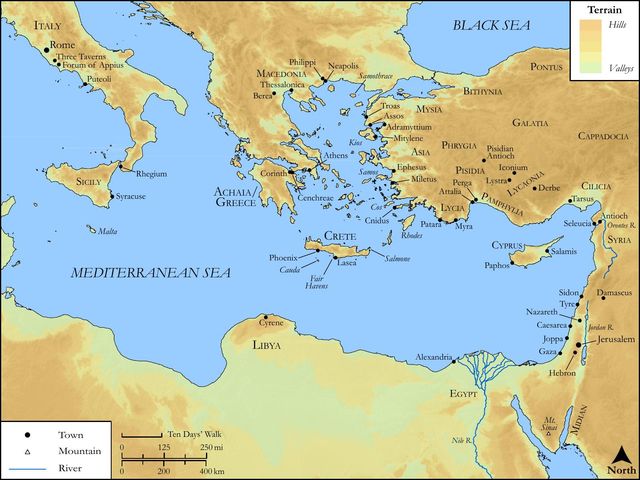
See on the biblical-era map
Study this verse
Public-domain commentary
Matthew Henry
From his Commentary on the Whole Bible. Henry comments on passages, not single verses — this entry covers Acts 3:1–11. His four-level outline is real structure in the source text, so it is rendered as structure.
We were told in general (Act 2:43) that many signs and wonders were done by the apostles, which are not written in this book; but here we have one given us for an instance. As they wrought miracles, not upon every body as every body had occasion for them, but as the Holy Spirit gave direction, so as to answer the end of their commission; so all the miracles they did work are not written in this book, but such only are recorded as the Holy Ghost thought fit, to answer the end of this sacred history.
I.The persons by whose ministry this miracle was wrought were Peter and John, two principal men among the apostles; they were so in Christ's time, one speaker of the house for the most part, the other favourite of the Master; and they continue so. When, upon the conversion of thousands, the church was divided into several societies, perhaps Peter and John presided in that which Luke associated with, and therefore he is more particular in recording what they said and did, as afterwards what Paul said and did when he attended him, both the one and the other being designed for specimens of what the other apostles did.
Peter and John had each of them a brother among the twelve, with whom they were coupled when they were sent out; yet now they seem to be knit together more closely than either of them to his brother, for the bond of friendship is sometimes stronger than that of relation: there is a friend that sticks closer than a brother. Peter and John seem to have had a peculiar intimacy after Christ's resurrection more than before, Joh 20:2. The reason of which (if I may have liberty to conjecture) might be this, that John, a disciple made up of love, was more compassionate to Peter upon his fall and repentance, and more tender of him in his bitter weeping for his sin, than any other of the apostles were, and more solicitous to restore him in the spirit of meekness, which made him very dear to Peter ever after; and it was good evidence of Peter's acceptance with God, upon his repentance, that Christ's favourite was made his bosom friend. David prayed, after his fall, Let those that fear thee turn unto me, Psa 119:79.
II.The time and place are here set down.
1.It was in the temple, whither Peter and John went up together, because it was the place of concourse; there were the shoals of fish among which the net of the gospel was to be cast, especially during the days of pentecost, within the compass of which we may suppose this to have happened. Note, It is good to go up to the temple, to attend on public ordinances; and it is comfortable to go up together to the temple: I was glad when they said unto me, Let us go. The best society is society in worshipping God.
2.It was at the hour of prayer, one of the hours of public worship commonly appointed and observed among the Jews. Time and place are two necessary circumstances of every action, which must be determined by consent, as is most convenient for edification. With reference to public worship, there must be a house of prayer and an hour of prayer: the ninth hour, that is, three o'clock in the afternoon, was one of the hours of prayer among the Jews; nine in the morning and twelve at noon were the other two. See Psa 55:17; Dan 6:10. It is of use for private Christians so far to have their hours of prayer as may serve, though not to bind, yet to remind conscience: every thing is beautiful in its season.
III.The patient on whom this miraculous cure was wrought is here described, Act 3:2.
He was a poor lame beggar at the temple gate. 1. he was a cripple, not by accident, but born so; he was lame from his mother's womb, as it should seem, by a paralytic distemper, which weakened his limbs; for it is said in the description of his cure (Act 3:7), His feet and ankle bones received strength. Some such piteous cases now and then there are, which we ought to be affected with and look upon with compassion, and which are designed to show us what we all are by nature spiritually: without strength, lame from our birth, unable to work or walk in God's service. 2. He was a beggar. Being unable to work for his living, he must live upon alms; such are God's poor. He was laid daily by his friends at one of the gates of the temple, a miserable spectacle, unable to do any thing for himself but to ask alms of those that entered into the temple or came out. There was a concourse, - a concourse of devout good people, from whom charity might be expected, and a concourse of such people when it might be hoped they were in the best frame; and there he was laid. Those that need, and cannot work, must not be ashamed to beg. He would not have been laid there, and laid there daily, if he had not been used to meet with supplies, daily supplies there. Note, Our prayers and our alms should go together; Cornelius's did, Act 10:4. Objects of charity should be in a particular manner welcome to us when we go up to the temple to pray; it is a pity that common beggars at church doors should any of them be of such a character as to discourage charity; but they ought not always to be overlooked: some there are surely that merit regard, and better feed ten drones, yea, and some wasps, than let one bee starve. The gate of the temple at which he was laid is here named: it was called Beautiful, for the extraordinary splendour and magnificence of it. Dr. Lightfoot observes that this was the gate that led out of the court of the Gentiles into that of the Jews, and he supposes that the cripple would beg only of the Jews, as disdaining to ask any thing of the Gentiles. But Dr. Whitby takes it to be at the first entrance into the temple, and beautified sumptuously, as became the frontispiece of that place where the divine Majesty vouchsafed to dwell; and it was no diminution to the beauty of this gate that a poor man lay there begging. 3. He begged of Peter and John (Act 3:3), begged an alms; this was the utmost he expected from them, who had the reputation of being charitable men, and who, though they had not much, yet did good with what they had. It was not many weeks ago that the blind and the lame came to Christ in the temple, and were healed there, Mat 21:14. And why might not he have asked more than an alms, if he knew that Peter and John were Christ's messengers, and preached and wrought miracles in his name? But he had that done for him which he looked not for; he asked an alms, and had a cure.
IV.We have here the method of the cure.
1.His expectations were raised. Peter, instead of turning his eyes form him, as many do from objects of charity, turned his eyes to him, nay, he fastened his eyes upon him, that his eye might affect his heart with compassion towards him, Act 3:4. John did so too, for they were both guided by one and the same Spirit, and concurred in this miracle; they said, Look on us. Our eye must be ever towards the Lord (the eye of our mind), and, in token of this, the eye of the body may properly be fixed on those whom he employs as the ministers of his grace. This man needed not to be bidden twice to look on the apostles; for he justly thought this gave him cause to expect that he should receive something form them, and therefore he gave heed to them, Act 3:5. Note, We must come to God both to attend on his word and to apply ourselves to him in prayer, with hearts fixed and expectations raised. We must look up to heaven and expect to receive benefit by that which God speaks thence, and an answer of peace to the prayers sent up thither. I will direct my prayer unto thee, and will look up.
2.His expectation of an alms was disappointed. Peter said, "Silver and gold have I none, and therefore none to give thee;" yet he intimated that if he had had any he would have given him an alms, not brass, but silver or gold. Note,
(1.)It is not often that Christ's friends and favourites have abundance of the wealth of this world. The apostles were very poor, had but just enough for themselves, and no overplus. Peter and John had abundance of money laid at their feet, but this was appropriated to the maintenance of the poor of the church, and they would not convert any of it to their own use, nor dispose of it otherwise than according tot he intention of the donors. Public trusts ought to be strictly and faithfully observed.
(2.)Many who are well inclined to works of charity are yet not in a capacity of doing any thing considerable, while others, who have wherewithal to do much, have not a heart to do any thing.
3.His expectations, notwithstanding, were quite outdone. Peter had not money to give him; but,
(1.)He had that which was better, such an interest in heaven, such a power from heaven, as to be able to cure his disease. Note, Those who are poor in the world may yet be rich, very rich, in spiritual gifts, graces, and comforts; certainly there is that which we are capable of possessing which is infinitely better than silver and gold; the merchandise and gain of it are better, Job 28:12, etc.; Pro 3:14, etc.
(2.)He gave him that which was better - the cure of his disease, which he would gladly have given a great deal of silver and gold for, if he had had it, and the cure could have been so obtained. This would enable him to work for his living, so that he would not need to beg any more; nay, he would have to give to those that needed, and it is more blessed to give than to receive. A miraculous cure would be a greater instance of God's favour, and would put a greater honour upon him, than thousands of gold and silver could. observe, When Peter had no silver and gold to give, yet (says he) such as I have I give thee. Note, Those may be, and ought to be, otherwise charitable and helpful to the poor, who have not wherewithal to give in charity; those who have not silver and gold have their limbs and senses, and with these may be serviceable to the blind, and lame, and sick, and if they be not, as there is occasion, neither would they give to them if they had silver and gold. As every one hath received the gift, so let him minister it. Let us now see how the cure was wrought.
[1.]Christ sent his word, and healed him (Psa 107:20); for healing grace is given by the word of Christ; this is the vehicle of the healing virtue derived from Christ. Christ spoke cures by himself; the apostles spoke them in his name. Peter bids a lame man rise up and walk, which would have been a banter upon him if he had not premised in the name of Jesus Christ of Nazareth: "I say it by warrant from him, and it shall be done by power from him, and all the glory and praise of it shall be ascribed to him." He calls Christ Jesus of Nazareth, which was a name of reproach, to intimate that the indignities done him on earth served but as a foil to his glories now that he was in heaven. "Give him what name you will, call him if you will in scorn Jesus of Nazareth, in that name you shall see wonders done; for, because he humbled himself, thus highly was he exalted." He bids the cripple rise up and walk, which does not prove that he had power in himself to do it, but that if he attempt to rise and walk, and, in a sense of his own impotency, depend upon a divine power to enable him to do it, he shall be enabled; and by rising and walking he must evidence what that power has wrought upon him; and then let him take the comfort, and let God have the praise. Thus it is in the healing of our souls, which are spiritually impotent.
[2.]Peter lent his hand, and helped him (Act 3:7): He took him by the right hand, in the same name in which he had spoken to him to arise and walk, and lifted him up. Not that this could contribute any thing to his cure; but it was a sign, plainly intimating the help he should receive from God, if he exerted himself as he was bidden. When God by his word commands us to rise, and walk in the way of his commandments, if we mix faith with that word, and lay our souls under the power of it, he will give his Spirit to take us by the hand, and lift us up. If we set ourselves to do what we can, God has promised his grace to enable us to do what we cannot; and by that promise we partake of a new nature, and that grace shall not be in vain; it was not here: His feet and ankle-bones received strength, which they had not done if he had not attempted to rise, and been helped up; he does his part, and Peter does his, and yet it is Christ that does all: it is he that puts strength into him. As the bread was multiplied in the breaking, and the water turned into wine in the pouring out, so strength was given to the cripple's feet in his stirring them and using them.
V.Here is the impression which this cure made upon the patient himself, which we may best conceive of if we put our soul into his soul's stead.
1.He leaped up, in obedience to the command, Arise. He found in himself such a degree of strength in his feet and ankle-bones that he did not steal up gently, with fear and trembling, as weak people do when they begin to recover strength; but he started up, as one refreshed with sleep, boldly, and with great agility, and as one that questioned not his own strength. The incomes of strength were sudden, and he was no less sudden in showing them. He leaped, as one glad to quit the bed or pad of straw on which he had lain so long lame.
2.He stood, and walked. He stood without either leaning or trembling, stood straight up, and walked without a staff. He trod strongly, and moved steadily; and this was to manifest the cure, and that it was a thorough cure. Note, Those who have had experience of the working of divine grace upon them should evidence what they have experienced. Has God put strength into us? Let us stand before him in the exercises of devotion; let us walk before him in all the instances of a religious conversation. Let us stand up resolutely for him, and walk cheerfully with him, and both in strength derived and received form him.
3.He held Peter and John, Act 3:11. We need not ask why he held them. I believe he scarcely knew himself: but it was in a transport of joy that he embraced them as the best benefactors he had ever met with, and hung upon them to a degree of rudeness; he would not let them go forward, but would have them stay with him, while he published to all about him what God had done for him by them. Thus he testified his affection to them; he held them, and would not let them go. Some suggest that he clung to them for fear lest, if they should leave him, his lameness should return. Those whom God hath healed love those whom he made instruments of their healing, and see the need of their further help.
4.He entered with them into the temple. His strong affection to them held them; but it could not hold them so fast as to keep them out of the temple, whither they were going to preach Christ. We should never suffer ourselves to be diverted by the utmost affectionate kindnesses of our friends from going in the way of our duty. But, if they will not stay with him, he is resolved to go with them, and the rather because they are going into the temple, whence he had been so long kept by his weakness and his begging: like the impotent man whom Christ cured, he was presently found in the temple, Joh 5:14. He went into the temple, not only to offer up his praises and thanksgivings to God, but to hear more from the apostles of that Jesus in whose name he had been healed. Those that have experienced the power of Christ should earnestly desire to grow in their acquaintance with Christ.
5.He was there walking, and leaping, and praising God. Note, The strength God has given us, both in mind and body, should be made us of to his praise, and we should study how to honour him with it. Those that are healed in his name must walk up and down in his name and in his strength, Zac 10:12. This man, as soon as he could leap, leaped for joy in God, and praised him. Here was that scripture fulfilled (Isa 35:6): Then shall the lame man leap as a hart. Now that this man was newly cured he was in this excess of joy and thankfulness. All true converts walk and praise God; but perhaps young converts leap more in his praises.
VI.How the people that were eye-witnesses of this miracle were influenced by it we are next told.
1.They were entirely satisfied in the truth of the miracle, and had nothing to object against it. They knew it was he that sat begging at the beautiful gate of the temple, Act 3:10. He had sat there so long that they all knew him; and for this reason he was chosen to be the vessel of this mercy. Now they were not so perverse as to make any doubt whether he was the same man, as the Pharisees had questioned concerning the blind man that Christ cured, Joh 9:9, Joh 9:18. They now saw him walking, and praising God (Act 3:9), and perhaps took notice of a change in his mind; for he was now as loud in praising God as he had before been in begging relief. The best evidence that it was a complete cure was that he now praised God for it. Mercies are then perfected, when they are sanctified.
2.They were astonished at it: They were filled with wonder and amazement (Act 3:10); greatly wondering, Act 3:11. They were in an ecstasy. There seems to have been this effect of the pouring out of the Spirit, that the people, at least those in Jerusalem, were much more affected with the miracles the apostles wrought than they had been with those of the same kind that had been wrought by Christ himself; and this was in order to the miracles answering their end.
3.They gathered about Peter and John: All the people ran together unto them in Solomon's porch: some only to gratify their curiosity with the sight of men that had such power; others with a desire to hear them preach, concluding that their doctrine must needs be of divine origin, which thus had a divine ratification. They flocked to them in Solomon's porch, a part of the court of the Gentiles, where Solomon had built the outer porch of the temple; or, some cloisters or piazzas which Herod had erected upon the same foundation upon which Solomon had built the stately porch that bore his name, Herod being ambitious herein to be a second Solomon. Here the people met, to see this great sight.
Historical interpretation
Five Centuries of Reception
13 surviving comments on this verse. Each one is dated, so this reads as a timeline rather than a list.
Select a marker to jump to its quote. Markers stagger vertically where authors wrote within a few decades of each other.
And immediately his legs and his feet received strength; and he walked, and entered with them into the temple, walking, and leaping, and praising God."
Do you see the riches of Christ’s ministers? Do you see the greatness and nature of the gifts they bestow when they have nothing? Earthly possession cannot bestow those riches.
That the lust of possessing, and money, are not to be sought for. In Solomon, in Ecclesiasticus: "He that loveth silver shall not be satisfied with silver." Also in Proverbs: "He who holdeth back the corn is cursed among the people; but blessing is on the head of him that communicateth it." Also in Isaiah: "Woe unto them who join house to house, and lay field to field, that they may take away something from their neighbour. Will ye dwell alone upon the earth? Also in Zephaniah: "They shall build houses, and shall not dwell in them; and they shall appoint vineyards, and shall not drink the wine of them, because the day of the Lord is near." Also in the Gospel according to Luke: "For what does it profit a man to make a gain of the whole world, but that he should lose himself? " And again: "But the Lord said unto him, Thou fool, this night thy soul is required of thee. Whose, then, shall those things be which thou hast provided? " And again: "Remember that thou hast received thy good things in this life. and likewise Lazarus evil things. But now he is besought, and thou grievest." And in the Acts of the Apostles: "But Peter said unto him, Silver and gold indeed I have not; but what I have I give unto you: In the name of Jesus Christ of Nazareth, rise up and walk. And, taking hold of his right hand, he lifted him up." Also in the first to Timothy: "We brought nothing into this world, but neither can we take anything away. Therefore, having maintenance and clothing, let us with these be content. But they who will become rich fall into temptation and a snare, and many and hurtful lusts, which drown man in perdition and destruction. For the root of all evils is covetousness, which some coveting, have made shipwreck from the faith, and have plunged themselves in many sorrows."
And who would not be astonished at their indifference to money, certified by their not turning from but welcoming a Master who forbade the possession of gold and silver, whose law did not even allow the acquisition of a second coat? Why, anyone only hearing such a law might reject it as too heavy, but these men are shown to have carried out the words in fact.
Faith is superior to rational methodologies when it comes to drawing the soul to assent. It is not the logical necessity of deductive proofs that engenders faith, but the activity of the Spirit. In the name of Jesus Christ of Nazareth, arise and walk! [Acts 3.6]. What followed this command was the work of the Spirit, and those who witnessed this miracle were compelled to admit the divinity of the Only-Begotten. Tell me, what is more compelling for assent, a complicated set of syllogistic premises entailing the logical conclusion, or a clearly seen miracle so great that it surpasses all that is humanly possible? Yet currently such things are not held in high regard. Indeed, what now inspires confidence when discussing God is not the works of the Spirit, but rather elaborate demonstrations which place their hope in the plausibility of the wisdom of the world, not in the powerful and clear revelation of the Spirit. It was through those who believed God in simplicity of heart without engaging in futile investigations that the Spirit gave this revelation for the salvation of many. - "On Psalm 115. Chapter 1."
So he gave not money, but he gave health. How much better it is to have health without money, than money without health! The lame man rose; he had not hoped for that: he received no money; though he had hoped for that. But riches are hardly to be found among the saints of the Lord, so as to become objects of contempt to them.
Such sort of persons were the Jews; lame, and the right thing being to ask for health, these same ask for money, grovelling on the ground: for this it was that they beset the temple-to get money. What then does Peter? He did not despise him; he did not look about for some rich subject; he did not say, If the miracle is not done to some great one, nothing great is done: he did not look for some honor from him, no, nor heal him in the presence of people; for the man was at the entrance, not where the multitude were, that is, within. But Peter sought no such object; nor upon entering did he proclaim the matter: no, it was by his bearing that he attracted the lame man to ask.
Let no one then be humiliated on account of his poverty: It is not poverty that humiliates, but wealth, which compels us to have need of many and forces us to be under obligations to many.… So, if poverty had made people wanting in boldness, Christ would not have sent his disciples with poverty to a work requiring great boldness. For the poor person is very strong and has nothing of which he may be wronged or evil to be prayed for. But the rich person is assailable on every side: just in the same way as one would easily catch a person who was dragging many long ropes after him, whereas one could not readily lay hold on a naked person. So here also it does not succeed in the case of the rich person: slaves, gold, lands, affairs innumerable, innumerable cares, difficult circumstances, necessities, make him an easy prey to all.
"Silver and gold," he says, "have I none." He does not say, I have none here, as we are wont to speak, but absolutely, I have none. "What then?" he might say, "do you take no notice of me, your suppliant?" Not so, but of what I have, receive thou. Do you remark how unassuming Peter is, how he makes no display even to the object of his beneficence?
But hitherto they always call Him, "of Nazareth." "In the name of Jesus Christ of Nazareth," said Peter, walk. For in the first instance, the thing required was, that He should be believed in.
Those men who received power from God never used that power as if it were their own but referred the power to him from whom they received it; for the power itself could never have any force except through the name of him who gave it. And so both the apostles and all the servants of God never did anything in their own name but in the name and invocation of Christ. For the power itself derived its force from the same source as its origin, and it could not be given through the instrumentality of the ministers, unless it had come from the Author.
What more sublime than this humility? what richer than this poverty?
Silver and gold have I none, etc. Indeed, the old tabernacle had the justifications of worship, and the secular sanctuary distinguished by gold and silver, but the blood of the Gospel shines more precious than the metals of the law, because the people who before lay mentally weak at the gilded posts, healed in the name of the Crucified, enter the temple of the heavenly kingdom. Otherwise, the blessed Peter, mindful of the Lord's precept, which says: Do not possess gold and silver (Matt. X), used to preserve the money placed at the apostles' feet not for himself, but for the use of the poor, who had left their patrimonies.
Continue studying Acts 3:6 across the web’s major study libraries — every link below opens this exact verse, chapter, or book on the destination site.
Read & Compare
 BibleGatewayThis verse in more than 200 translations and 70 languages.
 Bible.comThe YouVersion reader — hundreds of translations, reading plans, and highlights.
 ESV.orgCrossway's official English Standard Version reader.
 NET BibleThe NET translation with 60,000+ translators' notes on every rendering decision.
 STEP BibleTyndale House's free study tool — original text, vocabulary, and scholarly resources.
 BibliaLogos Bible Software's free web reader.
 USCCBThe New American Bible (Revised Edition) with the U.S. bishops' study notes.
Commentaries
 BibleHub CommentariesDozens of classic commentaries on this verse, gathered on one page.
 StudyLightMore than 100 commentary sets — the largest collection on the web.
 BibleRefPlain-English commentary on what this verse means, verse by verse.
 Enduring WordDavid Guzik's free commentary on this chapter, widely used by Bible teachers.
 Bible Study ToolsVerse commentary alongside Greek and Hebrew study aids.
Original Language & Research
- BibleHub InterlinearThe verse word by word — original language, transliteration, and English.
- BibleHub LexiconEvery word's original-language definition and Strong's entry.
 Blue Letter BibleDeep-study tools — Strong's numbers, concordance, and word studies.
 CNTR CollationThe earliest Greek manuscripts of this verse, collated letter by letter.
Sermons, Hymns & Audio


TrulyRandomVerse is not affiliated with these sites and doesn’t control their content. They’re linked because they’re genuinely useful.
Summary
Acts 3:6 captures a pivotal moment in the early church's ministry, where Peter, confronted by a man lame from birth begging for alms at the Temple gate, declares his lack of material wealth but immediately offers something infinitely more valuable: healing in the authoritative name of Jesus Christ of Nazareth. This dramatic encounter not only demonstrates the spiritual power entrusted to the apostles but also powerfully contrasts worldly resources with divine authority, resulting in an undeniable miracle that testifies to the resurrection and ongoing power of Jesus.
Context
ShowHideLiterary Context
This verse is situated immediately after the transformative events of Pentecost described in Acts 2, where the Holy Spirit empowers the apostles, leading to Peter's powerful sermon and the conversion of thousands. The early church is characterized by communal living, devotion to teaching, fellowship, and prayer, as detailed in Acts 2:42-47. Peter and John are on their way to the Temple for the hour of prayer, a customary Jewish practice, when they encounter the lame man. This miracle serves as the catalyst for Peter's second major sermon in Acts, found in Acts 3:12-26, which further proclaims Jesus as the Messiah and calls for repentance, leading to significant opposition from the religious authorities in Acts 4.
Historical & Cultural Context
The setting is the Temple in Jerusalem, specifically the gate called Beautiful, which was likely a prominent and ornate entrance where beggars often gathered, relying on the generosity of those entering for worship. Begging was a common means of survival for the disabled in a society without care for the needy systems. The man's lameness "from his mother's womb" (Acts 3:2) emphasizes the congenital and incurable nature of his condition, making his healing undeniably miraculous. The reference to "Jesus Christ of Nazareth" was crucial in this Jewish context, identifying Jesus as the long-awaited Messiah (Christ) and linking Him to His earthly origins, a point of contention for many who dismissed Him due to His humble background from Nazareth (John 1:46).
Key Themes
ShowHideThis passage profoundly contributes to several overarching themes in Acts. Firstly, it highlights the power and authority of the resurrected Jesus actively working through His apostles, demonstrating that the Holy Spirit's empowerment at Pentecost was not merely for speaking in tongues but for miraculous signs that validate the gospel message. Secondly, it underscores the contrast between worldly resources and spiritual power, showing that the church's true wealth lies not in material possessions but in the divine commission and presence of Christ. Thirdly, the healing serves as a public demonstration of God's redemptive work, drawing attention and providing an undeniable platform for proclaiming the good news of Jesus' death and resurrection, echoing Jesus' own ministry of healing as a sign of the Kingdom of God's arrival (Matthew 4:23-24). Finally, it exemplifies the apostolic mission to bear witness to Jesus, not just through words but through deeds that manifest His power.
Exposition and Analysis
ShowHideKey Word Analysis
ShowHideThis verb signifies "to give" in a very wide application, often implying bestowal, granting, or delivering. In Peter's declaration, "such as I have give I thee," it conveys the active imparting of something possessed. Peter is not merely offering a wish but an authoritative transfer of divine power, demonstrating that what he "has" is not material but spiritual, derived directly from Christ. The act of giving here is a powerful, active, and immediate impartation of healing.
More than a mere label, "name" in biblical thought (especially in the phrase "in the name of") encapsulates the full authority, character, reputation, and presence of the person. To act "in the name of Jesus Christ" means to act by His authority, under His power, and as His representative, invoking His very person and character to accomplish the deed. It is not a magical incantation but an acknowledgment of His supreme authority and the channel through which divine power flows.
This word means "to waken," "rouse," or "raise up" from sleep, lying, disease, or even death. Here, it is an imperative command for the lame man to literally get up from his prostrate position. The term carries a profound sense of divine enablement and resurrection power, mirroring how Jesus Himself was "raised up" from the dead. It implies a total transformation from a state of incapacitation to one of full mobility and vitality.
Verse Breakdown
ShowHide"Then Peter said, Silver and gold have I none;"
Peter's opening statement is a stark and honest declaration of his personal financial status. It immediately disabuses the lame man of any expectation of monetary relief, setting the stage for a different kind of provision. This humility also highlights the early apostles' reliance not on worldly wealth but on a spiritual treasury.
"but such as I have give I thee:"
This clause marks a dramatic pivot. Despite his material poverty, Peter asserts that he possesses something of immense value, something he is prepared to "give." This "something" is the divine power and authority vested in him by Jesus Christ, a power far surpassing any earthly currency. It underscores the spiritual richness of the apostles and the early church.
"In the name of Jesus Christ of Nazareth rise up and walk."
This is the core of the command and the source of the miracle. The healing is explicitly attributed not to Peter's own ability or piety, but to the authority and power inherent in the person and work of Jesus Christ. The specification "of Nazareth" grounds Jesus in His historical reality, while "Christ" affirms His messianic identity. The dual imperatives "rise up and walk" are direct, authoritative commands, demonstrating the immediate and transformative power unleashed through Jesus' name.
Literary Devices
ShowHideThe verse effectively employs Juxtaposition, contrasting Peter's material poverty ("Silver and gold have I none") with the spiritual abundance and authority he possesses ("such as I have give I thee"). This highlights the kingdom's values, where divine power far outweighs earthly wealth. The use of Imperative Mood in "rise up and walk" conveys the absolute authority and certainty of the command, emphasizing that the healing is not a request or a hope, but a direct, powerful decree. Furthermore, the phrase "In the name of Jesus Christ" functions as a form of Metonymy, where "name" stands in for the entire person, authority, character, and power of Jesus. It signifies acting by His proxy and with His full backing, making the miracle a direct manifestation of Christ's ongoing work.
Theological and Thematic Connections
ShowHideActs 3:6 powerfully illustrates the early church's understanding that their mission and power flowed directly from the resurrected Christ. The healing is not merely an act of compassion but a profound theological statement: God is actively at work through His Spirit, validating the apostles' message about Jesus. It underscores that true spiritual authority and effectiveness are not contingent on material resources or human abilities, but on a deep reliance on and identification with the person and power of Jesus Christ. This miracle, performed publicly at the Temple, served as an undeniable sign to the Jewish people that the God of Abraham, Isaac, and Jacob was now working through the Messiah, Jesus, whom they had crucified.
Reflection and Application
ShowHideActs 3:6 serves as a profound reminder for believers today that our effectiveness in God's kingdom does not stem from our worldly possessions, social standing, or personal talents, but from our intimate connection to and reliance upon Jesus Christ. Peter's bold declaration, "Silver and gold have I none; but such as I have give I thee," challenges us to examine what we truly possess and what we are willing to offer. Do we, like Peter, recognize the immeasurable value of the spiritual authority and power available to us in Christ? This passage calls us to step out in faith, ministering in the name of Jesus, trusting that His power, not our own, will accomplish His purposes. It encourages us to prioritize spiritual wealth over material gain and to be channels through which God's transformative power can flow into a hurting world, bringing healing, hope, and the undeniable reality of His presence.
Questions for Reflection
ShowHideFAQ
ShowHideWhy did Peter explicitly state, "Silver and gold have I none"?
ShowHidePeter's statement serves multiple purposes. Firstly, it manages the lame man's immediate expectation, as beggars typically sought monetary alms. Secondly, it highlights the early apostles' personal poverty, underscoring that their power did not come from worldly resources or personal wealth. Instead, it came from a divine source, emphasizing that the miracle was not a transaction but a divine intervention. This declaration sets a clear distinction between the temporary relief of money and the profound, life-altering power of Jesus Christ.
What does it mean to act "In the name of Jesus Christ"?
ShowHideActing "in the name of Jesus Christ" is far more than simply uttering a phrase; it signifies acting by the authority, power, and character of Jesus Himself. It means that Peter was not performing the miracle by his own inherent ability, but as a representative and channel for Christ's power. It implies invoking Jesus' presence and authority to accomplish His will. This concept is foundational to the New Testament, as believers are empowered to pray, teach, and perform works in His name (John 14:13-14, Colossians 3:17).
Was this type of miraculous healing common in the early church?
ShowHideYes, miraculous healings were a significant and recurring feature of the early church's ministry, especially through the apostles. The book of Acts frequently records instances of healing, deliverance, and other signs and wonders accompanying the preaching of the gospel (Acts 2:43, Acts 5:12, Acts 6:8). These miracles served as powerful confirmations of the resurrection of Jesus and the truth of the apostles' message, drawing many to faith and demonstrating the ongoing power of the Holy Spirit at work in the world.
Christ-Centered Fulfillment
ShowHideActs 3:6 finds its ultimate fulfillment in the person and work of Jesus Christ, who is the true source of all healing and authority. Peter's declaration and the subsequent miracle are a direct continuation of Jesus' own earthly ministry, where He consistently demonstrated His power over sickness and infirmity as a sign of the dawning of God's Kingdom (Matthew 9:35). The lame man's immediate and complete healing foreshadows the comprehensive restoration that Christ brings, not just physically, but spiritually. It is because Jesus "of Nazareth" was crucified and then "raised up" by God (Acts 2:24) that His "name" now carries such unparalleled authority. The power Peter wielded was not his own, but Christ's, demonstrating that the resurrected Lord continues to work through His body, the church, to bring about redemption and wholeness. This miracle points to Jesus as the ultimate Healer and the one through whom all blessings, both temporal and eternal, flow, culminating in the promise of complete bodily resurrection and spiritual renewal for all who believe in His name (Philippians 3:21).