


Romans 9:5
- ὧνhōnwhose [are]G3739R-GPMRelative pronoun Genitive Plural Masculine
- οἱhoitheG3588T-NPMDefinite article Nominative Plural Masculine
- πατέρεςpaterespatriarchsG3962N-NPMNoun Nominative Plural Masculine
- καὶkaiandG2532CONJConjunction
- ἐξexfromG1537PREPPreposition
- ὧνhōnwhom [is]G3739R-GPMRelative pronoun Genitive Plural Masculine
- ὁho<the>G3588T-NSMDefinite article Nominative Singular Masculine
- ΧριστὸςChristosChristG5547N-NSM-TNoun Nominative Singular Masculine Title
- τὸto<the>G3588T-ASNDefinite article Accusative Singular Neuter
- κατὰkataaccording toG2596PREPPreposition
- σάρκαsarkathe fleshG4561N-ASFNoun Accusative Singular Feminine
- ὁhowhoG3588T-NSMDefinite article Nominative Singular Masculine
- ὢνōnis beingG1510V-PAP-NSMVerb Present Active Participle Nominative Singular Masculine
- ἐπὶepioverG1909PREPPreposition
- πάντωνpantōnallG3956A-GPNAdjective Genitive Plural Neuter
- θεὸςtheosGodG2316N-NSM-TNoun Nominative Singular Masculine Title
- εὐλογητὸςeulogētosblessedG2128A-NSMAdjective Nominative Singular Masculine
- εἰςeistoG1519PREPPreposition
- τοὺςtoustheG3588T-APMDefinite article Accusative Plural Masculine
- αἰῶναςaiōnasagesG165N-APMNoun Accusative Plural Masculine
- ἀμήνamēnAmenG281INJ-HEBInterjection
English is a literal word-by-word gloss of the Greek, not the KJV's wording. Why?
This is the original text the KJV's translators worked from — each Greek word with its own literal English meaning in this verse, prepared by scholars at Tyndale House, Cambridge. The KJV translates whole sentences, not word by word, so its wording differs: one Greek word can become several English words, and the KJV may choose “charity” where the gloss reads “love”. Both are faithful — they answer different questions. For the KJV's own rendering, switch to the KJV text.
Details
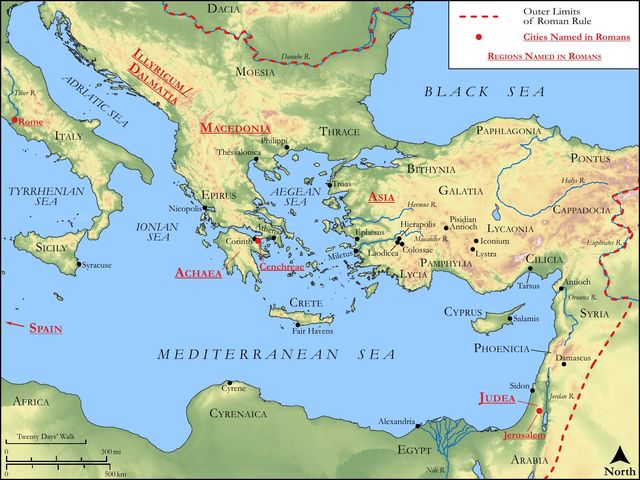
See on the biblical-era map

Study this verse
Historical interpretation
Three Centuries of Reception
13 surviving comments on this verse. Each one is dated, so this reads as a timeline rather than a list.
Select a marker to jump to its quote. Markers stagger vertically where authors wrote within a few decades of each other.
Whosoever will candidly consider each particular, will recognise the greatness of the gifts which were given by him. For from him have sprung the priests and all the Levites who minister at the altar of God. From him also [was descended] our Lord Jesus Christ according to the flesh. [Romans 9:5] From him [arose] kings, princes, and rulers of the race of Judah. Nor are his other tribes in small glory, inasmuch as God had promised, "Your seed shall be as the stars of heaven." All these, therefore, were highly honoured, and made great, not for their own sake, or for their own works, or for the righteousness which they wrought, but through the operation of His will.
And again, writing to the Romans about Israel, he says: "Whose are the fathers, and from whom is Christ according to the flesh, who is God over all, blessed for ever."
But when Christ alone (is mentioned), I shall be able to call Him "God," as the same apostle says: "Of whom is Christ, who is over all, God blessed for ever." For I should give the name of" sun" even to a sunbeam, considered in itself; but if I were mentioning the sun from which the ray emanates, I certainly should at once withdraw the name of sun from the mere beam.
Joseph, again, himself was made a figure of Christ in this point alone (to name no more, not to delay my own course), that he suffered persecution at the hands of his brethren, and was sold into Egypt, on account of the favour of God; just as Christ was sold by Israel-(and therefore, ) "according to the flesh," by His "brethren" -when He is betrayed by Judas.
Let us look next at the apostle's word: "Whose are the fathers, of whom as concerning the flesh Christ came, who is over all, God blessed for ever." This word declares the mystery of the truth rightly and clearly. He who is over all is God; for thus He speaks boldly, "All things are delivered unto me of my Father." He who is over all, God blessed, has been born; and having been made man, He is (yet) God for ever. For to this effect John also has said, "Which is, and which was, and which is to come, the Almighty." And well has he named Christ the Almighty. For in this he has said only what Christ testifies of Himself. For Christ gave this testimony, and said, "All things are delivered unto me of my Father; " and Christ rules all things, and has been appointed Almighty by the Father. And in like manner Paul also, in setting forth the truth that all things are delivered unto Him, said, "Christ the first-fruits; afterwards they that are Christ's at His coming. Then cometh the end, when He shall have delivered up the kingdom to God, even the Father; when He shall have put down all rule, and all authority, and power. For He must reign, till He hath put all enemies under His feet. The last enemy that shall be destroyed is death. For all things are put under Him. But when He saith, All things are put under Him, it is manifest that He is excepted which did put all things under Him. Then shall He also Himself be subject to Him who put all things under Him, that God may be all in all." If, therefore, all things are put under Him with the exception of Him who put them under Him, He is Lord of all, and the Father is Lord of Him, that in all there might be manifested one God, to whom all things are made subject together with Christ, to whom the Father hath made all things subject, with the exception of Himself. And this, indeed, is said by Christ Himself, as when in the Gospel He confessed Him to be His Father and His God. For He speaks thus: "I go to my Father and your Father, and to my God and your God." If then, Noetus ventures to say that He is the Father Himself, to what father will he say Christ goes away according to the word of the Gospel? But if he will have us abandon the Gospel and give credence to his senselessness, he expends his labour in vain; for "we ought to obey God rather than men."
It is clear from this passage that Christ is the “God who is over all.” The one who is over all has nothing over him, for Christ does not come after the Father but from the Father. The Holy Spirit is also included in this, as it is written: “The Spirit of the Lord fills the earth, and whoever contains all things knows every sound.” So if the Son is God over all and the Spirit is recorded as containing all things, it is clear that the nature and substance of the Trinity are shown to be one and over all things.
Of the gods, but which teaches us the wondrous condescension to us men of the awful glory of Him who is God over all.
Paul lists so many indications of the nobility and dignity of the Jewish people and of the promises they received in order to deepen his grief for all these things, because by not accepting the Savior they lost the privilege of their fathers and the merit of the promises, and they became worse than the Gentiles, whom they had previously detested when they were without God. For it is a worse evil to lose a dignity than never to have had it.As there is no mention of the Father’s name in this verse and Paul is talking about Christ, it cannot be disputed that he is called God here. For if Scripture is speaking about God the Father and adds the Son, it often calls the Father God and the Son Lord. If someone does not think that it is said here about Christ that he is God, then let him name the person about whom he thinks it is said, for there is no mention of God the Father in this verse.
"To whom pertaineth the adoption, and the glory, and the covenants, and the giving of the Law, and the service of God, and the promises; whose are the father's, and of whom as concerning the flesh Christ came, Who is over all, God blessed for ever. Amen."
And what is this? one asks. For if with a view to the belief of others he was willing to become accursed, he ought to have also wished for this in the Gentiles' behalf. But in fact if he had prayed for the Gentiles only, this would not have been equally clear. But since it is for the Jews only, it is a clear proof that it is only for Christ's glory that he is thus earnest.
For what he means is something of this kind: all were talking and accusing God, that after being counted worthy of the name of sons, and receiving the Law, and knowing Him beyond all men, and enjoying such great glory, and serving him beyond the whole world, and receiving the promises, and being from fathers who were His friends, and what was the greatest thing of all, having been forefathers of Christ Himself (for this is the meaning of the words, "of whom, as concerning the flesh, Christ came"), they are now cast out and disgraced; and in their place are introduced men who had never known Him, of the Gentiles. Now since they said all this, and blasphemed God, Paul hearing it, and being cut to the heart, and vexed for God's glory's sake, wished that he were accursed, had it been possible, so that they might be saved, and this blasphemy be put a stop to, and God might not seem to have deceived the offspring of those to whom He promised the gifts.
The patriarchs are Abraham, Isaac and Jacob. Paul writes here against the Manicheans, Photinus and Arius because Christ is of the Jews according to the flesh, and God, blessed forever.
Why the Apostle Paul writes in the same Epistle to the Romans: I could wish that I myself were accursed from Christ, for my brethren, my kinsmen according to the flesh: Who are Israelites, to whom the adoption belongs, and the glory, and the testament, and the giving of the law, and the service of God, and the promises: Whose are the fathers, and of whom is Christ, according to the flesh, who is over all things, God blessed for ever. Amen. (Romans 9:3 et seqq.) Indeed, a valid question, how can the Apostle who said above: Who shall separate us from the love of Christ? Tribulation or distress, or persecution, or famine, or nakedness, or danger, or sword? (Romans 8:35) And again: But I am sure that neither death nor life, nor angels nor principalities, nor things present nor things to come, nor powers, nor height nor depth, nor anything else in all creation, will be able to separate us from the love of God in Christ Jesus our Lord. (Romans 8:38-39), now confirm under oath and say: I speak the truth in Christ, I lie not, my conscience bearing me witness in the Holy Ghost: That I have great sadness, and continual sorrow in my heart. For I wished myself to be an anathema from Christ, for my brethren, who are my kinsmen according to the flesh. And so on. For if someone's love for God is so strong that he cannot be separated from His love, by neither the fear of death, nor the hope of life, nor persecution, nor hunger, nor nudity, nor danger, nor sword; and if Angels also, and Powers, both present and future, and all the Forces of heaven, and both the high and the deep, and every creature at once were to assail him, which cannot possibly be done: yet he would not be separated from the love of God, which he has in Christ Jesus: what is this great change, rather unheard-of prudence, that for the love of Christ, he would not want to have Christ? And lest we do not believe him, he swears and confirms in Christ, and calls his conscience as a witness, the Holy Spirit, that he has sadness, not light or casual, but great and unbelievable, and has sorrow in his heart, which does not sting for an hour and pass, but which continually remains in his heart. Where does this sadness lead? What profit is there in unceasing pain? Is it wished to be anathema from Christ, and to perish, so that others may be saved? But if we consider the voice of Moses asking God for the people of the Jews, and saying, "If thou wilt forgive them their sin, forgive; but if not, blot me out of thy book, which thou hast written" (Exod. 32. 31. 32), we will see the same feelings in Moses and Paul towards the flock entrusted to them. For a good shepherd lays down his life for his sheep. But a hireling, who is not a shepherd, whose own the sheep are not, sees the wolf coming and flees. And to say this same thing: I wished to be cursed by Christ; and erase me from your book which you have written. For those who are erased from the book of the living, and are not written with the just, are made anathema by the Lord. At the same time, see how great is the love of the Apostle for Christ, that he desires to die for him, and to perish alone, provided that the whole human race believes in him. To perish, however, not forever, but for the present. For whoever shall lose his life for Christ, shall save it (Matt. 10:39). Hence, he takes as an example the Forty-Third Psalm: For thy sake we are killed all the day long; we are accounted as sheep for the slaughter (Ps. 43:22). Therefore, the Apostle wishes to die in the flesh, so that others may be saved in the spirit; to pour out his blood so that many souls may be preserved. However, that anathema sometimes signifies slaying can be proved by many testimonies of the Old Testament. And lest we think the grief to be slight, and the cause of sorrow small, he joins it and says: For my brethren and kinsmen according to the flesh. When he calls them kinsmen and brethren according to the flesh, he shows that they are strangers to him in spirit. Whose adoption," he says, "is signified more significantly in Greek as ὑιοθεσία; these things were spoken of by the Lord: 'You are my firstborn son, Israel,' and 'I have begotten sons and exalted them' (Isaiah 1:2), but now he says, 'Alien sons have lied to me' (Psalm 17:46). And their glory is that they were chosen from all nations to be a special people of God, and their covenants, one in the letter and the other in the spirit, meant that those who once served ceremonies of the abolished Law in the flesh would afterwards serve in the spirit the commands of the eternal Gospel. And the law addresses both the new and the old Testament. And worship, that is, true religion. And promises; to fulfill whatever was promised to the fathers in their descendants. And (which is greater than all) from whom Christ was born of the Virgin Mary. And in order that we might know who this Christ is, he embraces the causes of his pain in one speech, who is blessed above all God forever, amen. And this great and such, is not received from those from whom he was born. And nevertheless, he praises the truth of judgement, so that the sentence of God may not seem displeasing to his kindred and brothers, and be either austere or excessive. In which, therefore, such great goods were present, he laments why so many evils are present now.
The Jews, who held only the first part of this confession, are refuted by the Lord. For when he asked them whose son they said Christ was, they answered “David’s.” This is true according to the flesh. But concerning his divinity … they answered nothing. Therefore the Lord said to them: “Why did David, in the Spirit, call him Lord?” in order that they might realize that they had only confessed that Christ is the son of David and had not said that Christ is Lord of this same David. The first fact is true according to his assumption of flesh, the other accordingto the eternity of his divinity.
God chose Israel for himself from the beginning, which is why he called it the firstborn. But the Israelites fell because they were proud, wicked and, worst of all, murderers of their Lord. Therefore they perished, for they were rejected and abandoned and excluded from God’s company, placed behind even the Gentiles and cut off from the hope promised to their ancestors.
Continue studying Romans 9:5 across the web’s major study libraries — every link below opens this exact verse, chapter, or book on the destination site.
Read & Compare
 BibleGatewayThis verse in more than 200 translations and 70 languages.
 Bible.comThe YouVersion reader — hundreds of translations, reading plans, and highlights.
 ESV.orgCrossway's official English Standard Version reader.
 NET BibleThe NET translation with 60,000+ translators' notes on every rendering decision.
 STEP BibleTyndale House's free study tool — original text, vocabulary, and scholarly resources.
 BibliaLogos Bible Software's free web reader.
 USCCBThe New American Bible (Revised Edition) with the U.S. bishops' study notes.
Commentaries
 BibleHub CommentariesDozens of classic commentaries on this verse, gathered on one page.
 StudyLightMore than 100 commentary sets — the largest collection on the web.
 BibleRefPlain-English commentary on what this verse means, verse by verse.
 Enduring WordDavid Guzik's free commentary on this chapter, widely used by Bible teachers.
 Bible Study ToolsVerse commentary alongside Greek and Hebrew study aids.
Original Language & Research
- BibleHub InterlinearThe verse word by word — original language, transliteration, and English.
- BibleHub LexiconEvery word's original-language definition and Strong's entry.
 Blue Letter BibleDeep-study tools — Strong's numbers, concordance, and word studies.
 CNTR CollationThe earliest Greek manuscripts of this verse, collated letter by letter.
Sermons, Hymns & Audio


TrulyRandomVerse is not affiliated with these sites and doesn’t control their content. They’re linked because they’re genuinely useful.
Summary
Romans 9:5 stands as a pivotal declaration within Paul's lament over Israel's unbelief, yet it simultaneously celebrates their unparalleled heritage. This verse climaxes a list of divine privileges bestowed upon the Israelites, culminating in the profound truth that from their lineage, according to human descent, came the Messiah, Jesus Christ, who is unequivocally declared to be God supreme over all, eternally blessed. It is a foundational statement affirming both the genuine humanity and the absolute deity of Christ, essential for understanding the Christian faith.
Context
ShowHideLiterary Context
Romans 9:5 concludes a deeply emotional section (Romans 9:1-5) where the Apostle Paul expresses profound sorrow and anguish over the spiritual condition of his fellow Israelites, who have largely rejected Jesus as the Messiah. Despite his personal anguish, Paul immediately affirms Israel's unique and glorious heritage, listing their unparalleled privileges in Romans 9:4: "the adoption, and the glory, and the covenants, and the giving of the law, and the service of God, and the promises." Verse 5 serves as the capstone of this list, presenting the ultimate privilege: the Messiah's human lineage from Israel. This verse also sets the stage for Paul's subsequent argument in Romans 9:6-29 concerning God's sovereign election and faithfulness, demonstrating that God's promises have not failed, even in the face of Israel's widespread unbelief.
Historical & Cultural Context
Paul is writing to the church in Rome, a diverse community of Jewish and Gentile believers. The question of Israel's place in God's plan, especially given the rise of a predominantly Gentile church, was a pressing theological and practical issue. For Jewish people of Paul's day, lineage and covenant identity were paramount. The Messiah was expected to come from the line of David, a descendant of Abraham and the patriarchs. Paul's affirmation that Christ came "as concerning the flesh" from the fathers (the patriarchs of Israel) would have resonated deeply with Jewish believers, establishing Jesus' legitimate claim to Messiahship within their historical and cultural framework. Simultaneously, the declaration of Christ's deity would challenge and expand their traditional understanding of the Messiah, presenting Him not just as a human king but as God incarnate.
Key Themes
ShowHideRomans 9:5 powerfully contributes to several key themes within the book of Romans and broader biblical theology. Firstly, it underscores Israel's Unique Privileges, highlighting their central role in God's redemptive history as the nation through whom the Messiah would come, as detailed in Romans 9:4-5. Secondly, the phrase "as concerning the flesh Christ came" affirms the Incarnation of Christ, emphasizing His genuine humanity and His historical connection to a specific people and lineage, a truth foundational to the gospel (John 1:14). Most significantly, the concluding clause, "who is over all, God blessed for ever," serves as a profound and explicit declaration of the Deity of Christ, asserting His divine nature and supreme sovereignty, a theme echoed throughout the New Testament, such as in Colossians 2:9.
Exposition and Analysis
ShowHideKey Word Analysis
ShowHideThis term, in the context of Romans 9:5, refers to Christ's human nature, His physical descent, and His genuine embodiment as a human being. It emphasizes that Jesus was truly born into the human family, sharing in our humanity, specifically from the lineage of Israel. This is crucial for understanding the Incarnation – that the divine Son took on human flesh.
As a primary preposition, epí here denotes superimposition, indicating Christ's supreme authority and position "over all." It signifies His ultimate sovereignty and dominion, not merely as a ruler but as the one who stands above and governs everything. This preposition reinforces the subsequent declaration of His deity.
This word refers to the supreme Divinity. In Romans 9:5, it is directly attributed to Christ, unequivocally identifying Him as God. This is a direct and powerful statement of Christ's divine nature, placing Him in the same category as the Father, as the ultimate object of worship and blessing.
Derived from eulogeō (to bless), this adjective means "adorable" or "worthy of praise." When applied to God, it signifies that He is the object of all blessing and adoration, inherently worthy of all praise. Attributing this to Christ further solidifies His divine identity, as only God is inherently blessed and worthy of eternal blessing.
Verse Breakdown
ShowHide"Whose [are] the fathers"
This opening clause refers back to the Israelites mentioned in Romans 9:4. It emphasizes their unique heritage, specifically their direct lineage from the revered patriarchs (Abraham, Isaac, Jacob), who were recipients of God's covenant promises. This establishes the historical and covenantal foundation for the subsequent statement about Christ.
"and of whom as concerning the flesh Christ [came]"
This is the ultimate privilege of Israel. From this very lineage of the fathers, the Messiah, Christ, came. The phrase "as concerning the flesh" (κατὰ σάρκα) underscores the genuine humanity of Jesus, His physical and genealogical connection to Israel. It affirms the reality of the Incarnation—that the eternal Son of God truly entered human history through a specific human family and nation.
"who is over all, God blessed for ever. Amen."
This is the climactic and most profound declaration of the verse. The "who" (ὁ ὢν) refers directly to Christ, identifying Him as the one "being over all" (ὁ ὢν ἐπὶ πάντων). This asserts His supreme sovereignty and universal dominion. The subsequent phrase, "God blessed for ever" (Θεὸς εὐλογητὸς εἰς τοὺς αἰῶνας), is a direct and unambiguous attribution of deity to Christ. He is not merely a divinely appointed king or prophet but God Himself, worthy of eternal praise and adoration. The "Amen" (ἀμήν) serves as a solemn affirmation of the truth and certainty of this declaration.
Literary Devices
ShowHideRomans 9:5 employs several powerful literary devices. The verse functions as a Climax within Paul's list of Israel's privileges, building from covenant and law to the ultimate gift of the Messiah. The final clause, "who is over all, God blessed for ever. Amen," serves as a profound Doxology, a formal expression of praise to God. This doxological statement, directed toward Christ, underscores His divine nature and worthiness of eternal worship. Furthermore, the verse utilizes Juxtaposition by placing Christ's human lineage ("as concerning the flesh") immediately before His divine sovereignty ("who is over all, God blessed for ever"). This stark contrast highlights the mystery and wonder of the Incarnation, affirming both His true humanity and His absolute deity. The "Amen" at the end acts as a powerful Affirmation, sealing the truth of the preceding declaration with solemnity and certainty.
Theological and Thematic Connections
ShowHideRomans 9:5 is a cornerstone text for Christian theology, serving as a robust affirmation of the dual nature of Jesus Christ: fully human and fully divine. Theologically, it asserts that the one who walked the earth, born of a Jewish woman, is simultaneously the eternal, sovereign God. This truth is foundational for understanding the efficacy of Christ's work. His humanity allowed Him to truly represent humanity, to suffer, die, and rise again as our substitute, experiencing the full weight of human existence and sin. His deity, however, ensured that His sacrifice was of infinite value, capable of atoning for the sins of all humanity and conquering death itself. Without His full deity, His sacrifice would be insufficient; without His full humanity, it would be irrelevant to our condition. This verse compels us to worship Christ not merely as a great teacher or prophet, but as the God who became man for our salvation, "blessed for ever."
Reflection and Application
ShowHideRomans 9:5 invites believers into a deeper apprehension of who Jesus truly is, calling us to worship Him with profound reverence and gratitude. To grasp that the one who suffered on the cross is also the "God blessed for ever" transforms our understanding of His love and power. This truth should inspire unwavering trust in His ability to save, sustain, and ultimately bring all things to their proper end. It reminds us that our faith is not in a mere historical figure, but in the living God who entered our world. It also serves as a powerful reminder of God's faithfulness to His promises, even when human expectations or actions seem to contradict them. We are called to live lives that reflect the sovereignty of Christ, submitting to His rule "over all" and joining in the eternal blessing of His name.
Questions for Reflection
ShowHideFAQ
ShowHideDoes Romans 9:5 explicitly state that Jesus is God?
ShowHideYes, Romans 9:5 is one of the clearest and most direct New Testament affirmations of the deity of Jesus Christ. The phrase "who is over all, God blessed for ever" is a direct attribution of divine identity to Christ. While some ancient manuscripts and interpretations have attempted to punctuate the verse differently to separate "God blessed for ever" as a separate doxology to the Father, the overwhelming scholarly consensus, supported by Greek grammar and the flow of Paul's argument, understands this phrase as referring directly to Christ. The structure "ὁ ὢν ἐπὶ πάντων Θεὸς εὐλογητὸς εἰς τοὺς αἰῶνας" (literally, "the one being over all, God blessed forever") naturally identifies the "who" (Christ) as "God blessed forever." This aligns with other New Testament passages that affirm Christ's deity, such as John 1:1 and Titus 2:13.
Christ-Centered Fulfillment
ShowHideRomans 9:5 finds its profound Christ-centered fulfillment in the person and work of Jesus, who perfectly embodies both the human lineage promised to Israel and the divine nature of God Himself. His coming "as concerning the flesh" fulfills centuries of Old Testament prophecy regarding a Messiah born of Abraham's seed, from the tribe of Judah, and the house of David (e.g., Genesis 12:3, 2 Samuel 7:12-16). This human connection makes Him the ultimate Kinsman-Redeemer, able to identify with humanity in every way, even to the point of death on a cross for our sins (Hebrews 2:14-18). Yet, the verse culminates in the glorious truth that this same Jesus is "who is over all, God blessed for ever." This declaration of His absolute deity is crucial, for it is His divine nature that imbues His human suffering and sacrifice with infinite value and power, making Him capable of bearing the sins of the world and conquering death (Colossians 2:9). He is not merely a human deliverer, but the divine Savior, the Creator and Sustainer of all things (John 1:3), who condescended to take on flesh to reconcile a fallen humanity to a holy God (2 Corinthians 5:19). Thus, Romans 9:5 points to the Incarnation as the ultimate act of God's love and redemptive purpose, where the infinite God became finite man, so that finite man might be reconciled to the infinite God.