


Romans 4:2
Bible text: King James Version (1769 Blayney text) · Public domain
Bible text: Berean Standard Bible · Public domain
Bible text: American Standard Version (1901) · Public domain
Bible text: World English Bible, Messianic edition · Public domain
Bible text: Geneva Bible (1599) · Public domain
Bible text: Young's Literal Translation · Public domain
- εἰeiIfG1487CONDConjunction
- γὰρgarforG1063CONJConjunction
- ἈβραὰμAbraamAbrahamG11N-NSM-PNoun Nominative Singular Masculine Individual
- ἐξexbyG1537PREPPreposition
- ἔργωνergōnworksG2041N-GPNNoun Genitive Plural Neuter
- ἐδικαιώθηedikaiōthēwas justifiedG1344V-API-3SVerb Aorist Passive Indicative 3rd Singular
- ἔχειecheihe hasG2192V-PAI-3SVerb Present Active Indicative 3rd Singular
- καύχημαkauchēmaground of boastingG2745N-ASNNoun Accusative Singular Neuter
- ἀλλ᾽all᾽butG235CONJConjunction
- οὐounotG3756PRT-NNegative Particle Negative
- πρὸςprostowardG4314PREPPreposition
- τὸνton<the>G3588T-ASMDefinite article Accusative Singular Masculine
- θεόνtheonGodG2316N-ASM-TNoun Accusative Singular Masculine Title
English is a literal word-by-word gloss of the Greek, not the KJV's wording. Why?
This is the original text the KJV's translators worked from — each Greek word with its own literal English meaning in this verse, prepared by scholars at Tyndale House, Cambridge. The KJV translates whole sentences, not word by word, so its wording differs: one Greek word can become several English words, and the KJV may choose “charity” where the gloss reads “love”. Both are faithful — they answer different questions. For the KJV's own rendering, switch to the KJV text.
Details
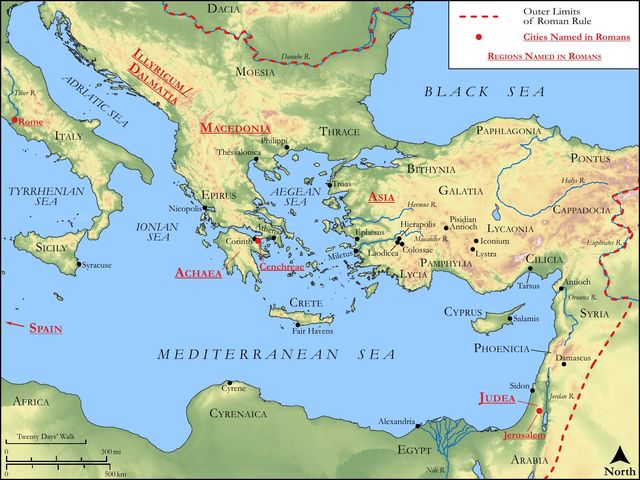
See on the biblical-era maps

Study this verse
Public-domain commentary
Matthew Henry
From his Commentary on the Whole Bible. Henry comments on passages, not single verses — this entry covers Romans 4:1–8. His two-level outline is real structure in the source text, so it is rendered as structure.
Here the apostle proves that Abraham was justified not by works, but by faith. Those that of all men contended most vigorously for a share in righteousness by the privileges they enjoyed, and the works they performed, were the Jews, and therefore he appeals to the case of Abraham their father, and puts his own name to the relation, being a Hebrew of the Hebrews: Abraham our father. Now surely his prerogative must needs be as great as theirs who claim it as his seed according to the flesh. Now what has he found? All the world is seeking; but, while the most are wearying themselves for very vanity, none can be truly reckoned to have found, but those who are justified before God; and thus Abraham, like a wise merchant, seeking goodly pearls, found this one pearl of great price. What has he found, kata sarka - as pertaining to the flesh, that is, by circumcision and his external privileges and performances? These the apostle calls flesh, Phi 3:3. Now what did he get by these? Was he justified by them? Was it the merit of his works that recommended him to God's acceptance? No, by no means, which he proves by several arguments.
I.If he had been justified by works, room would have been left for boasting, which must for ever be excluded.
If so, he hath whereof to glory (Rom 4:2), which is not to be allowed. "But," might the Jews say, "was not his name made great (Gen 12:2), and then might not he glory?" Yes, but not before God; he might deserve well of men, but he could never merit of God. Paul himself had whereof to glory before men, and we have him sometimes glorying in it, yet with humility; but nothing to glory in before God, Co1 4:4; Phi 3:8, Phi 3:9. So Abraham. Observe, He takes it for granted that man must not pretend to glory in any thing before God; no, not Abraham, as great and as good a man as he was; and therefore he fetches an argument from it: it would be absurd for him that glorieth to glory in any but the Lord.
II.It is expressly said that Abraham's faith was counted to him for righteousness.
What saith the scripture? Rom 4:3. In all controversies in religion this must be our question, What saith the scripture? It is not what this great man, and the other good man, say, but What saith the scripture? Ask counsel at this Abel, and so end the matter, Sa2 2:18. To the law, and to the testimony (Isa 8:20), thither is the last appeal. Now the scripture saith that Abraham believed, and this was counted to him for righteousness (Gen 15:6); therefore he had not whereof to glory before God, it being purely of free grace that it was so imputed, and having not in itself any of the formal nature of a righteousness, further than as God himself was graciously pleased so to count it to him. It is mentioned in Genesis, upon occasion of a very signal and remarkable act of faith concerning the promised seed, and is the more observable in that it followed upon a grievous conflict he had had with unbelief; his faith was now a victorious faith, newly returned from the battle. It is not the perfect faith that is required to justification (there may be acceptable faith where there are remainders of unbelief), but the prevailing faith, the faith that has the upper hand of unbelief.
III.If he had been justified by faith, the reward would have been of debt, and not of grace, which is not to be imagined.
This is his argument (Rom 4:4, Rom 4:5): Abraham's reward was God himself; so he had told him but just before (Gen 15:1), I am thy exceeding great reward. Now, if Abraham had merited this by the perfection of his obedience, it had not been an act of grace in God, but Abraham might have demanded it with as much confidence as ever any labourer in the vineyard demanded the penny he had earned. But this cannot be; it is impossible for man, much more guilty man, to make God a debtor to him, Rom 11:35. No, God will have free grace to have all the glory, grace for grace's sake, Joh 1:16. And therefore to him that worketh not - that can pretend to no such merit, nor show any worth or value in his work, which may answer such a reward, but disclaiming any such pretension casts himself wholly upon the free grace of God in Christ, by a lively, active, obedient faith - to such a one faith is counted for righteousness, is accepted of God as the qualification required in all those that shall be pardoned and saved. Him that justifieth the ungodly, that is, him that was before ungodly. His former ungodliness was no bar to his justification upon his believing: ton asebē - that ungodly one, that is, Abraham, who, before his conversion, it should seem, was carried down the stream of the Chaldean idolatry, Jos 24:2. No room therefore is left for despair; though God clears not the impenitent guilty, yet through Christ he justifies the ungodly.
IV.He further illustrates this by a passage out of the Psalms, where David speaks of the remission of sins, the prime branch of justification, as constituting the happiness and blessedness of a man, pronouncing blessed, not the man who has no sin, or none which deserved death (for then, while man is so sinful, and God so righteous, where would be the blessed man?) but the man to whom the Lord imputeth not sin, who though he cannot plead, Not guilty, pleads the act of indemnity, and his plea is allowed. It is quoted from Psa 32:1, Psa 32:2, where observe,
1.The nature of forgiveness. It is the remission of a debt or a crime; it is the covering of sin, as a filthy thing, as the nakedness and shame of the soul. God is said to cast sin behind his back, to hide his face from it, which, and the like expressions, imply that the ground of our blessedness is not our innocency, or our not having sinned (a thing is, and is filthy, though covered; justification does not make the sin not to have been, or not to have been sin), but God's not laying it to our charge, as it follows here: it is God's not imputing sin (Rom 4:8), which makes it wholly a gracious act of God, not dealing with us in strict justice as we have deserved, not entering into judgment, not marking iniquities, all which being purely acts of grace, the acceptance and the reward cannot be expected as debts; and therefore Paul infers (Rom 4:6) that it is the imputing of righteousness without works.
2.The blessedness of it: Blessed are they. When it is said, Blessed are the undefiled in the way, blessed is the man that walketh not in the counsel of the wicked, etc., the design is to show the characters of those that are blessed; but when it is said, Blessed are those whose iniquities are forgiven, the design is to show what that blessedness is, and what the ground and foundation of it. Pardoned people are the only blessed people. The sentiments of the world are, Those are happy that have a clear estate, and are out of debt to man; but the sentence of the word is, Those are happy that have their debts to God discharged. O how much therefore is it our interest to make it sure to ourselves that our sins are pardoned! For this is the foundation of all other benefits. So and so I will do for them; for I will be merciful, Heb 8:12.
Historical interpretation
Two Centuries of Reception
7 surviving comments on this verse. Each one is dated, so this reads as a timeline rather than a list.
Select a marker to jump to its quote. Markers stagger vertically where authors wrote within a few decades of each other.
This is a rhetorical argument, which goes like this: Someone who is justified by works has nothing to boast of before God. But Abraham did have something to glory in before God. Therefore he was justified by faith and not by works.In this whole passage it seems that the apostle wants to show that there are two justifications, one by works and the other by faith. He says that justification by works has its glory but only in and of itself, not before God. Justification by faith, on the other hand, has glory before God, who sees our hearts and knows those who believe in secret and those who do not believe. Thus it is right to say that it has glory only before God, who sees the hidden power of faith. But the one who looks for justification by works may expect honor mainly from other persons who see and approve of them.
Let no one think that someone who has faith enough to be justified and to have glory before God can at the same time have unrighteousness dwelling in him as well. For faith cannot coexist with unbelief, nor can righteousness with wickedness, just as light and darkness cannot live together.
This is a rhetorical argument. For Abraham indeed does have glory before God, but because of the faith by which he was justified, because nobody is justified by the works of the law in a way which would give him glory before God. And because those who keep the law are still being justified, Paul adds: “If Abraham was justified by works, he has something to boast about, but not before God.”
He had said that the world had become guilty before God, and that all had sinned, and that boasting was excluded and that it was impossible to be saved otherwise than by faith. He is now intent upon showing that this salvation, so far from being matter of shame, was even the cause of a bright glory, and a greater than that through works. For since the being saved, yet with shame, had somewhat of dejection in it, he next takes away this suspicion too. And indeed he has hinted at the same already, by calling it not barely salvation, but "righteousness. Therein" (he says) "is the righteousness of God revealed." For he that is saved as a righteous man has a confidence accompanying his salvation. And he calls it not "righteousness" only, but also the setting forth of the righteousness of God. But God is set forth in things which are glorious and shining, and great.
And he calls him "father, as pertaining to the flesh," to throw them out of the genuine relationship to him, and to pave the Gentiles' way to kinsmanship with him. And then he says, "For if Abraham were justified by works, he hath whereof to glory: but not before God." After saying that God "justified the circumcision by faith and the uncircumcision through faith," and making the same sufficiently sure in what he said before, he now proves it by Abraham more clearly than he promised, and pitches the battle for faith against works, and makes this righteous man the subject of the whole struggle.
For the great power of Paul is especially displayed in this, that he turns what is objected to the other side, and shows that what seemed rather to be on the side of salvation by works, viz. glorying or boldness of claim belonged much more truly to that by faith. For he that glorieth in his works has his own labors to put forward: but he that finds his honor in having faith in God, has a much greater ground for glorying to show, in that it is God that he glorifieth and magnifieth.
If Abraham was justified because of his circumcision, then God gave him nothing and he could have gloried in what he did to himself. Or it may mean that if Abraham carried out the ordinances, he had glory in his own eyes but not in God’s.
Since Abraham without the law obtained glory not by the works of the law (as if he could fulfill the law in his own strength), since the law had not yet been given, the glory belongs to God, not to him. For he was justified not by his own merit, as if by works, but by the grace of God through faith.
What can we say to those who insist that Abraham was justified by works because he was ready to sacrifice his son Isaac on the altar? Abraham was already an old man when God promised him that he would have a son and that his descendants would be as countless as the stars of the sky. Abraham piously believed that all things are possible with God and so exercised this faith. God reckoned him to be righteous on this account and gave Abraham a reward worthy of such a godly mind, viz., the forgiveness of his previous sins.… So even if Abraham was also justified by his willingness to sacrifice Isaac, this must be regarded as an evident demonstration of a faith which was already very strong.
The accomplishment of good works honors those who do them, but it does not reveal the kindness of God. Faith, on the other hand, reveals both the love for God of the one who believes and God’s kindness.
Continue studying Romans 4:2 across the web’s major study libraries — every link below opens this exact verse, chapter, or book on the destination site.
Read & Compare
 BibleGatewayThis verse in more than 200 translations and 70 languages.
 Bible.comThe YouVersion reader — hundreds of translations, reading plans, and highlights.
 ESV.orgCrossway's official English Standard Version reader.
 NET BibleThe NET translation with 60,000+ translators' notes on every rendering decision.
 STEP BibleTyndale House's free study tool — original text, vocabulary, and scholarly resources.
 BibliaLogos Bible Software's free web reader.
 USCCBThe New American Bible (Revised Edition) with the U.S. bishops' study notes.
Commentaries
 BibleHub CommentariesDozens of classic commentaries on this verse, gathered on one page.
 StudyLightMore than 100 commentary sets — the largest collection on the web.
 BibleRefPlain-English commentary on what this verse means, verse by verse.
 Enduring WordDavid Guzik's free commentary on this chapter, widely used by Bible teachers.
 Bible Study ToolsVerse commentary alongside Greek and Hebrew study aids.
Original Language & Research
- BibleHub InterlinearThe verse word by word — original language, transliteration, and English.
- BibleHub LexiconEvery word's original-language definition and Strong's entry.
 Blue Letter BibleDeep-study tools — Strong's numbers, concordance, and word studies.
 CNTR CollationThe earliest Greek manuscripts of this verse, collated letter by letter.
Sermons, Hymns & Audio


TrulyRandomVerse is not affiliated with these sites and doesn’t control their content. They’re linked because they’re genuinely useful.
Summary
Romans 4:2 presents a crucial hypothetical scenario within Paul's argument for justification by faith, using Abraham as the prime example. Paul asserts that if Abraham's righteousness were based on his own actions, he would indeed have a basis for self-congratulation or boasting among people; however, such a claim to glory would hold absolutely no validity or standing in the presence of God, whose standard for righteousness is fundamentally different and unattainable through human effort. This verse sets the stage for demonstrating that true righteousness before God is a gift received through faith, not an achievement earned by works.
Context
ShowHideLiterary Context
Romans 4:2 is an integral part of Paul's extended theological argument in the book of Romans concerning the nature of justification. Following his comprehensive indictment of both Jews and Gentiles as being under the power of sin in Romans 1-3, Paul concludes in Romans 3:20 that "by the deeds of the law there shall no flesh be justified in his sight." Having established the universal need for a righteousness that comes apart from the law, Paul then turns to Abraham in Romans 4 as the definitive historical and theological proof. Verse 1 introduces Abraham, and verse 2 immediately poses a counterfactual condition, setting up the logical antithesis that will be resolved in Romans 4:3, where Abraham's faith is explicitly stated as being "counted unto him for righteousness." This hypothetical statement in 4:2 serves to highlight the radical nature of God's way of righteousness.
Historical & Cultural Context
For Paul's Jewish audience, Abraham was not merely a historical figure but the revered patriarch, the father of their nation, and the paragon of righteousness. Jewish tradition, particularly in the intertestamental period, often emphasized Abraham's obedience and good deeds (e.g., his willingness to sacrifice Isaac, his adherence to God's commands) as the basis for his covenant relationship with God and his status as righteous. Many believed that Abraham's "works" (specifically, his faithfulness to the covenant and its demands, including circumcision and obedience to God's commands) were what secured his justification. Paul's argument directly challenges this deeply ingrained cultural and theological understanding, asserting that even Abraham, the epitome of Jewish piety, was not justified by his works but by his faith. This was a revolutionary and potentially offensive claim to those who held firm to a works-based understanding of righteousness.
Key Themes
ShowHideThis verse powerfully contributes to several overarching themes in Romans and Paul's theology. The primary theme is the stark contrast between justification by faith and justification by works. Paul argues that true righteousness before God is not earned through human effort or adherence to the law, but is a divine declaration based on faith. Closely related is the theme of the exclusion of boasting. If salvation or righteousness could be achieved through works, humans would have grounds to boast in their own accomplishments, which would undermine God's sole glory. Paul explicitly states this in Romans 3:27. By demonstrating that even Abraham had no grounds for boasting "before God," Paul reinforces that salvation is entirely a gift of grace. Finally, the verse highlights God's sovereign standard of righteousness, which transcends human merit and expectations, paving the way for the revelation of God's righteousness through Christ, as seen in Romans 3:21-26.
Exposition and Analysis
ShowHideKey Word Analysis
ShowHideMeaning "to render (i.e. show or regard as) just or innocent." This is a forensic or legal term, signifying a divine declaration of righteousness. It does not mean to "make righteous" in the sense of an internal transformation, but to "declare righteous" or "acquit" in a legal sense. In this context, it refers to God's act of declaring Abraham righteous in His sight.
Meaning "toil (as an effort or occupation); by implication, an act." In the context of Paul's argument, "works" primarily refers to human actions, particularly those performed in obedience to the Mosaic Law, which were believed by some to be the means of attaining righteousness or maintaining a righteous standing before God.
Meaning "a boast (properly, the object; by implication, the act) in a good or a bad sense." This word refers to a ground for boasting, pride, or self-commendation. Paul uses it to emphasize that if righteousness were achieved by human effort, it would lead to human pride and self-exaltation.
Verse Breakdown
ShowHide"For if Abraham were justified by works,"
This opening clause introduces a hypothetical condition. The "if" (G1487, ei) sets up a contrary-to-fact premise for the sake of argument. Paul is not suggesting that Abraham was justified by works, but rather exploring the logical consequence if that were the case. The phrase "by works" (G1537, ek, "from, out of" + G2041, érgon) indicates the source or basis of justification.
"he hath [whereof] to glory;"
This is the logical consequence of the hypothetical premise. If justification were by works, Abraham would have a "boast" or "ground for glorying" (G2745, kaúchēma). This "glory" would be a self-derived honor, a claim to merit based on his own performance. It implies a sense of achievement and self-sufficiency.
"but not before God."
This crucial antithetical phrase (G235, allá, "but" + G3756, ou, "not" + G4314, prós, "before, in the presence of" + G2316, theós, "God") utterly negates the possibility of boasting in the divine presence. While Abraham might have a basis for boasting in the eyes of other humans (e.g., for his obedience, his faith, his lineage), such boasting holds no weight or validity "before God." God's standard is absolute perfection and divine grace, which human works cannot achieve or impress. This phrase shifts the perspective from human evaluation to divine judgment, where human merit is irrelevant.
Literary Devices
ShowHidePaul employs several literary devices to make his argument forceful and clear. The primary device is a Hypothetical Statement (protasis: "if Abraham were justified by works," apodosis: "he hath whereof to glory"). This allows Paul to explore the logical implications of a works-based righteousness without affirming its reality. He then uses Antithesis or Contrast ("he hath whereof to glory; but not before God") to create a sharp distinction between human perception and divine reality. The "but not before God" serves as a powerful corrective, highlighting the ultimate standard by which all things are judged. This contrast underscores the radical difference between human merit and God's grace, effectively dismantling any human claim to self-righteousness.
Theological and Thematic Connections
ShowHideRomans 4:2 is a linchpin in Paul's argument for sola fide (faith alone). It decisively severs the link between human works and divine justification, asserting that any righteousness derived from human effort would inevitably lead to self-glory, which is antithetical to God's nature and His plan of salvation. By negating boasting before God, Paul emphasizes that salvation must be entirely a work of God's grace, received through faith, thereby ensuring that all glory belongs to Him alone. This foundational truth prevents human pride from corrupting the gospel and underscores the absolute necessity of God's unmerited favor for humanity's reconciliation.
Reflection and Application
ShowHidePaul's argument in Romans 4:2 challenges us to examine the true source of our confidence and identity. In a world that often values achievement, self-reliance, and visible success, it is easy to fall into the trap of seeking validation through our own "works"—whether they be moral uprightness, religious devotion, professional accomplishments, or social standing. This verse serves as a profound reminder that while such efforts might earn us praise or respect from others, they offer absolutely no standing or merit "before God." Our ultimate hope and righteousness cannot be found in what we do, but only in what God has done for us. This truth should cultivate a deep humility within us, recognizing our utter dependence on God's grace, and fostering a spirit of gratitude rather than self-congratulation. It calls us to lay down any pretense of self-sufficiency and to embrace the liberating reality that our acceptance by God is a gift, not a reward.
Questions for Reflection
ShowHideFAQ
ShowHideWhy does Paul use Abraham as an example to illustrate justification by faith, rather than by works?
ShowHidePaul uses Abraham as a strategic and powerful example precisely because Abraham was revered by Jews as the father of their nation and a paragon of righteousness, often believed to have earned his favor with God through his obedience and works. By demonstrating that even Abraham, the very embodiment of covenant faithfulness, was justified by faith before the Law was given and before circumcision was commanded, Paul dismantles the prevailing Jewish notion that righteousness came through adherence to the Law or through human effort. Abraham's story, particularly as recounted in Genesis 15:6, serves as an ancient, undeniable proof that God's method of justification has always been by faith, not by works, thus establishing a universal principle that applies to both Jews and Gentiles.
Does this verse mean that works are entirely irrelevant for a believer?
ShowHideNo, this verse does not mean that works are entirely irrelevant. Rather, it clarifies their role: works are not the basis for justification or righteousness before God. Paul consistently teaches that salvation is by grace through faith, apart from works (Ephesians 2:8-9). However, genuine faith is never barren; it always produces good works as a result and evidence of salvation, not as its cause. As James famously states, "faith without works is dead" (James 2:26). So, while works cannot justify us, they are an indispensable fruit of a justified life, demonstrating the reality of our transformed hearts and our love for God and neighbor.
What does "not before God" mean in the context of boasting?
ShowHideThe phrase "not before God" (Greek: ou pros Theon) signifies that any human boasting based on one's own works or achievements is utterly meaningless and invalid in God's sight. While a person might be able to boast before other humans, gaining their admiration or respect for their deeds, such boasting has no standing or merit in the divine court. God's standard of righteousness is perfect and absolute, and no human effort can ever meet it. Therefore, any attempt to present one's own "works" as a basis for justification or glory before God is futile. This phrase underscores God's absolute sovereignty in salvation and ensures that all glory for righteousness belongs to Him alone, as human pride is completely excluded (Romans 3:27).
Christ-Centered Fulfillment
ShowHideRomans 4:2, by decisively negating the possibility of boasting in human works before God, powerfully sets the stage for the absolute necessity and supremacy of Christ's work. If Abraham, the paragon of faith, could not be justified by his works in God's eyes, then no human being can. This verse implicitly highlights humanity's desperate need for an external, perfect righteousness. This righteousness is found exclusively in Jesus Christ, who perfectly fulfilled God's righteous demands on our behalf. He became sin for us, "that we might be made the righteousness of God in him" (2 Corinthians 5:21). Through His atoning sacrifice and resurrection, Christ accomplished the work that no human could ever achieve, providing the sole ground for our justification. Thus, all boasting is silenced, not because we have no glory, but because our glory is now entirely "in the Lord" (1 Corinthians 1:31). Our peace with God, our standing as righteous, and our eternal hope are all rooted in Christ's finished work, received by faith, ensuring that God alone receives all the glory (Romans 5:1). The "not before God" of human works becomes the glorious "before God" of Christ's imputed righteousness.