


2 Corinthians 11:30
- εἰeiIfG1487CONDConjunction
- καυχᾶσθαιkauchasthaito boastG2744V-PNNVerb Present Middle Or Passive Deponent Infinitive
- δεῖdeiit behooves [me]G1163V-PAI-3SVerb Present Active Indicative 3rd Singular
- τὰta[in] the [things]G3588T-APNDefinite article Accusative Plural Neuter
- τῆςtēsof theG3588T-GSFDefinite article Genitive Singular Feminine
- ἀσθενείαςastheneiasweaknessG769N-GSFNoun Genitive Singular Feminine
- μουmouof mineG3165P-1GSPersonal pronoun Genitive 1st Singular
- καυχήσομαιkauchēsomaiI will boastG2744V-FDI-1SVerb Future Middle Deponent Indicative 1st Singular
English is a literal word-by-word gloss of the Greek, not the KJV's wording. Why?
This is the original text the KJV's translators worked from — each Greek word with its own literal English meaning in this verse, prepared by scholars at Tyndale House, Cambridge. The KJV translates whole sentences, not word by word, so its wording differs: one Greek word can become several English words, and the KJV may choose “charity” where the gloss reads “love”. Both are faithful — they answer different questions. For the KJV's own rendering, switch to the KJV text.
Details
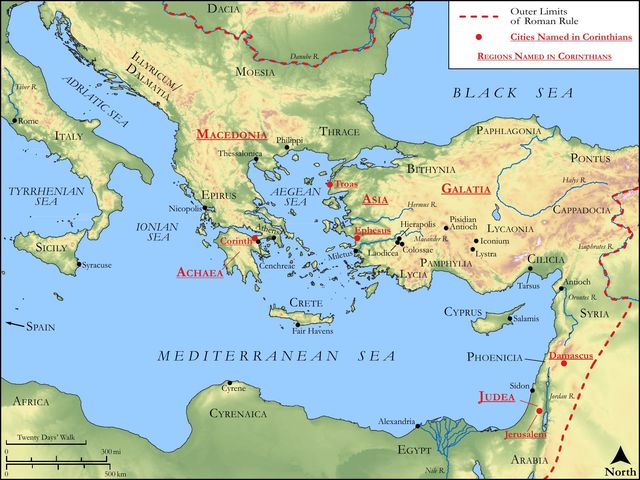
See on the biblical-era map

Study this verse
Public-domain commentary
Matthew Henry
From his Commentary on the Whole Bible. Henry comments on passages, not single verses — this entry covers 2 Corinthians 11:22–33.
Here the apostle gives a large account of his own qualifications, labours, and sufferings (not out of pride or vain-glory, but to the honour of God, who had enabled him to do and suffer so much for the cause of Christ), and wherein he excelled the false apostles, who would lessen his character and usefulness among the Corinthians. Observe,
I.He mentions the privileges of his birth (Co2 11:22), which were equal to any they could pretend to.
He was a Hebrew of the Hebrews; of a family among the Jews that never intermarried with the Gentiles. He was also an Israelite, and could boast of his being descended from the beloved Jacob as well as they, and was also of the seed of Abraham, and not of the proselytes. It should seem from this that the false apostles were of the Jewish race, who gave disturbance to the Gentile converts.
II.He makes mention also of his apostleship, that he was more than an ordinary minister of Christ, Co2 11:23.
God had counted him faithful, and had put him into the ministry. He had been a useful minister of Christ unto them; they had found full proofs of his ministry: Are they ministers of Christ? I am more so.
III.He chiefly insists upon this, that he had been an extraordinary sufferer for Christ; and this was what he gloried in, or rather he gloried in the grace of God that had enabled him to be more abundant in labours, and to endure very great sufferings, such as stripes above measure, frequent imprisonments, and often the dangers of death, Co2 11:23. Note, When the apostle would prove himself an extraordinary minister, he proves that he had been an extraordinary sufferer. Paul was the apostle of the Gentiles, and for that reason was hated of the Jews. They did all they could against him; and among the Gentiles also he met with hard usage. Bonds and imprisonments were familiar to him; never was the most notorious malefactor more frequently in the hands of public justice than Paul was for righteousness' sake. The jail and the whipping-post, and all other hard usages of those who are accounted the worst of men, were what he was accustomed to. As to the Jews, whenever he fell into their hands, they never spared him. Five times he fell under their lash, and received forty stripes save one, Co2 11:24. Forty stripes was the utmost their law allowed (Deu 25:3), but it was usual with them, that they might not exceed, to abate one at least of that number. And to have the abatement of one only was all the favour that ever Paul received from them. The Gentiles were not tied up to that moderation, and among them he was thrice beaten with rods, of which we may suppose once was at Philippi, Act 16:22. Once he was stoned in a popular tumult, and was taken up for dead, Act 14:19. He says that thrice he suffered shipwreck; and we may believe him, though the sacred history gives a relation but of one. A night and a day he had been in the deep (Co2 11:25), in some deep dungeon or other, shut up as a prisoner. Thus he was all his days a constant confessor; perhaps scarcely a year of his life, after his conversion, passed without suffering some hardship or other for his religion; yet this was not all, for, wherever he went, he went in perils; he was exposed to perils of all sorts. If he journeyed by land, or voyaged by sea, he was in perils of robbers, or enemies of some sort; the Jews, his own countrymen, sought to kill him, or do him a mischief; the heathen, to whom he was sent, were not more kind to him, for among them he was in peril. If he was in the city, or in the wilderness, still he was in peril. He was in peril not only among avowed enemies, but among those also who called themselves brethren, but were false brethren, Co2 11:26. Besides all this, he had great weariness and painfulness in his ministerial labours, and these are things that will come into account shortly, and people will be reckoned with for all the care and pains of their ministers concerning them. Paul was a stranger to wealth and plenty, power and pleasure, preferment and ease; he was in watchings often, and exposed to hunger and thirst; in fastings often, it may be out of necessity; and endured cold and nakedness, Co2 11:27. Thus was he, who was one of the greatest blessings of the age, used as if he had been the burden of the earth, and the plague of his generation. And yet this is not all; for, as an apostle, the care of all the churches lay on him, Co2 11:28. He mentions this last, as if this lay the heaviest upon him, and as if he could better bear all the persecutions of his enemies than the scandals that were to be found in the churches he had the oversight of. Who is weak, and I am not weak? Who is offended, and I burn not? Co2 11:29. There was not a weak Christian with whom he did not sympathize, nor any one scandalized, but he was affected therewith. See what little reason we have to be in love with the pomp and plenty of this world, when this blessed apostle, one of the best of men that ever lived, excepting Jesus Christ, felt so much hardship in it. Nor was he ashamed of all this, but, on the contrary, it was what he accounted his honour; and therefore, much against the grain as it was with him to glory, yet, says he, if I must needs glory, if my adversaries will oblige me to it in my own necessary vindication, I will glory in these my infirmities, Co2 11:30. Note, Sufferings for righteousness' sake will, the most of any thing, redound to our honour.
In the last two verses, he mentions one particular part of his sufferings out of its place, as if he had forgotten it before, or because the deliverance God wrought for him was most remarkable; namely, the danger he was in at Damascus, soon after he was converted, and not settled in Christianity, at least in the ministry and apostleship. This is recorded, Act 9:24, Act 9:25. This was his first great danger and difficulty, and the rest of his life was a piece with this. And it is observable that, lest it should be thought he spoke more than was true, the apostle confirms this narrative with a solemn oath, or appeal to the omniscience of God, Co2 11:31. It is a great comfort to a good man that the God and Father of our Lord Jesus Christ, who is an omniscient God, knows the truth of all he says, and knows all he does and all he suffers for his sake.
Historical interpretation
Historical reception
2 surviving comments on this verse. Each one is dated, so this reads as a timeline rather than a list.
Select a marker to jump to its quote. Markers stagger vertically where authors wrote within a few decades of each other.
Paul is saying this because if a Christian must boast, he should boast in humility, from which comes growth in God’s sight.
"If I must needs glory, I will glory of the things which concern my weakness." Seest thou that he no where glorieth of miracles, but of his persecutions and his trials? For this is meant by "weaknesses." And he shows that his warfare was of a diversified character. For both the Jews warred upon him, and the Gentiles stood against him, and the false brethren fought with him, and brethren caused him sorrow, through their weakness and by taking offense:-on every side he found trouble and disturbance, from friends and from strangers. This is the especial mark of an Apostle, by these things is the Gospel woven.
Continue studying 2 Corinthians 11:30 across the web’s major study libraries — every link below opens this exact verse, chapter, or book on the destination site.
Read & Compare
 BibleGatewayThis verse in more than 200 translations and 70 languages.
 Bible.comThe YouVersion reader — hundreds of translations, reading plans, and highlights.
 ESV.orgCrossway's official English Standard Version reader.
 NET BibleThe NET translation with 60,000+ translators' notes on every rendering decision.
 STEP BibleTyndale House's free study tool — original text, vocabulary, and scholarly resources.
 BibliaLogos Bible Software's free web reader.
 USCCBThe New American Bible (Revised Edition) with the U.S. bishops' study notes.
Commentaries
 BibleHub CommentariesDozens of classic commentaries on this verse, gathered on one page.
 StudyLightMore than 100 commentary sets — the largest collection on the web.
 BibleRefPlain-English commentary on what this verse means, verse by verse.
 Enduring WordDavid Guzik's free commentary on this chapter, widely used by Bible teachers.
 Bible Study ToolsVerse commentary alongside Greek and Hebrew study aids.
Original Language & Research
- BibleHub InterlinearThe verse word by word — original language, transliteration, and English.
- BibleHub LexiconEvery word's original-language definition and Strong's entry.
 Blue Letter BibleDeep-study tools — Strong's numbers, concordance, and word studies.
 CNTR CollationThe earliest Greek manuscripts of this verse, collated letter by letter.
Sermons, Hymns & Audio


TrulyRandomVerse is not affiliated with these sites and doesn’t control their content. They’re linked because they’re genuinely useful.
Summary
In 2 Corinthians 11:30, the Apostle Paul makes a profoundly counter-intuitive declaration, stating that if he is compelled to boast, he will choose to boast not in his strengths or accomplishments, but in his weaknesses and the many hardships he has endured. This statement serves as a radical redefinition of true spiritual authority and power, shifting the focus from human capability and worldly credentials to divine power made manifest through human frailty and dependence on God.
Context
ShowHideLiterary Context
This verse is embedded within a highly polemical and ironic section of Paul's second letter to the Corinthians, often referred to as his "fool's speech" or "boasting speech" (specifically 2 Corinthians 11:16-12:13). Paul reluctantly engages in boasting, not out of self-aggrandizement, but to expose the superficiality and false claims of "super-apostles" who were challenging his apostolic authority and integrity in the Corinthian church. These false teachers likely boasted in their eloquence, Jewish heritage, and apparent lack of suffering, presenting these as marks of divine favor and superior ministry. Paul, by contrast, lists an extensive catalog of his sufferings, persecutions, and vulnerabilities in 2 Corinthians 11:23-29, culminating in this declaration, which sets the stage for his profound theological explanation of the "thorn in the flesh" in 2 Corinthians 12:7-10.
Historical & Cultural Context
First-century Greco-Roman society, including the city of Corinth, placed high value on rhetoric, eloquence, social status, and visible signs of success and strength. Boasting was common, but it was always about one's achievements, lineage, or power. The false apostles in Corinth were likely appealing to these cultural values, presenting themselves as strong, impressive, and unburdened by hardship, which would have resonated with the Corinthians' desire for a powerful and impressive leader. Paul's radical reversal of this boasting paradigm—choosing to boast in weakness—would have been utterly scandalous and counter-cultural, challenging the very foundations of their societal understanding of power and authority. His ministry, marked by suffering and apparent weakness, stood in stark contrast to the self-promotion of his rivals.
Key Themes
ShowHideThe central theme Paul develops here is the paradox of strength in weakness, a foundational principle of his theology. He argues that true spiritual power is not found in human self-sufficiency or worldly credentials but is made perfect in acknowledged dependence on God through human frailty. This theme is intricately linked to humility and authenticity, as Paul's boasting in infirmities underscores his genuine reliance on God and the unadulterated nature of his ministry, directly contrasting with the deceptive and self-serving boasts of the false apostles. Furthermore, this passage profoundly contributes to the theme of God's power manifested through human frailty, setting the stage for the revelation that God's grace is sufficient and His strength is made perfect in weakness, as articulated in 2 Corinthians 12:9.
Exposition and Analysis
ShowHideKey Word Analysis
ShowHideThis verb means "to boast, brag, or take pride in something." Paul uses it with profound irony here. While boasting was typically associated with one's accomplishments or superior qualities, Paul subverts this conventional meaning, redirecting the object of his boasting from worldly strengths to spiritual weaknesses. This redefinition challenges the Corinthian understanding of what constitutes true spiritual authority and worth.
This impersonal verb signifies that something "is necessary" or "is binding." Paul's use of "if I must needs glory" indicates a reluctant compulsion rather than a desire. He is not naturally inclined to boast, especially not in his own experiences, but he feels it is necessary in this specific context to defend his legitimate apostleship and expose the false claims of his opponents. It implies a divine or moral imperative driving his unusual discourse.
Derived from a word meaning "without strength," this noun denotes "feebleness (of mind or body)," "malady," or "frailty." It encompasses not only physical ailments but also the vast array of weaknesses, persecutions, hardships, and vulnerabilities Paul faced as an apostle. This includes beatings, imprisonments, shipwrecks, hunger, and other forms of suffering detailed in 2 Corinthians 11:23-29. These are precisely the circumstances where Paul was utterly dependent on God, not his own power or resources.
Verse Breakdown
ShowHide"If I must needs glory,"
Paul begins with a conditional clause that conveys his reluctance and the forced nature of his boasting. He is not boasting out of pride or desire for self-promotion, but because the circumstances (the challenge from false apostles) necessitate it. The phrase "must needs" emphasizes a compelling obligation rather than a personal inclination.
"I will glory"
This clause indicates Paul's firm resolve once he has established the necessity of boasting. Having conceded the need to engage in this culturally expected act, he immediately pivots to redefine its content, preparing the audience for a shocking revelation.
"of the things which concern mine infirmities."
This is the radical and paradoxical core of the verse. Instead of listing impressive achievements, spiritual gifts, or signs of worldly success, Paul declares that the only things he will boast about are his weaknesses, vulnerabilities, and the many sufferings he has endured. This directly counters the self-promotion of the false apostles and sets the stage for the profound theological truth that God's power is most evident in human weakness.
Literary Devices
ShowHidePaul employs several potent literary devices in this verse and the surrounding context. The most prominent is Irony, as he engages in a "fool's speech" where he boasts, but in a manner completely contrary to conventional expectations. He uses the very act of boasting, typically associated with pride and self-exaltation, to highlight his humility and dependence on God. This creates a powerful Paradox, where weakness becomes the source of strength, and suffering becomes the ground for boasting. This counter-intuitive truth challenges the Corinthians' worldly wisdom and provides a profound theological insight. Furthermore, there is a clear Contrast established between Paul's authentic, suffering-laden ministry and the superficial, self-aggrandizing ministry of the false apostles. Paul's choice to glory in his infirmities serves as a stark and deliberate counterpoint to their boasts in human strength and worldly credentials.
Theological and Thematic Connections
ShowHide2 Corinthians 11:30 is a pivotal verse that encapsulates a profound theological truth central to Paul's understanding of ministry and the Christian life: God's power is perfected in human weakness. This concept stands in stark opposition to worldly notions of strength and success, which often prioritize self-sufficiency, impressive credentials, and visible triumphs. Paul reveals that true spiritual authority and effectiveness are not derived from human capability but from a humble, dependent reliance on God, especially in moments of frailty and suffering. This divine paradox ensures that all glory ultimately redounds to God, as His strength shines brightest when human strength is absent, preventing any human boasting except in the Lord.
Reflection and Application
ShowHidePaul's declaration in 2 Corinthians 11:30 offers a liberating and counter-cultural perspective for believers today. In a world that often celebrates strength, success, and self-reliance, this verse invites us to embrace our weaknesses, limitations, and even our sufferings as potential conduits for God's power. It challenges us to redefine what true strength looks like, shifting our focus from our own capabilities to God's boundless grace. When we are weak, vulnerable, or facing seemingly insurmountable challenges, it is precisely then that God's strength can be most profoundly displayed through us, preventing us from taking credit for His work and ensuring that His glory is magnified. This perspective transforms how we view personal difficulties, seeing them not as hindrances to ministry or signs of failure, but as opportunities for God to work in ways that transcend human ability, fostering deeper humility and dependence on Him.
Questions for Reflection
ShowHideFAQ
ShowHideWhy would Paul choose to "glory" in his infirmities? Isn't boasting a sin?
ShowHidePaul's "boasting" in 2 Corinthians 11:30 is highly ironic and serves a specific theological and apologetic purpose, not self-exaltation. While typical boasting (pride in oneself) is indeed condemned in Scripture (e.g., Jeremiah 9:23-24), Paul here subverts the very act of boasting. He is compelled to boast by the false apostles who are challenging his authority and ministry, but he chooses to boast in the exact opposite of what they would consider praiseworthy—his weaknesses and sufferings. His aim is to highlight that true apostolic authority and divine power are not found in human strength or worldly credentials but are made perfect in human weakness and dependence on God. This sets the stage for his profound statement in 2 Corinthians 12:9 that God's strength is made perfect in weakness, ensuring that all glory belongs to God.
Christ-Centered Fulfillment
ShowHide2 Corinthians 11:30 finds its ultimate Christ-centered fulfillment in the person and work of Jesus Christ, who perfectly embodied the paradox of strength in weakness. While possessing all divine power and glory, Christ "made himself of no reputation, and took upon him the form of a servant, and was made in the likeness of men" (Philippians 2:7). His earthly ministry was marked by humility, self-emptying, and ultimately, the ultimate "infirmity" of the cross. It was through His apparent weakness, suffering, and death on the cross that God's greatest power—the power to overcome sin and death—was fully manifested (1 Corinthians 1:18). Just as Paul's infirmities became the vessels for God's power, so too did Christ's voluntary humiliation and suffering become the means of our salvation and God's ultimate triumph. Believers are called to follow Christ's example, embracing their own weaknesses and sufferings, knowing that "He was crucified through weakness, yet he liveth by the power of God. For we also are weak in him, but we shall live with him by the power of God" (2 Corinthians 13:4). Thus, Paul's boasting in his infirmities is a profound echo of the gospel itself, where God's strength is most gloriously revealed through the weakness of His Son and His suffering servants.