


2 Corinthians 11:17
Bible text: King James Version (1769 Blayney text) · Public domain
Bible text: Berean Standard Bible · Public domain
Bible text: American Standard Version (1901) · Public domain
Bible text: World English Bible, Messianic edition · Public domain
Bible text: Geneva Bible (1599) · Public domain
Bible text: Young's Literal Translation · Public domain
- ὃhoWhatG3739R-ASNRelative pronoun Accusative Singular Neuter
- λαλῶlalōI am sayingG2980V-PAI-1SVerb Present Active Indicative 1st Singular
- οὐounotG3756PRT-NNegative Particle Negative
- κατὰkataaccording toG2596PREPPreposition
- κύριονkurion[the] LordG2962N-ASM-TNoun Accusative Singular Masculine Title
- λαλῶlalōam I sayingG2980V-PAI-1SVerb Present Active Indicative 1st Singular
- ἀλλ᾽all᾽butG235CONJConjunction
- ὡςhōsasG5613PRTParticle or Disjunctive
- ἐνeninG1722PREPPreposition
- ἀφροσύνῃaphrosunēfoolishnessG877N-DSFNoun Dative Singular Feminine
- ἐνeninG1722PREPPreposition
- ταύτῃtautēthisG3778D-DSFDemonstrative pronoun Dative Singular Feminine
- τῇtēatheG3588T-DSFDefinite article Dative Singular Feminine
- ὑποστάσειhupostaseiconfidenceG5287N-DSFNoun Dative Singular Feminine
- τῆςtēs<the>G3588T-GSFDefinite article Genitive Singular Feminine
- καυχήσεωςkauchēseōsof boastingG2746N-GSFNoun Genitive Singular Feminine
English is a literal word-by-word gloss of the Greek, not the KJV's wording. Why?
This is the original text the KJV's translators worked from — each Greek word with its own literal English meaning in this verse, prepared by scholars at Tyndale House, Cambridge. The KJV translates whole sentences, not word by word, so its wording differs: one Greek word can become several English words, and the KJV may choose “charity” where the gloss reads “love”. Both are faithful — they answer different questions. For the KJV's own rendering, switch to the KJV text.
Details
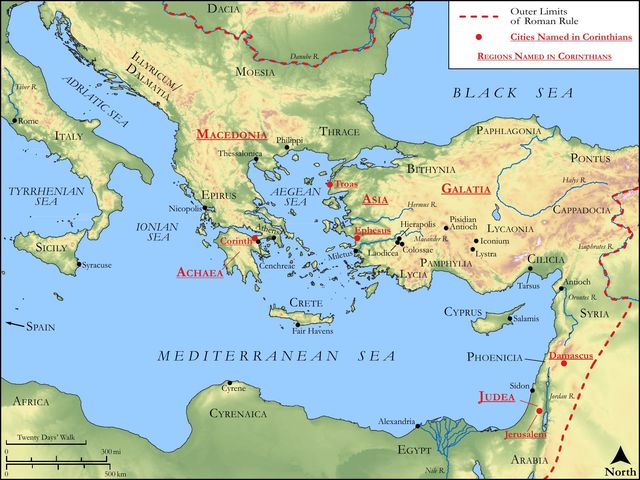
See on the biblical-era maps

Study this verse
Public-domain commentary
Matthew Henry
From his Commentary on the Whole Bible. Henry comments on passages, not single verses — this entry covers 2 Corinthians 11:16–21.
Here we have a further excuse that the apostle makes for what he was about to say in his own vindication. 1. He would not have them think he was guilty of folly, in saying what he said to vindicate himself: Let no man think me a fool, Co2 11:16. Ordinarily, indeed, it is unbecoming a wise man to be much and often speaking in his own praise. Boasting of ourselves is usually not only a sign of a proud mind, but a mark of folly also. However, says the apostle, yet as a fool receive me; that is, if you count it folly in me to boast a little, yet give due regard to what I shall say. 2. He mentions a caution, to prevent the abuse of what he should say, telling them that what he spoke, he did not speak after the Lord, Co2 11:17. He would not have them think that boasting of ourselves, or glorying in what we have, is a thing commanded by the Lord in general unto Christians, nor yet that this is always necessary in our own vindication; though it may be lawfully used, because not contrary to the Lord, when, strictly speaking, it is not after the Lord. It is the duty and practice of Christians, in obedience to the command and example of the Lord, rather to humble and abase themselves; yet prudence must direct in what circumstances it is needful to do that which we may do lawfully, even speak of what God has wrought for us, and in us, and by us too. 3. He gives a good reason why they should suffer him to boast a little; namely, because they suffered others to do so who had less reason. Seeing many glory after the flesh (of carnal privileges, or outward advantages and attainments), I will glory also, Co2 11:18. But he would not glory in those things, though he had as much or more reason than others to do so. But he gloried in his infirmities, as he tells them afterwards. The Corinthians thought themselves wise, and might think it an instance of wisdom to bear with the weakness of others, and therefore suffered others to do what might seem folly; therefore the apostle would have them bear with him. Or these words, You suffer fools gladly, seeing you yourselves are wise (Co2 11:19), may be ironical, and then the meaning is this: "Notwithstanding all your wisdom, you willingly suffer yourselves to be brought into bondage under the Jewish yoke, or suffer others to tyrannize over you; nay, to devour you, or make a prey of you, and take of you hire for their own advantage, and to exalt themselves above you, and lord it over you; nay, even to smite you on the face, or impose upon you to your very faces (Co2 11:20), upbraiding you while they reproach me, as if you had been very weak in showing regard to me," Co2 11:21. Seeing this was the case, that the Corinthians, or some among them, could so easily bear all this from the false apostles, it was reasonable for the apostle to desire, and expect, they should bear with what might seem to them an indiscretion in him, seeing the circumstances of the case were such as made it needful that whereinsoever any were bold he should be bold also, Co2 11:21.
Historical interpretation
Historical reception
3 surviving comments on this verse. Each one is dated, so this reads as a timeline rather than a list.
Select a marker to jump to its quote. Markers stagger vertically where authors wrote within a few decades of each other.
God does not approve of boasting, so this mode of speaking does not come from him. But the content of what he is saying is still true.
"That which I speak, I speak not after the Lord, but as in foolishness, in this confidence of glorifying."
Seest thou how glorying is not "after the Lord?" For He saith, "When ye shall have done all, say, We are unprofitable servants." Howbeit, by itself indeed it is not "after the Lord," but by the intention it becomes so. And therefore he said, "That which I speak," not accusing the motive, but the words. Since his aim is so admirable as to dignify the words also. For as a manslayer, though his action be of those most strictly forbidden, has often been approved from the intention; and as circumcision, although it is not 'after the Lord,' has become so from the intention, so also glorying. And wherefore then does he not use so great strictness of expression? Because he is hastening on to another point, and he freely gratifies even to superfluity those who are desirous to find a handle against him, so that he may say only the things that are profitable; for when said they were enough to extinguish all that suspicion. "But as in foolishness." Before he says, "Would that ye could bear with me in a little foolishness," but now "as in foolishness;" for the farther he proceeds, the more he clears his language. Then that thou mayest not think that he plays the fool on all points, he added, "in this confidence of glorying." In this particular he means.
Jesus said that when we have done all, we should confess that we are no more than unprofitable servants. This is why Paul says here that he is not speaking with the Lord’s authority.
Continue studying 2 Corinthians 11:17 across the web’s major study libraries — every link below opens this exact verse, chapter, or book on the destination site.
Read & Compare
 BibleGatewayThis verse in more than 200 translations and 70 languages.
 Bible.comThe YouVersion reader — hundreds of translations, reading plans, and highlights.
 ESV.orgCrossway's official English Standard Version reader.
 NET BibleThe NET translation with 60,000+ translators' notes on every rendering decision.
 STEP BibleTyndale House's free study tool — original text, vocabulary, and scholarly resources.
 BibliaLogos Bible Software's free web reader.
 USCCBThe New American Bible (Revised Edition) with the U.S. bishops' study notes.
Commentaries
 BibleHub CommentariesDozens of classic commentaries on this verse, gathered on one page.
 StudyLightMore than 100 commentary sets — the largest collection on the web.
 BibleRefPlain-English commentary on what this verse means, verse by verse.
 Enduring WordDavid Guzik's free commentary on this chapter, widely used by Bible teachers.
 Bible Study ToolsVerse commentary alongside Greek and Hebrew study aids.
Original Language & Research
- BibleHub InterlinearThe verse word by word — original language, transliteration, and English.
- BibleHub LexiconEvery word's original-language definition and Strong's entry.
 Blue Letter BibleDeep-study tools — Strong's numbers, concordance, and word studies.
 CNTR CollationThe earliest Greek manuscripts of this verse, collated letter by letter.
Sermons, Hymns & Audio


TrulyRandomVerse is not affiliated with these sites and doesn’t control their content. They’re linked because they’re genuinely useful.
Summary
In 2 Corinthians 11:17, the Apostle Paul reluctantly declares that his ensuing discourse, characterized by self-commendation, is not in line with the Lord's typical instruction or his own preferred method of ministry, but rather a necessary, albeit "foolish," concession compelled by the boasting of false apostles in Corinth. He frames this departure from his usual humility as a pragmatic response, undertaken in the "confidence" or "basis" of the situation, which forces him to engage in a form of boasting to defend his legitimate apostolic authority and the integrity of the gospel.
Context
ShowHideLiterary Context
This verse serves as a crucial pivot within Paul's "fool's speech" (often considered to span 2 Corinthians 10 through 2 Corinthians 12). Having previously established his apostolic authority and defended his ministry against detractors in 2 Corinthians 10 by emphasizing spiritual warfare and obedience to Christ, Paul now reluctantly adopts the rhetorical style of his opponents. He is about to engage in a form of self-commendation, which he explicitly states is "not after the Lord," indicating a deviation from his usual practice of boasting only in the Lord or in his weaknesses. This verse sets the stage for his ironic and sarcastic "boasting" about his sufferings, labors, and genuine apostolic credentials, which stands in stark contrast to the worldly boasting of the "super-apostles."
Historical & Cultural Context
The Corinthian church was plagued by external challenges from "false apostles" or "super-apostles" (as Paul sarcastically calls them in 2 Corinthians 11:5). These individuals likely arrived in Corinth with impressive letters of recommendation, eloquent rhetorical skills, and a self-assured demeanor, all highly valued among the Greeks of Corinth. They probably criticized Paul for his lack of polished oratory, his manual labor (which they might have seen as undignified for a teacher), and his apparent lack of impressive spiritual displays. In a culture where public speaking and self-promotion were common, Paul's humble approach was perceived as weakness. Paul's declaration in 2 Corinthians 11:17 acknowledges this cultural pressure and his forced engagement with it, even as he subverts its values.
Key Themes
ShowHideThe verse contributes significantly to several key themes in 2 Corinthians. Foremost is the theme of true versus false apostolic authority, contrasting Paul's Christ-centered, suffering-laden ministry with the self-exalting, worldly approach of his rivals. It highlights the theme of boasting, distinguishing between worldly self-commendation and legitimate boasting "in the Lord" (2 Corinthians 10:17) or in one's weaknesses (2 Corinthians 12:9-10). The tension between God's wisdom and worldly wisdom is also prominent, as Paul's "foolish" speech deliberately adopts a worldly posture to expose its emptiness. Ultimately, this section underscores the paradox of strength in weakness, a foundational concept for Paul, as his defense of his ministry often revolves around his sufferings and perceived deficiencies, which he sees as opportunities for Christ's power to be displayed.
Exposition and Analysis
ShowHideKey Word Analysis
ShowHideThis verb denotes the act of uttering words or talking. Paul uses it to explicitly describe the nature of his discourse that follows. By saying "That which I speak, I speak," he emphasizes the deliberate and conscious choice he is making to engage in this particular form of communication, even though it is against his usual principles.
Derived from a word meaning "senselessness" or "egotism," aphrosýnē here refers to a lack of sound judgment or prudence, often bordering on recklessness. Paul uses this term with heavy irony. He is not genuinely foolish, but he is adopting a "foolish" persona or method—one that involves self-commendation—because his opponents are operating on such worldly, foolish terms, forcing him to respond in kind.
This multifaceted term can mean "a setting under," "support," "substance," "essence," or "assurance." In this context, it refers to the underlying basis or ground for Paul's boasting. It's not a confidence in his own merits, but rather the compelling necessity or "substance" of the situation—the challenge posed by the false apostles—that serves as the foundation for his reluctant boasting. His "confidence" to boast comes from the circumstances, not from pride.
Verse Breakdown
ShowHide"That which I speak, I speak [it] not after the Lord"
Paul begins with a stark disclaimer. The phrase "not after the Lord" (οὐ κατὰ Κύριον, ou kata Kyrion) signifies that his upcoming boasting is not in accordance with Christ's character, His teachings, or the Spirit's usual leading for ministry. It implies that this self-commendation is not a divinely mandated or preferred method for an apostle. Paul typically boasts only in the Lord (1 Corinthians 1:31) or in his weaknesses, so this public declaration of self-praise is a pragmatic, uncomfortable departure from his norm, undertaken out of necessity rather than principle.
"but as it were foolishly"
Here, Paul employs deep irony and sarcasm. He is not truly acting foolishly in a negative sense, but he is adopting the "foolish" (worldly, self-exalting) posture of his opponents. By embracing this "foolishness," Paul intends to expose the absurdity and spiritual bankruptcy of their worldly boasting. It's a rhetorical strategy to fight fire with fire, but with a clear, self-aware disclaimer that he knows this is not the ideal way to operate.
"in this confidence of boasting"
This phrase clarifies the basis or "substance" (hypóstasis) of Paul's reluctant boasting. His "confidence" or "ground" for engaging in this uncharacteristic self-commendation is not rooted in personal pride or a desire for self-glory. Instead, it is compelled by the urgent need to defend his legitimate apostleship and the gospel message against the false claims and worldly boasting of his rivals. The situation itself provides the "confidence" or "basis" that forces him into this uncomfortable rhetorical mode.
Literary Devices
ShowHidePaul masterfully employs several literary devices in this verse to convey his complex message. The most prominent is Irony, as Paul explicitly states he will speak "foolishly," knowing full well that true wisdom lies elsewhere. This sets up the entire "fool's speech" where he will ironically boast about things that the world considers weaknesses (sufferings, persecutions) to demonstrate God's power. Closely related is Sarcasm, evident in his adoption of the "foolish" persona, which serves to mock and expose the folly of his opponents' worldly self-commendation. The phrase "not after the Lord" also functions as a form of Antithesis, sharply contrasting his forced, worldly method with his usual, Christ-centered approach. This deliberate rhetorical choice highlights his profound reluctance and the extreme pressure he feels to defend the gospel and his ministry against those who undermine it with worldly standards.
Theological and Thematic Connections
ShowHidePaul's reluctant declaration in 2 Corinthians 11:17 underscores a profound theological tension between worldly standards of success and God's paradoxical wisdom. It highlights that true spiritual authority and commendation come from God, not from human eloquence, impressive credentials, or self-promotion. Paul's willingness to step into a "foolish" mode, while explicitly disclaiming it as "not after the Lord," reveals his deep pastoral concern for the Corinthians, who were being swayed by superficial displays of power. This passage challenges believers to discern the true source of authority and to recognize that God's power is often made perfect in weakness, not in human strength or boastfulness.
Reflection and Application
ShowHidePaul's dilemma in 2 Corinthians 11:17 offers a powerful lesson for believers today. In a world that often values self-promotion, outward success, and impressive credentials, we, like Paul, can feel pressured to defend our faith or ministry using worldly metrics. This verse reminds us that while there may be times when we must speak up or assert truth, our ultimate confidence and basis for action should always be rooted in Christ, not in our own achievements or merits. It challenges us to examine our motives when we feel compelled to boast or defend ourselves, ensuring that our actions, even when uncomfortable, ultimately serve to glorify God and uphold His truth, rather than our own reputation. We are called to humility, recognizing that true strength comes from dependence on God, not from our own abilities or worldly acclaim.
Questions for Reflection
ShowHideFAQ
ShowHideWhy does Paul say he speaks "not after the Lord" in this context?
ShowHidePaul's statement "not after the Lord" (οὐ κατὰ Κύριον) is a crucial disclaimer. It means that the self-commendation he is about to engage in is not in accordance with Christ's character, His teachings, or the Spirit's usual leading for ministry. Paul typically boasts only in the Lord or in his weaknesses, as seen in 1 Corinthians 1:31 and 2 Corinthians 10:17. He is being forced into this "foolish" boasting by the false apostles who are undermining his authority and the gospel in Corinth. Therefore, he explicitly states that this is a pragmatic, uncomfortable deviation from his usual, Christ-centered approach, undertaken out of necessity rather than divine command or personal preference.
What does Paul mean by saying he speaks "as it were foolishly"?
ShowHideWhen Paul says he speaks "as it were foolishly" (ὡς ἐν ἀφροσύνῃ), he is employing irony and sarcasm. He is not genuinely acting foolishly in a negative sense. Instead, he is deliberately adopting the "foolish" (worldly, self-exalting) rhetorical style of his opponents, the "super-apostles," to expose their folly. In the eyes of the world, boasting about one's achievements was a sign of wisdom and strength, but from God's perspective, such self-exaltation is foolishness (1 Corinthians 3:19). Paul is turning their own game against them, using their methods to highlight the emptiness of their claims and the true nature of legitimate apostolic ministry, which is often characterized by weakness and suffering for Christ's sake, as he details in 2 Corinthians 11:23-33.
Who were the "false apostles" Paul was responding to in Corinth?
ShowHideThe "false apostles" (or "super-apostles" as Paul sarcastically calls them in 2 Corinthians 11:5) were individuals who had infiltrated the Corinthian church and were challenging Paul's authority and ministry. While their exact identity is debated among scholars, they were likely Jewish-Christian missionaries who emphasized their Jewish heritage, perhaps their connections to Jerusalem, and their impressive rhetorical skills. They probably boasted about their spiritual experiences and credentials, contrasting them with Paul's perceived weaknesses (lack of eloquence, manual labor, suffering). Paul viewed them as deceivers who were distorting the gospel and leading the Corinthians astray (2 Corinthians 11:3-4). His entire "fool's speech" in 2 Corinthians 10-12 is a direct response to their challenge.
Christ-Centered Fulfillment
ShowHidePaul's reluctant "foolish" boasting, though seemingly a departure from his Christ-centered norm, ultimately serves to highlight the profound contrast between worldly glory and the glory of Christ. While Paul states his boasting is "not after the Lord," this very disclaimer, and the content of his subsequent "boasting" (which focuses on his sufferings and weaknesses for the gospel), ultimately points back to Christ's own path of humility and self-emptying. Jesus, "though he was in the form of God, did not count equality with God a thing to be grasped, but emptied himself, by taking the form of a servant, being born in the likeness of men" (Philippians 2:6-7). Christ's ultimate "boast" or commendation came not through self-exaltation, but through His obedient suffering and death on the cross, through which God highly exalted Him (Philippians 2:8-9). Paul's "boasting" in his weaknesses (2 Corinthians 12:9-10) mirrors Christ's strength perfected in human weakness, demonstrating that true power and authority in the Kingdom of God are found not in worldly showmanship, but in identification with the suffering and humble Savior. Thus, even in this uncomfortable rhetorical maneuver, Paul's ultimate aim is to uphold the truth of the gospel and the pattern of Christ, who is the true standard for all ministry and life.