


2 Corinthians 9:4
Bible text: King James Version (1769 Blayney text) · Public domain
Bible text: King James Version with Strong's numbers · Public domain
Bible text: Berean Standard Bible · Public domain
Bible text: American Standard Version (1901) · Public domain
Bible text: World English Bible, Messianic edition · Public domain
Bible text: Geneva Bible (1599) · Public domain
Bible text: Young's Literal Translation · Public domain
- μήmēlestG3361PRT-NNegative Particle Negative
- πωςpōsperhapsG4458PRTParticle or Disjunctive
- ἐὰνeanmaybeG1437CONDConjunction
- ἔλθωσινelthōsinshall comeG2064V-2AAS-3PVerb 2nd Aorist Active Subjunctive 3rd Plural
- σὺνsunwithG4862PREPPreposition
- ἐμοὶemoime myselfG1473P-1DSPersonal pronoun Dative 1st Singular
- ΜακεδόνεςMakedonesMacedoniansG3110N-NPM-LGNoun Nominative Plural Masculine Location Gentilic
- καὶkaiandG2532CONJConjunction
- εὕρωσινheurōsinshall findG2147V-2AAS-3PVerb 2nd Aorist Active Subjunctive 3rd Plural
- ὑμᾶςhumasyouG4771P-2APPersonal pronoun Accusative 2nd Plural
- ἀπαρασκευάστουςaparaskeuastousunpreparedG532A-APMAdjective Accusative Plural Masculine
- καταισχυνθῶμενkataischunthōmenshall be put to shameG2617V-APS-1PVerb Aorist Passive Subjunctive 1st Plural
- ἡμεῖςhēmeiswe ourselves —G3165P-1NPPersonal pronoun Nominative 1st Plural
- ἵναinathatG2443CONJConjunction
- μὴmēnotG3361PRT-NNegative Particle Negative
- λέγωlegōI may sayG3004V-PAS-1SVerb Present Active Subjunctive 1st Singular
- ὑμεῖςhumeisyou yourselves —G4771P-2NPPersonal pronoun Nominative 2nd Plural
- ἐνeninG1722PREPPreposition
- τῇtēa<the>G3588T-DSFDefinite article Dative Singular Feminine
- ὑποστάσειhupostaseiconfidenceG5287N-DSFNoun Dative Singular Feminine
- ταύτῃtautēthisG3778D-DSFDemonstrative pronoun Dative Singular Feminine
- τῆςtēs<the>G3588T-GSFDefinite article Genitive Singular Feminine
- καυχήσεωςkauchēseōsof boastingG2746N-GSFNoun Genitive Singular Feminine
English is a literal word-by-word gloss of the Greek, not the KJV's wording. Why?
This is the original text the KJV's translators worked from — each Greek word with its own literal English meaning in this verse, prepared by scholars at Tyndale House, Cambridge. The KJV translates whole sentences, not word by word, so its wording differs: one Greek word can become several English words, and the KJV may choose “charity” where the gloss reads “love”. Both are faithful — they answer different questions. For the KJV's own rendering, switch to the KJV text.
Details
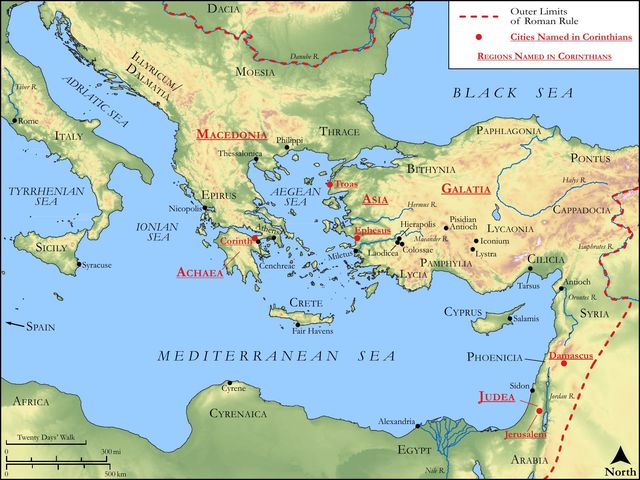
See on the biblical-era maps

Study this verse
Public-domain commentary
Matthew Henry
From his Commentary on the Whole Bible. Henry comments on passages, not single verses — this entry covers 2 Corinthians 9:1–5. His two-level outline is real structure in the source text, so it is rendered as structure.
In these verses the apostle speaks very respectfully to the Corinthians, and with great skill; and, while he seems to excuse his urging them so earnestly to charity, still presses them thereto, and shows how much his heart was set upon this matter.
I.He tells them it was needless to press them with further arguments to afford relief to their poor brethren (Co2 9:1), being satisfied he had said enough already to prevail with those of whom he had so good an opinion. For,
1.He knew their forwardness to every good work, and how they had begun this good work a year ago, insomuch that,
2.He had boasted of their zeal to the Macedonians, and this had provoked many of them to do as they had done. Wherefore he was persuaded, that, as they had begun well, they would go on well; and so, commending them for what they had done, he lays an obligation on them to proceed and persevere.
II.He seems to apologize for sending Titus and the other brethren to them.
He is unwilling they should be offended at him for this, as if he were too earnest, and pressed too hard upon them; and tells the true reasons why he sent them, namely,
1.That, having this timely notice, they might be fully ready (Co2 9:3), and not surprised with hasty demands, when he should come to them. When we would have others to do that which is good we must act towards them prudently and tenderly, and give them time.
2.That he might not be ashamed of his boasting concerning them, if they should be found unready, Co2 9:3, Co2 9:4. He intimates that some from Macedonia might haply come with him: and, if the collection should not then be made, this would make him, not to say them, ashamed, considering the boasting of the apostle concerning them. Thus careful was he to preserve their reputation and his own. Note, Christians should consult the reputation of their profession, and endeavour to adorn the doctrine of God our Saviour.
Historical interpretation
Historical reception
2 surviving comments on this verse. Each one is dated, so this reads as a timeline rather than a list.
Select a marker to jump to its quote. Markers stagger vertically where authors wrote within a few decades of each other.
It is obvious that if Paul arrives and finds that the Corinthians are not what they have been expected to be, he will be chagrined and they will feel even more frustrated.
"Lest by any means if there come with me any from Macedonia, we, (that we say not ye,) should be put to shame in this confidence." The shame is greater when the spectators he has arrayed against them are many, even those same persons who had heard his boasting. And he did not say, 'for I am bringing with me Macedonians;' 'for there are Macedonians coming with me;' lest he should seem to do it on purpose; but how said he? "Lest by any means, if there come with me any from Macedonia?" 'For this may happen,' he says, 'it is matter of possibility.' For thus he also made what he said unsuspected, but had he expressed himself in that other way, he would have even made them the more contentious. See how he leads them on, not from spiritual motives only, but from human ones as well. 'For,' says he, 'though you make no great account of me, and reckon confidently on my excusing you, yet think of them of Macedonia,' "lest by any means, if they come and find you;" and he did not say 'unwillingly,' but "unprepared," not having got all completed. But if this be a disgrace, not to contribute quickly; consider how great it were to contribute either not at all, or less than behoved. Then he lays down what would thereupon follow, in terms at once gentle and pungent, thus saying, "We, (that we say not ye,) should be put to shame." And he tempers it again, saying, "in this confidence" not as making them more listless, but as showing that they who were approved in all other respects, ought in this one also to have great fearlessness.
Continue studying 2 Corinthians 9:4 across the web’s major study libraries — every link below opens this exact verse, chapter, or book on the destination site.
Read & Compare
 BibleGatewayThis verse in more than 200 translations and 70 languages.
 Bible.comThe YouVersion reader — hundreds of translations, reading plans, and highlights.
 ESV.orgCrossway's official English Standard Version reader.
 NET BibleThe NET translation with 60,000+ translators' notes on every rendering decision.
 STEP BibleTyndale House's free study tool — original text, vocabulary, and scholarly resources.
 BibliaLogos Bible Software's free web reader.
 USCCBThe New American Bible (Revised Edition) with the U.S. bishops' study notes.
Commentaries
 BibleHub CommentariesDozens of classic commentaries on this verse, gathered on one page.
 StudyLightMore than 100 commentary sets — the largest collection on the web.
 BibleRefPlain-English commentary on what this verse means, verse by verse.
 Enduring WordDavid Guzik's free commentary on this chapter, widely used by Bible teachers.
 Bible Study ToolsVerse commentary alongside Greek and Hebrew study aids.
Original Language & Research
- BibleHub InterlinearThe verse word by word — original language, transliteration, and English.
- BibleHub LexiconEvery word's original-language definition and Strong's entry.
 Blue Letter BibleDeep-study tools — Strong's numbers, concordance, and word studies.
 CNTR CollationThe earliest Greek manuscripts of this verse, collated letter by letter.
Sermons, Hymns & Audio


TrulyRandomVerse is not affiliated with these sites and doesn’t control their content. They’re linked because they’re genuinely useful.
Summary
In 2 Corinthians 9:4, the Apostle Paul expresses a profound concern regarding the collection for the saints in Jerusalem. Having confidently boasted to the Macedonian churches about the Corinthians' readiness to give, Paul anticipates his arrival with these same Macedonians. His apprehension is that if the Corinthians are found unprepared with their promised contribution, it would lead to collective shame, particularly for Paul himself, whose prior boasting would be undermined, but also for the Corinthians whose commitment would be exposed as lacking follow-through. This verse serves as a gentle but firm exhortation for diligence and integrity in their promised act of generosity.
Context
ShowHideLiterary Context
This verse is situated within Paul's extended discussion (chapters 8-9) concerning the collection for the impoverished believers in Jerusalem. Paul has already established the theological basis for generous giving, citing the example of the Macedonian churches' overwhelming generosity despite their poverty (2 Corinthians 8:1-5). He has also appealed to the Corinthians' own past enthusiasm and commitment (2 Corinthians 8:10-11). Chapter 9 specifically focuses on the practical arrangements and the spiritual benefits of this giving. Verse 4 acts as a pragmatic warning, reinforcing the urgency and importance of their preparation, following Paul's explanation in 2 Corinthians 9:3 that he has sent brothers (Titus and others) ahead to ensure the collection is ready, so that his boasting about them would not prove empty.
Historical & Cultural Context
The collection for Jerusalem was a significant undertaking, symbolizing unity between Gentile and Jewish Christians and providing crucial aid to a struggling community. Jerusalem, the spiritual heartland, often faced economic hardship, exacerbated by famine and persecution. Paul's visits to various churches included organizing and facilitating these collections, which were not merely charitable acts but expressions of Christian solidarity and tangible evidence of the gospel's unifying power. The presence of "they of Macedonia" is critical; these were churches Paul had recently visited, and to whom he had commended the Corinthians' zeal. Public reputation and honor were highly valued among the Greeks and Romans. For Paul's "boasting" (a form of commendation) to be proven false would result in significant "shame" (dishonor), not just for Paul but for the Corinthian church and, by extension, the gospel itself.
Key Themes
ShowHideThe verse contributes to several overarching themes in 2 Corinthians and Paul's broader theology. It underscores the importance of integrity and faithfulness in Christian commitments, particularly in acts of generosity. Paul's concern for being "ashamed" highlights the theme of reputation and witness, emphasizing how the conduct of believers reflects on the gospel message. The concept of preparedness in giving is also prominent, suggesting that Christian benevolence should be intentional and organized, not haphazard (2 Corinthians 9:7). Furthermore, it subtly reinforces the theme of mutual accountability within the body of Christ, as the Corinthians' actions would directly impact Paul's credibility and the perception of the Macedonian churches. This also ties into Paul's consistent emphasis on transparency and good stewardship in handling funds, as seen in 2 Corinthians 8:20-21.
Exposition and Analysis
ShowHideKey Word Analysis
ShowHideThis adjective means "unready" or "not prepared." In this context, it refers to the practical state of the collection—that it might not be gathered, organized, or ready for Paul and the Macedonians to receive upon their arrival. It implies a lack of diligence or foresight rather than an unwillingness to give.
Derived from a word meaning "to shame down," this verb signifies to disgrace, dishonor, or put to the blush. Paul's concern is that if the Corinthians' promised generosity is not ready, it would bring public disgrace upon himself for his confident boasting, and implicitly, upon the Corinthians for their failure to follow through on their commitment.
This noun refers to the act of boasting or the object of boasting, and can be used in both a good and bad sense. Here, it refers to Paul's commendation and confidence in the Corinthians' readiness to give, which he had shared with the Macedonian churches. His "confident boasting" (combining with G5287 hypóstasis for "confident" or "assurance") was an expression of his firm conviction in their commitment and zeal.
Verse Breakdown
ShowHide"Lest haply if they of Macedonia come with me,"
Paul introduces a potential negative outcome using a phrase that conveys a genuine concern or apprehension. He envisions a scenario where he arrives in Corinth, accompanied by believers from Macedonia—the very people to whom he had praised the Corinthians' generosity. This sets up the public dimension of the potential embarrassment.
"and find you unprepared,"
This clause specifies the critical condition that would trigger the negative outcome. "Unprepared" refers to the state of the collection for the Jerusalem saints. It implies that the funds would not be gathered, sorted, or ready for transport, indicating a lack of diligence or follow-through on the Corinthians' part regarding their earlier commitment.
"we (that we say not, ye) should be ashamed"
Here, Paul reveals the consequence of their unpreparedness: shame. The parenthetical "that we say not, ye" is a rhetorical device. While the shame would undeniably fall upon the Corinthians for their failure, Paul graciously and strategically emphasizes his own potential shame. By including himself ("we"), he highlights his personal investment and vulnerability, making the appeal more pastoral and less accusatory, while still implicitly holding them accountable.
"in this same confident boasting."
This phrase identifies the source of the potential shame. Paul's "confident boasting" refers to the strong assurance and commendation he had given to the Macedonian churches regarding the Corinthians' readiness and zeal for the collection. If the Corinthians were found unprepared, this confident declaration would be exposed as hollow, leading to Paul's embarrassment and a loss of credibility.
Literary Devices
ShowHidePaul employs several literary devices in this verse. The phrase "Lest haply" (Greek: mēpōs) functions as a form of Anticipation or Prolepsis, where Paul foresees and addresses a potential problem before it occurs, aiming to prevent it. His use of the parenthetical remark, "(that we say not, ye)," is a clear example of Rhetorical Parenthesis. This device allows Paul to include an important aside that clarifies his meaning or softens a direct accusation, demonstrating his pastoral sensitivity while still conveying the gravity of the situation. By saying "we... should be ashamed," Paul also uses Identification or Solidarity, aligning himself with the Corinthians in a shared potential disgrace, which serves to motivate them through relational appeal rather than mere command. This also subtly employs Understatement regarding the Corinthians' share of the shame, making his appeal more effective.
Theological and Thematic Connections
ShowHideThis verse powerfully underscores the theological principle that Christian giving is not merely a spontaneous act but often requires diligent preparation, integrity, and faithfulness to commitments. Paul's concern for reputation highlights that our actions as believers have implications beyond ourselves, impacting the witness of the gospel and the credibility of its messengers. True generosity, therefore, is rooted in a heart that is not only willing but also diligent and committed to follow through, reflecting the order and faithfulness of God Himself. The potential shame underscores the importance of living a life consistent with our professed faith and commitments, especially when observed by other believers.
Reflection and Application
ShowHidePaul's apprehension in 2 Corinthians 9:4 serves as a timeless reminder that our spiritual commitments, especially those involving generosity and service, are not merely matters of good intention but require practical diligence and follow-through. It challenges us to consider whether our "confident boasting"—our declarations of faith, our promises to serve, our pledges to give—are backed by concrete action and preparation. When we commit to something in the name of Christ, our integrity is on the line, and by extension, the integrity of the Christian witness. This verse calls us to cultivate a spirit of preparedness in all areas of our Christian walk, ensuring that our actions consistently align with our words, bringing honor to God and encouragement to those who observe us. It's a call to proactive faithfulness, not reactive scrambling.
Questions for Reflection
ShowHideFAQ
ShowHideWhy was Paul so concerned about the Corinthians' preparedness?
ShowHidePaul's concern stemmed from multiple factors. Firstly, he had already boasted to the Macedonian churches about the Corinthians' zeal and readiness to contribute a year prior (2 Corinthians 9:2). If the collection wasn't ready upon his arrival with the Macedonians, it would expose his boasting as empty, leading to personal shame and a loss of credibility. Secondly, it would reflect poorly on the Corinthians themselves, undermining their commitment and potentially causing them embarrassment. Thirdly, and most importantly, the collection was a significant act of Christian unity and charity, and its successful completion was vital for the reputation of the gospel and the demonstration of love between different Christian communities. Paul wanted their giving to be a genuine, well-ordered act of faith, not a last-minute scramble (2 Corinthians 9:5).
What does "confident boasting" mean in this context?
ShowHideIn this context, "confident boasting" (Greek: hypóstasis kaúchēsis) refers to Paul's firm assurance and commendation of the Corinthian church to the Macedonian believers. Paul had presented the Corinthians as exemplary in their readiness and eagerness to participate in the collection for the saints in Jerusalem. This was not a boast for personal glory, but a commendation intended to stir up the Macedonians to similar generosity and to highlight the spiritual vitality of the Corinthian church. The term "confident" (G5287 hypóstasis) here carries the sense of a firm foundation or assurance, indicating that Paul's praise was based on a genuine expectation of their follow-through. His concern was that if they were unprepared, this "confident boasting" would be revealed as unfounded, resulting in shame for all involved.
Christ-Centered Fulfillment
ShowHideThe concern for preparedness and integrity in giving, as seen in 2 Corinthians 9:4, finds its ultimate fulfillment and motivation in the person and work of Jesus Christ. Our Lord Jesus perfectly embodied diligence and faithfulness in His ultimate act of giving. He was not "unprepared" for His mission; rather, He perfectly fulfilled the Father's will, meticulously preparing Himself for the cross (John 10:18). His life was a testament to perfect integrity, where His words and actions were always in complete alignment, a stark contrast to any human "unpreparedness" that might lead to shame. Indeed, Christ took upon Himself the shame and disgrace that our sin and unfaithfulness deserved, enduring the cross and despising its shame (Hebrews 12:2). Because of His perfect sacrifice, we are no longer under the condemnation of shame but are clothed in His righteousness (2 Corinthians 5:21). This profound truth empowers us to live lives of genuine, prepared generosity, knowing that our efforts, though imperfect, are made acceptable through Him, and our ultimate "boasting" is in the cross of Christ (Galatians 6:14).