


2 Corinthians 11:26
- ὁδοιπορίαιςhodoiporiaisin journeyingsG3597N-DPFNoun Dative Plural Feminine
- πολλάκιςpollakisoftenG4178ADVAdverb
- κινδύνοιςkindunoisin perilsG2794N-DPMNoun Dative Plural Masculine
- ποταμῶνpotamōnof riversG4215N-GPMNoun Genitive Plural Masculine
- κινδύνοιςkindunoisin perilsG2794N-DPMNoun Dative Plural Masculine
- λῃστῶνlēstōnof robbersG3027N-GPMNoun Genitive Plural Masculine
- κινδύνοιςkindunoisin perilsG2794N-DPMNoun Dative Plural Masculine
- ἐκekfrom [my own]G1537PREPPreposition
- γένουςgenousraceG1085N-GSNNoun Genitive Singular Neuter
- κινδύνοιςkindunoisin perilsG2794N-DPMNoun Dative Plural Masculine
- ἐξexfromG1537PREPPreposition
- ἐθνῶνethnōn[the] GentilesG1484N-GPNNoun Genitive Plural Neuter
- κινδύνοιςkindunoisin perilsG2794N-DPMNoun Dative Plural Masculine
- ἐνeninG1722PREPPreposition
- πόλειpolei[the] cityG4172N-DSFNoun Dative Singular Feminine
- κινδύνοιςkindunoisin perilsG2794N-DPMNoun Dative Plural Masculine
- ἐνeninG1722PREPPreposition
- ἐρημίᾳerēmia[the] wildernessG2047N-DSFNoun Dative Singular Feminine
- κινδύνοιςkindunoisin perilsG2794N-DPMNoun Dative Plural Masculine
- ἐνenonG1722PREPPreposition
- θαλάσσῃthalassē[the] seaG2281N-DSFNoun Dative Singular Feminine
- κινδύνοιςkindunoisin perilsG2794N-DPMNoun Dative Plural Masculine
- ἐνenamongG1722PREPPreposition
- ψευδαδέλφοιςpseudadelphoisfalse brothersG5569N-DPMNoun Dative Plural Masculine
English is a literal word-by-word gloss of the Greek, not the KJV's wording. Why?
This is the original text the KJV's translators worked from — each Greek word with its own literal English meaning in this verse, prepared by scholars at Tyndale House, Cambridge. The KJV translates whole sentences, not word by word, so its wording differs: one Greek word can become several English words, and the KJV may choose “charity” where the gloss reads “love”. Both are faithful — they answer different questions. For the KJV's own rendering, switch to the KJV text.
Details
See on the biblical-era map
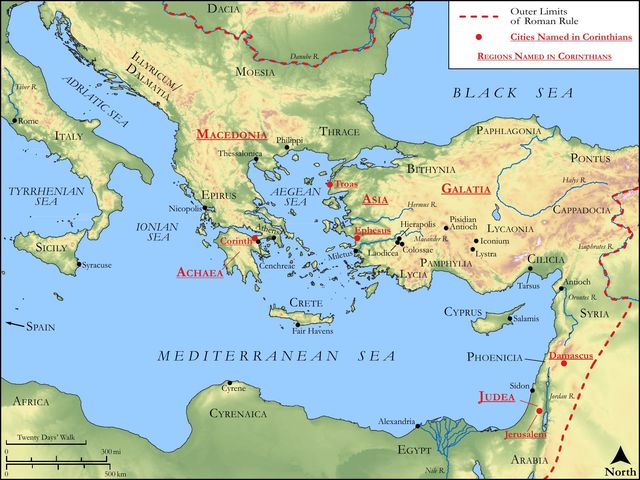

Study this verse
Public-domain commentary
Matthew Henry
From his Commentary on the Whole Bible. Henry comments on passages, not single verses — this entry covers 2 Corinthians 11:22–33.
Here the apostle gives a large account of his own qualifications, labours, and sufferings (not out of pride or vain-glory, but to the honour of God, who had enabled him to do and suffer so much for the cause of Christ), and wherein he excelled the false apostles, who would lessen his character and usefulness among the Corinthians. Observe,
I.He mentions the privileges of his birth (Co2 11:22), which were equal to any they could pretend to.
He was a Hebrew of the Hebrews; of a family among the Jews that never intermarried with the Gentiles. He was also an Israelite, and could boast of his being descended from the beloved Jacob as well as they, and was also of the seed of Abraham, and not of the proselytes. It should seem from this that the false apostles were of the Jewish race, who gave disturbance to the Gentile converts.
II.He makes mention also of his apostleship, that he was more than an ordinary minister of Christ, Co2 11:23.
God had counted him faithful, and had put him into the ministry. He had been a useful minister of Christ unto them; they had found full proofs of his ministry: Are they ministers of Christ? I am more so.
III.He chiefly insists upon this, that he had been an extraordinary sufferer for Christ; and this was what he gloried in, or rather he gloried in the grace of God that had enabled him to be more abundant in labours, and to endure very great sufferings, such as stripes above measure, frequent imprisonments, and often the dangers of death, Co2 11:23. Note, When the apostle would prove himself an extraordinary minister, he proves that he had been an extraordinary sufferer. Paul was the apostle of the Gentiles, and for that reason was hated of the Jews. They did all they could against him; and among the Gentiles also he met with hard usage. Bonds and imprisonments were familiar to him; never was the most notorious malefactor more frequently in the hands of public justice than Paul was for righteousness' sake. The jail and the whipping-post, and all other hard usages of those who are accounted the worst of men, were what he was accustomed to. As to the Jews, whenever he fell into their hands, they never spared him. Five times he fell under their lash, and received forty stripes save one, Co2 11:24. Forty stripes was the utmost their law allowed (Deu 25:3), but it was usual with them, that they might not exceed, to abate one at least of that number. And to have the abatement of one only was all the favour that ever Paul received from them. The Gentiles were not tied up to that moderation, and among them he was thrice beaten with rods, of which we may suppose once was at Philippi, Act 16:22. Once he was stoned in a popular tumult, and was taken up for dead, Act 14:19. He says that thrice he suffered shipwreck; and we may believe him, though the sacred history gives a relation but of one. A night and a day he had been in the deep (Co2 11:25), in some deep dungeon or other, shut up as a prisoner. Thus he was all his days a constant confessor; perhaps scarcely a year of his life, after his conversion, passed without suffering some hardship or other for his religion; yet this was not all, for, wherever he went, he went in perils; he was exposed to perils of all sorts. If he journeyed by land, or voyaged by sea, he was in perils of robbers, or enemies of some sort; the Jews, his own countrymen, sought to kill him, or do him a mischief; the heathen, to whom he was sent, were not more kind to him, for among them he was in peril. If he was in the city, or in the wilderness, still he was in peril. He was in peril not only among avowed enemies, but among those also who called themselves brethren, but were false brethren, Co2 11:26. Besides all this, he had great weariness and painfulness in his ministerial labours, and these are things that will come into account shortly, and people will be reckoned with for all the care and pains of their ministers concerning them. Paul was a stranger to wealth and plenty, power and pleasure, preferment and ease; he was in watchings often, and exposed to hunger and thirst; in fastings often, it may be out of necessity; and endured cold and nakedness, Co2 11:27. Thus was he, who was one of the greatest blessings of the age, used as if he had been the burden of the earth, and the plague of his generation. And yet this is not all; for, as an apostle, the care of all the churches lay on him, Co2 11:28. He mentions this last, as if this lay the heaviest upon him, and as if he could better bear all the persecutions of his enemies than the scandals that were to be found in the churches he had the oversight of. Who is weak, and I am not weak? Who is offended, and I burn not? Co2 11:29. There was not a weak Christian with whom he did not sympathize, nor any one scandalized, but he was affected therewith. See what little reason we have to be in love with the pomp and plenty of this world, when this blessed apostle, one of the best of men that ever lived, excepting Jesus Christ, felt so much hardship in it. Nor was he ashamed of all this, but, on the contrary, it was what he accounted his honour; and therefore, much against the grain as it was with him to glory, yet, says he, if I must needs glory, if my adversaries will oblige me to it in my own necessary vindication, I will glory in these my infirmities, Co2 11:30. Note, Sufferings for righteousness' sake will, the most of any thing, redound to our honour.
In the last two verses, he mentions one particular part of his sufferings out of its place, as if he had forgotten it before, or because the deliverance God wrought for him was most remarkable; namely, the danger he was in at Damascus, soon after he was converted, and not settled in Christianity, at least in the ministry and apostleship. This is recorded, Act 9:24, Act 9:25. This was his first great danger and difficulty, and the rest of his life was a piece with this. And it is observable that, lest it should be thought he spoke more than was true, the apostle confirms this narrative with a solemn oath, or appeal to the omniscience of God, Co2 11:31. It is a great comfort to a good man that the God and Father of our Lord Jesus Christ, who is an omniscient God, knows the truth of all he says, and knows all he does and all he suffers for his sake.
Historical interpretation
Historical reception
4 surviving comments on this verse. Each one is dated, so this reads as a timeline rather than a list.
Select a marker to jump to its quote. Markers stagger vertically where authors wrote within a few decades of each other.
Paul was in danger from rivers in winter, when there was constant rain and rivers often overflowed their banks. The danger at sea which he is alluding to here was the danger that in a shipwreck the soldiers guarding prisoners on board would kill them all rather than risk letting them swim to safety..
"In perils of rivers." For he was compelled also to cross rivers. "In perils of robbers, in perils in the city, in perils in the wilderness." 'Everywhere were contests set before me, in places, in countries, in cities, in deserts.' "In perils from the Gentiles, in perils amongst false brethren." Behold another kind of warfare. For not only did such as were enemies strike at him, but those also who played the hypocrite; and he had need of much firmness, much prudence.
Therefore, there are some who occupy the pastoral chair in order to care for the flock of Christ, but there are others who sit in it to gratify themselves by temporal honors and worldly advantages. These are the two kinds of pastors, some dying, some being born, who must needs continue in the Catholic church itself until the end of the world and the judgment of the Lord. If there were such men in the times of the apostles, whom the apostle lamented as false brothers when he said: “Perils from false brothers,” yet whom he did not proudly dismiss but bore with them and tolerated them, how much more likely is it that there should be such men in our times. Letter , To Felicia.
What great complaints the apostle Paul makes of false brothers. Yet he was not defiled by their physical companionship, because he was set apart from them by this distinction: purity of heart.
Continue studying 2 Corinthians 11:26 across the web’s major study libraries — every link below opens this exact verse, chapter, or book on the destination site.
Read & Compare
 BibleGatewayThis verse in more than 200 translations and 70 languages.
 Bible.comThe YouVersion reader — hundreds of translations, reading plans, and highlights.
 ESV.orgCrossway's official English Standard Version reader.
 NET BibleThe NET translation with 60,000+ translators' notes on every rendering decision.
 STEP BibleTyndale House's free study tool — original text, vocabulary, and scholarly resources.
 BibliaLogos Bible Software's free web reader.
 USCCBThe New American Bible (Revised Edition) with the U.S. bishops' study notes.
Commentaries
 BibleHub CommentariesDozens of classic commentaries on this verse, gathered on one page.
 StudyLightMore than 100 commentary sets — the largest collection on the web.
 BibleRefPlain-English commentary on what this verse means, verse by verse.
 Enduring WordDavid Guzik's free commentary on this chapter, widely used by Bible teachers.
 Bible Study ToolsVerse commentary alongside Greek and Hebrew study aids.
Original Language & Research
- BibleHub InterlinearThe verse word by word — original language, transliteration, and English.
- BibleHub LexiconEvery word's original-language definition and Strong's entry.
 Blue Letter BibleDeep-study tools — Strong's numbers, concordance, and word studies.
 CNTR CollationThe earliest Greek manuscripts of this verse, collated letter by letter.
Sermons, Hymns & Audio


TrulyRandomVerse is not affiliated with these sites and doesn’t control their content. They’re linked because they’re genuinely useful.
Summary
2 Corinthians 11:26 offers a stark and exhaustive catalog of the extreme dangers and hardships endured by the Apostle Paul during his extensive missionary journeys. This verse, part of Paul's reluctant "fool's speech," serves as compelling evidence of his authentic apostleship, contrasting his profound sufferings for the Gospel with the superficial boasts of the false apostles who challenged his authority in Corinth. It vividly portrays the relentless physical and relational perils that defined his commitment to Christ and the spread of the Good News.
Context
ShowHideLiterary Context
This verse is situated within a highly personal and polemical section of Paul's Second Letter to the Corinthians, specifically chapters 10-12, often termed his "fool's speech" or "boasting in weakness." Paul was compelled to defend his apostolic authority and integrity against a group of "super-apostles" or false teachers who had infiltrated the Corinthian church. These opponents likely boasted in their rhetorical skills, Jewish heritage, or worldly success, undermining Paul's ministry. In response, Paul sarcastically adopts their mode of boasting, but redirects it, not to worldly achievements, but to his immense sufferings and weaknesses for Christ. The immediate context sees Paul listing his afflictions, beginning in 2 Corinthians 11:23, where he claims to have "labored more abundantly" and "suffered more" than his rivals, before enumerating specific examples of his trials in 2 Corinthians 11:24-25. Verse 26 then expands this list, focusing on the constant dangers encountered during his travels.
Historical & Cultural Context
Paul's missionary journeys, particularly those through Asia Minor, Greece, and the Mediterranean, were fraught with peril. Travel in the ancient world, whether by land or sea, was inherently dangerous. Roads were often poorly maintained and susceptible to brigands, while sea voyages were at the mercy of unpredictable weather, rudimentary navigation, and piracy. Furthermore, as a Jewish Christian proclaiming a new message, Paul faced opposition from various groups. His own countrymen, the Jews, often viewed him as a renegade and blasphemer, leading to persecution. The "heathen" or Gentiles, particularly those whose economic interests were threatened by the Gospel (e.g., idol makers in Acts 19:23-41), or those who simply rejected his message, also posed significant threats. The mention of "false brethren" highlights the insidious danger from within the nascent Christian communities, where individuals claiming faith sought to undermine the true Gospel or Paul's legitimate authority, often out of jealousy, theological disagreement, or a desire for personal gain.
Key Themes
ShowHideThis verse powerfully contributes to several overarching themes within 2 Corinthians and Paul's broader theology. First, it underscores The Cost of Apostolic Ministry, vividly illustrating that genuine service to Christ often entails profound personal sacrifice, discomfort, and danger, directly contrasting with the superficiality of the "super-apostles" who likely sought comfort and acclaim. Second, it highlights Authenticity Through Suffering, arguing that Paul's willingness to endure such hardships—rather than diminishing his authority—served as irrefutable proof of his genuine devotion to Christ and his God-given call. His sufferings validated his message and mission, aligning with his later declaration that God's power is made perfect in weakness (2 Corinthians 12:9). Third, the comprehensive nature of the list reveals The Multifaceted Nature of Opposition faced by early Christians, ranging from natural dangers (waters, wilderness, sea) to human threats (robbers, countrymen, heathen, false brethren), both external and internal. This theme resonates with the broader biblical narrative of the spiritual warfare believers are engaged in (Ephesians 6:12).
Exposition and Analysis
ShowHideKey Word Analysis
ShowHideThis recurring word, appearing nine times in this single verse, is central to its meaning. It denotes "danger" or "risk," specifically a life-threatening situation. Its repetition emphasizes the constant, pervasive, and varied threats that characterized Paul's ministry, indicating a state of perpetual jeopardy rather than isolated incidents. It underscores the extreme vulnerability and constant exposure to harm that Paul willingly embraced for the sake of the Gospel.
While génos can refer broadly to "kin" or "nation," in this context, particularly given Paul's Jewish heritage, it specifically refers to his fellow Jews. This peril is particularly poignant as it highlights the deep betrayal and intense opposition Paul faced from those of his own ethnic and religious background, who often saw him as a traitor to their traditions for preaching salvation through Christ to both Jews and Gentiles. This internal conflict was often more painful than external opposition.
This compound word, meaning "spurious brother" or "pretended associate," points to individuals within the Christian community who claimed to be believers but secretly or openly opposed Paul's ministry, undermined the true Gospel, or sought to lead believers astray. This internal threat was arguably the most insidious, as it came from within the supposed circle of trust and fellowship, often causing greater spiritual and emotional distress than overt external persecution.
Verse Breakdown
ShowHide"[In] journeyings often"
This phrase sets the stage, indicating that Paul's life was characterized by frequent travel, which inherently exposed him to numerous dangers. His extensive missionary endeavors meant he was rarely in one place for long, constantly moving through diverse and often hostile environments.
"[in] perils of waters, [in] perils of robbers"
These clauses detail specific physical dangers. "Perils of waters" likely refers to dangers encountered during sea voyages (storms, shipwrecks, as mentioned in 2 Corinthians 11:25) or possibly rivers (floods, currents). "Perils of robbers" points to the common threat of brigands and highwaymen who preyed on travelers, especially on less-traveled routes.
"[in] perils by [mine own] countrymen, [in] perils by the heathen"
This highlights the human sources of opposition, categorizing them by group. "Countrymen" refers to Jews who persecuted Paul for his Christian message, often inciting riots or legal action against him. "Heathen" refers to Gentiles, who might oppose him due to their pagan beliefs, economic interests (e.g., idol worship), or general xenophobia.
"[in] perils in the city, [in] perils in the wilderness, [in] perils in the sea"
This tripartite clause covers the diverse geographical settings where Paul encountered danger. "City" refers to urban centers, often hotbeds of political and religious unrest where Paul faced mob violence, imprisonment, and legal challenges. "Wilderness" refers to unpopulated, desolate areas where he might face exposure, lack of resources, or wild animals. "Sea" reiterates the dangers of maritime travel, including storms, shipwrecks, and piracy.
"[in] perils among false brethren"
This final and perhaps most painful peril refers to the betrayal and opposition from those who claimed to be fellow believers but were in fact enemies of the true Gospel or Paul's legitimate apostolic authority. This internal strife was a constant source of grief and a significant threat to the integrity of the early church.
Literary Devices
ShowHideThe dominant literary device in 2 Corinthians 11:26 is Anaphora, the repetition of the phrase "in perils" at the beginning of successive clauses. This rhetorical technique creates a powerful cumulative effect, emphasizing the sheer volume, variety, and relentless nature of the dangers Paul faced. It builds a sense of overwhelming adversity, underscoring that peril was not an occasional occurrence but a constant companion of his ministry. The verse also employs Enumeration or Cataloging, as Paul lists a series of distinct dangers. This detailed list provides a vivid and concrete picture of his sufferings, making his claims of hardship undeniable and demonstrating the authenticity of his apostolic experience. The contrast between the external dangers (waters, robbers, city, wilderness, sea) and the internal, relational ones (countrymen, heathen, false brethren) also highlights the Breadth of Opposition, showing that Paul's trials came from every conceivable direction.
Theological and Thematic Connections
ShowHideThis verse profoundly illustrates the reality that faithful service to God often involves suffering and opposition, not as a sign of divine disfavor, but as an authenticating mark of genuine discipleship. Paul's litany of perils demonstrates that true ministry is not characterized by worldly ease or success, but by a willingness to endure hardship for the sake of the Gospel. It challenges a prosperity gospel mindset, instead affirming that God's power is often most evident in human weakness and vulnerability, as Paul himself articulates elsewhere. His survival through such a gauntlet of dangers implicitly testifies to God's preserving hand and sustaining grace, reinforcing the theme that God equips and protects those He calls, even amidst the most severe trials.
Reflection and Application
ShowHidePaul's vivid account of his "perils" in 2 Corinthians 11:26 serves as a profound mirror for contemporary believers, challenging our often-comfortable assumptions about the Christian life. It reminds us that following Christ is not a guarantee of ease, but often an invitation to participate in His sufferings, bearing witness to His truth in a hostile world. When we face our own "perils"—whether they be professional setbacks, relational betrayals, health crises, or spiritual opposition—Paul's example calls us to perseverance, resilience, and unwavering trust in God's sovereign care. It encourages us to re-evaluate our metrics for success, shifting from worldly achievements to faithfulness in the face of adversity, recognizing that God's strength is perfected in our weakness. This passage also underscores the importance of discernment, particularly regarding those who claim to be part of the faith community, reminding us that some of the deepest wounds can come from "false brethren."
Questions for Reflection
ShowHideFAQ
ShowHideWhy does Paul list all these dangers and sufferings? Is he complaining or boasting?
ShowHidePaul is not complaining, nor is he boasting in the conventional sense. In 2 Corinthians 11, Paul is reluctantly engaging in what he calls a "fool's speech" (see 2 Corinthians 11:17). He is forced to defend his legitimate apostolic authority against false teachers in Corinth who were likely boasting about their impressive rhetoric, Jewish heritage, or apparent success. To counter their superficial claims, Paul turns their boasting on its head. He "boasts" not in worldly accomplishments, but in his weaknesses, sufferings, and the immense hardships he has endured for the sake of the Gospel. His point is that his sufferings, far from discrediting him, actually validate his genuine ministry and demonstrate his authentic commitment to Christ, unlike the self-serving motives of the "super-apostles." This list serves as irrefutable evidence of the authenticity and cost of his ministry.
Christ-Centered Fulfillment
ShowHideWhile 2 Corinthians 11:26 directly details Paul's personal sufferings, it profoundly points to Christ in its demonstration of sacrificial love and enduring faithfulness. Paul's willingness to face "perils of waters," "robbers," "countrymen," "heathen," and "false brethren" mirrors the ultimate suffering and rejection experienced by Jesus Himself. Just as Paul endured betrayal from "false brethren," Jesus was betrayed by one of His own disciples (Judas Iscariot). The "perils by [mine own] countrymen" echo the rejection and crucifixion of Jesus by His own people (John 1:11). Ultimately, Paul's catalog of suffering for the sake of the Gospel reflects the pattern of Christ, who, though innocent, endured unimaginable suffering and death on the cross to secure salvation for humanity (Philippians 2:8). Paul's life, marked by these perils, becomes a living testament to the power of the resurrected Christ, whose strength is made perfect in weakness (2 Corinthians 12:9-10). Thus, Paul's sufferings are not merely biographical details but a profound participation in the sufferings of Christ, revealing the true cost of discipleship and the authentic nature of a life lived fully surrendered to the Lord.