


2 Corinthians 11:1
Bible text: King James Version (1769 Blayney text) · Public domain
Bible text: Berean Standard Bible · Public domain
Bible text: American Standard Version (1901) · Public domain
Bible text: World English Bible, Messianic edition · Public domain
Bible text: Geneva Bible (1599) · Public domain
Bible text: Young's Literal Translation · Public domain
- ὌφελονHophelonI wishG3785PRTParticle or Disjunctive
- ἀνείχεσθέaneichestheyou were bearing withG430V-IMI-2PVerb Imperfect Middle Indicative 2nd Plural
- μουmoumeG3165P-1GSPersonal pronoun Genitive 1st Singular
- μικρόνmikronlittleG3398A-ASNAdjective Accusative Singular Neuter
- τῇtēa<the>G3588T-DSFDefinite article Dative Singular Feminine
- ἀφροσύνης·aphrosunēsof foolishnessG877N-GSFNoun Genitive Singular Feminine
- ἀλλὰallabutG235CONJConjunction
- καὶkaiindeedG2532CONJConjunction
- ἀνέχεσθέanechestheyou do endureG430V-PMI-2PVerb Present Middle Indicative 2nd Plural
- μουmoumeG3165P-1GSPersonal pronoun Genitive 1st Singular
English is a literal word-by-word gloss of the Greek, not the KJV's wording. Why?
This is the original text the KJV's translators worked from — each Greek word with its own literal English meaning in this verse, prepared by scholars at Tyndale House, Cambridge. The KJV translates whole sentences, not word by word, so its wording differs: one Greek word can become several English words, and the KJV may choose “charity” where the gloss reads “love”. Both are faithful — they answer different questions. For the KJV's own rendering, switch to the KJV text.
Details
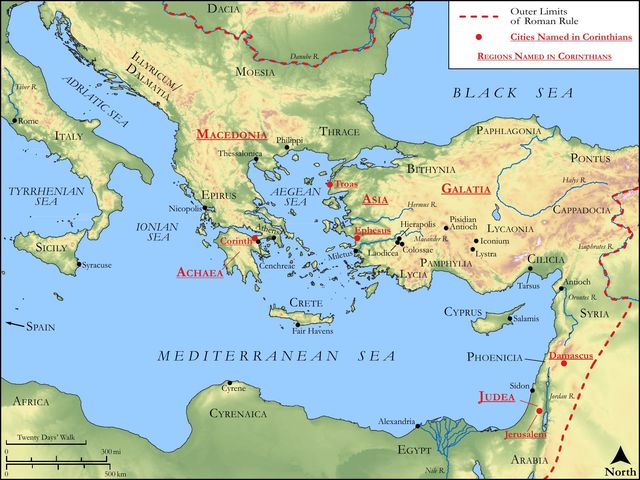
See on the biblical-era maps

Study this verse
Public-domain commentary
Matthew Henry
From his Commentary on the Whole Bible. Henry comments on passages, not single verses — this entry covers 2 Corinthians 11:1–4.
Here we may observe, 1. The apology the apostle makes for going about to commend himself. He is loth to enter upon this subject of self-commendation: Would to God you could bear with me a little in my folly, Co2 11:1. He calls this folly, because too often it is really no better. In his case it was necessary; yet, seeing others might apprehend it to be folly in him, he desires them to bear with it. Note, As much against the grain as it is with a proud man to acknowledge his infirmities, so much is it against the grain with a humble man to speak in his own praise. It is no pleasure to a good man to speak well of himself, yet in some cases it is lawful, namely, when it is for the advantage of others, or for our own necessary vindication; as thus it was here. For, 2. We have the reasons for what the apostle did. (1.) To preserve the Corinthians from being corrupted by the insinuations of the false apostles, Co2 11:2, Co2 11:3. He tells them he was jealous over them with godly jealousy; he was afraid lest their faith should be weakened by hearkening to such suggestions as tended to lessen their regard to his ministry, by which they were brought to the Christian faith. He had espoused them to one husband, that is, converted them to Christianity (and the conversion of a soul is its marriage to the Lord Jesus); and he was desirous to present them as a chaste virgin - pure, and spotless, and faithful, not having their minds corrupted with false doctrines by false teachers, as Eve was beguiled by the subtlety of the serpent. This godly jealousy in the apostle was a mixture of love and fear; and faithful ministers cannot but be afraid and concerned for their people, lest they should lose that which they have received, and turn from what they have embraced, especially when deceivers have gone abroad, or have crept in among them. (2.) To vindicate himself against the false apostles, forasmuch as they could not pretend they had another Jesus, or another Spirit, or another gospel, to preach to them, Co2 11:4. If this had been the case, there would have been some colour of reason to bear with them, or to hearken to them. But seeing there is but one Jesus, one Spirit, and one gospel, that is, or at least that ought to be, preached to them and received by them, what reason could there be why the Corinthians should be prejudiced against him, who first converted them to the faith, by the artifices of any adversary? It was a just occasion of jealousy that such persons designed to preach another Jesus, another Spirit, and another gospel.
Historical interpretation
Historical reception
4 surviving comments on this verse. Each one is dated, so this reads as a timeline rather than a list.
Select a marker to jump to its quote. Markers stagger vertically where authors wrote within a few decades of each other.
Paul says that he is being foolish when he starts to talk about himself but that he is forced to do so because these people were harboring unworthy thoughts, when they of all people ought to be thinking well of him.
Being about to enter upon his own praises he uses much previous correction. And he does this not once or twice, although the necessity of the subject, and what he had often said, were sufficient excuse for him. For he that remembereth sins which God remembered not, and who therefore saith that he was unworthy of the very name of the Apostles, even by the most insensate is seen clearly not to be saying what he is now going to say, for the sake of glory. For if one must say something startling, even this would be especially injurious to his glory, his speaking something about himself; and to the more part it is offensive. But nevertheless he regarded not timidly any of these things, but he looked to one thing, the salvation of his hearers. But still in order that he might not cause harm to the unthinking by this, by saying, I mean, great things of himself, he employs out of abundant caution these many preparatory correctives, and says, "Would that ye could bear with me," whilst I play the fool in some little things, yea, rather, "ye do indeed bear with me." Beholdest thou wisdom? For when he says, "would that," it is as putting it at their disposal: but when he even asserts [that they do], it is as confiding greatly in their affection, and as declaring that he both loves and is loved. Yea, rather, not from bare love merely, but from a sort of warm and insane passion he says that they ought to bear with him even when he plays the fool.
Paul calls himself foolish in order to demonstrate that it is those who boast about themselves who really are the foolish ones.
Paul realizes that wise people do not boast of themselves, but he has been forced to do so.
Continue studying 2 Corinthians 11:1 across the web’s major study libraries — every link below opens this exact verse, chapter, or book on the destination site.
Read & Compare
 BibleGatewayThis verse in more than 200 translations and 70 languages.
 Bible.comThe YouVersion reader — hundreds of translations, reading plans, and highlights.
 ESV.orgCrossway's official English Standard Version reader.
 NET BibleThe NET translation with 60,000+ translators' notes on every rendering decision.
 STEP BibleTyndale House's free study tool — original text, vocabulary, and scholarly resources.
 BibliaLogos Bible Software's free web reader.
 USCCBThe New American Bible (Revised Edition) with the U.S. bishops' study notes.
Commentaries
 BibleHub CommentariesDozens of classic commentaries on this verse, gathered on one page.
 StudyLightMore than 100 commentary sets — the largest collection on the web.
 BibleRefPlain-English commentary on what this verse means, verse by verse.
 Enduring WordDavid Guzik's free commentary on this chapter, widely used by Bible teachers.
 Bible Study ToolsVerse commentary alongside Greek and Hebrew study aids.
Original Language & Research
- BibleHub InterlinearThe verse word by word — original language, transliteration, and English.
- BibleHub LexiconEvery word's original-language definition and Strong's entry.
 Blue Letter BibleDeep-study tools — Strong's numbers, concordance, and word studies.
 CNTR CollationThe earliest Greek manuscripts of this verse, collated letter by letter.
Sermons, Hymns & Audio


TrulyRandomVerse is not affiliated with these sites and doesn’t control their content. They’re linked because they’re genuinely useful.
Summary
Paul, facing challenges to his apostolic authority from rival teachers in Corinth, makes an ironic and somewhat exasperated plea to the church. He asks them to tolerate his forthcoming "folly"—his necessary, yet uncomfortable, self-defense and boasting, which he undertakes not for personal glory but to safeguard the Gospel and the spiritual well-being of the Corinthians against the deceptive influence of false apostles.
Context
ShowHideLiterary Context
This verse marks the beginning of what scholars often term Paul's "fool's speech" or "boasting speech," which extends through 2 Corinthians 12. Having previously defended his ministry and integrity in 2 Corinthians 10, Paul now feels compelled to adopt the rhetorical style of his opponents—boasting—to expose its emptiness and to highlight the stark contrast between his genuine, suffering-filled apostleship and their superficial claims. The preceding chapters, particularly 2 Corinthians 8 and 2 Corinthians 9, deal with the collection for the saints in Jerusalem, demonstrating Paul's practical concern for the church, before he pivots back to the defense of his ministry, a theme that has been simmering throughout the letter.
Historical & Cultural Context
The Corinthian church was a vibrant but problematic community, situated in a major Roman port city known for its diverse population, wealth, and moral complexities. It was a hub of various philosophies and rhetorical styles, where eloquence and impressive displays of wisdom were highly valued. Paul's opponents, often labeled "super-apostles" in 2 Corinthians 11:5 and 2 Corinthians 12:11, were likely itinerant Christian teachers who had infiltrated the church, challenging Paul's authority, questioning his sincerity (e.g., his refusal to accept financial support, as discussed in 2 Corinthians 11:7-9), and perhaps even his physical presence and speaking ability (2 Corinthians 10:10). These opponents likely boasted of their own credentials, spiritual experiences, and rhetorical prowess, implicitly or explicitly undermining Paul's ministry and leading some Corinthians astray.
Key Themes
ShowHideThis verse introduces several crucial themes that Paul develops throughout the latter part of 2 Corinthians. Firstly, it highlights the theme of Apostolic Defense and Authority, as Paul is forced to vindicate his legitimate ministry against false teachers who sought to undermine it. Secondly, it underscores Ironic Humility and Paradoxical Boasting, where Paul, who typically shuns self-praise, adopts the "folly" of boasting to expose its absurdity and to contrast it with his true suffering for Christ (e.g., 2 Corinthians 11:23-28). Thirdly, the verse calls for Patience and Discernment from the Corinthians, urging them to "bear with" Paul as he speaks in an uncharacteristic manner, challenging them to look beyond outward appearances and worldly wisdom to discern true spiritual leadership and the authentic message of the Gospel. This discernment is vital for the church's spiritual health, as emphasized in Paul's concern for their purity in 2 Corinthians 11:2-3.
Exposition and Analysis
ShowHideKey Word Analysis
ShowHideThis interjection expresses a strong wish or desire, akin to "Oh that!" or "I wish that!" It conveys Paul's earnest longing for the Corinthians to grant him this unusual indulgence, highlighting the rhetorical discomfort he feels in having to engage in self-defense.
Derived from "to hold oneself up against," this verb means "to put up with," "to endure," or "to tolerate." Paul is not asking for mere passive listening but for active patience and forbearance, acknowledging that his forthcoming discourse might be difficult or even offensive to some who have been swayed by the "super-apostles." The repetition of this phrase at the end of the verse emphasizes the urgency and importance of their tolerance.
From a root meaning "senselessness" or "lack of understanding," this term can denote foolishness, recklessness, or even egotism. Paul uses it with profound irony. He does not genuinely believe his self-vindication is foolish, but he anticipates that his opponents, and perhaps some Corinthians influenced by them, might perceive it as such because it deviates from conventional, worldly standards of humility and self-promotion. By labeling his necessary defense as "folly," Paul underscores the absurdity of the situation that compels him to boast at all.
This particle, often translated as "but," "however," or "yet," functions here to emphasize the preceding request and to introduce the repeated plea. It adds a sense of urgency and reinforces the necessity of their patience, almost as if to say, "But truly, you must bear with me."
Verse Breakdown
ShowHide"Would to God ye could bear with me a little in [my] folly"
Paul initiates his plea with an earnest wish, expressing his desire for the Corinthians to tolerate his upcoming discourse. The phrase "a little" (Greek: mikrón) suggests he hopes for a brief period of their patience, acknowledging the unusual and uncomfortable nature of his "folly"—his forthcoming self-vindication and paradoxical boasting. This "folly" is not a genuine lack of wisdom on Paul's part, but a strategic, ironic adoption of his opponents' rhetorical style to expose their superficiality and to defend the integrity of the true Gospel.
"and indeed bear with me"
This second clause reiterates and intensifies the initial request. The particle "indeed" (Greek: allá) adds emphasis, underscoring the vital importance of their forbearance. The repetition of "bear with me" highlights Paul's profound need for the Corinthians' open-mindedness and patience as he embarks on this uncomfortable but necessary defense of his apostolic ministry against the deceptive influences of the false apostles.
Literary Devices
ShowHidePaul masterfully employs Irony throughout this verse and the subsequent "fool's speech." By referring to his necessary self-defense as "my folly," he subverts the expectations of his audience. He is not genuinely foolish, but he adopts the language of his opponents, who would likely consider his humble, suffering-laden ministry "foolish" compared to their worldly boasting. This ironic stance allows him to expose the true foolishness of their superficial claims. The Repetition of "bear with me" serves as an emphatic plea, highlighting the urgency and importance of the Corinthians' patience and willingness to listen to a message that might challenge their preconceived notions or comfort levels. This rhetorical device underscores the strained relationship and the critical need for the Corinthians to discern truth from falsehood.
Theological and Thematic Connections
ShowHideThis verse introduces Paul's uncomfortable but necessary defense of his apostolic authority, a defense rooted not in worldly credentials or rhetorical prowess, but in his genuine suffering and faithfulness to Christ. Theologically, it underscores the paradox of Christian leadership, where true strength is often found in weakness (2 Corinthians 12:9-10), and authentic ministry is demonstrated through sacrifice rather than self-promotion. Paul's "folly" is a divine wisdom that challenges human wisdom, revealing that God often chooses the weak and foolish things of the world to shame the strong and wise (1 Corinthians 1:27-29). The passage also highlights the ongoing struggle within the church against false teaching and the critical need for discernment among believers to distinguish between genuine and counterfeit spiritual leadership.
Reflection and Application
ShowHidePaul's plea to the Corinthians to "bear with me in my folly" resonates deeply with the challenges of Christian discipleship and leadership today. It reminds us that truth is not always presented in the most palatable or conventional ways, and that genuine spiritual authority may not conform to worldly expectations of charisma, eloquence, or self-promotion. We are called to cultivate a spirit of patience and discernment, willing to listen to uncomfortable truths and to look beyond superficial appearances to recognize the authentic work of God. This verse challenges us to examine our own biases and preferences, asking if we are truly open to hearing from those whom God has appointed, even when their methods or messages might seem unconventional or even "foolish" by worldly standards. It also offers a model for leaders: while humility is paramount, there are moments when a defense of one's ministry or the Gospel itself becomes necessary, not for personal vindication, but for the protection and spiritual health of the flock.
Questions for Reflection
ShowHideFAQ
ShowHideWhy does Paul call his boasting "folly"?
ShowHidePaul calls his boasting "folly" (Greek: aphrosýnē) with profound irony. He is adopting the language of his opponents, the "super-apostles," who likely boasted of their own credentials and eloquence, and who might have viewed Paul's humble, suffering-filled ministry as foolish or weak. By labeling his necessary self-defense as "folly," Paul highlights the absurdity of having to boast at all and exposes the emptiness of worldly boasting. His "folly" is, in fact, a divinely inspired wisdom that contrasts sharply with the superficial wisdom of the world, which values outward show over genuine spiritual substance. He is forced into this uncomfortable position to defend the integrity of the Gospel and the spiritual well-being of the Corinthian church from deceptive influences (2 Corinthians 11:2-3).
Christ-Centered Fulfillment
ShowHidePaul's "folly" in 2 Corinthians 11:1 finds its ultimate Christ-centered fulfillment in the paradoxical nature of the Gospel itself, where God's ultimate wisdom and power are revealed in what the world perceives as weakness and foolishness—the crucifixion of Jesus Christ. Just as Paul was compelled to boast in his weaknesses and sufferings (2 Corinthians 11:30), Christ's entire earthly ministry, culminating in His death on the cross, was a profound act of divine "folly" in the eyes of a world seeking power and glory. 1 Corinthians 1:18 declares that "the preaching of the cross is to them that perish foolishness; but unto us which are saved it is the power of God." Jesus, though God incarnate, "made himself of no reputation, and took upon him the form of a servant, and was made in the likeness of men" (Philippians 2:7). His willingness to endure shame, suffering, and a "foolish" death on a cross became the very means of salvation and the ultimate demonstration of God's wisdom and love. Thus, Paul's "folly" mirrors the divine strategy of redemption, where God's power is perfected in weakness, and His truth is revealed through means that defy human logic and worldly expectations, all centered on the humble, suffering, yet victorious Christ.