


Acts 16:22
Bible text: King James Version (1769 Blayney text) · Public domain
Bible text: Berean Standard Bible · Public domain
Bible text: American Standard Version (1901) · Public domain
Bible text: World English Bible, Messianic edition · Public domain
Bible text: Geneva Bible (1599) · Public domain
Bible text: Young's Literal Translation · Public domain
- καὶkaiAndG2532CONJConjunction
- συνεπέστηsunepestērose up togetherG4911V-2AAI-3SVerb 2nd Aorist Active Indicative 3rd Singular
- ὁhotheG3588T-NSMDefinite article Nominative Singular Masculine
- ὄχλοςochloscrowdG3793N-NSMNoun Nominative Singular Masculine
- κατ᾽kat᾽againstG2596PREPPreposition
- αὐτῶνautōnthemG846P-GPMPersonal pronoun Genitive Plural Masculine
- καὶkaiandG2532CONJConjunction
- οἱhoitheG3588T-NPMDefinite article Nominative Plural Masculine
- στρατηγοὶstratēgoimagistratesG4755N-NPMNoun Nominative Plural Masculine
- περιρήξαντεςperirēxanteshaving torn offG4048V-AAP-NPMVerb Aorist Active Participle Nominative Plural Masculine
- αὐτῶνautōnof themG846P-GPMPersonal pronoun Genitive Plural Masculine
- τὰtatheG3588T-APNDefinite article Accusative Plural Neuter
- ἱμάτιαhimatiagarmentsG2440N-APNNoun Accusative Plural Neuter
- ἐκέλευονekeleuonwere commandingG2753V-IAI-3PVerb Imperfect Active Indicative 3rd Plural
- ῥαβδίζειν·rhabdizeinto beat with rodsG4463V-PANVerb Present Active Infinitive
English is a literal word-by-word gloss of the Greek, not the KJV's wording. Why?
This is the original text the KJV's translators worked from — each Greek word with its own literal English meaning in this verse, prepared by scholars at Tyndale House, Cambridge. The KJV translates whole sentences, not word by word, so its wording differs: one Greek word can become several English words, and the KJV may choose “charity” where the gloss reads “love”. Both are faithful — they answer different questions. For the KJV's own rendering, switch to the KJV text.
Details
See on the biblical-era maps


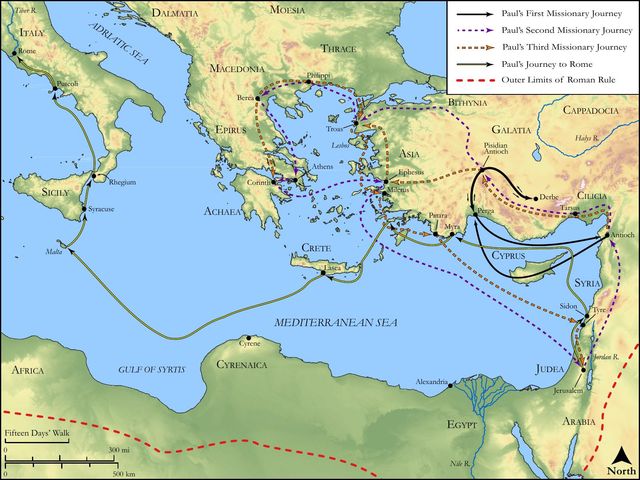
Study this verse
Public-domain commentary
Matthew Henry
From his Commentary on the Whole Bible. Henry comments on passages, not single verses — this entry covers Acts 16:16–24. His three-level outline is real structure in the source text, so it is rendered as structure.
Paul and his companions, though they were for some time buried in obscurity at Philippi, yet now begin to be taken notice of.
I.A damsel that had a spirit of divination caused them to be taken notice of, by proclaiming them to be the servants of God. Observe,
1.The account that is given of this damsel: She was puthonissa, possessed with such a spirit of divination as that damsel was by whom the oracles of Apollo at Delphos were delivered; she was actuated by an evil spirit, that dictated ambiguous answers to those who consulted her, which served to gratify their vain desire of knowing things to come, but often deceived them. In those times of ignorance, infidelity, and idolatry, the devil, by the divine permission, thus led men captive at his will; and he could not have gained such adoration from them as he had, if he had not pretended to give oracles to them, for by both his usurpation is maintained as the god of this world. This damsel brought her masters much gain by soothsaying; many came to consult this witch for the discovery of robberies, the finding of things lost, and especially to be told their fortune, and none came but with the rewards of divination in their hands, according to the quality of the person and the importance of the case. Probably there were many that were thus kept for fortune-tellers, but, it should seem, this was more in repute than any of them; for, while others brought some gain, this brought much gain to her masters, being consulted more than any other.
2.The testimony which this damsel gave to Paul and his companions: She met them in the street, as they were going to prayer, to the house of prayer, or rather to the work of prayer there, Act 16:16. They went thither publicly, every body knew whither they were going, and what they were going to do. If what she did was likely to be any distraction to them, or a hindrance in their work, it is observable how subtle Satan is, that great tempter, in taking the opportunity to give us diversion when we are going about any religious exercises, to ruffle us and to put us out of temper when we need to be most composed. When she met with them she followed them, crying, "These men, how contemptible soever they look and are looked upon, are great men, for they are the servants of the most high God, and men that should be very welcome to us, for they show unto us the way of salvation, both the salvation that will be our happiness, and the way to it that will be our holiness."
Now, (1.) This witness is true; it is a comprehensive encomium on the faithful preachers of the gospel, and makes their feet beautiful, Rom 10:15. Though they are men subject to like passions as we are, and earthen vessels, yet, [1.] "They are the servants of the most high God; they attend on him, are employed by him, and are devoted to his honour, as servants; they come to us on his errands, the message they bring is from him, and they serve the purposes and interest of his kingdom. The gods we Gentiles worship are inferior beings, therefore not gods, but these men belong to the supreme Numen, to the most high God, who is over all men, over all gods, who made us all, and to whom we are all accountable. They are his servants, and therefore it is our duty to respect them, and harken to them for their Master's sake, and it is at our peril if we affront them." [2.] "They show unto us the way of salvation." Even the heathen had some notion of the miserable deplorable state of mankind, and their need of salvation, and it was what they made some enquiries after. "Now," saith she, "these men are the men that show us what we have in vain sought for in our superstitious profitless application to our priests and oracles." Note, God has, in the gospel of his Son, plainly shown us the way of salvation, has told us what we must do that we may be delivered from the misery to which by sin we have exposed ourselves.
But, (2.) How came this testimony from the mouth of one that had a spirit of divination? Is Satan divided against himself? Will he cry up those whose business it is to pull him down? We may take it either, [1.] As extorted from this spirit of divination for the honour of the gospel by the power of God; as the devil was forced to say of Christ (Mar 1:24): I know thee who thou art, the Holy One of God. The truth is sometimes magnified by the confession of its adversaries, in which they are witnesses against themselves. Christ would have this testimony of the damsel to rise up in judgment against those at Philippi who slighted and persecuted the apostles; though the gospel needed no such testimony, yet it shall serve to add to their commendation that the damsel whom they looked upon as an oracle in other things proclaimed the apostles God's servants. Or, [2.] As designed by the evil spirit, that subtle serpent, to the dishonour of the gospel; some think she designed hereby to gain credit to herself and her prophecies, and so to increase her master's profit by pretending to be in the interest of the apostles, who, she thought, had a growing reputation, or to curry favour with Paul, that he might not separate her and her familiar. Others think that Satan, who can transform himself into an angel of light, and can say anything to serve a turn, designed hereby to disgrace the apostles; as if these divines were of the same fraternity with their diviners, because they were witnessed to by them, and then the people might as well adhere to those they had been used to. Those that were most likely to receive the apostles' doctrine were such as were prejudiced against these spirits of divination, and therefore would, by this testimony, be prejudiced against the gospel; and, as for those who regarded these diviners, the devil thought himself sure of them.
II.Christ caused them to be taken notice of, by giving them power to cast the devil out of this damsel.
She continued many days clamouring thus (Act 16:18); and, it should seem, Paul took no notice of her, not knowing but it might be ordered of God for the service of his cause, that she should thus witness concerning his ministers; but finding perhaps that it did them a prejudice, rather than any service, he soon silenced her, by casting the devil out of her.
1.He was grieved. It troubled him to see the damsel made an instrument of Satan to deceive people, and to see the people imposed upon by her divinations. It was a disturbance to him to hear a sacred truth so profaned, and good words come out of such a wicked mouth with such and evil design. Perhaps they were spoken in an ironical bantering way, as ridiculing the apostles' pretensions, and mocking them, as when Christ's persecutors complimented him with Hail, king of the Jews; and then justly might Paul be grieved, as any good man's heart would be, to hear any good truth of God bawled out in the streets in a canting jeering way.
2.He commanded the evil spirit to come out of her. He turned with a holy indignation, angry both at the flatteries and at the reproaches of the unclean spirit, and said, I command thee in the name of Jesus Christ to come out of her; and by this he will show that these men are the servants of the living God, and are able to prove themselves so, without her testimony: her silence shall demonstrate it more than her speaking could do. Thus Paul shows the way of salvation indeed, that it is by breaking the power of Satan, and chaining him up, that he may not deceive the world (Rev 20:3), and that this salvation is to be obtained in the name of Jesus Christ only, as in his name the devil was now cast out and by no other. It was a great blessing to the country when Christ by a word cast the devil out of those in whom he frightened people and molested them so that no man might pass by that way (Mat 8:28); but it was a much greater kindness to the country when Paul now, in Christ's name, cast the devil out of one who deceived people and imposed upon their credulity. Power went along with the word of Christ, before which Satan could not stand, but was forced to quit his hold, and in this case it was a strong hold: He came out the same hour.
III.The masters of the damsel that was dispossessed caused them to be taken notice of, by bringing them before the magistrates for doing it, and laying it to their charge as their crime. The preachers of the gospel would never have had an opportunity of speaking to the magistrates if they had not been brought before them as evil doers. Observe here,
1.That which provoked them was, that, the damsel being restored to herself, her masters saw that the hope of their gain was gone, Act 16:19. See here what evil the love of money is the root of! If the preaching of the gospel ruin the craft of the silversmiths (Act 19:24), much more the craft of the soothsayers; and therefore here is a great outcry raised, when Satan's power to deceive is broken: the priests hated the gospel because it turned men from the blind service of dumb idols, and so the hope of their gains was gone. The power of Christ, which appeared in dispossessing the woman, and the great kindness done to her in delivering her out of Satan's hand, made no impression upon them when they apprehended that they should hereby lose money.
2.The course they took with them was to incense the higher powers against them, as men fit to be punished: They caught them as they went along, and, with the utmost fury and violence, dragged them into the marketplace, where public justice was administered.
(1.)They brought them to the rulers, their justices of peace, to do by them as men taken into the hands of the law, the duumviri.
(2.)From them they hurried them to the magistrates, the praetors or governors of the city, tois stratēgois - the officers of the army, so the word signifies; but it is taken in general for the judges or chief rulers: to them they brought their complaint.
3.The charge they exhibited against them was that they were the troublers of the land, Act 16:20. They take it for granted that these men are Jews, a nation at this time as much an abomination to the Romans as they had long ago been to the Egyptians. Piteous was the case of the apostles, when it was turned to their reproach that they were Jews, and yet the Jews were their most violent persecutors!
(1.)The general charge against them is that they troubled the city, sowed discord, and disturbed the public peace, and occasioned riots and tumults, than which nothing could be more false and unjust, as was Ahab's character of Elijah (Kg1 18:17): Art thou he that troubleth Israel? If they troubled the city, it was but like the angel's troubling the water of Bethesda's pool, in order to healing - shaking, in order to a happy settlement. Thus those that rouse the sluggards are exclaimed against for troubling them.
(2.)The proof of this charge is their teaching customs not proper to be admitted by a Roman colony, Act 16:21. The Romans were always very jealous of innovations in religion. Right or wrong, they would adhere to that, how vain soever, which they had received by tradition from their fathers. No foreign nor upstart deity must be allowed, without the approbation of the senate; the gods of their country must be their gods, true or false. This was one of the laws of the twelve tables. Hath a nation changed their gods? It incensed them against the apostles that they taught a religion destructive of polytheism and idolatry, and preached to them to turn from those vanities. This the Romans could not bear: "If this grow upon us, in a little while we shall lose our religion."
IV.The magistrates, by their proceedings against them, caused them to be taken notice of.
1.By countenancing the persecution they raised the mob upon them (Act 16:22): The multitude rose up together against them, and were ready to pull them to pieces. It has been the artifice of Satan to make God's ministers and people odious to the commonalty, by representing them as dangerous men, who aimed at the destruction of the constitution and the changing of the customs, when really there has been no ground for such an imputation.
2.By going on to an execution they further represented them as the vilest malefactors: They rent off their clothes, with rage and fury, not having patience till they were taken off, in order to their being scourged. This the apostle refers to when he speaks of their being treated at Philippi, Th1 2:2. The magistrates commanded that they should be whipped as vagabonds, by the lictors or beadles who attended the praetors, and carried rods with them for that purpose; this was one of those three times that Paul was beaten with rods, according to the Roman usage, which was not under the compassionate limitation of the number of stripes not to exceed forty, which was provided by the Jewish law. It is here said that they laid many stripes upon them (Act 16:23), without counting how many, because they seemed vile unto them, Deu 25:3. Now, one would think, this might have satiated their cruelty; if they must be whipped, surely they must be discharged. No, they are imprisoned, and it is probable the present purpose was to try them for their lives, and put them to death; else why should there be such care taken to prevent their escape?
(1.)The judges made their commitment very strict: They charged the jailer to keep them safely, and have a very watchful eye upon them, as if they were dangerous men, that either would venture to break prison themselves or were in confederacy with those that would attempt to rescue them. Thus they endeavoured to render them odious, that they might justify themselves in the base usage they had given them.
(2.)The jailer made their confinement very severe (Act 16:24): Having received such a charge, though he might have kept them safely enough in the outer prison, yet he thrust them into the inner prison. He was sensible that the magistrates had a great indignation against these men, and were inclined to be severe with them, and therefore he thought to ingratiate himself with them, by exerting his power likewise against them to the uttermost. When magistrates are cruel, it is no wonder that the officers under them are so too. He put them into the inner prison, the dungeon, into which none were usually put but condemned malefactors, dark at noon-day, damp and cold, dirty, it is likely, and every way offensive, like that into which Jeremiah was let down (Jer 38:6); and, as if this were not enough, he made their feet fast in the stocks. Perhaps, having heard a report of the escape of the preachers of the gospel out of prison, when the doors were fast barred (Act 5:19; Act 12:9), he thought he would be wiser than other jailers had been, and therefore would effectually secure them by fastening them in the stocks; and they were not the first of God's messengers that had their feet in the stocks; Jeremiah was so treated, and publicly too, in the high-gate of Benjamin (Jer 20:2); Joseph had his feet hurt with fetters, Psa 105:18. Oh what hard usage have God's servants met with, as in the former days, so in the latter times! Witness the Book of Martyrs, martyrs in queen Mary's time.
Historical interpretation
Historical reception
1 surviving comment on this verse from the historical church.
"And the multitude rose up together against them: and the magistrates rent off their clothes, and commanded to beat them." O the irrational conduct! They did not examine, did not allow them to speak. And yet, such a miracle having taken place, ye ought to have worshipped them, ought to have held them as saviors and benefactors. For if money was what ye wished, why, having found so great wealth, did ye not run to it? This makes you more famous, the having power to cast out demons than the obeying them. Lo, even miracles, and yet love of money was mightier.
But observe them, Paul and Silas, how they do not answer, nor plead for themselves; "For when," saith he, "I am weak, then am I strong. My grace is sufficient for thee, for My strength is made perfect in weakness": so that by reason of their gentleness also they should be admired.
Continue studying Acts 16:22 across the web’s major study libraries — every link below opens this exact verse, chapter, or book on the destination site.
Read & Compare
 BibleGatewayThis verse in more than 200 translations and 70 languages.
 Bible.comThe YouVersion reader — hundreds of translations, reading plans, and highlights.
 ESV.orgCrossway's official English Standard Version reader.
 NET BibleThe NET translation with 60,000+ translators' notes on every rendering decision.
 STEP BibleTyndale House's free study tool — original text, vocabulary, and scholarly resources.
 BibliaLogos Bible Software's free web reader.
 USCCBThe New American Bible (Revised Edition) with the U.S. bishops' study notes.
Commentaries
 BibleHub CommentariesDozens of classic commentaries on this verse, gathered on one page.
 StudyLightMore than 100 commentary sets — the largest collection on the web.
 BibleRefPlain-English commentary on what this verse means, verse by verse.
 Enduring WordDavid Guzik's free commentary on this chapter, widely used by Bible teachers.
 Bible Study ToolsVerse commentary alongside Greek and Hebrew study aids.
Original Language & Research
- BibleHub InterlinearThe verse word by word — original language, transliteration, and English.
- BibleHub LexiconEvery word's original-language definition and Strong's entry.
 Blue Letter BibleDeep-study tools — Strong's numbers, concordance, and word studies.
 CNTR CollationThe earliest Greek manuscripts of this verse, collated letter by letter.
Sermons, Hymns & Audio


TrulyRandomVerse is not affiliated with these sites and doesn’t control their content. They’re linked because they’re genuinely useful.
Summary
Acts 16:22 powerfully depicts the immediate and visceral public outcry against Paul and Silas in Philippi, culminating in swift and brutal official action. Following accusations by the former masters of a demon-possessed girl, an incited crowd turns violently against the apostles, prompting the city magistrates to dramatically strip them of their clothes and command a severe beating, all without due process. This verse marks a pivotal moment in their mission, underscoring the intense opposition faced by early Christian evangelists in a Roman colonial setting.
Context
ShowHideLiterary Context
This verse is the climax of the immediate conflict initiated by Paul's exorcism of a spirit of divination from a slave girl in Philippi. Her masters, enraged at the loss of their lucrative income, seized Paul and Silas and dragged them before the city magistrates, leveling charges that exploited Roman civic pride and legal sensitivities. The preceding verses detail these accusations, specifically that Paul and Silas were "troubling our city" and "teaching customs which are not lawful for us to receive or observe, being Romans" (Acts 16:20-21). Acts 16:22 describes the immediate, unjust, and violent response of both the populace and the authorities, setting the stage for their subsequent imprisonment and the miraculous events that follow, including the conversion of the jailer and his household in Acts 16:25-34.
Historical & Cultural Context
Philippi was a significant Roman colony in Macedonia, established by Augustus as a settlement for Roman veterans. As a colonia, it enjoyed special privileges and its citizens were fiercely proud of their Roman identity and adherence to Roman law and customs. Roman law was highly suspicious of new, unauthorized religions, particularly those that seemed to challenge public order, Roman traditions, or the imperial cult. The accusation of introducing "unlawful customs" was therefore a grave charge, designed to inflame public sentiment and provoke official action. The "magistrates" (Greek: strategoi, Latin: duumviri) were the chief civil and judicial officials in a Roman colony, responsible for maintaining order. Their act of "renting off their clothes" was a dramatic public gesture of indignation and resolve, signaling their intention to take immediate and severe action, often a precursor to physical punishment. The command "to beat [them]" refers to flogging with rods (virgae), a common and brutal punishment for non-Roman citizens, administered summarily without trial, which was a clear violation of Roman legal procedure, especially given Paul's Roman citizenship (though this was unknown at the time).
Key Themes
ShowHideThis verse powerfully contributes to several overarching themes in Acts and the broader New Testament. Firstly, it highlights the theme of Persecution and Opposition that inevitably accompanies the spread of the Gospel, demonstrating that hostility can arise from economic interests, popular sentiment, and civil authorities alike. Secondly, it underscores the theme of Injustice and Mob Mentality, revealing how easily public officials can succumb to popular pressure, leading to gross miscarriages of justice where due process is abandoned. Thirdly, it exemplifies the Suffering for the Gospel that early believers willingly endured, echoing Jesus' warnings to His disciples about the cost of following Him, as seen in passages like John 15:20 where He states, "If they have persecuted me, they will also persecute you." The willingness of Paul and Silas to suffer unjustly for their faith serves as a profound testament to their unwavering commitment to Christ and His mission.
Exposition and Analysis
ShowHideKey Word Analysis
ShowHideThis term refers to a throng or crowd, often implying the general populace or even a rabble. In this context, it denotes the easily swayed public of Philippi, whose collective anger and prejudice were ignited by the accusations of the slave girl's masters. Their "rising up together" indicates a unified, aggressive movement against Paul and Silas, driven by emotion rather than reason.
Literally meaning "a general," this term refers to the chief civil and military officials in a Roman colony, equivalent to the Latin duumviri. These were powerful figures responsible for maintaining Roman order and law. Their immediate and severe reaction, without proper investigation, demonstrates their desire to appease the agitated crowd and uphold perceived Roman authority, even at the expense of justice.
Derived from rhabdos (a stick or rod), this verb specifically means "to strike with a stick" or "to bastinado," referring to a severe flogging with rods. This was a common form of corporal punishment in the Roman world, typically administered to non-citizens. The command to "beat them" signifies a brutal and humiliating physical assault, intended to inflict pain and publicly disgrace the accused.
Verse Breakdown
ShowHide"And the multitude rose up together against them:"
This clause describes the spontaneous and collective uprising of the general populace. Incited by the slave girl's masters and their inflammatory accusations, the crowd's sentiment quickly turned hostile, demonstrating the volatile nature of public opinion and the dangers of mob rule. Their unified action indicates a widespread condemnation of Paul and Silas, fueled by a mixture of prejudice, fear of foreign customs, and a desire to uphold Roman identity.
"and the magistrates rent off their clothes,"
This action by the magistrates was a dramatic and symbolic gesture. Tearing their own official robes was a public display of extreme indignation, outrage, or grief, signifying their strong disapproval and their resolve to take immediate, decisive, and severe action against Paul and Silas. It served to visually communicate their alignment with the agitated crowd and their determination to restore order by punishing the accused.
"and commanded to beat [them]."
This final clause details the magistrates' official decree. Without a formal trial or investigation into the charges, they summarily ordered the physical punishment of Paul and Silas. The command to "beat" them with rods was a brutal form of scourging, a public humiliation and a severe physical torment, highlighting the profound injustice and abuse of power inherent in this situation.
Literary Devices
ShowHideActs 16:22 employs several literary devices to heighten the drama and underscore the injustice. The rapid succession of events—the crowd's uprising, the magistrates' dramatic gesture, and the immediate command to beat—creates a sense of escalation and urgency, emphasizing the swift and unthinking nature of the persecution. The magistrates' act of "renting off their clothes" serves as powerful symbolism, representing their feigned outrage and their public commitment to a severe, albeit unjust, course of action. There is also a strong element of irony and dramatic irony present: the Roman officials, representatives of law and order, abandon due process and inflict unlawful punishment, especially significant given Paul's Roman citizenship, which they were unaware of. This scene also functions as foreshadowing, hinting at the continued persecution and suffering that Paul and other apostles would endure throughout their ministry, as well as the divine intervention that often accompanied such trials.
Theological and Thematic Connections
ShowHideActs 16:22 is a stark reminder of the cost of discipleship and the reality of suffering for the sake of the Gospel. Theologically, it demonstrates that God's kingdom advances not only through miraculous signs and conversions but also through the faithful endurance of His servants in the face of profound injustice and violence. The willingness of Paul and Silas to suffer without retaliation reflects a deep trust in God's sovereignty and a commitment to Christ's example. This episode underscores the tension between human authority and divine purpose, revealing how human systems, even those purporting to uphold justice, can become instruments of unrighteousness. Yet, God often uses such suffering as a catalyst for greater spiritual breakthroughs, as seen in the subsequent conversion of the Philippian jailer. The unjust treatment of Paul and Silas also highlights the pervasive presence of evil in the world, manifesting through mob mentality, economic greed, and the abuse of power, all of which stand in opposition to the truth and love of Christ.
Reflection and Application
ShowHideActs 16:22 challenges believers to confront the reality of opposition and injustice in a fallen world, particularly when advocating for truth and righteousness. It calls us to examine our own responses when faced with unfair treatment or hostility due to our faith or our commitment to biblical principles. Paul and Silas's subsequent actions—singing hymns in prison after their beating—exemplify a profound steadfastness and unwavering trust in God, even in the midst of severe suffering. This passage also serves as a potent warning against the dangers of mob mentality and the ease with which public opinion can be swayed by misinformation or self-interest, leading to the abandonment of justice. It compels us to cultivate discernment, to stand for what is right even when unpopular, and to resist the urge to join in condemnation without due process. Ultimately, this narrative reminds us that God's sovereign purposes are not thwarted by human wickedness; instead, He often uses trials and suffering as powerful means to advance His kingdom, transform lives, and display His glory, even in the darkest of circumstances.
Questions for Reflection
ShowHideFAQ
ShowHideWhat does it mean that the magistrates "rent off their clothes"?
ShowHideThe act of the magistrates "renting off their clothes" (Greek: perirrhḗgnymi) was a highly symbolic and dramatic gesture in that day. It was a public display of extreme indignation, outrage, or grief. In this context, it signified their strong disapproval of Paul and Silas and their determination to take immediate, severe action against them. It was a visual communication to the agitated crowd that the authorities were aligned with their anger and were prepared to exact punishment, signaling the end of any pretense of judicial process and the onset of summary judgment. This dramatic tearing of garments was often a precursor to physical violence or public humiliation.
Why were Paul and Silas beaten without a trial, especially if Paul was a Roman citizen?
ShowHidePaul and Silas were beaten without a trial due to a combination of factors: the magistrates' desire to appease the incited "multitude" (Greek: ochlos), the inflammatory nature of the accusations (disturbing the peace and introducing unlawful customs in a Roman colony), and the magistrates' probable haste to restore order. Roman law strictly forbade the beating of Roman citizens without a proper trial, and even then, only for specific offenses. The fact that Paul was a Roman citizen (as revealed later in Acts 16:37-39) makes this beating a clear and serious violation of his rights. The magistrates were likely unaware of Paul's citizenship at the time, or they simply disregarded due process in the face of public pressure and their own prejudices against the new, unauthorized religion. This incident highlights the corruption and injustice that could occur even within the vaunted Roman legal system.
Christ-Centered Fulfillment
ShowHideActs 16:22, with its vivid portrayal of unjust suffering, finds profound Christ-centered fulfillment in several ways. The experience of Paul and Silas directly mirrors the unrighteous condemnation and physical abuse suffered by Jesus Himself. Just as the Jewish leaders and the Roman authorities conspired to condemn Jesus without cause, swayed by the cries of a manipulated crowd, so too were Paul and Silas subjected to a mob's fury and the magistrates' arbitrary decree. Jesus, the ultimate innocent Lamb, was stripped, beaten, and crucified, enduring the ultimate injustice for the sins of humanity (Isaiah 53:5). The apostles' willingness to endure such suffering for the sake of the Gospel reflects their identification with Christ's passion and their commitment to follow in His footsteps, knowing that "the servant is not greater than his master" (John 15:20). Their endurance in Philippi, despite the brutal beating, becomes a powerful testimony to the resurrection power of Christ working through them, transforming a moment of profound injustice into an opportunity for divine intervention and the expansion of God's kingdom, ultimately leading to the conversion of the jailer and his household (Acts 16:31-34). Thus, their suffering is not merely a historical event but a participation in the ongoing redemptive work of Christ, demonstrating that His victory is often made manifest through the weakness and suffering of His faithful witnesses (2 Corinthians 12:9-10).