


Romans 4:22
Bible text: King James Version (1769 Blayney text) · Public domain
Bible text: Berean Standard Bible · Public domain
Bible text: American Standard Version (1901) · Public domain
Bible text: World English Bible, Messianic edition · Public domain
Bible text: Geneva Bible (1599) · Public domain
Bible text: Young's Literal Translation · Public domain
- διὸdioThereforeG1352CONJConjunction
- καὶkaialsoG2532CONJConjunction
- ἐλογίσθηelogisthēit was creditedG3049V-API-3SVerb Aorist Passive Indicative 3rd Singular
- αὐτῷautōto himG846P-DSMPersonal pronoun Dative Singular Masculine
- εἰςeisuntoG1519PREPPreposition
- δικαιοσύνηνdikaiosunēnrighteousnessG1343N-ASFNoun Accusative Singular Feminine
English is a literal word-by-word gloss of the Greek, not the KJV's wording. Why?
This is the original text the KJV's translators worked from — each Greek word with its own literal English meaning in this verse, prepared by scholars at Tyndale House, Cambridge. The KJV translates whole sentences, not word by word, so its wording differs: one Greek word can become several English words, and the KJV may choose “charity” where the gloss reads “love”. Both are faithful — they answer different questions. For the KJV's own rendering, switch to the KJV text.
Details
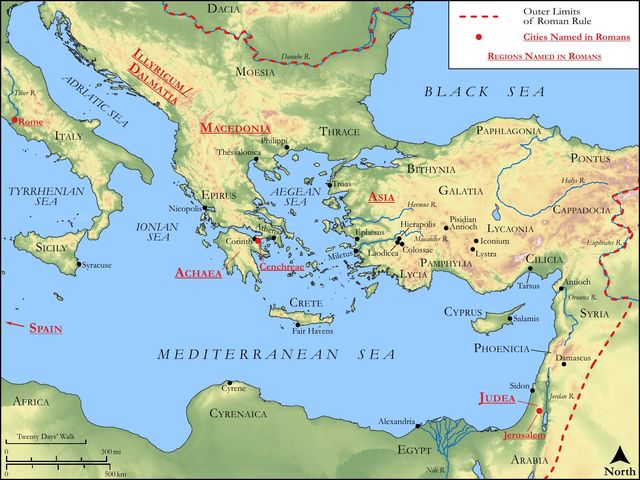
See on the biblical-era maps

Study this verse
Public-domain commentary
Matthew Henry
From his Commentary on the Whole Bible. Henry comments on passages, not single verses — this entry covers Romans 4:17–22. His two-level outline is real structure in the source text, so it is rendered as structure.
Having observed when Abraham was justified by faith, and why, for the honour of Abraham and for example to us who call him father, the apostle here describes and commends the faith of Abraham, where observe,
I.Whom he believed:
God who quickeneth. It is God himself that faith fastens upon: other foundation can no man lay. Now observe what in God Abraham's faith had an eye t - o that, certainly, which would be most likely to confirm his faith concerning the things promised: - 1. God who quickeneth the dead. It was promised that he should be the father of many nations, when he and his wife were now as good as dead (Heb 11:11, Heb 11:12), and therefore he looks upon God as a God that could breathe life into dry bones. He that quickeneth the dead can do any thing, can give a child to Abraham when he is old, can bring the Gentiles, who are dead in trespasses and sins, to a divine and spiritual life, Eph 2:1. Compare Eph 1:19, Eph 1:20. 2. Who calleth things which are not as though they were; that is, creates all things by the word of his power, as in the beginning, Gen 1:3; Co2 4:6. The justification and salvation of sinners, the espousing of the Gentiles that had not been a people, were a gracious calling of things which are not as though they were, giving being to things that were not. This expresses the sovereignty of God and his absolute power and dominion, a mighty stay to faith when all other props sink and totter. It is the holy wisdom and policy of faith to fasten particularly on that in God which is accommodated to the difficulties wherewith it is to wrestle, and will most effectually answer the objections. It is faith indeed to build upon the all-sufficiency of God for the accomplishment of that which is impossible to anything but that all-sufficiency. Thus Abraham became the father of many nations before him whom he believed, that is, in the eye and account of God; or like him whom he believed; as God was a common Father, so was Abraham. It is by faith in God that we become accepted of him, and conformable to him.
II.How he believed.
He here greatly magnifies the strength of Abraham's faith, in several expressions.
1.Against hope, he believed in hope, Rom 4:18. There was a hope against him, a natural hope. All the arguments of sense, and reason, and experience, which in such cases usually beget and support hope, were against him; no second causes smiled upon him, nor in the least favoured his hope. But, against all those inducements to the contrary, he believed; for he had a hope for him: He believed in hope, which arose, as his faith did, from the consideration of God's all-sufficiency. That he might become the father of many nations. Therefore God, by his almighty grace, enabled him thus to believe against hope, that he might pass for a pattern of great and strong faith to all generations. It was fit that he who was to be the father of the faithful should have something more than ordinary in his faith - that in him faith should be set in its highest elevation, and so the endeavours of all succeeding believers be directed, raised, and quickened. Or this is mentioned as the matter of the promise that he believed; and he refers to Gen 15:5, So shall thy seed be, as the stars of heaven, so innumerable, so illustrious. This was that which he believed, when it was counted to him for righteousness, Rom 4:6. And it is observable that this particular instance of his faith was against hope, against the surmises and suggestions of his unbelief. He had just before been concluding hardly that he should go childless, that one born in his house was his heir (Rom 4:2, Rom 4:3); and this unbelief was a foil to his faith, and bespeaks it a believing against hope.
2.Being not weak in faith, he considered not his own body, Rom 4:19. Observe, His own body was now dead - become utterly unlikely to beget a child, though the new life and vigour that God gave him continued after Sarah was dead, witness his children by Keturah. When God intends some special blessing, some child of promise, for his people, he commonly puts a sentence of death upon the blessing itself, and upon all the ways that lead to it. Joseph must be enslaved and imprisoned before he be advanced. But Abraham did not consider this, su katenoēse - he did not dwell in his thoughts upon it. He said indeed, Shall a child be born to him that is a hundred years old? Gen 17:17. But that was the language of his admiration and his desire to be further satisfied, not of his doubting and distrust; his faith passed by that consideration, and thought of nothing but the faithfulness of the promise, with the contemplation whereof he was swallowed up, and this kept up his faith. Being not weak in faith, he considered not. It is mere weakness of faith that makes a man lie poring upon the difficulties and seeming impossibilities that lie in the way of a promise. Though it may seem to be the wisdom and policy of carnal reason, yet it is the weakness of faith, to look into the bottom of all the difficulties that arise against the promise.
3.He staggered not at the promise of God through unbelief (Rom 4:20), and he therefore staggered not because he considered not the frowns and discouragements of second causes; su diekrithē - he disputed not; he did not hold any self-consultation about it, did not take time to consider whether he should close with it or no, did not hesitate nor stumble at it, but by a resolute and peremptory act of his soul, with a holy boldness, ventured all upon the promise. He took it not for a point that would admit of argument or debate, but presently determined it as a ruled case, did not at all hang in suspense about it: he staggered not through unbelief. Unbelief is at the bottom of all our staggerings at God's promises. It is not the promise that fails, but our faith that fails when we stagger.
4.He was strong in faith, giving glory to God, enedunamōthē - he was strengthened in faith, his faith got ground by exercise - crescit eundo. Though weak faith shall not be rejected, the bruised reed not broken, the smoking flax not quenched, yet strong faith shall be commended and honoured. The strength of his faith appeared in the victory it won over his fears. And hereby he gave glory to God; for, as unbelief dishonours God by making him a liar (Jo1 5:10), so faith honours God by setting to its seal that he is true, Joh 3:33. Abraham's faith gave God the glory of his wisdom, power, holiness, goodness, and especially of his faithfulness, resting upon the word that he had spoken. Among men we say, "He that trusts another, gives him credit, and honours him by taking his word;" thus Abraham gave glory to God by trusting him. We never hear our Lord Jesus commending any thing so much as great faith (Mat 8:10 and Mat 15:28): therefore God gives honour to faith, great faith, because faith, great faith, gives honour to God.
5.He was fully persuaded that what God had promised he was able to perform, plērophorētheis - was carried on with the greatest confidence and assurance; it is a metaphor taken from ships that come into the harbour with full sail. Abraham saw the storms of doubts, and fears, and temptations likely to rise against the promise, upon which many a one would have shrunk back, and lain by for fairer days, and waited a smiling gale of sense and reason. But Abraham, having taken God for his pilot, and the promise for his card and compass, resolves to weather his point, and like a bold adventurer sets up all his sails, breaks through all the difficulties, regards neither winds nor clouds, but trusts to the strength of his bottom and the wisdom and faithfulness of his pilot, and bravely makes to the harbour, and comes home an unspeakable gainer. Such was his full persuasion, and it was built on the omnipotence of God: He was able. Our waverings rise mainly from our distrust of the divine power; and therefore to fix us it is requisite we believe not only that he is faithful, but that he is able, that hath promised. And therefore it was imputed to him for righteousness, Rom 4:22. Because with such a confidence he ventured his all in the divine promise, God graciously accepted him, and not only answered, but out-did, his expectation. This way of glorifying God by a firm reliance on his bare promise was so very agreeable to God's design, and so very conducive to his honour, that he graciously accepted it as a righteousness, and justified him, though there was not that in the thing itself which could merit such an acceptance. This shows why faith is chosen to be the prime condition of our justification, because it is a grace that of all others gives glory to God.
Historical interpretation
Historical reception
3 surviving comments on this verse. Each one is dated, so this reads as a timeline rather than a list.
Select a marker to jump to its quote. Markers stagger vertically where authors wrote within a few decades of each other.
Paul claims that Abraham is worthy of this praise because although he knew that he could not do it himself, he strengthened his weakness by faith, so that he believed that with God’s help he could do what he knew was impossible by the laws of the universe. He was of great merit before God because he believed God over against his own knowledge, not doubting that because he was God he could do things which were impossible according to the world’s wisdom.Paul therefore urges the Gentiles to believe as firmly as Abraham did so that they might receive the promise of God and his grace without any hesitation, secure in the example of Abraham that the praise given to a believer increases if he believes what is incredible and seems to be foolish to the world. For the more foolish what he believes is thought to be, the more honor he will have, and indeed it would be foolish to believe it if it were said to occur without God.
"And therefore it was imputed to him for righteousness."
Abstaining then from curious questionings is glorifying God, as indulging in them is transgressing. But if by entering into curious questions, and searching out things below, we fail to glorify Him, much more if we be over curious in the matter of the Lord's generation, shall we suffer to the utmost for our insolence. For if the type of the resurrection is not to be searched into, much less those unutterable and awestiking subjects. And he does not use the word "believed" merely, but, "being fully persuaded." For such a thing is faith, it is clearer than the demonstration by reasons, and persuades more fully. For it is not possible for another reasoning succeeding to it to shake it afterwards. He indeed that is persuaded with words may have his persuasion altered too by them. But he that stays himself upon faith, hath henceforward fortified his hearing against words that may do hurt to it.
This was because Abraham believed so completely and so steadfastly.
Continue studying Romans 4:22 across the web’s major study libraries — every link below opens this exact verse, chapter, or book on the destination site.
Read & Compare
 BibleGatewayThis verse in more than 200 translations and 70 languages.
 Bible.comThe YouVersion reader — hundreds of translations, reading plans, and highlights.
 ESV.orgCrossway's official English Standard Version reader.
 NET BibleThe NET translation with 60,000+ translators' notes on every rendering decision.
 STEP BibleTyndale House's free study tool — original text, vocabulary, and scholarly resources.
 BibliaLogos Bible Software's free web reader.
 USCCBThe New American Bible (Revised Edition) with the U.S. bishops' study notes.
Commentaries
 BibleHub CommentariesDozens of classic commentaries on this verse, gathered on one page.
 StudyLightMore than 100 commentary sets — the largest collection on the web.
 BibleRefPlain-English commentary on what this verse means, verse by verse.
 Enduring WordDavid Guzik's free commentary on this chapter, widely used by Bible teachers.
 Bible Study ToolsVerse commentary alongside Greek and Hebrew study aids.
Original Language & Research
- BibleHub InterlinearThe verse word by word — original language, transliteration, and English.
- BibleHub LexiconEvery word's original-language definition and Strong's entry.
 Blue Letter BibleDeep-study tools — Strong's numbers, concordance, and word studies.
 CNTR CollationThe earliest Greek manuscripts of this verse, collated letter by letter.
Sermons, Hymns & Audio


TrulyRandomVerse is not affiliated with these sites and doesn’t control their content. They’re linked because they’re genuinely useful.
Summary
Romans 4:22 serves as a pivotal summary statement in Paul's exposition on justification, affirming that Abraham's unwavering faith in God's promise was divinely credited to him as righteousness, establishing a foundational principle for how humanity is declared righteous before a holy God.
Context
ShowHideLiterary Context
This verse concludes Paul's detailed argument in Romans 4:18-21 regarding Abraham's extraordinary faith. Paul highlights Abraham's belief in God's promise of numerous descendants despite his and Sarah's advanced age and physical incapacities, emphasizing that Abraham "did not waver through unbelief regarding the promise of God, but was strengthened in his faith and gave glory to God, being fully persuaded that God had power to do what he had promised" (Romans 4:20-21). Verse 22 directly follows this description, presenting the divine response to such faith: it was "imputed to him for righteousness." This statement then sets the stage for Paul to generalize Abraham's experience to all believers, both Jew and Gentile, in Romans 4:23-25.
Historical & Cultural Context
Paul is writing to a diverse church in Rome, comprising both Jewish and Gentile believers. A significant tension existed regarding the basis of salvation and righteousness—whether it was through adherence to the Mosaic Law and circumcision (as many Jewish Christians believed) or solely through faith in Christ. By appealing to Abraham, the revered patriarch of Israel, Paul strategically demonstrates that even before the Law was given (see Galatians 3:17), God's method of declaring people righteous was through faith. This argument directly challenges the prevailing Jewish understanding that righteousness was attained through works of the Law, aligning with the Old Testament narrative where Abraham's faith was explicitly "counted" as righteousness in Genesis 15:6.
Key Themes
ShowHideRomans 4:22 encapsulates several central themes of Paul's theology in Romans. Foremost is the theme of justification by faith, which asserts that human beings are declared righteous by God not on the basis of their works or adherence to a legal code, but solely through their trust and reliance on God's promises. This verse also underscores the theme of imputed righteousness, a forensic declaration where God credits righteousness to an individual's account, rather than it being an inherent quality or earned merit. Furthermore, Abraham serves as the paradigm of faith, demonstrating that the path to righteousness has always been consistent across redemptive history, applicable to all who believe, transcending ethnic or legal distinctions, as seen throughout Romans 4.
Exposition and Analysis
ShowHideKey Word Analysis
ShowHideFrom dia (through) and hos (which), meaning "through which thing" or "consequently." In this context, it functions as a strong logical connector, indicating that the imputation of righteousness is a direct result or consequence of Abraham's demonstrated faith described in the preceding verses. It underscores the cause-and-effect relationship between Abraham's belief and God's declaration.
A middle voice verb meaning "to take an inventory," "estimate," "reckon," "count," or "put to someone's account." It is an accounting term, signifying a transfer or crediting of something to an account. Here, it means that righteousness was not inherently possessed by Abraham as a result of his actions, but rather it was graciously credited or assigned to his spiritual account by God because of his faith. This forensic act is central to the doctrine of justification.
From dikaios (just, righteous), referring to equity of character or act, and specifically in Christian theology, "justification." It denotes a state of being right or just in the sight of God. In this verse, it is the divine declaration of a person's right standing before God, not based on their own moral perfection, but on God's gracious imputation. It is a legal verdict of "not guilty" and "righteous" in God's divine court.
Verse Breakdown
ShowHide"And therefore"
This opening phrase, utilizing the Greek kai dio, acts as a crucial logical bridge, linking the conclusion of Abraham's faith described in Romans 4:18-21 directly to the divine response. It emphasizes that what follows is a direct consequence of Abraham's unwavering trust in God's promises.
"it was imputed to him"
The "it" refers to Abraham's faith, specifically his belief in God's ability to fulfill His seemingly impossible promise of a son and numerous descendants. The verb "imputed" (Greek: elogisthē, a form of logízomai) signifies a divine act of crediting or reckoning. It means that God, in His sovereign grace, accounted Abraham's faith as the basis for a declaration of righteousness, rather than any works or merits of Abraham himself. This is a forensic, legal declaration, not a transformation of Abraham's inner character at that moment, but a change in his standing before God.
"for righteousness"
This phrase, using the Greek preposition eis (to or into), indicates the purpose or result of the imputation. Abraham's faith was not righteousness itself, nor was it a work that earned righteousness. Rather, his faith was the means through which God declared him righteous. It points to the objective of God's act: to establish Abraham in a right standing with Himself, a standing that was entirely a gift of grace received by faith.
Literary Devices
ShowHidePaul's concise statement in Romans 4:22 is rich with literary and rhetorical force. The primary device is Argumentation, as this verse serves as the logical conclusion to his detailed exposition of Abraham's faith, reinforcing his broader theological point about justification. Paul employs Exemplum, using Abraham as the quintessential model to illustrate a universal principle—that righteousness is obtained through faith, not works. This historical example lends undeniable authority and weight to his argument, especially for his Jewish audience. Furthermore, the verse relies on Theological Terminology, particularly the precise use of "imputed" (logízomai) and "righteousness" (dikaiosýnē). These terms are not merely descriptive but carry specific theological weight, functioning as a kind of Legal Metaphor drawn from the world of accounting and legal declarations, effectively conveying God's forensic act of declaring a person righteous.
Theological and Thematic Connections
ShowHideRomans 4:22 stands as a cornerstone in Paul's articulation of the doctrine of justification by faith, revealing God's consistent method of relating to humanity across redemptive history. It underscores that righteousness before God is not earned through human effort, adherence to law, or ritual performance, but is a gracious gift received through faith. Abraham's experience, recorded centuries before the Mosaic Law, demonstrates that God's declaration of "righteous" is a forensic act, crediting a right standing to those who believe, rather than an inherent quality achieved by works. This principle profoundly reshapes our understanding of salvation, shifting the focus from human merit to divine grace and the object of faith.
Reflection and Application
ShowHideRomans 4:22 offers profound spiritual comfort and practical guidance for believers today. In a world that often measures worth by achievement, performance, or adherence to rules, this verse radically reorients our understanding of our standing before God. It assures us that our acceptance by the Creator of the universe is not contingent upon our perfect obedience, flawless character, or religious rituals, but solely upon God's gracious act of crediting righteousness to us when we place our faith in Him. This truth liberates us from the exhausting burden of trying to earn God's favor and invites us into a relationship founded on grace. It cultivates humility, profound gratitude, and a confident assurance in our salvation, knowing that our "righteousness" is not our own, but a divine gift. This understanding should inspire us to live lives of joyful obedience, not for salvation, but from salvation, motivated by love and gratitude for such an immeasurable gift.
Questions for Reflection
ShowHideFAQ
ShowHideWhat does "imputed" mean in the context of Romans 4:22?
ShowHideIn Romans 4:22, "imputed" (from the Greek logízomai) is an accounting or legal term. It means that something is credited or reckoned to someone's account. In this case, God graciously credited or assigned righteousness to Abraham's spiritual account, not because Abraham earned it through perfect works, but because he believed God's promises. It's a forensic declaration, a divine verdict that declares a person righteous in God's sight, even though they are not inherently righteous in themselves. This concept is foundational to understanding how believers are justified before God through faith in Christ, as seen in passages like Romans 3:21-26.
Christ-Centered Fulfillment
ShowHideRomans 4:22, while focusing on Abraham, finds its ultimate and glorious fulfillment in Jesus Christ. Abraham's faith was "imputed to him for righteousness" because he believed God's promise, a promise that ultimately pointed to the coming Messiah. For believers today, the "it" that is imputed for righteousness is not merely our faith as an act, but the perfect righteousness of Christ Himself, received through faith. Just as Abraham looked forward in faith to God's promised deliverer, we look back in faith to Christ, the Lamb of God who takes away the sin of the world. Paul explicitly connects this in 2 Corinthians 5:21 where he states, "God made him who had no sin to be sin for us, so that in him we might become the righteousness of God." Our faith in Christ's atoning work on the cross and His resurrection (Romans 4:25) is the means by which God imputes Christ's perfect righteousness to our account, declaring us just and righteous in His sight. Thus, Abraham's experience is a powerful Old Testament foreshadowing of the New Testament reality of salvation by grace through faith in Jesus Christ, the one who truly embodies and provides all righteousness.