


1 Samuel 26:22
Bible text: King James Version (1769 Blayney text) · Public domain
Bible text: Berean Standard Bible · Public domain
Bible text: American Standard Version (1901) · Public domain
Bible text: World English Bible, Messianic edition · Public domain
Bible text: Geneva Bible (1599) · Public domain
Bible text: Young's Literal Translation · Public domain
- וַיַּעַןvai·Ya·'anand he answeredH6030Conj-w ¦ V-Qal-ConsecImperf-3msVerb Qal Consecutive Imperfect 3rd Singular Masculineוַandיַּעַןhe answered
- דָּוִדda·VidDavidH1732N-proper-mNoun Proper Masculine
- וַיֹּאמֶרvai·Yo·merand he saidH559Conj-w ¦ V-Qal-ConsecImperf-3msVerb Qal Consecutive Imperfect 3rd Singular Masculineוַandיֹּאמֶרhe said
- הִנֵּהhi·Nehhere!H2009PrtParticle Interjection
- חֲנִיתha·cha·nit[the] spear ofH2595N-fscNoun Singular Feminine Construct
- הַמֶּלֶךְha·Me·lekhthe kingH4428Art ¦ N-msNoun Singular Masculine Absoluteהַtheמֶּלֶךְking
- וְיַעֲבֹרve·ya·'a·Vorand let him pass overH5674Conj-w ¦ V-Qal-ConjImperf-3msVerb Qal Conjunction+Imperfect 3rd Singular Masculineוְandיַעֲבֹרlet him pass over
- אֶחָד'e·ChadoneH259N-fsNoun Singular Feminine Absolute
- מֵהַנְּעָרִיםme·ha·ne·'a·Rimfrom the young menH5288Prep-m ¦ Art ¦ N-mpNoun Plural Masculine Absoluteמֵfromהַtheנְּעָרִיםyoung men
- וְיִקָּחֶהָve·yi·ka·Che·haand let him take itH3947Conj-w ¦ V-Qal-ConjImperf-3ms ¦ 3fsVerb Qal Conjunction+Imperfect 3rd Singular Masculineוְandיִקָּחֶlet him takeהָit
English is a literal word-by-word gloss of the Hebrew, not the KJV's wording. Why?
This is the original text the KJV's translators worked from — each Hebrew word with its own literal English meaning in this verse, prepared by scholars at Tyndale House, Cambridge. The KJV translates whole sentences, not word by word, so its wording differs: one Hebrew word can become several English words, and the KJV may choose “the LORD” where the gloss reads “Yahweh”. Both are faithful — they answer different questions. For the KJV's own rendering, switch to the KJV text.
Details
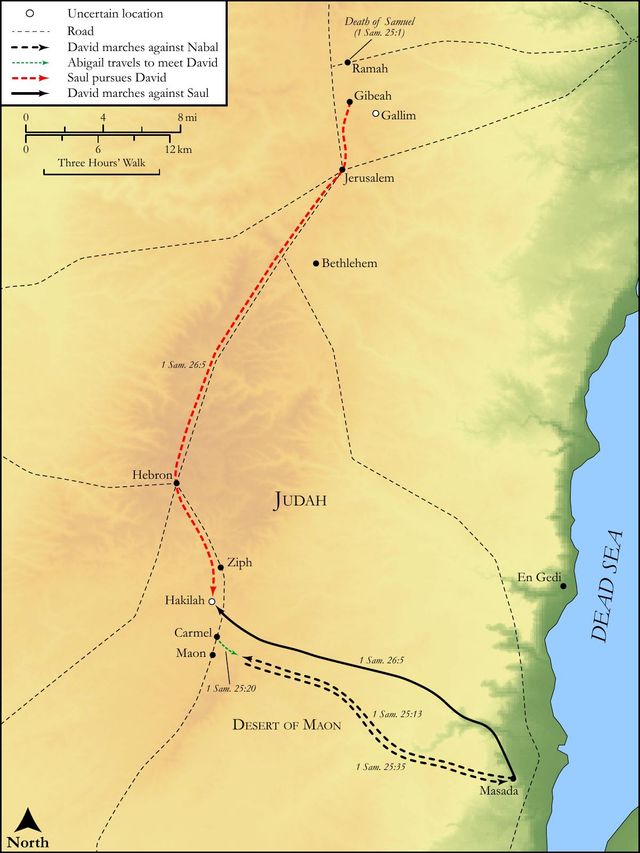
See on the biblical-era map
Study this verse
Public-domain commentary
Matthew Henry
From his Commentary on the Whole Bible. Henry comments on passages, not single verses — this entry covers 1 Samuel 26:21–25. His two-level outline is real structure in the source text, so it is rendered as structure.
Here is, I. Saul's penitent confession of his fault and folly in persecuting David and his promise to do so no more. This second instance of David's respect to him wrought more upon him than the former, and extorted from him better acknowledgements, Sa1 26:21. 1. He owns himself melted and quite overcome by David's kindness to him: "My soul was precious in thy eyes this day, which, I thought, had been odious!" 2. He acknowledges he has done very wrong to persecute him, that he has therein acted against God's law (I have sinned), and against his own interest (I have played the fool), in pursuing him as an enemy who would have been one of his best friends, if he could but have thought so. "Herein (says he) I have erred exceedingly, and wronged both thee and myself." Note, Those that sin play the fool and err exceedingly, those especially that hate and persecute God's people, Job 19:28. 3. He invites him to court again: Return, my son David. Those that have understanding will see it to be their interest to have those about them that behave themselves wisely, as David did, and have God with them. 4. He promises him that he will not persecute him as he has done, but protect him: I will no more do thee harm. We have reason to think, according to the mind he was now in, that he meant as he said, and yet neither his confession nor his promise of amendment came from a principle of true repentance.
II.David's improvement of Saul's convictions and confessions and the evidence he had to produce of his own sincerity.
He desired that one of the footmen might fetch the spear (Sa1 26:22), and then (Sa1 26:23),
1.He appeals to God as judge of the controversy: The Lord render to every man his righteousness. David, by faith, is sure that he will do it because he infallibly knows the true characters of all persons and actions and is inflexibly just to render to every man according to his work, and, by prayer, he desires he would do it. Herein he does, in effect, pray against Saul, who had dealt unrighteously and unfaithfully with him (Give them according to their deeds, Psa 28:4); but he principally intends it as a prayer for himself, that God would protect him in his righteousness and faithfulness, and also reward him, since Saul so ill requited him.
2.He reminds Saul again of the proof he had now given of his respect to him from a principle of loyalty: I would not stretch forth my hand against the Lord's anointed, intimating to Saul that the anointing oil was his protection, for which he was indebted to the Lord and ought to express his gratitude to him (had he been a common person David would not have been so tender of him), perhaps with this further implication, that Saul knew, or had reason to think, David was the Lord's anointed too, and therefore, by the same rule, Saul ought to be as tender of David's life as David had been of his.
3.Not relying much upon Saul's promises, he puts himself under God's protection and begs his favour (Sa1 26:24): "Let my life be much set by in the eyes of the Lord, how light soever thou makest of it." Thus, for his kindness to Saul, he takes God to be his paymaster, which those may with a holy confidence do that do well and suffer for it.
III.Saul's prediction of David's advancement.
He commends him (Sa1 26:25): Blessed be thou, my son David. So strong was the conviction Saul was now under of David's honesty that he was not ashamed to condemn himself and applaud David, even in the hearing of his own soldiers, who could not but blush to think that they had come out so furiously against a man whom their master, when he meets him, caresses thus. He foretels his victories, and his elevation at last: Thou shalt do great things. Note, Those who make conscience of doing that which is truly good may come, by the divine assistance, to do that which is truly great. He adds, "Thou shalt also still prevail, more and more," he means against himself, but is loth to speak that out. The princely qualities which appeared in David - his generosity in sparing Saul, his military authority in reprimanding Abner for sleeping, his care of the public good, and the signal tokens of God's presence with him - convinced Saul that he would certainly be advanced to the throne at last, according to the prophecies concerning him.
Lastly, A palliative cure being thus made of the wound, they parted friends. Saul returned to Gibeah re infect - without accomplishing his design, and ashamed of the expedition he had made; but David could not take his word so far as to return with him. Those that have once been false are not easily trusted another time. Therefore David went on his way. And, after this parting, it does not appear that ever Saul and David saw one another again.
Historical interpretation
Historical reception
1 surviving comment on this verse from the historical church.
And David answered and said: Behold, one of the king’s servants shall pass over and take it, etc. The Lord, responding through His teachers to the repentant Jews and those who have turned from the crime of persecution, said: Behold, the power of your kingdom rests with me; let the unity of the faithful pass into the unbelieving hearts of the proud, and let the spiritual weapons of the heavenly kingdom promised to you long ago be brought back swiftly. This was fulfilled in no small part in the times of the apostles, and remains to be fully completed in the times of Elijah, who preached and brought back the hearts of the fathers to the children. He says nothing about taking the cup of water, because the Lord does not teach that the shadow of the law should continue to be observed. The title of Psalm 53 remembers the betrayal of the Ziphites, which seems to refer more to an earlier betrayal, whereas there it is said according to the title: Is not David hidden among us? But here it is different: Behold, David is hidden in the hill of Achilah.
Continue studying 1 Samuel 26:22 across the web’s major study libraries — every link below opens this exact verse, chapter, or book on the destination site.
Read & Compare
 BibleGatewayThis verse in more than 200 translations and 70 languages.
 Bible.comThe YouVersion reader — hundreds of translations, reading plans, and highlights.
 ESV.orgCrossway's official English Standard Version reader.
 NET BibleThe NET translation with 60,000+ translators' notes on every rendering decision.
 STEP BibleTyndale House's free study tool — original text, vocabulary, and scholarly resources.
 BibliaLogos Bible Software's free web reader.
 USCCBThe New American Bible (Revised Edition) with the U.S. bishops' study notes.
Commentaries
 BibleHub CommentariesDozens of classic commentaries on this verse, gathered on one page.
 StudyLightMore than 100 commentary sets — the largest collection on the web.
 BibleRefPlain-English commentary on what this verse means, verse by verse.
 Enduring WordDavid Guzik's free commentary on this chapter, widely used by Bible teachers.
 Bible Study ToolsVerse commentary alongside Greek and Hebrew study aids.
Original Language & Research
- BibleHub InterlinearThe verse word by word — original language, transliteration, and English.
- BibleHub LexiconEvery word's original-language definition and Strong's entry.
 Blue Letter BibleDeep-study tools — Strong's numbers, concordance, and word studies.
 SefariaThe Hebrew text with Rashi and centuries of Jewish commentary.
Sermons, Hymns & Audio


TrulyRandomVerse is not affiliated with these sites and doesn’t control their content. They’re linked because they’re genuinely useful.
Summary
In 1 Samuel 26:22, David, having once again demonstrated profound integrity and self-restraint by sparing King Saul's life, boldly calls out to the king from a safe distance. This verse captures David's confident declaration as he presents Saul's own spear as irrefutable proof of his presence within the sleeping camp and his deliberate choice not to harm "the Lord's anointed." It powerfully underscores David's unwavering trust in God's divine protection and timing, even in the face of relentless and unjust persecution.
Context
ShowHideLiterary Context
This dramatic confrontation marks the second pivotal instance where David has the opportunity to kill King Saul but chooses to spare him, drawing a direct parallel to the earlier event in the cave of En Gedi. The narrative immediately preceding this verse details Saul's continued, paranoid pursuit of David into the wilderness of Ziph. David, accompanied by Abishai, stealthily infiltrates Saul's encampment, finding the entire army, including Saul, in a divinely induced deep sleep (1 Samuel 26:7-12). Despite Abishai's urging to strike Saul down, David vehemently refuses to harm God's anointed king, instead taking Saul's spear and water jug from beside his head. David then withdraws to a distant hill, and as Saul awakens, David uses these retrieved items as undeniable evidence of his presence and his merciful restraint, challenging Saul's general Abner for his failure to protect the king. This specific verse, 1 Samuel 26:22, is David's direct address to Saul, presenting the spear as the ultimate, tangible proof of his innocence and forbearance.
Historical & Cultural Context
In Israel, a king's spear was far more than a mere weapon; it was a potent emblem of his authority, military might, and personal security. Its placement near his head while sleeping signified its critical importance and constant readiness for defense. For David to take Saul's spear meant he had Saul's life literally in his hands, demonstrating an extraordinary level of vulnerability on Saul's part and an equally extraordinary act of restraint on David's. The concept of "the Lord's anointed" (Hebrew: mashiach) was profoundly significant in Israelite theology, referring to someone consecrated by God for a specific office, particularly the king. To harm such a person, even if they were acting wickedly, was considered an offense against God Himself, who had established their authority. David's actions reflect a deep understanding and respect for this theological principle, even as Saul's own actions violated the very trust inherent in his anointing.
Key Themes
ShowHideThis passage powerfully underscores several major theological and narrative themes prevalent throughout the books of Samuel. Firstly, Divine Protection and Providence are paramount, as God orchestrates the deep sleep of Saul's army, delivering Saul into David's hands not for vengeance, but as a testament to David's character and God's sovereign control over the unfolding events. Secondly, David's Integrity and Innocence are highlighted; his consistent refusal to take matters into his own hands against Saul, first in the cave at En Gedi and now in the camp, demonstrates his pure motives and unwavering trust in God's ultimate vindication. The spear serves as tangible, irrefutable proof of his mercy and lack of malice. Thirdly, Respect for God's Anointed is a central tenet of David's faith. Despite Saul's wicked intentions and relentless pursuit, David maintains profound reverence for Saul's position as king, recognizing that Saul's anointing by God made him untouchable by human hand. This principle is foundational to David's character and his understanding of divine authority, setting him apart from Saul's own disregard for divine commands, as seen in Saul's disobedience in 1 Samuel 15.
Exposition and Analysis
ShowHideKey Word Analysis
ShowHideThe term חֲנִית (chănîyth), derived from a root meaning "to pitch a tent," refers to a lance or javelin, typically used for thrusting. In this context, it is more than just a weapon; it is a potent symbol of Saul's royal authority, military power, and personal security. Its placement "at his head" signifies its immediate availability and critical importance to the king. David's act of taking it, rather than Saul's life, transforms it into a symbol of Saul's vulnerability, David's access, and David's merciful restraint. It becomes the undeniable, physical proof of David's integrity and a silent witness to God's providence.
The numeral אֶחָד (ʼechâd), meaning "united" or "one," emphasizes the singularity of the request. David's command, "let one of the young men come over," highlights the ease with which he could have acted alone against Saul. It underscores his complete confidence in his actions and his lack of fear towards Saul's entire army. By asking for "one" man to retrieve the spear, David is not only challenging Saul's failed protection but also subtly asserting his own moral and spiritual superiority, implying that even a single one of Saul's men would suffice for a task that should have been impossible for David to accomplish in the first place.
The word נַעַר (naʻar) refers to a boy or young man, often implying a servant or a member of a king's retinue or military guard. David's command, "let one of the young men come over and fetch it," is a bold, almost defiant challenge directed not only at Saul but also at his elite guards. It implies that Saul's own trusted protectors, who were supposed to ensure his safety, have utterly failed. This command underscores David's complete confidence in his actions and his daring them to acknowledge the truth of what has transpired and to retrieve the symbol of their king's shame and David's mercy.
Verse Breakdown
ShowHide"And David answered and said,"
This phrase marks David's confident and public declaration. He is not whispering or hiding; he is speaking loudly enough for Saul and his men to hear him from a distance, initiating a direct confrontation that is both accusatory and revelatory. His "answer" is to Saul's recognition of his voice, setting the stage for a dramatic reveal and underscoring David's readiness to face the consequences of his actions, knowing his conscience is clear.
"Behold the king's spear!"
This is the dramatic climax of David's proof. "Behold" (הִנֵּה, hinneh) is an interjection used to draw immediate attention, signifying a crucial revelation. By presenting the spear, David offers irrefutable, tangible evidence that he was indeed in Saul's camp and had the king's life in his hands. It is a powerful, non-verbal accusation against Saul's relentless, unfounded pursuit and a clear, undeniable demonstration of David's pure intentions and merciful restraint.
"and let one of the young men come over and fetch it."
This is a direct challenge and a test of Saul's integrity and the competence of his guard. David, from his position of safety, dares Saul to send one of his men to retrieve the spear. This command further highlights the shame of Saul's guard and the extent of David's access to the king's most vulnerable state. It also serves as a public demonstration of David's lack of malice; he is not using the spear as a weapon against Saul, but as an object lesson in forbearance and trust in God's justice, inviting Saul to acknowledge the truth of the situation.
Literary Devices
ShowHideThe passage makes effective use of several Literary Devices. Symbolism is central, with the spear representing Saul's authority, his vulnerability, and David's profound mercy. David's act transforms this instrument of royal power into a tangible testament of his integrity and God's protective hand. There is significant Dramatic Irony in the scene, as Saul relentlessly pursues David with murderous intent, while David, having multiple opportunities to kill the king, consistently refuses to harm him, demonstrating a higher moral and spiritual ground. The deep sleep that falls upon Saul's entire camp is a clear instance of Divine Intervention, highlighting God's protective hand over David and His sovereign control over events, orchestrating the circumstances to reveal David's character. The entire exchange is a powerful Contrast between Saul's paranoia, vengeful spirit, and spiritual decline versus David's trust, patience, and unwavering respect for God's anointed. Finally, David's public challenge, "let one of the young men come over and fetch it," serves as a Defiant Challenge or a Rhetorical Question, underscoring his confidence and Saul's humiliation.
Theological and Thematic Connections
ShowHideThis episode profoundly illustrates the tension between human vengeance and divine justice, a recurring theme throughout Scripture. David's refusal to harm Saul, despite immense provocation and clear opportunity, is not merely an act of personal integrity but a deep theological conviction rooted in his reverence for God's sovereignty over kingship. He understood that Saul's anointing placed him under God's unique protection, and only God had the right to remove him from power. This act of patient endurance and trust in God's timing stands in stark contrast to the human impulse for immediate retribution. It teaches that true vindication comes from God, not from our own hands, and that our obedience and integrity in the face of injustice are paramount. David's actions model the principle of "leaving room for God's wrath" rather than seeking personal revenge.
Reflection and Application
ShowHideDavid's actions in 1 Samuel 26:22 offer a profound model for believers navigating personal conflict and injustice. In a world that often champions retaliation and self-vindication, David's unwavering commitment to God's justice and his respect for divinely ordained authority, even when that authority is corrupt, challenges us to a higher standard. His integrity, demonstrated not just by words but by tangible proof (the spear), reminds us that our character is forged in the crucible of adversity. We are called to trust God's timing for justice, to refuse to take matters into our own hands, and to maintain a clear conscience, knowing that God sees and will ultimately vindicate His faithful servants. This passage encourages us to respond to those who wrong us with mercy and patience, reflecting the very character of God and demonstrating a faith that believes God is fully capable of handling our adversaries.
Questions for Reflection
ShowHideFAQ
ShowHideWhy didn't David kill Saul if he had the chance?
ShowHideDavid's refusal to kill Saul, despite having multiple opportunities (both here and in 1 Samuel 24), stemmed from his profound reverence for Saul's position as "the Lord's anointed" (1 Samuel 26:9). David understood that Saul had been chosen and consecrated by God for the kingship, and therefore, to lay hands on him would be to offend God Himself, who alone had the right to appoint and remove rulers. David believed that God, who had established Saul, would also be the one to remove him in His own perfect time and way. This demonstrates David's deep faith and his commitment to allowing God to execute justice and establish His kingdom according to His divine will, rather than through human violence or usurpation.
What was the significance of David taking Saul's spear and water jug?
ShowHideTaking Saul's spear and water jug served as irrefutable, tangible proof of David's presence in the sleeping camp and his deliberate choice to spare Saul's life. The spear, a potent symbol of royal authority and personal defense, being taken from right beside Saul's head, dramatically illustrated Saul's extreme vulnerability and David's complete, unhindered access. The water jug, a common item for sustenance, further emphasized the intimacy of David's access to Saul's personal space. These items were not taken as trophies of war but as silent, undeniable witnesses to David's mercy and integrity. They served to humiliate Saul and his general Abner by exposing their utter failure to protect the king, while simultaneously vindicating David in the eyes of any who might doubt his intentions.
Christ-Centered Fulfillment
ShowHideDavid's remarkable act of sparing Saul's life, despite Saul's relentless pursuit and murderous intent, prefigures the ultimate act of mercy and self-sacrifice found in Jesus Christ. David, the "man after God's own heart," refused to take vengeance on his enemy, trusting God for vindication. This foreshadows Christ, the true Son of David, who, though innocent and supremely powerful, did not come to condemn the world but to save it (John 3:17). While David refused to harm "the Lord's anointed," Jesus, as the perfectly "Anointed One" (Christ), willingly allowed Himself to be harmed, persecuted, and ultimately crucified by His enemies. He did not call down legions of angels to defend Himself (Matthew 26:53), nor did He retaliate when reviled (1 Peter 2:23). Instead, He offered Himself as the Lamb of God, taking away the sin of the world (John 1:29), even praying for the forgiveness of those who crucified Him (Luke 23:34). David's mercy spared a king for a time; Christ's mercy secured eternal life for His enemies, transforming them into His beloved children through His ultimate sacrifice on the cross (Romans 5:8). This profound act of love and non-retaliation is the pinnacle of the principle David exemplified.