


1 Samuel 24:14
Bible text: King James Version (1769 Blayney text) · Public domain
Bible text: Berean Standard Bible · Public domain
Bible text: American Standard Version (1901) · Public domain
Bible text: World English Bible, Messianic edition · Public domain
Bible text: Geneva Bible (1599) · Public domain
Bible text: Young's Literal Translation · Public domain
- אַחֲרֵי'a·cha·ReiafterH310Adj-mpcAdjective Numerical Plural Masculine Construct
- מִיmiwhom?H4310InterrogPronoun Interrogative
- יָצָאya·Tza'has he come outH3318V-Qal-Perf-3msVerb Qal Perfect 3rd Singular Masculine
- מֶלֶךְMe·lekh[the] king ofH4428N-mscNoun Singular Masculine Construct
- יִשְׂרָאֵלYis·ra·'ElIsraelH3478N-properNoun Proper Location
- אַחֲרֵי'a·cha·ReiafterH310Adj-mpcAdjective Numerical Plural Masculine Construct
- מִיmiwhom?H4310InterrogPronoun Interrogative
- אַתָּה'a·Tah[are] youH859Pro-2msPronoun Personal 2nd Singular Masculine
- רֹדֵףro·DefpursuingH7291V-Qal-Prtcpl-msVerb Qal Participle Singular Masculine Absolute
- אַחֲרֵי'a·cha·ReiafterH310Adj-mpcAdjective Numerical Plural Masculine Construct
- כֶּלֶבKe·leva dogH3611N-msNoun Singular Masculine Absolute
- מֵתMetdeadH4191V-Qal-Prtcpl-msVerb Qal Participle Singular Masculine Absolute
- אַחֲרֵי'a·cha·ReiafterH310Adj-mpcAdjective Numerical Plural Masculine Construct
- פַּרְעֹשׁpar·'Osha fleaH6550N-msNoun Singular Masculine Absolute
- אֶחָד'e·ChadoneH259N-fsNoun Singular Feminine Absolute
English is a literal word-by-word gloss of the Hebrew, not the KJV's wording. Why?
This is the original text the KJV's translators worked from — each Hebrew word with its own literal English meaning in this verse, prepared by scholars at Tyndale House, Cambridge. The KJV translates whole sentences, not word by word, so its wording differs: one Hebrew word can become several English words, and the KJV may choose “the LORD” where the gloss reads “Yahweh”. Both are faithful — they answer different questions. For the KJV's own rendering, switch to the KJV text.
Details
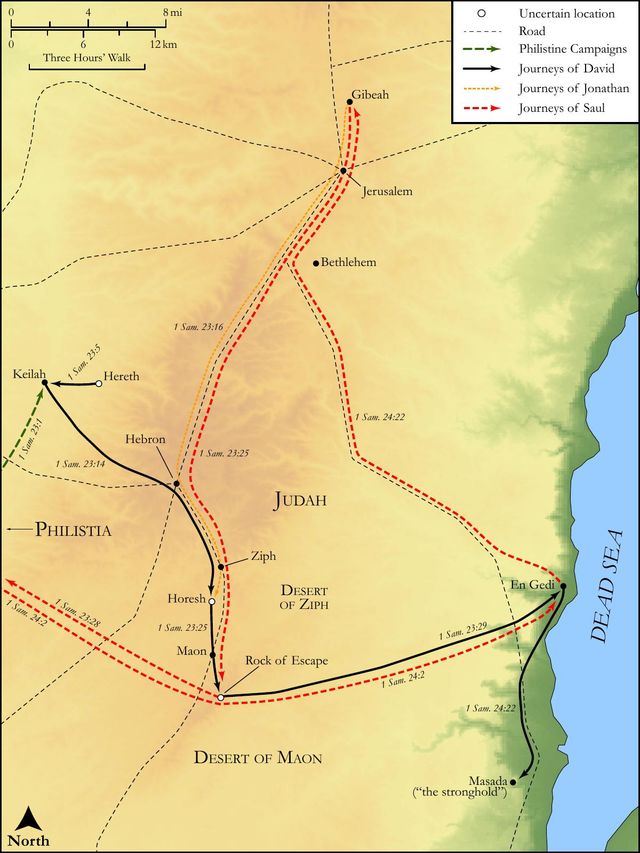
See on the biblical-era map
Study this verse
Public-domain commentary
Matthew Henry
From his Commentary on the Whole Bible. Henry comments on passages, not single verses — this entry covers 1 Samuel 24:9–15. His two-level outline is real structure in the source text, so it is rendered as structure.
We have here David's warm and pathetic speech to Saul, wherein he endeavours to convince him that he did him a great deal of wrong in persecuting him thus and to persuade him therefore to be reconciled.
I.He calls him father (Sa1 24:11), for he was not only, as king, the father of his country, but he was, in particular, his father-in-law.
From a father one may expect compassion and a favourable opinion. For a prince to seek the ruin of any of his good subjects is as unnatural as for a father to seek the ruin of his own children.
II.He lays the blame of his rage against him upon his evil counsellors:
Wherefore hearest thou men's words? Sa1 24:9. It is a piece of respect due to crowned heads, if they do amiss, to charge it upon those about them, who either advised them to it or should have advised them against it. David had reason enough to think that Saul persecuted him purely from his own envy and malice, yet he courteously supposes that others put him on to do it, and made him believe that David was his enemy and sought his hurt. Satan, the great accuser of the brethren, has his agents in all places, and particularly in the courts of those princes that encourage them and give ear to them, who make it their business to represent the people of God as enemies to Caesar and hurtful to kings and provinces, that, being thus dressed up in bear-skins, they may "be baited."
III.He solemnly protests his own innocence, and that he is far from designing any hurt or mischief to Saul:
"There is neither evil nor transgression in my hand, Sa1 24:11. I am not chargeable with any crime, nor conscious of any guilt, and, had I a window in my breast, thou mightest through it see the sincerity of my heart in this protestation: I have not sinned against thee (however I have sinned against God), yet thou huntest my soul," that is, "my life." Perhaps it was about this time that David penned the seventh psalm, concerning the affair of Cush the Benjamite (that is, Saul, as some think), wherein he thus appeals to God (Sa1 24:3-5): If there be iniquity in my hands, then let the enemy persecute my soul and take it, putting in a parenthesis, with reference to the story of this chapter, Yea, I have delivered him that without cause is my enemy.
IV.He produces undeniable evidence to prove the falsehood of the suggestion upon which Saul's malice against him was grounded.
David was charged with seeking Saul's hurt: "See," says he, "yea, see the skirt of thy robe, Sa1 24:11. Let this be a witness for me, and an unexceptionable witness it is; had that been true of which I am accused, I should now have had thy head in my hand and not the skirt of thy robe, for I could as easily have cut off that as this." To corroborate this evidence he shows him,
1.That God's providence had given him opportunity to do it: The lord delivered thee, very surprisingly, to day into my hand, whence many a one would have gathered an intimation that it was the will of God he should now give the determining blow to him whose neck lay so fair for it. When Saul had but a very small advantage against David he cried out, God has delivered him into my hand (Sa1 23:7), and resolved to make the best of that advantage; but David did not so.
2.That his counsellors and those about him had earnestly besought him to do it: Some bade me kill thee. He had blamed Saul for hearkening to men's words and justly; "for," says he, "if I had done so, thou wouldest not have been alive now." 3. That it was upon a good principle that he refused to do it; not because Saul's attendants were at hand, who, it may be, would have avenged his death; no, it was not by the fear of them, but by the fear of God, that he was restrained from it. "He is my lord, and the Lord's anointed, whom I ought to protect, and to whom I owe faith and allegiance, and therefore I said, I will not touch a hair of his head." Such a happy command he had of himself that his nature, in the midst of the greatest provocation, was not suffered to rebel against his principles.
V.He declares it to be his fixed resolution never to be his own avenger:
"The Lord avenge me of thee, that is, deliver me out of thy hand; but, whatever comes of it, my hand shall not be upon thee" (Sa1 24:12), and again (Sa1 24:13), for saith the proverb of the ancients, Wickedness proceedeth from the wicked. The wisdom of the ancients is transmitted to posterity by their proverbial sayings. Many such we receive by tradition from our fathers; and the counsels of common persons are very much directed by this, "As the old saying is." Here is one that was in use in David's time: Wickedness proceedeth from the wicked, that is,
1.Men's own iniquity will ruin them at last, so some understand it. Forward furious men will cut their own throats with their own knives. Give them rope enough, and they will hang themselves. In this sense it comes in very fitly as a reason why his hand should not be upon him.
2.Bad men will do bad things; according as men's principles and dispositions are, so will their actions be. This also agrees very well with the connexion. If David had been a wicked man, as he was represented, he would have done this wicked thing; but he durst not, because of the fear of God. Or thus: Whatever injuries bad men do us (which we are not to wonder at; he that lies among thorns must expect to be scratched), yet we must not return them; never render railing for railing. Though wickedness proceed from the wicked, yet let it not therefore proceed from us by way of retaliation. Though the dog bark at the sheep, the sheep does not bark at the dog. See Isa 32:6-8.
VI.He endeavours to convince Saul that as it was a bad thing, so it was a mean thing, for him to give chase to such an inconsiderable person as he was (Sa1 24:14): Whom does the king of Israel pursue with all this care and force? A dead dog; a flea; one flea, so it is in the Hebrew. It is below so great a king to enter the lists with one that is so unequal a match for him, one of his own servants, bred a poor shepherd, now an exile, neither able nor willing to make any resistance. To conquer him would not be to his honour, to attempt it was his disparagement. If Saul would consult his own reputation, he would slight such an enemy (supposing he were really his enemy) and would think himself in no danger from him. David was so far from aspiring that he was, in his own account, as a dead dog. Mephibosheth thus calls himself, Sa2 9:8. This humble language would have wrought upon Saul if he had had any spark of generosity in him. Satis est prostrsse leoni - Enough for the lion that he has laid his victim low. What credit would it be to Saul to trample upon a dead dog? What pleasure could it be to him to hunt a flea, a single flea, which (as some have observed), if it be sought, is not easily found, if it be found, is not easily caught, and, if it be caught, is a poor prize, especially for a prince. Aquila non captat muscas - The eagle does not dart upon flies. David thinks Saul had no more reason to fear him than to fear a flea-bite.
VII.He once and again appeals to God as the righteous Judge (Sa1 24:12 and Sa1 24:15):
The Lord judge between me and thee. Note, The justice of God is the refuge and comfort of oppressed innocence. If men wrong us, God will right us, at furthest, in the judgment of the great day. With him David leaves his cause, and so rests satisfied, waiting his time to appear for him.
Historical interpretation
Two Centuries of Reception
2 surviving comments on this verse. Each one is dated, so this reads as a timeline rather than a list.
Select a marker to jump to its quote. Markers stagger vertically where authors wrote within a few decades of each other.
The Creator compares himself to the lowest of his creatures so that you may regard nothing as despicable which is known to have been fashioned by his agency. As Scripture has it, “God made all things very good.” Thus David too followed his Teacher and compared himself with the humblest flea; for the real power of religion is that the more an individual humbles himself after the model of the Creator, the more splendidly he is exalted to glory.
Whom do you persecute, king of Israel? Whom do you persecute? etc. Israel means a man seeing God. Whom then do you persecute, O people, who were chosen before all other nations to see the glory of divine brightness? Whom do you persecute? Is it that great and most vigilant shepherd of holy sheep, whom you did not hesitate to betray to death and continue to hate even after his death? He who was lowly in human appearance but swift in the leap of resurrection, having escaped your hands when you attempted to seize him, you foolishly think that you can again grasp him thundering from heaven? Indeed, I do not seek my glory; there is one who seeks and judges. Let it seem absurd to no one that a dead dog or a flea bears the Lord's figure, since in another place due to the frailty of the flesh, which he received from a virgin's flesh without male seed, he says of himself: "But I am a worm, and not a man" (Psalm XXII). And due to the glory of the resurrection, which he quickly and swiftly completed from death to life as if by a leap: "And I am shaken out as a locust" (Psalm CVIII).
Continue studying 1 Samuel 24:14 across the web’s major study libraries — every link below opens this exact verse, chapter, or book on the destination site.
Read & Compare
 BibleGatewayThis verse in more than 200 translations and 70 languages.
 Bible.comThe YouVersion reader — hundreds of translations, reading plans, and highlights.
 ESV.orgCrossway's official English Standard Version reader.
 NET BibleThe NET translation with 60,000+ translators' notes on every rendering decision.
 STEP BibleTyndale House's free study tool — original text, vocabulary, and scholarly resources.
 BibliaLogos Bible Software's free web reader.
 USCCBThe New American Bible (Revised Edition) with the U.S. bishops' study notes.
Commentaries
 BibleHub CommentariesDozens of classic commentaries on this verse, gathered on one page.
 StudyLightMore than 100 commentary sets — the largest collection on the web.
 BibleRefPlain-English commentary on what this verse means, verse by verse.
 Enduring WordDavid Guzik's free commentary on this chapter, widely used by Bible teachers.
 Bible Study ToolsVerse commentary alongside Greek and Hebrew study aids.
Original Language & Research
- BibleHub InterlinearThe verse word by word — original language, transliteration, and English.
- BibleHub LexiconEvery word's original-language definition and Strong's entry.
 Blue Letter BibleDeep-study tools — Strong's numbers, concordance, and word studies.
 SefariaThe Hebrew text with Rashi and centuries of Jewish commentary.
Sermons, Hymns & Audio


TrulyRandomVerse is not affiliated with these sites and doesn’t control their content. They’re linked because they’re genuinely useful.
Summary
In 1 Samuel 24:14, David delivers a profoundly strategic and poignant address to King Saul, immediately after sparing Saul's life in the cave of En Gedi. This verse culminates David's impassioned plea, encapsulating his rhetorical strategy of extreme self-abasement, as he questions the sheer absurdity of the reigning monarch, "the king of Israel," relentlessly pursuing someone as utterly insignificant and non-threatening as a "dead dog" or a "flea." It serves as a powerful appeal to Saul's reason, conscience, and royal dignity, aiming to underscore David's innocence, loyalty, and the ultimate futility of Saul's obsessive and misguided hunt.
Context
ShowHideLiterary Context
This verse represents the rhetorical climax of David's address to King Saul in 1 Samuel 24, following a dramatic confrontation. Saul, driven by paranoia, is relentlessly hunting David with 3,000 chosen men. David and his men are hidden in a cave when Saul enters to relieve himself, unaware of their presence. Despite the urging of his men to kill Saul, David refuses, demonstrating profound reverence for the Lord's anointed, stating, "The Lord forbid that I should do this thing unto my master, the Lord's anointed, to stretch forth mine hand against him, seeing he is the anointed of the Lord" (1 Samuel 24:6). Instead, David quietly cuts off a corner of Saul's robe. After Saul leaves, David calls out, revealing himself and presenting the robe fragment as tangible proof of his proximity and his deliberate decision to spare Saul's life. Verse 14 is the powerful conclusion to this emotional appeal, designed to expose the irrationality of Saul's pursuit and affirm David's blamelessness and loyalty.
Historical & Cultural Context
In Israel, the institution of kingship was deeply sacred, viewed as divinely ordained. Saul was God's anointed, and despite God's rejection of him, David continued to honor this divine appointment, as evidenced by his refusal to harm Saul. The metaphors David employs—"dog" and "flea"—are deeply rooted in the cultural understanding of the time. Dogs were generally considered unclean scavengers, associated with contempt, lowliness, and even prostitution in some contexts, making a "dead dog" the epitome of worthlessness and powerlessness. Fleas, while irritating, were utterly insignificant, difficult to catch, and posed no substantial threat. David's choice of these terms would have been immediately understood by Saul as an extreme act of self-abasement, highlighting the immense power disparity between them and the demeaning nature of Saul's obsessive pursuit. This cultural context amplifies the rhetorical and emotional impact of David's words.
Key Themes
ShowHideThis verse profoundly contributes to several overarching themes within the book of 1 Samuel. It vividly illustrates David's humility and self-abasement, demonstrating his willingness to lower himself in status and dignity to appeal to Saul's reason, rather than resorting to violence or asserting his own growing power and divine favor. It powerfully underscores the futility and absurdity of unjust persecution, questioning why a mighty king would waste national resources and personal energy pursuing someone so inconsequential and innocent. Furthermore, it subtly reinforces David's unwavering trust in God's sovereignty and ultimate vindication, as his refusal to harm Saul and his humble appeal suggest a reliance on divine justice rather than human retaliation. This aligns with the broader narrative of God's hand guiding David's ascent while Saul's reign deteriorates due to his disobedience, paranoia, and spiritual decline, as seen in passages like 1 Samuel 15 and 1 Samuel 16.
Exposition and Analysis
ShowHideKey Word Analysis
ShowHideIn ancient Israelite culture, dogs were generally viewed with disdain, often associated with impurity, scavenging, and low social status. To call oneself a "dog" was an extreme act of self-abasement, signifying utter worthlessness and contemptibility. The addition of "dead" (מֵת, met) further intensifies this image, portraying David as not merely lowly, but utterly powerless, harmless, and an object of no consequence, akin to refuse.
This tiny, irritating insect represents something insignificant, difficult to catch, yet ultimately harmless and unworthy of serious attention. Chasing a flea is a demeaning and futile exercise, yielding no honor or significant result. David's use of this term emphasizes the disproportionate effort Saul is expending on a perceived threat that is, in reality, utterly trivial and non-existent.
This verb signifies running after, often with hostile intent, to chase, or to persecute. David's use of this term highlights the relentless, aggressive, and ultimately misguided nature of Saul's hunt. It underscores the king's obsession with David, portraying it as an undignified and unworthy endeavor given the perceived insignificance of the one being pursued.
Verse Breakdown
ShowHide"After whom is the king of Israel come out? after whom dost thou pursue?"
These are powerful rhetorical questions posed by David directly to Saul. They are designed not to elicit an answer, but to provoke Saul into a profound self-reflection on the sheer absurdity and indignity of his actions. David strategically contrasts Saul's exalted title, "the king of Israel"—the divinely appointed leader of God's people, responsible for national welfare—with the object of his relentless and personal vendetta. The implicit accusation is that a king of such stature should be engaged in matters of national importance, honor, and justice, not in a personal, obsessive, and undignified hunt against an innocent subject.
"after a dead dog, after a flea."
David provides the devastating answer to his own rhetorical questions, employing two potent metaphors of extreme self-deprecation. By equating himself to a "dead dog," he declares himself utterly worthless, powerless, and non-threatening—an object beneath the king's notice, incapable of harming or challenging Saul's authority or throne. The metaphor of a "flea" further reinforces this idea, portraying himself as a tiny, insignificant nuisance that, while perhaps irritating (like David's mere existence might be to Saul), poses no substantial danger and is utterly unworthy of such a grand and costly pursuit. These images highlight the immense disparity between Saul's royal power and David's perceived insignificance, exposing the profound futility, misplaced priorities, and personal degradation inherent in Saul's obsessive hunt.
Literary Devices
ShowHideDavid's speech in 1 Samuel 24:14 is masterfully crafted, employing several literary devices that amplify its emotional and persuasive power. The verse opens with two Rhetorical Questions, "After whom is the king of Israel come out? after whom dost thou pursue?" These questions are not meant to elicit an answer but to force Saul to confront the irrationality and indignity of his actions. David then employs powerful Metaphors, likening himself to a "dead dog" and a "flea." These are stark images of utter insignificance, worthlessness, and powerlessness, serving as a form of Hyperbole to exaggerate his perceived lowliness and make Saul's relentless pursuit appear even more ridiculous and beneath his royal dignity. This extreme Self-Deprecation is a strategic rhetorical move, designed to disarm Saul, appeal to his sense of reason and honor, and highlight David's innocence and lack of threat. There is also a strong element of Irony, as David, the divinely anointed future king, portrays himself as utterly worthless, while the present king, Saul, is acting in a manner that is both undignified and destructive to himself by chasing such a "worthless" target.
Theological and Thematic Connections
ShowHideDavid's profound act of self-abasement in 1 Samuel 24:14 carries significant theological weight, demonstrating a deep understanding of humility, trust in divine sovereignty, and the proper response to unjust suffering. By portraying himself as utterly insignificant, David not only appeals to Saul's conscience but also implicitly affirms his reliance on God for vindication, rather than resorting to human strength or retaliation. This posture reflects a profound spiritual maturity, where personal honor and self-defense are submitted to God's ultimate justice and timing. It underscores the biblical principle that true strength often lies in humility and dependence on God, especially when facing persecution from those in power. David's example serves as a powerful testament to the wisdom of patient endurance and the belief that God will ultimately expose truth and establish justice.
Reflection and Application
ShowHideDavid's response to Saul's relentless and unjust persecution in 1 Samuel 24:14 offers a powerful paradigm for navigating conflict and adversity in our own lives. Instead of retaliating, asserting his rights, or succumbing to bitterness and revenge, David chose humility, a reasoned appeal to conscience, and a demonstration of his blamelessness. This teaches us the profound wisdom of responding to aggression not with matching force, but with a clear display of innocence and a willingness to humble ourselves, trusting that God will ultimately vindicate the righteous. It challenges us to examine our own priorities, asking if we are expending our energy on futile pursuits or personal grievances, much like Saul, rather than focusing on what truly matters in God's kingdom and aligning with His purposes. David's example encourages us to release our need for immediate justice or personal revenge, placing our trust in God's sovereign hand to work all things for good and to bring about His perfect timing and resolution, even when it means appearing weak or insignificant in the eyes of the world.
Questions for Reflection
ShowHideFAQ
ShowHideWhy did David use such demeaning terms to describe himself?
ShowHideDavid used the terms "dead dog" and "flea" as a deliberate and highly effective rhetorical strategy of extreme self-abasement. In Israel, a "dog" was a term of profound contempt, signifying impurity, low social status, and worthlessness, with "dead" further emphasizing utter powerlessness. A "flea" was a tiny, insignificant nuisance, difficult to catch but posing no substantial threat. By equating himself to these creatures, David aimed to achieve several critical objectives: first, to demonstrate his utter harmlessness and lack of any threat to Saul's throne or authority; second, to highlight the sheer absurdity, indignity, and futility of the mighty "king of Israel" pursuing such an inconsequential target; and third, to appeal directly to Saul's conscience and sense of royal dignity by showing his own humility, submission, and innocence. It was a powerful, non-violent form of persuasion, designed to de-escalate the conflict by exposing the irrationality of Saul's obsession and affirming David's blamelessness. This act of humility is a recurring theme in David's life, as seen in his repeated refusal to harm Saul even when given the opportunity, such as in 1 Samuel 26:9-11.
Christ-Centered Fulfillment
ShowHideThe profound humility and self-abasement displayed by David in 1 Samuel 24:14, where he likens himself to a "dead dog" and a "flea" in the face of unjust persecution, powerfully foreshadows the ultimate humility and suffering of Jesus Christ. While David's self-deprecation was a strategic rhetorical device to disarm an earthly king, Christ's self-emptying was a divine reality, a voluntary act of infinite condescension for the salvation of humanity. The prophet Isaiah describes the Messiah as one who "hath no form nor comeliness; and when we shall see him, there is no beauty that we should desire him. He is despised and rejected of men; a man of sorrows, and acquainted with grief" (Isaiah 53:2-3). Like David, who refused to lift his hand against God's anointed despite having the power to do so, Jesus, though innocent and supremely powerful, submitted to unjust suffering and crucifixion, offering no resistance and entrusting Himself to the Father who judges justly (1 Peter 2:23). The "dead dog" and "flea" imagery, representing utter worthlessness and insignificance, finds its ultimate fulfillment in Christ's willingness to be made "sin for us, who knew no sin; that we might be made the righteousness of God in him" (2 Corinthians 5:21), enduring the ultimate contempt, rejection, and humiliation to secure our redemption. His humble submission, even unto death on a cross (Philippians 2:8), stands as the supreme act of self-abasement, turning apparent weakness into ultimate victory and demonstrating God's power perfected in humility.