


1 Samuel 26:20
Bible text: King James Version (1769 Blayney text) · Public domain
Bible text: King James Version with Strong's numbers · Public domain
Bible text: Berean Standard Bible · Public domain
Bible text: American Standard Version (1901) · Public domain
Bible text: World English Bible, Messianic edition · Public domain
Bible text: Geneva Bible (1599) · Public domain
Bible text: Young's Literal Translation · Public domain
- וְעַתָּהve·'a·Tahand nowH6258Conj-w ¦ AdvAdverbוְandעַתָּהnow
- אַל'almay notH408NegParticle Negative
- יִפֹּלyi·Polit fallH5307V-Qal-Imperf-3msVerb Qal Imperfect 3rd Singular Masculine
- דָּמִיda·Mimy bloodH1818N-msc ¦ 1csNoun Singular Masculine Constructדָּמִbloodיmy
- אַרְצָה'Ar·tzah[the] ground towardsH776N-fs ¦ SfxNoun Singular Feminine Absoluteאַרְצָ[the] groundהtowards
- מִנֶּגֶדmi·Ne·gedfrom beforeH5048Prep-m ¦ Adj-mscAdjective Numerical Singular Masculine Constructמִfromנֶּגֶדbefore
- פְּנֵיpe·Nei[the] presence ofH6440N-mpcNoun Plural Masculine Construct
- יְהוָהYah·wehYahwehH3068N-properNoun Proper Title
- כִּיkiforH3588PrtParticle Conditional
- יָצָאya·Tza'he has come outH3318V-Qal-Perf-3msVerb Qal Perfect 3rd Singular Masculine
- מֶלֶךְMe·lekh[the] king ofH4428N-mscNoun Singular Masculine Construct
- יִשְׂרָאֵלYis·ra·'ElIsraelH3478N-properNoun Proper Location
- לְבַקֵּשׁle·va·Keshto seekH1245Prep-l ¦ V-Piel-InfVerb Piel Infinitive Constructלְtoבַקֵּשׁseek
- אֶת'et<obj.>H853DirObjMParticle Object Indicator
- פַּרְעֹשׁpar·'Osha fleaH6550N-msNoun Singular Masculine Absolute
- אֶחָד'e·ChadoneH259N-fsNoun Singular Feminine Absolute
- כַּאֲשֶׁרka·'a·Sherjust asH834Prep-k ¦ RelParticle Relativeכַּjustאֲשֶׁרas
- יִרְדֹּףyir·Dofsomeone pursuesH7291V-Qal-Imperf-3msVerb Qal Imperfect 3rd Singular Masculine
- הַקֹּרֵאha·ko·Re'the partridgeH7124Art ¦ N-msNoun Singular Masculine Absoluteהַtheקֹּרֵאpartridge
- בֶּהָרִיםbe·ha·Rimin the mountainsH2022Prep-b ¦ N-mpNoun Plural Masculine Absoluteבֶּin theהָרִיםmountains
English is a literal word-by-word gloss of the Hebrew, not the KJV's wording. Why?
This is the original text the KJV's translators worked from — each Hebrew word with its own literal English meaning in this verse, prepared by scholars at Tyndale House, Cambridge. The KJV translates whole sentences, not word by word, so its wording differs: one Hebrew word can become several English words, and the KJV may choose “the LORD” where the gloss reads “Yahweh”. Both are faithful — they answer different questions. For the KJV's own rendering, switch to the KJV text.
Details
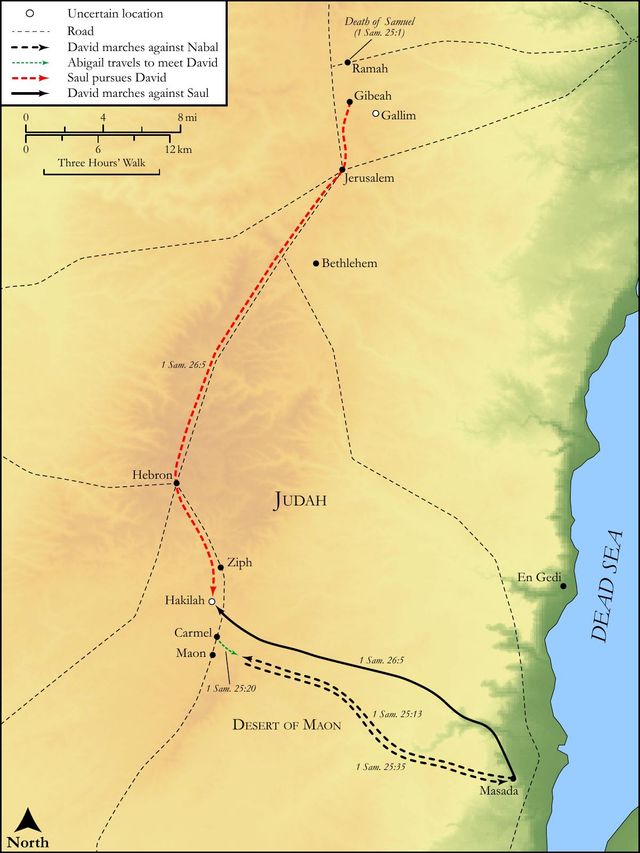
See on the biblical-era map
Study this verse
Public-domain commentary
Matthew Henry
From his Commentary on the Whole Bible. Henry comments on passages, not single verses — this entry covers 1 Samuel 26:13–20. His two-level outline is real structure in the source text, so it is rendered as structure.
David having got safely from Saul's camp himself, and having brought with him proofs sufficient that he had been there, posts himself conveniently, so that they might hear him and yet not reach him (Sa1 26:13), and then begins to reason with them upon what had passed.
I.He reasons ironically with Abner, and keenly banters him.
David knew well that it was from the mighty power of God that Abner and the rest of the guards were cast into so deep a sleep, and that God's immediate hand was in it; but he reproaches Abner as unworthy to be captain of the lifeguards, since he could sleep when the king his master lay so much exposed. By this it appears that the hand of God locked them up in this deep sleep that, as soon as ever David had got out of danger, a very little thing awakened them, even David's voice at a great distance roused them, Sa1 26:14. Abner got up (we may suppose it early in a summer's morning) and enquired who called, and disturbed the king's repose. "It is I," says David, and then he upbraids him with his sleeping when he should have been upon his guard. Perhaps Abner, looking upon David as a despicable enemy and one that there was no danger from, had neglected to set a watch; however, he himself ought to have been more wakeful. David, to put him into confusion, told him, 1. That he had lost his honour (Sa1 26:15): "Art not thou a man? (so the word is), a man in office, that art bound, by the duty of thy place, to inspect the soldiery? Art not thou in reputation for a valiant man? So thou wouldst be esteemed, a man of such courage and conduct that there is none like thee; but now thou art shamed for ever. Thou a general! Thou, a sluggard!" 2. That he deserved to lose his head (Sa1 26:16): "You are all worthy to die, by martial law, for being off your guard, when you had the king himself asleep in the midst of you. Ecce signum - Behold this token. See where the king's spear is, in the hand of him whom the king himself is pleased to count his enemy. Those that took away this might as easily and safely have taken away his life. Now see who are the king's best friends, you that neglected him and left him exposed or I that protected him when he was exposed. You pursue me as worthy to die, and irritate Saul against me; but who is worthy to die now?" Note, Sometimes those that unjustly condemn others are justly left to fall into condemnation themselves.
II.He reasons seriously and affectionately with Saul.
By this time he was so well awake as to hear what was said, and to discern who said it (Sa1 26:17): Is this thy voice, my son David? In the same manner he had expressed his relentings, Sa1 24:16. He had given his wife to another and yet calls him son, thirsted after his blood and yet is glad to hear his voice. Those are bad indeed that have never any convictions of good, nor ever sincerely utter good expressions. And now David has as fair an opportunity of reaching Saul's conscience as he had just now of taking away his life. This he lays hold on, though not of that, and enters into a close argument with him, concerning the trouble he still continued to give him, endeavouring to persuade him to let fall the prosecution and be reconciled.
1.He complains of the very melancholy condition he was brought into by the enmity of Saul against him. Two things he laments: - (1.) That he was driven from his master and from his business: "My lord pursues after his servant, Sa1 26:18. How gladly would I serve thee as formerly if my service might be accepted! but, instead of being owned as a servant, I am pursued as a rebel, and my lord is my enemy, and he whom I would follow with respect compels me to flee from him." (2.) That he was driven from his God and from his religion; and this was a much greater grievance than the former (Sa1 26:19): "They have driven me out from the inheritance of the Lord, have made Canaan too hot for me, at least the inhabited parts of it, have forced me into the deserts and mountains, and will, ere long, oblige me entirely to quit the country." And that which troubled him was not so much that he was driven out from his own inheritance as that he was driven out from the inheritance of the Lord, the holy land. It should be more comfortable to us to think of God's title to our estates and his interest in them then of our own, and that with them we may honour him then that with them we may maintain ourselves. Nor was it so much his trouble that he was constrained to live among strangers as that he was constrained to live among the worshippers of strange gods and was thereby thrust into temptation to join with them in their idolatrous worship. His enemies did, in effect, send him to go and serve other gods, and perhaps he had heard that some of them had spoken to that purport of him. Those that forbid our attendance on God's ordinances do what in them lies to estrange us from God and to make us heathens. If David had not been a man of extraordinary grace, and firmness to his religion, the ill usage he met with from his own prince and people, who were Israelites and worshippers of the true God, would have prejudiced him against the religion they professed and have driven him to communicate with idolaters. "If these be Israelites," he might have said, "let me live and die with Philistines;" and no thanks to them that their conduct had not that effect. We are to reckon that the greatest injury that can be done us which exposes us to sin. Of those who thus led David into temptation he here says, Cursed be they before the Lord. Those fall under a curse that thrust out those whom God receives, and send those to the devil who are dear to God.
2.He insists upon his own innocency: What have I done or what evil is in my hand? Sa1 26:18. He had the testimony of his conscience for him that he had never done nor ever designed any mischief to the person, honour, or government, of his prince, nor to any of the interests of his country. He had lately had Saul's own testimony concerning him (Sa1 24:17): Thou art more righteous than I. It was very unreasonable and wicked for Saul to pursue him as a criminal, when he could not charge him with any crime.
3.He endeavours to convince Saul that his pursuit of him is not only wrong, but mean, and much below him: "The king of Israel, whose dignity is great, and who has so much other work to do, has come out to seek a flea, as when one doth hunt a partridge in the mountains," Sa1 26:20 - a poor game for the king of Israel to pursue. He compares himself to a partridge, a vert innocent harmless bird, which, when attempts are made upon its life, flies if it can, but makes no resistance. And would Saul bring the flower of his army into the field only to hunt one poor partridge? What a disparagement was this to his honour! What a stain would it be on his memory to trample upon so weak and patient as well as so innocent an enemy! Jam 5:6, You have killed the just, and he doth not resist you.
4.He desires that the core of the controversy may be searched into and some proper method taken to bring it to an end, Sa1 26:19. Saul himself could not say that justice put him on thus to persecute David, or that he was obliged to do it for the public safety. David was not willing to say (though it was very true) that Saul's own envy and malice put him on to do it; and therefore he concludes it must be attributed either to the righteous judgment of God or to the unrighteous designs of evil men. Now, (1.) "If the Lord have stirred thee up against me, either in displeasure to me (taking this way to punish me for my sins against him, though, as to thee, I am guiltless) or in displeasure to thee, if it be the effect of that evil spirit from the Lord which troubles thee, let him accept an offering from us both - let us join in making our peace with God, reconciling ourselves to him, which may be done, by sacrifice; and then I hope the sin will be pardoned, whatever it is, and the trouble, which is so great a vexation both to thee and me, will come to an end." See the right method of peace-making; let us first make God our friend by Christ the great Sacrifice, and then all other enmities shall be slain, Eph 2:16; Pro 16:7. But, (2.) "If thou art incited to it by wicked men, that incense thee against me, cursed be they before the Lord," that is, they are very wicked people, and it is fit that they should be abandoned as such, and excluded from the king's court and councils. He decently lays the blame upon the evil counsellors who advised the king to that which was dishonourable and dishonest, and insists upon it that they be removed from about him and forbidden his presence, as men cursed before the Lord, and then he hoped he should gain his petition, which is (Sa1 26:20), "Let not my blood fall to the earth, as thou threatenest, for it is before the face of the Lord, who will take cognizance of the wrong and avenge it." Thus pathetically does David plead with Saul for his life, and, in order to that, for his favourable opinion of him.
Continue studying 1 Samuel 26:20 across the web’s major study libraries — every link below opens this exact verse, chapter, or book on the destination site.
Read & Compare
 BibleGatewayThis verse in more than 200 translations and 70 languages.
 Bible.comThe YouVersion reader — hundreds of translations, reading plans, and highlights.
 ESV.orgCrossway's official English Standard Version reader.
 NET BibleThe NET translation with 60,000+ translators' notes on every rendering decision.
 STEP BibleTyndale House's free study tool — original text, vocabulary, and scholarly resources.
 BibliaLogos Bible Software's free web reader.
 USCCBThe New American Bible (Revised Edition) with the U.S. bishops' study notes.
Commentaries
 BibleHub CommentariesDozens of classic commentaries on this verse, gathered on one page.
 StudyLightMore than 100 commentary sets — the largest collection on the web.
 BibleRefPlain-English commentary on what this verse means, verse by verse.
 Enduring WordDavid Guzik's free commentary on this chapter, widely used by Bible teachers.
 Bible Study ToolsVerse commentary alongside Greek and Hebrew study aids.
Original Language & Research
- BibleHub InterlinearThe verse word by word — original language, transliteration, and English.
- BibleHub LexiconEvery word's original-language definition and Strong's entry.
 Blue Letter BibleDeep-study tools — Strong's numbers, concordance, and word studies.
 SefariaThe Hebrew text with Rashi and centuries of Jewish commentary.
Sermons, Hymns & Audio


TrulyRandomVerse is not affiliated with these sites and doesn’t control their content. They’re linked because they’re genuinely useful.
Summary
In 1 Samuel 26:20, David, having once again demonstrated his profound respect for God's anointed by sparing King Saul's life, appeals to the king from a distance. This poignant declaration encapsulates David's unwavering integrity, his reliance on divine justice, and his profound humility, even as he faces relentless and absurd persecution from the reigning monarch. It highlights the stark contrast between Saul's irrational obsession and David's steadfast character, trusting God to be the ultimate arbiter of his innocence and the protector of his divinely appointed destiny.
Context
ShowHideLiterary Context
This verse is a pivotal moment in the latter half of 1 Samuel, specifically within the second account of David sparing Saul's life (compare with 1 Samuel 24). Following renewed pursuit by Saul and his elite forces, David, accompanied by Abishai, infiltrates Saul's camp under the cover of night. Instead of seizing the opportunity to kill the sleeping king, David merely takes Saul's spear and water jug from beside his head, a symbolic act demonstrating his power to act but choosing restraint out of reverence for the LORD's anointed. After withdrawing to a distant hill, David calls out to Abner, Saul's commander, and then directly to Saul himself, exposing their negligence and appealing to Saul's conscience. This verse serves as the emotional and rhetorical climax of David's plea, articulating the profound injustice of Saul's relentless vendetta and David's unwavering trust in God.
Historical & Cultural Context
In ancient Israel, the king was considered "the LORD's anointed" (Hebrew: mashiach), a sacred office established by divine decree. To harm the king, even a wicked one, was to transgress against God's chosen representative, a concept David deeply respected. David's repeated refusal to lay a hand on Saul, despite ample opportunity and Saul's clear intent to kill him, underscores his profound faith in God's timing for his own ascension to the throne and his adherence to divine principles. The concept of "blood falling to the earth" carries significant weight, evoking the idea of innocent blood shed without retribution, which was believed to cry out for justice from the ground (as seen in Genesis 4:10). Furthermore, the imagery of hunting a "flea" or "partridge" speaks to the cultural understanding of humble, elusive, and insignificant targets, emphasizing the dishonor and futility of a king's pursuit of such prey.
Key Themes
ShowHideThe verse powerfully contributes to several overarching themes in 1 Samuel. Firstly, it highlights David's unwavering integrity and righteousness in the face of profound injustice, contrasting sharply with Saul's escalating paranoia and spiritual decline, which began after his rejection by God in 1 Samuel 15. Secondly, it underscores the theme of divine sovereignty and protection, as David, despite being hunted like an animal, remains under God's watchful eye, his life miraculously preserved by divine providence. Thirdly, the imagery of the "flea" and "partridge" emphasizes Saul's futile and undignified obsession, portraying his royal power as misdirected and his efforts as ultimately fruitless against one whom God protects and has chosen as king, as prophesied in 1 Samuel 16. Finally, David's appeal to the "face of the LORD" reinforces the theme of divine justice, trusting that God sees his plight and will ultimately vindicate the innocent.
Exposition and Analysis
ShowHideKey Word Analysis
ShowHideThis term (H1818, דָּם) refers to the life force, specifically that which, when shed, causes death. In this context, "my blood fall to the earth" signifies a violent, unjust death. David's plea invokes the ancient understanding that innocent blood shed on the ground cries out for justice and divine intervention, similar to the cry of Abel's blood in Genesis 4:10.
The verb (H1245, בָּקַשׁ) means to search out, to strive after, or to pursue with intent. Here, it describes Saul's active and relentless pursuit of David. The use of this word underscores the king's deliberate and focused effort, making the subsequent comparison to hunting a flea or partridge even more ironic and demeaning to Saul's royal dignity.
This term (H6550, פַּרְעֹשׁ) refers to a tiny, insignificant, and bothersome insect. David's self-identification as a "flea" is a profound expression of humility and an ironic rhetorical device. It underscores the absurdity of the king of Israel expending vast resources and royal dignity to hunt such a trivial target. It also subtly implies that David is difficult to catch and, like a flea, will continue to evade Saul's grasp.
The word (H7124, קוֹRֵא) refers to a specific type of game bird, likely the Chukar partridge, known for its elusiveness and habit of fleeing into rugged, mountainous terrain when pursued. This simile vividly portrays Saul's relentless but ultimately fruitless pursuit of David, emphasizing the dishonorable and wasteful nature of his efforts against a divinely protected individual.
Verse Breakdown
ShowHide"Now therefore, let not my blood fall to the earth before the face of the LORD:"
This is David's earnest plea for his life, framed as an appeal to divine justice. "My blood fall to the earth" signifies a violent, unjust death, implying that his life would be taken prematurely and without cause. The phrase "before the face of the LORD" emphasizes that God is the omniscient witness and ultimate judge. David is not merely asking Saul to spare him, but is calling upon God to intervene and prevent such an injustice, trusting in God's righteous judgment and protective power.
"for the king of Israel is come out to seek a flea,"
This clause provides the immediate justification for David's plea, highlighting the profound irony and absurdity of the situation. The "king of Israel," the most powerful man in the land, divinely appointed to rule and protect his people, has debased himself by relentlessly pursuing David, whom he likens to a "flea"—a creature of utter insignificance and nuisance. This metaphor underscores Saul's irrational paranoia and the disproportionate effort he is expending, portraying his actions as beneath the dignity of his office.
"as when one doth hunt a partridge in the mountains."
This second simile further amplifies the futility and dishonor of Saul's pursuit. Hunting a partridge in the mountains is a difficult, arduous, and often unrewarding task, as these birds are elusive and adept at escaping. By comparing himself to a partridge, David emphasizes his elusiveness and the ultimate fruitlessness of Saul's efforts. It also subtly suggests that Saul's methods are dishonorable, akin to hunting a wild, insignificant creature rather than engaging in a noble pursuit. The imagery of "mountains" evokes the rugged, desolate terrain where David has been forced to hide, further emphasizing his vulnerable but ultimately protected state.
Literary Devices
ShowHideThe verse is rich in Simile, employing two distinct comparisons: David as a "flea" and David as a "partridge in the mountains." These similes are not merely descriptive but serve a powerful rhetorical purpose, highlighting the absurdity and injustice of Saul's pursuit. The comparison to a "flea" also functions as Hyperbole, exaggerating David's perceived insignificance to underscore the king's misplaced priorities. There is profound Irony in the king of Israel, God's anointed, dedicating his resources to hunting an innocent man who is himself God's chosen successor, reducing a royal pursuit to the level of chasing vermin or elusive game. David's plea itself is an example of Pathos, appealing to Saul's conscience and the divine standard of justice through an expression of vulnerability and an assertion of innocence. The phrase "let not my blood fall to the earth before the face of the LORD" is a form of Merism, where "blood" represents life, and its "falling to the earth" signifies a violent death, invoking a broader concept of divine judgment over the shedding of innocent life.
Theological and Thematic Connections
ShowHideDavid's plea in 1 Samuel 26:20 resonates deeply with the biblical themes of innocent suffering, divine justice, and the sanctity of life. His refusal to retaliate against Saul, despite the profound injustice, mirrors the righteous suffering of many biblical figures who entrusted their vindication to God. David's appeal to the "face of the LORD" underscores the conviction that God is not only a witness to human affairs but also the ultimate arbiter of justice, who sees the hidden motives and protects the righteous. This reliance on God for vindication, rather than resorting to self-help or vengeance, is a hallmark of true faith. The imagery of blood crying out from the earth connects David's plight to a universal biblical principle that the shedding of innocent blood is an affront to God and demands divine reckoning, reinforcing the sacred value of human life and God's unwavering commitment to righteousness.
Reflection and Application
ShowHideDavid's conduct in 1 Samuel 26:20 offers profound lessons for navigating injustice and persecution in our own lives. When we are unjustly targeted, slandered, or pursued, David's example calls us to resist the urge for self-vindication or retaliation. Instead, we are invited to maintain our integrity, to humble ourselves before God, and to appeal to His ultimate justice. David's willingness to appear insignificant ("a flea") before his persecutor, while simultaneously appealing to the highest authority ("the face of the LORD"), teaches us that true strength lies not in asserting our own rights or power, but in trusting God to be our defender and vindicator. This posture of humility and faith allows God to work on our behalf, ensuring that His purposes, not human malice, will ultimately prevail. We are reminded that God sees our suffering, hears our cries, and will, in His perfect timing, bring about justice and peace for those who trust in Him, transforming our trials into testimonies of His faithfulness.
Questions for Reflection
ShowHideFAQ
ShowHideWhy does David compare himself to a "flea" and a "partridge"?
ShowHideDavid uses these two similes to powerfully convey the absurdity and injustice of Saul's relentless pursuit. Comparing himself to a "flea" (H6550, פַּרְעֹשׁ, parʻôsh') emphasizes his perceived insignificance in the grand scheme of the kingdom, highlighting how beneath a king's dignity it is to expend such energy on a trivial target. It also subtly suggests his elusiveness and difficulty to catch. The comparison to a "partridge in the mountains" (H7124, קוֹרֵא, qôrêʼ') further underscores the futility and dishonor of Saul's hunt. Partridges are notoriously difficult to catch in rugged terrain, symbolizing Saul's wasted efforts and David's continued evasion, protected by God's providence. Both images serve to shame Saul by revealing the undignified and ultimately fruitless nature of his vendetta against one whom God protects.
What does "let not my blood fall to the earth before the face of the LORD" mean?
ShowHideThis is a profound plea to God for justice and protection. "My blood fall to the earth" is an idiom for being killed, specifically an unjust and violent death. The phrase "before the face of the LORD" (H6440, פָּנִים, pânîym) means in God's sight or presence, emphasizing His omniscience and role as ultimate judge. David is asserting his innocence and appealing to God as the ultimate witness and arbiter. He is asking God to prevent his innocent blood from being shed, trusting that God sees his plight and will intervene. This echoes the biblical concept that innocent blood shed on the ground cries out to God for vengeance or justice, as seen in Genesis 4:10. David is essentially saying, "God, you see my innocence; do not let me die unjustly, for you are the righteous judge."
Christ-Centered Fulfillment
ShowHideDavid's innocent suffering and his refusal to harm God's anointed, even when unjustly pursued, profoundly foreshadow the perfect Christ. Like David, Jesus was an innocent man, "the Lamb of God, who takes away the sin of the world!" (John 1:29), relentlessly pursued by those in power who sought to kill Him without cause. Yet, Jesus, the true King of Israel and the ultimate Anointed One, did not resist His captors (Matthew 26:53), nor did He retaliate against His persecutors, but "entrusted himself to him who judges justly" (1 Peter 2:23). Instead, He willingly allowed His "blood to fall to the earth," not as an injustice to be merely avenged, but as a redemptive sacrifice for the sins of humanity, for "without the shedding of blood there is no forgiveness" (Hebrews 9:22). While David appealed to God for vindication from unjust death, Christ's death was the very means of our salvation, and His vindication came through His glorious resurrection (Romans 4:25), conquering sin and death. Thus, David's humility and trust in God's ultimate justice point directly to the One who perfectly embodied innocent suffering and was ultimately exalted to the highest place (Philippians 2:8-9), becoming the source of eternal salvation for all who obey Him (Hebrews 5:9).