


1 Samuel 26:19
- וְעַתָּהve·'a·Tahand nowH6258Conj-w ¦ AdvAdverbוְandעַתָּהnow
- יִשְׁמַעyish·ma'let him hearH8085V-Qal-Imperf-3msVerb Qal Imperfect 3rd Singular Masculine
- נָאna'pleaseH4994PrtParticle Interjection
- אֲדֹנִי'a·do·Nimy lordH113N-msc ¦ 1csNoun Singular Masculine Constructאֲדֹנִlordיmy
- הַמֶּלֶךְha·Me·lekhthe kingH4428Art ¦ N-msNoun Singular Masculine Absoluteהַtheמֶּלֶךְking
- אֵת'et<obj.>H853DirObjMParticle Object Indicator
- דִּבְרֵיdiv·Rei[the] words ofH1697N-mpcNoun Plural Masculine Construct
- עַבְדּוֹav·Dohis servantH5650N-msc ¦ 3msNoun Singular Masculine Constructעַבְדּservantוֹhis
- אִם'imifH518PrtParticle Conditional
- יְהוָהYah·wehYahwehH3068N-properNoun Proper Title
- הֱסִיתְךָhe·si·te·Khahe has incited youH5496V-Hiphil-Perf-3ms ¦ 2msVerb Hiphil Perfect 3rd Singular Masculineהֱסִיתְhe has incitedךָyou
- בִיviagainst <the> mePrep-b ¦ 1csSuffix Personal 1st Singular common genderבִagainst <the>יme
- יָרַחya·Rachmay he smellH7306V-Hiphil-Imperf-3msVerb Hiphil Imperfect 3rd Singular Masculine
- מִנְחָהmin·Chahan offeringH4503N-fsNoun Singular Feminine Absolute
- וְאִםve·'Imand ifH518Conj-w ¦ PrtParticle Conditionalוְandאִםif
- בְּנֵיbe·Nei[the] sons ofH1121N-mpcNoun Plural Masculine Construct
- הָאָדָםha·'a·Dam<the> humankindH120Art ¦ N-msNoun Singular Masculine Absoluteהָ<the>אָדָםhumankind
- אֲרוּרִים'a·ru·Rim[be] cursedH779V-Qal-PassPrtcpl-mpVerb Qal Participle Passive Plural Masculine Absolute
- הֵםhemtheyH1992Pro-3mpPronoun Personal 3rd Plural Masculine
- לִפְנֵיlif·Nei<to> beforeH6440Prep-l ¦ N-mpcNoun Plural Masculine Constructלִ<to>פְנֵיbefore
- יְהוָהYah·wehYahwehH3068N-properNoun Proper Title
- כִּיkiforH3588PrtParticle Conditional
- גֵרְשׁוּנִיge·re·Shu·nithey have driven out meH1644V-Piel-Perf-3cp ¦ 1csVerb Piel Perfect 3rd Plural common genderגֵרְשׁוּthey have driven outנִיme
- הַיּוֹםhai·Yomthis dayH3117Art ¦ N-msNoun Singular Masculine Absoluteהַthisיּוֹםday
- מֵהִסְתַּפֵּחַme·his·ta·Pe·achfrom having a shareH5596Prep-m ¦ V-Hithpael-InfVerb Hithpael Infinitive Constructמֵfromהִסְתַּפֵּחַhaving a share
- בְּנַחֲלַתbe·na·cha·Latin [the] inheritance ofH5159Prep-b ¦ N-fscNoun Singular Feminine Constructבְּinנַחֲלַת[the] inheritance of
- יְהוָהYah·wehYahwehH3068N-properNoun Proper Title
- לֵאמֹרle·Mor<to> sayingH559Prep-l ¦ V-Qal-InfVerb Qal Infinitive Constructלֵ<to>אמֹרsaying
- לֵךְlekhgoH1980V-Qal-Imp-2msVerb Qal Imperative 2nd Singular Masculine
- עֲבֹד'a·VodserveH5647V-Qal-Imp-2msVerb Qal Imperative 2nd Singular Masculine
- אֱלֹהִים'E·lo·HimgodsH430N-mpNoun Plural Masculine Absolute
- אֲחֵרִים'a·che·RimotherH312Adj-mpAdjective Plural Masculine Absolute
English is a literal word-by-word gloss of the Hebrew, not the KJV's wording. Why?
This is the original text the KJV's translators worked from — each Hebrew word with its own literal English meaning in this verse, prepared by scholars at Tyndale House, Cambridge. The KJV translates whole sentences, not word by word, so its wording differs: one Hebrew word can become several English words, and the KJV may choose “the LORD” where the gloss reads “Yahweh”. Both are faithful — they answer different questions. For the KJV's own rendering, switch to the KJV text.
Details
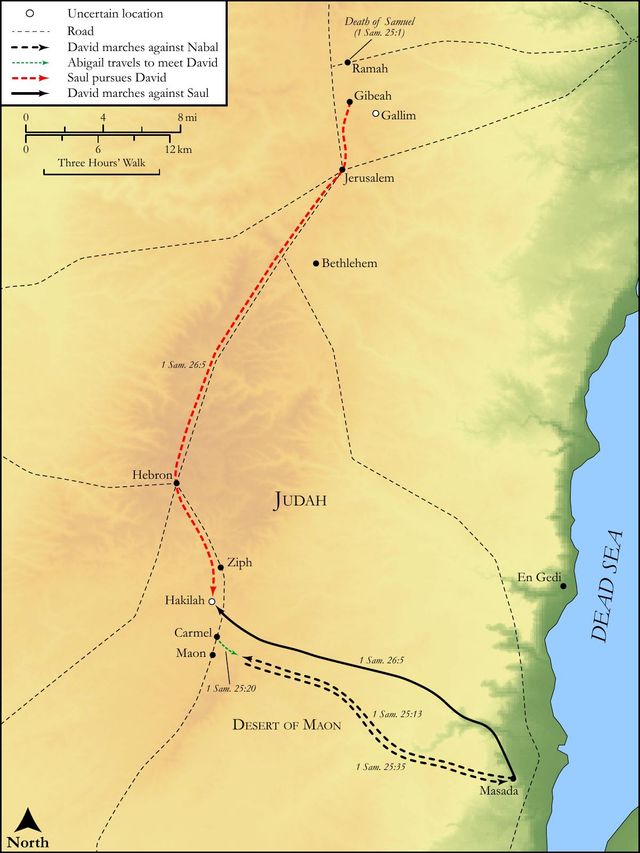
See on the biblical-era map
Study this verse
Public-domain commentary
Matthew Henry
From his Commentary on the Whole Bible. Henry comments on passages, not single verses — this entry covers 1 Samuel 26:13–20. His two-level outline is real structure in the source text, so it is rendered as structure.
David having got safely from Saul's camp himself, and having brought with him proofs sufficient that he had been there, posts himself conveniently, so that they might hear him and yet not reach him (Sa1 26:13), and then begins to reason with them upon what had passed.
I.He reasons ironically with Abner, and keenly banters him.
David knew well that it was from the mighty power of God that Abner and the rest of the guards were cast into so deep a sleep, and that God's immediate hand was in it; but he reproaches Abner as unworthy to be captain of the lifeguards, since he could sleep when the king his master lay so much exposed. By this it appears that the hand of God locked them up in this deep sleep that, as soon as ever David had got out of danger, a very little thing awakened them, even David's voice at a great distance roused them, Sa1 26:14. Abner got up (we may suppose it early in a summer's morning) and enquired who called, and disturbed the king's repose. "It is I," says David, and then he upbraids him with his sleeping when he should have been upon his guard. Perhaps Abner, looking upon David as a despicable enemy and one that there was no danger from, had neglected to set a watch; however, he himself ought to have been more wakeful. David, to put him into confusion, told him, 1. That he had lost his honour (Sa1 26:15): "Art not thou a man? (so the word is), a man in office, that art bound, by the duty of thy place, to inspect the soldiery? Art not thou in reputation for a valiant man? So thou wouldst be esteemed, a man of such courage and conduct that there is none like thee; but now thou art shamed for ever. Thou a general! Thou, a sluggard!" 2. That he deserved to lose his head (Sa1 26:16): "You are all worthy to die, by martial law, for being off your guard, when you had the king himself asleep in the midst of you. Ecce signum - Behold this token. See where the king's spear is, in the hand of him whom the king himself is pleased to count his enemy. Those that took away this might as easily and safely have taken away his life. Now see who are the king's best friends, you that neglected him and left him exposed or I that protected him when he was exposed. You pursue me as worthy to die, and irritate Saul against me; but who is worthy to die now?" Note, Sometimes those that unjustly condemn others are justly left to fall into condemnation themselves.
II.He reasons seriously and affectionately with Saul.
By this time he was so well awake as to hear what was said, and to discern who said it (Sa1 26:17): Is this thy voice, my son David? In the same manner he had expressed his relentings, Sa1 24:16. He had given his wife to another and yet calls him son, thirsted after his blood and yet is glad to hear his voice. Those are bad indeed that have never any convictions of good, nor ever sincerely utter good expressions. And now David has as fair an opportunity of reaching Saul's conscience as he had just now of taking away his life. This he lays hold on, though not of that, and enters into a close argument with him, concerning the trouble he still continued to give him, endeavouring to persuade him to let fall the prosecution and be reconciled.
1.He complains of the very melancholy condition he was brought into by the enmity of Saul against him. Two things he laments: - (1.) That he was driven from his master and from his business: "My lord pursues after his servant, Sa1 26:18. How gladly would I serve thee as formerly if my service might be accepted! but, instead of being owned as a servant, I am pursued as a rebel, and my lord is my enemy, and he whom I would follow with respect compels me to flee from him." (2.) That he was driven from his God and from his religion; and this was a much greater grievance than the former (Sa1 26:19): "They have driven me out from the inheritance of the Lord, have made Canaan too hot for me, at least the inhabited parts of it, have forced me into the deserts and mountains, and will, ere long, oblige me entirely to quit the country." And that which troubled him was not so much that he was driven out from his own inheritance as that he was driven out from the inheritance of the Lord, the holy land. It should be more comfortable to us to think of God's title to our estates and his interest in them then of our own, and that with them we may honour him then that with them we may maintain ourselves. Nor was it so much his trouble that he was constrained to live among strangers as that he was constrained to live among the worshippers of strange gods and was thereby thrust into temptation to join with them in their idolatrous worship. His enemies did, in effect, send him to go and serve other gods, and perhaps he had heard that some of them had spoken to that purport of him. Those that forbid our attendance on God's ordinances do what in them lies to estrange us from God and to make us heathens. If David had not been a man of extraordinary grace, and firmness to his religion, the ill usage he met with from his own prince and people, who were Israelites and worshippers of the true God, would have prejudiced him against the religion they professed and have driven him to communicate with idolaters. "If these be Israelites," he might have said, "let me live and die with Philistines;" and no thanks to them that their conduct had not that effect. We are to reckon that the greatest injury that can be done us which exposes us to sin. Of those who thus led David into temptation he here says, Cursed be they before the Lord. Those fall under a curse that thrust out those whom God receives, and send those to the devil who are dear to God.
2.He insists upon his own innocency: What have I done or what evil is in my hand? Sa1 26:18. He had the testimony of his conscience for him that he had never done nor ever designed any mischief to the person, honour, or government, of his prince, nor to any of the interests of his country. He had lately had Saul's own testimony concerning him (Sa1 24:17): Thou art more righteous than I. It was very unreasonable and wicked for Saul to pursue him as a criminal, when he could not charge him with any crime.
3.He endeavours to convince Saul that his pursuit of him is not only wrong, but mean, and much below him: "The king of Israel, whose dignity is great, and who has so much other work to do, has come out to seek a flea, as when one doth hunt a partridge in the mountains," Sa1 26:20 - a poor game for the king of Israel to pursue. He compares himself to a partridge, a vert innocent harmless bird, which, when attempts are made upon its life, flies if it can, but makes no resistance. And would Saul bring the flower of his army into the field only to hunt one poor partridge? What a disparagement was this to his honour! What a stain would it be on his memory to trample upon so weak and patient as well as so innocent an enemy! Jam 5:6, You have killed the just, and he doth not resist you.
4.He desires that the core of the controversy may be searched into and some proper method taken to bring it to an end, Sa1 26:19. Saul himself could not say that justice put him on thus to persecute David, or that he was obliged to do it for the public safety. David was not willing to say (though it was very true) that Saul's own envy and malice put him on to do it; and therefore he concludes it must be attributed either to the righteous judgment of God or to the unrighteous designs of evil men. Now, (1.) "If the Lord have stirred thee up against me, either in displeasure to me (taking this way to punish me for my sins against him, though, as to thee, I am guiltless) or in displeasure to thee, if it be the effect of that evil spirit from the Lord which troubles thee, let him accept an offering from us both - let us join in making our peace with God, reconciling ourselves to him, which may be done, by sacrifice; and then I hope the sin will be pardoned, whatever it is, and the trouble, which is so great a vexation both to thee and me, will come to an end." See the right method of peace-making; let us first make God our friend by Christ the great Sacrifice, and then all other enmities shall be slain, Eph 2:16; Pro 16:7. But, (2.) "If thou art incited to it by wicked men, that incense thee against me, cursed be they before the Lord," that is, they are very wicked people, and it is fit that they should be abandoned as such, and excluded from the king's court and councils. He decently lays the blame upon the evil counsellors who advised the king to that which was dishonourable and dishonest, and insists upon it that they be removed from about him and forbidden his presence, as men cursed before the Lord, and then he hoped he should gain his petition, which is (Sa1 26:20), "Let not my blood fall to the earth, as thou threatenest, for it is before the face of the Lord, who will take cognizance of the wrong and avenge it." Thus pathetically does David plead with Saul for his life, and, in order to that, for his favourable opinion of him.
Historical interpretation
Historical reception
1 surviving comment on this verse from the historical church.
If the Lord incites you against me, etc. If, he says, led by the Spirit of God you persecute me, it is necessary that I appease the divine mercy with sacrifices and prayers; but if not by the will of the Lord, but against His will, having been corrupted by the deception of wicked men, you thought it right to rage for a time against the innocent; it is certain that those are held worthy of a curse in the divine examination, who, by wicked persuasions repelling me from His tabernacle and holy land, compel me to live among idolaters, whom I utterly detest. And if this flame of persecution has arisen from men, as I said, it is just in every way that my blood should not be shed by the impious, which the hands of persecutors have thus far unjustly sought. According to the mystical understanding, it is the voice of the members of Christ, that is, of His faithful, who, caught by the persecution of wicked men, are accustomed to diligently examine their hearts. And if for their sins they recognize that punishment of chastisement is inflicted upon them by the Lord through such men, they immediately strive to purge these with sacrifices of due contrition. But if they see themselves unjustly suffering injuries or deaths from the impious, so that they may be called away from the path of truth, they indeed understand those who do these things as deserving eternal curse from the Lord; because they wish to turn the faithful of Christ from the inheritance of the Catholic faith even to the idolatry of gentility or any kind of heresy. However, those who innocently suffer these things rejoice, being saved by the Lord from all death and corruption, and indeed even anticipating receiving the palm of their patience. We can also accept it as said in the person of the apostles to the persecuting Jews: If the Lord incites you to persecute us, His wrath is appeased by our prayers; but if, which is more true, the sons of men, they are accursed by the Lord, who have driven us out preaching divine things, so that we do not dwell in Judea and Jerusalem; they said, Depart; and because you believe Jesus to be God, serve Him rather among the nations, who are accustomed to worship alien gods.
Continue studying 1 Samuel 26:19 across the web’s major study libraries — every link below opens this exact verse, chapter, or book on the destination site.
Read & Compare
 BibleGatewayThis verse in more than 200 translations and 70 languages.
 Bible.comThe YouVersion reader — hundreds of translations, reading plans, and highlights.
 ESV.orgCrossway's official English Standard Version reader.
 NET BibleThe NET translation with 60,000+ translators' notes on every rendering decision.
 STEP BibleTyndale House's free study tool — original text, vocabulary, and scholarly resources.
 BibliaLogos Bible Software's free web reader.
 USCCBThe New American Bible (Revised Edition) with the U.S. bishops' study notes.
Commentaries
 BibleHub CommentariesDozens of classic commentaries on this verse, gathered on one page.
 StudyLightMore than 100 commentary sets — the largest collection on the web.
 BibleRefPlain-English commentary on what this verse means, verse by verse.
 Enduring WordDavid Guzik's free commentary on this chapter, widely used by Bible teachers.
 Bible Study ToolsVerse commentary alongside Greek and Hebrew study aids.
Original Language & Research
- BibleHub InterlinearThe verse word by word — original language, transliteration, and English.
- BibleHub LexiconEvery word's original-language definition and Strong's entry.
 Blue Letter BibleDeep-study tools — Strong's numbers, concordance, and word studies.
 SefariaThe Hebrew text with Rashi and centuries of Jewish commentary.
Sermons, Hymns & Audio


TrulyRandomVerse is not affiliated with these sites and doesn’t control their content. They’re linked because they’re genuinely useful.
Summary
In 1 Samuel 26:19, David, having once again demonstrated his unwavering loyalty by sparing King Saul's life, makes a poignant appeal to his relentless pursuer. He presents a profound spiritual dilemma, questioning whether Saul's animosity is divinely orchestrated, in which case a sacrificial offering could appease God, or if it originates from malicious human influence. David laments the devastating consequence of being unjustly driven from the promised land, "the inheritance of the LORD," equating this exile to a forced abandonment of his covenant God for foreign deities, thereby underscoring the severe spiritual and physical toll of Saul's unrighteous persecution.
Context
ShowHideLiterary Context
This verse serves as a powerful rhetorical climax within David's second opportunity to kill Saul, yet he chooses to spare him, mirroring the earlier encounter in 1 Samuel 24. In both instances, David consistently demonstrates profound respect for God's anointed king and unwavering commitment to righteous conduct, even when facing extreme injustice. Here, in 1 Samuel 26, David, accompanied by Abishai, infiltrates Saul's sleeping camp, takes Saul's spear and water jug, and then calls out to Abner and Saul from a safe distance. Verse 19 is an integral part of David's impassioned plea, where he seeks to understand the true source of Saul's relentless pursuit and to clear his own name. His words emphasize his innocence and the severe spiritual ramifications of his unjust exile, serving as a direct, heartfelt appeal for reconciliation and justice, highlighting the deep personal and theological stakes involved.
Historical & Cultural Context
For ancient Israelites, the land of Canaan was far more than mere territory; it was the tangible "inheritance of the LORD" (Numbers 26:53), a divine gift promised to Abraham and his descendants as the sacred space for covenant relationship, worship, and divine blessing. To be driven from this land was tantamount to being cut off from God's presence, the community of faith, and the locus of true worship, effectively forcing one into a realm where pagan gods were worshipped. Such exile carried immense spiritual and social stigma, implying a loss of identity, divine protection, and access to sacred rituals. Furthermore, the concept of divine "stirring up" or "incitement" (often through an adversary) was understood within a worldview where God maintained ultimate sovereignty over all events, even those seemingly negative. While God's ultimate control was acknowledged, human responsibility for sin remained paramount. David's lament profoundly reflects the deep cultural and theological significance of the land as the very embodiment of God's covenant with Israel.
Key Themes
ShowHideThis verse powerfully articulates several central themes within the book of Samuel and broader biblical theology. It highlights the tension between Divine Sovereignty and Human Agency, as David contemplates both God's potential role in his suffering and the malicious actions of "children of men." It profoundly underscores the Spiritual Significance of the Land, portraying exile from "the inheritance of the LORD" as a catastrophic spiritual crisis, akin to being compelled into idolatry. This connects directly to the broader theme of Covenant Faithfulness, as David strives to remain loyal to Yahweh despite being driven from His land and tempted to serve other gods. David's plea also exemplifies Righteous Suffering and Trust in God's Justice, as he refrains from vengeance and appeals to both divine and human justice, trusting that God will ultimately vindicate him, a theme frequently echoed in the Psalms (e.g., Psalm 7:8-9). Finally, it illuminates the Destructive Nature of Malice and Slander, as David pronounces a curse upon those who have falsely accused him and instigated Saul's persecution, leading to his forced displacement and profound spiritual peril.
Exposition and Analysis
ShowHideKey Word Analysis
ShowHideThis term (H113) signifies a sovereign, master, or owner, used here by David to respectfully address Saul as "my lord the king." While it can refer to human authority, its broader usage in Scripture, including for God Himself, imbues David's address with a recognition of Saul's divinely appointed, albeit currently mismanaged, authority. David's use of this title underscores his humility and his respect for the office, even while challenging the man.
The Hebrew verb (H5496) means "to prick," "stimulate," "entice," or "provoke." David uses it to describe a potential divine instigation behind Saul's relentless persecution. This acknowledges God's ultimate sovereignty, suggesting that if God is the source of this opposition, it might be for a specific purpose (e.g., testing, discipline, or preparation for kingship), which could then be appeased through an offering. This contrasts sharply with human adversaries, whom he curses, implying a recognition of God's mysterious control over all circumstances, even difficult ones.
This primitive root (H1644) means "to drive out from a possession," "expatriate," or "divorce." David's use of this word vividly portrays his forced expulsion from the land of Israel. It's not merely a voluntary departure but an aggressive, coercive act that severs his connection to his rightful place. The intensity of this word highlights the profound injustice and the spiritual crisis of being dislocated from the "inheritance of the LORD."
Verse Breakdown
ShowHide"Now therefore, I pray thee, let my lord the king hear the words of his servant."
David opens with a humble yet firm appeal to Saul, acknowledging his royal authority ("my lord the king") while presenting himself as a loyal "servant." This respectful address is a strategic rhetorical move, designed to open Saul's ears to reason and justice, setting a tone of earnest entreaty rather than defiance, despite David being the unjustly hunted party.
"If the LORD have stirred thee up against me, let him accept an offering:"
David first considers the possibility that God is the ultimate cause of Saul's animosity. This reflects a deep theological understanding of divine sovereignty, where God can use even human adversaries for His purposes. If the conflict is divinely ordained, David suggests a spiritual solution: an offering or sacrifice to appease God, implying that a right relationship with God would resolve the earthly conflict.
"but if [they be] the children of men, cursed [be] they before the LORD;"
David then presents the alternative: if human malice, specifically slanderers or advisors ("the children of men"), is the true source of Saul's persecution, he pronounces a severe curse upon them. This highlights the gravity of their sin in God's eyes, as they are actively working against God's anointed and disrupting His divine plan. The distinction emphasizes human culpability for malicious actions, contrasting them with God's sovereign purposes.
"for they have driven me out this day from abiding in the inheritance of the LORD, saying, Go, serve other gods."
This clause provides the justification for David's curse and reveals the profound spiritual danger he perceives. Being driven from "the inheritance of the LORD" (the promised land) is presented as a spiritual exile, effectively forcing him into pagan territory where he would be pressured to abandon Yahweh and worship foreign deities. This is a deeply felt, hyperbolic accusation, underscoring the extreme spiritual and physical hardship imposed by his persecutors, who are, in effect, compelling him towards apostasy.
Literary Devices
ShowHideDavid's speech in this verse employs several powerful literary devices to convey his profound distress and appeal for justice. He masterfully constructs a Dilemma for Saul, presenting two mutually exclusive explanations for his persecution: divine instigation or malicious human influence. This rhetorical strategy compels Saul to confront the true source of his actions. The implied question, "Which is it, God or men?" functions as a potent Rhetorical Appeal, designed to provoke Saul into self-reflection about the spiritual implications of his relentless pursuit. Furthermore, David utilizes Hyperbole when he claims his persecutors are "saying, Go, serve other gods." While they did not literally utter these words, being driven from the land of Israel into pagan territory would inevitably expose him to the immense pressure and temptation of idolatry, making the statement a vivid exaggeration of the spiritual danger. The phrase "inheritance of the LORD" itself serves as rich Symbolism, representing not merely physical land but the covenant relationship with God, divine blessing, and the sacred locus of true worship. David's lament over being driven from it powerfully underscores the profound spiritual significance of his unjust exile.
Theological and Thematic Connections
ShowHideDavid's lament in 1 Samuel 26:19 powerfully articulates the profound spiritual and existential crisis of being alienated from God's people and land. His willingness to consider divine instigation reflects a deep-seated belief in God's ultimate sovereignty, even over human suffering and conflict. However, his swift curse upon "the children of men" reveals his clear understanding of human responsibility for malice and injustice. This tension between divine sovereignty and human culpability is a recurring theme throughout Scripture, reminding us that while God is ultimately in control, human choices have real and often devastating consequences. David's distress over being driven from the "inheritance of the LORD" highlights the intimate connection between place, people, and covenant in ancient Israelite theology, where the land was not merely property but a sacred space for communion with God. His fear of being forced to "serve other gods" underscores the constant spiritual battle against idolatry and the importance of remaining steadfast in one's allegiance to the one true God, even in exile.
Reflection and Application
ShowHideDavid's words in 1 Samuel 26:19 offer a profound template for navigating times of unjust suffering and persecution. His initial posture of seeking to understand the source of the animosity—whether divine permission or human malice—models a crucial step in spiritual discernment. When facing adversity, it is vital to prayerfully consider if God is allowing a trial for our growth and refinement, or if the opposition stems from human envy, misunderstanding, or outright malice. David's distress over being driven from "the inheritance of the LORD" and the implied pressure to "serve other gods" resonates deeply with the spiritual battles believers face today. Our "inheritance" is not a physical land but our spiritual standing in Christ and our secure place within the community of faith. Anything that seeks to alienate us from this spiritual heritage or tempt us towards compromise with the world's values is a profound threat to our allegiance to God. David's steadfastness in appealing to God's justice, rather than resorting to revenge, serves as a powerful example of maintaining integrity and trusting in God's ultimate vindication, even when circumstances are dire. We are called to protect our spiritual environment, cling to our identity in Christ, and resist all pressures that would lead us away from our faithful allegiance to Him.
Questions for Reflection
ShowHideFAQ
ShowHideWhat does David mean by "If the LORD have stirred thee up against me"? Is God truly the source of evil or conflict?
ShowHideDavid's statement reflects a common biblical understanding of God's ultimate sovereignty over all events, even those that appear negative or involve human sin. In ancient Israelite thought, nothing happened outside of God's overarching permission or purpose. The phrase "stirred up" (Hebrew çûwth, H5496) implies that God might be permitting or even orchestrating Saul's animosity, not necessarily as a direct instigator of evil, but perhaps as a means of testing David, refining his character, or fulfilling a larger divine plan (e.g., preparing David for kingship). It acknowledges that God can use even the wicked actions of humans to achieve His righteous ends, as seen in the broader narrative of the Bible (e.g., Genesis 50:20). However, this does not absolve human agents of their moral responsibility for their sinful choices, which David clearly distinguishes by cursing "the children of men" who maliciously drive him out. David is not accusing God of evil, but rather acknowledging His mysterious control over all circumstances, even those that bring suffering.
Christ-Centered Fulfillment
ShowHideDavid's lament in 1 Samuel 26:19, particularly his anguish at being "driven out this day from abiding in the inheritance of the LORD, saying, Go, serve other gods," finds its ultimate fulfillment and reversal in Jesus Christ. David, though innocent, was unjustly persecuted and exiled from the promised land, facing the spiritual threat of idolatry. Christ, the truly innocent One, was likewise rejected by His own people and driven out, not just from the land, but ultimately to the cross outside the city gates, bearing our reproach (Hebrews 13:12). Yet, unlike David, who feared being forced to serve other gods, Jesus perfectly resisted all temptation to compromise His allegiance to the Father, even when offered all the kingdoms of the world (Matthew 4:8-10). Through His sacrificial death and glorious resurrection, Christ reclaims the ultimate "inheritance of the LORD" – not a physical land, but the spiritual kingdom of God and eternal life. He brings His followers into this eternal inheritance, making them "heirs of God and fellow heirs with Christ" (Romans 8:17). We are no longer alienated or forced into spiritual exile, but are brought near by the blood of Christ, made citizens with the saints, and members of God's household (Ephesians 2:19). Thus, what David feared—being cut off from God's inheritance and compelled towards idolatry—is definitively overcome in Christ, who secures our eternal belonging and empowers us to serve the true God alone.