


2 Samuel 20:19
Bible text: King James Version (1769 Blayney text) · Public domain
Bible text: King James Version with Strong's numbers · Public domain
Bible text: Berean Standard Bible · Public domain
Bible text: American Standard Version (1901) · Public domain
Bible text: World English Bible, Messianic edition · Public domain
Bible text: Geneva Bible (1599) · Public domain
Bible text: Young's Literal Translation · Public domain
- אָנֹכִי'a·no·KhiIH595Pro-1csPronoun Personal 1st Singular common gender
- שְׁלֻמֵיshe·lu·Mei[am] [the] peaceful [ones] ofH7999V-Qal-PassPrtcpl-mpVerb Qal Participle Passive Plural Masculine Construct
- אֱמוּנֵי'e·mu·Nei[the] faithful [ones] ofH529Adj-mpcAdjective Plural Masculine Construct
- יִשְׂרָאֵלYis·ra·'ElIsraelH3478N-properNoun Proper Location
- אַתָּה'a·TahyouH859Pro-2msPronoun Personal 2nd Singular Masculine
- מְבַקֵּשׁme·va·Kesh[are] seekingH1245V-Piel-Prtcpl-msVerb Piel Participle Singular Masculine Absolute
- לְהָמִיתle·ha·Mitto killH4191Prep-l ¦ V-Hiphil-InfVerb Hiphil Infinitive Constructלְtoהָמִיתkill
- עִיר'ira cityH5892N-fsNoun Singular Feminine Absolute
- וְאֵםve·'Emand a motherH517Conj-w ¦ N-fsNoun Singular Feminine Absoluteוְandאֵםa mother
- בְּיִשְׂרָאֵלbe·Yis·ra·'Elin IsraelH3478Prep-b ¦ N-properNoun Proper LocationבְּinיִשְׂרָאֵלIsrael
- לָמָּהLa·mah<to> why?H4100Prep-l ¦ InterrogPronoun Interrogativeלָ<to>מָּהwhy?
- תְבַלַּעte·va·La'will you swallow upH1104V-Piel-Imperf-2msVerb Piel Imperfect 2nd Singular Masculine
- נַחֲלַתna·cha·Lat[the] inheritance ofH5159N-fscNoun Singular Feminine Construct
- יְהוָהYah·wehYahwehH3068N-properNoun Proper Title
English is a literal word-by-word gloss of the Hebrew, not the KJV's wording. Why?
This is the original text the KJV's translators worked from — each Hebrew word with its own literal English meaning in this verse, prepared by scholars at Tyndale House, Cambridge. The KJV translates whole sentences, not word by word, so its wording differs: one Hebrew word can become several English words, and the KJV may choose “the LORD” where the gloss reads “Yahweh”. Both are faithful — they answer different questions. For the KJV's own rendering, switch to the KJV text.
Details
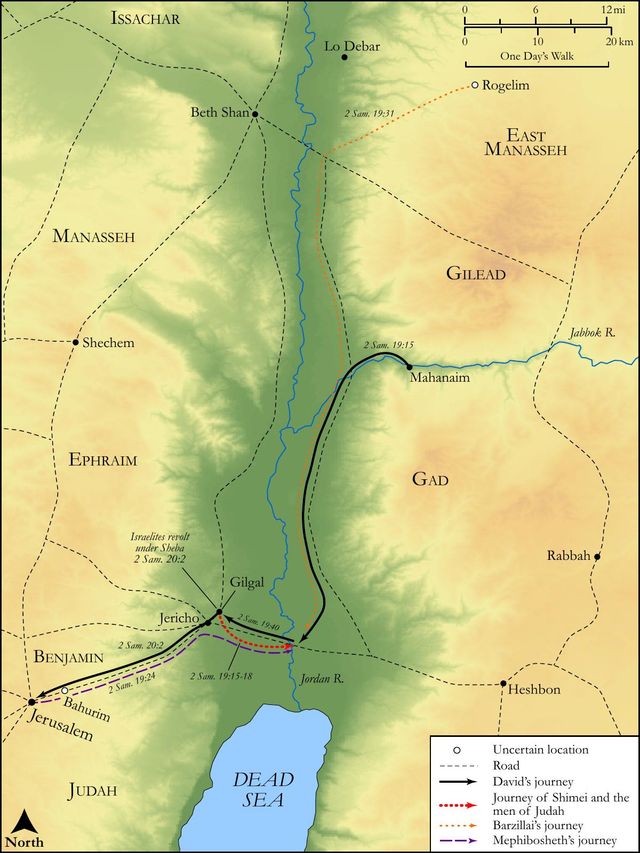
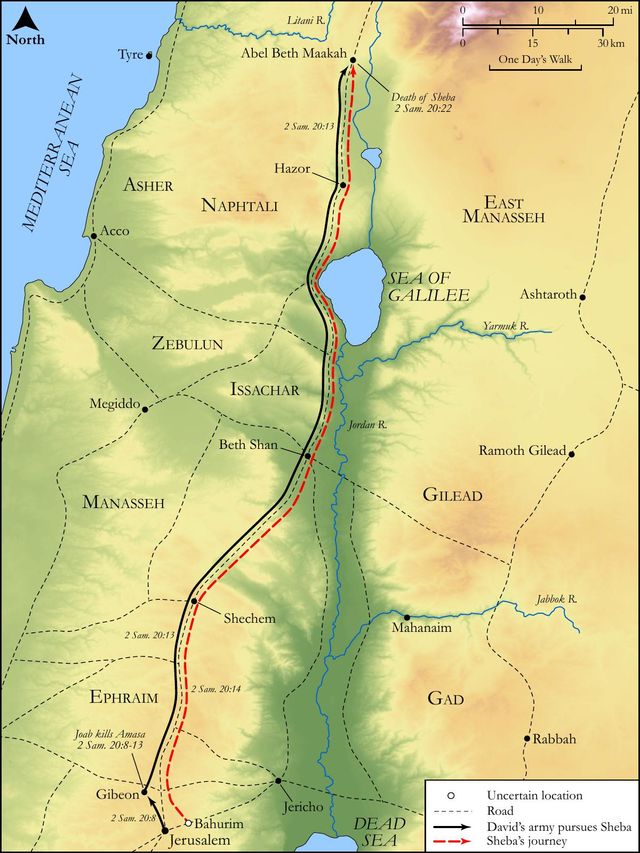
See on the biblical-era maps

Study this verse
Public-domain commentary
Matthew Henry
From his Commentary on the Whole Bible. Henry comments on passages, not single verses — this entry covers 2 Samuel 20:14–22. His four-level outline is real structure in the source text, so it is rendered as structure.
We have here the conclusion of Sheba's attempt.
I.The rebel, when he had rambled over all the tribes of Israel, and found them not so willing, upon second thoughts, to follow him, as they had been upon a sudden provocation to desert David (having only picked up a few like himself, that sided with him), at length entered Abel-Beth-maacah, a strong city in the north, in the lot of Naphtali, where we find it placed, Kg2 15:29. Here he took shelter, whether by force or with consent does not appear; but his adherents were most Berites, of Beeroth in Benjamin, Sa2 20:14. One bad man will find or make more.
II.Joab drew up all his force against the city, besieged it, battered the wall, and made it almost ready for a general storm, Sa2 20:15.
Justly is that place attacked with all this fury which dares harbour a traitor; nor will that heart fare better which indulges those rebellious lusts that will not have Christ to reign over them.
III.A discreet good woman of the city of Abel brings this matter, by her prudent management, to a good issue, so as to satisfy Joab and yet save the city. Here is,
1.Her treaty with Joab, and her capitulation with him, by which he is engaged to raise the siege, upon condition that Sheba be delivered up. It seems, none of all the men of Abel, none of the elders or magistrates, offered to treat with Joab, no, not when they were reduced to the last extremity. They were stupid and unconcerned for the public safety, or they stood in awe of Sheba, or they despaired of gaining any good terms with Joab, or they had not sense enough to manage the treaty. But this one woman and her wisdom saved the city. Souls know no difference of sexes. Though the man be the head, it does not therefore follow that he has the monopoly of the brains, and therefore he ought not, by any salique law, to have the monopoly of the crown. Many a masculine heart, and more than masculine, has been found in a female breast; nor is the treasure of wisdom the less valuable for being lodged in the weaker vessel. In the treaty between this nameless heroine and Joab,
(1.)She gains his audience and attention, Sa2 20:16, Sa2 20:17. We may suppose it was the first time he had ever treated with a woman in martial affairs.
(2.)She reasons with him on behalf of her city, and very ingeniously.
[1.]That it was a city famous for wisdom (Sa2 20:18), as we translate it. She pleads that this city had been long in such reputation for prudent knowing men that it was the common referee of the country, and all agreed to abide by the award of its elders. Their sentence was an oracle; let them be consulted and the matter is ended, all sides will acquiesce. Now shall such a city as this be laid in ashes and never treated with?
[2.]That the inhabitants were generally peaceable and faithful in Israel, Sa2 20:19. She could speak, not for herself only, but for all those whose cause she pleaded, that they were not of turbulent and seditious spirits, but of known fidelity to their prince and peaceableness with their fellow-subjects; they were neither seditious nor litigious.
[3.]That it was a mother in Israel, a guide and nurse to the towns and country about; and that it was a part of the inheritance of the Lord, a city of Israelites, not of heathen; and the destruction of it would lessen and weaken that nation which God had chosen for his heritage.
[4.]That they expected him to offer them peace before he made an attack upon the, according to that known law of war, Deu 20:10. So the margin reads (Sa2 20:18): They plainly spoke in the beginning (of the siege), saying, Surely they will ask of Abel, that is, "The besiegers will demand the traitor, and will ask us to surrender him; and if they do, we will soon come to an agreement, and so end the matter." Thus she tacitly upbraids Joab for not offering them peace, but hopes it is not too late to beg it.
(3.)Joab and Abel's advocate soon agree that Sheba's head shall be the ransom of the city. Joab, though in a personal quarrel he had lately swallowed up and destroyed Amasa, yet, when he acts as a general, will by no means bear the imputation of delighting in bloodshed: "Far be it from me that I should delight to swallow up or destroy, or design it but when it is necessary for the public safety, Sa2 20:20. The matter is not so. Our quarrel is not with your city; we would hazard our lives for its protection. Our quarrel is only with the traitor that is harboured among you; deliver him up, and we have done." A great deal of mischief would be prevented if contending parties would but understand one another. The city obstinately holds out, believing Joab aims at its ruin. Joab furiously attacks it, believing the citizens all confederates with Sheba. Whereas both were mistaken; let both sides be undeceived, and the matter is soon accommodated. The single condition of peace is the surrender of the traitor. It is so in God's dealing with the soul, when it is besieged by conviction and distress: sin is the traitor; the beloved lust is the rebel; part with that, cast away the transgression, and all shall be well. No peace on any other terms. Our wise woman immediately agrees to the proposal: Behold, his head shall be thrown to thee presently.
2.Her treaty with the citizens. She went to them in her wisdom (and perhaps she had as much need of it in dealing with them as in dealing with Joab) and persuaded them to cut off Sheba's head, probably by some public order of their government, and it was thrown over the wall to Joab. He knew the traitor's face, and therefore looked no further, intending not that any of his adherents should suffer. The public safety was secured, and he felt no wish to gratify the public revenge. Joab hereupon raised the siege, and marched back to Jerusalem, with the trophies rather of peace than victory.
Continue studying 2 Samuel 20:19 across the web’s major study libraries — every link below opens this exact verse, chapter, or book on the destination site.
Read & Compare
 BibleGatewayThis verse in more than 200 translations and 70 languages.
 Bible.comThe YouVersion reader — hundreds of translations, reading plans, and highlights.
 ESV.orgCrossway's official English Standard Version reader.
 NET BibleThe NET translation with 60,000+ translators' notes on every rendering decision.
 STEP BibleTyndale House's free study tool — original text, vocabulary, and scholarly resources.
 BibliaLogos Bible Software's free web reader.
 USCCBThe New American Bible (Revised Edition) with the U.S. bishops' study notes.
Commentaries
 BibleHub CommentariesDozens of classic commentaries on this verse, gathered on one page.
 StudyLightMore than 100 commentary sets — the largest collection on the web.
 BibleRefPlain-English commentary on what this verse means, verse by verse.
 Enduring WordDavid Guzik's free commentary on this chapter, widely used by Bible teachers.
 Bible Study ToolsVerse commentary alongside Greek and Hebrew study aids.
Original Language & Research
- BibleHub InterlinearThe verse word by word — original language, transliteration, and English.
- BibleHub LexiconEvery word's original-language definition and Strong's entry.
 Blue Letter BibleDeep-study tools — Strong's numbers, concordance, and word studies.
 SefariaThe Hebrew text with Rashi and centuries of Jewish commentary.
Sermons, Hymns & Audio


TrulyRandomVerse is not affiliated with these sites and doesn’t control their content. They’re linked because they’re genuinely useful.
Summary
In 2 Samuel 20:19, a sagacious woman from Abel-beth-maachah confronts Joab, King David's military commander, who is poised to destroy her city in pursuit of the rebel Sheba. Her impassioned address serves as a courageous appeal for peace and justice, asserting the city's loyalty and distinguishing its innocent inhabitants from the fugitive. She challenges Joab with the profound moral implications of annihilating a prominent "mother city" and, by extension, a cherished part of the Lord's own inheritance in Israel, thereby seeking to avert a catastrophic and unjust act of war.
Context
ShowHideLiterary Context
This verse is situated at the critical juncture of Sheba son of Bichri's rebellion against King David, as detailed throughout 2 Samuel 20. Following the resolution of Absalom's rebellion and David's return to Jerusalem, a new separatist uprising led by Sheba, a Benjaminite, quickly gains momentum, threatening the fragile unity of the newly restored kingdom. Joab, David's ruthless but effective general, pursues Sheba to the fortified city of Abel-beth-maachah. As Joab's forces begin to construct a siege ramp against the city wall, intending to breach and destroy it to capture Sheba, the wise woman's intervention, initiated by her initial call from the wall, interrupts this destructive trajectory. Her words in this verse represent a pivotal moment, shifting the narrative from impending military devastation to a potential resolution through negotiation, highlighting the power of wisdom to avert catastrophe.
Historical & Cultural Context
The period of David's reign was characterized by both the consolidation of his kingdom and persistent internal strife, with rebellions like Sheba's posing significant threats to national stability. Abel-beth-maachah, located in the northern territory of Naphtali, was strategically important, likely serving as a regional administrative or economic center. The term "mother in Israel" (Hebrew: 'em b'Yisra'el) was a significant cultural descriptor for a prominent, ancient, or capital city that nurtured and provided for surrounding towns and villages, much like a mother cares for her children. To destroy such a city was not merely an act of war but a profound desecration, akin to tearing apart the very fabric of the nation. Joab, as David's commander, operated within a military culture that often employed harsh tactics to suppress rebellion, but even within this context, the indiscriminate destruction of an Israelite city, especially one claiming peace and loyalty, would have been viewed with moral gravity. The woman's appeal leverages this cultural understanding of a city's sacred identity and its relationship to the broader "inheritance of the LORD."
Key Themes
ShowHideThe verse powerfully articulates several key themes. Firstly, it underscores the theme of peace versus indiscriminate violence. The woman's assertion that her city is "peaceable and faithful" directly contrasts with Joab's destructive intent, highlighting the moral imperative to seek peaceful resolutions where possible, especially among kin. Secondly, the theme of Israel as God's inheritance is central. Her rhetorical question, "why wilt thou swallow up the inheritance of the LORD?", elevates the conflict beyond a mere military campaign, framing the potential destruction of an Israelite city as an affront to God's own chosen people and land, a concept deeply rooted in covenant theology, as seen in Deuteronomy 4:20 and Psalm 79:1. Thirdly, the verse exemplifies wisdom in crisis. The woman's ability to articulate a persuasive argument, appealing to shared national identity, divine heritage, and moral responsibility, demonstrates profound wisdom and courage, showcasing how discernment can avert catastrophe. Lastly, it touches on the theme of innocent suffering, implicitly arguing against collective punishment when a specific offender can be isolated, a principle of justice found elsewhere in the Law, such as in Deuteronomy 24:16.
Exposition and Analysis
ShowHideKey Word Analysis
ShowHideDerived from the primitive root H7999, shâlam signifies a state of being safe, complete, or at peace. It encompasses wholeness, well-being, and harmony. When the woman declares her city "peaceable," she asserts its desire to live in tranquility, free from conflict, and implies that it is not participating in the rebellion. This word contrasts sharply with Joab's destructive intent, highlighting the city's non-belligerent stance.
From the primitive root H539, ʼâman denotes firmness, trustworthiness, steadfastness, and fidelity. It implies a deep-seated loyalty and reliability. By stating her city is "faithful in Israel," the wise woman asserts its allegiance to King David and the nation, thereby distinguishing its inhabitants from the rebel Sheba. This declaration aims to disarm Joab's presumption that the entire city is complicit in the uprising.
This primitive word (H517) literally means "mother" and is used metaphorically here in the phrase "a mother in Israel" ('em b'Yisra'el). It designates a leading, foundational, or capital city that serves as a nurturing center for surrounding towns and villages, much like a mother provides for her children. The destruction of such a city would be an immense loss, not just of a physical location, but of a cultural, economic, and administrative hub vital to the identity and well-being of the broader Israelite community.
This primitive root (H1104) means to make away with, specifically by swallowing, but generally, to destroy, cover, or devour. The woman's use of this vivid verb emphasizes the utter annihilation Joab intends.
Nachălâh (H5159) refers to something inherited, an estate, patrimony, or portion. Yᵉhôvâh (H3068) is the self-Existent or Eternal God, Jehovah. This phrase refers to the land and people of Israel as God's special possession, given to them through the covenant. To "swallow up" a city that is part of this inheritance is presented as an act of sacrilege, implying a direct affront to God Himself. The woman appeals to Joab's understanding of Israel's unique relationship with God, suggesting that destroying an Israelite city is an attack on God's own property and His covenant people.
Verse Breakdown
ShowHide"I [am one of them that are] peaceable [and] faithful in Israel:"
The wise woman begins by establishing the identity and character of her city and its inhabitants. She speaks on behalf of the collective, asserting their desire for peace and their unwavering loyalty to the nation of Israel and its king, David. This statement directly refutes any assumption that the entire city is rebellious or deserves destruction, drawing a clear distinction between the city's populace and the fugitive Sheba.
"thou seekest to destroy a city and a mother in Israel:"
This clause is a direct and powerful accusation against Joab. The woman highlights the profound nature of his intended action, not merely as the destruction of any city, but specifically of a "mother in Israel"—a term that elevates the city's status to one of vital importance, a foundational and nurturing center for the region. This phrase evokes a sense of deep loss and sacrilege, appealing to Joab's conscience and his understanding of national identity.
"why wilt thou swallow up the inheritance of the LORD?"
This is a potent rhetorical question that serves as the climax of her appeal. By framing the city's destruction as the "swallowing up" of God's inheritance, the woman elevates the immediate military conflict to a theological plane. She challenges Joab to consider the divine implications of his actions, implying that to destroy a part of Israel is to attack God's own chosen people and land, thereby questioning the moral and spiritual legitimacy of his pursuit.
Literary Devices
ShowHideThe verse is rich with Rhetorical Question, as the woman's final query, "why wilt thou swallow up the inheritance of the LORD?", is not seeking information but rather aiming to provoke introspection and moral reconsideration in Joab, forcing him to confront the ultimate implications of his actions. The phrase "a mother in Israel" employs vivid Metaphor and Personification, likening the city to a nurturing matriarch, thereby imbuing it with a sense of life, value, and vulnerability that makes its destruction all the more tragic and morally reprehensible. There is also a strong sense of Pathos, as the woman's plea is designed to evoke pity and compassion from Joab, contrasting the city's declared peace and faithfulness with his violent intent. The stark Juxtaposition of the city's "peaceable and faithful" nature against Joab's intent to "destroy" and "swallow up" highlights the profound moral dilemma at hand. Furthermore, the woman acts as a Synecdoche, where a part (the wise woman) represents the whole (the city of Abel-beth-maachah), embodying its collective wisdom and desire for survival.
Theological and Thematic Connections
ShowHideThe profound plea of the wise woman in 2 Samuel 20:19 resonates with enduring theological principles concerning the sacredness of human life, the value of God's people, and the pursuit of justice. Her appeal to the city as "peaceable and faithful" and "a mother in Israel" underscores the biblical emphasis on community, loyalty, and the intrinsic worth of a people whom God has chosen as His own "inheritance." The question "why wilt thou swallow up the inheritance of the LORD?" elevates the conflict from a mere military engagement to a spiritual affront, reminding us that actions against God's people or His created order have divine implications. This narrative serves as a powerful testament to the impact of wise counsel and the importance of discerning between the guilty and the innocent, advocating for the preservation of life and the avoidance of indiscriminate destruction, especially when a more just resolution is possible.
Reflection and Application
ShowHideThe courageous intervention of the wise woman of Abel-beth-maachah offers a profound lesson in moral courage, diplomatic wisdom, and the redemptive power of a single voice in the face of overwhelming force. Her ability to articulate the value of her community, appeal to shared identity, and invoke divine accountability serves as a timeless model for those who would stand for justice and peace. In our own lives, we are often confronted with situations where indiscriminate judgment or collective punishment threatens to harm the innocent. This passage challenges us to cultivate discernment, to speak up for the vulnerable, and to seek peaceful, just resolutions rather than resorting to destructive force. It reminds us that true strength lies not in the capacity to destroy, but in the wisdom to preserve, to protect God's inheritance—whether that be human lives, communities, or the broader creation—and to uphold principles of righteousness even in the midst of conflict. We are called to be agents of peace and faithfulness, distinguishing ourselves from those who sow discord and destruction, and to value every part of God's handiwork.
Questions for Reflection
ShowHideFAQ
ShowHideWhat does "a mother in Israel" truly mean in this context?
ShowHideThe phrase "a mother in Israel" (Hebrew: 'em b'Yisra'el) is a metaphorical and honorific title for a prominent, ancient, or capital city that serves as a nurturing and foundational center for surrounding towns and villages. It signifies a city that provides support, identity, and resources, much like a mother cares for her children. By using this term, the wise woman emphasizes the profound historical, cultural, and social importance of Abel-beth-maachah, underscoring that its destruction would be an irreparable loss, not just of a physical place, but of a vital hub for the entire region and, by extension, for the nation of Israel itself. It elevates the city's status beyond a mere collection of buildings to a living, nurturing entity. This concept is also seen in Judges 5:7.
Why was Joab willing to destroy an entire Israelite city for one man?
ShowHideJoab, as King David's military commander, was fiercely loyal and ruthless in suppressing threats to David's throne. Sheba's rebellion was a serious challenge to David's authority, and Sheba had taken refuge in Abel-beth-maachah, indicating the city's potential complicity or at least its unwillingness to surrender the rebel. From a military perspective, Joab's strategy was to eliminate the threat by any means necessary, even if it meant destroying the city that harbored the rebel. This approach, while effective in quelling rebellions, often prioritized military expediency over moral considerations or the lives of innocent civilians. The wise woman's intervention in 2 Samuel 20:19 directly challenges this ruthless logic, appealing to a higher moral and theological standard.
Christ-Centered Fulfillment
ShowHideThe narrative of the wise woman of Abel-beth-maachah, who offers a life for a life to save her city, powerfully foreshadows the ultimate act of substitutionary atonement found in Jesus Christ. Just as the city, though largely innocent, faced destruction because of the presence of one rebel, humanity, though created in God's image, was condemned by the pervasive sin of one man, Adam, as seen in Romans 5:12. The wise woman's plea for a single life (Sheba's) to be given up to save the many resonates deeply with the Gospel message, where the innocent Lamb of God, Jesus Christ, willingly offered His perfect life as a ransom for many, fulfilling the prophecy in Mark 10:45. He is the ultimate "peaceable and faithful" one, whose perfect obedience and sacrifice "swallowed up" the power of sin and death, securing an eternal inheritance for those who believe, as attested in Colossians 2:14 and Hebrews 9:15. Furthermore, Christ Himself embodies the ultimate wisdom in crisis, not merely averting physical destruction but offering spiritual salvation, becoming the "mother" or nurturing center for all who are adopted into God's family, the new "inheritance of the LORD," as described in Ephesians 1:11. Through His sacrifice, the truly innocent suffered for the truly guilty, ensuring that God's people, His precious inheritance, would not be swallowed up by judgment but redeemed for eternal life.