


2 Samuel 20:16
- וַתִּקְרָאva·tik·Ra'and she called outH7121Conj-w ¦ V-Qal-ConsecImperf-3fsVerb Qal Consecutive Imperfect 3rd Singular Feminineוַandתִּקְרָאshe called out
- אִשָּׁה'i·Shaha womanH802N-fsNoun Singular Feminine Absolute
- חֲכָמָהcha·kha·MahwiseH2450Adj-fsAdjective Singular Feminine Absolute
- מִןminfromH4480PrepPreposition
- הָעִירha·'Irthe cityH5892Art ¦ N-fsNoun Singular Feminine Absoluteהָtheעִירcity
- שִׁמְעוּshim·'UlistenH8085V-Qal-Imp-2mpVerb Qal Imperative 2nd Plural Masculine
- שִׁמְעוּshim·'UlistenH8085V-Qal-Imp-2mpVerb Qal Imperative 2nd Plural Masculine
- אִמְרוּ'im·rusayH559V-Qal-Imp-2mpVerb Qal Imperative 2nd Plural Masculine
- נָאna'pleaseH4994PrtParticle Interjection
- אֶל'eltoH413PrepPreposition
- יוֹאָבyo·'AvJoabH3097N-proper-mNoun Proper Masculine
- קְרַבke·Ravdraw nearH7126V-Qal-Imp-2msVerb Qal Imperative 2nd Singular Masculine
- עַד'adtoH5704PrepPreposition
- הֵנָּהHe·nahhereH2008AdvAdverb
- וַאֲדַבְּרָהva·'a·da·be·Rahso let me speakH1696Conj-w ¦ V-Piel-Imperf-1csVerb Piel Imperfect 1st Singular common genderוַsoאֲדַבְּרָהlet me speak
- אֵלֶיךָ'e·Lei·khato youH413Prep ¦ 2msPreposition Definiteאֵלֶיtoךָyou
English is a literal word-by-word gloss of the Hebrew, not the KJV's wording. Why?
This is the original text the KJV's translators worked from — each Hebrew word with its own literal English meaning in this verse, prepared by scholars at Tyndale House, Cambridge. The KJV translates whole sentences, not word by word, so its wording differs: one Hebrew word can become several English words, and the KJV may choose “the LORD” where the gloss reads “Yahweh”. Both are faithful — they answer different questions. For the KJV's own rendering, switch to the KJV text.
Details
See on the biblical-era map

Study this verse
Public-domain commentary
Matthew Henry
From his Commentary on the Whole Bible. Henry comments on passages, not single verses — this entry covers 2 Samuel 20:14–22. His four-level outline is real structure in the source text, so it is rendered as structure.
We have here the conclusion of Sheba's attempt.
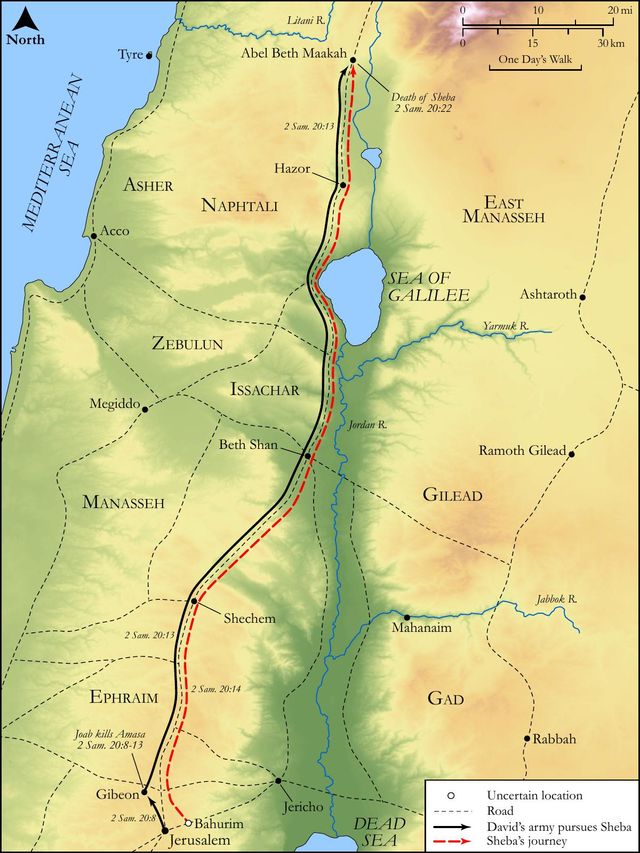
I.The rebel, when he had rambled over all the tribes of Israel, and found them not so willing, upon second thoughts, to follow him, as they had been upon a sudden provocation to desert David (having only picked up a few like himself, that sided with him), at length entered Abel-Beth-maacah, a strong city in the north, in the lot of Naphtali, where we find it placed, Kg2 15:29. Here he took shelter, whether by force or with consent does not appear; but his adherents were most Berites, of Beeroth in Benjamin, Sa2 20:14. One bad man will find or make more.
II.Joab drew up all his force against the city, besieged it, battered the wall, and made it almost ready for a general storm, Sa2 20:15.
Justly is that place attacked with all this fury which dares harbour a traitor; nor will that heart fare better which indulges those rebellious lusts that will not have Christ to reign over them.
III.A discreet good woman of the city of Abel brings this matter, by her prudent management, to a good issue, so as to satisfy Joab and yet save the city. Here is,
1.Her treaty with Joab, and her capitulation with him, by which he is engaged to raise the siege, upon condition that Sheba be delivered up. It seems, none of all the men of Abel, none of the elders or magistrates, offered to treat with Joab, no, not when they were reduced to the last extremity. They were stupid and unconcerned for the public safety, or they stood in awe of Sheba, or they despaired of gaining any good terms with Joab, or they had not sense enough to manage the treaty. But this one woman and her wisdom saved the city. Souls know no difference of sexes. Though the man be the head, it does not therefore follow that he has the monopoly of the brains, and therefore he ought not, by any salique law, to have the monopoly of the crown. Many a masculine heart, and more than masculine, has been found in a female breast; nor is the treasure of wisdom the less valuable for being lodged in the weaker vessel. In the treaty between this nameless heroine and Joab,
(1.)She gains his audience and attention, Sa2 20:16, Sa2 20:17. We may suppose it was the first time he had ever treated with a woman in martial affairs.
(2.)She reasons with him on behalf of her city, and very ingeniously.
[1.]That it was a city famous for wisdom (Sa2 20:18), as we translate it. She pleads that this city had been long in such reputation for prudent knowing men that it was the common referee of the country, and all agreed to abide by the award of its elders. Their sentence was an oracle; let them be consulted and the matter is ended, all sides will acquiesce. Now shall such a city as this be laid in ashes and never treated with?
[2.]That the inhabitants were generally peaceable and faithful in Israel, Sa2 20:19. She could speak, not for herself only, but for all those whose cause she pleaded, that they were not of turbulent and seditious spirits, but of known fidelity to their prince and peaceableness with their fellow-subjects; they were neither seditious nor litigious.
[3.]That it was a mother in Israel, a guide and nurse to the towns and country about; and that it was a part of the inheritance of the Lord, a city of Israelites, not of heathen; and the destruction of it would lessen and weaken that nation which God had chosen for his heritage.
[4.]That they expected him to offer them peace before he made an attack upon the, according to that known law of war, Deu 20:10. So the margin reads (Sa2 20:18): They plainly spoke in the beginning (of the siege), saying, Surely they will ask of Abel, that is, "The besiegers will demand the traitor, and will ask us to surrender him; and if they do, we will soon come to an agreement, and so end the matter." Thus she tacitly upbraids Joab for not offering them peace, but hopes it is not too late to beg it.
(3.)Joab and Abel's advocate soon agree that Sheba's head shall be the ransom of the city. Joab, though in a personal quarrel he had lately swallowed up and destroyed Amasa, yet, when he acts as a general, will by no means bear the imputation of delighting in bloodshed: "Far be it from me that I should delight to swallow up or destroy, or design it but when it is necessary for the public safety, Sa2 20:20. The matter is not so. Our quarrel is not with your city; we would hazard our lives for its protection. Our quarrel is only with the traitor that is harboured among you; deliver him up, and we have done." A great deal of mischief would be prevented if contending parties would but understand one another. The city obstinately holds out, believing Joab aims at its ruin. Joab furiously attacks it, believing the citizens all confederates with Sheba. Whereas both were mistaken; let both sides be undeceived, and the matter is soon accommodated. The single condition of peace is the surrender of the traitor. It is so in God's dealing with the soul, when it is besieged by conviction and distress: sin is the traitor; the beloved lust is the rebel; part with that, cast away the transgression, and all shall be well. No peace on any other terms. Our wise woman immediately agrees to the proposal: Behold, his head shall be thrown to thee presently.
2.Her treaty with the citizens. She went to them in her wisdom (and perhaps she had as much need of it in dealing with them as in dealing with Joab) and persuaded them to cut off Sheba's head, probably by some public order of their government, and it was thrown over the wall to Joab. He knew the traitor's face, and therefore looked no further, intending not that any of his adherents should suffer. The public safety was secured, and he felt no wish to gratify the public revenge. Joab hereupon raised the siege, and marched back to Jerusalem, with the trophies rather of peace than victory.
Continue studying 2 Samuel 20:16 across the web’s major study libraries — every link below opens this exact verse, chapter, or book on the destination site.
Read & Compare
 BibleGatewayThis verse in more than 200 translations and 70 languages.
 Bible.comThe YouVersion reader — hundreds of translations, reading plans, and highlights.
 ESV.orgCrossway's official English Standard Version reader.
 NET BibleThe NET translation with 60,000+ translators' notes on every rendering decision.
 STEP BibleTyndale House's free study tool — original text, vocabulary, and scholarly resources.
 BibliaLogos Bible Software's free web reader.
 USCCBThe New American Bible (Revised Edition) with the U.S. bishops' study notes.
Commentaries
 BibleHub CommentariesDozens of classic commentaries on this verse, gathered on one page.
 StudyLightMore than 100 commentary sets — the largest collection on the web.
 BibleRefPlain-English commentary on what this verse means, verse by verse.
 Enduring WordDavid Guzik's free commentary on this chapter, widely used by Bible teachers.
 Bible Study ToolsVerse commentary alongside Greek and Hebrew study aids.
Original Language & Research
- BibleHub InterlinearThe verse word by word — original language, transliteration, and English.
- BibleHub LexiconEvery word's original-language definition and Strong's entry.
 Blue Letter BibleDeep-study tools — Strong's numbers, concordance, and word studies.
 SefariaThe Hebrew text with Rashi and centuries of Jewish commentary.
Sermons, Hymns & Audio


TrulyRandomVerse is not affiliated with these sites and doesn’t control their content. They’re linked because they’re genuinely useful.
Summary
In 2 Samuel 20:16, amidst the critical rebellion of Sheba against King David, an unnamed "wise woman" from the besieged city of Abel of Beth-Maachah emerges as a pivotal figure. As Joab's forces prepare to utterly destroy the city to capture a single rebel, this woman courageously and strategically cries out, demanding an immediate audience with the formidable general. Her decisive intervention initiates a crucial dialogue that ultimately averts widespread destruction, demonstrating the profound impact of wisdom, diplomacy, and courageous intercession in a moment of extreme crisis.
Context
ShowHideLiterary Context
This verse is strategically placed within the tumultuous narrative of King David's later reign, specifically following the deeply destabilizing Absalom's rebellion and David's complex return to Jerusalem. The immediate preceding events describe the opportunistic uprising of Sheba, a Benjaminite, who capitalizes on lingering tribal tensions to declare independence from David (compare 2 Samuel 20:1-2). Joab, David's ruthless but undeniably effective general, is dispatched to quell this new threat. The pursuit of Sheba leads Joab's forces to Abel of Beth-Maachah, a fortified city in northern Israel where Sheba has sought refuge (2 Samuel 20:14-15). Joab's siege tactics are brutal and efficient, involving the construction of a siege ramp and the undermining of the city walls, signaling imminent and total destruction. It is at this precise, desperate juncture, with the lives of innocent inhabitants hanging in the balance, that the wise woman intervenes, acting as a voice of reason and a last resort for her community. Her action dramatically shifts the narrative's focus from military confrontation to diplomatic negotiation, powerfully illustrating how wisdom can avert catastrophe.
Historical & Cultural Context
Abel of Beth-Maachah was a strategically significant city, likely situated in the northern reaches of Israel, near the border with Aram. Its fortification made it a stronghold, but ancient sieges, if prolonged or determined, often resulted in the city's capitulation or complete destruction, with dire consequences for its inhabitants, including enslavement or death. The concept of "utter destruction" (Hebrew: herem) was a grim reality of ancient warfare, sometimes divinely mandated in specific contexts (e.g., as outlined in Deuteronomy 20:16-18). Joab's readiness to destroy an entire city to capture one man, Sheba, underscores the harsh realities of ancient military campaigns and the lengths to which commanders would go to eliminate threats to royal authority. In a predominantly patriarchal society, the emergence of an unnamed woman as a key negotiator is particularly noteworthy. While women generally occupied subordinate social roles, the Old Testament occasionally presents "wise women" (such as the wise woman of Tekoa or the woman who killed Abimelech in Judges 9:53) who, through their discernment, rhetorical skill, and courage, could influence powerful men and resolve complex, seemingly intractable situations. This highlights a cultural recognition of practical wisdom as a valuable asset, regardless of gender, especially during times of profound crisis.
Key Themes
ShowHideThis verse powerfully contributes to several overarching themes within the book of 2 Samuel and the broader Deuteronomistic History. It emphatically underscores the theme of wisdom in leadership and crisis, demonstrating how practical discernment and strategic communication can prevent unnecessary bloodshed and achieve peaceful resolutions where brute force might fail. The "wise woman" embodies this theme, serving as a stark contrast to Joab's destructive impulse and Sheba's rebellious folly. The narrative also highlights the value of human life and the moral imperative to seek alternatives to widespread destruction, even in wartime. It implicitly critiques the indiscriminate nature of war when a single life (Sheba's) is deemed worth the annihilation of an entire city. Furthermore, the verse emphasizes the power of an individual voice, particularly one from an unexpected or overlooked source, to dramatically alter the course of events. This resonates with the recurring biblical motif of God often working through the overlooked or seemingly insignificant. Finally, it subtly reinforces the theme of divine providence, suggesting that even in moments of intense human conflict and moral ambiguity, God can raise up individuals to guide events toward a more just or merciful outcome, aligning with the broader narrative of God's continued work in the life of David and his kingdom, despite its many flaws and conflicts, as seen in passages like 2 Samuel 7.
Exposition and Analysis
ShowHideKey Word Analysis
ShowHideThis adjective (H2450), derived from the Hebrew root חָכָם, denotes practical skill, shrewdness, discernment, and the profound ability to apply knowledge effectively to real-life situations. While the form used here is feminine (חֲכָמָה), the root meaning emphasizes a wisdom that leads to prudent action and sound judgment, often in a judicial or mediatory capacity. In this context, it signifies the woman's exceptional ability to accurately assess the dire situation, understand Joab's motivations, and devise a strategy to save her city, demonstrating a wisdom that is both perceptive and proactive.
The verb "cried" (H7121) indicates a public, urgent, and distinct vocalization. It suggests that her voice was not a mere whisper but a deliberate, authoritative call, intended to be heard above the din and chaos of the siege. This action implies a remarkable boldness and a profound sense of urgency, as she courageously interrupts a military operation to demand attention, highlighting her conviction and resolve in the face of imminent danger and widespread destruction.
The emphatic repetition of the imperative "hear" (H8085, from שָׁמַע) serves as a powerful rhetorical device designed to cut through the noise of battle and demand immediate attention. It is a desperate yet authoritative plea, compelling Joab and his men to pause their destructive actions and listen. This doubled imperative underscores the extreme gravity of the situation and the woman's determined attempt to engage in dialogue and negotiation before it is irrevocably too late for her city.
Verse Breakdown
ShowHide"Then cried a wise woman out of the city"
This opening clause immediately introduces the central figure of this dramatic scene—an unnamed woman whose defining characteristic is her exceptional wisdom. Her action of "crying out" signifies an immediate, public, and courageous intervention from within the besieged city walls, demonstrating her remarkable initiative and leadership in a dire and desperate situation.
"Hear, hear; say, I pray you, unto Joab"
This constitutes the urgent substance of her plea. The repeated "Hear, hear" is an emphatic call for attention, a desperate yet authoritative demand for the besieging army to halt their destructive work and listen to reason. Her instruction to "say, I pray you, unto Joab" indicates her astute understanding of military protocol and hierarchy, recognizing that she, as a woman from a besieged city, might not be able to directly address the commander without an intermediary. This reveals her strategic thinking and respect for established order, even in an emergency.
"Come near hither, that I may speak with thee"
This final phrase is a direct, albeit indirectly delivered, invitation to Joab. It clearly articulates her precise purpose: to engage in a personal, face-to-face dialogue with the commander. This invitation suggests her profound confidence in her ability to negotiate and her unwavering belief that a peaceful resolution is indeed possible through direct communication, standing in stark contrast to the ongoing military assault and the impending doom.
Literary Devices
ShowHideThe verse employs several significant literary devices to heighten its impact and convey its message. Character Introduction is paramount, as the "wise woman" is immediately presented as the pivotal figure; her wisdom, rather than her name or lineage, is her defining trait, emphasizing the universal nature of her insight and the source of her authority. The powerful use of Repetition ("Hear, hear") serves as an emphatic plea, highlighting the extreme urgency and desperation of her call while simultaneously demanding immediate and undivided attention from the besiegers. There is a strong element of Dramatic Irony, as the reader is aware that the city is innocent of Sheba's rebellion, and its destruction would be an unjust tragedy, making the woman's intervention the sole hope for averting a catastrophe that Joab is unwittingly about to inflict. Furthermore, the scene is imbued with palpable Suspense, as the city's fate hangs precariously in the balance, creating intense tension that is momentarily relieved and then resolved by her courageous and wise voice.
Theological and Thematic Connections
ShowHideThis singular act of a wise woman crying out from a besieged city resonates deeply with profound biblical themes of divine wisdom, the inherent value of human life, and the transformative power of intercession. It powerfully illustrates that God's wisdom is not confined to the powerful, the prominent, or the officially designated leaders, but can authentically emerge from unexpected sources, even an unnamed woman in a patriarchal society, to bring about deliverance and preserve life. Her courageous intervention highlights a crucial theological principle: that often, the true path to peace and preservation lies not in overwhelming force or unthinking aggression, but in discerning dialogue, courageous defense of life, and a willingness to seek alternatives to destruction. The narrative implicitly praises the act of seeking peace and averting unnecessary bloodshed, reflecting a divine concern for justice, mercy, and the well-being of all people, even those caught in the devastating crossfire of human conflict.
Reflection and Application
ShowHideThe intervention of the wise woman in 2 Samuel 20:16 offers profound and timeless lessons for contemporary life. It challenges us to recognize that genuine wisdom and viable solutions can emerge from the most unexpected places and people, often those we might overlook or dismiss based on their social standing, gender, or lack of official authority. Her remarkable courage to rebuke the powerful, to bravely interrupt a destructive course of action, and to advocate passionately for her community's survival serves as an enduring and inspiring model. In our own lives, whether navigating personal conflicts, resolving community disputes, or confronting broader societal challenges, we are called to cultivate a similar spirit of discernment and courageous defense of the weak. This means not only being willing to speak up when injustice or destruction looms but also actively fostering an environment where diverse voices are genuinely heard and valued, and where dialogue, negotiation, and peaceful resolution are prioritized over unthinking aggression. Her story powerfully reminds us that true leadership often involves a humble willingness to listen to unexpected counsel and to choose the path of diplomacy, preservation, and reconciliation, even when the default seems to be confrontation or brute force.
Questions for Reflection
ShowHideFAQ
ShowHideWho was this "wise woman," and why is she unnamed?
ShowHideThe Bible does not provide the personal name of this "wise woman" from Abel of Beth-Maachah. Her anonymity is a common literary device for many minor yet significant characters in biblical narratives, often serving to highlight their specific role or the universal message they convey rather than their individual identity. In this particular case, her being unnamed emphasizes that profound wisdom and courageous action can emerge from anyone, regardless of their social standing, gender, or personal renown. Her wisdom and decisive action are the central focus, not her individual person. She functions as an archetype of practical sagacity and courageous intercession, similar in function to the wise woman of Tekoa who also famously advised King David.
What was Joab's motivation for destroying the entire city to capture one man?
ShowHideJoab's primary motivation was to swiftly and decisively end Sheba's rebellion, which posed a direct and immediate threat to King David's newly reunited kingdom. In ancient warfare, it was a common and often brutal practice to destroy cities that harbored rebels or resisted royal authority as a severe deterrent to future uprisings. Joab, known throughout the biblical narrative for his ruthless efficiency and unwavering loyalty to David (as seen in his killing of Absalom in 2 Samuel 18:14), likely viewed the city of Abel as complicit in Sheba's rebellion by offering him refuge. His intent was to eliminate the threat completely and send an unmistakable message about the severe consequences of defying David's rule, even if it meant sacrificing innocent lives to achieve his military objective.
Christ-Centered Fulfillment
ShowHideThe intervention of the wise woman in 2 Samuel 20:16, who courageously intercedes to save her city from utter destruction, serves as a powerful and poignant foreshadowing of Christ's ultimate role as the divine Intercessor and Peacemaker. Just as she steps into a scene of impending judgment and offers a path to peace through discerning dialogue and the surrender of the one causing conflict, so too does Jesus Christ stand between a humanity deserving of judgment and a holy, righteous God. He is the very embodiment of God's wisdom (1 Corinthians 1:24, 1 Corinthians 1:30), who, through His sacrificial death, became the ultimate "wise one" who graciously averts divine wrath from all who believe. He is the Lamb of God who takes away the sin of the world, the "one" whose voluntary surrender (His death on the cross) brings profound peace and eternal salvation to "many" (Mark 10:45). His triumphant cry from the cross, "It is finished" (John 19:30), echoes the wise woman's urgent plea, bringing a decisive end to the siege of sin and death and opening the way for eternal reconciliation with God. Through Him, the ultimate wisdom of God is revealed, not in destruction, but in the self-giving love that saves a multitude from perishing, ushering in an eternal peace that surpasses all understanding (Philippians 4:7).