


2 Samuel 20:15
Bible text: King James Version (1769 Blayney text) · Public domain
Bible text: King James Version with Strong's numbers · Public domain
Bible text: Berean Standard Bible · Public domain
Bible text: American Standard Version (1901) · Public domain
Bible text: World English Bible, Messianic edition · Public domain
Bible text: Geneva Bible (1599) · Public domain
Bible text: Young's Literal Translation · Public domain
- וַיָּבֹאוּvai·ya·Vo·'uand they cameH935Conj-w ¦ V-Qal-ConsecImperf-3mpVerb Qal Consecutive Imperfect 3rd Plural Masculineוַandיָּבֹאוּthey came
- וַיָּצֻרוּvai·ya·Tzu·ruand they laid siegeH6696Conj-w ¦ V-Qal-ConsecImperf-3mpVerb Qal Consecutive Imperfect 3rd Plural Masculineוַandיָּצֻרוּthey laid siege
- עָלָיו'a·Lavon himH5921Prep ¦ 3msPreposition Definiteעָלָיonוhim
- בְּאָבֵלָהbe·'a·Ve·lahin Abel <towards>H62Prep-b ¦ N-proper ¦ SfxNoun Proper LocationבְּinאָבֵלָAbelה<towards>
- בֵּיתbeitBethH62N-mscNoun Singular Masculine Construct
- הַמַּעֲכָהha·ma·'a·Khah<the> MaacahH62Art ¦ N-properNoun Proper Locationהַ<the>מַּעֲכָהMaacah
- וַיִּשְׁפְּכוּvai·yish·pe·Khuand they poured outH8210Conj-w ¦ V-Qal-ConsecImperf-3mpVerb Qal Consecutive Imperfect 3rd Plural Masculineוַandיִּשְׁפְּכוּthey poured out
- סֹלְלָהso·le·Laha moundH5550N-fsNoun Singular Feminine Absolute
- אֶל'elagainstH413PrepPreposition
- הָעִירha·'Irthe cityH5892Art ¦ N-fsNoun Singular Feminine Absoluteהָtheעִירcity
- וַתַּעֲמֹדva·ta·'a·Modand it stoodH5975Conj-w ¦ V-Qal-ConsecImperf-3fsVerb Qal Consecutive Imperfect 3rd Singular Feminineוַandתַּעֲמֹדit stood
- בַּחֵלba·Chelby the rampartH2426Prep-b ¦ N-msNoun Singular Masculine Absoluteבַּby theחֵלrampart
- וְכָלve·kholand allH3605Conj-w ¦ N-mscNoun Singular Masculine Constructוְandכָלall
- הָעָםha·'Amthe peopleH5971Art ¦ N-msNoun Singular Masculine Absoluteהָtheעָםpeople
- אֲשֶׁר'a·SherwhichH834RelParticle Relative
- אֶת'et[was] withH854PrepPreposition
- יוֹאָבyo·'AvJoabH3097N-proper-mNoun Proper Masculine
- מַשְׁחִיתִםmash·chi·Tim[were] about to destroyH7843V-Hiphil-Prtcpl-mpVerb Hiphil Participle Plural Masculine Absolute
- לְהַפִּילle·ha·Pilto make fallH5307Prep-l ¦ V-Hiphil-InfVerb Hiphil Infinitive Constructלְtoהַפִּילmake fall
- הַחוֹמָהha·cho·Mahthe wallH2346Art ¦ N-fsNoun Singular Feminine Absoluteהַtheחוֹמָהwall
English is a literal word-by-word gloss of the Hebrew, not the KJV's wording. Why?
This is the original text the KJV's translators worked from — each Hebrew word with its own literal English meaning in this verse, prepared by scholars at Tyndale House, Cambridge. The KJV translates whole sentences, not word by word, so its wording differs: one Hebrew word can become several English words, and the KJV may choose “the LORD” where the gloss reads “Yahweh”. Both are faithful — they answer different questions. For the KJV's own rendering, switch to the KJV text.
Details
See on the biblical-era maps
Study this verse
Public-domain commentary
Matthew Henry
From his Commentary on the Whole Bible. Henry comments on passages, not single verses — this entry covers 2 Samuel 20:14–22. His four-level outline is real structure in the source text, so it is rendered as structure.
We have here the conclusion of Sheba's attempt.
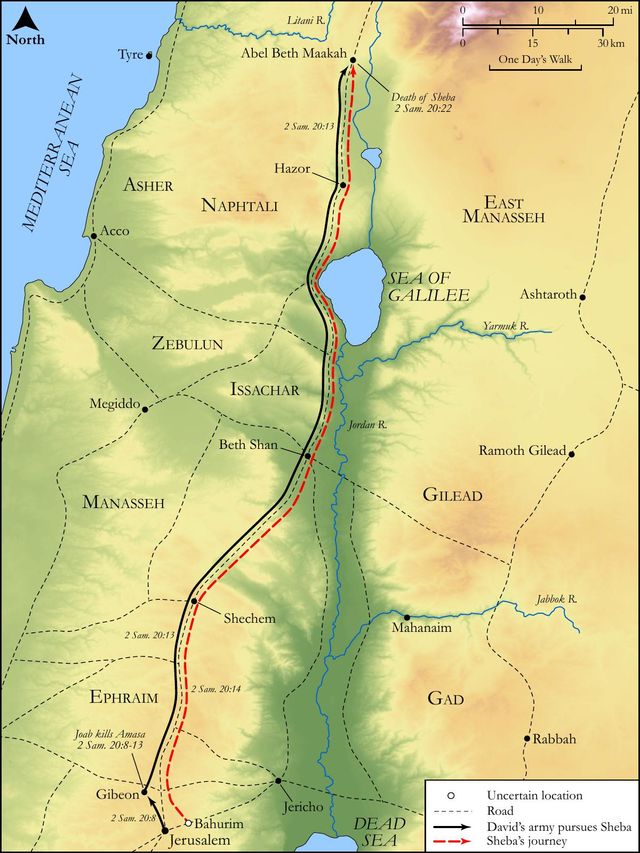
I.The rebel, when he had rambled over all the tribes of Israel, and found them not so willing, upon second thoughts, to follow him, as they had been upon a sudden provocation to desert David (having only picked up a few like himself, that sided with him), at length entered Abel-Beth-maacah, a strong city in the north, in the lot of Naphtali, where we find it placed, Kg2 15:29. Here he took shelter, whether by force or with consent does not appear; but his adherents were most Berites, of Beeroth in Benjamin, Sa2 20:14. One bad man will find or make more.
II.Joab drew up all his force against the city, besieged it, battered the wall, and made it almost ready for a general storm, Sa2 20:15.
Justly is that place attacked with all this fury which dares harbour a traitor; nor will that heart fare better which indulges those rebellious lusts that will not have Christ to reign over them.
III.A discreet good woman of the city of Abel brings this matter, by her prudent management, to a good issue, so as to satisfy Joab and yet save the city. Here is,
1.Her treaty with Joab, and her capitulation with him, by which he is engaged to raise the siege, upon condition that Sheba be delivered up. It seems, none of all the men of Abel, none of the elders or magistrates, offered to treat with Joab, no, not when they were reduced to the last extremity. They were stupid and unconcerned for the public safety, or they stood in awe of Sheba, or they despaired of gaining any good terms with Joab, or they had not sense enough to manage the treaty. But this one woman and her wisdom saved the city. Souls know no difference of sexes. Though the man be the head, it does not therefore follow that he has the monopoly of the brains, and therefore he ought not, by any salique law, to have the monopoly of the crown. Many a masculine heart, and more than masculine, has been found in a female breast; nor is the treasure of wisdom the less valuable for being lodged in the weaker vessel. In the treaty between this nameless heroine and Joab,
(1.)She gains his audience and attention, Sa2 20:16, Sa2 20:17. We may suppose it was the first time he had ever treated with a woman in martial affairs.
(2.)She reasons with him on behalf of her city, and very ingeniously.
[1.]That it was a city famous for wisdom (Sa2 20:18), as we translate it. She pleads that this city had been long in such reputation for prudent knowing men that it was the common referee of the country, and all agreed to abide by the award of its elders. Their sentence was an oracle; let them be consulted and the matter is ended, all sides will acquiesce. Now shall such a city as this be laid in ashes and never treated with?
[2.]That the inhabitants were generally peaceable and faithful in Israel, Sa2 20:19. She could speak, not for herself only, but for all those whose cause she pleaded, that they were not of turbulent and seditious spirits, but of known fidelity to their prince and peaceableness with their fellow-subjects; they were neither seditious nor litigious.
[3.]That it was a mother in Israel, a guide and nurse to the towns and country about; and that it was a part of the inheritance of the Lord, a city of Israelites, not of heathen; and the destruction of it would lessen and weaken that nation which God had chosen for his heritage.
[4.]That they expected him to offer them peace before he made an attack upon the, according to that known law of war, Deu 20:10. So the margin reads (Sa2 20:18): They plainly spoke in the beginning (of the siege), saying, Surely they will ask of Abel, that is, "The besiegers will demand the traitor, and will ask us to surrender him; and if they do, we will soon come to an agreement, and so end the matter." Thus she tacitly upbraids Joab for not offering them peace, but hopes it is not too late to beg it.
(3.)Joab and Abel's advocate soon agree that Sheba's head shall be the ransom of the city. Joab, though in a personal quarrel he had lately swallowed up and destroyed Amasa, yet, when he acts as a general, will by no means bear the imputation of delighting in bloodshed: "Far be it from me that I should delight to swallow up or destroy, or design it but when it is necessary for the public safety, Sa2 20:20. The matter is not so. Our quarrel is not with your city; we would hazard our lives for its protection. Our quarrel is only with the traitor that is harboured among you; deliver him up, and we have done." A great deal of mischief would be prevented if contending parties would but understand one another. The city obstinately holds out, believing Joab aims at its ruin. Joab furiously attacks it, believing the citizens all confederates with Sheba. Whereas both were mistaken; let both sides be undeceived, and the matter is soon accommodated. The single condition of peace is the surrender of the traitor. It is so in God's dealing with the soul, when it is besieged by conviction and distress: sin is the traitor; the beloved lust is the rebel; part with that, cast away the transgression, and all shall be well. No peace on any other terms. Our wise woman immediately agrees to the proposal: Behold, his head shall be thrown to thee presently.
2.Her treaty with the citizens. She went to them in her wisdom (and perhaps she had as much need of it in dealing with them as in dealing with Joab) and persuaded them to cut off Sheba's head, probably by some public order of their government, and it was thrown over the wall to Joab. He knew the traitor's face, and therefore looked no further, intending not that any of his adherents should suffer. The public safety was secured, and he felt no wish to gratify the public revenge. Joab hereupon raised the siege, and marched back to Jerusalem, with the trophies rather of peace than victory.
Continue studying 2 Samuel 20:15 across the web’s major study libraries — every link below opens this exact verse, chapter, or book on the destination site.
Read & Compare
 BibleGatewayThis verse in more than 200 translations and 70 languages.
 Bible.comThe YouVersion reader — hundreds of translations, reading plans, and highlights.
 ESV.orgCrossway's official English Standard Version reader.
 NET BibleThe NET translation with 60,000+ translators' notes on every rendering decision.
 STEP BibleTyndale House's free study tool — original text, vocabulary, and scholarly resources.
 BibliaLogos Bible Software's free web reader.
 USCCBThe New American Bible (Revised Edition) with the U.S. bishops' study notes.
Commentaries
 BibleHub CommentariesDozens of classic commentaries on this verse, gathered on one page.
 StudyLightMore than 100 commentary sets — the largest collection on the web.
 BibleRefPlain-English commentary on what this verse means, verse by verse.
 Enduring WordDavid Guzik's free commentary on this chapter, widely used by Bible teachers.
 Bible Study ToolsVerse commentary alongside Greek and Hebrew study aids.
Original Language & Research
- BibleHub InterlinearThe verse word by word — original language, transliteration, and English.
- BibleHub LexiconEvery word's original-language definition and Strong's entry.
 Blue Letter BibleDeep-study tools — Strong's numbers, concordance, and word studies.
 SefariaThe Hebrew text with Rashi and centuries of Jewish commentary.
Sermons, Hymns & Audio


TrulyRandomVerse is not affiliated with these sites and doesn’t control their content. They’re linked because they’re genuinely useful.
Summary
2 Samuel 20:15 offers a vivid and detailed portrayal of the intense military siege orchestrated by Joab, King David's formidable commander, against the city of Abel of Bethmaachah. This fortified city served as the final refuge for Sheba son of Bichri, the instigator of a fresh rebellion against David's newly restored kingdom. The verse meticulously describes the aggressive and systematic engineering tactics employed by Joab's forces, specifically the construction of a massive siege ramp and the relentless battering of the city's walls, highlighting the swift, decisive, and destructive measures taken to quell the insurrection and re-establish central authority.
Context
ShowHideLiterary Context
This verse is situated at a critical juncture in David's reign, immediately following the traumatic and destabilizing rebellion led by his son Absalom. With Absalom defeated and David returning to Jerusalem, a new, albeit short-lived, threat emerges from Sheba son of Bichri, a Benjaminite who incites a significant portion of Israel to declare their independence from David, proclaiming, "We have no portion in David, neither have we inheritance in the son of Jesse: every man to his tents, O Israel!" 2 Samuel 20:1. David, recognizing the urgency of this new insurrection, dispatches Amasa to pursue Sheba. However, Amasa's delay prompts David to send Abishai, instructing him to take Joab's seasoned men and pursue Sheba swiftly lest he fortify cities and cause further harm 2 Samuel 20:4-6. Joab, ever the pragmatic and ruthless commander, ambushes and murders Amasa, reasserting his dominant position as army commander 2 Samuel 20:8-10. With Amasa eliminated, Joab assumes full command of the pursuit, cornering Sheba in the northern city of Abel of Bethmaachah. Thus, 2 Samuel 20:15 describes the climactic moment of this pursuit, detailing the military actions taken by Joab's army as they prepare to breach the city's defenses to capture or eliminate the rebel leader.
Historical & Cultural Context
Abel of Bethmaachah was a significant fortified city in the tribal territory of Naphtali, located in the northern reaches of Israel, near the borders of Aram. It was known for its strategic importance and, as later verses reveal, for its reputation as a "mother city" and a place of wisdom 2 Samuel 20:18-19. The warfare of David's day, particularly against fortified settlements, frequently relied on siege tactics. The "casting up a bank" (Hebrew: solelah) refers to the construction of a massive earthen ramp or mound, a common and highly effective siege engineering technique. This ramp allowed the attacking force to gradually ascend to the height of the city walls, providing an elevated platform for archers, slingers, and eventually, for bringing battering rams or direct assault forces to bear. The "trench" (Hebrew: cheyl) typically denoted an outer defensive wall or rampart, often accompanied by a ditch or moat, serving as an initial barrier to the city's main fortifications. The detail that the solelah "stood in the trench" signifies that this primary outer defense had been successfully neutralized or filled, bringing the besiegers directly to the main city wall. Such extensive military operations demanded considerable logistical planning, engineering expertise, and a large, well-disciplined fighting force, all hallmarks of David's sophisticated army under Joab's experienced leadership, as consistently demonstrated throughout 2 Samuel.
Key Themes
ShowHideThis verse powerfully illustrates several crucial themes pertinent to the broader narrative of David's reign and the stability of the Israelite monarchy. Firstly, it vividly depicts the brutal and methodical realities of ancient siege warfare, offering a detailed glimpse into the engineering and tactical precision required to overcome formidable urban defenses. The construction of the solelah and the systematic battering of walls were standard, yet highly destructive, elements of such conflicts. Secondly, the passage underscores the decisive military action taken by David's administration to swiftly quell rebellion and reassert central authority. Joab's unrelenting pursuit of Sheba, culminating in this siege, demonstrates the unwavering resolve with which threats to the unified kingdom were addressed, serving as a stark deterrent against future insurrections. Finally, the verse reinforces Joab's unparalleled effectiveness as a military commander. Despite his often controversial character, ruthless methods, and personal ambition, Joab consistently proved himself to be an exceptionally capable, indispensable, and strategically brilliant military leader for King David, as evidenced by his long tenure as commander of the army 2 Samuel 8:16. His strategic acumen and ability to execute complex military operations were paramount in maintaining the stability and security of David's reign during a turbulent period.
Exposition and Analysis
ShowHideKey Word Analysis
ShowHideThis term refers specifically to a siege mound or ramp. According to H5550, it is an "active participle feminine of סָלַל, but used passively; a military mound, i.e. rampart of besiegers." This was a massive, carefully engineered earthen structure, often reinforced with timber, constructed by the attacking army. Its purpose was to gradually ascend to the height of a city's defensive walls, providing a stable, elevated platform from which soldiers could launch projectiles, deploy siege engines like battering rams, or directly assault the wall, thereby neutralizing the defenders' height advantage. The construction of a solelah was a monumental undertaking, signaling a determined and often prolonged siege.
As per H2426, this word denotes "an intrenchment; army, bulwark, host, [phrase] poor, rampart, trench, wall." In the context of ancient city defenses, it refers to the outer defensive rampart or wall that often encircled ancient cities, typically accompanied by a ditch or moat. It served as an initial line of defense, designed to slow down or impede attackers before they reached the main city wall. The phrase "it stood in the trench" indicates that Joab's solelah had successfully reached and potentially filled or bridged this outer defensive barrier, bringing the besiegers directly to the primary fortifications of Abel of Bethmaachah.
According to H7843, this is "a primitive root; to decay, i.e. (causatively) ruin (literally or figuratively); batter, cast off, corrupt(-er, thing), destroy(-er, -uction), lose, mar, perish, spill, spoiler, [idiom] utterly, waste(-r)." The verb used here implies a forceful, destructive action, specifically to damage, demolish, or ruin. In the context of siege warfare, it refers to the systematic and violent assault on the city wall, likely using battering rams or other heavy implements, with the explicit aim "to throw it down." This highlights the intensity and destructive intent of Joab's army, signaling that they were not merely containing the city but actively working to breach its defenses.
Verse Breakdown
ShowHide"And they came and besieged him in Abel of Bethmaachah"
This clause identifies the aggressors ("they," referring to Joab's army) and their specific target ("him," referring to Sheba son of Bichri). It establishes the geographical setting of the confrontation: Abel of Bethmaachah, a strategically important and fortified city in the northern kingdom, which Sheba had chosen as his final refuge. The act of "besieging" signifies the commencement of a full-scale military blockade, cutting off the city's supplies and communications, and initiating preparations for a direct assault.
"and they cast up a bank against the city"
This describes the primary offensive action undertaken by the besiegers. The "bank" (Hebrew: solelah) was a formidable and labor-intensive piece of ancient military engineering. Its construction was a crucial step in overcoming the city's defenses, allowing the attacking force to gain a height advantage and bring their full destructive power to bear directly upon the walls.
"and it stood in the trench"
This phrase signifies a critical and successful advancement for Joab's army. The "trench" (Hebrew: cheyl) refers to the outer defensive works, often a rampart or ditch, that provided an initial layer of protection for the city. The fact that the siege ramp had reached and established itself within this outer defense meant that the first line of protection had been neutralized, clearing the way for a direct assault on the main city wall.
"and all the people that [were] with Joab battered the wall, to throw it down"
This final clause details the direct and destructive assault on the city's primary fortification. The phrase "all the people that were with Joab" emphasizes the unified, concerted, and overwhelming effort of the entire army. They were actively engaged in "battering the wall," likely employing battering rams or other heavy implements, with the clear and stated objective "to throw it down," indicating their unwavering intent to decisively breach the city's defenses and gain entry.
Literary Devices
ShowHideThe verse employs Vivid Imagery to paint a clear and dynamic picture of the siege. Phrases like "cast up a bank," "stood in the trench," and "battered the wall" evoke strong visual and kinetic sensations, immersing the reader in the intensity and physicality of the military action. There is a palpable sense of Military Precision conveyed through the methodical description of the siege tactics: first the approach and encirclement, then the systematic construction of the siege ramp, its successful placement within the outer defenses, and finally the direct, concerted assault on the main wall. This demonstrates the highly strategic, organized, and disciplined nature of Joab's army. The verse also exhibits a form of Foreshadowing, as the aggressive and successful breaching of the outer defenses and the relentless battering of the main wall strongly imply the imminent fall of the city, setting the stage for the dramatic resolution that immediately follows in the narrative.
Theological and Thematic Connections
ShowHideWhile primarily a historical account of military conflict, 2 Samuel 20:15 offers profound theological and thematic insights into the nature of rebellion, divine order, and human leadership. It underscores the destructive consequences of disunity and insurrection within a community, echoing the broader biblical principle that a "house divided against itself cannot stand" Matthew 12:25. The relentless pursuit and decisive action taken by Joab's army, though brutal, can be seen as a reflection of the necessary enforcement of order against chaos, a theme often associated with God's establishment of governing authorities. It subtly highlights the necessity of strong, albeit imperfect and sometimes ruthless, leadership in maintaining societal stability and preventing widespread anarchy. The narrative reminds us that human sin and defiance, particularly against established and divinely sanctioned authority, often lead to severe and far-reaching consequences, affecting not only the instigators but also innocent bystanders caught in the crossfire. Ultimately, it speaks to the relentless nature of justice in the face of rebellion, whether human or divine.
Reflection and Application
ShowHideThe detailed account of the siege in 2 Samuel 20:15, though describing ancient warfare, offers powerful metaphors for spiritual and personal challenges in our contemporary lives. Just as Joab's army meticulously constructed a ramp and relentlessly battered the wall to overcome a fortified obstacle, we too often face "walls" in our lives—stubborn sins, deeply ingrained destructive habits, relational barriers, or spiritual strongholds that seem impenetrable and resistant to change. This passage encourages us to approach such challenges with strategic persistence, unwavering determination, and a refusal to yield. It reminds us that overcoming deeply entrenched issues often requires sustained effort, a systematic dismantling of defenses, and a refusal to give up until the "wall" is brought down by God's power working through us. Furthermore, the narrative of Sheba's rebellion and its violent suppression serves as a stark reminder of the destructive power of division and disunity, whether in families, churches, or broader communities. It calls us to actively pursue unity, reconciliation, and loyalty to righteous authority, understanding that internal strife and rebellion can be far more damaging and costly than external threats.
Questions for Reflection
ShowHideFAQ
ShowHideWhat was the significance of Abel of Bethmaachah in this narrative?
ShowHideAbel of Bethmaachah was a strategically important, fortified city located in the northern territory of Naphtali, near the border with Aram. Its significance in this narrative stems from its reputation as a "mother city in Israel" and a place known for its wisdom, as indicated by the wise woman who later intervenes to save the city 2 Samuel 20:18-19. For Sheba to seek refuge there suggested he believed its formidable defenses, or perhaps its inhabitants' renowned wisdom, would protect him from Joab's relentless pursuit. For Joab to besiege it meant he was willing to go to great lengths to capture Sheba, even risking the destruction of a significant Israelite city, underscoring the severity of the rebellion and the commander's determination.
Why was Joab so relentless in his pursuit of Sheba, even after Amasa's death?
ShowHideJoab's relentless pursuit of Sheba was driven by several critical factors. Firstly, as David's loyal, albeit ruthless, commander, his paramount mission was to re-establish the king's authority and crush any rebellion that threatened the fragile unity of Israel, especially after the recent turmoil of Absalom's revolt. Sheba's declaration, "We have no part in David!" 2 Samuel 20:1, was a direct challenge to David's throne and had the potential to plunge the nation into further devastating civil war. Secondly, Joab had just murdered Amasa, his rival for the position of army commander, and needed to immediately demonstrate his indispensability and effectiveness to King David. A swift and decisive victory against Sheba would solidify his controversial position and unequivocally prove his worth as the supreme military leader. His actions reflect a pragmatic, no-nonsense approach to maintaining power, order, and the stability of the kingdom.
Christ-Centered Fulfillment
ShowHideWhile 2 Samuel 20:15 describes a literal military siege against a physical city, it powerfully foreshadows the ultimate spiritual siege and decisive victory achieved by Jesus Christ. Just as Joab's army systematically constructed a ramp and relentlessly battered the defenses of Abel of Bethmaachah, Christ, through His perfect life, atoning death, and glorious resurrection, launched a decisive and victorious assault on the spiritual strongholds of sin, death, and the devil. The "walls" of human rebellion and separation from God, which seemed impenetrable and insurmountable, were utterly "battered" and "thrown down" by His perfect sacrifice on the cross. The "trench" of our spiritual alienation and the "bank" of our insurmountable sin debt were overcome when Christ "canceled the record of debt that stood against us with its legal demands; this he set aside, nailing it to the cross" Colossians 2:14. He triumphed over the spiritual powers that held humanity captive, disarming "the rulers and authorities and put[ting] them to open shame, by triumphing over them in him" Colossians 2:15. Jesus is the ultimate commander who, through His own body, broke down the "dividing wall of hostility" between God and humanity, and between Jew and Gentile Ephesians 2:14, securing a victory that offers true peace, reconciliation, and eternal life to all who believe and surrender to His reign.