


2 Samuel 20:20
Bible text: King James Version (1769 Blayney text) · Public domain
Bible text: Berean Standard Bible · Public domain
Bible text: American Standard Version (1901) · Public domain
Bible text: World English Bible, Messianic edition · Public domain
Bible text: Geneva Bible (1599) · Public domain
Bible text: Young's Literal Translation · Public domain
- וַיַּעַןvai·Ya·'anand he answeredH6030Conj-w ¦ V-Qal-ConsecImperf-3msVerb Qal Consecutive Imperfect 3rd Singular Masculineוַandיַּעַןhe answered
- יוֹאָבyo·'AvJoabH3097N-proper-mNoun Proper Masculine
- וַיֹּאמַרvai·yo·Marand he saidH559Conj-w ¦ V-Qal-ConsecImperf-3msVerb Qal Consecutive Imperfect 3rd Singular Masculineוַandיֹּאמַרhe said
- חָלִילָהcha·Li·lahfar be itH2486PrtParticle Interjection
- חָלִילָהcha·Li·lahfar be itH2486PrtParticle Interjection
- לִיLito <the> mePrep-l ¦ 1csSuffix Personal 1st Singular common genderלִto <the>יme
- אִם'imifH518PrtParticle Conditional
- אֲבַלַּע'a·va·La'I will swallow upH1104V-Piel-Imperf-1csVerb Piel Imperfect 1st Singular common gender
- וְאִםve·'imand ifH518Conj-w ¦ PrtParticle Conditionalוְandאִםif
- אַשְׁחִית'ash·ChitI will destroyH7843V-Hiphil-Imperf-1csVerb Hiphil Imperfect 1st Singular common gender
English is a literal word-by-word gloss of the Hebrew, not the KJV's wording. Why?
This is the original text the KJV's translators worked from — each Hebrew word with its own literal English meaning in this verse, prepared by scholars at Tyndale House, Cambridge. The KJV translates whole sentences, not word by word, so its wording differs: one Hebrew word can become several English words, and the KJV may choose “the LORD” where the gloss reads “Yahweh”. Both are faithful — they answer different questions. For the KJV's own rendering, switch to the KJV text.
Details
See on the biblical-era maps
Study this verse
Public-domain commentary
Matthew Henry
From his Commentary on the Whole Bible. Henry comments on passages, not single verses — this entry covers 2 Samuel 20:14–22. His four-level outline is real structure in the source text, so it is rendered as structure.
We have here the conclusion of Sheba's attempt.
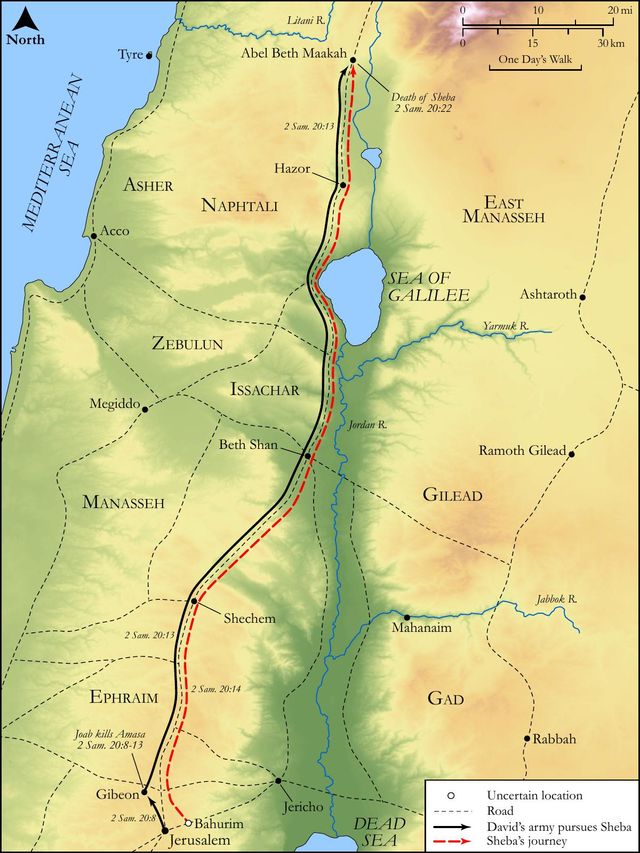
I.The rebel, when he had rambled over all the tribes of Israel, and found them not so willing, upon second thoughts, to follow him, as they had been upon a sudden provocation to desert David (having only picked up a few like himself, that sided with him), at length entered Abel-Beth-maacah, a strong city in the north, in the lot of Naphtali, where we find it placed, Kg2 15:29. Here he took shelter, whether by force or with consent does not appear; but his adherents were most Berites, of Beeroth in Benjamin, Sa2 20:14. One bad man will find or make more.
II.Joab drew up all his force against the city, besieged it, battered the wall, and made it almost ready for a general storm, Sa2 20:15.
Justly is that place attacked with all this fury which dares harbour a traitor; nor will that heart fare better which indulges those rebellious lusts that will not have Christ to reign over them.
III.A discreet good woman of the city of Abel brings this matter, by her prudent management, to a good issue, so as to satisfy Joab and yet save the city. Here is,
1.Her treaty with Joab, and her capitulation with him, by which he is engaged to raise the siege, upon condition that Sheba be delivered up. It seems, none of all the men of Abel, none of the elders or magistrates, offered to treat with Joab, no, not when they were reduced to the last extremity. They were stupid and unconcerned for the public safety, or they stood in awe of Sheba, or they despaired of gaining any good terms with Joab, or they had not sense enough to manage the treaty. But this one woman and her wisdom saved the city. Souls know no difference of sexes. Though the man be the head, it does not therefore follow that he has the monopoly of the brains, and therefore he ought not, by any salique law, to have the monopoly of the crown. Many a masculine heart, and more than masculine, has been found in a female breast; nor is the treasure of wisdom the less valuable for being lodged in the weaker vessel. In the treaty between this nameless heroine and Joab,
(1.)She gains his audience and attention, Sa2 20:16, Sa2 20:17. We may suppose it was the first time he had ever treated with a woman in martial affairs.
(2.)She reasons with him on behalf of her city, and very ingeniously.
[1.]That it was a city famous for wisdom (Sa2 20:18), as we translate it. She pleads that this city had been long in such reputation for prudent knowing men that it was the common referee of the country, and all agreed to abide by the award of its elders. Their sentence was an oracle; let them be consulted and the matter is ended, all sides will acquiesce. Now shall such a city as this be laid in ashes and never treated with?
[2.]That the inhabitants were generally peaceable and faithful in Israel, Sa2 20:19. She could speak, not for herself only, but for all those whose cause she pleaded, that they were not of turbulent and seditious spirits, but of known fidelity to their prince and peaceableness with their fellow-subjects; they were neither seditious nor litigious.
[3.]That it was a mother in Israel, a guide and nurse to the towns and country about; and that it was a part of the inheritance of the Lord, a city of Israelites, not of heathen; and the destruction of it would lessen and weaken that nation which God had chosen for his heritage.
[4.]That they expected him to offer them peace before he made an attack upon the, according to that known law of war, Deu 20:10. So the margin reads (Sa2 20:18): They plainly spoke in the beginning (of the siege), saying, Surely they will ask of Abel, that is, "The besiegers will demand the traitor, and will ask us to surrender him; and if they do, we will soon come to an agreement, and so end the matter." Thus she tacitly upbraids Joab for not offering them peace, but hopes it is not too late to beg it.
(3.)Joab and Abel's advocate soon agree that Sheba's head shall be the ransom of the city. Joab, though in a personal quarrel he had lately swallowed up and destroyed Amasa, yet, when he acts as a general, will by no means bear the imputation of delighting in bloodshed: "Far be it from me that I should delight to swallow up or destroy, or design it but when it is necessary for the public safety, Sa2 20:20. The matter is not so. Our quarrel is not with your city; we would hazard our lives for its protection. Our quarrel is only with the traitor that is harboured among you; deliver him up, and we have done." A great deal of mischief would be prevented if contending parties would but understand one another. The city obstinately holds out, believing Joab aims at its ruin. Joab furiously attacks it, believing the citizens all confederates with Sheba. Whereas both were mistaken; let both sides be undeceived, and the matter is soon accommodated. The single condition of peace is the surrender of the traitor. It is so in God's dealing with the soul, when it is besieged by conviction and distress: sin is the traitor; the beloved lust is the rebel; part with that, cast away the transgression, and all shall be well. No peace on any other terms. Our wise woman immediately agrees to the proposal: Behold, his head shall be thrown to thee presently.
2.Her treaty with the citizens. She went to them in her wisdom (and perhaps she had as much need of it in dealing with them as in dealing with Joab) and persuaded them to cut off Sheba's head, probably by some public order of their government, and it was thrown over the wall to Joab. He knew the traitor's face, and therefore looked no further, intending not that any of his adherents should suffer. The public safety was secured, and he felt no wish to gratify the public revenge. Joab hereupon raised the siege, and marched back to Jerusalem, with the trophies rather of peace than victory.
Continue studying 2 Samuel 20:20 across the web’s major study libraries — every link below opens this exact verse, chapter, or book on the destination site.
Read & Compare
 BibleGatewayThis verse in more than 200 translations and 70 languages.
 Bible.comThe YouVersion reader — hundreds of translations, reading plans, and highlights.
 ESV.orgCrossway's official English Standard Version reader.
 NET BibleThe NET translation with 60,000+ translators' notes on every rendering decision.
 STEP BibleTyndale House's free study tool — original text, vocabulary, and scholarly resources.
 BibliaLogos Bible Software's free web reader.
 USCCBThe New American Bible (Revised Edition) with the U.S. bishops' study notes.
Commentaries
 BibleHub CommentariesDozens of classic commentaries on this verse, gathered on one page.
 StudyLightMore than 100 commentary sets — the largest collection on the web.
 BibleRefPlain-English commentary on what this verse means, verse by verse.
 Enduring WordDavid Guzik's free commentary on this chapter, widely used by Bible teachers.
 Bible Study ToolsVerse commentary alongside Greek and Hebrew study aids.
Original Language & Research
- BibleHub InterlinearThe verse word by word — original language, transliteration, and English.
- BibleHub LexiconEvery word's original-language definition and Strong's entry.
 Blue Letter BibleDeep-study tools — Strong's numbers, concordance, and word studies.
 SefariaThe Hebrew text with Rashi and centuries of Jewish commentary.
Sermons, Hymns & Audio


TrulyRandomVerse is not affiliated with these sites and doesn’t control their content. They’re linked because they’re genuinely useful.
Summary
In 2 Samuel 20:20, Joab, King David's formidable military commander, issues a vehement and unequivocal denial of any intent to inflict widespread destruction or indiscriminate violence upon the city of Abel of Beth-maachah. This forceful declaration is a direct response to the wise woman's challenge from the city wall, through which Joab clarifies his precise objective: to apprehend Sheba, the rebel leader who has sought refuge within the city, rather than to "swallow up or destroy" its innocent inhabitants or the city itself. Joab's emphatic statement underscores a crucial distinction between targeted justice against a specific insurgent and the wanton devastation of a loyal Israelite community during wartime.
Context
ShowHideLiterary Context
This verse is strategically placed within the narrative of 2 Samuel 20, immediately following Absalom's failed rebellion and a period of lingering political instability and tribal tension within Israel. Sheba, a Benjaminite, capitalizes on these divisions to incite a new insurrection against King David. Joab, ever the decisive military leader, swiftly pursues Sheba to the fortified city of Abel of Beth-maachah. As Joab's forces prepare for a siege, a "wise woman" from the city initiates a critical dialogue from the wall, questioning Joab's intentions in 2 Samuel 20:16. Joab's response in 2 Samuel 20:20 is a direct and forceful denial, setting the stage for the negotiation that ultimately resolves the conflict without a full-scale assault. This exchange highlights the power of communication and strategic thinking even amidst military conflict, demonstrating a pragmatic approach to achieving objectives with minimal collateral damage.
Historical & Cultural Context
The period of David's reign was marked by both the unification of the Israelite tribes under a single monarchy and persistent internal strife, particularly the tribal rivalries between Judah and the northern tribes. Sheba's rebellion, much like Absalom's, exploited these deep-seated divisions. Warfare in Israel, including siege tactics, could be brutal, but there were also established customs regarding the treatment of cities, sometimes allowing for negotiation before total destruction, as seen in the laws of warfare outlined in Deuteronomy 20:10-14. The emergence of a "wise woman" in such a critical situation is noteworthy; these figures often possessed significant moral authority and practical wisdom within Israelite society, capable of mediating disputes and influencing outcomes, as exemplified by the woman of Tekoa in 2 Samuel 14. Joab's willingness to engage with her, rather than simply proceeding with the siege, reflects a pragmatic approach aimed at achieving his objective with minimal cost and collateral damage to a fellow Israelite city.
Key Themes
ShowHideThe narrative in 2 Samuel 20 explores several prominent themes crucial to understanding the dynamics of David's kingdom. Leadership and Authority are central, as David's rule is once again challenged, and Joab acts decisively to reassert royal control. A critical theme is the distinction between Justice and Indiscriminate Violence; Joab's denial emphasizes that his mission is precisely targeted at a specific rebel, Sheba, rather than a general destruction of the city or its innocent inhabitants. This highlights the concept of Accountability, where the individual rebel is distinguished from the collective populace. The pivotal role of Wisdom and Diplomacy is also evident through the wise woman's intervention, demonstrating that even in military contexts, dialogue can avert unnecessary bloodshed and achieve strategic goals. Finally, the passage underscores the Fragility of Unity within Israel, constantly threatened by internal divisions and the lingering effects of previous conflicts, a theme that resonates throughout the books of 1 Samuel and 2 Samuel.
Exposition and Analysis
ShowHideKey Word Analysis
ShowHideThis word (H2486), often doubled as in this verse ("חָלִילָה לִּי חָלִילָה לִּי"), functions as a powerful interjection expressing strong abhorrence, indignation, or emphatic denial. Derived from a root meaning "to profane," it literally implies "a profaned thing be it to me" or "God forbid!" It is used to convey an absolute rejection of a proposed or implied action. Joab's repetition of "far be it" underscores the depth of his revulsion at the idea of indiscriminately destroying an Israelite city, signaling his moral and strategic distance from such an act.
The verb (H1104) means to make away with, specifically by swallowing; generally, to destroy, devour, or engulf. It conveys the idea of complete absorption or annihilation, leaving nothing behind. In this context, it speaks to the utter obliteration of the city and its inhabitants, implying a total and irreversible devastation, a complete consumption of its existence.
The verb (H7843) means to decay, ruin, corrupt, spoil, or lay waste. While similar to "swallow up," it often implies a process of decay, a state of ruin, or a marring of something's integrity rather than immediate consumption. Together, "swallow up or destroy" forms a comprehensive expression of destructive actions, from complete annihilation to gradual ruin, which Joab vehemently denies intending for the city.
Verse Breakdown
ShowHide"And Joab answered and said,"
This opening clause immediately establishes the conversational framework. Joab is presented as directly responding to the wise woman's implied accusation or question regarding his intentions toward the city. It sets the stage for his emphatic declaration, indicating that his words are a direct counter-statement designed to clarify a perceived misunderstanding or challenge to his motives.
"Far be it, far be it from me,"
This is the emotional and volitional core of Joab's response. The powerful doubling of "Far be it" (חָלִילָה לִּי חָָלִילָה לִּי) serves as an intense rhetorical device, emphasizing the absolute impossibility and moral repugnance of the action he is about to deny. It functions as a strong, oath-like statement, conveying that such an act would be anathema to him, utterly contrary to his character, principles, or strategic objectives in this specific context.
"that I should swallow up or destroy."
This final clause precisely specifies the actions Joab so vehemently disavows. The coupling of the verbs "swallow up" and "destroy" covers the full spectrum of devastating outcomes—from complete obliteration to ruin and corruption. By denying these intentions, Joab clarifies that his objective is not general devastation but a targeted military operation aimed solely at the rebel leader, Sheba, not the innocent populace or the city itself. This crucial distinction is foundational for understanding his strategy and for the subsequent peaceful resolution that saves the city from siege.
Literary Devices
ShowHideThe verse employs several significant literary devices that amplify its meaning and impact. Repetition is prominently featured in "Far be it, far be it from me," which serves to intensify Joab's emphatic denial and convey the profound depth of his abhorrence for the suggested action. This doubling creates a sense of urgency, conviction, and absolute rejection. The statement itself functions as a powerful Rhetorical Denial, where Joab refutes an unstated but clearly implied accusation from the wise woman, thereby clarifying his true intentions and setting the record straight. This denial also establishes a stark Contrast between the perceived intent (indiscriminate destruction) and Joab's actual, more targeted objective (apprehending Sheba). This contrast highlights the moral and strategic distinction Joab wishes to make, emphasizing that his military actions are not wanton but purposeful. Furthermore, the use of the two verbs "swallow up" and "destroy" can be understood as a Merism, a literary device where two contrasting or complementary terms are used to express a totality, in this case, the full extent of devastation, from complete annihilation to gradual ruin.
Theological and Thematic Connections
ShowHideJoab's emphatic denial in 2 Samuel 20:20, "Far be it, far be it from me, that I should swallow up or destroy," resonates with profound theological and thematic principles concerning justice, warfare, and the sanctity of human life within a covenant community. While Joab is known for his ruthless pragmatism as a military commander, his statement here reflects a recognition, however strategic, that not all destruction is permissible, especially against loyal Israelites. It aligns with the biblical emphasis on targeted justice, where punishment is ideally meted out to the guilty, not indiscriminately to the innocent, a principle articulated in Deuteronomy 24:16. This distinction is crucial within a covenant community, where the lives of fellow Israelites hold a particular sanctity. The wise woman's intervention and Joab's response also highlight the importance of dialogue and seeking peaceful resolutions even in the midst of conflict, preventing unnecessary bloodshed and upholding a measure of order and righteousness within the kingdom. This echoes aspects of God's own character, who is just and merciful, distinguishing between the wicked and the righteous, and always providing a way for repentance and reconciliation.
Reflection and Application
ShowHideJoab's vehement denial offers a powerful lesson in the importance of clarifying intentions, especially when actions might be misinterpreted or when there's a risk of causing unintended harm. In our personal and communal lives, misunderstandings can escalate conflicts unnecessarily. Just as Joab sought to distinguish between the rebel Sheba and the innocent city, we are called to exercise discernment, ensuring our responses and actions are targeted toward the actual problem or offense, rather than causing widespread damage or alienating those who are not truly at fault. This applies to interpersonal relationships, church conflicts, and even broader societal issues. It reminds us that even in the pursuit of justice or resolution, there is a moral imperative to protect the innocent and seek the most peaceful and least destructive path. Our words have the power to either ignite or extinguish conflict, and a clear, honest, and empathetic explanation of our motives can often prevent greater harm and open doors for constructive dialogue, leading to resolutions that honor human dignity and preserve relationships.
Questions for Reflection
ShowHideFAQ
ShowHideWhat was the "wise woman's" role in this narrative?
ShowHideThe wise woman of Abel of Beth-maachah played a pivotal role as a courageous mediator and astute negotiator. Recognizing the imminent threat of Joab's siege, she initiated a dialogue from the city wall, appealing to Joab's sense of justice and strategic pragmatism. She challenged his intent to destroy a loyal Israelite city, effectively providing an opportunity for Joab to clarify his objectives and for the city to avoid destruction. Her wisdom and courage in speaking directly to the military commander ultimately led to a peaceful resolution, saving her city by facilitating the delivery of Sheba's head to Joab, as detailed in 2 Samuel 20:16-22.
Why was Joab so emphatic in his denial?
ShowHideJoab's emphatic denial ("Far be it, far be it from me") was crucial for several reasons. Firstly, it immediately diffused the tension and directly addressed the wise woman's implied accusation that he intended indiscriminate destruction. Secondly, it clarified his true, targeted objective: to apprehend Sheba, the rebel leader, not to harm the city or its innocent inhabitants. This distinction was important for both strategic and moral reasons, as destroying a loyal Israelite city without just cause would have been a significant act of injustice and a stain on David's reign. His strong denial opened the door for negotiation and a peaceful resolution, allowing him to achieve his military goal without a costly and bloody siege, thereby preserving resources and lives.
Christ-Centered Fulfillment
ShowHideJoab's vehement denial of wanting to "swallow up or destroy" the city, but rather to target the rebel within it, finds its ultimate and perfect fulfillment in the person and mission of Jesus Christ. Unlike earthly commanders who, even with good intentions, might still cause collateral damage, Jesus came not to condemn or destroy, but to save. As John 3:17 declares, "For God sent not his Son into the world to condemn the world; but that the world through him might be saved." Jesus' mission was precisely targeted: to seek and save the lost (Luke 19:10), to liberate humanity from the rebellion of sin and its destructive power, not to annihilate humanity itself. While sin is the "rebel" within us that leads to spiritual death, Christ's desire is not to "swallow up or destroy" the sinner, but to offer redemption and life. His abhorrence is for sin, not for the one enslaved by it. He perfectly distinguishes between the sin and the sinner, offering a path to peace and reconciliation through His atoning sacrifice (Romans 5:8), demonstrating ultimate justice perfectly intertwined with boundless mercy, a stark contrast to the limited and often harsh justice of human warfare. His kingdom is built on salvation and restoration, not on destruction, fulfilling the prophetic vision of a King who brings peace and healing (Isaiah 9:6-7).