


2 Samuel 20:21
- לֹאlo'[is] notH3808NegParticle Negative
- כֵןkhensoH3651AdvAdverb
- הַדָּבָרha·da·Varthe matterH1697Art ¦ N-msNoun Singular Masculine Absoluteהַtheדָּבָרmatter
- כִּיkiforH3588PrtParticle Conditional
- אִישׁ'isha manH376N-msNoun Singular Masculine Absolute
- מֵהַרme·Harfrom [the] hill country ofH2022Prep-m ¦ N-mscNoun Singular Masculine Constructמֵfromהַר[the] hill country of
- אֶפְרַיִם'ef·Ra·yimEphraimH669N-proper-mNoun Proper Masculine
- שֶׁבַעShe·va'[who is] ShebaH7652N-proper-mNoun Proper Masculine
- בֶּןben[the] son ofH1121N-mscNoun Singular Masculine Construct
- בִּכְרִיbikh·RiBicriH1075N-proper-mNoun Proper Masculine
- שְׁמוֹshe·Mohis nameH8034N-msc ¦ 3msNoun Singular Masculine Constructשְׁמnameוֹhis
- נָשָׂאna·Sa'he has lifted upH5375V-Qal-Perf-3msVerb Qal Perfect 3rd Singular Masculine
- יָדוֹya·Dohis handH3027N-csc ¦ 3msNoun Singular common gender Constructיָדhandוֹhis
- בַּמֶּלֶךְba·Me·lekhagainst the kingH4428Prep-b ¦ N-msNoun Singular Masculine Absoluteבַּagainst theמֶּלֶךְking
- בְּדָוִדbe·da·Vidagainst DavidH1732Prep-b ¦ N-proper-mNoun Proper MasculineבְּagainstדָוִדDavid
- תְּנוּte·nugiveH5414V-Qal-Imp-2mpVerb Qal Imperative 2nd Plural Masculine
- אֹתוֹ'o·To<obj.> himH853DirObjM ¦ 3msParticle Object Indicatorאֹת<obj.>וֹhim
- לְבַדּוֹle·va·Doto only himH905Prep-l ¦ N-msc ¦ 3msNoun Singular Masculine Constructלְtoבַדּonlyוֹhim
- וְאֵלְכָהve·'e·le·Khahso let me goH1980Conj-w ¦ V-Qal-Imperf-1csVerb Qal Imperfect 1st Singular common genderוְsoאֵלְכָהlet me go
- מֵעַלme·'Alfrom onH5921Prep-m ¦ PrepPrepositionמֵfromעַלon
- הָעִירha·'Irthe cityH5892Art ¦ N-fsNoun Singular Feminine Absoluteהָtheעִירcity
- וַתֹּאמֶרva·To·merand she saidH559Conj-w ¦ V-Qal-ConsecImperf-3fsVerb Qal Consecutive Imperfect 3rd Singular Feminineוַandתֹּאמֶרshe said
- הָאִשָּׁהha·'i·Shahthe womanH802Art ¦ N-fsNoun Singular Feminine Absoluteהָtheאִשָּׁהwoman
- אֶל'eltoH413PrepPreposition
- יוֹאָבyo·'AvJoabH3097N-proper-mNoun Proper Masculine
- הִנֵּהhi·Nehhere!H2009PrtParticle Interjection
- רֹאשׁוֹro·Shohis headH7218N-msc ¦ 3msNoun Singular Masculine Constructרֹאשׁheadוֹhis
- מֻשְׁלָךְmush·Lakh[is] about to be thrownH7993V-Hophal-PassPrtcpl-msVerb Hophal Participle Passive Singular Masculine Absolute
- אֵלֶיךָ'e·Lei·khato youH413Prep ¦ 2msPreposition Definiteאֵלֶיtoךָyou
- בְּעַדbe·'AdbehindH1157Adj-cscAdjective Numerical Singular common gender Construct
- הַחוֹמָהha·cho·Mahthe wallH2346Art ¦ N-fsNoun Singular Feminine Absoluteהַtheחוֹמָהwall
English is a literal word-by-word gloss of the Hebrew, not the KJV's wording. Why?
This is the original text the KJV's translators worked from — each Hebrew word with its own literal English meaning in this verse, prepared by scholars at Tyndale House, Cambridge. The KJV translates whole sentences, not word by word, so its wording differs: one Hebrew word can become several English words, and the KJV may choose “the LORD” where the gloss reads “Yahweh”. Both are faithful — they answer different questions. For the KJV's own rendering, switch to the KJV text.
Details
See on the biblical-era map
Study this verse
Public-domain commentary
Matthew Henry
From his Commentary on the Whole Bible. Henry comments on passages, not single verses — this entry covers 2 Samuel 20:14–22. His four-level outline is real structure in the source text, so it is rendered as structure.
We have here the conclusion of Sheba's attempt.
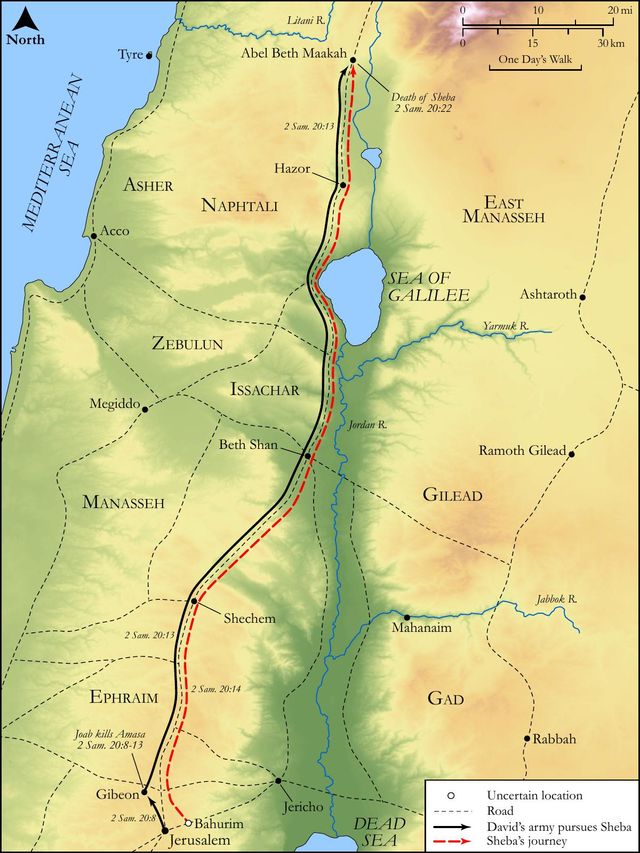
I.The rebel, when he had rambled over all the tribes of Israel, and found them not so willing, upon second thoughts, to follow him, as they had been upon a sudden provocation to desert David (having only picked up a few like himself, that sided with him), at length entered Abel-Beth-maacah, a strong city in the north, in the lot of Naphtali, where we find it placed, Kg2 15:29. Here he took shelter, whether by force or with consent does not appear; but his adherents were most Berites, of Beeroth in Benjamin, Sa2 20:14. One bad man will find or make more.
II.Joab drew up all his force against the city, besieged it, battered the wall, and made it almost ready for a general storm, Sa2 20:15.
Justly is that place attacked with all this fury which dares harbour a traitor; nor will that heart fare better which indulges those rebellious lusts that will not have Christ to reign over them.
III.A discreet good woman of the city of Abel brings this matter, by her prudent management, to a good issue, so as to satisfy Joab and yet save the city. Here is,
1.Her treaty with Joab, and her capitulation with him, by which he is engaged to raise the siege, upon condition that Sheba be delivered up. It seems, none of all the men of Abel, none of the elders or magistrates, offered to treat with Joab, no, not when they were reduced to the last extremity. They were stupid and unconcerned for the public safety, or they stood in awe of Sheba, or they despaired of gaining any good terms with Joab, or they had not sense enough to manage the treaty. But this one woman and her wisdom saved the city. Souls know no difference of sexes. Though the man be the head, it does not therefore follow that he has the monopoly of the brains, and therefore he ought not, by any salique law, to have the monopoly of the crown. Many a masculine heart, and more than masculine, has been found in a female breast; nor is the treasure of wisdom the less valuable for being lodged in the weaker vessel. In the treaty between this nameless heroine and Joab,
(1.)She gains his audience and attention, Sa2 20:16, Sa2 20:17. We may suppose it was the first time he had ever treated with a woman in martial affairs.
(2.)She reasons with him on behalf of her city, and very ingeniously.
[1.]That it was a city famous for wisdom (Sa2 20:18), as we translate it. She pleads that this city had been long in such reputation for prudent knowing men that it was the common referee of the country, and all agreed to abide by the award of its elders. Their sentence was an oracle; let them be consulted and the matter is ended, all sides will acquiesce. Now shall such a city as this be laid in ashes and never treated with?
[2.]That the inhabitants were generally peaceable and faithful in Israel, Sa2 20:19. She could speak, not for herself only, but for all those whose cause she pleaded, that they were not of turbulent and seditious spirits, but of known fidelity to their prince and peaceableness with their fellow-subjects; they were neither seditious nor litigious.
[3.]That it was a mother in Israel, a guide and nurse to the towns and country about; and that it was a part of the inheritance of the Lord, a city of Israelites, not of heathen; and the destruction of it would lessen and weaken that nation which God had chosen for his heritage.
[4.]That they expected him to offer them peace before he made an attack upon the, according to that known law of war, Deu 20:10. So the margin reads (Sa2 20:18): They plainly spoke in the beginning (of the siege), saying, Surely they will ask of Abel, that is, "The besiegers will demand the traitor, and will ask us to surrender him; and if they do, we will soon come to an agreement, and so end the matter." Thus she tacitly upbraids Joab for not offering them peace, but hopes it is not too late to beg it.
(3.)Joab and Abel's advocate soon agree that Sheba's head shall be the ransom of the city. Joab, though in a personal quarrel he had lately swallowed up and destroyed Amasa, yet, when he acts as a general, will by no means bear the imputation of delighting in bloodshed: "Far be it from me that I should delight to swallow up or destroy, or design it but when it is necessary for the public safety, Sa2 20:20. The matter is not so. Our quarrel is not with your city; we would hazard our lives for its protection. Our quarrel is only with the traitor that is harboured among you; deliver him up, and we have done." A great deal of mischief would be prevented if contending parties would but understand one another. The city obstinately holds out, believing Joab aims at its ruin. Joab furiously attacks it, believing the citizens all confederates with Sheba. Whereas both were mistaken; let both sides be undeceived, and the matter is soon accommodated. The single condition of peace is the surrender of the traitor. It is so in God's dealing with the soul, when it is besieged by conviction and distress: sin is the traitor; the beloved lust is the rebel; part with that, cast away the transgression, and all shall be well. No peace on any other terms. Our wise woman immediately agrees to the proposal: Behold, his head shall be thrown to thee presently.
2.Her treaty with the citizens. She went to them in her wisdom (and perhaps she had as much need of it in dealing with them as in dealing with Joab) and persuaded them to cut off Sheba's head, probably by some public order of their government, and it was thrown over the wall to Joab. He knew the traitor's face, and therefore looked no further, intending not that any of his adherents should suffer. The public safety was secured, and he felt no wish to gratify the public revenge. Joab hereupon raised the siege, and marched back to Jerusalem, with the trophies rather of peace than victory.
Continue studying 2 Samuel 20:21 across the web’s major study libraries — every link below opens this exact verse, chapter, or book on the destination site.
Read & Compare
 BibleGatewayThis verse in more than 200 translations and 70 languages.
 Bible.comThe YouVersion reader — hundreds of translations, reading plans, and highlights.
 ESV.orgCrossway's official English Standard Version reader.
 NET BibleThe NET translation with 60,000+ translators' notes on every rendering decision.
 STEP BibleTyndale House's free study tool — original text, vocabulary, and scholarly resources.
 BibliaLogos Bible Software's free web reader.
 USCCBThe New American Bible (Revised Edition) with the U.S. bishops' study notes.
Commentaries
 BibleHub CommentariesDozens of classic commentaries on this verse, gathered on one page.
 StudyLightMore than 100 commentary sets — the largest collection on the web.
 BibleRefPlain-English commentary on what this verse means, verse by verse.
 Enduring WordDavid Guzik's free commentary on this chapter, widely used by Bible teachers.
 Bible Study ToolsVerse commentary alongside Greek and Hebrew study aids.
Original Language & Research
- BibleHub InterlinearThe verse word by word — original language, transliteration, and English.
- BibleHub LexiconEvery word's original-language definition and Strong's entry.
 Blue Letter BibleDeep-study tools — Strong's numbers, concordance, and word studies.
 SefariaThe Hebrew text with Rashi and centuries of Jewish commentary.
Sermons, Hymns & Audio


TrulyRandomVerse is not affiliated with these sites and doesn’t control their content. They’re linked because they’re genuinely useful.
Summary
2 Samuel 20:21 captures the dramatic climax of a negotiation between Joab, King David's military commander, and an unnamed wise woman from Abel of Beth-maachah. Joab has besieged the city to capture Sheba, a rebel who incited a new insurrection against David. The wise woman, acting as a spokesperson for her city, shrewdly clarifies that the city itself is not in rebellion but merely harboring the fugitive. She then offers a decisive, albeit brutal, solution: the delivery of Sheba's head to spare the city from destruction. This verse powerfully illustrates the woman's diplomatic acumen, the pragmatic ruthlessness of ancient warfare, and the lengths to which a community would go to secure its survival amidst political upheaval in David's kingdom.
Context
ShowHideLiterary Context
This verse is situated within the immediate aftermath of Absalom's failed rebellion, a period of intense instability and tribal fragmentation in David's kingdom. It forms the crucial turning point in the narrative of Sheba's rebellion, which begins in 2 Samuel 20:1. Joab, David's seasoned but often brutal general, has pursued Sheba to Abel of Beth-maachah, a fortified city in the northern territory of Naphtali. The preceding verses detail Joab's siege preparations, including building a siege ramp against the city wall (2 Samuel 20:15). The dialogue initiated by the wise woman in 2 Samuel 20:16 and culminating in this verse, shifts the narrative from military confrontation to a diplomatic resolution, highlighting the power of words and wisdom over brute force. This swift conclusion to Sheba's revolt stands in stark contrast to the protracted and devastating conflict of Absalom's rebellion.
Historical & Cultural Context
The period described in 2 Samuel was characterized by a fragile unity within Israel, frequently fractured by deep-seated tribal loyalties and resentments, particularly between Judah (David's tribe) and the northern tribes. Sheba, a Benjamite, capitalized on this discontent, rallying the northern tribes with the provocative cry, "We have no portion in David!" (2 Samuel 20:1). Cities under siege in the ancient Near East faced horrific consequences if they resisted capture, including the slaughter of inhabitants, plunder, and enslavement. The wise woman's intervention reflects the desperate plight of a city facing total annihilation for inadvertently harboring a rebel. Her ability to speak on behalf of the city, though unnamed, suggests a recognized position of influence or authority, perhaps as an elder or a respected figure, a phenomenon not uncommon in ancient Israelite society where wisdom was highly esteemed (Proverbs 31:23).
Key Themes
ShowHideThis verse significantly contributes to several overarching themes within 2 Samuel. Firstly, it starkly illustrates the precariousness of David's unified kingdom and the persistent tribal tensions that would ultimately lead to its division after Solomon's reign. Sheba's rebellion, though quickly suppressed, underscores the deep-seated disaffection that simmered beneath the surface of David's rule. Secondly, the passage powerfully highlights the theme of wisdom and diplomacy as a potent alternative to violence. The wise woman's strategic communication and her willingness to make an agonizing choice save her city, demonstrating that true leadership can avert widespread catastrophe. This contrasts sharply with the destructive paths chosen by figures like Absalom and Sheba. Finally, the verse reinforces the consequences of rebellion against God's anointed king, not only for the rebel but for the innocent communities caught in the crossfire. Joab's focused objective to eliminate the threat, rather than indiscriminately punish, also speaks to the pragmatic nature of military justice in the Davidic kingdom, seeking to restore order rather than merely inflict vengeance.
Exposition and Analysis
ShowHideKey Word Analysis
ShowHideThis word (H1697) from the root meaning "to speak," refers to a word, a thing, an affair, or a cause. In the wise woman's opening statement, "The matter is not so," it signifies the core issue or accusation at hand. She uses it to directly refute Joab's implicit assumption that the entire city is complicit in Sheba's rebellion, immediately shifting the focus from collective guilt to the specific individual, Sheba.
This term (H3027) refers to the physical hand, but it is used extensively in a figurative sense to denote power, authority, means, or action. The phrase "lifted up his hand against the king" is a potent idiom for rebellion, insurrection, or an act of defiance and violence against a sovereign. By using this phrase, the woman clearly defines Sheba's action as treason, justifying Joab's military response and the city's desperate need to distance itself from such an act.
This word (H7218) literally means the head of a body, but it also carries figurative meanings of beginning, chief, or leader. In the context of "his head shall be thrown to thee over the wall," it refers to the literal severed head of Sheba, serving as undeniable proof of his execution. This gruesome detail underscores the finality of the act and the city's desperate commitment to fulfilling Joab's demand to secure its survival.
Verse Breakdown
ShowHide"The matter [is] not so: but a man of mount Ephraim, Sheba the son of Bichri by name, hath lifted up his hand against the king, [even] against David:"
The wise woman initiates the dialogue by directly refuting Joab's implied accusation that the entire city is rebellious. She clarifies that the issue is not with the city's loyalty, but with a specific individual—Sheba, identified by his lineage and his act of treason ("lifted up his hand against the king, even against David"). This precise identification of the culprit and the nature of his crime immediately frames the conflict as one concerning an individual rebel, not the collective city.
"deliver him only, and I will depart from the city."
This is Joab's concise and non-negotiable demand, presented as a clear ultimatum. His objective is singular: the apprehension and elimination of Sheba. He assures the woman that his quarrel is not with the city itself, but with the rebel harbored within its walls. This statement provides the city with a direct and immediate pathway to peace and survival, contingent upon their cooperation in delivering Sheba.
"And the woman said unto Joab, Behold, his head shall be thrown to thee over the wall."
The wise woman's response is immediate, decisive, and chillingly pragmatic. Without hesitation, she accepts Joab's terms, demonstrating her absolute commitment to saving her people. Her promise to deliver Sheba's severed head, a gruesome but effective proof of his demise, signifies the city's willingness to make the ultimate sacrifice of one individual to secure the safety and survival of the entire community.
Literary Devices
ShowHideThe passage employs several potent literary devices to convey its dramatic tension and resolution. Dialogue is central, driving the narrative forward as the wise woman and Joab engage in a high-stakes negotiation that determines the fate of an entire city. The woman's opening phrase, "The matter [is] not so," serves as a powerful reversal of Joab's implied assumptions, immediately shifting the power dynamic and opening a path for diplomacy rather than destruction. The phrase "lifted up his hand against the king" is a clear idiom, succinctly conveying the gravity of Sheba's treason and the justification for Joab's siege. The entire exchange functions as a synecdoche, where the wise woman represents the entire city of Abel of Beth-maachah, and her actions determine the fate of all its inhabitants. Finally, the stark image of Sheba's head being "thrown... over the wall" is a vivid and brutal metonymy for his execution and the city's desperate act of self-preservation, emphasizing the grim realities of ancient warfare and the lengths to which people would go to survive.
Theological and Thematic Connections
ShowHideThis pivotal exchange in 2 Samuel 20:21 resonates with profound theological and thematic implications. It highlights the biblical emphasis on justice and accountability, demonstrating that while collective punishment was a real threat in ancient warfare, there was also a recognition of individual culpability. The wise woman's plea for discernment and Joab's focused objective underscore the principle that the innocent should not suffer for the actions of the guilty, a theme echoed throughout biblical law and prophetic literature. Furthermore, the passage showcases the divine value placed on wisdom and peacemaking, even in the direst circumstances. The woman's strategic intervention, driven by a desire to preserve life, mirrors the broader biblical call to seek peace and pursue justice, demonstrating how God can use unexpected agents to bring about resolution and prevent greater catastrophe. It also subtly reinforces the concept of a righteous king's authority, as rebellion against David, God's anointed, is treated with utmost seriousness, yet tempered by a willingness to spare the innocent.
Reflection and Application
ShowHideThe narrative of the wise woman of Abel of Beth-maachah in 2 Samuel 20:21 offers timeless lessons for contemporary life, particularly concerning leadership, conflict resolution, and moral courage. In moments of crisis, it is often the voice of wisdom and discernment that can cut through the noise of aggression and fear to identify the true problem and propose a viable solution. The woman's ability to remain calm, articulate the facts, and offer a decisive, albeit difficult, path to peace is a powerful model for navigating complex challenges. Her actions remind us that true leadership isn't always about wielding overt power, but often about strategic communication, understanding the core objective of the opposing party, and being willing to make hard choices for the greater good of the community. This passage challenges us to consider how we respond when our communities, families, or organizations face threats, urging us to seek understanding, prioritize peace, and hold individuals accountable, rather than allowing collective blame or indiscriminate action to prevail. It underscores that even in the face of overwhelming force, a single voice of reason, courage, and self-sacrifice can alter the course of events and preserve what is valuable.
Questions for Reflection
ShowHideFAQ
ShowHideWho was the wise woman of Abel of Beth-maachah, and why is she unnamed?
ShowHideThe Bible does not provide her name, which is common for many significant female figures in the Old Testament, often emphasizing their role or actions over their personal identity. She is simply identified as "a wise woman" (2 Samuel 20:16). Her wisdom, rather than her lineage or personal details, is the focal point. She likely held a position of respect or authority within the city, perhaps as an elder or a recognized community leader, allowing her to speak on behalf of the inhabitants and negotiate directly with Joab. Her anonymity allows her to represent the collective wisdom and desperate plight of the city itself.
Why was Joab willing to negotiate rather than simply destroy the city?
ShowHideJoab's primary objective was to apprehend Sheba, the rebel who had "lifted up his hand against the king" (2 Samuel 20:21). His mission was to restore order and eliminate the threat to David's reign, not to engage in indiscriminate destruction. The wise woman's intervention clarified that the city itself was not complicit in Sheba's rebellion, but merely harboring him. By offering to deliver Sheba, she provided Joab with a swift and efficient means to achieve his military objective without expending further resources or causing unnecessary bloodshed, which would have been politically undesirable for David's already fragile kingdom. His willingness to negotiate shows a pragmatic approach to warfare, focused on achieving the strategic goal with minimal collateral damage.
What happened to Sheba after this verse?
ShowHideFollowing the wise woman's promise in 2 Samuel 20:21, the city's inhabitants took immediate action. They "cut off the head of Sheba the son of Bichri, and threw it out to Joab" (2 Samuel 20:22). This swift and brutal act fulfilled the woman's promise and Joab's demand, effectively ending Sheba's rebellion. Upon receiving the head, Joab blew the trumpet, and his forces withdrew from the city, returning to Jerusalem. Sheba's rebellion was thus quickly and decisively crushed, restoring a fragile peace to David's kingdom.
Christ-Centered Fulfillment
ShowHideWhile 2 Samuel 20:21 describes a grim act of judgment and sacrifice for the preservation of a physical city and kingdom, it subtly foreshadows the ultimate, infinitely greater act of substitutionary sacrifice found in Jesus Christ. The wise woman's desperate plea to deliver one life to save many finds its perfect and divine fulfillment in the person and work of Jesus. Humanity, much like the city of Abel of Beth-maachah, was under a sentence of judgment due to its rebellion against God's holy rule—a rebellion far deeper and more pervasive than Sheba's treason against David. Yet, God, in His infinite wisdom and boundless love, did not demand the head of a rebel from humanity. Instead, He offered His own Son, the innocent Lamb of God who takes away the sin of the world, as the perfect, once-for-all sacrifice. Jesus, the true Son of David and the eternal King, willingly "lifted up his hand" not in rebellion, but to be nailed to the cross, taking upon Himself the full weight of humanity's sin and rebellion (Isaiah 53:5-6). Through His death, He became the one delivered up "over the wall" of sin and death, not to appease a human commander, but to satisfy divine justice and secure an everlasting peace for all who believe (Romans 5:1). Thus, the bloody resolution in 2 Samuel 20:21, born of human necessity and pragmatism, points forward to the glorious, redemptive act of God, where one perfect life was given to save not just a city, but all who would trust in the ultimate King and Peacemaker, Jesus Christ, bringing about an eternal reconciliation far surpassing any temporal peace (Colossians 1:19-20).